FDTD HARD SOURCE AND SOFT SOURCE REVIEWS AND MODIFICATIONS
M. Mansourabadi and A. Pourkazemi
Department of Electrical Engineering K.N.Toosi University of Technology Seyedkhandan, Dr. Shariati Ave P. O. BOX: 16315-1355, Tehran, Iran
Abstract—We intend to study two kinds of sources known as Hard Source and Soft Source, which are the simplest kinds of sources used in FDTD. We introduce an exact method to control the direction of propagation of a plane wave which can be either a hard source or soft source. Also we show that a simple implementation of a soft source in the Yee algorithm causes an undesired propagation which can result in incorrect answers. To remove this error we suggest a method for different kinds of sources and modes.
1. INTRODUCTION
After the release of Yee’s paper on FDTD in 1966 [1], a lot of effort has been paid to develop this novel method. Many people have strengthened the base of this method and lots of applications have been developed through the FDTD method [2, Ch. 1, 3, 4, 5, Ch. 1]. FDTD is an algorithm suitable for use with a computer and can be used as a real-time solver of electromagnetic problems [5, Ch. 1, 6, 7].
are going to discuss, is used to simulate a physical source or excite a structure to obtain the desired response [5, Ch. 5].
There have been different kinds of sources introduced and analyzed (e.g., point wise E and H hard source, J and M current source, the plane-wave source and waveguide source) [5, Ch. 5].
The basic sources called Hard Source and Soft Source are the simplest kinds of source used in the FDTD method. These sources are formed by setting electric and magnetic fields to the amount of source1 at proper positions [5, Ch. 5], [10, Ch. 1]. A hard source can simulate a physical source like a probe exciting a waveguide [5, Sec. 5.2]. A soft source may be used to excite a structure; for example to find the resonance frequencies of a cavity one can use a pulsed hard source to excite the cavity [5, Sec. 5.2], but this can be done easily by using a soft source instead of the pulsed hard source.
Although these kinds of sources are simple and applicable, there are some problems with them.
The first problem is the matter of determining the direction of propagation of a plane wave. We will introduce a method to specify the direction of plane wave propagation in a medium for any polarization (e.g., TEM, TM, TE, etc.). The propagation along any direction besides propagation along major axes will be discussed too. Note that our method is different from the T F/SF (Total Field and Scattered Field) method [11].
The second problem is the error existing in amplitude and shape of a soft source. The amplitude and shape of a soft source is dependent on the spatial and temporal grids used in the simulation. We show that using soft sources without correction leads to incorrect results. We suggest a simple method to eliminate this error.
To unify the results, we use the same basic Parameters necessary for the FDTD method in the scripts. This Parameters are available in Appendix A.
2. THE YEE ALGORITHM’S NOTATION
Throughout this paper we assume that the simulation’s environment is free space (εr = 1, µr = 1, σ = 0, σ∗ = 0). Also we use a notation
which will ease the way we manipulate the equations.
Suppose there is a TEM plane wave propagating along thez axis and polarized in the x direction. The interleaved equations can be obtained from [8] as below:
En+
1 2
x
K+1
2
= En−
1 2
x
K+1
2
+ ∆t ε0∆z
Hyn(K)−Hyn(K+ 1)
, (1)
Hyn+1(K+ 1) = Hyn(K+ 1)
+ ∆t µ0∆z
En+
1 2
x
K+1
2
−En+
1 2
x
K+3
2
.(2)
Knowing the definition of the speed of light in free space (c =
1
√ε
0µ0), the intrinsic impedance of free space (η =
µ
0
ε0) [9], and the
Courant number2 (S = c∆∆zt) [5, Ch. 4], we can write the following equations:
∆t ε0∆z
= ∆t
õ
0
õ
0√ε0√ε0∆z
= c∆t
∆zη=Sη, (3)
∆t µ0∆z
= ∆t
√ε
0
√ε
0√µ0√µ0∆z
= c∆t ∆z
1 η =
S
η. (4)
Substituting (3) and (4) in (1) and (2) respectively, results in:
En+
1 2
x
K+1
2
= En−
1 2
x
K+1
2
+SηHyn(K)−Hyn(K+ 1), (5)
Hyn+1(K+ 1) = Hyn(K+ 1)
+S η
En+
1 2
x
K+1
2
−En+
1 2
x
K+3
2
. (6)
Looking at (5) and (6), it is clear that to write the equations for the electric fields one should multiply the expressions of the magnetic fields by Sη, and to write the equations for the magnetic fields one should multiply the expressions of the electric fields by Sη. We will use the same notation throughout this paper. We can apply the same notation for higher order dimensions too, but for simplicity when dealing with higher order dimensions, we suppose ∆x = ∆y = ∆z. For example a T Mz case [10] will be:
En+
1 2
z
i−1
2, j+ 1 2
=En−
1 2
z
i−1
2, j+ 1 2
+Sη Hyn
i, j+12
−Hyn
i−1, j+12
+
Hxn
i−12, j
−Hxn
i−12, j+1
, (7)
Hxn+1
i−1 2, j+ 1
=Hxn
i−1
2, j+ 1
+S η
En+
1 2
z
i−1
2, j+ 1 2
−En+
1 2
z
i−1
2, j+ 3 2
, (8)
Hyn+1
i, j+1 2
= Hyn
i, j+1 2
+S
η
En+
1 2
z
i+1
2, j+ 1 2
−En+
1 2
z
i−1
2, j+ 1 2
. (9)
3. DIRECTION OF PROPAGATION OF A PLANE WAVE HARD SOURCE
3.1. TEM Mode Plane Wave Hard Source
We begin with a TEM case whose equations were written in the new notation (see (5) and (6)). Suppose there is a hard source emitting an electric field at the point Ks propagating in the positivez direction3.
To show the accuracy of propagation and to compare the results, we also perform a simultaneous simulation propagating bilaterally in both−zand +zdirections. For simplicity suppose the source is a unit step which is zero forn < ns and is one forn > ns. Figure 1 shows the
field configuration for different time steps after applying the source. If there has been no source and excitation forn < ns thus:
En+
1 2
x
K+ 1
2
≡ 0, for n < ns (10)
Hyn+1(K+ 1) ≡ 0 every K.
According to the FDTD algorithm, after applying (5), one should assign the electric sources, and then should apply (6), and finally assign the magnetic sources. This cycle is repeated again and again as
(b) (a)
Figure 1. Fields configuration for one dimensional propagation of a hard source at point Ks for different time steps after applying the
source (TEM mode) (a) Hard source propagating bilaterally in both
−zand +zdirections (b) Hard source propagating in the +zdirection.
desired [10, Ch. 1]. With this concept, after applying the electric source at the pointKs and the time step ns, the algorithm of the bilaterally
propagating source is as below:
Ens+
1 2
x
Ks+
1 2
= 0. (11)
Source assignment is
Ens+
1 2
x
Ks+
1 2
= 1. (12)
Relation (11) is obtained by substituting the parameters into (5). We use (6) to calculate magnetic fields at the positions ofKs and Ks+ 1
and the time step ofns+ 1:
Hns+1
y (Ks) = −
S
η, (13)
Hns+1
y (Ks+ 1) =
S
Calculating the electric fields at Ks−12,Ks+12 and Ks+32 gives:
Ens+
3 2
x
Ks−
1 2
= S2, (15)
Ens+
3 2
x
Ks+
1 2
= 1−2S2, (16)
Ens+
3 2
x
Ks+
3 2
= S2. (17)
And source assignment is
Ens+
3 2
x
Ks+
1 2
= 1. (18)
The fields calculated during these steps are illustrated in Fig. 1(a). Note that we did not calculate the fields at other positions because they are definitely zero.
Now we do the same procedure to the algorithm of oriented propagation, forn > ns:
Ens+
1 2
x
Ks+
1 2
= 0, (19)
And source assignment is
Ens+
1 2
x
Ks+
1 2
= 1. (20)
We apply the magnetic source just after and before the position of the electric source (i.e., we apply the magnetic sources at Ks and
Ks+ 1). The reason will be clear very soon. We apply theses sources
as below:
Hns
y (Ks) = α×1 =α, (21)
Hns
y (Ks+ 1) = β×1 =β. (22)
whereα and β are unknown coefficients to be decided. Note the time step index; we have not already calculated the magnetic fields atns+1,
so we choose the time index ns4.
4 This notation does not cause any consistency in our work. One can usen
s+ 1 but the
We calculate the magnetic fields at the positions Ks and Ks+ 1
and the timens+ 1:
Hns+1
y (Ks) = α−
S
η, (23)
Hns+1
y (Ks+ 1) = β+
S
η. (24)
If we follow the algorithm, the electric field will be:
Ens+
3 2
x
Ks−
1 2
= −Sα+S2, (25)
Ens+
3 2
x
Ks+
1 2
= 1−2S2+S(α−β), (26)
Ens+
3 2
x
Ks+
3 2
= Sβ+S2. (27)
And source assignment is
Ens+
3 2
x
Ks+
1 2
= 1. (28)
The fields calculated during these steps are illustrated in Fig. 1(b). We can decide coefficients α and β according to the direction of propagation. If the plane wave is propagating in the positivezdirection any fields forK < Ks+12 must be zero. It is true whenα = Sη, and to
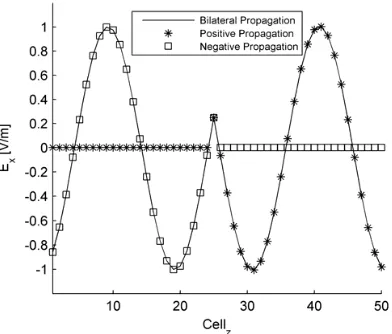
avoid disturbing non-source produced wave propagating in the negative zdirection, (22) should not be applied. If propagation in the negative z direction is desired, then we must set β =−Sη and (21) should not be applied. The results of simulation of both cases are compared to the case of bilateral propagation in Fig. 2.
Of course one can decide the source definitions by knowing the directions of field components. For example, suppose propagation along positivezis desired. In this case the magnetic component before the source position is in −y direction or we can interpret that it has a negative value. So to eliminate the propagation along negative z, one can set this component to positive value of what it is expected to be. To explain more, after setting the electric field to 1, the magnetic field just before it, would be −Sη. So setting this magnetic field to Sη is enough to eliminate the propagation along negativez.
Figure 2. Propagation of a hard source in the bilateral, positive and negative directions (Courant number = 0.6, TEM mode).
3.2. Procedure of Orienting a Plane Wave Hard Source
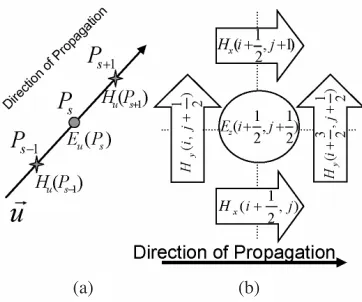
To explain a general case, where we want to control a plane wave propagation direction; assume propagation along the u direction is desired. The source assignment can beEu(Ps) =Source. To control
the direction of propagation, the magnetic sources must be assigned just before or after the point Ps (see Fig. 3(a)). One can write them
asHu(Ps−1) =α×SourceorHu(Ps+1) =β×Source.
For example in the T Mz case, when the propagation of a plane
wave with z electric field component along the x direction is needed, the magnetic component would be theymagnetic component Fig. 3(b). To decide the direction of propagation one can follow Yee’s algorithm for some time steps, then by arranging the electric field before or after5 the point Ps and setting it to zero, one can find
the source assignments while the other source assignments to avoid interference with other propagations will be ignored. This can be done more easily by using the analytical method explained in Section 3.1.
This procedure is correct for any polarization and direction. For example, if we do the same procedure to a plane wave propagating in the x direction in T Mz mode, the z electric field component and y
magnetic field component are as below:
(a) (b)
Figure 3. Field configuration used to explain the basic idea of determining the direction of propagation (a) Electric source and adjacent magnetic fields laid along the direction of propagation (b) Electric source and adjacent x magnetic field component which lay along the direction of propagation (T Mz mode).
For propagation in the negativex direction, it must be:
En+
1 2
z
is+
1 2, j+
1 2
= Sourcen, for everyn (29)
Hyn
is+ 1, j+
1 2
= +S
ηSource
n, and j.
For propagation in the positivex direction, it must be:
En+
1 2
z
is+
1 2, j+
1 2
= Sourcen, for everyn (30)
Hyn
is, j+
1 2
= −S
ηSource
n, and j.
Note that these source assignments should be done at the same time.
3.3. Orienting an Oblique Plane Wave Hard Source
sources adjacent to the electric source in an appropriate way so that the appropriate direction of propagation results.
Consider a T Mz oblique plane wave which is propagating at the
angle 0≤φ≤90 relative to the positivex axis. To avoid propagation in the area behind the source positions one must set bothHx and Hy
fields to proper amounts. It means that the procedure of orienting the source propagation (discussed in Section 3.2) must be done toHx and
Hy, separately. If the indices of the source positions are expressed by
js=f(is), the electric and magnetic source assignments will be:
En+
1 2
s
is+
1 2, js+
1 2
= Sourcen, for everyn (31)
Hxn
is+
1 2, js
= +S
ηSource
n, and j
Hyn
is, js+
1 2
= −S
ηSource
n, and j
s=f(is).
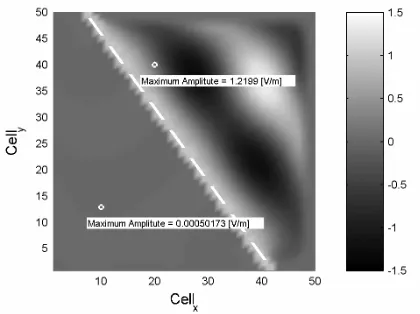
We perform aT Mz plane wave propagation at angleφ= 55. The
source positions are chosen so that the resulted wave front would be smooth. The methodLook-Up Table [5, Sec. 5.7.2] is used to define the source. This method beside Interpolation of Look-Up Table Data [5, Sec. 5.7.2] can improve the resulting wave. Figure 4 shows the result of the simulation. The existing wave behind the source positions is because of the leakage at the interface of PMLs [12].
If the hard source is a magnetic source, one can follow the instructions discussed, considering that source assignments must be done just after calculating the electric fields.
4. PLANE WAVE SOFT SOURCE
4.1. TEM Mode Plane Wave Soft Source
We show that a simple soft source assignment does not result in a correct answer and then suggest a method to get rid of this problem. Consider TEM propagation in the positive z direction and polarized in thex direction. The soft source assignment is as below:
En+
1 2
x
Ks+
1 2
=En+
1 2
x
Ks+
1 2
+Sourcen. (32)
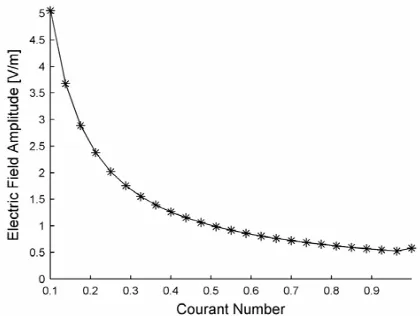
A script is written to simulate this sort of source and sample the electric field at the source position. The source is a sinusoidal one. The Courant number is changed from 0.1 to 1. In this range the simulation is stable [5, Ch. 4, 13]. Figure 5 shows the amplitude of the sampled field with respect to the Courant number.
Figure 5. Amplitude of the sampled electric field at the position of a soft source as a function of the Courant number (TEM mode).
It is evident that only when S = 0.5, the amplitude is almost correct and in other cases the amplitude is not correct. To correct this problem we use the following source assignment instead of (32):
En+
1 2
x
Ks+
1 2
=En+
1 2
x
Ks+
1 2
where α is the unknown parameter. We follow Yee’s algorithm and assume the source is a unit step applied at n = 0. We used a script which is able to manipulate the symbolic variables. We calculated the electric field at the source position after 5 time steps. The calculated electric field is:
E5+
1 2
z
Ks+
1 2
=α×S
5S−40S3+ 126S5−160S7+ 70S9
. (34)
Note that the polynomial obtained from the script is a function of the Courant number (S). Expression (34) is the electric field after source assignment. The electric field is to be equal to the source, so the following equation must be held:
E5+
1 2
z
Ks+
1 2
=α×S5S−40S3+126S5−160S7+70S9= 1. (35)
It gives:
α = 1 S
1
5S−40S3+ 126S5−160S7+ 70S9. (36)
Note that the range of S is between 0 and 1. Calculating the average of the fraction in (36), the result isα = 1.9998. We performed the same simulation, but this time the parameter n is changed. The results are illustrated in Fig. 6(a).
As we see, when n increases, a approaches 2, so the coefficient can be 2. To make sure, this time a script is written to calculate this coefficient for different amount of Courant numbers. A sinusoidal source is applied and the electric field is sampled at the source point. The result is shown in Fig. 6(b). The numerical result proves the conclusion obtained by the symbolic analysis. Although we used a step or sinusoidal source to get these results, using other sources. Simulating the plane wave in a 2-D or 3-D medium does not change the coefficients.
4.2. Oriented Plane Wave Soft Source
The only remaining point is to control the direction of propagation of a plane wave soft source. After performing analyses as mentioned in Section 4.1, both symbolic and numeric, the results will be the same as Fig. 7.
Note that the source is supposed to be propagating in the positive z direction so the source assignments would be:
En+
1 2
x
Ks+
1 2
= En+
1 2
x
Ks+
1 2
(a)
(b)
Figure 6. Analyzed results of the correction coefficient for a bilateral soft source (TEM mode) (a) Result of a symbolic analysis of the correction coefficientαwith respect to the time step number (b) Result of a symbolic analysis of the correction coefficient with respect to the Courant number.
Hyn(Ks) = Hyn(Ks) +α×
S
η ×Source
n.
To change the direction of propagation, we simply use the following relations:
En+
1 2
x
Ks+
1 2
= En+
1 2
x
Ks+
1 2
+α×S×Sourcen (38)
Hyn(Ks+ 1) = Hyn(Ks+ 1)−α×
S
η ×Source
n.
It is clear from Fig. 7 that the coefficient needed to correct the propagation is half of that obtained in previous case where the wave was propagating bilaterally. Again these results are correct for 2-D and 3-D cases too. Note that the source types will not change the results.
5. T Mz MODE SINUSOIDAL SOFT SOURCE
(a)
(b)
Figure 7. Analysis results of the correction coefficient for a positive direction soft source (TEM mode) (a) Result of symbolic a analysis of the correction coefficient α with respect to the time step number (b) Result of a symbolic analysis of the correction coefficient with respect to the Courant number.
to remove this inaccuracy. We begin with a sinusoidal source located at the center of a 2-D area surrounded by PMLs. The T Mz mode is
considered. The electric field is sampled at the source position. The source assignment is as below:
En+
1 2
z
is−
1 2, js+
1 2
=En+
1 2
z
is−
1 2, js+
1 2
+Sourcen. (39)
One can see the amplitude of sampled field with respect to the Courant number curve in Fig. 8(a). Note that the range ofSis between 0.1 and √1
2, so that the simulation would be stable [5, Ch 4, 13].
The procedure used here is the same as that used for a plane wave. The only difference is, that because of PMLs, we split the Ez
field component intoEzx and Ezy, and the source assignments are as
below:
En+
1 2
zx
is−1
2, js+ 1 2
=En+
1 2
zx
is−1
2, js+ 1 2
+α
2×S×Source
n (40)
En+
1 2
zy
is−1
2, js+ 1 2
=En+
1 2
zy
is−1
2, js+ 1 2
+α
2×S×Source
(a)
(b)
Figure 8. Analysis results for a cylindrical sinusoidal soft source (T Mz mode) (a) Amplitude of the sampled electric field with respect
to the Courant number (b) Correction coefficientαwith respect to the Courant number.
We just performed the numerical simulation. The coefficient with respect to the Courant number is shown in Fig. 8(b). It is clear that α = 6 and we note that if one does not want to split the Ez field
component, he should use the source assignment as below:
En+
1 2
z
is−
1 2, js+
1 2
=En+
1 2
z
is−
1 2, js+
1 2
+α×S×Sourcen. (41)
Note that this result is correct only for a sinusoidal source.
6. T Mz GENERALIZED SOFT SOURCE
In previous section we studied a simple method which corrects soft source problem. But that method works well with sinusoidal sources. In this section we want to introduce a method which is applicable for all kinds of sources.
The other one is the main simulation where the boundary conditions are assigned as electromagnetic problem dictates. But instead of placing a source at source position, the effect of source existence is placed.
Consider a Gaussian pulse propagating in T Mz mode. The
source is applied to electric component. We perform two distinct simulations mentioned before. To apply the effect of source in the second simulation, we should consider roles ofHxandHyin calculating
Ez. Relation (7) shows these roles.
Assume that soft source assignment is done as below:
En+
1 2
z
i−1
2, j+ 1 2
=En−
1 2
z
i−1
2, j+ 1 2
+αSη Hˆyn
i, j+12
−Hˆn y
i−1, j+12
+ ˆ
Hxn
i−12, j
−Hˆn x
i−12, j+ 1
(42)
where ˆHx and ˆHy denotes the fields obtained in reference propagation
simulation. The only unknown parameter would be α. Setting the source to unit step for all times, one can decide this coefficient by
(a)
(b)
(c)
Figure 9. Gaussian pulse propagation (T Mz mode) (a) time domain
performing either a symbolic simulation or a numerical simulation. Anyway the results will not be different andα =−1. Figure 9 shows the results of simulation for different kinds of sources in time, frequency and spatial domains.
Note that to save memory and time, the two dimensional propagation reference simulation can be changed to one dimensional simulation. The procedure can be found in [5, Ch. 12].
7. CONCLUSIONS
We suggested an exact method to control the direction of propagation of a TEM plane wave in any polarizations and directions. This was done by assigning an electric and magnetic source at the same time at specific positions. We showed that the amplitude of soft sources, either a TEM plane wave or a cylindrical wave, varies according to the Courant number unless a correction is performed. A simple method to obtain this correction was suggested for TEM mode and, although we used this method for a step unit pulse, the result is correct for every kind of signal. We also suggested a general method to solve this problem for any modes and kinds of sources.
APPENDIX A.
The basic parameters used in the scripts are listed in this appendix. FDTD Basic Parameters:
Number of Time Steps = 215
Number of Cells along each axis = 50 ∆x= ∆y= ∆z= 0.05λmin
∆t= S∆cz, 0< S ≤1 (One-Dimensional) ∆t= S∆cx, 0< S ≤ √1
2 (Two-Dimensional)
Step Source: Amplitude = 1mV Sinusoidal Source: Amplitude = 1mV Frequency = 1 GHz
REFERENCES
2. Fayedeh, H., C. Ghobadi, and J. Nourinia, “An improvement for FDTD analysis of thin-slot problems,”Progress In Electromagnet-ics Research B, Vol. 2, 15–25, 2008.
3. Wang, M. Y. and J. Xu, “FDTD study on wave propagation in layered structures with biaxial anisotropic metamaterials,” Progress In Electromagnetics Research, PIER 81, 253–265, 2008. 4. Taflove, A.,Computational Electrodyamics: The Finite-Difference
Time-Domain Method, 2nd edition, Artech House, Norwood, MA, 2000.
5. Taflove, A.,Computational Electrodyamics: The Finite-Difference Time-Domain Method, 3rd edition, Artech House, Norwood, MA, 2005.
6. Juntunen, J., “Selected electrodynamics in computational electromagnetics for radio engineering,” Ph.D dissertation, Department of Electrical and Communications Engineering, Helsinki University of Technology, Espoo, Finland, 2001.
7. Wang, L., D. Yang, and Q. Chang, “A new design for Terahertz photonic crystal fiber using the finite-difference time-domain method,” Progress In Electromagnetics Research Symposium, Hangzhou, China, August 22–26, 2005.
8. Liu, Y., Z. Liang, and Z. Yang, “A novel FDTD approach featuring two-level parallelization on PC cluster,” Progress In Electromagnetics Research, PIER 80, 393–408, 2008.
9. Balanis, C. A., Advanced Engineering Electromagnetics, 1st edition, John Wiley & Sons, New York, 1989.
10. Sullivan, D. M., Electromagnetic Simulation Using the FDTD Method, IEEE Press, New York, 2000.
11. Umashankar, K. R. and A. Toflove, “A novel method to analyse electromagnetic scattering of complex objects,” IEEE Trans. Electromagn.Compat., Vol. 24, 39–405, 1982.
12. Berenger, J. P., “Perfectly matched layer for the FDTD solution of wave structure interaction problems,” IEEE Trans.Antennas and Propag., Vol. 51, 110–117, 1996.