© 2016, IRJET | Impact Factor value: 4.45 | ISO 9001:2008 Certified Journal
| Page 1348
Speech Enhancement Using Deep Neural Network
Pallavi D. Bhamre
1, Hemangi H. Kulkarni
21
Post-graduate Student, Department of Electronics and Telecommunication, R. H. Sapat College of Engineering,
Management studies and Research, Nashik , Maharashtra, India
2
Asst. Professor, Department of Electronics and Telecommunication, R. H. Sapat College of Engineering,
Management studies and Research, Nashik, Maharashtra, India
---***---Abstract -
Speech is the main source of humaninteraction. The quality and intelligibility of speech signals during communication are generally corrupted by the surrounding noise. Corrupted speech signals therefore to be enhanced to improve quality and intelligibility. In the field of speech processing, much effort has been devoted to develop speech enhancement techniques in order to restore the speech signal by reducing the amount of disturbing noise. Speech enhancement deals with improving the quality and intelligibility of speech degraded in the presence of background noise. In various acoustic environments, especially at low Signal-to-Noise ratios (SNR), the goal of speech enhancement methods is to improving the quality and intelligibility of speech. Regarding intelligibility, different machine learning methods that aim to estimate an ideal binary mask have revealed promising results. This project covers the work of speech enhancement by use of the supervised method Deep Neural Network (DNN). In contrast to the different noise reduction techniques such as MMSE, the supervised method enhance the speech by finding a mapping function between the noisy and clean speech signals based on deep neural networks.
Key Words: Deep Neural Networks, Dropout, Global Variance equalization, Noise aware training, Speech enhancement.
1.INTRODUCTION
In today’s technological era speech is the most important way of communication. Speech is a source through which human can talk.
Now what is Speech Enhancement? Enhancement means the improvement in the value or quality of something. When this applied to speech, this simply means improvement in intelligibility or quality of the degraded speech signal by using signal processing tools.
Speech Enhancement is difficult problem for two reasons. First, the nature and characteristics of the noise signals can change dramatically in time and application to application. Second, the performance measurement is also defined differently for different applications.
In recent years, many researches had being carried out in the field of Speech processing. The main problem with any
Speech processing experiment is the background noise. Clean speech is corrupted with the background noisy environment. So the main goal of Speech Enhancement is to improve the quality of noise which gets corrupted by the noisy background environment so that the clean speech can be recognized. The main goal of Speech Enhancement is to improve the intelligibility and quality of the noisy speech signal which gets degraded in adverse conditions. Also, the performance of the Speech Enhancement in real acoustic environment is not always satisfactory. Speech Enhancement has wide number of applications such as mobile communication, hearing aid devices and Speech recognition system.
Different Speech Enhancement techniques are developed in the recent years such as spectral subtraction, Minimum mean square error (MMSE), Log MMSE, Optimally modified log spectral amplitude (OM-LSA), Wiener filtering, etc. The improvement in the Speech Signal-to-noise ratio (SNR) is the main goal of these Speech Enhancement techniques.
© 2016, IRJET | Impact Factor value: 4.45 | ISO 9001:2008 Certified Journal
| Page 1349
improved by first, distributions of low-level,
untransformed spectral envelops are used as parameters for synthesis. Second, instead of using single Gaussian distribution, here graphical models with multiple hidden variables, including restricted Boltzmann machine (RBM) and deep belief networks (DBN). Here focus on the acoustic modeling to tackle the over-smoothing problem [5]. An explicit denoising process in learning the DAE (Deep auto encoder) is included. Greedy layer wised pre-training plus fine tuning strategy in pre-training of DAE which is used as filter for speech estimation [6]. DNN maps the relationship between the noisy and clean speech signals. A large training set of speech and noise files is designed and then DNN model is applied as a non regression model. Also, the strategy called global variance equalization, dropout and noise aware training is used which gives better results [7].
As the noise corruption process is complex, a non-linear model like neural network is used. Neural Network maps the relationship between clean and noisy speech signals. Early, shallow neural network (SNN) is used as a non-linear filter. It predicts the clean speech in the time or frequency domain. SNN takes only one hidden layer with 160 neurons. It was proposed to estimate the Signal-to-Noise ratio (SNR) on the amplitude modulation spectrograms and then noise is suppressed according to the estimated SNR of different channels. The SNR are estimated in the limited frequency resolution and it was not efficient to suppress the noise with sharp spectral peaks. Also, the small size of the network can not able to learn the mapping the relationship between the clean and noisy speech. So Deep neural network is used where the layer used are more in numbers. Here training is done using a large set of dataset which contains clean speech data and noise speech data.
In this paper, DNN based Speech Enhancement is used via training deep and large neural network architecture contains large set of data. Three strategies are also used to improve the quality of enhanced speech and generalization capability of DNN. Firstly, Global Variance Equalization is used. It equalizes between the global variance of the enhanced features and reference clean speech features. It was proposed to alleviate the over-smoothing issue in DNN based Speech enhancement system. Secondly, dropout is used. It deals with the over fitting issue. Third, noise aware training is used which deals to improve the performance. The paper is organized in following sections. Section I gives the basic introduction. Section II explains the System overview. Section III presents Results and discussion. Section IV gives Conclusion.
2. PROPOSED SYSTEM
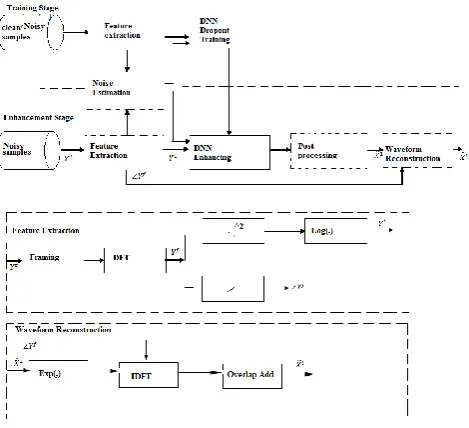
The block diagram of proposed system is given in
fig.1. A DNN is used for mapping the input and noisy
features. The system is constructed in two parts: 1)
Training Stage and 2) Enhancement stage.
In the training stage, the DNN model is trained using
the log-spectral features from the pairs of noisy and
clean speech. Here a log-spectral feature is used as it
is assume to give perceptually relevant parameters.
Firstly, short-time Fourier analysis is applied to the
input signal to find the discrete Fourier transform of
each overlapped window and then the log-spectral
features are calculated.
In the enhancement stage, the noisy speech features
are processed by trained DNN model to find the clean
speech features. After we obtain the log-spectral
features of clean speech,
̂
, the reconstructed
spectrum
̂
is given by:
̂ {
̂} 〈
(1)
Where
〈
denotes
dimension phase of the
noisy speech. A frame of speech signal is obtained
from inverse DFT of the current frame spectrum.
Finally, overlap add method is used to synthesize the
waveform.
Another two blocks namely noise estimation for
noise aware training and post processing with global
variance equalization is used to improve the overall
performance of the speech enhancement system. The
dropout is used to improve the generalization
capacity of DNN.
© 2016, IRJET | Impact Factor value: 4.45 | ISO 9001:2008 Certified Journal
| Page 1350
Fig -1: Block Diagram of speech enhancement system2.1 Basic DNN Training
The architecture used here is feed forward
neural network. It has many levels of non linearities
so that it represents the highly non-linear regression
model which maps the noisy features to the clean
features. Here the training of DNN model consists of
unsupervised pre-training part and a supervised
fine-tuning part. The hidden unit is of sigmoid type
and output unit is linear. We first pre-train a deep
generative model with the normalized log-spectra of
noisy speech by stacking multiple restricted
Boltzmann machines and then the back-propagation
algorithm with the MMSE based object function
between the normalized log-power spectral features
of the estimated and the reference clean speech is
used to train the DNN. A mini-batch stochastic
gradient descent algorithm is used to improve the
error function as given by:
∑
‖
̂
(2)
Where
is the mean squared error,
̂
and
is the estimated and reference normalized
log-spectral features at sample index n, N is the batch
size.
2.2
Post-processing
with
global
variance
equalization
One of the error residual problems is
over-smoothing which causes a muffling effect on the
estimated clean speech when compared with
reference clean speech. Global variance equalization
is used to alleviate this problem. Here the
equalization between the global variance of the
estimated and reference clean speech features is
taken.
The global variance of the estimates clean speech
features is defined as:
∑
(
̂ ∑
̂
)
(3)
Where
̂
is the d-th component of a DNN output
vector at n-th frame and M is the total number of
speech frames in the training set.
To address the over-smoothing problem, a global
equalization factor
is given as follows:
√
(4)
Where
and
is the d-th dimension
of the global variance of the reference features and
the estimation features respectively.
A dimension independent global equalization factor
β is given by:
√
(5)
Where
and
is the dimension independent
global variance of the reference and the estimation
features respectively.
2.3
Dropout Training
One of the challenges in DNN based speech
enhancement system is to address the mismatches
between the training and testing conditions which is
caused by different SNR levels, speaker variabilities,
noise type, etc. To address this mismatches issues, a
strategy called dropout is used to improve the
generalization capability of the DNN.
[image:3.595.38.273.109.323.2]© 2016, IRJET | Impact Factor value: 4.45 | ISO 9001:2008 Certified Journal
| Page 1351
the robustness in mismatched cases especially that
noises which is not seen in the training data. At the
enhancement stage, DNN discounts all the weights
that are involved in the dropout training (1-p).
2.4
Noise aware training
The relationship between the clean speech and
noise signal is non linear and complicated so it is
difficult to estimate the clean speech spectra
especially for non-stationary noises. The noise
information of each utterance was not specifically
utilized in the basic training of DNN. To enable this
noise awareness, DNN is fed with the noisy speech
samples augmented with an estimate of the noise. So
DNN can use this additional on-line noise
information to predict the clean speech.
The input vector of the DNN with the noise estimate
is given by:
[
̂] (6)
̂
∑
(7)
Where
is the log-spectral feature vector of the
current noisy speech frame n and
̂
is fixed over the
utterance and estimated using the first T frames.
3
.
RESULTS AND DISCUSSION
The database is taken from the Aurora2 database.
Here 8 different noise types such as airport noise,
street noise, restaurant noise, car noise, exhibition
noise, babble noise, station noise and train noise are
used. The clean speech file is corrupted with above
mentioned noises at different SNR levels, i.e., 20 dB,
15 dB, 10 dB and 5 dB, to build a multi-condition
training set of pairs of noisy and clean speech signals.
All these noise types are taken for the training of
DNN. A speech enhancement method MMSE is taken
for performance comparison with our DNN
approach.
All the clean speech and noise waveform were
down-sampled to 8 KHz. The frame length is 32msec i.e.,
256 samples are taken of each speech file and frame
shift is 16msec i.e., 128 samples. The dimension of
the log-spectral feature vector is 129. Perceptual
evaluation of speech quality (PESQ) was used for
objective measure. PESQ is calculated by comparing
the enhanced speech with the clean reference
speech. It ranges from -0.5 to 4.5 [18].Other
subjective measures such as Segmental SNR (SSNR),
Log spectral distortion (LSD), Log likelihood ratio
(LLR) is taken also. All of them are obtained by
comparing the enhanced speech with clean reference
speech. SSNR denotes the degree of noise reduction,
while LSD represents the speech distortion.
The number of epoch for the RBM pre-training in
each layer is set to 20. The learning rate of
pre-training was set to 0.0005. For the fine-tuning of the
baseline, the learning rte was set to 0.1 for the first
10 epochs and then decreased by 10% after each
subsequent epoch. The momentum rate is 0.9. The
total number of epoch at this stage is 50. The
mini-batch size N is set to 128. For the back-propagation
algorithm with dropout regularization, the
corruption level for input layer is 0.1 and for each
hidden layer is 0.2. The initial momentum rate of
dropout is 0.5 and then the rate increases to 0.9 in
the first 10 epochs, after it kept as 0.9. The first T=6
frames of each utterance is used for a noise estimate
in NAT.
Table 1 list for PESQ value for 3 SNR values and 4
noise types without dropout and noise aware
training.
T
able -1: PESQ values for 3 SNR and 4 noise types without dropout and noise aware trainingNoise Type 0 dB 5 dB 10 dB
Airport 3.0107 3.2015 3.4066
Babble 3.0564 3.3877 3.3999
Car 3.2061 3.3714 3.5142
Exhibition 3.4858 3.4883 3.4709
Table 2 lists the DNN with global variance
equalization
and
without
global
variance
equalization.
Table -2: DNN value with GV and without GV
Noise Type Without GV equalization With GV equalization
Airport 3.4066 3.6399
Babble 3.3999 3.4721
Car 3.5142 3.5862
© 2016, IRJET | Impact Factor value: 4.45 | ISO 9001:2008 Certified Journal
| Page 1352
Table 3.lists the DNN value with only DNN and DNN
with different three strategy used and DNN with all
three techniques.
Table -3: PESQ value of DNN of noisy speech and Enhanced speech
Noise type with SNR value
DNN DNN with GV
DNN with Drop-out
DNN with NAT
DNN with GV, Dropout and NAT
Airport_0dB 2.8303 2.7521 3.037 3.1502 3.1668
Babble_0dB 3.004 2.8865 2.8944 3.0531 3.21
Car_0 dB 2.7778 2.8711 2.7733 2.8786 3.212
[image:5.595.29.281.194.312.2]Exhibition_0 dB 2.7843 2.8714 2.9022 3.066 3.48
Table -4: Different parameters with different noise types at different SNR
Noise
type 0 dB 5 dB
SSNR PESQ LLR LSD SSNR PESQ LLR LSD
Airport -2.08 3.06 0.11 0.37 -7.73 3.18 0.11 0.38
Babble -2.30 3.23 0.13 0.39 -8.02 3.06 0.11 0.37
Car -2.48 3.03 0.16 0.42 -8.11 3.17 0.14 0.40
Figure 2 describes waveform of clean speech and
noisy speech
Fig -2: Waveform of clean speech and noisy speech
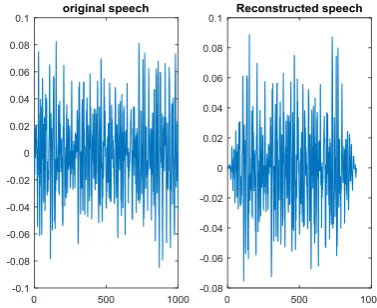
Figure 3 describes the Original speech and
reconstructed speech
.
Fig -3: Waveform of original speech and reconstructed speech
Chart-1:PESQ value for different Noise types at SNR=0 dB using different strategies.
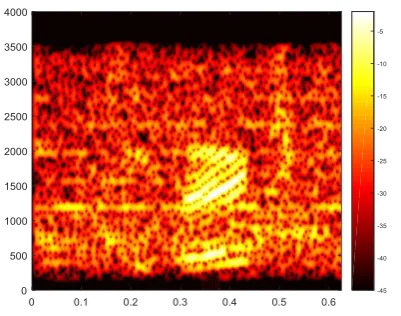
Figures 5 and 6 describes the Spectrogram of Noisy
speech and DNN enhanced speech respectively.
[image:5.595.312.560.315.469.2] [image:5.595.28.278.364.471.2] [image:5.595.315.510.563.717.2]© 2016, IRJET | Impact Factor value: 4.45 | ISO 9001:2008 Certified Journal
| Page 1353
Fig -5: Spectrogram of DNN Enhanced speechTable 5 lists the comparison between DNN and
MMSE speech enhancement method. (a) is the value
of MMSE and (b) is the value of DNN Enhanced.
Table -5: PESQ value of comparison between MMSE and DNN Enhanced
SNR Airport Babble Car
(a) (b) (a) (b) (a) (b)
SNR 0dB 1.983 3.010 2.155 3.056 2.033 3.219
SNR 5dB 2.385 3.201 2.326 3.387 2.334 3.371
SNR 10dB 2.631 3.278 2.499 3.836 2.440 3.355
Average 2.333 3.163 2.326 3.426 2.269 3.315
4. CONCLUSIONS
In this paper, DNN based Speech Enhancement
system is proposed. By using various DNN
configurations, a large training set is needed to learn
the mapping function between the noisy and clean
speech features. Also the three strategies used with
DNN gives good results. Proposed post-processing
technique, Global variance equalization is effective in
brightening the formants spectra of the enhanced
speech signals. Also two improved training
techniques reduce the residual noise and increase
the performance. As compared with the typical
speech enhancement method called MMSE, our DNN
proposed system gives better results.
REFERENCES
[1] Jae S. Lim, Alan V. Oppenheim, “Enhancement and Bandwidth Compression of Noisy Speech,”Proceedings of the IEEE, VOL. 67, no. 12, December 1979.
[2] Yariv Ephraim, David Malah, “Speech Enhancement Using a- Minimum Mean- Square Error Short-Time Spectral Amplitude Estimator,” IEEE Transactions on Acoustica, Speech and Signal processing, Vol. ASSP-32, no.6, December 1984.
[3] Yariv Ephraim, David Malah, “Speech Enhancement Using a- Minimum Mean- Square Error Short-Time Spectral Amplitude Estimator,” IEEE Transactions on Acoustica, Speech and Signal processing, Vol. ASSP-32, no.6, December 1985.
[4] Olivier Cappe, “Elimination of the Musical Noise Phenomenon with the Ephraim and Malah Noise Suppressor,” IEEE transactions 1994.
[5] Zhen-Hua Ling, LiDeng, and Dong yu, “Modeling Spectral Envelopes Using Restricted Boltzmann Machines and Deep Belief Networks for Statistical Parametric Speech Synthesis,” IEEE Transactions on Audio, speech and Language, vol.21. no.10. October 2013.
[6] Xugang Lu, Yu Tsao, Shigeki Matsuda, Choiri Hori, “Speech Enhancement Based on Deep Denoising Autoencoder,” in Proc. Interspeech, 2013,pp 436-440.
[7] Xu, Jun Du, Li-Rong Dai, and Chin-Hui Lee, “A Regression Approach to Speech EnhancementBased on Deep Neural Networks,” IEEE/ACM transactions on audio, speech language processing, vol.23, no.1, January 2015.
[8] S. Boll, “Suppression of acoustic noise in speech using spectral subtraction,” IEEE Trans. Acoustic, Speech, Signal Process., vol. ASSP-27,no. 2, pp. 113–120, Apr. 1979.
[9]J. Tchorz and B. Kollmeier, “SNR estimation based on amplitude modulation analysis with applications to noise suppression,” IEEE Trans.Speech Audio Process., vol. 11, no. 3, pp. 184–192, May 2003.
[10] I. Cohen and B. Berdugo, “Speech enhancement for non-stationary noise environments,” Signal Process., vol. 81, no. 11, pp. 2403–2418, 2001.
[11] Y. X. Wang and D. L. Wang, “Towards scaling up classification-basedspeech separation,” IEEE Trans. Audio, Speech, Lang. Process., vol. 21, no. 7, pp. 1381–1390, Jul. 2013.
[12] S. Rangachari and P. C. Loizou, “A noise-estimation algorithm forchighly non-stationary environments,”
[image:6.595.46.247.106.264.2]© 2016, IRJET | Impact Factor value: 4.45 | ISO 9001:2008 Certified Journal
| Page 1354
[13] M. Seltzer, D. Yu, and Y. Wang, “An investigation of deep neural networks for noise robust speech recognition,” in Proc. ICASSP, 2013, pp. 7398–7402.
[14] A. Narayanan, D. L. Wang, “Joint noise adaptive training for robust automatic speech recognition,” in Proc. ICASSP, 2014, pp. 2523–2527.
[15]G. Shi, M. M. Shanechi, and P. Aarabi, “On the importance of phase in human speech recognition,” IEEE Trans. Audio, Speech, Lang. Process., vol. 14, no. 5, pp. 1867–1874, Sep. 2006.
[16] J. Du and Q. Huo, “A speech enhancement approach using piecewiselinear approximation of an explicit model of environmental distortions,” in Proc. Interspeech, 2008, pp. 569–572.
[17] S. Rangachari, P. C. Loizou, and Y. Hu, “A noise estimation algorithm with rapid adaptation for highly nonstationary environments,” in Proc. ICASSP, 2004, pp. 305–308.
[18] ITU-T, Rec. P.862, Perceptual evaluation of speech quality (PESQ): An objective method for end-to-end speech quality assessment of narrowband telephone
networks and speech codecs International
Telecommunication Union-Telecommunication
Standardization Sector, 2001.
[19] H. G. Hirsch and D. Pearce, “The AURORA experimental framework for the performance evaluations of speech recognition systems under noisy conditions,” in
Proc. ISCA ITRW ASR, 2000, pp. 181–188.