www.ijiset.com
66
Flora and Plant Communities of the Eastern
Sector of Saint Katherine Protectorate, South
Sinai, Egypt
Om Mohammed Khafagi
P1
P
, AlBaraa ElSaied
P2
P
, Mohamed Metwally
P2
P
and Rahma Hegazy
P1
P
1
P
Botany Department, Faculty of Science, Al-Azhar University (Girls)
P
2
P
Botany Department, Faculty of Science, Al-Azhar University (Boys)
U
Abstract
A total of 25 stands representing different habitats of Saint Khatherine protectorate, south sinai, Egypt have been chosen to represent the most common plant communities. Species were identified and their scientific names were updated. Nine distinct locations (Hamatet Abada, Shaq Elgragnia, Wadi Al Arbeen, Shaq Musa, El Talaa, Itlah, El Faraa, El Mesirdi and Ain Elshkia) at different elevation (1488-2076 m asl ). Five quadrats were set at each stand. For each stand density, frequancy, abundance, relative density, relative frequancy, relative abundunce and the important value index were calculated for each species. A total of 61 species belonging to 26 families were recoreded, Compositae and Libiatae were the most common families. Nine plant communities were identified, Matthiola arabica
and 32TArtemisia herba-alba 32Twere the most
commen dominant species at eight standseach, followed by Alkanna orientalis at two stands,
Fagonia mollis at two stands, followed by
Phlomis aurea, Teucrium polium, Echinops glaberrimus, Hypericum sinaicum,
and Cynodon dactylon, each at only one stand.
U
Introduction
Sinai is the meeting point of two continents; Africa and Asia. This union is reflected in the physiography, climate and plant cover of Sinai. Sinai is of special ecological interest because of its variable environment, beautiful landscape, distinctive flora and above all its uniqueness and contrasts
(Zahran and Willis, 2009). Although Sinai is surrounded on three-fifths of its perimeter by water, the climate is dry and the peninsula contains large tracts of desert and high rugged mountains. No permanent rivers flow from Sinai, yet during winter storms torrents of water rush down the usually dry wadis and can wash away concrete bridges and roadbeds
(Zahran and Willis, 2009). The Saint Katherine Protectorate (SKP) is one of Egypt’s largest protected areas and includes the country’s highest mountains. This arid,
mountainous ecosystem supports a surprising biodiversity and a high proportion of endemic and rare plants. The flora of the mountains differs from the other areas, due to its unique geology, morphology and climate. Sinai is currently recognized as one of the central regions for flora diversity in the Middle East by the IUCN the World Conservation Union and Worldwide Fund for Nature (IUCN, 1994).
In 1993 the Egyptian government designated the Saint Katherine area as a future National Park. The Saint Katherine region is situated in the southern Sinai and is part of the upper Sinai massif (Danin, 1983). It is located between 33° 55' to 34° 30' East, and 28° 30'to 28° 35' North. Elevation ranges from 1300 to 2600 m asl. This region is characterized by outcrops of smooth granite uplifted to form several mountain peaks (e.g. Gebel Catherina 2641m asl, Gebel Abbas 2364 m, Gebel Musa 2285 m, and Gebel Ras Safsafa 2168 m) (Said, 1962).
Ayyad et al. (2000) suggested that Sinai contains approximately 1285 species, with South Sinai supporting 800, including 34 endemics; 62% were estimated as being rare or very rare. The estimated number of endemic species in Sinai is 28 which constitutes about 3.2% of its total flora (Danin, 1986). Moustafa & Zaghloul (1996) reported that the highest percentage (57.1%) of these endemic species is found in gorge habitats of the rugged mountainous districts which contain the highest peaks in Egypt (Saint Katherine Mountain). (Khafagi et al., 2012) recorded 38 families dominant with Asteraceae (15 %), Lamiaceae (11.5 %), Scrophulariaceae (6.1 %) and Caryophyllaceae (5.3 %), Hypericum sinaicum was recorded as dominant species with 5 %. Recently, Hatim et al. (2016)
www.ijiset.com
67
endemic species is highest in insular floras, peninsulas and mountain chains. Abd El-Wahab et al. (2004) studied the conservation of medicinal plants in St. Katherine Protectorate, South Sinai, Egypt. They assessed the present status of the medicinal plants in St. Katherine Protectorate, distribution, the causes of its loss and the specific threats facing conservation and sustainable use of these globally significant medicinal species.. Sinai has the highest mountain peak in Egypt, Saint Katherine mountain with altitude of 2641m asl .The area around mount Katherine is very unique, therefore, the area was declared to be one of the largest protected areas in Egypt.Vegetation of Saint Katherine has been studied by several authors (Moustafa and Zaghloul, 1993; Ward et al., 2002; Tan, 2005 and Zahran and Willis, 2009).
The present study aims at identifying some of the plant communities growing in the eastern sector of Saint Ktherine protectorate and species distribution along the study area.
U
Materials and methods
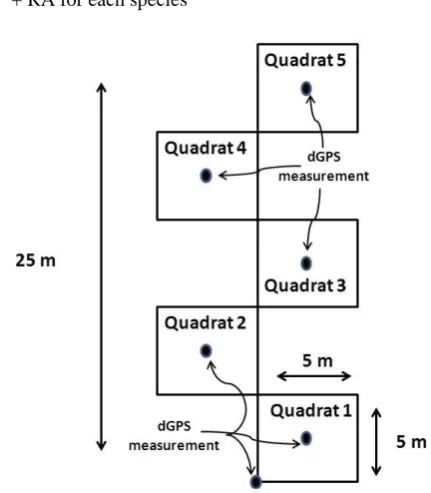
Vegetation of twenty five stands, with five quadrats (5×5 m) using The Quadrate Transect Method (Fig.1). The GPS position of each stand was recoeded including latitude, longitude, habitate and altitude were recorded (Table 1.), and are represented in Map 1. The floristic composition of each stand was recorded. All plant species existing in each site were listed after complete identification according to Täckholm (1974) and Boulos (1999-2005).Plant names were updated after (32Twww.the32T plant list.org). Voucher herbarium
specimens were prepared and kept in the herbarium of the Department of Botany and Microbiolgy, Faculty of Science, Al-Azhar University (Girl’s Branch). A checklist of all plant species is given in Table 2. Density (D), percentage of frequency (F), abundance (A), relative density (RD), relative frequency (RF), relative abundance (RA), and importance value (IVI) were calculated for each species in each site.according to the following equations
(Braun – Blanquet, 1964).
1. Density (D): Total number of individuals of a species / Total number of quadrats studied (mP
2
P
)
2. Relative density (R.D): density of species / Σ of densities of all species) x 100
3. Frequency (F): Total number of quadrats in which a species occurs / total number of quadrats stuied) x 100
4. Relative frequency (RF): Frequency of a species \ Σ of % frequencies % of all species
5. Abundance (A): Total number of individuals of a species \ Total number of quadrats where the species is present
6. Relative Abundance (RA) Abundance of a species \ Σ of abundances of all species
7. Importance Value Index (I.V.I): RD + RF + RA for each species
Fig 1. A schematic illustration for the vegetation survey method.
U
Results
www.ijiset.com
68
Table1. GPS position of the studied 25 stands including sites, habitate, longitude, latitude and altitude.
Site Stands Habitate Latitude Longtitude Altitude
Hamatet Abada Stand 1 Wadi bed 28.52491 33.97797 1910
Shaq Elgragnia
Stand 2 Gorges 28.51023 33.95083 1810 Stand 3 Gorges 28.52010 33.96090 1811 Stand 4 Gorges 28.53911 33.97902 1820
Wadi El-Arba'een Stand 5 Wadi bed 28.54440 33.96410 1724
Stand 6 Wadi bed 28.54283 33.96477 1690
Shaq Musa
Stand 7 Gorges 28.54152 33.96576 1920 Stand 8 Gorges 28.54469 33.96450 2076 Stand 9 Gorges 28.54353 33.95651 1980
El-Talaa Stand 10 Wadi bed 28.54217 33.96555 1643
Stand 11 Wadi bed 28.52824 33.96354 1636
Itlah
Stand 12 Gorges 28.52303 33.96033 1542 Stand 13 Gorges 28.52685 33.96371 1525 Stand 14 Wadi bed 28.55129 33.93447 1503 Stand 15 Wadi bed 28.55321 33.93482 1488
Elfaraa
Stand 16 Wadi bed 28.55435 33.93552 1809 Stand 17 Wadi bed 28.57192 33.93098 1824 Stand 18 Slope 28.57348 33.93016 1830 Stand 19 Slope 28.57413 33.92950 1829 Stand 20 Slope 28.57492 33.92829 1828 Stand 21 Slope 28.53878 33.94013 1828
El-Mesirdi
Stand 22 Wadi bed 28.54790 33.94403 1912 Stand 23 Terraces 28.54075 33.96265 1716 Stand 24 Terraces 28.54443 33.93378 1694
Ain El-shkia Stand 25 Terraces 28.54437 33.93078 1807
www.ijiset.com
69
Table 2. List of the species and their families recorded in twenty five stands in the study area
No. SPECIES Family Common Arabic name
1 Adiantum capillus-veneris f. rimicola (Sloss.) Adiantaceae تﺎﻨﺒﻟا ﺮﻌﺷ .ﺮﯿﺒﻟا ةﺮﺑﺰﻛ 2 Deverra triradiata Hochst. ex Boiss Apiaceae خﻮﺼﻗ- نﺎﺠﯿﻠﻋ- حﻮﺟز
3 Phoenix dactylifera L. Areaceae ﮫﻠﺨﻧ
4 Gomphocarpus sinaicus Boiss Apocynaceae يﺮﺑ ﻞﺟﺮﺣ 5 Achillea fragrantissima (Forssk.) Sch. Bip. Asteraceae مﻮﺼﯿﻗ 6 Artemisia herba-alba Asso Asteraceae ﺢﯿﺷ 7 Centaurea aegyptiaca L. Asteraceae راﺮﻤﯾ 8 Centaurea eryngioides Lam. Asteraceae نﺪﺒﻟا ﺔﯿﺤﻟ 9 Centaurea scoparia Sieber ex Spreng. Asteraceae نﺎﻗﺮﺑ 10 Chiliadenus montanus (Vahl) Brullo. Asteraceae ةﺪﯿﮭﻧ ،هﺪﯿﻨھ 11 Echinops glaberrimus DC Asteraceae ﺮﯿﺸﺧ 12 Echinops spinosissimus Turra Asteraceae ﺮﯿﺸﺧ 13 Erigeron trilobus (Decne.) Boiss Asteraceae ﮫﻠﺴﯿﻠﺳ ،ﮫﺒﯿﻠﺣ 14 Gymnarrhena micrantha Desf. Asteraceae ﻒﯿﺷﺮﺧ 15 Olivaea leptocarpa DeJong & Beaman Asteraceae نﻮﺘﯾز هﺮﺠﺷ 16 Pulicaria undulata (L.) C. A. Mey. Asteraceae ﺪﺒﺳ . ثاﺪﺛد . ثﺎﺛد 17 Tanacetum sinaicum (Fresen.) Delile ex
Asteraceae ﺮﻣ 18 Alkanna orientalis (L.) Boiss. Boraginaceae ﺪﯿﺒﻠﻟا 19 Diplotaxis harra (Forssk.) Boiss Brassicaceae هرﺎﺣ 20 Farsetia aegyptia Turra Brassicaceae ﻲﺒﯾﺮﺟ ، ﮫﺑﺮﺟ 21 Matthiola arabica Boiss. Brassicaceae ﻢﺨﻤﺧ 22 Zilla spinosa (L.) Prantl Brassicaceae ﺔﻠﺴﺑ- ﺔﻠﺳ- ﮫﻟز 23 Capparis spinosa L. Cappariaceae ﻞﺒﺠﻟا درو- ﻒﺼﻟ 24 Bufonia multiceps Decne Caryophyllaceae ﮫﻣﺪﻋ 25 Silene schimperiana Boiss. Caryophyllaceae ﻖﯿﺼﻟ 26 Pterocephalus sanctus Decne. Dipsacaceae ﻞﯿﺴﻋ . ﺔﻨﯿﻠﺠﻣ . ﮫﺠﻠﻋ 27 Euphorbia obovata Decne Euphorbaiceae ﮫﻨﯿﺑ 28 Astracantha echinus(DC.)podlech Fabaceae سﺪﻗ 29 Hypericum sinaicum Hochst. ex Boiss Hypericaceae ﻞﺒﺠﻟا يﺎﺷ ، ﺦﺒﻟ ، ﺢﯿﻛر 30 Juncus rigidus Desf. Juncaceae ﺮﻣ رﺎﻤﺳ، ﺮﺼﺣرﺎﻤﺳ ، رﺎﻤﺳ 31 Ballota undulata (Sieber ex Fresen.) Benth Lamiaceae ةﺮﻓز . ﺔﺻﺎﻐﻟا 32 Lavandula coronopifolia Poir. Lamiaceae ﺔﺘﯾز 33 Mentha longifolia (L.) L. Lamiaceae ﻖﺒﺣ ، ﻚﺒﺣ 34 Nepeta septemcrenata Ehrenb.ex Benth. Lamiaceae ﺔﺴﯿﺴﻣ ، ﮫﯿﺘﯾز 35 Origanum syriacum L Lamiaceae شﻮﻗدﺮﺑ ، ﺮﺘﻋز 36 Phlomis aurea Decne. Lamiaceae ةﺮﯿھز . رورﻮﻋ 37 Salvia aegyptiaca L. Lamiaceae ﺔﻠﻋر . ﮫﯿﺘﯾز
38 Salvia spinosa L. Lamiaceae لاﺰﻐﻟا ةﺮﺠﺷ . رﺎﻤﺤﻟا ناذ . نﻮﻧاذ 39 Stachys aegyptiaca Pers Lamiaceae ﻞﻏر- تﺎﻏر- ﻢطﺮﺟ
40 Teucrium polium L. Lamiaceae ةﺪﻌﺟ
41 Thymus decussatus Benth. Lamiaceae ﺮﺘﯿﻋز- ناﺮﺘﻋز
42 Ficus carica L. Moraceae ﻦﯿﺗ
43 Peganum harmala L. Nitrariaceae ﻞﻣﺮﺣ ، نﻼﻣﺮﺣ 44 Papaver aculeatum Thunb. Papaveraceae نﻮﯿﻓا 45 Veronica anagalis –aquatica L. Plantaginaceae ﮫﯿﻤﻟا ﺐﺸﻋ 46 Kickxia aegyptiaca (L.) Nābelek. Plantagonaceae ﺔﻨﯿﻨﯿﺠﻣ، ﺐﯾﺪﻟا ﺐﺸﻋ 47 Plantago sinaica (Barneoud) Decne. Plantagonaceae ﺔﻨﮭﯾﺪﻣ . نﺪﺒﻟا ﺔﯿﻋر . ﻞﻤﺤﻟا نﺎﺴﻟ 48 Cynodon dactylon (L.) Pers. Poaceae ﻼﯿﺠﻧ– ﺪﯾﺪﻣ
www.ijiset.com
70
53 Rosa arabica Crep. Rosaceae يﺮﺒﻟا درﻮﻟا
54 Galium setaceum Lam. Rubiaceae ﺔﺴﯿﺴﺑ
55 Anarrhinum duriminium (Brot.) Pers Scrophulariaceae ﺔﻌﯿﻓر .ﮫﺠﯿﻓرأ 56 Scrophularia libanotica Boiss. Scrophulariaceae ﻚﯿﻠﺷ 57 Verbascum sinaiticum Benth. Scrophulariaceae عﺎﻣﺮﺧ 58 Hyoscyamus muticus L. Solanaceae ناﺮﻜﺳ 59 Solanum americanum Mill. Solanaceae ﺐﯾﺪﻟا ﺐﻨﻋ . ﺐﺋﺬﻟا ﺐﻨﻋ 60 Fagonia arabica L Zygophyllaceae قﺮﺒﺷ ، ﺔﻗرو ، ﻞﻤﺠﻟا ةﻮﻠﺣ 61 Fagonia mollis Delile Zygophyllaceae ﺔﻗرو ، ﺔﻋﺎﻜﺸﻟا
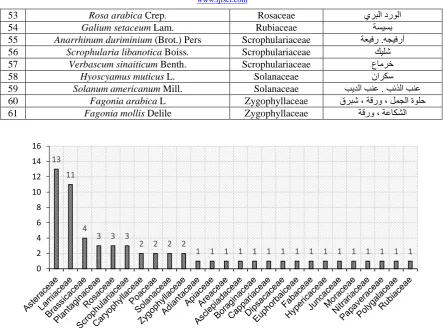
Fig 2. Shows 26 families represent the studied 25 stand in the present study
The selected 25 stands were located in nine sites, each site may contain one or more stands. In the following section, the describtion of the nine sites and the 25 stands is listed:
Site 1: Hamatet A’bada
Hamatet A'abada is located at 28.532065°N 33.970985° E, 28.513828°N 33.975373°E., with altitude range: 1850:2160 (m asl) .Soil texture of the wadi Hammatet A'abada contains 15% Bolder, 30% Rocks, 30% Gravel and 25%Sand. It has medium grazing pressure.This wadi is in a steep gorge which rises from the end of Wadi Arbaein steeply upwards towards to summit of Mount St. Katherine.The gorge consists of bolder and rocks substrate with granite geology with sporadic sandstone features. The distance from Saint Kathreine city is about 4.2 km. The topography of the wadi is concave and the slope exposure varies from east to northeast to west. The distance from Saint Kathreine city is about 1.4 km. There is a high diversity and cover of species in this wadi. There is moderate to high disturbance impacts from grazing to human disturbance from Bedouin
gardens and wells. This site includs one stand (Stand 1)
Stand 1‘‘Alkanna orientalis Community’’
In this stand, 7 species were recorded, the characteristic species of this community are Alkanna orientals (I.V.I. = 126.55),
Artemisia herba-alb (I.V.I. = 56.01), Zilla spinosa (I.V.I. = 37.44). Other associated species have lower importance values. The dominant species is Alkanna orientalis;
Artemisia herba-alb is the co-dominant species. 32TEchinops spinosissimus32T, Gomphocarpus sinaicus, Achillea fragrantissima are rare species.
Site 2: Shaq El Gragnia
Shaq Elgragnia is located at 28.532072°N 33.969543°E, 28.518591°N 33.970243°E. with altitude range: 1810:2150 (m asl). Soil texture of Shaq Elgragnia contains 40% bolder, 40% rocks, 15% gravel and 5% sand. It has low human activity, and low grazing pressure. The gorge consists of bolder and rocks substrate with granite and basalt geology. The gorge has a rigid topography with a North to Northwest slope exposure. The distance from Saint Kathreine
13 11
4
3 3 3
2 2 2 2
1 1 1 1 1 1 1 1 1 1 1 1 1 1 1 1
www.ijiset.com
71
city is about 4.5 km. This location included three stands (Stands 2, 3, 4).
Stand 2‘‘Alkanna orientalis Community’’
In this stand, 13 species were recorded, the characteristic species of this community are Alkana orientalis (I.V.I= 47.66), Adiantum capillus-veneris (I.V.I = 41.93), Veronica anagalis (I.V.I = 33.58). The other associated species have lower importance value. The dominant species is Alkana orientalis; Adiantum capillus-veneris is the co-dominant species. Ficus caraca and
Pterocephalus sanctus are rare species.
Phlomis aurea and Ballota Undulata are endemic plants. Nepeta septemcrenata is near endemic plant species.
Stand 3‘‘Phlomis aurea Community’’
In this stand, 10 species were recorded, the characteristic species of this community are Phlomis aurea (I.V.I.=61.41),
Echinops spinosissimus (I.V.I.=56.21), Alkana orientalis (I.V.I.= 51.95). The other associated species have lower importance values. The dominant species is Phlomis aurea species;
Echinops spinosissimus is the co-dominant species.Tanacetum sinaicum and Anarrhinum duriminium are rare species.Phlomis aurea, Ballota undulate, Tanacetum sinaicum and Anarrhinum duriminium are endemic plants. Nepeta septemcrenata is near endemic plant species.
Stand 4‘‘Artemisia herba-alb community’’
In this stand, 14 species were recorded, the characteristic species of this community are Artemisia herba-alba (I.V.I.= 62.32), Alkanna orientalis (I.V.I. = 35.74),
Origanum syriacum (I.V.I. = 34.83). The other associated species have lower importance values. The dominant is Artemisia herba-alba
species; Alkanna orientalis is the co-dominant species.Ficus caraca is rare species Origanum syriacum, Ballota undulata and Phlomis aurea
are endemic plants. Nepeta septemcrenata is near endemic plant species.
Site 3: Wadi El-Arb'een
Wadi El –Arae'en is located 28.553238°N 33.948651°E, 28.534353°N 33.965879°E, with altitude range: 1620-1772 (m asl).Soil texture of Wadi El –Arae'en contains 30% bolder , 45 %rocks, 20 % gravel and 5 % sand .The wadi has high human activity and high grazing pressure. It is bounded by Gebel EL-Sarwo (2150 m asl) to the east, and extension of Gebel Safsafa (2168 m asl), and Gebel EL-Rabba at the Northern
boundary, (N: 28.54540, E: 33.95536). Wadi bed is moderately vegetated, with a rocky substrate. Large boulders are found near edges of Wadi. Trail heavily used by tourists and camels (route to Mt. Sinai and Mt. St. Katherine). Wadi bed is covered by small gravel (<5cm). Grazing is heavy on: Stachys aegyptiaca, Ballota undulata, and Seriphidium herba-album.In wadi El-Arbae’en, one can easy recognize the beautiful cave on the right hand side, which is one of most wonderful places in this wadi. This location included two stands (Stands 5, 6).
Stand 5 ‘‘Fagonia mollis community ’’
In this stand, 12 species were recorded, the characteristic species of this community are Fagonia mollis (I.V.I. = 84.33), Alkana orientalis (I.V.I. = 49.33), Matthiola arabica (I.V.I. = 34.19). The other associated species have lower importance values. The dominant is Fagonia mollis
species; Alkana orientals is the co-dominant species. Peganum harmala, Tanacetum sinaicum, Galium setaceum, Chiliadenus montanus and Stachys aegyptiaca are rare species. Tanacetum sinaicum, Bufonia multiceps and phlomis aurea are endemic plants. Galium setaceum is near endemic plant species.
Stand 6‘‘Fagonia. Mollis community’’
In this stand, 20 species were recorded, the characteristic species of this community are Fagonia mollis (I.V.I. = 41.99), Achillea fragrantissima (I.V.I. =38.78),
Bufonia multiceps (I.V.I. = 27.23). The other associated species have lower importance values. The dominant is Fagonia mollis
specie; Achillea fragrantissima is the co-dominant species. Tanacetum sinaicum, Gomphocarpus sinaica, Anarrhinum duriminium, Ballota undulata and Silene schimperiana are rare species.Origanum syriacum, Anarrhinum duriminium, Tanacetum sinaicum, Phlomis aurea, Ballota undulate
and Bufonia multiceps are endemic plants.Galium setaceum is near endemic plant.
Site 4: Shaq Musa
www.ijiset.com
72
gorge consists of bolder and rocks substrate with granite geology with sporadic sandstone features. The gorge has a rigid topography with Northwest slope exposure. The distance from Saint kathreine city is about 4.2 km. This location included three stands (Stands 7, 8, 9).
Stand 7 ‘‘Echinops glaberrimus
community’’
In this stand, 14species were recorded, the characteristic species of this community are Echinops glaberrimus (I.V.I. = 58.63), Phlomis aurea (I.V.I. = 42.30),
Verbascum sinaiticum (I.V.I. = 28.09). The other associated species have lower importance values. The dominant is Echinops glaberrimusspecies; Phlomis aurea is the co-dominant species. Peganum harmala, Nepeta septemcrenata, Zilla spinosa, Gomphocarpus sinaicus and Stachys aegyptiaca are rare species. Tanacetum sinaicum, Origanum syriacum, phlomis aurea and Ballota undulata
are endemic plants. Nepeta septemcrenata is near endemic plant species.
Stand 8‘‘Artemisia herba-alba community"
In this stand, 14 species were recorded, the characteristic species of this community are Artemisia herba-alba (I.V.I. = 84.87), Echinops glaberrimus (I.V.I. = 39.96),
Tanacetum sinaicum (I.V.I. = 30.28). The other associated species have lower importance values. The dominant is Artemisia herba-alba
species; Echinops glaberrimus is the co-dominant species, Tanacetum sinaicum,
Teucrium polium, Gymnarrhena micrantha
and Verbascum sinaiticum are rare species.Tanacetum sinaicum, Ballota undulata
and phlomis aurea are endemic plants.
Stand 9‘‘Artemisia herba-alba community’’
In this stand, 20 species were recorded, the characteristic species of this community are Artemisia herba-alba (I.V.I.= 69.83), phlomis aurea (I.V.I. = 37.28),
Echinops glaberrimus (I.V.I. = 28.03). The other associated species have lower importance values. The dominant is Artemisia herba-alba
species; phlomis aurea is the co-dominant species, Rosa arabica, Polygala sinaica, Gymnarrhena micrantha, Verbascum sinaiticum and Achillea fragrantissima are rare species. Tanacetum sinaicum, Origanum syriacum, Ballota undulata, phlomis aurea and
Polygala sinaica are endemic plants.
Site 5: Eltalaa
Wadi Eltalaa is located 28.568102N 33.933169 E, 28.530832 N 33.934723 E, with altitude range: 1530-1810 (m asl).Soil texture of wadi Eltalaa contains 35% bolder, 35 % rocks, 25 % gravel, and 5 % sand. The wadi has high human activity and high grazing pressure. Wadi bed consists of course sand substrate with granite geology and basalt dykes. The topography of the wadi is concave and the slope exposure varies from east to northeast to west. The distance from Saint Kathreine city is about 1.4 km. There is a high diversity and cover of species in this wadi. There is moderate to high disturbance impacts from grazing and human disturbance from Bedouin gardens and wells. The vegetation is suffering from high intensity of disturbance and grazing by camels that are used for riding. This location included five stands (Stands 10, 11).
Stand 10‘‘Matthiola arabica community’’
In this stand, 19 species were recorded, the characteristic species of this community are Matthiola arabica (I.V.I. = 48.62), Origanum syriacum (I.V.I. = 31.54),
Teucrium polium (I.V.I. = 28). The other associated species have lower importance value. Here, the dominant is Matthiola arabica
species;Origanum syriacum is co-dominant species, Peganum harmala,Zilla spinosa,
Diplotaxis harra, Echinops glaberrimus, Anarrhinum duriminium and Tanacetum sinaicum are rare species, Origanum syriacum, Tanacetum sinaicum, phlomis aurea and
Anarrhinum duriminium are endemic plants.
Stand 11‘‘Matthiola Arabica community’’
In this stand, 19 species were recorded, the characteristic species of this community are Matthiola arabica (I.V.I.= 77.17), Euphorbia obovata (I.V.I. = 33.66),
Pulicaria undulata (I.V.I. = 22.23). The other associated species have lower importance values. The dominant is Matthiola arabica
species; Euphorbia obovatae is the co-dominant species, Stachys aegyptiaca and
Anarrhinum duriminium are rare species. Euphorbia obovata, Origanum syriacum, Tanacetum sinaicum, phlomis aurea, Anarrhinum duriminium and Ballota undulata
are endemic plants.
Site 6: Shaq Itlah
www.ijiset.com
73
sand. Shaq Itlah has high human activity, and medium grazing pressure. The gorge consists of boulder and rocks with granite geology. The topography of the gorge is concave and the slope exposure is northwest. The distance from Saint Kathreine city is about 5 km. There is a high plant diversity and cover of species in this gorge. This location included four stands ( Stands 12, 13, 14 and 15).
Stand 12 ‘‘Matthiola arabica community’’
In this stand, 23 species were recorded, the characteristic species of this community are Matthiola arabica (I.V.I. =60.49), Euphorbia obovata (I.V.I. =30.58),
Achillea fragrantissima (I.V.I. = 26.51). The other associated species have lower importance values. The dominant is Matthiola arabica
species; Euphorbia obovata is the co-dominant species. Diplotaxis harra, pulicaria undulate, Fagonia arabica, Farsetia aegyptia, Ficus
Carica, Mentha longifolia, Solanum americanum, Alkana orientalis, Bufonia multiceps ,Phlomis aurea , Origanum syriacum ,Salvia spinosa and Zilla spinosa are rare species. Euphorbia obovata, phlomis aurea, Anarrhinum duriminium and Bufonia multiceps are endemic plants. Galium setaceum is near endemic plant.
Stand 13 ‘‘Matthiola arabica community’’
In this stand, 12 species were recorded, the characteristic species of this community are Matthiola arabica (I.V.I. =89.07), Fagonia mollis (I.V.I. =38.46),
Verbascum sinaiticum (I.V.I. =28.53). The other associated species have lower importance values. The dominant is Matthiola arabica
species; Fagonia mollis is the co-dominant species. Ficus Carica, Deverra triradiata, Juncus rigidus and Ballota undulata are rare species.Origanum syriacum and Ballota undulata are endemic plants.
Stand 14 ‘‘Matthiola arabica community’’
In this stand, 21 species were recorded, the characteristic species of this community are Matthiola arabica (I.V.I. =42.01), Achillea fragrantissima (I.V.I. =34.27), Diplotaxis harra (I.V.I. = 31.40). The other associated species have lower importance values.The dominant is Matthiola arabica
species; Achillea fragrantissima is the co-dominant species. Verbascum sinaiticum is rare species, Origanum syriacum, Bufonia multiceps, Phlomis aurea, Anarrhinum duriminium and Tanacetum sinaicum are
endemic plants. Galium setaceum is near endemic plant.
Stand 15 ‘‘Matthiola arabica community’’
In this stand, 23 species were recorded, the characteristic species of this community are Matthiola arabica (I.V.I. =84.52), Cynodon dactylon (I.V.I. =21.82),
Lavandula coronopifolia (I.V.I.=20.50).The other associated species have lower importance values. The dominant is Matthiola arabica
species; Cynodon dactylon is the co-dominant species. Verbascum sinaiticum, Pulicaria undulate, Capparis spinosa, Origanum Syriacum, Echinops glaberrimus, Anarrhinum duriminium, Galium setaceum, Dipoltaxis harra, Hyoscyamus muticus and Chiliadenus montanus are rare species. Origanum syriacum
and Anarrhinum duriminium are endemic plants. Galium setaceum is near endemic plant.
Site 7: Al- Far'aa
Wadi Elfaraa is located at °N: 28.54440°, E: 33.96410, with altitude range: 1809-1830 (m asl). Soil texture of Wadi Elfaraa contains 10 % bolder, 10 % rocks, 40 % gravel and 40 % sand. Elfaraa has high human activity and high grazing pressure. This location consists of two slops between them wadi bed. Two stands were established in right slop, two stands were established on left slop and two stands in wadi bed. This location included six stand stands (Stands 16, 17, 18, 19, 20, and 21).
Stand 16 ‘‘Artemisia herba-alba community’’
In this stand, 12 species were recorded, the characteristic species of this community are Artemisia herba-alba (I.V.I.= 118.30), Bufonia multiceps (I.V.I. = 45.46),
Thymus decussatus (I.V.I.= 31.60). The other associated species have lower importance values. The dominant is Artemisia herba-alba
species; Bufonia multiceps is the co-dominant species. Pulicaria undulata, Stachys aegyptiaca and Fagonia mollis are rare species
Tanacetum sinaicum, Bufonia multiceps are endemic plants and Thymus decussates is near endemic plant.
Stand 17 ‘‘Artemisia herba-alba community’’
In this stand, 13 species were recorded, the characteristic species of this community are Artemisia herba-alba (I.V.I. = 74.19), Tanacetum sinaicum (I.V.I. = 59.67),
Zilla Spinoza (I.V.I.= 35.80).The other associated species have lower importance values. The dominant is Artemisia herba-alba
co-www.ijiset.com
74
dominant species. Matthiola arabica, Pterocephalus sanctus, Ballota undulata, and Fagonia mollis, are rare species. Tanacetum sinaicum, Ballota undulata, phlomis aurea are endemic plants.Galium setaceum is near endemic plant.
Stand 18 ‘‘Teucrium polium community ’’
In this stand, 15 species were recorded, the characteristic species of this community are Teucrium polium (I.V.I. = 35.54), Chiliadenus montanus (I.V.I.= 35.24),
Pterocephalus sanctus (I.V.I. = 29.91). The other associated species have lower importance values. The dominant is Teucrium polium
species; Chiliadenus montanus is the co-dominant species. Crataegus x sinaica and
Ballota undulata are rare species. Tanacetum sinaicum, Ballota undulata, phlomis aurea and
Plantago sinaica are endemic plants. Galium setaceum is near endemic plant.
Stand 19‘‘Artemisia herba-alba community ’’
In this stand, 10 species were recorded, the characteristic species of this community are Artemisia herba-alba (I.V.I.= 87.89), Tanacetum sinaicum (I.V.I. = 43.24),
Stachys aegyptiaca (I.V.I. = 39.12). The other associated species have lower importance values. The dominant is Artemisia herba-alba
species; Tanacetum sinaicum is the co-dominant species. Galium setaceum and
Alkanna orientalis are rare species .Tanacetum sinaicum and phlomis aurea are endemic plants. Galium setaceum is near endemic
Stand 20‘‘Artemisia herba-alba community’’
In this stand, 11 species were recorded, the characteristic species of this community are Artemisia herba-alba (I.V.I. = 69.17), Stachys aegyptiaca (I.V.I.= 67.75) , Teucrium polium (I.V.I. = 45.79). The other associated species have lower importance values.The dominant is Artemisia herba-alba
species; Stachys aegyptiaca is the co-dominant species. Echinops glaberrimus, Centaurea scoparia are rare species. Tanacetum sinaicum, phlomis aurea and Plantago sinaica
are endemic plant.
Stand 21‘‘Artemisia herba-alba community’’
In this stand, 14 species were recorded, the characteristic species of this community are Artemisia herba-alba (I.V.I.= 161.13), Stachys aegyptiaca (I.V.I. = 26.68), Bufonia multiceps (I.V.I.= 21.14).The other associated species have lower importance values. The dominant is Artemisia herba-alba
species; Stachys aegyptiaca is the co-dominant species. Gomphocarpus sinaicus, Fagonia mollis, Nepeta septemcrenata, Deverra triradiata, Silene schimperiana, Diplotaxis harra and Pterocephalus sanctus
are rare species. Tanacetum sinaicum and
Bufonia multiceps are endemic plants. Nepeta septemcrenata is near endemic plant species.
Site 8: El- Elmsirdi
El msirdi is located at 28.532751 N 33.940485 E, 28.547157 N 33.940460 E, with altitude range: 1650-1915 (m asl).Soil texture of El msirdi contains 40 % bolder, 30 % rocks, 20 %gravel and 10 % sand. It has high human activity, and high grazing pressure. The gorge consists of boulder and rocks with granitic geology. The topography of the gorge is concave and the slope exposure varies from north to north east. The distance from Saint Kathreine city is about 1.8 km. There is a high plant diversity and cover of species in this gorge. This location included three stands (Stands 22, 23 and 24).
Stand 22‘‘Matthiola arabica community’’
In this stand, 19 species were recorded, the characteristic species of this community are Matthiola arabica (I.V.I. = 65.90), Anarrhinum duriminium (I.V.I. = 40.28), Origanum syriacum (I.V.I. = 31.27). The other associated species have lower importance values. The dominant is Juncus rigidus species; Verbascum sinaiticum is the co-dominant species. Nepeta septemcrenata, Astragalus echinus are rare species.Origanum syriacum, Anarrhinum duriminium, Tanacetum sinaicum, Ballota undulate, Phlomis aurea are
endemic plants. Nepeta septemcrenata is near endemic.
Stand 23 ‘‘Hypericum sinaicum community’
In ths stand, 13 species were recorded, the characteristic species of this community are Hypericum sinaicum (I.V.I. = 69.46), Verbascum sinaiticum (I.V.I. = 48.31),
Mentha longifolia (I.V.I. = 39.99). The other associated species have lower importance values. The dominant is Hypericum sinaicum
species; Verbascum sinaiticum is the co-dominant species. Phoenix dactylifera, Olivaea leptocarpa, Papaver aculeatum is rare species. Origanum syriacum is endemic plants.
Stand 24 ‘‘Matthiola arabica community’’
www.ijiset.com
75
57.24), Verbascum sinaiticum (I.V.I. = 51.91),
Alkana orientalis (I.V.I. = 38.98). The other associated species have lower importance values. The dominant is Matthiola arabica
species; Verbascum sinaiticum is the co-dominant species. Centaurea eryngioides, Zilla spinosa, Silene schimperiana, Artemisia herba-alba, Echinops glaberrimus, Tanacetum sinaicum, Solanum americanum , Phlomis aurea ,Deverra triradiata and Anarrhinum duriminium are rare species.Origanum syriacum,Tanacetum sinaicum, Anarrhinum duriminium and Phlomis aurea are endemic plants.Galium setaceum is near endemic plant.
Site 9: Ain El- Shekaia
Ain El-Shekia is located at 28.32.601°N, 33.55.964°E.,with altitude1807 (m asl).Soil texture of Ain El-Shekia contains 90 % bolder, %2 rocks, 3 % gravel and 5 % sand. It has high human activity, and high grazing pressure. Cliff consists of boulders with granite geology. The topography of the cliff is sharpen and the slope exposure to west. A spring of water through the rocks is present characterized by a good rate of water flow all over the year. Bedouins and tourists consider it as a first rest in their trip to El-Galt El-Azraq. The water is always cool, and is a favorite watering site for camels. There is a high diversity of species in this gorge. There is moderate to high disturbance impacts from grazing to human disturbance (Tourism). This location included one stands (25).
Stand 25‘‘Cynodon dactylon community’’
In this stand, 17 species were recorded, the characteristic species of this community are Cynodon dactylon (I.V.I. = 41.57), Mentha longifolia, Alkana orientalis and Matthiola arabica (I.V.I. = 27.29),
Verbascum sinaiticum and Achillea fragrantissima (I.V.I. = 25.10). The other associated species have lower importance values. The dominant species is Cynodon dactylon species; Mentha longifolia, Alkana orientalis and Matthiola Arabica are the co-dominant species. Adiantumcapillus-veneris, Teucrium polium, Ficus carica, Nepeta septemcrenata, Plantago sinaica and Echinops glaberrimus are rare species. Phlomis aurea
and Plantago sinaica are endemic plants. Nepeta septemcrenata is near endemic plant.
U
Disscussion
The present study aimed at identifyig major plant communities dominanting the 25 studied stands from Saint Katherine protectorate. Results showed the presence of
nine plant communities along the nine sites of the study area. The major plant communities were Matthiola arabica, 32TArtemisia herba-alba32T
species, Alkanna orientalis, Fagonia mollis, Phlomis aurea, Teucrium polium, Echinops glaberrimus, Hypericum sinaicum,
and Cynodon dactylon
Matthiola arabiaca community:
Matthiola arabiaca is the most commen dominant species, dominating eight stands belonging to three sites out of the 25 studied stands and the nine sites (10, 11 in talaa , 12, 13, 14, 15 in Itlah and 22, 24 in El Mesirdi), with elevation range between 1488 m asl and 1912 m asl. Matthiola arabica is
dicotyledoneae plant from family Cruciferae.
Matthiola arabica is perennial species which found in different landforms (Gorges, Slopes, Terraces) in St. Katherine area (Ayyad et al., 2000). Grazing activity is moderate with
Matthiola arabica being heavily impacted in Safsafa Mountain (Guenther et al., 2005).
High elevation sites were dominant by
Matthiola arabiaca with considerably higher plant coverage and species richness (Guenther
et. al., 2005). Matthiola arabica is present as
an associated species in (Arbain, Itlah, Ferah, Naqb Hawa, El Roumana, Tynia, Ahmar, Shraig,Tellacah) are high-elevation (1385-1859 m asl) wadis with a varied geology (granite, sandstone, and basalt), Vegetation richness and percentage cover are high, perhaps because of a moderately high moisture availability throughout this group of wadi’s
(Guenther et. al., 2005).
Artemisia herba-alba community:
Artimisia herba-alba is dominant species at eight stands belonging to three sites out of the 25 studied stands and the nine sites (4 in El Gragnia 8, 9 in Shaq Musa and 16, 17 and 19, 20 , 21 in El Faraa), with elevation range between 1809 m asl and 2076 m asl. Artimisia herba-alba is a perennial species found in different landforms (Gorges, Slopes, Terraces and Ridges) in St. Katherine area (Ayyad et
al., 2000). Artemisia herba-alba is the
dominant species characterizing the mountainous habitats (Moustafa et al, 2006).
Artemisia herba-alba is most abundant species on the very steep gorges, in the crevices between boulders and large stones. Artemisia herba-alba is growing in very low species richness, and grows in the fine and looser soil texture (Ayyad et al., 2000). Artemisia
www.ijiset.com
76
(Moustafaet al, 2006). Artemisia herba-albawas an associated species in Farsh El Luz, Shaq Musa in the region to signify abundant water resources (Guenther et al., 2005). In the high-elevation sites surrounding the ring dyke, the dominant plant species include Artimisia
herba-alba (Guenther et al., 2005). Artimisia herba-alba occurs at high elevations (2200– 2400 m asl), and occupies a wide range of landform types such as open slopes, slopes with depressions, shaded gorges and, in some cases, terraces (Ayyad et al., 2000).
Alkanna orientalis community:
Alkanna orientalis is dominant species at two stands belonging to two sites out of the 25 studied stands and the nine sites (1 in Hamatet Abada and 2 in El Gragnia) ), with elevation at 1810 m asl and 1910 m asl. Alkanna orientalis
is perennial species which found in different landforms (Gorges ,Slopes, Terraces, Ridges) in St. Katherine area (Ayyad et al., 2000).
Alkanna orientalis is comman in the mountains surrounding the St Katherine (Zahran and
Willis, 2009). Alkanna orientalis is dominant species in the rocky slopes of the mouth of Wadi El-Raha. Alkanna orientals grows in fissures of the boulders of gully bed in the mouth of Wadi El-Arbaeen, Alkanna
orientalis is an associated with Peganum harmala (Zahran and Willis, 2009).
Fagonia mollis community:Fagonia
mollis is dominant species at two stands belonging to one sites out of the 25 studied stands and the nine sites (5 and 6 in Wadi Al Arbeen) with elevation at 1724 m asl, 1690 m asl. Fagonia mollis is perennial species found in different landforms (Gorges, Slopes, Terraces, Ridges) in St. Katherine area (Ayyad
et al., 2000). The flora of the Sinai mountains
is dominated by Irano-Turanian species, it is accompanied by Fagonia mollis in stony alluvium (Zahran and Willis, 2009). Fagonia
mollis is calcicolous species in the large tributaries of Wadi Sidri. Fagonia mollis is associated species in the flood channel (wadi bed) of the upstream part of Wadi El-Tor. In the wadi bed Fagonia mollis is an associates species. On the flat soil of the gully bed, between the boulders, Fagonia mollis is comman. Fagonia mollis is common plant on sandy habitat (Zahran and Willis, 2009).
Phlomis aurea community:Phlomis
aurea is dominant species at one stand belonging to one sites out of the 25 studied stands and the nine sites (3 in El Gragnia) , with elevation of 1811 m asl . Phlomis aurea
(Lamiaceae) is a wild Golden-woolly perennial species growing in Sinai especially in Gebel Mousa and Saint Katharine mountains, its common Arabic name is Awarwar (Täckholm 1974, Boulos 2002). Phlomis aurea is endemic, restricted to the high altitudes in Southern Sinai (Bolous 2009). Phlomis aurea
is not used as medicinal plant in South Sinai.
Phlomis aurea individuals grow well in the moist-shade habitats as individuals that grow in moist soil and under the boulders or rocks have good vitality (Shabana, 2013). Phlomis aurea is dominant at 2000:2200 (m asl)
(Khafagi and Omar, 2012). The bed of Wadi El-Arbaeen has a rich flora includes Phlomis aurea. Phlomis aurea is common species on the northern slope o f Gebel Musa, also Phlomis aurea is abundant in the flora of midway to the summit of Gebel Musa. In the flat part of Farsh El-Gebel the vegetation is thinner than in the runnels Phlomis aurea is common there. Phlomis aurea is an associated species with Peganum harmala in the mouth of Wadi El-Arbaeen (Zahran and Willis, 2009).
Teucrium polium
community:Teucrium polium is dominant at one stand belonging to one sites out of the 25 studied stands and the nine sites (18 in El Faraa) , with elevation of 1830 m asl.
Teucrium polium is the dominant on the lower dunes of the Mediterranean coastal area of Sinai (Kassas, 1952). Teucrium polium is associated at the final stage there are huge sand dunes with rocky centres. Teucrium polium is also found on the flat soil of the gully bed, between the boulders, and is growing in fissures of the boulders. Teucrium polium is rare species to Peganum harmala in the mouth of Wadi El-Arbaeen. Teucrium polium is rare in midway to the summit of Gebel Musa
(Zahran and Willis, 2009).
Echinops glaberrimus community:
Echinops glaberrimus is dominant at one stand belonging to one sites out of the 25 studied stands and the nine sites (7 in Shaq Musa) , with elevation of 1920 m asl. Echinops glaberrimus is dicotyledoneae plant from family Compositae (Guenther et al., 2005).
Echinops glaberrimus is perennial species found in different landforms (Gorges, Slopes, Terraces, Ridges) in St. Catherine area (Ayyad
et al., 2000). Echinops glaberrimus is occur at
www.ijiset.com
77
(Ayyad etal., 2000). Echinops glaberrimus isfound in the mountains surrounding the St Katherine monastery.Echinops glaberrimus is
common on the northern slope o f Gebel Musa
(Zahran and Willis, 2009).
Hypericum sinaicum community:
Hypericum Sinaicum is dominant at one stand belonging to one sites out of the 25 studied stands and the nine sites (23 in El Mesirdi) , with elevation of 1716 m asl. Hypericum Sinaicum is dominant at 2000:2200 (m asl)
(Khafagi and Omar, 2012). Most of the
Hupericum sinaicum populations were small and the plants occurred sporadically in space, as little groups or as individuals. The survey showed that there was no specific habitat preference for Hypericum, Cliffs and Gorges are equal in recordings the highest presence (27.2 % for each). It was found that H. sinaicum has a narrow range of distribution between 1515 m asl and 2036 m asl. A bout 50
% of H. sinaicum individuals’ concentrated between elevations 1800 m asl : 2000 m asl
(Omar, 2013). Hypericum Sinaicum is common in the bed of Wadi El-Arbaeen.
Hypericum Sinaicum is recorded in the southern mountain (Zahran and Willis,
2009).
Cynodon dactylon community:
Cynodon dactylon is dominant at one stand belonging to one sites out of the 25 studied stands and the nine sites (25 in Ain Elskkia), with elevation of 1807 m asl. Cynodon dactylon is growing in the high-elevation (1763-2004 m asl) wadis (Guenther et al.,
2005). Cynodon dactylon is a common species
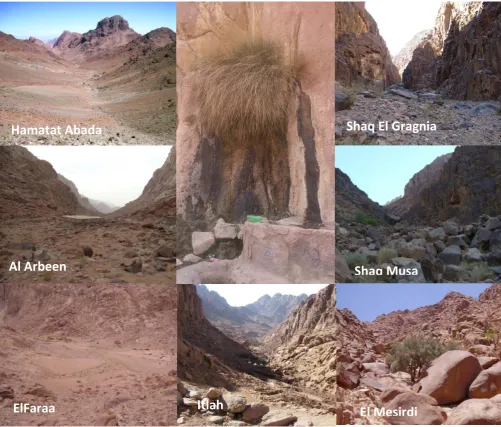
Fig. 3. Showing different nine sites of the study area
Hamatat Abada
Shaq El Gragnia
Al Arbeen
Ain el shkia
Shaq Musa
Itlah
www.ijiset.com
78
every where in coastal habitats in northern Mediterranean coast of Sinai. Cynodon dactylon is an associate species in the coast of Sheikh Zuwayid (about 20 km west of Rafah) and extended for about 22 km from sea landward (Zahran and Willis, 2009).
Cynodon dactylon is an associated species in depressions between the dunes contain a characteristic salt marsh. The interdune depression is an adverse habitat being divided into saline and non-saline facies due to the level of ground water. In non-saline areas,
Cynodon dactylon is an associate species in the
downstream part of Wadi El-Tor communities in the saline areas Cynodon dactylon is also an associate species (Zahran and Willis, 2009).
U
Conclusion
The present work is a contribution to the vegetation of Saint Katherine protectorate. Nine sites including 25 stands were studied and nine plant communities have been identified. Further studies investigating vegetation and monitoring diferrent environmental changes and anthropogenic activities in Saint Katherine protectorate are strongly recommended.
U
References
Abd El-Wahab, R.; Zaghloul, M. and Moustafa, A. (2004). Conservation of medicinal plants in St. Catherine Protectorate, South Sinai, Egypt. I. Evaluation of ecological status and human impact. Proc. I Inter. Conf. on Strategy of Egyptian Herbaria, Giza, Egypt: 231-251.
Ayyad, M.; Fakhry and Moustafa, A. (2000). Plant biodiversity in the St. Katherine area of the Sinai Peninsula, Egypt. Biodiversity &Conservation 9: 265-281.
Boulos, L. (1999). Flora of Egypt. vol. I (Azollaceae– Oxalidaceae). A1– Hadara Publishing, Cairo, Egypt, 419 p.
Boulos, L. (2000). Flora of Egypt: Volume Two Geraniaceae-Boraginaceae). Al-Hadara Publishing, Cairo, Egypt, 352 pp.
Boulos, L. (2002). Flora of Egypt: Volume Three (Verbinaceae- Compositae). Al-Hadara Publishing, Cairo, Egypt, pp. 373.
Boulos, L. (2005). Flora of Egypt: Volume Four Alismataceae-Orchidaceae). Al-Hadara Publishing, Cairo, Egypt, 617 pp.
Boulos, L. (2009). Flora of Egypt: Checklist (revised annotated ed.). Al-Hadra Publishing, Cairo, Egypt, pp. 410
Braun-Blanquet, J. (1964). Plant Sociology. Translated by G.D. Fuller and H.S. Connard, McGraw-Hill Book Co., Inc. New York, London. 439 pp.
Danin, A. (1983). Desert Vegetation of Israel and Sinai. Jerusalem: Cana Publishing House. 148 pp.
Danin, A. (1986). Flora and vegetation of Sinai. Proceedings of the Royal Society of Edinburgh 89B: 159-168
EL-Wahab, R.; Zayed, A. , Moustafa, A. , Klopatek, J. , & Helmy, M. (2006).
Landforms, vegetation, and soil quality in south Sinai, Egypt. Egypt. Soc. Environ. Sci., 1(2), 127-138..
Guenther, R.; Gilbert, F.; Zalat, S.; Selink and Volunteers of the operation wallacea in Eygpt (2005). Vegetation and grazing in the St. Katherine protectorate, south Sinai, Egypt. Egyptian journal of Biology, 7:55-65.
Hatim, M.; Shaltout, K.; Schamine´e, J.; Kady, H.; Janssen, j. and El-Sheikh, M. (2016).
VegEgyptecoinformatics:
contribution to Sinai flora and vegetation. Rend. Fis. Acc. Lincei, 27: 383-399.
IUCN, (1994). IUCN Redlist Categories. Prepared by the Special Survival Commission. IUCN, Gland, Switzerland.
Jenny, H. (l941). Factors of Soil Formation.McGraw-Hill. New York.
Kassas, M. (1952). Habitat and plant communities in the Egyptian Desert. Introduction. Journal of Ecology, 40:
342-351.
Kassas, M. (1953). Habitat and plant communities in the Egyptian Desert. II- The features of a desert community. Journal of Ecology, 41: 248-256.I
Khafagi, O.; Hatab, E. and Omar, K. (2012). Challenges towards Hypericumsinaicumconservation in South Sinai, Egypt. Jordan Journal of Biological Sciences, 6 (2): 117-126
Moustafa, A. and Zaghloul, M. (1996).
Environment and vegetation in the montane Saint Catherine area, South Sinai, Egypt. Journal of Arid Environments 34, 331–349.
Moustafa, A. and Zaghloul, M. (1993).
www.ijiset.com
79
distribution of plant species in gorge habitats, South Sinai. Egyptian Proceeding 1P
st
P
Conference Egyptian Hungarian Environment, Egypt, 268-274.
Omar, K. (2013). Using geographical information systems (GIS) to detect the ecological and geographical status of H-ypericumsinaicum in Saint Katherin Protectorate, South Sinai, Egypt. P.h.D. Thesis, Faculty of Sciences, Al-Azhar University, Cairo, Egypt, 297 pp.
Omar, K., Khafagi, O. and Elkholy, M. (2012). Eco-geographical analysis on mountain plants: A case study of Nepeta septemcrenata in south Sinai, Egypt. Lambert Academic Publishing, 236 pp.
Shabana, H.(2004). Variability among phlomis aurea decne Populations in southern sinai M.Sc. Thesis, Faculty of Sciences, Al-azhar University, Cairo, Egypt, 280 pp.
Täckholm, V. (1974). Students’ Flora of Egypt, 2nd edn. Cairo Univ. (Publ.), Cooperative Printing Company, Beirut, 888 pp.
Tan, K. (2005). Soil sampling, preparation and analysis. CRC Press, Boca Raton, Florida, 2742- 33487 pp.
Ward, J. F.; Malard, K. and Tockner, (2002). Landscape ecology: a framework for integrating pattern and process in river corridors. Landscape Ecol., 17 (1): 35-45.