RankSign : an efficient signature algorithm based on the rank
metric
Philippe Gaborit1, Olivier Ruatta1,Julien Schrek1 and Gilles Z´emor2
1
Universit´e de Limoges, XLIM-DMI, 123, Av. Albert Thomas 87060 Limoges Cedex, France. gaborit,schrek,[email protected]
2
Universit´e de Bordeaux, Institut de Math´ematiques, UMR 5251,
Abstract. In this paper we propose a new approach to code-based signatures that makes use in particular of rank metric codes. When the classical approach consists in finding the unique preimage of a syndrome through a decoding algorithm, we propose to introduce the notion of mixed decoding of erasures and errors for building signature schemes. In that case the difficult problem becomes, as is the case in lattice-based cryptography, finding a preimage of weight above the Gilbert-Varshamov bound (case where many solutions occur) rather than finding a unique preimage of weight below the Gilbert-Varshamov bound. The paper describes RankSign: a new signature algorithm for the rank metric based on a new mixed algorithm for decoding erasures and errors for the recently introduced Low Rank Parity Check (LRPC) codes. We explain how it is possible (depending on choices of parameters) to obtain a full decoding algorithm which is able to find a preimage of reasonable rank weight for any random syndrome with a very strong probability. We study the semantic security of our signature algorithm and show how it is possible to reduce the unforgeability to direct attacks on the public matrix, so that no information leaks through signatures. Finally, we give several examples of parameters for our scheme, some of which with public key of size 5760 bits and signature of size 1728 bits. Moreover the scheme can be very fast for small base fields.
Keys words: Signature algorithm, rank metric
1 Introduction
The problem of finding an efficient signature algorithm has been a major challenge for code-based cryptography since its introduction in 1978 by McEliece. Signing with error-correcting codes can be achieved in different ways: the CFS algorithm [7] considers extreme parameters of Goppa codes to obtain a class of codes in which a non-negligeable part of random syndromes are invertible. This scheme has a very small signature size, however it is rather slow and the public key is very large. Another possibility is to use the Fiat-Shamir heuristic to turn a zero-knowledge authentication scheme (like the Stern authentication scheme [28]) into a signature scheme. This approach leads to very small public keys of a few hundred bits and is rather fast, but the signature size in itself is large (about 100,000b), so that overall no wholly satisfying scheme is known.
is very different from the Hamming distance. The rank metric has received in recent years very strong attention from the coding community for their application to network coding. Moreover, this metric can also be used for cryptography. Indeed it is possible to construct rank-analogues of Reed-Solomon codes: the Gabidulin codes. Gabidulin codes inspired early cryptosystems, like the GPT cryposystem ([12]), but they turned out to be inherently vulnera-ble because of the very strong structure of the underlying codes. More recently, by considering an approach similar to NTRU [18](and also MDPC codes [24]) constructing a very efficient cryptosystem based on weakly structured rank codes was shown to be possible [13]. How-ever, in terms of signatures based on the rank metric, only systems that use Fiat-Shamir are presently known [14].
An interesting point in code-based cryptography is that in general the security of the pro-tocols relies on finding small weight vectorsbelowthe Gilbert-Varshamov bound (the typical minimum weight of a random code). This is noticeably different from lattice based cryptog-raphy for which it is very common for the security of a signature algorithm [17, 23] to rely on the capacity to approximate a random vector far beyond its closest lattice vector element (the Gap-CVP problem).
Traditionally, this approach was not developed for code-based cryptography since no decoding algorithm is known that decodes beyond the Gilbert-Varshamov bound: in fact this problem is somewhat marginal for the coding community since it implies many possibilities for decoding, while the emphasis is almost always to find the most probable codeword or a short list of most likely codewords.
Our contribution
The main contribution of this paper is the introduction of a new way of considering code-based signatures, by introducing the idea that it is possible to invert a random syndrome not below the Gilbert-Varshamov bound, but above it. The approach is similar in spirit to what is done in lattice-based cryptography. We describe a new algorithm for LRPC codes, a recently introduced class of rank codes, the new algorithm permits in practice decoding both errors and (generalized) rank erasures. This new algorithm enables us to approximate a syndrome beyond the Gilbert-Varshamov bound. The algorithm is a unique decoder (not a list decoder) but can give different solutions depending on the choice of the erasure. We explain precisely in which conditions one can obtain successful decoding for any given syndrome and give the related probabilistic analysis. Based on this error/erasure algorithm we propose a new signature scheme RankSign. We give conditions for which no information leakage is possible from real signatures obtained through our scheme. This point is very important since information leaking from real signatures was the weakness through which the NTRUSign scheme came to be attacked [19, 6, 26]. Finally, we give examples of parameters: they are rather versatile, and their size depends on a bound on the amount of potentially leaked information. In some cases one obtains public keys of size 5700 bits with signatures of length 1728 bits, moreover the scheme is rather fast.
2 Background on rank metric codes and cryptography
2.1 Definitions and notation
Notation :Letq be a power of a primep,m an integer and letVnbe andimensional vector space over the finite field GF(qm). Let β = (β1, . . . , βm) be a basis of GF(qm) overGF(q).
LetFi be the map fromGF(qm) toGF(q) whereFi(x) is thei-th coordinate ofxin the basis β.
To anyv = (v1, . . . , vn) in Vn we associate the matrixv∈ Mm,n(Fq) in whichvi,j =Fi(vj). The rank weight of a vectorv can be defined as the rank of the associated matrix v. If we name this value rank(v) we can define a distance between two vectorsx, ythrough the formula dr(x, y) = rank(x−y). We refer to [21] for more details on codes for the rank distance.
A rank code C of length n and dimension k over GF(qm) is a subspace of dimension k of GF(qm) viewed as a (rank) metric space. The minimum rank distance of the code C is the minimum rank of non-zero vectors of the code. In the following,C is a rank metric code of lengthnand dimensionk overGF(qm). The matrixGdenotes ak×ngenerator matrix ofC andH one of its parity check matrix.
Definition 1. Let x = (x1, x2,· · ·, xn) ∈ GF(qm)n be a vector of rank r. We denote E the
GF(q)-sub vector space of GF(qm) generated by x1, x2,· · · , xn. The vector space E is called the supportof x.
Remark 1. The notion of support of a code word for the Hamming distance and for the the one introduced in definition 1 are different but they share a common principle: in both cases, suppose one is given a syndrome s and that there exists a low weight vector x such that H.xt=s, then, if the support ofxis known, it is possible to recover all the coordinates values ofx by solving a linear system.
Definition 2. Let e be an error vector of rank r and error support space E. We denote by
generalized erasure of dimensiontof an errore, a subspaceT of dimensiontof its error supportE.
The notion of erasure for Hamming distance corresponds to knowing a particular position of the error vector (hence some partial information on the support), in the rank distance case, the support of the error being a subspaceE, the equivalent notion of erasure (also denoted generalized erasure) is therefore the knowledge of a subspaceT of the error supportE.
2.2 Bounds for rank metric codes
The classical bounds for the Hamming metric have straightforward rank metric analogues, since two of them are of interest for the paper we recall them below.
S0= 1, for t≥1 we have (see [21]):
S(n, m, q, t) = t−1
Y
j=0
(qn−qj)(qm−qj) qt−qj
From this we deduce the volume of a ballB(n, m, q, t) of radiust inGF(qm) to be:
B(n, m, q, t) = t
X
i=0
S(n, m, q, i)
In the linear case the Rank Gilbert-Varshamov boundGV R(n, k, m, q) for a [n, k] linear code over GF(qm) is then defined as the smallest integer t such thatB(n, m, q, t)≥qm(n−k). The Gilbert-Varshamov bound for a rank code C with dual matrix H, corresponds to the smallest rank weight r for which, for any syndromes, there exists on the average a wordx of rank weight r such that H.xt =s. To give an idea of the behaviour of this bound, it can be shown that, asymptotically in the casem=n([21]): GV R(n,k,m,qn ) ∼1−
q
k n.
Singleton bound The classical Singleton bound for a linear [n, k] rank code of minimum rank r over GF(qm) works in the same way as for linear codes (by finding an information set) and reads r ≤ 1 +n−k: in the case when n > m this bound can be rewritten as r≤1 +b(n−nk)mc[21]. Codes achieving this bound are called Maximum Rank Distance codes (MRD).
2.3 Cryptography and rank codes
The main use of rank codes in the cryptographic context is through the rank analogue of the classical syndrome decoding problem.
Maximum Likelihood - Rank Syndrome Decoding problem (ML-RSD) LetH be a (n−k)×n matrix overGF(qm) with k ≤ n,s ∈ GF(qm)n−k . The problem is to find the smallest weightr such that rank(x) =r and Hxt=s.
In that case it is not proven that the problem is N P-hard, but this problem is very close to the syndrome decoding problem which is NP-hard, moreover the problem can be seen as a structured version of the MinRank problem which is also NP-hard (the RSD problem can be attacked as a MinRank problem but in practice the attack does not work since there are too many unknowns [8]). Moreover the problem has been studied for more than 20 years and the best algorithms are exponential, so that the problem is generally believed to be hard.
There exist several types of generic attacks on the problem:
not take account of the value of n in the exponent. Very recently the two previous attacks were generalized in [15] by Gaborit et al.in (n−k)3m3q(r−1)b(k+1)n mc)) and take the value of ninto account and were used to break some repaired versions of the GPT cryposystem.
- algebraic attacks: the particular nature of the rank metric makes it a natural field for algebraic attacks and solving by Groebner basis, since these attack are largely independent of the value ofq and in some cases may also be largely independent of m. These attacks are usually the most efficient when q increases and when the parameters are not too high (say less than 30). There exist different types of algebraic equations settings: the first one by Levy and Perret [20] in 2006 considers a quadratic setting by taking as unknowns the support E of the error and the error coordinates regarding E, there is also the Kernel attack by [8] and the minor approach which consists in considering multivariate equations of degreer+ 1 obtained from minors of matrices [9], and more recently the annulator setting by Gaborit et al.in [15] (which is valid on certain type of parameters but may not be independent on m). In our context for some of the parameters considered in the end of the paper, the Levy-Perret attack is the most efficient one to consider. All the complexities for Grobner basis attacks are estimated through the very nice program of L. Bettale [4].
The case of more than one solution: approximating beyond the GVR bound
In code based cryptography there is usually only one solution to the syndrome problem (for instance for the McEliece scheme), now in this situation we are interested in the case when there are a large number of solutions. This case is reminiscent of lattice-based cryptography when one tries to approximate as much as possible a given syndrome by a word of weight as low as possible.
This motivates us to introduce a new problem which corresponds to finding a solution to the general decoding problem for the case when the weight of the word associated to the syndrome is greater than the GVR bound, in that case there may be several solutions, and hence the term decoding does not seem well chosen. Notice that in a lattice cryptography context, it corresponds to the case of Gap-CVP, which does not make sense here, since it implies a multiplicative gap.
Approximate - Rank Syndrome Decoding problem (App-RSD)LetHbe a (n−k)×n matrix overGF(qm) withk≤n,s∈GF(qm)n−k and letr be an integer. The problem is to find a solution of rankr such that rank(x) =r and Hxt=s.
It is help to first consider the situation of a binary linear [n, k] Hamming metric code. Given a random element of lengthn−kof the syndrome space, we know that with high probability there exists word that has this particular syndrome and whose weight is on the GV bound. This word is usually hard to find, however. Now what is the lowest minimum weight for which it is easy to find such a word ? A simple approach consists in takingn−krandom column of the parity-check matrix (a potential support of the solution word) and inverting the associated matrix, multiplying by the syndrome gives us a solution of weight (n−k)/2 on average. In fact it is difficult to do better than this without a super-polynomial increase in complexity.
be a solution vector, so that H.xt = s. If we consider the syndrome equations induced in the small fieldGF(q), there are n.r unknowns and m.(n−k) equations. Hence it is possible (with a good probability) to solve the system whenevernr≥m(n−k), therefore it is possible to find in probabilistic polynomial time a solution to a typical instance of the RSD problem whenever r ≥ m(nn−k) = 1 +bm(nn−k)c, which corresponds to the Singleton bound (except if m(n−k)
n is an integer).
This proves the following proposition:
Proposition 1. There is a probabilistic polynomial time algorithm that solves random in-stances of the App-RSD problem in polynomial time whenr≥1 +bm(nn−k)cor forr ≥ m(nn−k) if m(nn−k) is an integer.
For a rank weightrbelow this bound, the best known attacks are, as in the Hamming distance case, obtained by considering the cost of finding a word of rankr divided by the number of potential solutions: Bq(mn,k,m,q(n−k)). In practice the complexity we find is coherent with this.
3 Approximating a random syndrome beyond the GVR bound with
LRPC codes
3.1 Decoding algorithm in rank metric
The rank metric has received a lot of attention in the context of network coding [27]. There exist very few algorithms, however, for decoding codes in the rank metric. The most well known [n, k] codes which are decodable are the Gabidulin codes [11]. These codes can correct up to n−2k errors, and have been proposed for encryption: but since they cannot decode up to the GVR bound, they do not seem suitable for full decoding in the spirit of [7] for signature algorithms. Another more recent family of decodable codes are the LRPC codes [13], these codes are defined through a low rank matrix.
Definition 3. A Low Rank Parity Check (LRPC) code of rank d, length n and dimension k over GF(qm) is a code defined by an (n−k)×n parity check matrix H = (hij), such that all its coordinates hij belong to the same GF(q)-subspace F of dimension d of GF(qm). We denote by{F1, F2,· · · , Fd} a basis ofF.
These codes can decode with a good probability up to n−dk errors, they can be used for encryption [13], but since they can decode only up to n−2k errors at best, they also seems unsuitable for signature algorithms.
3.2 Using LRPC codes to approximate a random syndrome beyond the GVR bound
High level overview The traditional approach for decoding random syndromes, that is used by the CFS scheme for instance, consists in taking advantage of the decoding properties of a code (e.g. a Goppa code) and considering parameters for which the proportion of decodable vectors – the decodable density – is not too low. For the Hamming metric, this approach leads to very flat dual matrices, ie, codes with high rate and very low Hamming distance. In the rank metric case, this approach leads to very small decodable densities and does not work in practice. However, it is possible to proceed otherwise. It turns out that the decoding algorithm of LRPC codes can be adapted so that it is possible to decode not only errors but also (generalized) erasures. This new decoding algorithm allows us to decode more rank errors since the support is then partially known. In that case since the size of the balls depends directly on the dimension of the support, it leads to a dramatic increase of the size of the decodable balls. Semantically, what happens is that the signer can fix an erasure space, which relaxes the condition for finding a preimage. This approach works because in the particular case of our algorithm, it is possible to consider the erasure space at no cost in terms of error correction: to put it differently, the situation for LRPC is different from traditional Hamming metric codes for which “an error equals two erasures”.
In practice it is possible to find parameters (not flat at all) for which it is possible to decode a random syndrome with the constraint that its support contains a fixed random subspace. Fix-ing part of the rank-support of the error, (the generalized erasure) allows us more rank-errors. For suitable parameters, the approach works then as follows: for a given random syndrome-space elements, one chooses a random subspaceT of fixed dimensiont(a generalized erasure of Definition 2), and the algorithm returns a small rank-weight word, whose rank-supportE containsT, and whose syndrome is the given elements. Of course, there is no unicity of the errore since different choices of T lead to different errors e, which implies that the rank of the returned error is above the GVR bound: it is however only just above the GVR bound for the right choice of parameters.
LRPC decoding with errors and generalized erasures
Setting: Let an [n, k] LRPC code be defined by an (n−k)×n parity-check matrixH whose entries lie in a spaceF ⊂GF(qm) of small dimension d. Lett andr0 be two parameters such that
r0≤ n−k d .
Setr=t+r0. Given an element of the syndrome spaces, we will be looking for a rankrvector eof GF(qm)nwith syndromes. We first look for an acceptable subspaceE of dimensionr of GF(qm) and then solve the linear system H.et = s where e∈ En. To this end we choose a random subspaceT of dimension tof GF(qm) and impose the conditionT ⊂E.
The subspaceT being fixed, we now describe the set of decodable elements of the syndrome space. We will then see how to decode them.
Definition 4. Let F1 and F2 be two fixed linearly independent elements of the space F. We
shall say that an elements∈GF(qm)n−k of the syndrome space is T-decodableif there exists a rank r subspace E of GF(qm) satisfying the following conditions.
(ii) dim(F1−1hF Ei ∩F2−1hF Ei) = dimE,
(iii) the coordinates of s all belong to the space hF Ei and together with the elements of the spacehF Ti they generate the whole ofhF Ei.
Decoding algorithm. We now argue that if a syndrome s is T-decodable, we can effectively find eof rank r such that H.et =s. We first determine the required support space E. Since the decoder knows the subspaces F and T, he has access to the product spacehF Ti. He can then construct the subspaceS generated byhF Ti and the coordinates ofs. Condition (iii) of T-decodability ensures that the subspace S is equal tohF Ei for someE, and since
F1−1hF Ei ∩F2−1hF Ei ⊃E,
condition (ii) implies that E is uniquely determined and that the decoder recovers E by computing the intersection of subspacesF1−1S∩F2−1S.
It remains to justify that once the subspace E is found, we can always find eof support E such thatH.et=s. This will be the case if the mapping
En→ hF Ein−k (1)
e7→H.et
can be shown to be surjective. Extend{F1, F2}to a basis{F1,· · · , Fd}ofFand let{E1,· · ·, Er} be a basis ofE. Notice that the systemH.et=scan be rewritten formally as a linear system in the small fieldGF(q) where the coordinates of eand the elements ofH are written in the basis {E1,· · · , Er} and {F1,· · · , Fd} respectively, and where the syndrome coordinates are written in the product basis{E1.F1,· · · , Er.Fd}. We therefore have a linear system withn.r unknowns and (n−k).rdequations overGF(q) that is defined by an (n.r)×(n−k)rdformal matrixHf (say) whose coordinates are functions only ofH (see [13] for more details on how to obtainHf fromH).
We now see that the matrixH can be easily chosen so that the matrixHf is of maximal rank n.r, which makes the mapping (1) surjective, for any subspace E of dimension d satisfying condition (i) ofT-decodability.
Remarks:
1. For applications, we will consider only the case wherenr = (n−k)rd, meaning that the mapping (1) is always one-to-one.
2. The system H.et = s can be formally inverted and stored in a pre-processing phase, so that the decoding complexity is only that of multiplication by a square matrix of length nr, rather than a cubic inversion.
3. In principle, the decoder could derive the supportE by computing
E =F1−1S∩ · · · ∩Fd−1S (2)
rather than simply E =F1−1S∩F2−1S, and the procedure would work in the same way in cases when (2) holds but not the simpler condition (ii). This potentially increases the set of decodable syndromes, but the gain is somewhat marginal and condition (ii) makes the forthcoming analysis simpler. For similar reasons, when conditions (i)–(iii) are not all satisfied, we do not attempt to decode even if there are cases when it stays feasable.
Input:T =hT1,· · ·, Ttia subspace ofGF(qm) of dimensiont,Han (n−k)×nmatrix with elements in a subspaceF =hF1,· · ·, Fdiof dimensiond, ands∈GF(qm)n−k.
Output: a vectore= (e1, . . . en) such thats=H.et, withei∈E,E a subspace of dimension dimE=r=t+n−k
d satisfyingT ⊂E.
1. Syndrome computations
a) Compute a basisB={F1T1,· · ·, FdTt}of the product spacehF.Ti. b) Compute the subspaceS =hB∪ {s1,· · ·, sn−k}i.
2. Recovering the supportE of the error
Compute the support of the error E = F1−1S ∩F2−1S, and compute a basis {E1, E2,· · ·, Er}ofE.
3. Recovering the error vectore= (e1, . . . , en) For 1 ≤ i≤ n, writeei =Pn
i=1eijEj, solve the system H.e
t = s, where the
equationsH.et and the syndrome coordinatessi are written as elements of the product spaceP = hE.Fi in the basis{F1E1,· · ·, F1Er,· · ·, FdE1,· · ·, FdEr}. The system hasnrunknowns (the eij) inGF(q) and (n−k).rdequations from the syndrome.
Fig. 1.Algorithm 1: a general errors/erasures decoding algorithm for LRPC codes
3.3 Proportion of decodable syndromes for unique decoding of LRPC codes
Signature algorithms based on codes all inject the message space in some way into the syn-drome space and then decode them to form a signature. We should therefore estimate the proportion of decodable syndromes. The classical decoding approach tells us to look for a preimage byHthat sits on the Gilbert-Varshamov bound: for typical random codes, a preim-age typically exists and is (almost) unique. Computing such a preimpreim-age is a challenge, however. In our case, we are looking for a preimage above the Gilbert-Varshamov bound, for which many preimages exist, but for a fixed (erasure) subspaceT, decoding becomes unique again. In the following, we count the number of T-decodable syndromes and show that for some adequate parameter choices, their proportion can be made to be close to 1.
It will be convenient to use the following notation.
Definition 5. For a subspace T of GF(qm) of dimension t, denote by E(T) the number of subspaces of dimension r =r0+t that containT.
Lemma 1. We have
E(T) = r0−1
Y
i=0
qm−t−i−1 qi+1−1
Proof. Consider the case wherer=t+1, we need to construct distinct subspaces of dimension t+ 1 containingT. This can be done by adjoining an element ofGF(qm) modulo the subspace T, which gives (qm−qt)/(qt+1−qt) = (qm−t−1)/(q−1) possibilities. Now any subspace of dimensiont+ 1 containsqt+1−1 supspaces of dimension tcontainingT. A repetition of this approachr0−1 times gives the formula. (see also [22] p.630). ut
Theorem 1. The number T(t, r, d, m) of T-decodable syndromes satisfies the upper bound:
Furthermore, under the conditions r(2d−1)≤m and
dimhF Ti= dimFdimT, (3)
dim(F1−1F+F2−1F) = 2 dimF −1 = 2d−1, (4) we also have the lower bound:
1− 1
q−1
2
E(T)qrd(n−k)≤ T(t, r, d, m).
Note that condition (4) depends only on the subspaceF and can be ensured quite easily when designing the matrix H. Random spaces F with random elements F1 and F2 will typically
have this property. Condition (3) depends on the choice of the subspaceT: as will be apparent from Lemma below, for a random subspaceT condition (3) holds with probability very close to 1.
To prove Theorem 1 we will rely on the following lemma, whose proof we relegate to the Appendix.
Lemma 2. Let A be a fixed subspace of Fmq of dimension α and let T be a subspace of dimension t (with possibly t= 0) such that dimhATi =αt. Let B be a subspace generated by T together withβ random independent uniform vectors, with β satisfyingα(t+β)≤m. Then
P(dimhABi< α(t+β))≤ q
α(t+β)
(q−1)qm.
Proof of Theorem 1.To obtain aT-decodable syndrome, we must choose n−kelements in a spacehF Ei for a given spaceE that containsT. There areE(T) ways of choosingE, and for any givenE there are at most qdimFdimE = qdr ways of choosing a syndrome coordinate in hF Ei. This gives the upper bound onT(t, r, d, m).
We proceed to prove the lower bound. First consider that Lemma 2 proves that, when we randomly and uniformly choose a subspaceE that containsT, then with probability at least 1−1/(q−1), we have:
dimh(F1−1F+F2−1F)Ei= dim(F1−1F+F2−1F) dimE = (2d−1)r by property (4). This last fact implies, that
dim(F1−1hF Ei+F2−1hF Ei) = 2dr−r (5)
since clearly
F1−1hF Ei+F2−1hF Ei=h(F1−1F+F2−1F)Ei.
Now, since we haveE⊂F1−1F∩F2−1F, applying the formula dim(A+B) = dimA+ dimB− dimA∩B to (5) gives us simultaneously that:
In other words, both conditions (i) and (ii) ofT-decodability are satisfied. We have therefore proved that the proportion of subspacesE containing T that satisfy conditions (i) and (ii) is at least (1−1/(q−1)).
Now letE be a fixed subspace satisfying conditions (i) and (ii). Among all (n−k)-tuples of elements of hF Ei, the proportion of those (n−k)-tuples that together with hF Ti generate the whole ofhF Ei is at least
1−1
q 1−
1 q2
. . .
1− 1 qi
. . .≥1− 1
q−1. (6)
We have therefore just proved that given a subspaceE satisfying conditions (i) and (ii), there are at least (1−1/q)(qrd)n−k (n−k)-tuples of hF Ein−k satisfying condition (iii).
To conclude, notice that since a T-decodable syndrome entirely determines the associated subspace E, the set ofT-decodable syndromes can be partitioned into sets of (n−k)-tuples of hF Ein−ksatisfying condition (iii) for all E satisfying conditions (i) and (ii). The two lower bounds on the number of such E and the number of T-decodable syndromes inside a given
hF Ein−k give the global lower bound of the Theorem. ut
Remarks:
1. It can be shown with a finer analysis that the term (1−1(q−1))2 in the lower bound can be improved to a quantity close to 1−1(q−1).
2. For large q, Theorem 1 shows that, for most choices of T, the density of T-decodable syndromes essentially equals
E(T)qrd(n−k) qm(n−k) ≈q
(r−t)(m−r)+(n−k)(rd−m). (7)
Remarkably, it is possible to choose sets of parameters (m, t, r, d), with (n−k) = d(r−t), such that the exponent in (7) equals zero, which gives a density very close to 1.
Example of parameters with density almost1:q= 2, m= 45, n= 40, k= 20, t= 5, r= 10, the algorithm decodes up to r = t+r0 = 15 for a fixed random partial support T of dimension 5. The GVR bound for a random [40,20] code with m = 45 is 13, the Singleton bound is 20, we see that the decoding radius 15 is therefore just above the GVR bound at 13 and rather far from the Singleton bound at 20. Moreover one can notice that if parameters (m, t, r, d) satisfy the two equations (r−t)(m−r) + (n−k)(rd−m) = 0 and (n−k) =d(r−t) (the case for which the density is almost 1), then for any α integer greater than 1, the set (αm, αt, αr, d) satisfy the same equations, and hence for a given d one obtains an infinite family of parameters with density almost 1.
Decoding in practice.In practice it easy enough to find sets of parameters for which the density of decodable syndromes is very close to 1, i.e. such that (r−t)(m−r)+(n−k)(rd−m) = 0. Whenq= 2, the formula (7) is only an approximation, and simulations give a density close to 1/3 rather than 1.
4 RankSign : a rank-based signature scheme
decoding results are obtained ford= 2: the natural strategy is to define for the public key a matrixH0 =AHP, whereA is a random (n−k)×(n−k) invertible matrix in the extension field andP is an invertible n×n matrix in the small field. However, it is easily possible for a cryptanalyst to recover the words of small weight d= 2 inH0 and it is therefore necessary to hide the matrix H in another way. In what follows we present a simple type of masking: RankSign+ which consists in adding a few random columns toH, other more complex types of masking are also possible:RankSign× (RankSign-multiply) and RankSign+×, which are presented in Appendix C.
4.1 The RankSign+ scheme: augmented LRPC codes
Suppose one has a fixed support T of dimension t. We consider the public matrix H0 = A(R|H)P withR a random (n−k)×t0 matrix inGF(qm). We will typically take t0 =tbut one could envisage other values of t0. We denote byaugmented LRPC codes such codes with parity-check matrices H0 =A(R|H)P.
Starting from a partial support T that has been randomly chosen and is then fixed, the signature consists in decoding not a random sbut the syndrome s0 =s−R.(e1,· · · , et)t for ei random independent elements ofT.
The overall rank of the solution vector e is still r = t+r0. the masking gives us that the minimum rank-weight of the code generated by the rows of H0 is t+d rather than purely d: therefore recovering the hidden structure involves finding relatively large minimum weight vectors in a code. In practice we considerd= 2 andHis an/2×nmatrix with all coordinates in a space F of dimension 2. Moreover for {F1, F2} a basis of F, we choose the matrix H
such that when H is written in the basis {F1, F2}, one obtains a n×ninvertible matrix (of
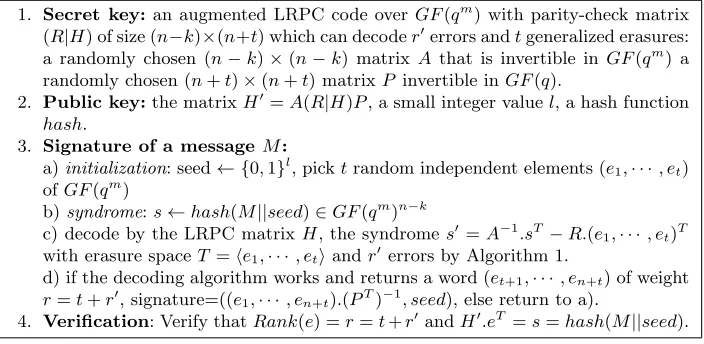
maximal rank) over GF(q). It can be done easily. Figure 2 describes the scheme, where || denotes concatenation.
1. Secret key:an augmented LRPC code over GF(qm) with parity-check matrix (R|H) of size (n−k)×(n+t) which can decoder0errors andtgeneralized erasures: a randomly chosen (n−k)×(n−k) matrix A that is invertible inGF(qm) a randomly chosen (n+t)×(n+t) matrixP invertible inGF(q).
2. Public key:the matrixH0=A(R|H)P, a small integer valuel, a hash function
hash.
3. Signature of a messageM:
a)initialization: seed← {0,1}l
, picktrandom independent elements (e1,· · ·, et) ofGF(qm)
b)syndrome:s←hash(M||seed)∈GF(qm)n−k
c) decode by the LRPC matrixH, the syndromes0 =A−1.sT−R.(e
1,· · ·, et)T with erasure spaceT=he1,· · ·, etiandr0 errors by Algorithm 1.
d) if the decoding algorithm works and returns a word (et+1,· · ·, en+t) of weight r=t+r0, signature=((e1,· · ·, en+t).(PT)−1, seed), else return to a).
4. Verification: Verify thatRank(e) =r=t+r0andH0.eT =s=hash(M||seed).
Fig. 2.TheRankSign+ signature algorithm
The cost of the decoding algorithm is quadratic because of preprocessing ofHf−1, hence the major cost comes from the linear algebra over the large fieldGF(qm).
Signature complexity:(n−k)×(n+t) operations inGF(qm). Verification complexity: (n− k)×(n+t) operations inGF(qm).
The lengthl of the seed can be taken as Log80
2(q) for instance. 4.2 Optimized parameters: cyclic-RankSign
In order to decrease the size of the public key it is possible to use a quasi-cyclic structure. Whenever all parametersn, k, tor/andlare divisible by a certain cyclicity orderσit is possible to consider that all matrices consist of small cyclic σ×σ random matrices. This particular type of structure divides the size of the public by a factorσ.
5 Security
5.1 A difficult problem
We now introduce a problem to which the security of our scheme can be reduced, we then discuss the difficulty of the problem.
Approximate Syndrome Decoding Problem for augmented LRPC codes (App-RSD-LRPC-Aug)
Given a masked parity-check matrixH0 =A(R|H)P of an augmented LRPC codes as defined in the previous section, and a random syndrome s, find a vector x of not too small rank d (typically of rank (GVR + Singleton)/2 ) such that H0.xt=s.
Assumption:The problem App-RSD-LRPC-Aug is difficult.
Discussion on the assumption:The family of augmented LRPC codes is not of course a family of random codes, but they are weakly structured codes: the main point being that they have a parity-check matrix one part of which consists only in low rank coordinates the other part consisting in random entries. The attacker never has direct access to the LRPC matrix H, which is hidden by the augmented part.
There are two different types of attacks on the problem: structural attacks in which the attacker tries to recover the structure of the code, or the attacker can try to forge directly a signature and try to find codewords of weight r =t+r0. We consider in the following these two approaches and explain why it is difficult to attack this problem.
Structural attacks on the public key: trying to recover the secret key
Previously known structural attacks The main structural attack for the rank metric is the Overbeck attack on the GPT cryptosystem, the attack consists in considering concatenated public matrices Gq, Gq2, ..., Gqn−k−, in that case the particular structure of Gabidulin codes enables one to find a concatenated matrix with a rank default; this is due to the particular structure of the Gabidulin codes and the fact that for Gabidulin codes Gqi is very close to Gqi+1. In the case of LRPC codes, since the rows are taken randomly in a small space, this attack makes no sense, and cannot be generalized.
Attack on the parity-check matrix H0: another approach consists in finding directly words of small weight induced by the structure of the code, from which one can hope to recover the global structure. For augmented LRPC codes, the rank of the minimum weight words isd+t: d for LRPC and t for the masking. This attack becomes very hard when t increases, even for lowt. For instance for t = 2 and d = 2 it gives a minimum weight of 4, which for most parameters n and kis already out of reach of the best known attacks on the rank syndrome decoding (see Section 2).
Attack on the isometry matrix P: The attacker can also try to guess the action of P on H, since d is usually small negating this action may permit to attack directly a code of rank d. Since d is small it is enough to guess the resulting action of P on n−k+ 3 columns by considering only the action of P coming from the first t columns of the matrix R - the only columns which may increase the rank-, it means guessing (n−k+ 3)×t elements of GF(q) (since coordinates of P are inGF(q), hence a complexity of q(n−k+3)t. In general this attack is not efficient, except in the case of quasi-cyclic matrices and small q, in which case the complexity becomes q(n−kσ+3)t, forσ the index of quasi-cyclicity.
Direct attack on the syndrome In that case one has to find a word of weight between the GVR bound and the Singleton bound, as discussed in Section 2 the best attack consists in computing the complexity of finding a word of given weight divided by the number of such words (the traditionnal approach for Hamming metric, which is also applicable here). Parameters are chosen in order to resist this attack.
5.2 Unforgeability
Theorem 2 below states the unforgeability of signatures. It essentially states that valid signa-tures leak no information on the secret key. More precisely, under the random oracle model, there exists a polynomial time algorithm that takes as input the public matrix H0 and, pro-duces couples (m, σ), where m is a message and σ a valid signature for m when one’s only access to the hashing oracle is through the simulator, and this with the same probability dis-tribution as those output by the authentic signature algorithm. Therefore whatever forgery can be achieved from the knowledge ofH0 and a list of valid signed messages, can be simulated and reproduced with the public matrixH0 as only input.
Theorem 2. : For any algorithmAthat leads to a forged signature using N ≤q/2authentic signatures, there is an algorithm A0 with the same complexity that leads to a forgery using only the public key as input and without any authentic signatures.
Proof. see Appendix B ut
Corollary 1. Let us take q > 2tsec, with tsec a security parameter polynomially equivalent to n. If a polynomial time forger succeeds in forging the signature with some probability, he can solve the difficult problem App-RSD-LRPC-Aug with the same complexity and the same probability.
Proof. Theorem 2 tells us that either the forger used N > q/2 signatures, or he did not use any. In the case when the forger did not use signatures, the problem of forging a new signature is exactly the same as the problem App-RSD-LRPC-Aug. In the other case, the forger used N > q/2 signatures and the forger could not run in polynomial time in the parameter n. ut
6 Practical security and parameters
6.1 Parameters
In the following we give some examples of parameters. The parameters are adjusted to resist all previously known attacks. The security reduction holds for up to q/2 signatures, hence if one considers q = 240 it means we are protected against leakage for up to 240 obtained authentic signatures. such an amount of signatures is very difficult to obtain in real life, moreover if one multiplies by the amount of time necessary to obtain a signature (about 230 for q = 240) we clearly see that obtaining such a number of authentic signatures is out of reach, and it justifies our security reduction.
We also give parameters for q lower than 240: in that case the reduction is weaker in the sense that it does not exclude a leaking attack for sufficiently many signatures. However, such a leaking attack seems difficult to obtain anyway, and these parameters can be seen as challenges for our system.
example the casen= 16 gives 270 quadratic equations for 126 unknowns, with a theoretical complexity of 2120 from [4]. For smallerq, the best attacks are combinatorial (Gaboritet al.). •RankSign+
In that case the matrixH0 is a (n−k)×(n+t) matrix.
n n-k m q t r’ r GVR Singleton public key (bits) sign. size (bits) security
16 8 18 2402 4 6 5 8 57600 8640 130
16 8 18 28 2 4 6 5 8 11520 1728 120
16 8 18 2162 4 6 5 8 23040 3456 120
32 16 39 2 5 8 13 10 16 13104 988 80
40 20 45 2 5 10 15 12 20 22500 1350 110
•Cyclic−RankSign+
In that case the matrix H0 is a (n−k)×(n+t) quasi-cyclic matrix, and all matrices A, P, R are formed with concatenation ofσ×σ cyclic blocks. We consider solely the caseσ = 2. The complexity may be a little smaller than in the previous case since in that case attacks that try to guess a part ofP are more efficient because of the cyclicity.
n n-k m q t r’ r σ Singleton public key (bits) sign. size (bits) security
16 8 18 2402 4 6 2 8 28300 8640 130
16 8 18 28 2 4 6 2 8 5760 1728 90
16 8 18 2162 4 6 2 8 11520 3456 120
6.2 Implementation
We implemented our scheme in a non optimized way, the results we obtained showed that for small q the scheme was very fast, when q increases, one has to consider the cost of multiplication in GF(q), however for q = 28 or q = 216 some optimized implementation may reduce this cost.
7 Conclusion
References
1. Thierry P. Berger, Pierre-Louis Cayrel, Philippe Gaborit, Ayoub Otmani: Reducing Key Length of the McEliece Cryptosystem. AFRICACRYPT 2009: 77-97
2. Thierry P. Berger, Pierre Loidreau: Designing an Efficient and Secure Public-Key Cryptosystem Based on Reducible Rank Codes. INDOCRYPT 2004: 218-229
3. Luk Bettale, Jean-Charles Faug`ere, Ludovic Perret: Hybrid approach for solving multivariate systems over finite fields. J. Mathematical Cryptology 3(3): 177-197 (2009)
4. http://www-polsys.lip6.fr/ bettale/hybrid
5. Florent Chabaud, Jacques Stern: The Cryptographic Security of the Syndrome Decoding Problem for Rank Distance Codes. ASIACRYPT 1996: 368-381
6. L´eo Ducas, Phong Q. Nguyen: Learning a Zonotope and More: Cryptanalysis of NTRUSign Counter-measures. ASIACRYPT 2012: 433-450
7. Courtois N., Finiasz M. and Sendrier N. : How to achieve a McEliece based digital signature scheme. Proc. of Asiacrypt 2001, Springer LNCS Vol. 2248, pp. 157–174 (2001)
8. J.-C. Faug`ere, F. Levy-dit-Vehel, L. Perret. Cryptanalysis of MinRank. InCRYPTO 2008, LNCS 5157, pages 280–296. Springer Verlag, 2008.
9. Jean-Charles Faug`ere, Mohab Safey El Din, Pierre-Jean Spaenlehauer: Computing loci of rank defects of linear matrices using Gr¨obner bases and applications to cryptology. ISSAC 2010: 257-264
10. Jean-Charles Faug`ere, Ayoub Otmani, Ludovic Perret, Jean-Pierre Tillich: Algebraic Cryptanalysis of McEliece Variants with Compact Keys. EUROCRYPT 2010: 279-298
11. Ernst M. Gabidulin, Theory of Codes with Maximum Rank Distance, Probl. Peredachi Inf, (21), pp. 3-16 (1985).
12. Ernst M. Gabidulin, A. V. Paramonov, O. V. Tretjakov: Ideals over a Non-Commutative Ring and thier Applications in Cryptology. EUROCRYPT 1991: 482-489
13. P. Gaborit and G. Murat and O. Ruatta and G. Z´emor, Low Rank Parity Check Codes and their application in cryptography. Published in Workshop Codes and Cryptography (WCC 2013), Bergen (available at http://www.selmer.uib.no/WCC2013/pdfs/Gaborit.pdf)
14. Philippe Gaborit, Julien Schrek, Gilles Z´emor: Full Cryptanalysis of the Chen Identification Protocol. PQCrypto 2011: 35-50
15. P. Gaborit, O. Ruatta and J. Schrek, On the complexity of the rank syndrome decoding problem, eprint,http://arxiv.org/abs/1301.1026
16. Craig Gentry, Chris Peikert, Vinod Vaikuntanathan: Trapdoors for hard lattices and new cryptographic constructions. STOC 2008: 197-206
17. Oded Goldreich, Shafi Goldwasser, Shai Halevi: Public-Key Cryptosystems from Lattice Reduction Problems. CRYPTO 1997: 112-131
18. Jeffrey Hoffstein, Jill Pipher, Joseph H. Silverman: NTRU: A Ring-Based Public Key Cryptosystem. ANTS 1998: 267-288
19. Jeffrey Hoffstein, Nick Howgrave-Graham, Jill Pipher, Joseph H. Silverman, William Whyte: NTRUSIGN: Digital Signatures Using the NTRU Lattice. CT-RSA 2003: 122-140
20. F. Levy-dit-Vehel and L. Perret, Algebraic decoding of rank metric codes, proceedings of YACC06. 21. P. Loidreau, Properties of codes in rank metric, http://arxiv.org/abs/cs/0610057
22. J. MacWilliams and N.J.A. Sloane, ”The theory of error correcting codes”, North Holland, Ninth im-pression (1977)
23. Daniele Micciancio, Oded Regev, Lattice-based Cryptography Book chapter in Post-quantum Cryptog-raphy, D. J. Bernstein and J. Buchmann (eds.), Springer (2008
24. Rafael Misoczki and Jean-Pierre Tillich and Nicolas Sendrier and Paulo S. L. M. Barreto, MDPC-McEliece: New McEliece Variants from Moderate Density Parity-Check Codes Cryptology ePrint Archive: Report 2012/409
25. Ourivski, A. V. and Johansson, T., New Technique for Decoding Codes in the Rank Metric and Its Cryptography Applications,Probl. Inf. Transm.(38), 237–246 (2002)
26. Phong Q. Nguyen, Oded Regev: Learning a Parallelepiped: Cryptanalysis of GGH and NTRU Signa-tures. EUROCRYPT 2006: 271-288
27. D. Silva, Kschishang, R. K¨otter, “Communication over Finite-Field Matrix Channels,” IEEE Trans. Inf. Theory, vol. 56, pp. 1296–1305, Mar. 2010.
A Typical dimensions for products of subspaces
We provide here a proof of Lemma 2 that we recall.
Lemma 2. Let A be a fixed subspace of Fmq of dimension α and let T be a subspace of dimension t (with possibly t= 0) such that dimhATi =αt. Let B be a subspace generated by T together withβ random independent uniform vectors, with β satisfyingα(t+β)≤m. Then
P(dimhABi< α(t+β))≤ q
α(t+β)
(q−1)qm.
Proof. Suppose first thatB =B0+hbiwhere bis a uniformly chosen random element of Fmq and whereB0⊃T is a fixed space such that dimhAB0i=α(t+β−1).LetAP be a projective version ofA, meaning that for everya6= 0 inA, we have exactly one element of the set
{λa, λ∈F∗q}
inAP.
We have dimhABi< α(t+β−1) +αif and only if the subspacebAhas a non-zero intersection withhAB0i, and also if and only if the set bAP has a non-zero intersection withhAB0i. Now,
P dimhAB0i ∩Ab6={0}≤
X
a∈AP, a6=0
P ab∈ hAB0i (8)
= |A| −1 q−1
qα(t+β−1)
qm (9)
= q
α(t+β)
(q−1)qm −
qα(t+β−1)
(q−1)qm. (10)
since for any fixeda6= 0, we have thatabis uniformly distributed inFmq , and since the number of elements inbAP equals (|A| −1)/(q−1).
Now write
B0=T ⊂B1=T +hb1i ⊂B2 =T +hb1, b2i ⊂ · · · ,⊂Bi=T+hb1, . . . , bii ⊂ · · · ⊂B =Bβ whereb1. . . , bβ are independent uniform vectors in Fmq . We have that the probability
P(dimhABi<dimAdimB)
thatAB is not full-rank is not more than β
X
i=1
P(dimhABii<dimAdimBi | dimhABi−1i= dimAdimBi−1)
so that (10) gives:
P(dimhABi<dimAdimB)≤ 1
q−1 β−1
X
i=0
1
qm−(t+i+1)α − 1 qm−(t+i)α
(11)
≤ 1
q−1
1 qm−α(t+β) −
1 qm−tα
≤ 1
B Proof of Theorem 2
Recall that a signature of a message M is a pair (x0, y0) where y0 is a hashed value of the message M and y0 = H0x0T and rank(x0) = r. If A is an algorithm that leads to a forgery with the use ofN authentic signatures, then the algorithmA0 consists of a simulated version
ofAwhere authentic signatures (x0, y0) are replaced by couples (x00, y00) wherex00is randomly and uniformly chosen among vectors of rank-weight e, and y00 =H0x00T is claimed to be the hashed value of the messageM output by a random oracle. In the random oracle model, the algorithmA0 must behave exactly as algorithmAand give the same output whenever (x00, y00) is statistically indistinguishable from (x0, y0).
We now compare the statistics of (x0, y0) and (x00, y00). We haveH0 =A(R|H)P and since the transformation:
(x0, y0)7→(xa=P x0, ya=A−1y0) (13) (x00, y00)7→(xs=P x00, ys =A−1y00) (14) is one-to-one, comparing the statistics of (x0, y0) and (x00, y00) amounts to comparing the dis-tributions of (xa, ya) (authentic) and (xs, ys) (simulated).
Now (xa, ya) is obtained in the following way: the signer chooses a subspaceT ofFqm together with a random vectorτ ∈Ttof rank tand is given a vectoruwhich is uniformly distributed in the syndrome space Fnqm−k and is equal to A−1h(M)−RτT. Precisely, the signer chooses a random vector τ of rank t, and sets T to be the subspace generated by its coordinates. The signer then proceeds to try to decodeu, meaning it looks for a subspace E of Fqm that containsT and such that all coordinates of ufall into hF Ei, whereF is the space generated by the elements of the LRPC matrixH. He succeeds exactly when the syndrome vector u is T-decodable in the sense of Definition 4: when this doesn’t occur, the decoder aborts.
When the syndromeu is T-decodable, the decoder proceeds to solve the equation
HxTH =u (15)
and then sets
xa = (τ, xH)
to create the couple (xa, ya= (R|H)(xa)T) in (13). Recall from Remark 1 in Section 3.2 that the matrixH has been chosen so that equation (15) (equivalently equation (1)) always has a unique solution for everyT-decodable u.
We may therefore speak aboutT-decodablecouples(xH, u), whereuuniquely determines xH and xH uniquely determines u. Now, to re-cap, the authentic signer starts with uniformely random u, and whenever u turns out to be non T-decodable, then we declare a decoding failure and start the whole process again generating anotherτ, another random spaceT and anotheruby another call to the random oracleh(meaning a counter appended to the message M is incremented before applying the random hash again). This keeps happening until we hit aT-decodableu. We see therefore that when it does hit aT-decodableu, the couple
(xH, u)
We now turn to the action of the simulator: what the simulator does is he tries to generate a uniformT-decodable couple (xH, u) through xH rather than throughu like the signer.
Specifically, the simulator starts with a random subspaceE of Fqm of dimension r and anx00 with coordinates independently and uniformly drawn from E. Since the transformation (14) x00 7→ xs =P x00 is rank-preserving, the simulator is implicitely creating a uniform vector xs ofEn. Write
xs= (τ, xH).
With overwhelming probability (at least 1−1/qr−t), the vectorτ ∈Et is of maximum rank-weight t, since its coordinates are independently and uniformly chosen in E. The vector τ generates the required random space T. Let u = HxTH: note that by construction, all its coordinates must be in hF Ei. Consider the conditions (i),(ii),(iii) of Definition 4 for u to be T-decodable.
Remember that the first two conditions (i) and (ii) are properties only of the subspace E. When they are not satisfied, no choice ofxH can yield a T-decodable couple (xH, u). When conditions (i) and (ii) are satisfied we have that, since the mapping (15)xH 7→uis invertible, the vectoruis a uniform random vector inhF Ein−k. Sincen−k+ dimhF Ti= dimhF Ei, the probability that condition (iii) is not satisfied is governed by the probability than a random vector falls into a given subspace of hF Ei of co-dimension 1 and is of the order of 1/q: it is also at most 1/(q−1) according to computation (6). We also see that the number of xH that satisfies condition (iii) is independent of the spaceE and is always the same for all E that satisfy conditions (i) and (ii). This last fact implies that when
– A random uniform subspaceE is chosen among all possible subspacesE of dimensionr,
– a random xH is chosen in En,
then either (xH, u) is notT-decodable, or (xH, u) isT-decodable and is uniformly distributed among allT-decodable couples.
The simulator has no oracle to tell him when he has produced a non T-decodable couple, he can only hope this doesn’t occur. As long as he produces T-decodable couples (xH, u), then they are distributed (uniformly) exactly as those that are produced by the authentic signer and are undistinguishable from them. If we callπ the probability that he produces a non-decodableu, then he can reasonably expect to produce a list of approximately N = 1/π signatures (x00, y00) that are undistiguishable from genuine signatures in the random oracle model.
C Other types of masking
Besides the augmented LRPC simple masking of Section 4, it is also possible to consider other types of masking, even if in that case there is no formal reduction, these masking have independent interest.
C.1 The RankSign× scheme: multiplied LRPC codes
Let H be a parity-check matrix of an LRPC coder, for l a small fixed integer, we consider nowM a random invertible n×n matrix of the form:
M = (M1|M2)
with M1 a random n×l matrix over GF(qm) and M2 a random n×(n−l) matrix in the
base fieldGF(q). Now consider the matrix
H00 =H.(M−1)t
. We denote bymultiplied LRPC codes, the codes with parity-check matrices of the formH00. The matrixH00 enables one to approximate a syndrome to a rankr+t+l rather thanr+t with uniquelyH. Hence the masking increases the rank of the small vector (remember that this rank has to be lower than the Singleton bound) but it considerably masks H. Indeed if M has a regular form, the inverse matrixM−1 is rather tricky and considerably masksH. In that case one takes as public key:H00=AH.((M P)−1)t, suppose that for a given syndrome swe want to solveH00.e0t=s, one proceeds as follows:
H00.e0t=s⇔H.(e0(P M)−1)T =A−1s=s0
Rewriting the right handside asH.et=s0, we can decodes0 ine=e0(P M)−1 withrank(e) = t+r, and hence
e0 =eM P
now sinceMhas the particular form previously described, the rank ofe0isrank(e)+l=t+r+l, the invertible matrixM does not change the weight.
Unlike the previous masking, this masking increases the obtained rank of the signature, and therefore makes the difference with the Singleton bound already big enough.
C.2 The RankSign+× scheme: augmented-multiplied LRPC codes
This last masking combines the two previous masking scheme, we consider codes with parity-check matrices of the form:
H0.(M−1)t
forH0 an augmented matrix andM a matrix defined for multiplied LRPC, we denote these codes byaugmented-multiplied LRPC codes. In theRankSign×one starts from an augmented matrix H0 as in RankSign+ rather than an LRPC parity-check matrix H. The decoding
C.3 Parameters for RankSign×
•RankSign×
In that case the matrixH00is a (n−k)×(n) matrix, and the rank of the signature isr+t+l.
n n-k m q t r r’ l Singleton public key sign. size security
40 20 39 2 3 10 13 2 19 15600 1185 100
•RankSign+×
In that case the matrix H000 is a (n−k)×(n+t0) matrix (with t’=t), and the rank of the signature isr+t+l.
n n-k m q t r r’ l Singleton public key sign. size security
40 20 39 2 3 10 13 2 18 17940 1185 90
•Cyclic−RankSign+×
In that case the matrixH000 is a (n−k)×(n+t) quasi-cyclic matrix, the rank of the signature isr+t+l, and all implied matrices (A, P, R, M) are formed with concatenation ofσ×σ cyclic blocks.
n n-k m q t r r’ l σ Singleton public key sign. size security