_____________________________________________________________________________________________________
www.sciencedomain.org
Sensitivity and Specificity CSF Heat Shock Protein
Levels in Differentiation of Bacterial Meningitis: A
Cross Sectional Study: Tehran, Iran
Mohammad Reza Shokrolahii
1, Samileh Noorbakhsh
2*, Khalil Shabanzadeh
2,
Anahita Eizadi
3, Aliakbar Rahbarimanesh
3and Azardokht Tabatabaei
21
Department of Pediatric Infectious Diseases, Qom University of Medical Sciences, Qom, Iran. 2
Research Center of Pediatric Infectious Diseases, Iran University of Medical Sciences, Tehran, Iran. 3
Bahrami Hospital, Tehran University of Medical Sciences, Tehran, Iran. Authors’ contributions
This work was carried out in collaboration between all authors. All authors read and approved the final manuscript.
Article Information
DOI: 10.9734/BJMMR/2016/22297 Editor(s): (1) Roberto Manfredi, Department of Medical and Surgical Sciences, University of Bologna, Bologna, Italy. Reviewers: (1) Rodrigo Crespo Mosca, Sao Paulo University, Brazil. (2)Ketan Vagholkar, D. Y. Patil University School of Medicine, India. Complete Peer review History:http://sciencedomain.org/review-history/12027
Received 27th September 2015 Accepted 13th October 2015 Published 30th October 2015
ABSTRACT
Background: Bacterial meningitis is a fatal disease with high mortality and morbidity that needs
emergency management.
Objective: Determination the sensitivity and specificity CSF Heat Shock Protein 70 levels in
differentiation of bacterial meningitis.
Methods: A cross sectional study had done upon 86 meningitis children (10.75±1.67 months)
admitted at 2 referral hospitals (Rasoul Akram & Bahrami) in Tehran. CSF samples were obtained from 104 patients with suspected meningitis and examined for the presence of invading pathogens, changes in CSF with blood cell counts and protein and/or glucose concentrations. Based on CSF parameters (CSF culture /or universal PCR), 27 patients; were diagnosed as having bacterial meningitis and 59 patients had aseptic meningitis. All CSF samples were assayed for HSP70 using quantitative ELISA. The HSP70 level in CSF was measured to analysis the results, Mann-Whitney test was used. A ROC curve was constructed to illustrate various cut-offs of CSF-HSP70 levels.
Results: Area under ROC curve was 0.948; CSF– HSP70 Cutoff level 0.39 pg/dl had 96%
sensitivity and 77% specifity; 89% PPV for differentiating the bacterial meningitis. CSF-HSP70 level in bacterial meningitis was significantly higher than viral meningitis (P=0.000). It was related to sex (P=0.05) of patients but not related to their ages.
Conclusion: CSF-HSP70 level has a high PPV (89%), good sensitivity (96%) and moderate
specifity (77%) in differentiation of bacterial meningitis. Adding the CSF-HSP70 level as a complementary test to other conventional CSF tests is so useful in diagnosis of bacterial meningitis especially in meningitis cases that received antibiotic treatment before admission or partially treated meningitis.
Keywords: HSP70; meningitis; bacterial meningitis; CSF.
1. INTRODUCTION
Bacterial meningitis is a fatal disease with high mortality and morbidity that needs emergency management [1-2]. An accurate and rapid diagnosis of acute bacterial meningitis is essential for earlier treatment and a good outcome [3-5]. The gold-standard test for diagnosis is CSF culture which are positive in 80% of cases [4-5]. Biomarkers are becoming increasingly important tools within all areas of medicine [5,6]. Recently some biologic markers has been used for diagnosis of serious bacterial infections like bacterial meningitis [7,8]. Various biological markers like CRP, procalcitonin, STREM-1, was useful for diagnosis and to differentiate between bacterial and aseptic meningitis [7,8]. Other biomarkers like Heat shock protein (HSP) in CSF as a complementary test, might be helpful to differentiate bacterial from aseptic meningitis [9-11].
Bacterial meningitis has become much less common in developed countries since the introduction of universal immunization against S. pneumonia and H. influenza type b beginning at 2 mo of age [2-4]. But bacterial meningitis continues to be a most important illness with high morbidity and mortality among unvaccinated children in Iran [12-14].Due to multiple problems (low technical; instrumenst and expert persons for culture) in some developing countries like Iran, there are not enough criteria for discarding the bacterial meningitis [13-14]. Recently, the biomarkers (CRP ,procalcitonin,STREM-1) level in CSF of Iranian children were able to differentiate bacterial from aseptic meningitis [15-17]. The negative tests were value for rule out the bacterial meningitis [13-14].Khosravi et al. [15] concluded that CSF-CRP can be used in rapid diagnosis of septic and aseptic meningitis in neonates.
Aim of this study was to evaluate the sensitivity and specificity of CSF HSP70 levels in
differentiation between bacterial and viral meningitis in children.
2. METHODS AND MATERIALS
A cross sectional study from October 2012 to April 2013 done in pediatric infectious ward of Rasul Akram Hospital in Tehran. This study was approved by the Ethical Committee in the Research Center of Pediatric Infectiuos Diseases affiliates by Tehran University of Medical Sciences. Consent letter obtained from patients.
CSF samples were obtained from 112 patients with suspected meningitis and examined for the presence of invading organisms, changes in CSF (white blood cell counts, and protein r glucose concentrations). Based on CSF parameters, 86 children with final diagnosis of meninigitis selected and further studies were done upon CSF samples.
Data collection: Initially, a check list was completed by an authorized physician for each cases (e.g. age, gender, analysis of all CSF samples, biochemical parameters, gram stain, LPA and CSF culture (in both convention and Bactec medium /or universal bacterial PCR), final diagnosis, HSP70 level in CSF(pg/dl).
Classification of disease in cases done by 2 pediatricians according to neurologic signs; imaging changes (CT scan /or MRI), and CSF changes [4]. Final diagnosis issued by two specialists blinded to the results of HSP70 determinations according to CSF changes [4].
2.1 Cases Definition
2.1.1 Inclusion criteria
2.1.2 Normal CSF
Normal Glucose, normal protein, WBC= or <5 and negative tests for bacteria.
Bacterial meningitis (Group A) defined as clinical signs of meningitis and positive CSF culture; positive blood cultures +/- CSF culture; or/positive universal bacterial PCR in CSF/ with or without LPA test / positive gram stain for bacteria in CSF.
Aseptic meningitiswere defined as Clinical signs of meningitis with known infectious etiologies e.g.: Viral meningitis; Measles, VZV, Mumps .with CSF changes: At least 10 white blood cells/mm with mononuclear cell predominance; the absence of bacterial growth on culture/or negative universal bacterial PCR in the CSF, negative Latex particle agglutination /negative gram stain for bacteria in CSF.
2.1.3 Exclusion criteria
All confirmed cases with other noninfectious etiologies: Brain Tumor, vascular disease, ADEM.
2.1.4 Lab tests
Initially, CSF samples were examined microscopically for biochemical and total WBC and differential. Gram stain was performed on all CSF samples. After centrifugation, deposits were cultured on sheep blood agar and incubated in a candle jar at 37°C for 48 h and followed and sub cultured as standard techniques [1,2]. The BACTEC Ped Plus medium (Becton Dickenson company) and automated system was used (Bio Merieux), isolates were identified using standard techniques [1]. Latex agglutination tests using the BD Directigen; Meningitis Combo Test (Becton Dickinson, Maryland, USA). An Universal PCR assay for the detection of N.
meningitides, H. influenza and S. pneumonia
used only on CSF samples suggestive of bacterial meningitis with negative other tests (Culture ,gram stain , LPA)[1].
0.5-3 ml of CSF was collected and stored at-.CSF –Hsp70 level determined by using the ELISA kits (STRESS XPRESS ,stressgen biotechnologies Canada) in 55 cases. Results were interpreted as suggested by the manufacturer.
2.2 Statistical Analysis
Quantitative variables were summarized as mean ± standard deviation (SD) and qualitative variables as count with percentage. Comparison between qualitative variable and test results was assessed by chi-square (or Fisher exact test if proper).Chi square values (CI 95%, p<0.05) were considered statistically significant. A ROC curve was constructed to illustrate various cut-offs of CSF- HSP 70 levels in differentiating the type of meningitis in case. Statistical calculation was performed with SPSS statistical software (version 13; SPSS).
3. Results
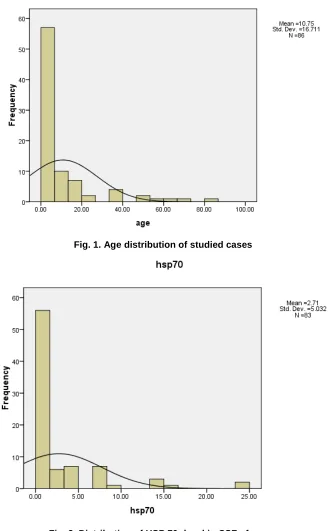
Eighty six cases children enrolled in this study.;59.3% were male and 40.7% female. The age range of the cases was 6-86 months; mean = 21.75±1.67 months (Fig. 1) 27/86 (35.7%) of cases had bacterial meningitis (mean age = 7.20±14.9 months); aseptic meningitis diagnosed in (68.6%; n=59) cases (mean age =12.37±17.35 months).
3.1 In Bacterial Meningitis Cases
8.1% of cases had positive gram stain for bacteria in CSF.
Positive CSF culture proved in 24.4% of cases positive universal bacterial PCR in CSF was 45%. Positive LPA test detected in 19.2% of cases.
Distribution of HSP 70 -level in CSF of all cases showed in Fig. 2. The CSF HSP 70 level had significant difference between bacterial and nonbacterial meningitis (mean = 7.45±6.65 vs 0.42±0.66; T test Sig. (2-tailed); p=0.000). Also significant difference observed between 2 sex (mean = 3.57±6.07 in male vs 1.40±2.31 in female; p=0.05).
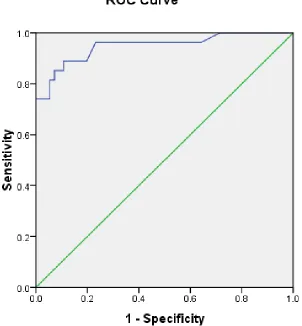
A ROC curve analysis showed an AUC (area under ROC curve) was 0.948 (95% CI; 0.894– 1003, P = 0.000);
CSF –Hsp70 Cutoff level 0.39 pg/dl had 96% sensitivity and 77% specifity.
4. DISCUSSION
In present study, very low amount of CSF – Hsp70 (Cutoff level 0.39 pg/dl) had good sensitivity (96%) and PPV (89%). This test was
c
excellent for proofing the bacterial meningitis. The high PPV (89%) is excellent for discriminating bacterial meningitis from other inflammatory disorders. But moderate specifity
(77%) is accepatable for diagnosis of bacterial meningitis if in this state with high suspicion, searching bacterial DNA s in serum or CSF added to conventional tests.
Fig. 1. Age distribution of studied cases
Fig. 3. Diagonal segments are produced by ties
Eisenhut reported the elevation of mediators of cellular stress response in bacterial meningitis [10].
Like here, Tang et al. studied whether cerebrospinal fluid (CSF) levels of high mobility group box 1 (HMGB1) or heat shock protein 72 (HSP 72) are elevated in patients with meningitis. From 104 children (13 with bacterial meningitis, 38 with aseptic meningitis, 7 with tuberculosis meningitis, and 46 without meningitis CSF levels of Heat shock protein were significantly elevated in patients with bacterial meningitis or tuberculosis meningitis and correlated well with CSF white blood cell counts in patients with bacterial meningitis or tuberculous meningitis [9]. Tzong-Shi et al. reported that Heat shock treatment protects osmotic stress–induced dysfunction of the blood-brain barrier through preservation of tight junction proteins [11].
Schultz et al. reported serum PCT and sTREM-1 level as the markers of infection in critically ill
patients. They concluded that combination of systemic PCT and local/or systemic sTREM-1 could be useful in distinguishing patients with infection from those with non-infectious illness [6].
Two studies for PCT in meningitis in Iran published 15,16. A serum PCT level (> 0.5 ng /ml) had high sensitivity and specificity (90.1% and 97.1% respectively) in the diagnosis of bacterial meningitis. (P Value =0.000) [15].
Khosravi et al. study determined the higher cerebrospinal fluid CRP level in newborns with septic meningitis [15].
RAHIMI et al. reported CSF- PCT level in bacterial meningitis was significantly (P value= 0.00) higher than viral meningitis according to the results of universal PCR for bacteria [16].
meningitis have a reliable sensitivity (85%) but a poor specificity (68%) for diagnosis. The High NPV (90%) for CSF-STREM level was excellent for ruling out the bacterial meningitis.It concluded that this test may be useful in situation where pre existing antibiotic treatment has caused “sterilization” of the CSF or in other confusing clinical settings.But the low PPV (60% ) was non sufficient for discriminating bacterial meningitis from other inflammatory disorders [17].
The strengths of this study .All CSF samples searched for the presence of bacterial infection (culture, LPA testing and PCR as final test).This is the first report for quantification and determining the cut off level for CSF Hsp70level in different types of meningeal infection.
High PPV (89%), good sensitivity (96%) and moderate specifity (77%) of HSP test, facilitate the accuracy of the initial diagnosis.In compare with other CSF biomarkers (PCT, STREM level),
CSF -HSP70 test is a better test for
discriminating bacterial meningitis from non bacterial meningitis. The CSF -HSP70 as a complementary test could be added to other conventional CSF tests especially in cases with negative culture and in whom were already on antibiotic treatment.
5. CONCLUSION
CSF -HSP70 level has a high PPV (89%), good
sensitivity(96%) and moderate specifity (77%) in differentiation of bacterial meningitis Adding the
CSF -HSP70 level as a complementary test to
other conventional CSF tests is so useful in diagnosis of bacterial meningitis. This test is important in meningitis cases that received antibiotic treatment before admission or partially treated meningitis.
Coordinates of the curve Test result variable (s):hsp70 Positive if greater
than or equal Toa
Sensitivity 1 – specificity
.3300 .963 .339 .3700 .963 .268 .3900 .963 .232 .4500 .889 .196 .5100 .889 .161 .5950 .889 .143 .6850 .889 .107 .7400 .852 .107 .7900 .852 .089
Area under the curve Test result variable(s):hsp70
Area Std.
Errora Asymptotic Sig.b Asymptotic 95% confidence interval Lower bound Upper bound
.948 .028 .000 .894 1.003
The test result variable(s): hsp70 has at least one tie between the positive actual state group and the negative actual state group. Statistics may be biased.
a. Under the nonparametric assumption b. Null hypothesis: True area =0.5
COMPETING INTERESTS
Authors have declared that no competing interests exist.
REFERENCES
1. Carbonnelle E. Laboratory diagnosis of bacterial meningitis: Usefulness of various tests for the determination of the etiological agent. Med Mal Infect. 2009;39(7-8): 581-605.
2. Shameem S, Vinod Kumar CS, Neelagund YF. Bacterial meningitis: Bacterial meningitis: Rapid diagnosis and microbial profile: a multicentered study. J Commun Dis. 2008;40(2):111-20.
3. Negrini B, Kelleher KJ, Wald ER. Pediatrics. Cerebrospinal fluid findings in aseptic versus bacterial meningitis 2000; 105(2):316-9.
4. Feigin RD, Cutrer WB. CSF findings in Supporative Diseases of the CNS and Meninges (Table 450), Text book of Pediatrics Infectious Diseases 2009;1:6th edition, Saunders.
5. Mary R, Veinberg F, Couderc R. Acute meningitidis, acute phase proteins and procalcitonin. Ann Biol Clin (Paris). 2003; 61(2):127-37.
6. Schultz MJ, Determann RM. PCT and sTREM-1: The markers of infection in critically ill patients? Med Sci Monit. 2008; 14(12):RA241-7.
8. Täuber MG, Kennedy S, Tureen JH, Lowenstein DH. Experimental pneumo-coccal meningitis causes central nervous system pathology without inducing the 72-kd heat shock protein. Am J Pathol. 1992; 141(1):53–60.
9. Daolin Tang, Rui Kang, Lizhi Cao, Guoyuan Zhang, Yan Yu, Weimin Xiao, et al. A pilot study to detect high mobility group box 1 and heat shock protein 72 in cerebrospinal fluid of pediatric patients with meningitis. Critical Care Medicine. 2008; 36(1):291-295.
10. Eisenhut Michael. Mediators of cellular stress response in bacterial meningitis Critical Care Medicine. 2008;36(1): 365-366.
11. Tzong-Shi Lu, Hsiang-Wen Chen, Maw-Hsiung Huang, Shu-Jung Wang, Rei-Cheng Yang. Heat shock treatment protects osmotic stress–induced dysfunction of the blood-brain barrier through preservation of tight junction proteins. Cell Stress Chaperones. 2004; 9(4):369–377.
12. Fahimzad AR, Mamaishi S, Noorbakhsh S, Siadati A, Hashemi FB, Tabatabaei SR, et al. Study of antibiotics resistance in pediatric acute bacterial meningitis with E-Test method. Iranian J of Ped. 16(2): 149-156.
13. Noorbakhs S, Siadati A, Rimaz SH, Mamaishi S, Ashtiani M, Erfanian, et al. Determination of appropriate antibiotics in bacterial meningitis of children based on MIC. Tehran Univ Med J. 63(1):68-72. 14. Barati M, Noorbakhsh S, Bageri Hoseini H,
Mortazavi H R. BACTEC medium: A useful method for detection of microorganisms in sterile body fluids. Tehran Univ Med J. 2008;66(5):315-320.
15. Khosravi N, Khalesi N, Noorbakhsh S, Javadinia SH, Asgarian R, A Tabatabai. The relationship between cerebrospinal fluid C-reactive protein and neonatal meningitis. Tehran University Medical Journal. 2014;71(11):723-728.
16. Rahimi H, Sedighi I, Kakhodaee A, Siadati A, Noorbakhsh S. Evaluation of sensitivity and spesificity of CSF procalcitonin levels in differentiation of bacterial and viral meningitis, in children older than two months. Tehran Univ Med J. 2005;63(3): 255-262.
17. Sobouti B, Noorbakhsh S, Shamshiri AR, Tabatabaei A. Diagnostic value for soluble triggering expressed on myeloid cells-1 level in cerebrospinal fluid of children. Canadian Journal on Medicine. 2011;2(3): 63-75.
________________________________________________________________________________
© 2016 Shokrolahii et al.; This is an Open Access article distributed under the terms of the Creative Commons Attribution License (http://creativecommons.org/licenses/by/4.0), which permits unrestricted use, distribution, and reproduction in any medium, provided the original work is properly cited.
Peer-review history: