Clinical Ophthalmology
Dove
press
O r i g i n a l r e s e a r C h
open access to scientific and medical research
Open access Full Text article
Finding the best glaucoma questionnaire: a
qualitative and quantitative evaluation of glaucoma
knowledge assessments
Jullia a rosdahl1
Kelly W Muir1,2
1Department of Ophthalmology, Duke University, Durham, nC, Usa; 2health services research and Development, Durham Veterans affairs Medical Center, Durham, nC, Usa
Objective: The goal of the study was to determine which glaucoma quiz provides the best information about patient glaucoma knowledge to clinicians in clinical practice settings.
Methods: Four glaucoma quizzes were identified from the literature and national eye education programs and were qualitatively analyzed to categorize questions by topic. Quizzes were assessed by 64 glaucoma specialists using an online survey, with descriptive statistics. Comments about the quizzes were analyzed qualitatively using themes and representative quotations.
Results: Quizzes covered content that was important for glaucoma diagnosis and management. The National Eye Health Education Program (NEHEP) and Prevent Blindness America quiz-zes covered primarily diagnosis, screening, and risk factors, and the quizquiz-zes from the literature primarily covered causes of glaucoma, vision loss, eye drops, and systemic disease. Overall, the NEHEP quiz was ranked best for clinical practice, ranked first by 38%. Ranked second overall, the Gray quiz was ranked first by 34% and last by 34%.
Conclusion: The NEHEP quiz was rated most useful for assessing baseline general glaucoma knowledge for a busy clinical practice. The Gray quiz appears to be more useful as part of a comprehensive education program, perhaps in combination with an ophthalmic educator.
Keywords: patient education, quiz, clinical practice
Introduction
Education is a key for both the diagnosis and management of glaucoma, as patients need to understand that they have the disease to participate in their treatment. Public awareness campaigns can educate people about the importance of early diagnosis and early treat-ment to potentially prevent blindness from glaucoma.1 Once glaucoma is diagnosed, it is
commonly treated with daily eye drop medications, often for decades in asymptomatic patients.2 Patient education is critical for adherence to glaucoma treatment plans,3 but for
many patients there are significant gaps in the understanding of the disease, particularly with regard to medication side effects, symptoms, and progression to blindness.4 The belief
that the disease is “not serious enough” is associated with poor adherence to follow-up care.5 However, assessing glaucoma knowledge and providing the most appropriate
education in the limited time available in a clinical encounter is difficult.6
Educational interventions do appear to improve eye drop medication adherence, but assessing glaucoma knowledge is not routine.7 Multiple glaucoma quizzes have been
developed for glaucoma patients, to assess glaucoma knowledge, both in the setting of research instruments and for community use. No study has compared these quizzes to see which one of these serves best to gather “glaucoma knowledge” information from glaucoma patients in clinical practice.
Correspondence: Jullia a rosdahl Department of Ophthalmology, Duke University, 2351 erwin road, DUMC 3802, Durham, nC 27710, Usa Tel +1 919 684 8850
Fax +1 919 681 8267 email [email protected]
Journal name: Clinical Ophthalmology Article Designation: Original Research Year: 2015
Volume: 9
Running head verso: Rosdahl and Muir
Running head recto: Glaucoma quizzes for clinical practice DOI: http://dx.doi.org/10.2147/OPTH.S90332
Clinical Ophthalmology downloaded from https://www.dovepress.com/ by 118.70.13.36 on 21-Aug-2020
For personal use only.
Number of times this article has been viewed
This article was published in the following Dove Press journal: Clinical Ophthalmology
Dovepress
rosdahl and Muir
The purpose of this study was to qualitatively compare four candidate quizzes and to assess which would be most useful to the clinician in a clinical practice setting taking care of glaucoma patients. The overarching goal of this research program is to improve patient education materials, and this study is the first step to determine which knowledge quizzes do practicing clinicians prefer. Subsequently, the quizzes that are preferred by clinicians will be tested in glaucoma patients, to get patient feedback, and for validation in glaucoma patients. Ultimately, a quiz that has been vetted by doctors and patients will be used to assess the effect of educational interventions on glaucoma knowledge. The first step in this process is presented here, addressing the question of which quiz providers like the best.
Methods
Identification and qualitative evaluation of
glaucoma knowledge quizzes
Glaucoma knowledge assessments used in research studies were identified from the glaucoma literature and were cho-sen for further investigation based on the following criteria: development using both patient and expert opinion and feedback, use in glaucoma patient populations, and having general glaucoma knowledge content. The glaucoma knowl-edge assessment from Gray et al8 is a short-answer format
assessment and contains eleven questions. The glaucoma knowledge assessment from Hoevenaars et al9 is a true–
false format assessment, and 19 statements about glaucoma were evaluated in this study. Glaucoma quizzes developed by the National Eye Health Education Program ([NEHEP], ten true–false questions) and Prevent Blindness America ([PBA], nine true–false questions), which are available online and are used for public health awareness, were included in the review. All questions from each quiz were categorized based on the topic addressed by the question, to compare the content of each quiz.
survey of glaucoma specialists
A survey of glaucoma specialists was performed to determine which of the four glaucoma quizzes would be most useful in clinical practice. The study protocol was reviewed by the Duke Institutional Review Board and determined to be exempt. An anonymous online survey (Supplementary mate-rials) using Qualtrics (Qualtrics, Provo, UT, USA) was sent to the membership of the American Glaucoma Society (AGS), after review by and permission from the AGS Research Committee, using the AGS listserve. The survey included the four glaucoma quizzes (presented in random order), as
well as questions to rate and rank the quizzes regarding their utility in clinical practice. Five-item scales were used to rate each quiz based on the following: how well the quiz covered information needed by glaucoma patients, how easy it was to understand the language of the quiz, and how willing glau-coma patients would be to complete the quiz. After reviewing and rating each quiz, the respondent ranked the four quizzes. Demographic information was also collected such as age, sex, percent of practice caring for glaucoma, and length of time since glaucoma fellowship training. The survey was active for 2 weeks in August 2014, taken offline after tapering of the response rate, with a total of 84 responses. A total of 64 respondents completed the question ranking all four quizzes. The actual sample size of 64 gives a confidence interval of 12, at the 95% confidence level.
Data analysis of survey responses
Descriptive statistics were used for the survey data. Re -sponses are presented as percentages and means with standard deviations. The provider comments from the survey were analyzed qualitatively, grouping by themes (using word) with representative quotations.
Results
Qualitative assessment of the quizzes and
questions
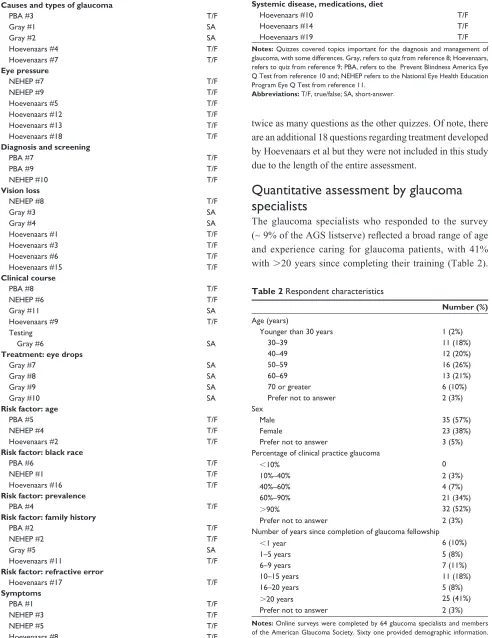
The glaucoma quizzes covered content that is important for the diagnosis and management of glaucoma, with some dif-ferences between the quizzes (Table 1). The Eye Q Test from PBA has questions covering: causes and types of glaucoma, diagnosis and screening, clinical course, risk factors, and symptoms; however, eye pressure and treatment, as well as vision loss, are not covered. The Eye Q Test from NEHEP has questions covering the following: eye pressure, diagnosis and screening, vision loss, clinical course, risk factors, and symp-toms, but causes and types of glaucoma and treatments are not covered. The assessment from Gray et al has questions cover-ing the followcover-ing: causes and types of glaucoma, vision loss, clinical course, treatment, and family history as a risk factor, but eye pressure, diagnosis and screening, and symptoms are not covered. Also, there is only one risk factor question in this quiz, compared to three to four risk factor questions in each of the other questionnaires. The assessment from Hoevenaars et al has questions covering the following: causes and types of glaucoma, eye pressure, vision loss, clinical course, and risk factors, but diagnosis and screening and treatment are not covered. This is the only quiz that includes questions about systemic disease, other medications, and diet, and it has about
Clinical Ophthalmology downloaded from https://www.dovepress.com/ by 118.70.13.36 on 21-Aug-2020
Dovepress glaucoma quizzes for clinical practice
Quiz question Format
Causes and types of glaucoma
PBa #3 gray #1 gray #2 hoevenaars #4 hoevenaars #7 T/F sa sa T/F T/F Eye pressure neheP #7 neheP #9 hoevenaars #5 hoevenaars #12 hoevenaars #13 hoevenaars #18 T/F T/F T/F T/F T/F T/F
Diagnosis and screening
PBa #7 PBa #9 neheP #10 T/F T/F T/F Vision loss neheP #8 gray #3 gray #4 hoevenaars #1 hoevenaars #3 hoevenaars #6 hoevenaars #15 T/F sa sa T/F T/F T/F T/F Clinical course PBa #8 neheP #6 gray #11 hoevenaars #9 Testing gray #6 T/F T/F sa T/F sa
Treatment: eye drops
gray #7 gray #8 gray #9 gray #10 sa sa sa sa
Risk factor: age
PBa #5 neheP #4 hoevenaars #2 T/F T/F T/F
Risk factor: black race
PBa #6 neheP #1 hoevenaars #16 T/F T/F T/F
Risk factor: prevalence
PBa #4 T/F
Risk factor: family history
PBa #2 neheP #2 gray #5 hoevenaars #11 T/F T/F sa T/F
Risk factor: refractive error
hoevenaars #17 T/F
Symptoms PBa #1 neheP #3 neheP #5 hoevenaars #8 T/F T/F T/F T/F (Continued)
Quiz question Format
Systemic disease, medications, diet
hoevenaars #10 hoevenaars #14 hoevenaars #19 T/F T/F T/F
Notes: Quizzes covered topics important for the diagnosis and management of glaucoma, with some differences. gray, refers to quiz from reference 8; hoevenaars, refers to quiz from reference 9; PBa, refers to the Prevent Blindness america eye Q Test from reference 10 and; neheP refers to the national eye health education Program eye Q Test from reference 11.
Abbreviations: T/F, true/false; sa, short-answer.
Table 1 Categorization of four glaucoma quiz questions, by topic Table 1 (Continued)
twice as many questions as the other quizzes. Of note, there are an additional 18 questions regarding treatment developed by Hoevenaars et al but they were not included in this study due to the length of the entire assessment.
Quantitative assessment by glaucoma
specialists
The glaucoma specialists who responded to the survey (~ 9% of the AGS listserve) reflected a broad range of age and experience caring for glaucoma patients, with 41% with .20 years since completing their training (Table 2).
Table 2 respondent characteristics
Number (%)
age (years)
Younger than 30 years 1 (2%)
30–39 11 (18%)
40–49 12 (20%)
50–59 16 (26%)
60–69 13 (21%)
70 or greater 6 (10%)
Prefer not to answer 2 (3%)
sex
Male 35 (57%)
Female 23 (38%)
Prefer not to answer 3 (5%)
Percentage of clinical practice glaucoma
,10% 0
10%–40% 2 (3%)
40%–60% 4 (7%)
60%–90% 21 (34%)
.90% 32 (52%)
Prefer not to answer 2 (3%)
number of years since completion of glaucoma fellowship
,1 year 6 (10%)
1–5 years 5 (8%)
6–9 years 7 (11%)
10–15 years 11 (18%)
16–20 years 5 (8%)
.20 years 25 (41%)
Prefer not to answer 2 (3%)
Notes: Online surveys were completed by 64 glaucoma specialists and members of the american glaucoma society. sixty one provided demographic information. Most respondents, aged 40–70 years old, were male and had a clinical practice of at least 60% glaucoma.
Clinical Ophthalmology downloaded from https://www.dovepress.com/ by 118.70.13.36 on 21-Aug-2020
Dovepress
rosdahl and Muir
Most of the respondents spent more than half of their time caring for glaucoma, and over half of the specialists have a practice that is .90% glaucoma. Most of the specialists were not familiar with the quizzes in the survey prior to this study (Table S1).
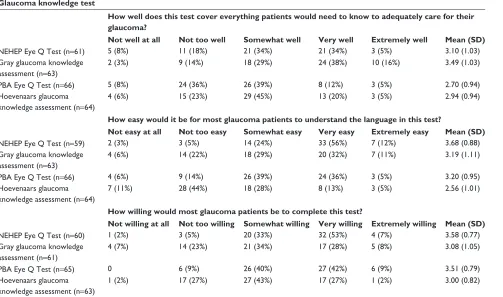
Glaucoma specialists reviewed each of the quizzes and rated each with respect to content, language, and willingness of patients to complete the quiz (Table 3). They rated the quizzes from Gray et al and NEHEP highest for how well the quiz covered everything patients would need to know to adequately care for their glaucoma. The NEHEP quiz was also rated highest for how easy it would be for most glaucoma patients to understand the language. The NEHEP and PBA quizzes were rated highest for how willing most glaucoma patients would be to complete them.
Overall, the NEHEP quiz was ranked #1 by 38% of respondents, and the Gray et al assessment was ranked #1 by 34% (Table 4). Interestingly, the Gray et al assessment was ranked #4 or last by an equal number of respondents, 34%, suggesting a broad range of opinion regarding this particular test.
Qualitative comments from glaucoma
specialists
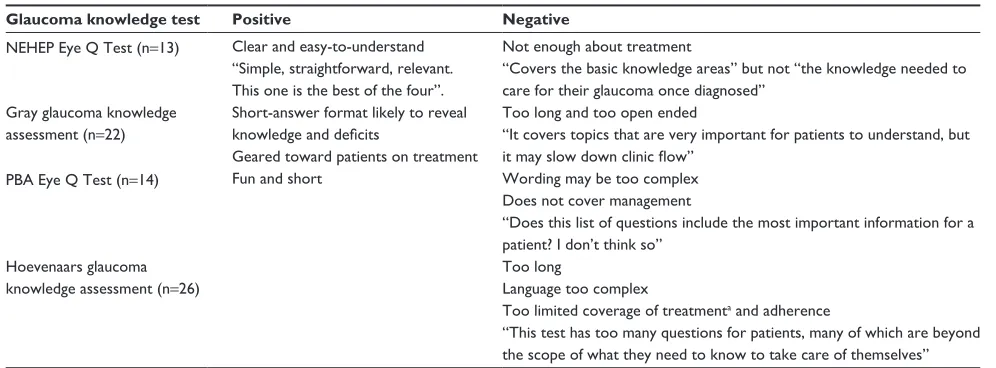
The respondents noted that both the true–false format of the NEHEP and PBA Eye Q Tests was fun, and that shorter was overall better (Table 5). They noted that the short-answer format of the assessment from Gray et al might reveal more about a patient’s knowledge and gaps in their understanding, but that this quiz would take too much time. The assessment from Hoevenaars et al was too long and the language too complex for clinical practice.
Discussion
The purpose of this study was to identify a glaucoma quiz that would be most useful in clinical practice, using expert provider opinion. Glaucoma specialists with significant clini-cal experience caring for glaucoma patients ranked the Eye Q Test from NEHEP as most useful, due to it being clear, easy-to-understand, and covering “the basics”, although a deficiency of this quiz is that the knowledge about glau-coma treatment is not covered. The short-answer format assessment from Gray et al garnered both strong positive
Table 3 respondent ratings of glaucoma knowledge quizzes
Glaucoma knowledge test
How well does this test cover everything patients would need to know to adequately care for their glaucoma?
Not well at all Not too well Somewhat well Very well Extremely well Mean (SD)
neheP eye Q Test (n=61) 5 (8%) 11 (18%) 21 (34%) 21 (34%) 3 (5%) 3.10 (1.03)
gray glaucoma knowledge assessment (n=63)
2 (3%) 9 (14%) 18 (29%) 24 (38%) 10 (16%) 3.49 (1.03)
PBa eye Q Test (n=66) 5 (8%) 24 (36%) 26 (39%) 8 (12%) 3 (5%) 2.70 (0.94)
hoevenaars glaucoma knowledge assessment (n=64)
4 (6%) 15 (23%) 29 (45%) 13 (20%) 3 (5%) 2.94 (0.94)
How easy would it be for most glaucoma patients to understand the language in this test?
Not easy at all Not too easy Somewhat easy Very easy Extremely easy Mean (SD)
neheP eye Q Test (n=59) 2 (3%) 3 (5%) 14 (24%) 33 (56%) 7 (12%) 3.68 (0.88)
gray glaucoma knowledge assessment (n=63)
4 (6%) 14 (22%) 18 (29%) 20 (32%) 7 (11%) 3.19 (1.11)
PBa eye Q Test (n=66) 4 (6%) 9 (14%) 26 (39%) 24 (36%) 3 (5%) 3.20 (0.95)
hoevenaars glaucoma knowledge assessment (n=64)
7 (11%) 28 (44%) 18 (28%) 8 (13%) 3 (5%) 2.56 (1.01)
How willing would most glaucoma patients be to complete this test?
Not willing at all Not too willing Somewhat willing Very willing Extremely willing Mean (SD)
neheP eye Q Test (n=60) 1 (2%) 3 (5%) 20 (33%) 32 (53%) 4 (7%) 3.58 (0.77)
gray glaucoma knowledge assessment (n=61)
4 (7%) 14 (23%) 21 (34%) 17 (28%) 5 (8%) 3.08 (1.05)
PBa eye Q Test (n=65) 0 6 (9%) 26 (40%) 27 (42%) 6 (9%) 3.51 (0.79)
hoevenaars glaucoma knowledge assessment (n=63)
1 (2%) 17 (27%) 27 (43%) 17 (27%) 1 (2%) 3.00 (0.82)
Notes: The respondents rated each glaucoma knowledge quiz with regard to content, language, and their perception of how willing patients would be to complete the quiz. gray, refers to quiz from reference 8; hoevenaars, refers to quiz from reference 9; PBa, refers to the Prevent Blindness america eye Q Test from reference 10 and; neheP refers to the national eye health education Program eye Q Test from reference 11. The gray quiz had the highest mean score on how well the quiz covered information needed by glaucoma patients. response totals with percentages are given, as well as the mean and standard deviation. The neheP quiz had the highest mean scores for clarity of language and for willingness of patients to complete the quiz.
Abbreviation: sD, standard deviation.
Clinical Ophthalmology downloaded from https://www.dovepress.com/ by 118.70.13.36 on 21-Aug-2020
Dovepress glaucoma quizzes for clinical practice
Table 4 Overall ranking
Glaucoma knowledge test Mean rank (SD) (1 is best) Number ranked as #1 (best) (%) Number ranked as #4 (last) (%)
neheP eye Q Test 1.94 (0.89) 24 (37.5%) 3 (4.7%)
gray glaucoma knowledge assessment
2.55 (1.28) 22 (34.4%) 22 (34.4%)
PBa eye Q Test 2.70 (0.94) 7 (10.9%) 14 (21.9%)
hoevenaars glaucoma knowledge assessment
2.81 (1.14) 11 (17.2%) 25 (39.1%)
Notes: gray, refers to quiz from reference 8; hoevenaars, refers to quiz from reference 9; PBa, refers to the Prevent Blindness america eye Q Test from reference 10 and; neheP refers to the national eye health education Program eye Q Test from reference 11. The respondents ranked the four quizzes based on how well the quiz would assess glaucoma knowledge in clinical practice. Overall, the NEHEP quiz was ranked best. Interestingly, the Gray quiz was ranked first and last by approximately a third of the respondents, suggesting a dichotomous reaction to this quiz.
Abbreviation: sD, standard deviations.
and negative opinion, with a third of respondents ranking it first and another third ranking it last. The comments from the respondents as well as the ratings of content, ease, and willingness to complete suggest the following explanation: this assessment covers important content and the open-ended short-answer format is better in identifying gaps in knowledge, however, those same attributes may make this test less appealing to patients and more time consuming in a busy clinical setting.
This spectrum of opinion may also reflect the spectrum of glaucoma patients and their individual educational needs. The NEHEP Eye Q Test was developed as a public health tool and may be best at assessing knowledge in patients with early glaucoma, glaucoma suspect, or risk factors for glaucoma. The assessment from Gray et al, which was developed for patients with glaucoma, is best for patients who know that they have glaucoma and are undergoing treatment. Importantly, based on the provider feedback in our study, this assessment would best be incorporated into
a clinical practice as part of a more comprehensive educa-tion program, perhaps in combinaeduca-tion with an experienced ophthalmic technician or a trained ophthalmic nurse educator.
The limitations of this study include the small sample size, with a response rate of ~9% of the number of indi-viduals on the AGS listserve. The reasons may include the following: an incentive was not offered; the survey was distributed in August when some providers may not have been available; and multiple reminders were not sent, due to the use of the AGS listserve, which is not a research instrument. Also, the survey design did not allow respon-dents to go back and review the quizzes again when ranking them, which contributed to some dissatisfaction with the survey experience and may have contributed to only 64 respondents completing the ranking question, of the 84 total respondents who completed the survey. Importantly, this study did not include evaluation and feedback from glaucoma patients.
Table 5 summary of qualitative comments from respondents
Glaucoma knowledge test Positive Negative
neheP eye Q Test (n=13) Clear and easy-to-understand “simple, straightforward, relevant. This one is the best of the four”.
not enough about treatment
“Covers the basic knowledge areas” but not “the knowledge needed to care for their glaucoma once diagnosed”
gray glaucoma knowledge assessment (n=22)
short-answer format likely to reveal knowledge and deficits
geared toward patients on treatment
Too long and too open ended
“it covers topics that are very important for patients to understand, but it may slow down clinic flow”
PBa eye Q Test (n=14) Fun and short Wording may be too complex Does not cover management
“Does this list of questions include the most important information for a patient? i don’t think so”
hoevenaars glaucoma knowledge assessment (n=26)
Too long
language too complex
Too limited coverage of treatmenta and adherence
“This test has too many questions for patients, many of which are beyond the scope of what they need to know to take care of themselves”
Notes: The survey included a section for comments on each quiz. gray, refers to quiz from reference 8; hoevenaars, refers to quiz from reference 9; PBa, refers to the Prevent Blindness america eye Q Test from reference 10 and; neheP refers to the national eye health education Program eye Q Test from reference 11. The comments were grouped by theme and are summarized in the table, with representative quotations. aThe quiz developed by hoevenaars et al includes 18 additional questions regarding
treatment, which were not included in this study due to length.
Clinical Ophthalmology downloaded from https://www.dovepress.com/ by 118.70.13.36 on 21-Aug-2020
Dovepress
rosdahl and Muir
This study describes the first step toward a meaningful assessment of glaucoma knowledge in patients, to be used to evaluate patient education interventions, and their effects on glaucoma knowledge. The next step is to evaluate the quizzes preferred by their doctors in glaucoma patients.
Conclusion
The true–false quiz from NEHEP appears to be most useful for assessing baseline general glaucoma knowledge in the setting of a busy clinical practice, and the short-answer quiz from Gray appears to be more useful as part of a compre-hensive education program, perhaps in combination with an ophthalmic educator.
Acknowledgments
The authors acknowledge the American Glaucoma Society and the members who completed the survey. This work was funded by an NEI K12 award to JAR. KM receives salary support from a VA HSR&D career development award.
Disclosure
The authors declare that they have no conflicts of inter-est related to this work. JAR serves on the glaucoma subcommittee of the National Eye Health Program (no involvement in the development of the NEHEP quiz).
References
1. Chen PP. Risk and risk factors for blindness from glaucoma. Curr Opin
Ophthalmol. 2004;15(2):107–111.
2. Vass C, Hirn C, Sycha T, Findl O, Bauer P, Schmetterer L. Medical interventions for primary open angle glaucoma and ocular hypertension.
Cochrane Database Syst Rev. 2007;(4):CD003167.
3. Waterman H, Evans JR, Gray TA, Henson D, Harper R. Interventions for improving adherence to ocular hypotensive therapy. Cochrane
Database Syst Rev. 2013;4:CD006132.
4. Danesh-Meyer HV, Deva NC, Slight C, et al. What do people with glaucoma know about their condition? A comparative cross-sectional incidence and prevalence survey. Clin Experiment Ophthalmol. 2008; 36(1):13–18.
5. Kosoko O, Quigley HA, Vitale S, Enger C, Kerrigan L, Tielsch JM. Risk factors for noncompliance with glaucoma follow-up visits in a residents’ eye clinic. Ophthalmology. 1998;105(11):2105–2111. 6. Lim MC, Watnik MR, Imson KR, Porter SM, Granier AM. Adherence
to glaucoma medication: the effect of interventions and association with personality type. J Glaucoma. 2013;22(6):439–446.
7. Newman-Casey PA, Weizer JS, Heisler M, Lee PP, Stein JD. Systematic review of educational interventions to improve glaucoma medication adherence. Semin Ophthalmol. 2013;28(3):191–201.
8. Gray TA, Fenerty C, Harper R, et al. Preliminary survey of educational support for patients prescribed ocular hypotensive therapy. Eye (Lond). 2010;24(12):1777–1786.
9. Hoevenaars JG, Schouten JS, van den Borne B, Beckers HJ, Webers CA. Knowledge base and preferred methods of obtaining knowledge of glaucoma patients. Eur J Ophthalmol. 2005;15(1):32–40.
10. PBA (Prevent Blindness America) http://www.preventblindness. org/sites/default/files/national/documents/fact_sheets/MK19_ GlaucEyeQ_0.pdf. Accessed on September 2, 2015.
11. NEHEP (National Eye Health Education Program) https://nei.nih.gov/ sites/default/files/nehep-pdfs/EyeQTest_for_Toolkit.pdf. Accessed on September 2, 2015.
Clinical Ophthalmology downloaded from https://www.dovepress.com/ by 118.70.13.36 on 21-Aug-2020
Dovepress glaucoma quizzes for clinical practice
Supplementary materials
survey message and content
email message content
request for your help with a glaucoma patient education project
I am writing to request your participation in this study regard-ing patient glaucoma knowledge. The purpose of this study is to compare four publicly available “glaucoma knowledge tests” for glaucoma patients, to see which would be best for clinical practice. Glaucoma specialists are best positioned to evaluate what glaucoma patients need to know about glau-coma and what testing they would be willing to do.
This survey should take you approximately 5–10 minutes to complete. After following the attached link, you will be directed to the anonymous online survey. You will be shown each of the four patient’s “glaucoma knowledge tests” (in random order) and asked to rate each quiz by answering several questions. After reviewing and rating all four quizzes, you will be asked to rank them, from most useful in clinical practice to least.
I hope that you will be able to take the time to complete this short survey to give your valuable input. The major benefit of participation in this survey is the identification of a clini-cally useful knowledge assessment for glaucoma patients. We hope that this study will facilitate the further development of patient-centered education for glaucoma patients. Individual responses will not be linked to a specific person. The use of the American Glaucoma Society membership will be acknowl-edged in any publications that arise from this project.
Completion of the survey indicates implied consent to participate. Your participation is voluntary. If you wish to decline, simply do not fill in the survey. Please contact me at [email protected] or the Duke IRB at (919) 668–5111 with any questions or concerns.
Many thanks for your time and interest in glaucoma patient education,
Jullia
Jullia Rosdahl MD PhD Duke Eye Center [email protected]
survey content
Please review and rate each of the four “glaucoma
knowl-edge tests”. After you have reviewed and rated each one, please rank them based on which you think would be best
for clinical practice.
The four glaucoma knowledge tests will be presented in random order:
– National Eye Health Education Program (NEHEP) Eye Q Test
– Prevent Blindness America (PBA) Eye Q Test
– Gray Glaucoma knowledge assessment, Gray et al. Eye. (2010);24:1777–1789.
– Hoevenaars Glaucoma knowledge assessment, Hoevenaars et al. Euro J Ophthal. (2005);15:32–40. Please review the following glaucoma knowledge test. Please rate the glaucoma knowledge test in the following areas:
How well does this test cover everything patients would need to know to adequately care for their glaucoma?
– Not well at all – Not too well – Somewhat well – Very well – Extremely well
How easy would it be for most glaucoma patients to under-stand the language in this test?
– Not easy at all – Not too easy – Somewhat easy – Very easy – Extremely easy
How willing would most glaucoma patients be to complete this test?
– Not willing at all – Not too willing – Somewhat willing – Very willing – Extremely willing
Please use this space to share any comments or concerns about this test.
Please rank all four of the “glaucoma knowledge tests” that
you have just reviewed and rated, such that a 1 represents the best test for assessing glaucoma knowledge in clinical practice, and a 4 represents the worst test.
_ NEHEP Eye Q Test (ten questions, True/false) _ PBA Eye Q Test (nine questions, True/false)
_ Gray Glaucoma knowledge assessment, Gray et al (eleven questions, short answer)
_ Hoevenaars Glaucoma knowledge assessment, Hoev-enaars et al (19 questions, True/false)
Demographic questions
How old are you? Younger than 30, 30–39, 40–49, 50–59, 60–69, 70 or greater, prefer not to answer
What is your sex? male, female, prefer not to answer What percentage of your clinical practice is glaucoma? Less than 10%, 10%–40%, 40%–60%, 60%–90%, greater than 90%, prefer not to answer
Clinical Ophthalmology downloaded from https://www.dovepress.com/ by 118.70.13.36 on 21-Aug-2020
Clinical Ophthalmology
Publish your work in this journal
Submit your manuscript here: http://www.dovepress.com/clinical-ophthalmology-journal
Clinical Ophthalmology is an international, peer-reviewed journal covering all subspecialties within ophthalmology. Key topics include: Optometry; Visual science; Pharmacology and drug therapy in eye diseases; Basic Sciences; Primary and Secondary eye care; Patient Safety and Quality of Care Improvements. This journal is indexed on
PubMed Central and CAS, and is the official journal of The Society of Clinical Ophthalmology (SCO). The manuscript management system is completely online and includes a very quick and fair peer-review system, which is all easy to use. Visit http://www.dovepress.com/ testimonials.php to read real quotes from published authors.
Dovepress
Dove
press
rosdahl and Muir
How many years since you completed your glaucoma fellowship? .1 year, 1–5 years, 6–9 years, 10–15 years, 16–20 years, ,20 years, prefer not to answer
How familiar are you with the glaucoma knowledge quizzes in this survey?
a. NEHEP Eye Q Test
○ Extremely familiar
○ Fairly familiar
○ Somewhat familiar
○ Not at all b. PBA Eye Q Test
○ Extremely familiar
○ Fairly familiar
○ Somewhat familiar
○ Not at all
Table S1 Familiarity with the glaucoma knowledge quizzes
Glaucoma knowledge test How familiar are you with the glaucoma knowledge quizzes in this survey?
Extremely familiar Fairly familiar Somewhat familiar Not at all Mean (SD)
neheP eye Q Test (n=61) 6 (10%) 5 (8%) 15 (25%) 35 (57%) 3.30 (0.99)
gray glaucoma knowledge assessment (n=60)
3 (5%) 2 (3%) 8 (13%) 47 (78%) 3.65 (0.78)
PBa eye Q Test (n=61) 3 (5%) 6 (10%) 9 (15%) 43 (70%) 3.51 (0.87)
hoevenaars glaucoma knowledge assessment (n=60)
2 (3%) 0 8 (13%) 50 (83%) 3.77 (0.62)
Notes: The respondents rated their familiarity with each glaucoma knowledge quizzes prior to the study. Most of the glaucoma specialists who responded were unfamiliar with most or all of the quizzes.
Abbreviations: sD, standard deviation; PBa, Prevent Blindness america; neheP, national eye health education Program.
c. Gray Glaucoma knowledge assessment
○ Extremely familiar
○ Fairly familiar
○ Somewhat familiar
○ Not at all
d. Hoevenaars Glaucoma knowledge assessment
○ Extremely familiar
○ Fairly familiar
○ Somewhat familiar
○ Not at all
Thank you very much for completing this survey. Your time is very much appreciated.
If you would like to be informed of the results of this survey, please email me at [email protected].
Clinical Ophthalmology downloaded from https://www.dovepress.com/ by 118.70.13.36 on 21-Aug-2020