Reflections on Slide with a Twist Attacks
Itai Dinur1, Orr Dunkelman2, Nathan Keller3, and Adi Shamir4
1 Ecole Normale Sup´erieure´ D´epartement d’Informatique, 45 rue d’Ulm, 75230 Paris, France
[email protected] 2 Computer Science Department
University of Haifa Haifa 31905, Israel [email protected] 3 Department of Mathematics
Bar-Ilan University Ramat Gan 52900, Israel [email protected]
4 Faculty of Mathematics and Computer Science Weizmann Institute of Science
P.O. Box 26, Rehovot 76100, Israel [email protected]
Abstract. Slide attacks use pairs of encryption operations which are slid against each other.Slide with a twist attacks are more sophisticated variants of slide attacks which slide an encryption operation against a decryption operation. Designed by Biryukov and Wagner in 2000, these attacks were used against several cryptosystems, including DESX, the Even-Mansour construction, and Feistel structures with four-round self-similarity. They were further extended in 2012 to themirror slidex frame-work, which was used to attack the 20-round GOST block cipher and several additional variants of the Even-Mansour construction. In this paper, we revisit all the previously published applications of these tech-niques and show that in almost all cases, the same or better results can be achieved by a simpler attack which is based on the seemingly unre-lated idea of exploiting internalfixed points. The observation that such fixed points can be useful in cryptanalysis of block ciphers is known for decades and is the basis of thereflection attack presented by Kara in 2007. However, all the examples to which reflection attacks were ap-plied were based on particular constructions such as Feistel structures or GOST key schedules in which it was easy to explicitly list and count the fixed points. In this paper, we generalize Kara’s reflection attack by using the combinatorial result that random involutions on 2n
Keywords: Cryptanalysis, Reflection attack, Slide with a twist, Fixed points, Random Involutions, Feistel structures, Even-Mansour scheme, DESX, GOST (block cipher)
1
Introduction
Many cryptographic schemes have some form of self similarity (in which the scheme can be compared to a modified form of itself), and many cryptanalytic techniques had been developed over the last 15 years to take advantage of this fact. The simplest technique (which was proposed by Biryukov and Wagner [2] at FSE’99) is theslide attack, which compares the encryption process to a slightly shifted version of itself (e.g., by a single round). A pair of encryptions is called a
slid pair if they contain the same corresponding values after each round in their overlapping part. Such a pair makes it possible to consider only the short non-overlapping parts at the beginning and the end of the encryption, and to recover the key from their known inputs and outputs. One of the unique properties of slide attacks is that they can break an arbitrarily large number of rounds with the same complexity, since they ignore the long common part of the two encryptions.
One year later, at Eurocrypt 2000, Biryukov and Wagner developed an ad-vanced version of this attack called aslide with a twist attack [3] by considering a more complicated form of self similarity, which shifts and reverses one encryp-tion in order to get the other encrypencryp-tion. In their paper, they used such slid pairs of an encryption and a decryption in order to attack the Even-Mansour scheme and some variants of DES with modified key schedules.
In 2007, Kara [16] developed a different approach which he called a reflec-tion attack, in which he showed how to improve the attack on the encryption scheme 2K-DES by exploiting the existence of some internal fixed points. This scheme is defined as a Feistel structure with an arbitrary number of rounds which alternately uses two keys in subsequent rounds, and the fixed point is created whenever the F function in a particular round produces a zero value. Kara showed that in this case there is a palindromic structure of values before and after this round, which can be exploited by the cryptanalyst. The same type of fixed points was already used by Coppersmith [5] at Crypto’85 to explain a mysterious cycling behavior of iterated DES which was experimentally observed by Kalisky et al. [15]. More recently, Courtois used fixed points in a series of attacks against GOST [6] and other schemes [1,7]. Also, Soleimany et al. [18] used such a fixed point based property of the lightweight block cipher PRINCE in order to construct a new type of distinguisher for that cipher.
In this paper, we show that almost all the slide with a twist attacks mentioned above can be either matched or improved by using a unified technique (that we call enhanced reflection) which combines involutions and fixed points in a new way. In particular, we use a classical combinatorial result (which is not known by our entire community) that randomly chosen involutions over 2n values are expected to haveO(2n/2) fixed points (whereas randomly chosen permutations are expected to have only O(1) fixed points). By identifying a large involution deep inside a given scheme, we can use a relatively small number of encryptions in order to obtain with high probability either one or two fixed points of this involution, and then proceed to extract the key from the parts of the scheme that remain after deleting the involution. This eliminates the need in previous reflection attacks to characterize and count all the possible fixed points of such an involution. In fact, the only previously studied cases in which we could not apply this new technique were when the involutions were so simple that they behaved in a completely non-random way. For example, XORing a key to a value is an involution, but it clearly has no fixed points when the key is nonzero.
In addition to generalizing and unifying previous attacks based on such self similarity, the new approach makes it possible to improve the best known attack on several cryptographic schemes. For example, while a slide with a twist attack on 18-round GOST block cipher requires a barely-practical time complexity of 264, the enhanced reflection attack can break the same version with a practical 233time complexity using the same amount of data.5
Likewise, while the mirror slidex attack on a single-key Even-Mansour con-struction with addition operations requires either 2n/2 adaptively chosen
plain-texts or 2n/2 memory, our enhanced reflection attack requires only 2n/2 known
plaintexts and a constant amount of memory to achieve the same goal. Finally, we can apply our technique to a Feistel structure with four-round self-similarity surrounded by key whitenings, which was conjectured in [9] to be immune to slide-type attacks.
2
The Slide With a Twist and the Mirror Slidex Attacks
In this section, we present a brief description of the slide with a twist attack and of its enhancement – the mirror slidex attack. For sake of brevity, we present the general framework of the mirror slidex attack, and view the original slide with a twist attack as a special case. After describing the attack techniques, we list the applications presented in [3,9,10]. A detailed treatment of these applications is given in Sections 3 and 4.
P
E0
E1
E2
C
C∗
E−1 2
E−1 1
E−1 0
P∗ =
x
y
Fig. 1.A Mirror Slid Pair (P, P∗)
2.1 The General Attack Framework
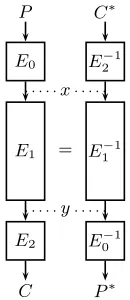
The mirror slidex attack can be applied in principle to any block cipher that can be decomposed as a cascade of three sub-ciphers: E=E2◦E1◦E0, where the middle layerE1 is an involution, i.e.,E1◦E1 is the identity mapping.6
LetE be such a cipher, and assume that for two plaintext/ciphertext pairs (P, C),(P∗, C∗), we have
E0(P) =E2−1(C∗). (1) Note that for a random choice of two pairs, this event happens with probability 2−n. Since E
1 is an involution for whichE1 = (E1)−1, in this case we can also deduce that:
E1(E0(P)) =E1−1(E2−1(C∗)). By the construction, this implies that:
E−1
2 (C) =E1(E0(P)) =E1−1(E2−1(C∗)) =E0(P∗). (2) If Equation (1) holds (and thus, Equation (2) also holds), the pair (P, P∗) is
called amirror slid pair(depicted in Figure 1).
The mirror slid pairs can be used to mount a cryptanalytic attack onE. In the attack, the adversary asks for the encryption of O(2n/2) known plaintexts
P1, P2, . . .(wherenis the block size ofE) and denotes the corresponding cipher-texts byC1, C2, . . .. For each of theO(2n) pairs (Pi, Pj), the adversary assumes that it is a mirror slid pair and tries to solve the system of equations:
(
Cj =E2(E0(Pi)),
Ci=E2(E0(Pj))
(3)
(which is equivalent to Equations (1) and (2)). IfE0andE2are “simple enough”, the adversary can solve the system efficiently and recover the key material used in E0andE2.
If the amount of subkey material used in E0 and E2 is at most n bits (in total), it is expected that at most a few of the systems of equations generated by the 2n plaintext pairs7 are consistent (since the equation system is a 2n -bit condition). One of them is the system generated by the mirror slid pair, which is expected to exist in the data with a non-negligible probability since the probability of a random pair to be a mirror slid pair is 2−n. Hence, the adversary obtains only a few suggestions for the key, which contain the right key with a non-negligible probability. If the amount of key material used in E0 andE2 is larger than n bits, the adversary can still find the right key, by enlarging the data set by a small factor and using key ranking techniques (exploiting the fact that the right key is suggested by all mirror slid pairs, while the other pairs suggest “random” keys).
The data complexity of the attack isO(2n/2) known plaintexts, and its time complexity isO(2n)·t, where tis the time required for solving the system (3).
The slide with a twist attack is a special case of the mirror slidex framework in whichE2=Identity. In such a case, the system of equations presented above is simplified to:
(
Cj =E0(Pi),
Ci=E0(Pj).
(4)
We note that in [3] where the slide with a twist attack was introduced, it was presented in a different way. However, the presentations are equivalent and for the purpose of the current paper, the presentation given here is sufficient.
2.2 Applications of the Slide with a Twist Attack
In [3,9,10], the authors presented numerous applications of the slide with a twist and the mirror slidex techniques.
1. Feistel constructions with self similarity.These constructions are based on DES, with the sequence of subkeys replaced by a periodic sequence, such as k0, k1, k0, k1, . . .. In [3], the authors considered two such constructions called 2K-DES and 4K-DES (with two-round and four-round self similarity, respectively), and presented known plaintext attacks of complexity 2n/2and chosen plaintext attacks of complexity 2n/4on both variants. They also con-sidered DES with a modified key schedule proposed by Brown and Seberry, which appears to be 4-round self-similar, and devised an even faster attack on it, using specific properties of DES.
2. Feistel constructions with self similarity surrounded by key whiten-ings.These constructions are based on the block cipher DESX (defined as 7 We note that in some cases, it is possible to discard candidate plaintext pairs before
DES surrounded by key whitenings), with the sequence of subkeys replaced by a periodic sequence. In [10], the authors considered 2K-DESX and 4K-DESX (with two-round and four-round self similarity, respectively). They presented a known plaintext attack of complexity 2n/2 on 2K-DESX, but stated that they could not find any attack which is faster than 2n on 4K-DESX.
3. Reduced variants of the GOST block cipher.In [3], the authors con-sidered a variant of the GOST block cipher in which the key additions are replaced by XORs. They showed that 20 rounds of this variant can be bro-ken in 233 data and 270 time, and presented a set of 2128 weak keys for this variant, for which the encryption is reduced to a Feistel construction with 4-round self similarity. In [9], it was shown that 20 rounds of original GOST can also be broken by slide with a twist, in a slightly increased time of 277. 4. DESX and the Even-Mansour construction.In [3], the authors showed that the Even-Mansour construction (defined asE(P) =K2⊕F(P⊕K1), whereK1, K2 are secret keys andF is a publicly known permutation) can be broken in 2n/2 time and memory, using 2n/2queries to E and 2n/2 com-putations ofF. They also presented a similar attack that breaks DESX in 233 data and 289 time.8
5. Variants of the Even-Mansour construction.In [9] it was shown that if the public permutation used in the Even-Mansour construction is an in-volution, the construction can be broken in 2n/2 time and memory, with 2n/2 queries to E and no computations of F. Numerous other variants of the Even-Mansour construction were studied in [9], most notably a variant defined asE(P) =K+F(P+K) whereF is a publicly known involution, that was shown to be completely breakable in 2n/2 time and memory, with 2n/2queries to E and no computations ofF.
We consider all these applications in detail in the next two sections, and show that for all of them (except for the simplest attacks of [3] on DESX and Even-Mansour, in which the involution is just a XOR with a key, which is not sufficiently random), our enhanced reflection attack performs at least as well as the slide with a twist attack, and in some cases it performs significantly better. We consider applications (3)–(5) in Section 3, right after the presentation of the new technique. Applications (1)–(2) will be considered in Section 4, as our results for those variants require some additional observations specific to Feistel constructions, and are directly related to the originalreflectionattack [16] (that is also considered in Section 4).
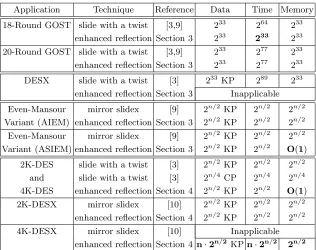
Application Technique Reference Data Time Memory 18-Round GOST slide with a twist [3,9] 233 264 233
enhanced reflection Section 3 233 233
233 20-Round GOST slide with a twist [3,9] 233 277 233 enhanced reflection Section 3 233 277 233 DESX slide with a twist [3] 233 KP 289 233
enhanced reflection Section 3 Inapplicable Even-Mansour mirror slidex [9] 2n/2KP 2n/2 2n/2 Variant (AIEM) enhanced reflection Section 3 2n/2KP 2n/2 2n/2 Even-Mansour mirror slidex [9] 2n/2KP 2n/2 2n/2 Variant (ASIEM) enhanced reflection Section 3 2n/2KP 2n/2 O(1)
2K-DES slide with a twist [3] 2n/2KP 2n/2 2n/2 and slide with a twist [3] 2n/4 CP 2n/4 2n/4 4K-DES enhanced reflection Section 4 2n/2KP 2n/2 O(1) 2K-DESX mirror slidex [10] 2n/2KP 2n/2 2n/2
enhanced reflection Section 4 2n/2KP 2n/2 2n/2 4K-DESX mirror slidex [10] Inapplicable
enhanced reflection Section 4 n·2n/2
KPn·2n/2
2n/2
Table 1.Summary of Applications (and Comparison with Slide-based Attacks)
3
Enhanced Reflection Attacks Using Fixed Points of
Involutions
In this section we present our enhanced reflection attack which is based on the simple fact that random involutions have a surprisingly large number of fixed points. We describe scenarios in which the attack is advantageous over the slide with a twist attack. Then we consider several specific applications of the slide with a twist attack presented in [3,9,10] and show how the enhanced reflection attack applies to them.
3.1 The Basic Idea
The starting point of the enhanced reflection attack is a classical result on the number of fixed points of involutions.
Theorem 1 ([12], page 596). Let I : S → S be drawn at random from the family of involutions on a set S with N elements. Then the expected number of fixed points of I is√N−1/2 +o(1).
Section 3.3, XORing with a non-zero constant is an involution with no fixed points.
Denote by f(n) the number of involutions on n elements. Consider a ran-dom involution σ on n elements. The explanation of the theorem starts from computing the probability that 1 is a fixed point ofσ.
Observe that if we take any involution on {2,3, . . . , n} and add to it 1 as a fixed point, we get an involution on {1,2, . . . , n}. On the other hand, all in-volutions that have 1 as a fixed point are of this form. Hence, the number of involutions on{1,2, . . . , n}in which 1 is a fixed point is exactlyf(n−1). Thus, the probability that 1 is a fixed point of a random involution isf(n−1)/f(n). As there is nothing special with adding 1, and by the linearity of expectation, the expected number of fixed points isn·f(n−1)/f(n).
Finally, to show that the expected number of fixed points is close to√n, we have to show that the number of involutions onnelements satisfiesf(n)/f(n−
1)≈√n. This is a standard (but not easy) fact that follows from the exponential generating function off(n), that can be shown to beez+z2/2
.
The theorem allows to significantly simplify the attack of the mirror slidex framework presented in Section 2. Let E be a block cipher that can be decom-posed as a cascade of three sub-ciphers: E = E2◦E1◦E0, where the middle layerE1is an involution. Assume that for a plaintext/ciphertext pair (P, C), the intermediate encryption value after the application ofE0, i.e.,E0(P), is a fixed point of E1 (for a random involution on n-bit values, this happens with prob-ability 2−(n/2)). In such a case, we have C =E
2(E1(E0(P))) = E2(E0(P)). If the same condition holds for two plaintext/ciphertext pairs (P, C),(P∗, C∗), we
obtain the following system of equations, that resembles (but is not equivalent to) the system of equations (3):
(
C=E2(E0(P)),
C∗=E
2(E0(P∗)).
(5)
We call plaintext/ciphertext pairs (P, C) for which the condition holds “special plaintexts”.
The system of equations (5) can be constructed for a general scheme E =
E2◦E1◦E0, even ifE1 is not an involution. However, in general permutations there is only one fixed point on average, and thus, we need the entire codebook in order to exploit (5). When E1 is an involution, we expect that it has about 2n/2 fixed points by Theorem 1, and thus, we can exploit (5) given as little as 2n/2 known plaintexts (we remind the reader that a small increase in the data complexity can increase the success rate).
The attack algorithm is very simple: The adversary asks for the encryption of O(2n/2) known plaintexts P1, P2, . . . (where n is the block size of E) and denotes the corresponding ciphertexts byC1, C2, . . .. For each of theO(2n) pairs9
9 We alert the reader that in most slide attacks, the ordered pair (P
i, Pj) is different
than the ordered pair (Pj, Pi), as the question of which plaintext is slid with respect
(Pi, Pj), the adversary assumes that both Pi andPj are special plaintexts and tries to solve the system of equations:
(
Ci=E2(E0(Pi)),
Cj =E2(E0(Pj)).
(6)
IfE0andE2are “simple enough”, the adversary can solve the system efficiently and recover the key material used in E0 and E2. The data complexity of the attack is O(2n/2) known plaintexts, and its time complexity isO(2n·t), where
t is the time required for solving the system (6).
In the special case in whichE2=Identity, that was considered in the slide with a twist attack, the system of equations (6) is simplified to:
(
Ci=E0(Pi),
Cj =E0(Pj).
(7)
The rest of the algorithm is the same as in the attack above.
3.2 Advantages Over the Mirror Slidex Attack
While the enhanced reflection framework looks very similar to the mirror slidex attack framework, it has several advantages over it:
1. Attacks whenE2◦E0 is simple.In some cases, the functionE2◦E0is so simple, that a single pairC=E2(E0(P)) is sufficient for breakingE2◦E0. In such a case, the advantage of the enhanced reflection attack over mirror slidex can be huge, as its time complexity is onlyO(2n/2·t) instead ofO(2n·t). Indeed, instead of iterating over all O(2n) pairs, it is sufficient to go over
O(2n/2) known plaintexts, assume for each plaintextP
ithat it is special, and try to solve the equationCi =E2(E0(Pi)). Such an optimization does not seem to be possible in the mirror slidex attack which inherently works with pairs and thus requiresO(2n·t) time. We demonstrate this advantage below in the concrete example of 18-round GOST, where mirror slidex requires 264 time and the enhanced reflection attack requires only 232 time.
2. Exploiting differentials in E1. Consider the slide with a twist frame-work, i.e., ciphers of the formE =E2◦E1, and assume that there exists a differentialα→β forE1 with probability p≫2−n/2. In such a case, we can mount an improved chosen plaintext attack in which we attach to each plaintext/ciphertext pair (P, C) the pairP∗ =P ⊕α, C∗ =E(P ⊕α). If
some pair (P, C) is special, i.e.,E1(P) =P, then with probabilityp, we have
C∗=E(P∗) =E
2(P∗⊕β), and thus, we obtain the system of equations: (
C=E2(P),
C∗=E2(P∗⊕β). (8)
than theO(2n·t) time complexity of the slide with a twist attack on the same variant. The same improvement can be obtained when the differential uses addition rather than XOR. Note that the slide with a twist attack cannot exploit differential properties ofE1 since it isinherently independent of the structure ofE1, apart from the fact that it is an involution.10
3. Reducing the memory complexity in certain cases. In some of the scenarios considered in [3,9], the mirror slidex attack can be optimized by reducing the system of equations (3) to a single equation of the formP⊕C=
P∗⊕C∗. In such cases, the attack can be performed in time O(2n/2) by sorting the plaintext/ciphertext pairs according to P ⊕C, and searching for a collision. Such an attack requires eitherO(2n/2) memory or O(2n/2) adaptively chosen plaintext queries (if we use Pollard’s rho method). As we show in the examples of variants of the Even-Mansour construction below, in some of these cases, system (6) can be reduced to an extremely simple equation of the formP⊕C=f(K), for some simple functionf. In such cases, the enhanced reflection attack can be performed in a memoryless manner, by iterating overO(2n/2) known plaintexts, assuming for each plaintext that it is special, and testing the key suggestion instantly by trial encryption. 4. Applying the two techniques in parallel. As the enhanced reflection
attack and the mirror slidex attacks exploit different properties of the data and both require only known plaintexts, they can be applied in parallel, using the same data set. While this does not reduce the overall time complexity of the attack, it reduces the data complexity by a factor of up to 2 (the exact factor depends on the desirable success probability of the attack).
3.3 Applications of the Enhanced Reflection Attack
In this section, we review several applications of the slide with a twist and mirror slidex attacks, and investigate how the enhanced reflection attack applies to them.
Reduced-Round Variants of GOST GOST [13] is the Russian government standard block cipher. It is a 64-bit block and 256-bit key cipher with a Feistel structure of 32 rounds. The round function accepts an input and a subkey of 32 bits each. As the exact structure of the round function is irrelevant to this work, we refer the interested reader to [13]. There are a few key recovery attacks on the full GOST in the single key-model (e.g., [8,14]), or in the multi-key settings (e.g., [6], which also uses fixed-point properties), and a simple 2 chosen plaintext related-key distinguisher is easy to construct for the full cipher. As we
are interested in comparison of the enhanced reflection, we restrict ourselves to reduced-round variants of the GOST block cipher.
The key schedule algorithm takes the 256-bit key and treats it as eight 32-bit words, i.e.,K=K1, . . . , K8. The subkeySKr of roundris
SKr= (
K(r−1) mod 8+1 r∈ {1, . . . ,24};
K33−r r∈ {25, . . . ,32}.
In [9], Dunkelman et al. showed that a reduced variant of GOST that consists of its last 20 rounds can be broken by a slide with a twist attack. The basic observation behind the attack is that the last 16 rounds of GOST constitute an involution, and thus, the last 20 rounds of GOST can be written asE=E1◦E0, whereE1is an involution andE0is 4-round GOST. Thus, the slide with a twist attack can break 20-round GOST with 233 known plaintexts and 265·t time, where t is the time required to solve the system (4) for 4-round GOST. Since Dinur et al. [8] showed that 4-round GOST can be broken in 212time given two known plaintexts, the overall complexity of the attack is 277 encryptions.
Using the enhanced reflection attack, we can break 20-round GOST with the same number of known plaintexts. Instead of the system of equations (4), we obtain the system (7) that can be solved with the same time complexity. Both attacks on 20-round GOST succeed once two fixed points are found, and for 233 known plaintext (at least) two such fixed points exist with probability of 59.4%. With 233.5known plaintexts, the success rate jumps to about 90.8%.
In this case the enhanced reflection attack has the same time complexity and success rate as the previous attack. However, the advantage of the new technique over slide with a twist can be demonstrated by considering another reduced variant of GOST that consists of the last 18 rounds. This variant can again be written asE=E1◦E0, whereE1is an involution, but in this caseE0is 2-round GOST, which can be broken instantly given asingle knownplaintext/ciphertext pair. Hence, the new technique allows us to break this variant with about 233 known plaintexts and 233 time using key ranking techniques on the last two round keys. The slide with a twist attack on this variant requires 264 time, as one cannot avoid checking all the 264 candidate slid pairs.
We note that this attack on 18-round GOST can be considered as an instance of the original reflection attack [16] on GOST, which is based on exploiting fixed points of the last 16 rounds of GOST. However, the approach here is more general than in the reflection attack, and the same attack applies when the last 16 rounds of GOST are replaced by any involution, unlike in the original reflection attack that studies only certain special classes of involutions.
DESX and the Even-Mansour Construction DESX is an extension of DES proposed by Rivest in 1984, in order to defend DES against exhaustive key search attacks without changing its design significantly. It is defined as:
DESXK0,K1,K2(P) =K2⊕DESK1(P⊕K0).
The Even-Mansour (EM) construction was proposed in 1991 by Even and Man-sour [11], as an attempt to devise the “simplest possible” block cipher using a single unkeyed permutation. It is defined as:
EMK0,K1(P) =K1⊕ F(P ⊕K0),
whereF is modelled as a publicly known random permutation.
In [3], Biryukov and Wagner showed that the slide with a twist technique can be used to attack DESX and EM. The basic idea behind the attack is that since XOR with a key is an involution, EM can be represented asE=E1◦E0, where E1 is an involution andE0(P) =F(P⊕K0). In this case, the system of equations (4) can be written as:
(
F−1(Ci) =P j⊕K0,
F−1(Cj) =P i⊕K0.
(9)
Summing these equations leads to cancellation ofK0, and after rearranging we obtain the single equationPi⊕F−1(Ci) =Pj⊕F−1(Cj). This allows to break EM in data and time ofO(2n/2), by sorting the plaintext/ciphertext pairs according to the valuePi⊕ F−1(Ci) and looking for collisions.
DESX can be attacked in the same way, after guessing the value of K1. For each of the 256 possible DES keys, the above attack is repeated (each time taking 233 known plaintexts and 233 time). As the plaintexts can be reused for each DES key guess, the total data complexity of the attack on DESX is 233 known plaintexts, and the time complexity is 256·233= 289.
Somewhat surprisingly, these two attacks are the only cases we encountered so far in which the slide with a twist attack cannot be transformed to the new framework. The reason is prosaic: the XOR with a key, that is used as the involu-tion in the attack, is so simple that it cannot be treated as arandom involution, and thus, Theorem 1 does not apply. In fact, it is clear that unless the XORed key equals zero, this operation has no fixed points at all. This demonstrates that there exist very specific cases in which the enhanced reflection attack cannot replace the slide with a twist technique, and emphasizes the need to apply this attack carefully.
1. EM with involution (IEM): E(P) =K1⊕ I(P⊕K0)
2. Addition EM with involution (AIEM): E(P) =K1+I(P+K0), 3. Conjugation EM with involution (CIEM): E(P) =−K1+I(P+K0),
The last three variants are a special case of the first three, in which K1 =
K0. They are denoted SIEM, ASIEM, and CSIEM, respectively (“S” stands for single-key). Dunkelman et al. showed that in the IEM, AIEM, CIEM, and ASIEM variants the mirror slidex attack allows to recoverK0⊕K1orK0+K1 using O(2n/2) queries toE and no queries at all toI. For the ASIEM variants , this constitutes a complete break of the construction, as the knowledge of
K0+K0= 2K0reveals all the bits ofK0 except the most significant bit. We present the enhanced reflection attack on AIEM, where similar attacks are applicable to the other variants. In the attack, AIEM is written as E =
E2◦E1◦E0, whereE1=I is an involution, andE0, E2are addition with a key. The system of equations (3) can be simplified in this case to
(
Ci=Pj+K0+K1,
Cj =Pi+K0+K1.
(10)
If we subtract the two equations, the subkeys are cancelled, and after rearranging we obtain the equation Pi+Ci =Pj+Cj. Given 2n/2 queries toE, we expect such a pair with probability11 39.3%, which can be easily identified using 2n/2 time and memory without a single query toI. The solution is then substituted into (10) to obtainK0+K1.
The attack of [9] translates easily to the enhanced reflection framework. We consider pairs of special points (Pi, Ci),(Pj, Cj). Instead of the system of equa-tions (10), we obtain the system:
(
Ci=Pi+K0+K1,
Cj =Pj+K0+K1.
(11)
After subtracting the two equations and rearranging we obtain the equation
Pi−Ci = Pj −Cj. Such a pair can be found in O(2n/2) time and memory using 2n/2 known plaintext queries toE and no queries toI (with probability of 39.3%).12 The solution is then substituted into (11) to obtainK
0+K1. In ASIEM, the situation turns out to be simpler. Each special plaintext yields the equation C =P +K0+K0, which suggests only two values for K0. These values can be tested immediately by a trial encryption. Hence, the enhanced
11To increase the probability of success to 90%, one should use 2n/2+1.1 known plain-texts.
reflection attack on ASIEM is memoryless: The adversary examines 2n/2 plain-text/ciphertext pairs sequentially, and for each one of them she obtains two key suggestions that are checked immediately by a trial encryption. There is no need for more than a constant number of memory cells. It should be mentioned that in [9], memoryless variants of the mirror slidex attacks were also consid-ered. However, these variants require 2n/2 adaptively chosen plaintexts, while our attack requires the same number ofknown plaintexts.
4
Improved Attacks on Feistel Constructions with Self
Similarity: Reflection Attacks and Beyond
One of the first applications of the slide attack [2] is the cryptanalysis of Feistel constructions with self-similar round functions. Consider a Feistel construction
Ewhose round function isF(x) =f(x⊕k), wherekis a subkey andf is a public permutation. If the list of subkeys used in the encryption process is periodic with a period of length r, i.e., K1, K2, . . . , Kr, K1, K2, . . ., we say that E has an r -round self similarity. As this construction is obviously a generalization of the structure of DES, Biryukov and Wagner [2] called itrK-DES.
In [2], the slide attack was used to break 2K-DES using 233adaptively chosen plaintexts and 233time. In [3], Biryukov and Wagner used the slide with a twist attack to break 2K-DES and 4K-DES in 233data and time in the known plaintext model, and in 217 data and time in the chosen plaintext model. Dunkelman et al. [10] used the mirror slidex framework to extend the attacks to 2K-DESX, defined as 2K-DES surrounded by key whitenings. It was mentioned in [10] that the mirror slidex attack cannot be extended to 4K-DESX.
In [16], Kara showed that 2K-DES can be broken by the original reflection attack that exploits fixed points of (2m−1)-round 2K-DES that turns out to be an involution. Kara’s attack requires 233known plaintexts and time, but unlike the slide with a twist attack, it requires only a constant amount of memory. Kara’s idea is essentially the same as the idea behind our attacks, but while we rely on a general property of random involutions to assure the existence of a large number of fixed points, Kara uses specific properties of Feistel constructions to determine the fixed points explicitly. As a result, the original reflection attack can be applied only in specific scenarios, and in particular, it cannot be applied against the ciphers considered in Section 3.3.
P
F
L L
F
L L
F
L L
F
L L
.. .
F
L L
F
L L
C
P
F
L L
F
L L
F
L L
F
L L
.. .
F
L L
F
L L
C K1
K2
K1
K2
K1
K2
K1
K2
K3
K4
K3
K4 XL
0 X0R X0L X0R
XL
2m X2Rm X4Lm X4Rm
Fig. 2.The Structure of 2K-DES and 4K-DES
4.1 Reflection Properties of 2K-DES and 4K-DES
Throughout this section,E denotes a 2K-DES (or 4K-DES) construction with 2m(or 4m) rounds (see Figure 2 for a figure describing 2K-DES). We denote the input to roundi by (XL
i , XiR). Hence, the plaintext is P = (X0L, X0R) and the ciphertext is C = (XL
2m, X2Rm) (or C = (X4Lm, X4Rm), respectively). The output of theF-function in roundris denotedOutr.
Kara’s Reflection Attack on 2K-DES The original reflection attack on E
is based on the following observation, made already in 1985 by Coppersmith [5].
Proposition 1. Let(P, C)be a plaintext/ciphertext pair for2m-round 2K-DES, such that in the encryption process ofP we haveOutm= 0. ThenPL=CL and
Proof. We prove by induction that for anyi ≥1, we haveXL
m+i =XmL−i. For
i= 1, we haveXL
m+1=XmL−1⊕Outm, and thus, the assertion follows from the assumptionOutm= 0. Assume that the claim holds for alli < t. The assumption implies thatXL
m+t−1=XmL−t+1, and hence,Outm+t−1=FKm+t−1(X L
m+t−1) =
FKm−t+1(X L
m−t+1) = Outm−t+1, as Km+t−1 = Km−t+1 by the 2K-DES key schedule. Therefore,
XmL+t=XmL+t−2⊕Outm+t−1=XmL−t+2⊕Outm−t+1=XmL−t.
This completes the inductive proof. Substitutingi=m, we obtainPL =XL 0 =
XL
2m = CL. Substituting i = m+ 1 (and treating a natural extension of the cipher in both directions), we obtain PR =XL
−1 =X2Lm+1 =CR⊕Out2m, as asserted.
We note that plaintext/ciphertext pairs that satisfy the assumption of the proposition are fixed points of the involutionI composed of the 2m−1 rounds starting at 2 and ending at 2mof E. Hence, the proposition shows that ifF is a permutation then the number of fixed points ofI is at least 2n/2. In fact, as noted by Kara [16], Coppersmith [5] showed that these are the only fixed points ofI, and thus, I has exactly 2n/2 fixed points.
Definition 1. If a plaintext/ciphertext pair(P, C)satisfies a reflection property (like the assumption of Proposition 1), it is called a reflection point ofE.
The propertyPL=CLmakes it possible to detect reflection points instantly. Then, given a reflection point, the equationPR=CR⊕Out2myields the sugges-tionK2=f−1(PR⊕CR)⊕CL. The suggestion can be checked instantly given another reflection point. Hence, the reflection attack requires O(2n/2) known plaintexts and time and only a constant amount of memory.
Another Reflection Property of 2K-DES The following is an alternative reflection property of 2K-DES:
Proposition 2. Let(P, C)be a plaintext/ciphertext pair for2m-round 2K-DES, such that in the encryption process of P we have XL
m−1 = XmL ⊕∆, where
∆=K1⊕K2. ThenPL=CR⊕∆ andPR=CL⊕∆.
Proof. We prove by induction that for anyi≥1, we haveXmL+i−1=XmL−i⊕∆. For i = 1, this is exactly the assumption. Assume that the claim holds for all i < t. The assumption implies that XL
m+t−2 = XmL−t+1⊕∆, and hence,
Outm+t−2 = FKm+t−2(X L
m+t−2) = FKm−t+1(X L
m−t+1) = Outm−t+1 (as in 2K-DES the key schedule assures theKm+t−2⊕Km−t+1=∆ for allt). Therefore,
XmL+t−1=XmL+t−3⊕Outm+t−2=XmL−t+2⊕∆⊕Outm−t+1=XmL−t⊕∆.
This completes the inductive proof. Substitutingi=m, we obtainPL =XL 0 =
XL
2m−1⊕∆=CR⊕∆. Substitutingi=m+ 1 (and treating a natural extension of the cipher in both directions), we obtain PR =XL
Reflection points (according to the new property) can be detected instantly using the equationPL⊕CR=PR⊕CL=∆, along with a suggestionK
1⊕K2=
∆. The attack can be completed, e.g., by exhaustive search overK1 (given that
K1⊕K2is already known). The complexity of the attack is 2n/2known plaintexts and time, and only a constant amount of memory. Finally, as the reflection points exploited in this attack are different from Kara’s fixed points, this attack can be applied in parallel with Kara’s attack, which results in reducing the data complexity by a factor of 2.
Reflection Property for 4K-DES Combining the ideas behind the two re-flection properties for 2K-DES presented above, one can obtain the following reflection property of 4K-DES:
Proposition 3. Let(P, C)be a plaintext/ciphertext pair for4m-round 4K-DES, such that in the encryption process of P we have XL
2m−1 =X2Lm+1⊕∆, where
∆=K2⊕K4. ThenPL=CL andPR=CR⊕Out4m⊕∆.
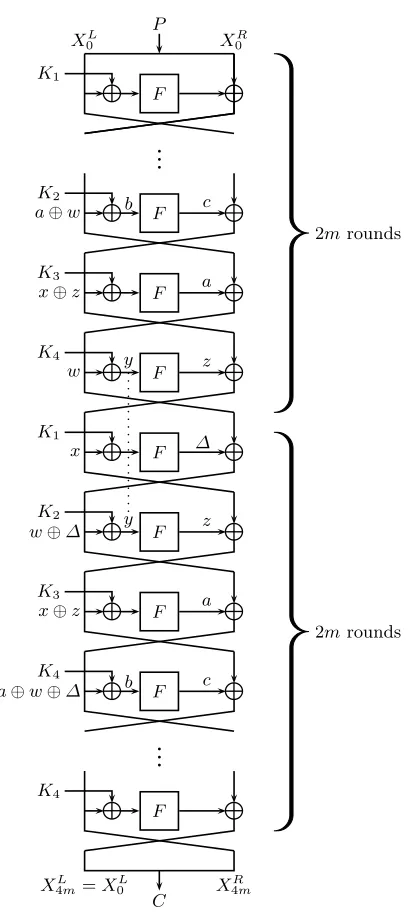
Proof. We prove by induction that for anyi≥1, we have
X2Lm+2i−1=X2Lm−2i+1⊕∆ and X2Lm+2i−2=X2Lm−2i+2.
For i = 1, this is exactly the assumption. Assume that the claim holds for all
i < t. The assumption implies that XL
2m+2t−3 = X2Lm−2t+3 ⊕∆, and hence,
Out2m+2t−3 = FK2m+2t−3(X L
2m+2t−3) = FK2m−2t+3(X L
2m−2t+3) = Out2m−2t+3 by the key schedule of 4K-DES that assures thatK2m+2t−3⊕K2m−2t+3=∆for allt. Therefore,
X2Lm+2t−2=X2Lm+2t−4⊕Out2m+2t−3 =XL
2m−2t+4⊕Out2m−2t+3=X2Lm−2t+2.
(12)
By the structure of 4K-DES, the subkeys of rounds 2m+ 2t−2 and 2m−2t+ 2 are equal for allt. Hence, (12) impliesOut2m+2t−2=Out2m−2t+2. Therefore,
X2Lm+2t−1=X2Lm+2t−3⊕Out2m+2t−2=
XL
2m−2t+3⊕∆⊕Out2m−2t+2=X2Lm−2t+1⊕∆.
This completes the inductive proof (depicted in Figure 3). Substitutingi= 2m, we obtain PL = XL
0 = X4Lm = CL. Substituting i = 2m+ 1 (and treating a natural extension of the cipher in both directions), we obtain PR = XL
−1 =
XL
4m+1⊕∆=CR⊕Out4m⊕∆, as asserted.
The propertyPL=CL allows us to detect reflection points instantly. Then, given a reflection point, the adversary guesses∆and obtains a suggestion forK4 from the equationPR=CR⊕Out
both K4 and ∆. The rest of the attack is trivial.13, Therefore, the reflection attack requires O(2n/2) known plaintexts (to obtain 3 reflection points) and time, and only a constant amount of memory.
4.2 Applications of the New Reflection Properties
In this section, we consider all Feistel constructions with self similar round func-tions studied in [3,10]. We show that all of them (including 4K-DESX for which the mirror slidex attack fails) can be broken by an enhanced reflection attack with the same data and time complexities (in the known plaintext model) as the slide with a twist attack, and sometimes with a lower memory complexity.
2K-DES and 4K-DES In [3], Biryukov and Wagner showed that 2K-DES and 4K-DES can be broken using the slide with a twist attack. The attacks require either O(2n/2) data, time, and memory in the known plaintext model, andO(2n/4) data, time and memory in the chosen plaintext model. The attack on 4K-DES is applied to a variant of DES proposed by Brown and Seberry [4] and to a 24-round variant of GOST under a weak key class, as both these ciphers are Feistel constructions with a 4-round self-similarity.
The attack on 2K-DES can be viewed as a typical application of the mirror slidex framework E = E2◦E1◦E0, where E2 is the identity function, E1 is (2m−1)-round 2K-DES (which is an involution), andE0is a single DES round. The attack on 4K-DES is a bit more involved, as the role of E1 is played by (4m−3)-round 4K-DES, which is not an involution.
As was shown in Section 4.1, both 2K-DES and 4K-DES can be broken by a reflection attack (either Kara’s original attack or our enhanced reflection attacks) in data and time of O(2n/2) and a constant amount of memory. Hence, our enhanced reflection attacks strictly improve over the attacks of [3] in the known plaintext model. It should be noted, however, that the reflection framework does not allow obtaining a speedup in the chosen plaintext model, and thus, when chosen plaintexts are available, the slide with a twist attacks of [3] are advantageous over our attacks.
Attacking 2K-DESX The construction 2K-DESX is defined asE(P) =Kpost⊕ (E′(Kpre⊕P)), where E′ is 2K-DES with subkeys K1, K2. Note that K1, K2
aren/2-bit keys, whileKpre, Kpost aren-bit keys.
In [10], Dunkelman et al. showed that 2K-DESX can be broken in O(2n/2) known plaintexts and time using a variant of the mirror slidex attack. It was mentioned in [10] that the mirror slidex attack cannot break 4K-DESX. In-stead, [10] considers a variant of 4K-DESX in which the last round of the middle Feistel part is removed, and shows that it can be broken in O(2n/2) data and time, like 2K-DESX.
13We note that a similar reflection property exists with PR =CR and PL=CL⊕
Using our alternative reflection property for 2K-DES, we can break 2K-DESX in O(2n/2) data and time (thus, achieving the same result as the mirror slidex attack of [10]). Let (P′, C′) be a reflection point of E′ (that is an instantiation
of 2K-DES, as defined above) according to our property. Then P′L⊕C′R =
P′R ⊕C′L = K
1⊕K2. Hence, if (P = P′ ⊕Kpre, C = C′ ⊕Kpost) is the corresponding plaintext/ciphertext pair for E, then (P, C) satisfies the system of equations:
(
PL⊕CR=K
1⊕K2⊕KpreL ⊕KpostR ,
PR⊕CL=K
1⊕K2⊕KpreR ⊕KpostL .
(13)
Note that the right hand side of both equations is equal for all reflection points. Hence, an adversary can ask for the encryption ofO(2n/2) known plaintexts and store them in a hash table, sorted according to (PL⊕CR, PR⊕CL). Each pair of reflection points must yield a collision in the table (due to the system (13). On the other hand, as a collision is ann-bit condition, the table is expected to contain onlyO(1) collisions. One of them is expected to follow from a pair of reflection points. Once the reflection points are detected, the system of equations (13) yields n bits of information on the secret keys. The rest of the keys can be recovered using auxiliary techniques.
The data and time complexities of the attack areO(2n/2). Note that unlike the attack on 2K-DES, this attack cannot be performed in a memoryless manner (unless adaptively chosen plaintexts are used), since the reflection points are detected using a hash table. Thus, the complexity of this attack is exactly equal to the complexity of the mirror slidex attack on the same variant.
We note that Kara’s reflection property cannot be used directly to attack 2K-DESX. Indeed, a fixed point (P′, C′) ofE′ with respect to Kara’s property
satisfiesP′L=C′L, or equivalently,PL=CL⊕KL
pre⊕KpostL . Thus, any reflection point yields a suggestion forKL
pre⊕KpostL . However, as mentioned in Section 4.1,
E′has exactly 2n/2reflection points and any non-reflection point satisfiesP′L6=
C′L, and thus, necessarily suggests an incorrect value forKL
pre⊕KpostL . Hence, the probability of the correct value of KL
pre⊕KpostL to be suggested is exactly 2−n/2, that is equal to the probability of a random suggestion. Therefore, the key material cannot be detected in a straightforward way.
Attacking 4K-DESX The advantage of the enhanced reflection attack over mirror slidex can be seen in the example of 4K-DESX that according to [10] cannot be attacked by mirror slidex. Our reflection property for 4K-DES allows to break 4K-DESX inO(n2n/2) data and time.
Let (P′, C′) be a reflection point ofE′ (that is an instantiation of 4K-DES,
as defined above), i.e., P′L =C′L. Hence, if (P =P′⊕Kpre, C =C′⊕Kpost)
is the corresponding plaintext/ciphertext pair forE, then (P, C) satisfiesPL⊕
CL=KL
pre⊕KpostL . In addition, a non-reflection point can be assumed to satisfy the n/2-bit condition PL⊕CL =KL
pre⊕KpostL with probability 2−n/2. (Note that at this point, 4K-DESX differs from 2K-DESX where non-reflection points necessarily suggest wrong keys). Hence, the correct value of KL
suggested with probability 2·2−n/2, while each incorrect value is suggested with probability close to 2−n/2. This allows to detect the correct suggestion ofKL
pre⊕
KL
postusingO(n2n/2) known plaintexts and time. After the correct suggestion is detected, the adversary can detect the reflection points (as these points suggest the correct value ofKL
pre⊕KpostL ), and then she can retrieve more key material by solving the second equationPR=CR⊕Out
4m⊕(K2⊕K4)⊕KpreR ⊕KpostR . (For example, she can guess (K2⊕K4)⊕KpreR ⊕KpostR and check whether two reflection points yield the same suggestion for K4 – the subkey used in F4m). The rest of the key can be retrieved by auxiliary techniques.
The total data and time complexities of the attack areO(n2n/2). As in the attack on 2K-DESX, it is not clear how to execute this attack in a memoryless manner, since the reflection points are detected using a key ranking procedure.
5
Conclusions
In this paper we devised an enhanced reflection attack which exploits the large number of fixed points we expect to find in random involutions which are located deep inside the cryptosystem. We showed that this attack is at least as good (and in many cases better) than the slide with a twist attack which was introduced in 2000, except when the involution is too simple and non-random (e.g., XORing a non-zero key is an involution which has no fixed points). In particular, we used it to improve the best known attack on GOST reduced to 18 rounds, and on DESX in which the key schedule repeats itself every four rounds.
Acknowledgements
The second author was supported in part by the Israel Science Foundation through grants No. 827/12 and No. 1910/12. The third author was supported by the Alon Fellowship.
References
1. Bard, G.V., Ault, S.V., Courtois, N.T.: Statistics of Random Permutations and the Cryptanalysis of Periodic Block Ciphers. Cryptologia 36(3), 240–262 (2012), http://dx.doi.org/10.1080/01611194.2011.632806
2. Biryukov, A., Wagner, D.: Slide Attacks. In: Knudsen, L.R. (ed.) Fast Software Encryption, 6th International Workshop, FSE ’99, Rome, Italy, March 24-26, 1999, Proceedings. Lecture Notes in Computer Science, vol. 1636, pp. 245–259. Springer (1999),http://dx.doi.org/10.1007/3-540-48519-8_18
4. Brown, L., Seberry, J.: Key Scheduling In Des Type Cryptosystems. In: Se-berry, J., Pieprzyk, J. (eds.) Advances in Cryptology - AUSCRYPT ’90, Interna-tional Conference on Cryptology, Sydney, Australia, January 8-11, 1990, Proceed-ings. Lecture Notes in Computer Science, vol. 453, pp. 221–228. Springer (1990), http://dx.doi.org/10.1007/BFb0030363
5. Coppersmith, D.: The Real Reason for Rivest’s Phenomenon. In: Williams [19], pp. 535–536, http://dx.doi.org/10.1007/3-540-39799-X_42
6. Courtois, N.: Algebraic Complexity Reduction and Cryptanalysis of GOST. IACR Cryptology ePrint Archive 2011, 626 (2011), http://eprint.iacr.org/2011/626 7. Courtois, N.T., Bard, G.V.: Random Permutation Statistics and an Im-proved Slide-Determine Attack on KeeLoq. In: Naccache, D. (ed.) Cryp-tography and Security: From Theory to Applications - Essays Dedicated to Jean-Jacques Quisquater on the Occasion of His 65th Birthday. Lec-ture Notes in Computer Science, vol. 6805, pp. 35–54. Springer (2012), http://dx.doi.org/10.1007/978-3-642-28368-0_6
8. Dinur, I., Dunkelman, O., Shamir, A.: Improved Attacks on Full GOST. In: Canteaut, A. (ed.) Fast Software Encryption - 19th International Workshop, FSE 2012, Washington, DC, USA, March 19-21, 2012. Revised Selected Pa-pers. Lecture Notes in Computer Science, vol. 7549, pp. 9–28. Springer (2012), http://dx.doi.org/10.1007/978-3-642-34047-5_2
9. Dunkelman, O., Keller, N., Shamir, A.: Minimalism in Cryptography: The Even-Mansour Scheme Revisited. In: Pointcheval, D., Johansson, T. (eds.) Advances in Cryptology - EUROCRYPT 2012 - 31st Annual International Conference on the Theory and Applications of Cryptographic Techniques, Cambridge, UK, April 15-19, 2012. Proceedings. Lecture Notes in Computer Science, vol. 7237, pp. 336–354. Springer (2012),http://dx.doi.org/10.1007/978-3-642-29011-4_21
10. Dunkelman, O., Keller, N., Shamir, A.: Slidex Attacks on the Even-Mansour Encryption Scheme. J. Cryptology 28(1), 1–28 (2015), http://dx.doi.org/10.1007/s00145-013-9164-7
11. Even, S., Mansour, Y.: A Construction of a Cipher from a Sin-gle Pseudorandom Permutation. J. Cryptology 10(3), 151–162 (1997), http://dx.doi.org/10.1007/s001459900025
12. Flajolet, P., Sedgewick, R.: Analytic Combinatorics. Cambridge University Press (2009),http://www.cambridge.org/uk/catalogue/catalogue.asp?isbn=9780521898065 13. Government Committee of the USSR for Standards: Gosudarstvennei Standard
28147-89: Cryptographic Protection for Data Processing Systems. Tech. rep. (1989) 14. Isobe, T.: A Single-Key Attack on the Full GOST Block Cipher. In: Joux, A. (ed.) Fast Software Encryption - 18th International Workshop, FSE 2011, Lyngby, Denmark, February 13-16, 2011, Revised Selected Papers. Lec-ture Notes in Computer Science, vol. 6733, pp. 290–305. Springer (2011), http://dx.doi.org/10.1007/978-3-642-21702-9_17
15. Jr., B.S.K., Rivest, R.L., Sherman, A.T.: Is DES a pure cipher? (re-sults of more cycling experiments on DES). In: Williams [19], pp. 212–226, http://dx.doi.org/10.1007/3-540-39799-X_17
16. Kara, O.: Reflection Attacks on Product Ciphers. IACR Cryptology ePrint Archive 2007, 43 (2007),http://eprint.iacr.org/2007/043
18. Soleimany, H., Blondeau, C., Yu, X., Wu, W., Nyberg, K., Zhang, H., Zhang, L., Wang, Y.: Reflection Cryptanalysis of PRINCE-Like Ciphers. In: Moriai, S. (ed.) Fast Software Encryption - 20th International Work-shop, FSE 2013, Singapore, March 11-13, 2013. Revised Selected Papers. Lecture Notes in Computer Science, vol. 8424, pp. 71–91. Springer (2013), http://dx.doi.org/10.1007/978-3-662-43933-3_5
P
F
L L
. ..
F
L L
F
L L
F
L L
F
L L
F
L L
F
L L
F
L L
. ..
F
L L
C K1
K2
K3
K4
K1
K2
K3
K4
K4
∆ a⊕w
x⊕z
w
x
w⊕∆
x⊕z
a⊕w⊕∆ b
y
y
b
z
z a
a c
c
2mrounds
2mrounds XL
0 X0R
XL
4m=X0L X4Rm