Hand Gesture and Common Interaction
Recognition Using MEMS
S.Karthick
1, R.Radhika Shridevi
2PG Student [EST], Dept. of EEE, Saveetha Engineering College, Thandala m , Chennai, India1,2
ABSTRACT: The main a im of th is project is to provide hand ges ture recognition with low cost, high dynamic rate and to replace vision based hand gesture recognition . In this project, a wea rable prototype model for Hand gesture recognition and common interaction system using MEMS accele ro meter has been made. It a lso provides a compacted portable device. The accele rations of a hand mot ion in three perpendicular directions are detected by MEMS accelero meter and the acceleration values were transmitted to mic rocontroller. An automatic gesture recognition algorith m is developed to identify individual gestures in a sequence. Finally the gesture is recognized by comparing the acceleration values with the stored templates that has been stored in EEPROM.If the motion of the MEMS is equal to stored templates, then the respective number is displayed on the LCD and the audio sample is played through speaker via voice Module.
KEYWORDS: M icro Electro Mechanical Systems ,Microcontrolle r, LCD,Speaker.
I.INTRODUCTION
Gesture recognition enables humans to communicate with the machine and interact naturally without any mechanical devices. Gesture recognition has been a research area which rece ived much attention from research communit ies such as human computer interaction and image processing. The increase in Human-Machine Interactions (HMI) has made user interface technology progressively more impo rtant. Gesture recognition can be conducted by computer vision and image processing.
In this project, a wearable prototype model for Hand gesture recognition and common interaction system using MEMS accelero meter d igital sensor has been designed. The accelerations of a hand motion in three perpendicular d irections are detected by accelero meter and its accele ration values are transmitted to mic rocontroller. An automat ic gesture recognition algorith m is developed to identify individual gestures in a sequence.
Finally the gesture is recognized by comparing the acceleration values with the templates that has been stored in EEPROM and the respective commands are displayed on the LCD and co mmon interaction samp les are played through the speaker using a voice module. The ma in aim of the project is to replace vision based hand gesture recognition with MEMS accele ro meter. The ma in objective of this project is to provide hand gesture recognition with high dynamic rate at low cost. It is a compact portable device and also it is designed to aid specially cha llenged people.
The existing gesture recognition system is based on image/video, magnetic or inertial trac king techniques touch screen. Wired gloves are used to provide input to the computer about the position and rotation of the hands using magnetic or inertia l trac king devices. The first commerc ially available hand tracking glove typ e device is the Data Glove, a glove type device which can detect hand position, movements and finger bending. This uses fibre optic cables which is running down the back of the hand.
In touch screen, the gesture should be written on the screen and it will be compared with the templates and desired output is shown in screen. It is mostly applicab le in 2D ga ming.
In wired g loves hand gestures techniques, light pulses are created. When the fingering motion is bend, light leaks through small crac ks and the bending loss is registered, hence it is not high accurate and also cost is high.In image/video based hand gestures techniques, there are many challenges associated with the accuracy and usefulness of gesture recognition software. For image based gesture recognition there are limitations on the equipment used, slower dynamic response and image noise. Images or video may not be under consistent lighting or in the sa me location. Ite ms in the background or distinct features of the users may ma ke recognition more difficult. Furthermore , the distance from the camera and the camera 's resolution and quality, also cause variations in recognition accuracy and also it r equires high cost to imple ment. The cost of the touch screen is high and also it cannot be used to identify 3D gestures.
To overcome the limitations such as unexpected ambient optical noise, slowe r dynamic response, and relatively la rge data collections/processing of vision based method and to strike a balance between accuracy of collected data and cost of devices, an Inertial Measurement Un it is utilized in this project to detect the accelerations of hand motions in three dimensions.
The proposed recognition system is imp le mented based on MEMS acce lerat ion digital sensor. Since heavy computation burden will be brought if gyroscopes are used for inertial measurement and hence the project is based on MEMS accelero meters only and gyroscopes are not imp le men ted for mot ion sensing.
II. S YSTEM MODEL AND ASSUMPTION
The PIC16F877A is one of the latest products from M icrochip. For its low price, wide range of application, high quality and easy availability, it is an ideal solution in applications such as: the co ntrol of different processes in industry, mach ine control devices, measurement of d iffe rent values etc.
Some of its ma in features are
PIC16F877A series normally has five input/output ports. They are used for the input/output interfacing with
other devices/circuits.
Most of these port pins are mu ltip le xed fo r handling a lternate function for peripheral features on the devices.
All ports in a PIC ch ip are b i-d irectional.
It has an operating frequency of (0-20) M Hz.
Software selectable frequency range of 8M Hz to 31 KHz.
It requires 2.0-5.5 voltage of power supply.
The LIS302DL is an ultra compact lo w-power three a xes linear M EMS accele ro meter sensor. It includes a sensing
ele ment and an IC interface ab le to provide the measured acceleration to the e xternal world through I2C/SPI serial
Some of the ma in features of WTV-SR Voice Module a re:
7 kinds of operating modes: MP3 mode, one to one key mode, paralle l mode, one record one play key mode,
Audio-book mode, two -wire serial mode and three-wire serial mode.
Support MIC and LINE-IN record ing;
Support plug-in 64M bit SPI-FLASH, record ing time up to 1600 seconds
Support upload and download voice via USB.
Support playback the high-quality voice which down loaded fro m co mputer.
A Liquid Crystal Display (LCD) is a flat panel display, e lectronic visual d isplay or video display that uses the light modulating properties of liquid c rystals. Liquid c rystals do not emit light directly. LCDs are available to display arbitrary images (as in a general purpose computer display) or fixed images which can be displayed or hidden, such as preset words, digits and seven segment displays as in a digital c lock. They use the same basic technology, except that arbitrary images are made up of a large number of small p ixe ls, while other displays have larger ele ments They are common in consumer devices such as clocks, watches, calculators, telephones and have replaced cathode ray tube (CRT) displays in most applications. They are available in a wider range of screen sizes than CRT and plas ma displays and since they do not use phosphors, they do not suffer image distortion. LCDs are however, susceptible to image persistence.
COM-0915 is a small audio speaker that is ideal for radio and amplifier projects. It has a power rating of 0.5W with an impedance of 8 ohm. It has a dimension of 50mm dia meter, 16mm he ight and 28mm base diameter. Dyna mic loudspeaker uses a lightweight diaphragm or cone, connected to a rigid basket or fra me v ia a fle xib le suspension, commonly ca lled a spider, that constrains a voice coil to move a xia lly through a cylindrica l magnetic gap. When an electrica l signal is applied to the voice coil, a magnetic fie ld is created by the electric current in the voice coil, making it a variable electro magnet. The coil and the driver's magnetic system interact, generating a mechanical force that causes the coil (and thus, the attached cone) to move back and forth, thereby reproducing sound under the control of the applied electrical signal co ming fro m the a mplifier.
Enclosed Vibration motor (325-100) is designed without any external moving parts and also includes screw holes on the most case plate. This vibration motor is a uni vibration motor with diameter 24.4mm. It has operating voltage as 3V. This vib ration motor is a 3 pole machine and has precious metal brushes and is wound to 3V no minal.
III . DATA PROCESSING
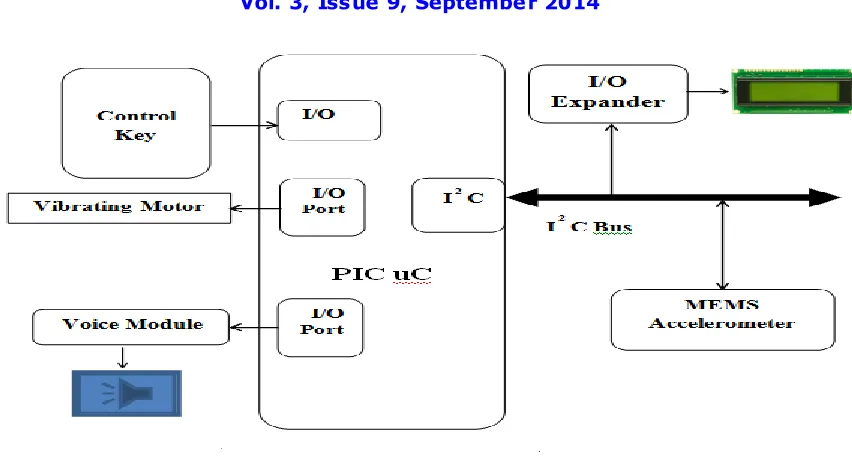
Fig 1 Block d iagra m of hardwa re connection
Sometimes a “ghost” gesture may be detected, i.e., due to environmental v ibrations or unintended hand motions, it would not happen in our system as we providing a control key ,so it will active only when we are using the device for hand gesture. The following flow chart will e xpla in overall data processing system. Based on the movement, the gesture sequence from M EMS will be send to PIC-microcontroller through I²C bus. At the gesture segmentation, the data will be checked whether it is a single dimension or two dimensions .Then the gesture is norma lized and later it will be aligned based on centre of mass. It will be compared with the stored standard pattern. If the recogn ition is true then the PIC-microcontroller will enable the output unit .If it is not true then it will go back to area sequence recognition and analysed again.
All the templates are stored and the programs are programmed in EEPROM me mory. Using embedded C programming language, programs are coded into the PIC-microcontrolle r. At the stage of alignment by centre of mass, the MEMS motion is compared to the stored templates which have been stored in the memo ry. After the recognition of motion, the PIC-mic rocontroller will enable the output unit.
IV.OUTPUT UNIT
Vibrat ing motor has been used to provide acknowledgement after the completion of each gesture. It is connected at the
one of the I/O port of PIC-micro controller. Enc losed Vibration Motor (325-100) has been enabled by PIC-mic rocontroller after each gesture. This component is added for specially challenged peoples and it can be
modified based on the require ment.
V. S IMULATION AND RES ULT
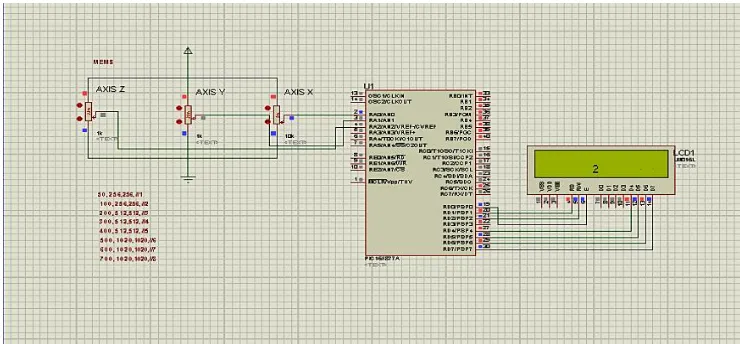
MPLA B IDE v8 is a 32-bit application on Mic rosoft Windows and includes several free software co mponents for application development, hardwa re e mu lation and debugging. Hi-tech C co mpiler V9.5 is used for programming 16F877A PIC microcontrolle r. The HI-TECH C Co mpiler for PIC10/12/16 MCUs is a free-standing, optimizing ANSI C co mp ile r. It supports all PIC10, PIC12 and PIC16 series devices.
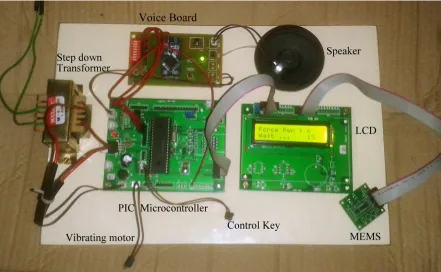
The hardware consists of MEMS, speaker, LCD, vibrat ing motor, Vo ice board, PIC-microcontroller. Using step down transformer, input 220V is stepped down to 12V and the rectifier is used to convert input AC signal to DC signal. Constant voltage is provided to microcontrolle r by using regulator. Voice Board consist of voice module. Control Key is pressed and hold to initiate the operation. Now the M EMS is moved in certa in nume rica l act ion and the respective a xes values are given to PIC-M icrocontrolle r. Then the microcontrolle r will co mpare the motion with the stored patterns and it will enable the LCD to display the corresponding number and the audio sample is played through speaker. After recognizing each gesture, acknowledge ment is provided by the vibrating motor. The hard ware output has been shown in Fig
Fig 3 Hardwa re Output
VI. CONCLUS ION
[3] Carlo Colombo and Benedetto Allotta, “Image-Based Robot Task Planning and Control Using a Compact Visual Rep resentation”, January 1999.
[4] Fels S. S. and G. E. Hinton, “ Glove-talk: A neural network interface between a data glove and a speech synthesizer,” IEEE Trans. Neural Netw., vol. 4, no. l, pp. 2–8, January 1993.
[5] K.S.Fu, “ Syntactic Recognition in Character Recognition”, New York Academic, vol. 112, Mathematics in Science and Engineering, May 1972.
[6] Mathieu Hautefeuille, Conor ’Mahony, Brendan O’Flynn, John Barton, and Frank Peters, “A Wireless MEMS Sensor System for Telecommunications Reliability Monitoring”, March 2010.
[7] Murthy G. R. S. & R. S. Jadon “A Review of Vision based Hand Gesture Recognition”, December 2009
[8] Narendra Ahuja and Ming-Hsuan Yang, “ Extraction of 2D Motion Trajectories and Its Application to Hand Gesture Recognition”, August 2002.
[9] Newman W. M. And R. F. Sproull, “Principles of Interactive Computer Graphics”, New York: McGraw-Hill, September 1979.