ISSN 2286-4822 www.euacademic.org
Impact Factor: 3.4546 (UIF)
DRJI Value: 5.9 (B+)
Concept Maps in Teaching of Science: An
Innovative Practice
1NEEPA BHARUCHA Assistant Professor M. B. Patel College of Education Sardar Patel University, Vallabh Vidyanagar India
Abstract:
Teaching Science in middle school is both rewarding and demanding. Creating an exciting learning environment with a rich science curriculum that engages all students is challenging enough. How can we know if students develop a coherent and scientific understanding of the important concepts? Is it possible to produce a snapshot of this understanding? In this research paper the researcher came across to many such questions, and shared her experience to develop and try out of the concept- maps at classroom of science to understand the thinking generating ability of students as a way to monitor students' teaching learning processes.
In this research the researcher constructed an elaborated programme on development and try out of certain concept maps. The programme was implemented on the students of class IX and measured their learning outcomes in relation to achievement, concept attainment and science process skills. Their tacit perceptions were availed through qualitative technique using teachers ' observation and students ' verbal responses.
The detailed quantitative analysis interpretation and analysis of data was carried out. The results are discussed and further suggestions and recommendations are mentioned, too.
Key words: concept maps, teaching science, middle school
1.0 INTRODUCTION:
The National Science Education Standards and other reform movements, identify the essential contexts and the types of high-quality end products that we should expect from scientifically literate students. "Outcomes are high quality, acuminating demonstrations of significant learning in context." (Spady, 1994:17) William Spady reminds us that the operative word is demonstration. Outcomes identify in general terms that end product we expect students to develop or achieve.
There is a Tool that can help teachers and curriculum developers to face the challenge of planning concept mapping. Concept maps are essential tools for planning and teaching, and they can help improve students' concept constructions, while helping to avoid misconceptions. Concept Mapping is a more recent development that is becoming widely used as constructivist learning models are more accepted in Science education.
The lack of uniformity of concepts and the multitude of nation systems in use.
The highly fragmented and often very linear character of curricula in which insufficient attention is paid to concept definitions
Limited attention in science education to opportunities for synthesis in which students are explicitly taught the links between different concepts and how to visualize the methods; those opportunities would enhance students' linkage between different concepts and with phenomena themselves.
This kind of empirical scientific research on concept mapping in combination with visualization of related concept in regular settings for well defined problem areas in the teaching methodology is a part of a still largely unexplored research area. (Francis co et. al, 1998)
2.0 SIGNIFICANCE AND RELEVANCE OF THE STUDY:
As students are introduced to new science concepts, they embark on a cognitive process of constructing meaning and making sense by consciously or subconsciously integrating new ideas with their existing knowledge. Concept maps provide a unique graphical view of how students organize, connect and synthesize information. As a result concept mapping offers benefits to both students and teachers.
Concept maps give students an opportunity to:
naturally integrates literacy and science by providing a starting point for writing about science.
Concept maps are also valuable tools for teachers because they provide information about students' understanding. Teachers can examine how well a student understands science by observing the sophistication of their concept map. Highly sophisticated maps show highly integrated knowledge structures, which are important because they facilitate cognitive activities such as problem solving. A closer look at the propositions in a concept map also reveals student's level of understanding. Accordingly, Teachers can quickly find gaps in learning and modify lesson plans based on the information from students' concept maps.
Based on above significance of the concept mapping this study will lead to meaningful learning to the students of the group. After the execution of the programme the students would realize the conceptual connections and the main ideas and the relationships among the concepts. This study may help teachers understand the various concepts that are embedded in the larger topic they are to teach.
Also this study would be benefited for students to use them as advance organizers to focus students ' attention and guide them along to see a bigger picture and for use as a mental scaffolding for organizing their thoughts and discoveries. The developed process skills and concept attainment would also be measured.
Finally, the programme would create and enhance constructivist learning and understand science not only in part, but the gestalt vision would be focused in students' attitude.
3.0 THEORETICAL FRAMEWORK OF THE STUDY:
students towards meaningful learning is ' concept map.' Concept mapping is seen as a useful tool for helping students learn about the structure of knowledge and the process of knowledge production or meta knowledge. In contrast to students who learn by rote, students who employ meaningful learning are expected to retain knowledge over an extensive time span and find new related learning progressively easier.
The use of concept maps as a teaching strategy was first developed by J. D. Novak in the early 1980's, derived from Asubel's learning theory which places central emphasis on the influence of students' prior knowledge on sub sequential meaningful learning. Concept maps are diagrammatic representations which show meaningful relationships between concepts in the form of propositions which are linked together by words, circles and cross links. Concepts are arranged hierarchically with the super ordinate concepts at the top of the map and subordinate at the bottom which are less inclusive than higher ones'. Cross links ' are used to connect different segments of the concept hierarchy, which indicate synthesis of related concepts, a new interpretation of old ideas, and some degree of creative thinking.
4.0 RESEARCH QUESTIONS:
1. What are concept maps? How they are related to other concepts of same group?
2. What will be the classroom strategies for teaching concept map?
3. What types of hands on learning activities will support learning concept map?
4. Can a conceptual framework of lesson plan be developed for teaching concept map?
5. How concept maps may help students for further learning to construct concept maps?
6. Can the teaching of concept maps develop higher order thinking among the students?
7. What will be the impact of concept mapping on the content and the structure of the students' knowledge?
8. What will be the effectiveness of teaching concept map on students' achievement, process skills and concept attainment?
4.1 Objective of the study:
1. To select a unit lesson from the textbooks of class IX and derive their relationship with the common group concepts. 2. To identify the subordinate, coordinate and super ordinate concepts.
3. To list out the characteristics of related concepts.
4. To develop concept maps and process of teaching concept maps.
5. To construct learning activities for teaching concept maps.
6. To study the students' process and responses for learning concept maps.
4.2 Task Objectives:
1. To select a unit lesson for class IX and derive concepts from the lesson and their relationship among common group concepts.
2. To construct hands on learning activities for teaching concept maps.
3. To construct Science achievement test, concept attainment test, Science process skill test to measure effectiveness of the programme.
4.3 Hypotheses of the Study:
Ho1: There is no significant difference between the mean
scores of Science Achievement Test (SAT) of the experimental and the controlled group.
Ho2: There is no significant difference between the mean
scores of Concept Attainment Test (CAT) of the experimental and the controlled group.
Ho3: There is no significant difference between the mean
scores of Science Processes Skill Test (SPST) of the experimental and the controlled group.
Ho4: There is no significant difference between the mean scores
of male and female (boys and girls) of the experimental group on their total scores ( of SAT, CAT, SPST)
5.0 RESEARCH METHODOLOGY:
The Experimental Design:
Experimentation is the type of educational research in which the investigator controls the educative factors to which a group of students is subjected during the period of inquiry and observes the resulting achievement.
Post-test Only Control Group Design:
In this design pretests of the dependent variable are not administered on the experimental and control groups. The steps involved in the post-test only control group designs are as follows:
- Randomly assign subjects to the experimental and control groups.
- Administer the treatment to the experimental group but not to the control group and.
- Administer the post test to both groups.
This design is recommended when it is not possible to locate a suitable pretest or when there is a possibility that the pretest may have an effect on the experimental group.
5.1 The Population and Sample:
For this study the class IX students of Anand High School, Anand made the population. The students were of Gujarati medium and perusing their study through GSEB syllabus.
5.2 Construction of Tools:
For the measurement and try out of the programme on concept maps quantitative methods are used. So, it was necessary for researcher to prepare tests to have numerical information.
5.2.1 Construction of an Achievement test:
The achievement of learners on teaching concept mapping was measured by an achievement test constructed by the researcher based on the content of the chapter 21- Our Natural Resource. The essay type, short answered and objective types of questions were included in the test. The test items comprised of 25 marks and LOT and HOT questions were constructed. The learning out comes were framed in terms of objectives in the context of Bloom's taxonomy of cognitive domain.
5.2.2 Construction of Concept Attainment test:
Concept attainment is "the search for and listing of attributes that can be used to distinguish exemplars from no exemplars of various categories (Bruner, Goodnow, and Austin, 1967)
During the implementation and construction of concept maps it was kept in mind that concept teaching provides a chance to analyze students' thinking processes and help them develop more effective learning.
After the treatment the students were given a concept Attainment Test (CAT) to measure the acquiring of a new concept. The questions were constructed based on positive and negative examples, construction and identification of concept map and concepts, classification of concepts etc. The major emphasis was on the analysis of thinking exercise to develop concept. Through this test the students quickly revealed the depth of their understanding of learnt concepts.
5.2.3 Construction of a Science Process Skill Test:
useful throughout life. The basic process skills are observing, measuring, hypothesizing, experimenting, communication, inferring etc. According to the following objectives the researcher constructed a test to measure the basic process skills in science. (i) Relate the process skills to their sense organs (ii) Describe how process skills can be used in everyday living.
The questions constructed in science Process Skill Test (SPST) included all the basic process skills. The test was validated with the opinions of the experts.
While implementing the concept maps in the classroom the researcher let the students realize that they should study and think of science in various place at-home, on the way to school and then at school. Hence, the objective of measuring the science process skills had been fulfilled.
5.3 Nature, Concept and Execution of the Programme:
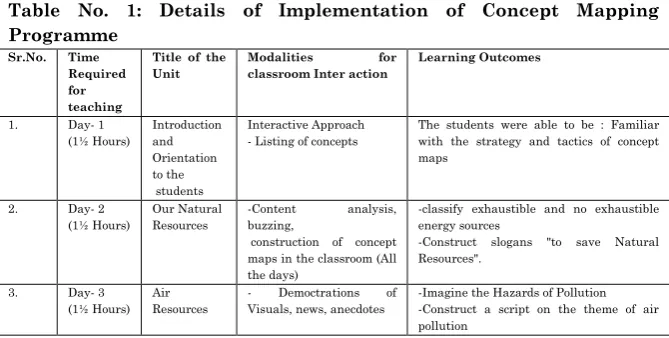
An elaborate programme on development and tryout of certain concept map was prepared following mental endeavors which would create the input for the students of secondary schools. The programme comprised of content analysis of key terms and concepts, different concept maps on the sub topics of our Natural Resources, Worksheets based on the concept mapping activity, variety full classroom tactics and activities, assignment and self learning through internet.
Table No. 1: Details of Implementation of Concept Mapping Programme
Sr.No. Time Required for teaching
Title of the Unit
Modalities for classroom Inter action
Learning Outcomes
1. Day- 1
(1½ Hours) Introduction and Orientation to the students Interactive Approach - Listing of concepts
The students were able to be : Familiar with the strategy and tactics of concept maps
2. Day- 2
(1½ Hours)
Our Natural Resources
-Content analysis, buzzing,
construction of concept maps in the classroom (All the days)
-classify exhaustible and no exhaustible energy sources
-Construct slogans "to save Natural Resources".
3. Day- 3
(1½ Hours) Air Resources
- Democtrations of Visuals, news, anecdotes
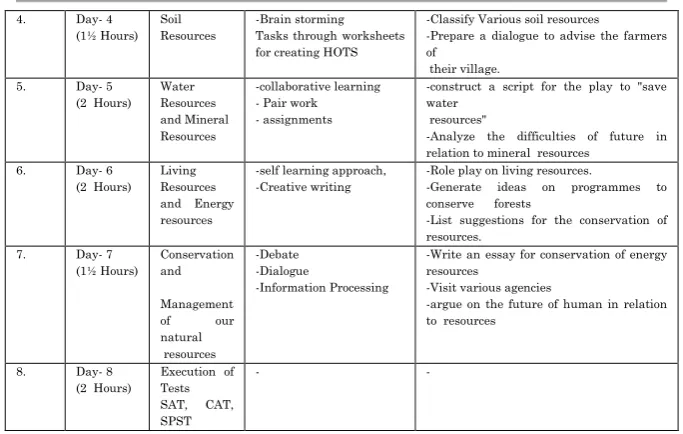
4. Day- 4 (1½ Hours)
Soil Resources
-Brain storming Tasks through worksheets for creating HOTS
-Classify Various soil resources -Prepare a dialogue to advise the farmers of
their village.
5. Day- 5
(2 Hours) Water Resources and Mineral Resources
-collaborative learning - Pair work - assignments
-construct a script for the play to "save water
resources"
-Analyze the difficulties of future in relation to mineral resources
6. Day- 6
(2 Hours) Living Resources and Energy resources
-self learning approach, -Creative writing
-Role play on living resources.
-Generate ideas on programmes to conserve forests
-List suggestions for the conservation of resources.
7. Day- 7
(1½ Hours)
Conservation and
Management
of our
natural resources
-Debate -Dialogue
-Information Processing
-Write an essay for conservation of energy resources
-Visit various agencies
-argue on the future of human in relation to resources
8. Day- 8
(2 Hours)
Execution of Tests SAT, CAT, SPST
- -
The table shows that the programme for concept mapping encompassed all the topic of the chapter 21, of class IX text book, Seven concept map were developed using various teaching learning activities and nearly 12 hours to complete the treatment. the data shows that the Development of Concept Mapping programme was a comprehensive programme.
6.0 DATA ANALYSIS AND INTERPRETATION:
Table 2: Comparison of the students in the Experimental and the controlled group in relation to score on SAT
SAT N Mean S.D. SED t ratio sig.
Cont. 54 10.48 3.19 0.43 - 7,646 0.00
exp. 54 15.90 3.64 049
Table 2 indicates that the t value obtained from the mean scores of SAT of the exp. and the controlled group is - 7.646. The significance value obtained here is 0.00 which is less than 0.05, So, Ho there is no significant difference between the mean
group for SAT . The S. D. exp. group on SAT is 3.64 which is significantly higher than S. D. of the controlled group. Thus, this indicates that the exp. group is higher in scores on SAT than controlled group.
Table 3: Comparison of the students in the Experimental and the controlled group in relation to score on CAT
N Mean S.D. SED t ratio sig.
Cont. -CAT 54 9.01 2.07 0.28 - 17,479 .00
Exp.- CAT 54 18.93 3.93 0.53
From the table 3 can be seen that at df =53, the t -ratio for the students in the experimental and the controlled group in relation to their scores on CAT is -17,479. Which is less than the significance value obtained here is 0.00. Hence, Ho2 : There
is no significant difference between the mean scores of concept attainment Test (CAT) of the experimental and the controlled group is rejected.
The mean score of experimental group on CAT is 18.57 which is significantly higher than the mean score of the controlled group on CAT. The standard deviation of exp. group on CAT is 3.93 which is significantly higher than the controlled group on CAT. Thus this indicates that the experimental group is significantly higher in their ability of concept attainment.
Table 4: Comparison of the students in the Experimental and the controlled group in relation to their scores on SPST
N Mean S.D. SED t ratio sig. P value
Cont. -SPST 54 10.25 3.85 0.52 - 6.04 .00
Exp.- SPST 54 15.75 4.83 0.65
Table 4 indicates that the t value obtained from the mean scores of the experimental and the controlled group on the SPST (Science Processing Skill Test) is -6.04. The significance P value obtained here is .00 which is less than 0.05. So, Ho3 : "
The mean score of experimental group on SPST is 15.75, which is significantly higher than the mean score of the controlled group on SPST. The standard deviation of exp. group is 4.83 which is higher than the controlled group on SPST. Thus, this interpretation indicates that the experimental group is significantly higher than the controlled group in their achievement of Science Process Skills.
Table 5: Comparison of the Students of the Experimental group on their Total scores in relation to Gender
Male Female Total
Total 41 13 54
Mean(M) 48.20 56.69 50.24
Std. deviation (S.D.) 10.97 5.02 10.49
Std. Error (SE) 1.71 1.39 1.43
ANOVA Summery :
Sum of Squares
df Mean
Square
F Sig.
Between Groups 712.66 1 712.66
Within Groups 5123.87 52 98.52 7.233 0.010
Total 5836.87 53
Table 5 indicates that the F-ratio derived from the standard error of the difference between the mean scores of male and female students is 7.233.
The significance value is 0.010 which is 7.233 less than 0.05. This shows that the Ho13.
"There is no significant difference between the mean score of Male and Female of experimental group on their total score" is rejected.
The mean scores of the female students of the experimental group on their total score is 56.69. Which is significantly higher than that of the total scores of male students of the experimental group i.e. 48.19.
7.1 FINDINGS OF THE STUDY:
1. The experimental group is higher on the post test's scores of Science Achievement Test (SAT) than controlled group.
2. The experimental group is significantly higher on the post test of Concept Attainment Test (CAT) than that of controlled group. hence, it cloud be said that the experimental group had performed in building up of concept maps.
3. The experimental group scored significantly better on the scores of Science Process Skills Test. Compared to controlled group. Hence, it could be said that the effectiveness of development of concept maps had shown positive effect on the science process skills of the experimental group.
4. In experimental group it was found that the students had better performed better in concept attainment test than that of science achievement test. They have higher ability in Science Achievement Test than that of science process skill Test. the students of experimental group have higher ability in concept attainment than their ability in science process skills. 5. The female students of the experimental group on their total scores have higher achievement than that of male students of the experimental group.
The area had not made any influence on the performance of the students of the experimental group on their total score.
6. The results of Science Process Skills Test (SPST) shows that,
The girls and boys of the experimental group do not show any difference on the scores of SPST. i.e. SPST scores have not shown any gender difference.
7.2 RECOMMENDATIONS:
After completing the experiment, analysis and interpretations, some recommendations are presented for the parishioners. The intention of recommendations is to enhance the quality of the educational practices, competence, performance and evaluation.
7.2.1 Recommendations for teachers:
(i) The teachers should develop concept maps for each lesson of their textbooks, which can help them to overview the chapter and also they can search out cause-effect relationship, logical connectedness and sequence of each concept, sub concepts and coordinate concepts.
(ii) During classroom instruction the teachers should develop various tactics to make learning possible.
(iii) The teachers should enhance Higher Order Thinking by executing creative tactics to construct concept maps.
(iv) Concept map construction develops certain skills like visualization and relationship of concepts, Generalization, critical evaluation, creation and construction. Hence, the teachers should develop tasks and activity based teaching-learning processes in their class room.
(v) The teachers should make their students to learn concept and Science Process Skills using this strategy.
7.2.2 Recommendations for Teacher -educators:
(i) The teacher-educators should as an innovation in their practices, develop and create strategies of concept mapping for their instruction.
(ii) The lesson planning of science should include concept-maps and construction of concept map during ongoing class room interaction.
objectives and evaluation tests in terms of higher order thinking and for execution of concept maps, variety full tactics to make their classrooms as learning hubs, with learning sources and resources.
(iv) The exposure to pre-service teachers' active learning processes would generate creative ideas, critical analysis, generalization and evaluation among them.
(v) During practice teaching such innovative practices should be carried out to evaluate its effectiveness and for further modifications.
7.2.3 Recommendations for the Text-book Writers:
(i) The new textbooks of science should be written with identification of all concepts and sub concepts. For each chapter there should be comprehensive concept maps.
(ii) There should be shown appropriateness of each concept, its logical relation with other concepts, cause-effect relationship of concepts, connectedness of concepts.
(iii) Science is the subject, building upon certain fundamental concepts. Hence, learning of concepts is a prior for the students. The pedagogy of concept map construction would enhance and generate learning among students.
(iv) The writers should suggest various higher order thinking tasks, experiments and activities for the students, while learning through concept maps.
(v) Science text books employ formal and serious approach to present the content. Instead of it, processes based, concept-map based text books raise the level of interest, and also the receptivity of the content.
7.3 SUGGESTIONS FOR FURTHER RESEARCHES:
(i) Development of concept maps integrating the Blended learning Design for the secondary school students to measure their higher order thinking.
(ii) Development and execution of lesson plans using concept maps in science class room.
(iii) Creation of concept maps for the understanding and integration of new ideas in to students' thinking.
(iv) Analysis of concepts of class VIII, IX, X text books of science using concept mapping.
(v) Learning through concept map design for mathematics, social studies and languages.
(vi) Effectiveness of concept maps on students' cognitive skills.
(vii) To investigate how well students understand the correct connections among concepts in a subject, to document the nature and frequency of students' misconceptions and to capture the development of students' ideas.
(viii) Creation of new knowledge e.g. transforming tacit knowledge into an organizational resource, mapping team knowledge.
(ix) Development of concept maps to communicate complex ideas, and brain storming.
(x) Construction of integrated knowledge structures by concept mapping and visualization of concepts and their relationship.
(xi) Construction of concept maps as a tool of assessment in various subjects.
(xii) Construction of concept maps in the facilitation of creative thinking.
7.4 MY RESEARCH EXPERIENCE:
adjoining science concepts and linking them, the holistic approach of content analysis was developed. Which could be extremely bane facial for the future practices of constructivist lesson planning for me and my student.
While constructing the concept map the students were also found awesome. They were eager and keen to develop concept maps under the process of HOTS, activities, experiences and worksheets. They reflected that the science is not merely a subject of facts, information and cramming up. They realized that the concepts are the basic of every scientific idea. Their conceptual perception and deriving of concepts through various ideas made them autonomous learners during this research experiment. Their performance was reflected in their concept attainment test, science process skills tests and science achievement test.
This small research has developed an insight of teaching fundamental science concepts through concept mapping which would enable higher order thinking among students.
Flying from the abstract concepts to concrete concept maps created and generated constructivist learning among the students. Teaching factual information alone does not help students to develop science concepts at a higher level, but it was found that the specific attempts through learning move up the hierarchical ladder.
Such research practice could add up positive effect and result in classroom practices and researches if it is replicated.
REFERENCES:
Asubel D.P.(1963). The psychology of meaningful verbal learning. New York:Gvune and Stratton.
Asubel D.P., Novak J. d. & Hanesian, H. (1978) educational psychology : A cognitive view (2nd ed.) New York :Holt, Rinehart and Winston
Edwards. J., & Eraser K. (1983) Concept maps as reflections of conceptual understanding, Research in Science Education, 13, 19-26.
Hoffman B. (1962), The tyranny of testing. New York : Carwell-collier.
Macnamara, J. (1982) Names for things : A study of Human learning : Cambridge:MA:M.I.T. Press.
Marsha Veil & Bruce Joyce, Models of Teaching.
Mayer, R.E. (2004), should there Be a Three-strikes Rule Against Pure discovery Learning ? The case for Guided Methods of Instruction. American Psychologist 59(1), 14-19.
Novak J. D. & Alberto J. Canvas (2008) Florida Institute for Human & Machine Cognition, Pensacola F1, 32-502. Rao Manjula P., Regional Institute of Education, Mysore, India,
Effect of concept-mapping in science on science Achievement, cognitive skills and attitude of students. Meena Kharatmal & Nagarjuna G., TIFR, Mumbai, India,
Redifined concept maps for science Education : A feasibility study.
Suveller, J., Krischner, P.A. & Clark, R. B. (2007). Why minimally guided teaching techniques do not work : a reply to commentaries Educational Psychologist, 42(2), 115-121.
Jim Vanides, Yue Yin, Miki Tomita, Maria Araceli Ruiz-Primo, (2005) National Science Teachers Association (NSTA), Reprinted from science scope, Vol.28, No.8, Summer, 2005.
Spady, W.G.(1994) Choosing outcomes of significance. Educational Leadership, 51(6), 18-22.
Pendley et.al.(1994), Lee and Fensham(1990) Stensvold & Wilson (1992)
Nakhlen (1992), Herron (1996), Taber(1997) sanger & Greenbowe (1999).
Joel J. Mintzes, Uni. of North carolina at Wilmington. James H. Wanderree, Louisiana State University.
National Association for Research in Science Teaching (NARST) Chi, M.T.H.R. Glaser and M.J.Far 1988. The nature of
expertire, Hillsdale, NJ : lawrence Earlbaum.
Duschl, R. a. 2003 Assessment of Inquiry. In Everyday assessment in the science classroom, eds. J. M. Atkin and J. E. Cottey 41-59, Arlington, VA : NSTA Press. Bloom, B, s. (1956) Taxonomy of Educational Objectives. The
classification of Educational Goals. New York : David Mackay.
Spady, W. G. (1994) Choosing outcomes of significance Educational leadership, 51(6), 18-22. http:// www.
uncwil.edu/people/minzes. web page :
Science.coe.uwf.edu / NAEST/ NARST. html.