Available online:
https://edupediapublications.org/journals/index.php/IJR/
P a g e | 1086Encrypted Scaling and Cropping by Parlier Cryptosystem
using Key Encryption
Sampathirao Raju & Indurthi Ravindra Kumar
Assistant Professor, Dept. of IT, JB Institute Of Engineering & Technology Hyderabad,
Email Id: - [email protected] ; Email Id: - [email protected]
ABSTRACT
The advancement of distributed computing and an extreme increment in picture measure are influencing the outsourcing of
picture stockpiling and handling an appealing business to demonstrate. Though this outsourcing has many favorable circumstances, determining information classification in the cloud is one of the primary concerns. There are cutting edge encryption plans for learning classification in the cloud. In any case, such plans don't authorize cloud datacenters to perform operations over scrambled pictures. In this paper, we address this worry by proposing 2DCrypt, an adjusted Paillier
cryptosystem-predicated picture scaling and editing plan for multi-utilizer settings that authorizations cloud datacenters to scale and product a picture in the encoded space. To expect a
high stockpiling overhead came about because of the straightforward per-pixel encryption, we propose a space-proficient
tiling plan that approvals tile-level picture scaling and trimming operations. Basically, in lieu of encoding every pixel independently, we can scramble a tile of pixels. 2DCrypt is to such an extent that numerous clients can view or process the pictures without sharing any encryption keys – an essential alluring for down to earth
arrangements in legitimate associations. Our examination and results demonstrate that 2DCrypt is IND-CPA secure and brings about a satisfactory overhead. When scaling a 512 * 512 picture by a factor of two, 2DCrypt requires a picture utilizer to download roughly 5:3 times a greater
number of information than the un-encoded scaling and need to work around 2:3 seconds more to obtain the scaled picture in plaintext.
Key words: - Image Outsourcing, Hidden
Image Processing, Encrypted Scaling and
Cropping, Parlier Cryptosystem, Key,
Available online:
https://edupediapublications.org/journals/index.php/IJR/
P a g e | 10871. INTRODUCTION
Distributed computing is an appealing
worldview for getting to basically illimitable
capacity and
Computational assets. [1]With its
compensation as-you-go display, customers
get to quick and dependable equipment,
paying just for the assets they require to use
without the hazards of cosmically
tremendous forthright speculations.
[3-4]These days, building applications for sight
and sound substance facilitated in
frameworks oversaw by outsider cloud
suppliers is predominant. Pictures may
contain very touchy and individual data. If
not for fended, delicate data in the pictures
may be liable to unapproved gets to by cloud
suppliers.[5] A verdant way to deal with
forefend classification of outsourced
pictures is to encode the pictures up to they
are put away in the cloud. Be that as it may,
once this is done, it may not be conceivable
to perform fundamental picture preparing
operations, for example, scaling and editing.
For example, a remote pathologist, getting to
a tremendously epic histopathology picture,
would expect first to get to a downsized
variant,[9] and after that perform scaling and
editing operations to get a perfect
determination for the District of Interest
(ROI). With pictures that are scrambled
using standard encryption procedures, such
operations would require the customer
machine to download the full scrambled
pictures, decode them on the nearby
machine, and after that play out the
operations. This influences the work process
to moderate and wasteful in light of the fact
that a plenty of information is pre-gotten and
prepared.
2. RELEGATED WORK 2.1Existing System
An Image Outsourcer is in charge of tending
to security and protection concerns added to
picture outsourcing. [7]To accomplish this,
the Image Outsourcer scrambles the picture
in advance of sending it to the cloud
datacenter. Further, the Image Outsourcer
can store early pictures on a cloud server,
destroy/alter subsisting ones, and oversee
get to control strategies, (for example,
read/indite get to rights) to manage access to
the pictures put away on the cloud server.
Keeping in mind the end goal to give the
multi-utilizer bolster, [8]we lengthen the
changed Paillier cryptosystem with the end
goal that every utilizer has her own key to
encode or decode the pictures. In this
manner, incorporating an early utilizer or
re-Available online:
https://edupediapublications.org/journals/index.php/IJR/
P a g e | 1088encryption of subsisting pictures put away in
the cloud.
2.2Proposed System
Various methodologies, including yet are
not outlined to, Public Key Cryptosystem
(PKC), watermarking, [10]Shamir's mystery
sharing and turmoil predicated encryption,
have been proposed to rampart pictures. To
endorse cloud datacenters to perform
operations on the scrambled picture, halfway
homomorphic cryptosystem-predicated
arrangements have been proposed. It offers
either mix or augmentation operations.
[6]Barely any works have been proposed for
testing scrambled pictures predicated on
powerful extraction of picture highlights.
Yet proposed tile-level encryption plot
2DCrypt can have less computational and
capacity overheads than the open per-pixel
encryption, the adaptability of separating an
individual pixel is muddled.
3. IMPLEMENTATION
3.1 Picture Outsourcer: This substance
outsources the putting away and preparing
(i.e., scaling and editing) of pictures to an
outsider cloud supplier. It could be an
individual or an association, for example, a
doctor's facility. In the last case, a few
clients can go about as an Image Outsources.
Regularly, this element claims the picture.
An Image Outsourcer is in charge of tending
to security and protection concerns attached
to picture outsourcing. To accomplish this,
the Image Outsourcer scrambles the picture
up to sending it to the cloud datacenter.
Further, the Image Outsourcer can store
early pictures on a cloud server,
destroy/adjust subsisting ones, and oversee
get to control approaches, (for example,
read/indite get to rights) to direct access to
the pictures put away on the cloud server.
3.2 Cloud Server: It is the segment of
foundation gave by a cloud convenience
supplier, for example, Amazon S31, for
putting away and handling pictures. It stores
encoded pictures and access strategies used
to manage access to the pictures. Subsequent
to making endorse checks, it recovers an
asked for picture from its picture store. In
the event that the entrance ask for satisfies
get to approaches, it scales or potentially
trims pictures in an encoded way, i.e.,
without unscrambling them.
3.3 Image Utilizer: it is endorsed by the
Image Outsourcer to get to the asked for
picture put away in a scrambled frame on
the Cloud Server. Contingent upon
authorize, an Image Utilizer can issue either
read demand or process ask for (i.e., scaling
Available online:
https://edupediapublications.org/journals/index.php/IJR/
P a g e | 1089Image Utilizer unscrambles the picture
returned by the demand. Note that in a
multi-utilizer setting, (I) an Image Utilizer
can adjust a picture that will be available by
other Image Users, or (ii) an Image Utilizer
can get to pictures handled by other Image
Users. In the two cases, Image Users don't
require to allot any keying material.
3.4 Key Management Ascendancy
(KMA): It causes and denies keys. It
induces a customer and server key match for
every utilizer, be it an Image Outsourcer or
Image Utilizer. The customer and the server
side keys are safely transmitted to the
utilizer and the Cloud Server, separately. At
whatever point required (verbalize in key
lost or purloined cases), the KMA disavows
the keys from the framework with the
fortress of the Cloud Server.
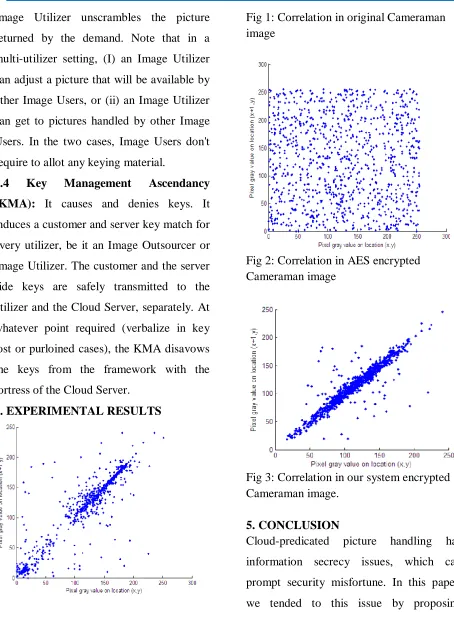
4. EXPERIMENTAL RESULTS
Fig 1: Correlation in original Cameraman image
Fig 2: Correlation in AES encrypted Cameraman image
Fig 3: Correlation in our system encrypted Cameraman image.
5. CONCLUSION
Cloud-predicated picture handling has
information secrecy issues, which can
prompt security misfortune. In this paper,
Available online:
https://edupediapublications.org/journals/index.php/IJR/
P a g e | 10902DCrypt, a changed Paillier
cryptosystem-predicated plot that authorizes a cloud server
to perform scaling and editing operations
without taking in the picture content. In
2DCrypt, clients don't require to allot keys
for getting to the picture put away in the
cloud. Subsequently, 2DCrypt is consistent
for situations where it isn't alluring for the
picture utilizer to keep up per-picture keys.
Besides, 2DCrypt is more reasonable than
subsisting plans predicated on Shamir's
mystery sharing since it neither utilizes more
than one datacenter nor hypothesizes that
various foes could conspire by getting to a
specific number of datacenters. To make
2DCrypt commonsense, we propose a few
enhancements to decrement overheads came
about because of the use of the altered
Paillier cryptosystem. To start with, we
proposed a space effective tiling plan that
endorses the cloud to perform per-tile
operations. In 2DCrypt, we put various
pixels in a tile, and encode the tile in lieu of
scrambling every pixel freely. Moreover, we
enhanced the changed Paillier plan to
encircle its stockpiling essential. Because of
these enhancements, 2DCrypt requires
roughly 40 times less distributed storage
than the verdant per-pixel encryption. The
computational overhead is furthermore
essentially diminished due to less
encryptions and decodings rounds. The
correct computational overhead and the
information required by the picture utilizer,
be that as it may, are subject to the picture
estimate and the client's scaling and
trimming parameters We trust that 2DCrypt
can be extended in numerous ways. An
ostentatiously recognizable heading is to
extend this work for compacted pictures.
Another approach can use our origination
for tending to security issues in more
specific pictures, for example,
histopathology pictures and G.I.S maps. It
will intrigue to examine in the event that we
can use properties of these particular
pictures to additionally diminish overheads.
Another conceivable future work can stretch
our work to video preparing in scrambled
spaces.
6. REFERENCE
[1] Manoranjan Mohanty, Muhammad
Rizwan Asghar, and Giovanni Russello
2DCrypt: Image Scaling and Cropping in
Encrypted Domains IEEE Transactions on
Information Forensics and Security
(Volume:PP , Issue: 99 ),24 June 2016
[2] M. Naehrig, K. Lauter, and V.
Vaikuntanathan, “Can homomorphic
Available online:
https://edupediapublications.org/journals/index.php/IJR/
P a g e | 1091the 3rd ACM Workshop on Cloud
Computing Security Workshop, 2011, pp.
113–124.
[3] A. Shamir, “How to share a secret,”
Communications of the ACM, vol. 22, pp.
612–613, November 1979.
[4] M. Mohanty, W. T. Ooi, and P. K. Atrey,
“Scale me, crop me, know me not:
supporting scaling and cropping in secret
image sharing,” in Proceedings of the 2013
IEEE International Conference on
Multimedia & Expo, San Jose, USA, 2013.
[5] K. Kansal, M. Mohanty, and P. K. Atrey,
“Scaling and cropping of wavelet-based
compressed images in hidden domain,” in
Multimedia Modeling, ser. Lecture Notes in
Computer Science, 2015, vol. 8935, pp.
430–441.
[6] C.-C. Thien and J.-C. Lin, “Secret image
sharing,” Computers and Graphics, vol. 26,
pp. 765–770, October 2002.
[7] T. Bianchi, A. Piva, and M. Barni,
“Encrypted domain DCT based on homomorphic cryptosystems,” EURASIP
Journal on Multimedia and Information
Security, vol. 2009, pp. 1:1– 1:12, January
2009.
[8] X. Sun, “A blind digital watermarking
for color medical images based on PCA,” in
Proceedings of the IEEE International
Conference on Wireless Communications,
Networking and Information Security,
Beijing, China, August 2010, pp. 421–427.
[9] N. K. Pareek, V. Patidar, and K. K. Sud,
“Image encryption using chaotic logistic
map,” Image and Vision Computing, vol.
24, pp. 926– 934, September 2006.
[10] W. Lu, A. L. Varna, and M. Wu,
“Confidentiality-preserving image search: A
comparative study between homomorphic
encryption and distance-preserving
randomization,” IEEE Access, vol. 2, pp.
125–141, February 2014.
Authors
SAMPATHI RAO RAJU
Currently working as Assistant professor in
the department of Information Technology
in JB institute of engineering and
Technology (UGC AUTONOMOUS) form
16 -JAN-2017 to till date. Worked as
Assistant professor in the department of
Available online:
https://edupediapublications.org/journals/index.php/IJR/
P a g e | 1092Engineering College from 15-DEC-2015 to
20-DEC-2016.
INDURTHI RAVINDRA KUMAR
Currently working as Assistant professor in
the department of Information Technology
in JB institute of engineering and
Technology (UGC AUTONOMOUS) form