Banothu BalaSubramanyam
Assistant professor,Dept. of EEE, Madhira institute of technology & sciences, Telangana, India
Abstract: In order to exploitation distributed generation (DG) unit interfacing converters to actively recompense harmonics, this paper suggests an enhanced current control approach, which effortlessly assimilates system harmonic mitigation capabilities with the primary DG power generation function. As the proposed current controller has two well- decoupled control branches to independently control fundamental and harmonic DG currents, local nonlinear load harmonic current detection and distribution system harmonic voltage detection are not necessary for the proposed harmonic compensation method. Furthermore, a closed-loop power control scheme is employed to directly derive the fundamental current reference without using any phase-locked loops (PLL). The proposed power control scheme effectively eradicates the influences of steady-state fundamental current tracking errors in the DG units. Thus, an accurate power control is realized even when the harmonic compensation functions are activated hybrid system operates under normal conditions which include normal room temperature in the case of solar. The simulation results are obtainable to exemplify the operating principle, feasibility and reliability of this proposed system.
Keywords- Index Terms-Active power filter, distributed generation, harmonic compensation, harmonic extraction, phase-locked loop (PLL), resonant controller, virtual impedance.
I. INTRODUCTION
Today, there may be an increasing use of small-scale renewable electricity assets into present-day electric grids, due to the fact the cutting-edge developing demands for electrical strength [1, 2]. Photovoltaics, wind energy, and hydroelectric are 3 of the renewable energies which might be ordinarily used; they're easy for the environment and inexhaustible. This renewable energy has skilled speedy technological improvement, which makes them at low priced
charges. This advantage lets in the electricity security of countries to lessen imports of fossil fuels, which has the same opinion to maintain a lower cost than usual fees and improve the usual of the dwelling without harming the environment, mainly in a time when the financial disaster is well timed. Another advantage, they could effortlessly guide the electric community in remote websites and rural regions [2]. As shown in Fig. 1, or the charge of funding of wind strength turned into more essential in 2010, but he started out dropped in 2012 and 2013 to 12% in assessment to the solar energy that has skilled the equal trouble a year later compared to the wind, in spite of the economic issues many countries help applications connecting renewable power with international and neighborhood power grid. In order to combine specific styles of renewable electricity assets, the idea of microgrid (MG) became proposed several years ago [3]. A microgrid may be defined as part of the grid such as high power movers, strength electronics converters, dispensed electricity storage structures, and nearby masses [4] This makes the electric community more flexible and shrewd [5]. Microgrids and virtual strength flora (VPPs) are low voltage distribution network concepts which could take part in energetic network management of a clever grid [6, 7]. They are getting an essential idea to integrate dispensed era (DG) and energy storage structures [5, 8]. The hobby of DG grows and is taking importance [9] whilst it's miles composed of various electricity assets: Photovoltaics, wind power and hydroelectrics with electric energy storage (EES) (e.g., batteries or exceptional capacitors) [6] forming a Hybrid Energy System (HES) [2], because they are able to effortlessly aid the electric community in island mode and rural regions or grid- connection mode. Other non-renewable based totally strength systems (diesel or fuel), whose generation profile can be without difficulty controlled also are probably to be incorporated into microgrids [10].
This offers the consumer the possibility to supply and garage a part of the electric electricity of the
complete gadget [9]. The use of DPGS of power systems makes no experience without the usage of allotted storage systems to deal with the power balances [5]. Microgrids have to be able to locally remedy power issues and for this reason growth flexibility [11]. The increase carried in latest years in energy electronics makes this latter very appealing while integrating renewable electricity sources, distributed energy storage systems, and energetic masses [4, 12]. The Power Electronic Converters are generally used as interfaces between those devices and the MG, performing as a voltage source (voltage supply inverter VSI, in the case of AC network micro) [3, 8, 12]. MGs want so as to function intelligently in each grid and island mode [13]. At the equal time, AC and DC assets sometimes coexist in a realistic microgrid. The interfacing converters are normally connected in parallel [3]. The manipulating of the parallel VSIs forming an MG has been investigated in final years [12]. Thus, the finest project is to make sure a balance and voltage law for offering a better electricity great for the consumer [9]. In order to avoid circulating currents most of the converters without the use of any essential verbal exchange between them, the stoop-manage method is regularly applied [5, 11]. This is a kind of collaborative manage used for percentage active and reactive strength between VSIs in a cooperative manner [12]. These manage loops, additionally
referred to as P − ω and Q − E droops, have been
applied to connect inverters in parallel in uninterruptible power delivery (UPS) structures to keep away from mutual manage wires whilst acquiring appropriate strength sharing [5, 11, 14, 15]. However, despite the fact that this approach achieves excessive reliability and versatility, however, the rate to pay is that the sharing is acquired through voltage and frequency deviations of the machine (load established frequency and amplitude deviations) [12, 16, 17] this that restrict its application [5, 11]. In order to remedy these troubles, an external control loop named secondary manipulate is carried out inside the microgrid primary control to restore the nominal values frequency and amplitude in the microgrid [4, 5, 11, 12]. An extra tertiary manipulates can be used to bidirectional manage the electricity flowing. In case of AC microgrids, the goal is to alter the energy flows between the grid and the microgrid on the factor of not unusual coupling (PCC) [5, 11,
18, 19]. In international locations with hydropower capability, small hydro mills are used on the distribution degree, a good way to sustain the application community in dispersed or faraway places [20].
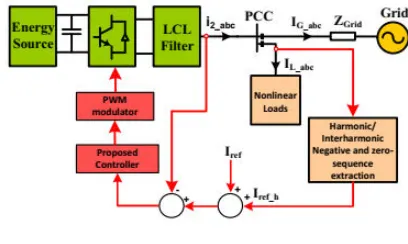
Fig. 1 shows the block diagram of a three-phase, fourwire, grid-connected DG unit, in which a common threephase voltage-source inverter (VSI) is connected to the grid via an LCL filter. The local loads are connected to the PCC, which are placed at DG unit terminals. As depicted in Fig. 1, the DG output currents are regulated by the proposed controller, while the harmonic extraction block extracts the loads harmonic/interharmonic currents and produce the harmonic/interharmonic currents references to inject a set of pure sinusoidal balanced three-phase grid currents.
Fig. 1. Compensation scheme for current-controlled DG unit
II. PROPOSED CONTROL SCHEME
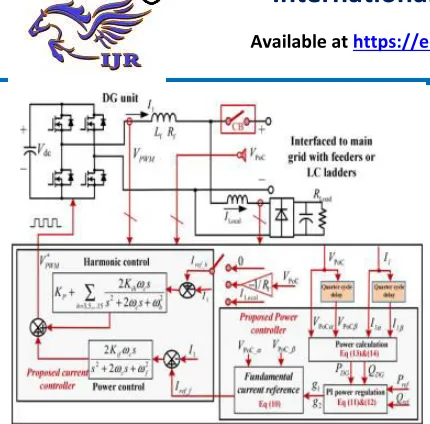
Fig.2 DG unit with the proposed control scheme
The energy surplus of the DG Grid can be sent to the utility system. The role of the battery as the energy storage becomes less important because the power is balanced by the utility grid. In this case, the only function of the battery is to eliminate frequent power transfer between the dc and ac link. The dc/dc converter of the battery can be controlled as the energy buffer using the technique [15].
Fig. 3. Structure of the proposed robust controller.
The complete structure of the proposed controller is shown in Fig. 3. The first part of the controller measures the PCC voltage and sends it to its main part. The second part of the controller uses a high-order sliding mode differentiator to calculate the time derivatives of the virtual control laws φ1 and φ2 in (15) and (19), containing both disturbances and uncertainties, and sends the estimated values to its main part.
The main converter is designed to operate bidirectionally to incorporate complementary characteristic of wind and solar sources [16], [17].
The control objectives of the main converter are to maintain a stable dc-link voltage for variable dc load and to synchronize with the ac link and utility system. The combined time average equivalent circuit model of the booster and main converter is shown in Fig. 4 based on the basic principles and descriptions in [18] and [19] for booster and inverter respectively. In order to maintain stable operation of the DG Grid under various supply and demand conditions, a coordination control algorithm for booster and main converter is proposed based on basic control algorithms of the grid interactive inverter. The control block diagram is shown in Fig.5.
Fig.4. Time average model for the booster and main converter
Fig. 5.The simulation control block diagram.
III. SIMULATION RESULTS
Simulink is the dominant, graphical interfaced, modeling and simulation tool, used in many engineering fields. Sim Power Systems (SPS) developed by Hydro-Quebec Research Center (IREQ) is a Simulink toolbox that provides multiple model components, all based on electromechanical and electromagnetic equations, for the simulation of power systems and machine drives.
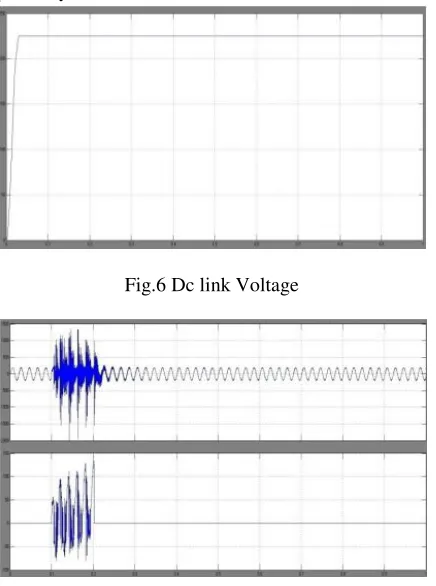
Fig.6 Dc link Voltage
Fig.7 Grid Load voltage and grid without controller
Fig.8 Grid Load Voltage and Current in phase with each other
IV. CONCLUSION
In this paper, a simple harmonic compensation strategy is proposed for current-controlled DG unit interfacing converters. By separating the conventional proportional and multiple resonant controllers into two parallel control branches, the proposed method realizes power control and harmonic compensation without using any local nonlinear load harmonic current extraction or PoC harmonic voltage detection. Moreover, the input of the fundamental power control branch is regulated by a closed-loop power control scheme, which evades the adoption of PLLs. The proposed power Generation of PV Cell with MPPT control method ensures accurate power control even when harmonic compensation tasks are activated in the DG unit or the PoC voltage changes.
REFERENCES
[1] G. Chicco and P. Mancarella, "Distributed multi-generation: A comprehensive view," Renewable and Sustainable Energy Reviews, vol. 13, pp. 535-551, 4// 2009.
[2] A. Llaria, O. Curea, J. Jiménez, and H. Camblong, "Survey on microgrids: Unplanned islanding and related inverter control techniques," Renewable Energy, vol. 36, pp. 2052-2061, 8// 2011.
[4] J. C. Vasquez, J. M. Guerrero, J. Miret, M. Castilla, V. de, x00F, et al., "Hierarchical Control of Intelligent Microgrids," Industrial Electronics Magazine, IEEE, vol. 4, pp. 23-29, 2010.
[5] J. M. Guerrero, J. C. Vasquez, J. Matas, G. V. Luis, and M. Castilla, "Hierarchical Control of Droop-Controlled AC and DC Microgrids- A General Approach Toward Standardization," Industrial Electronics, IEEE Transactions on, vol. 58, pp. 158-172, 2011.
[6] O. Palizban, K. Kauhaniemi, and J. M. Guerrero, "Microgrids in active network management—Part I: Hierarchical control, energy storage, virtual power plants, and market participation," Renewable and Sustainable Energy Reviews.
[7] K. H. Sirviö, "Integrating low voltage distribution systems to distribution automation," Master, Faculty of technology, University Of Vaasa, Finland, 2012.
[8] J. M. Guerrero, J. C. Vasquez, and R. Teodorescu, "Hierarchical control of droop-controlled DC and AC microgrids- a general approach towards standardization," in Industrial Electronics, 2009. IECON '09. 35th Annual Conference of IEEE, 2009, pp. 4305-4310.
[9] J. M. Guerrero, J. C. Vasquez, J. Matas, J. L. Sosa, and L. G. de Vicuna, "Parallel operation of uninterruptible power supply systems in microgrids," in Power Electronics and Applications, 2007 European Conference on, 2007, pp. 1-9.
[10] J. Rocabert, A. Luna, F. Blaabjerg, Rodri, x, and P. guez, "Control of Power Converters in AC Microgrids," Power Electronics, IEEE Transactions on, vol. 27, pp. 4734-4749, 2012.
[11] J. M. Guerrero, M. Chandorkar, T. Lee, and P. C. Loh, "Advanced Control Architectures for Intelligent Microgrids-Part I: Decentralized and Hierarchical Control," Industrial Electronics, IEEE Transactions on, vol. 60, pp. 1254-1262, 2013.
[12] J. C. Vasquez, J. M. Guerrero, M. Savaghebi, J. Eloy-Garcia, and R. Teodorescu, "Modeling, Analysis, and Design of Stationary-Reference-Frame Droop-Controlled Parallel Three-Phase Voltage
Source Inverters," Industrial Electronics, IEEE Transactions on, vol. 60, pp. 1271-1280, 2013.
[13] S. C. Bhattacharyya, "Review of alternative methodologies for analysing off-grid electricity supply," Renewable and Sustainable Energy Reviews, vol. 16, pp. 677-694, 1// 2012.
[14] J. M. Guerrero, J. C. Vasquez, and R. Teodorescu, "Hierarchical control of droop-controlled DC and AC microgrids – a general approach towards standardization," in Industrial Electronics, 2009. IECON '09. 35th Annual Conference of IEEE, 2009, pp. 4305-4310.
[15] J. M. Guerrero, N. Berbel, J. Matas, L. G. de Vicuna, and J. Miret, "Decentralized Control for Parallel Operation of Distributed Generation Inverters in Microgrids Using Resistive Output Impedance," in IEEE Industrial Electronics, IECON 2006 - 32nd Annual Conference on, 2006, pp. 5149-5154.
[16] P. L. Villenueve, "Concerns generated by islanding [electric power generation]," Power and Energy Magazine, IEEE, vol. 2, pp. 49-53, 2004.
[17] M. C. Chandorkar, D. M. Divan, and R. Adapa, "Control of parallel connected inverters in standalone AC supply systems," Industry Applications, IEEE Transactions on, vol. 29, pp. 136-143, 1993.
[18] H. Chaoyong, H. Xuehao, and H. Dong, "Hierarchical control techniques applied in micro-grid," in Power System Technology (POWERCON), 2010 International Conference on, 2010, pp. 1-5.
[19] J. M. Guerrero, J. C. Vasquez, J. Matas, M. Castilla, and L. G. de Vicuna, "Control Strategy for Flexible Microgrid Based on Parallel Line-Interactive UPS Systems," Industrial Electronics, IEEE Transactions on, vol. 56, pp. 726-736, 2009.