Secured Video Using Reversible Texture
Synthesis
Komal M.Patil, Prof.S.P.Deshmukh
M. E, Dept. of E&TC, Smt. Kashibai Navale College of Engineering, vadgaon, Pune, India
Professor, Dept. of E&TC, Smt. Kashibai Navale College of Engineering, vadgaon, Pune, India
ABSTRACT: By utilizing a reversible surface the paper proposes a novel approach for steganography synthe-sister. A surface combination handle re-tests a littler surface video which orchestrates another surface video with a comparative nearby appearance and discretionary size. To hide mystery messages, the paper surface union process into steganography. The calculation covers the source tex-ture video and inserts mystery messages through the procedure of surface amalgamation, with differentiation to utilizing a current cover video and to shroud the messages. This will permit separating mystery messages and the source surface from a stego manufactured surface. It has likewise two separate advertisement vantages. To start with it offers the implanting limit which is straightforwardly relative to the span of the stego surface video and furthermore, the reversible ability can gives usefulness which permits recuperation of the source surface. The calculation can likewise give different quantities of installing limits delivers outwardly sensible surface recordings and recuperate the source texture.
KEYWORDS: Data embedding, example-based approach, reversible, steganography, texture synthesis.
I.INTRODUCTION
The standard explanation behind steganography is to shroud information in a way that keeps the disclosure of concealed messages. The significance of Steganography is secured composing. The use of steganography fuses change of correspondence between two gatherings whose presence is dark to an aggressor and their flourishing depends on after perceiving the nearness of this correspondence. In a stenographic system, the information concealing methodology is started by perceiving a cover medium's overabundance (Bits can be altering without destroying that medium's integrity).The embedding process replaces these abundance bits with data from the covered message to outline a stego medium. The goal of steganography is to keep the puzzle message impalpably. Most stenographic systems accept control over a current picture as a cover medium. While introducing concealed messages into this cover picture, bowing of picture may happen. In perspective of this reason two drawbacks happen .First, the traverse of the cover picture is settled, so more riddle messages are embedded consider more picture winding. Along these lines to keep up picture quality it will give confined introducing capacity to a specific cover picture. Second, that photo steganalysis approach is used to perceive disguised messages in the stego picture. This approach can beat the photo steganography and reveals that a covered message is being passed on in a stego picture.
Steganography is the act of concealing private or delicate data inside something that has all the earmarks of being nothing out of the standard thing. Steganography in the current feeling of the word more often than not alludes to data or a document that has been hidden inside an advanced Picture, Video or Audio record.
II. REVIEW OF LITERATURE
The substance of a 3D shape can frequently be all around caught by its striking element bends. In this dad per [15], K. Xu, D. Cohen-Or, T. Ju, L. Liu, H. Zhang, S. Zhou, and Y. Xiong investigate the utilization of remarkable bends in combining instinctive, shape-uncovering surfaces on surfaces. Their surface combination is guided by two standards: coordinating the course of the surface examples to those of the striking bends, and adjusting the noticeable element lines in the surface to the remarkable bends precisely. They have watched that surfaces integrated by these standards fit actually to the surface geometry, as well as outwardly uncover, even fortify, the shape's basic attributes. They call these component adjusted shape finishing. Their strategy is completely programmed, and presents two novel specialized parts in vector-field-guided surface combination: a calculation that situates the remarkable bends on a surface for obliged vector field era, and a component to-include surface advancement.
To start with, it produces Cubism-like pictures as stego pictures to occupy the programmer's thoughtfulness regarding the message information inserted in them.By utilizing the base shading moving of ±1 to install information bits, the subsequent pixels' shading contrasts between the created Cubism like picture and the stego picture are small to the point that a programmer will fail to acknowledge the presence of the concealed information. The proposed information concealing system is exceptionally appropriate for use in undercover correspondence or mystery keeping. Four measures of randomization of the information message information and the preparing request of them with a mystery key and a few arbitrary number creating capacities have been embraced in the proposed technique. This improves enormously the security of the proposed strategy.
Information concealing strategies onto pictures give devices to ensuring copyright or sending mystery messages, and they are as of now used as a straightforward information gadget of a wireless by identifying an information inserted in a picture with a prepared computerized camera. This paper exhibits a strategy for incorporating surface pictures for inserting subjective information by using the brilliant procedures of creating monotonous surface examples through element learning of a specimen picture. H. Otori and S. Koriyama developed the strategies so that a combined picture can viably cover the installed design, and the example can be powerfully identified from a shot picture. They exhibit the possibility of their methods utilizing surface examples including a picture checked from genuine material..
Information concealing strategies onto pictures give devices to ensuring copyright or sending mystery messages, and they are as of now used as a straightforward information gadget of a wireless by identifying an information inserted in a picture with a prepared computerized camera. This paper exhibits a strategy for incorporating surface pictures for inserting subjective information by using the brilliant procedures of creating monotonous surface examples through element learning of a specimen picture. H. Otori and S. Kuriyama developed the strategies so that a combined picture can viably cover the installed design, and the example can be powerfully identified from a shot picture. They exhibit the possibility of their methods utilizing surface examples including a picture checked from genuine material.
III.PROPOSED SYSTEM ARCHITECTURE
Index Table Generation Process:
The principal procedure is the file table era where we create a file table to record the area of the source fix set SP in the engineered surface. The file table enables us to get to the manufactured surface and recover the source surface totally. Such a reversible installing style uncovers one of the significant advantages our proposed calculation offers.
record table can be resolved utilizing where TPn indicates the quantity of patches in the stego engineered surface. For effortlessness, we picked fitting parameters for Tw, Th, Pw, Ph, and Pd, so that the quantity of sections is a whole number. For instance, if Tw×Th=488×488, Pw×Ph=48×48, and Pd=8, at that point we can produce a file table (12×12) containing 144 passages.
(3)
When we convey source surface to accomplish the way of reversibility, the source patches can be circulated in a fairly scanty way if the manufactured surface has a determination.
That is substantially bigger than that of the source surface, as appeared in Fig. 3.4.2(a).On the opposite, the source patches might be dispersed in a fairly thick way if the manufactured surface has a determination that is marginally bigger than that of the source surface. 3.4.2(b). For the fix circulation, we abstain from situating a source surface fix on the fringes of the engineered surface. This will urge the outskirts to be created by message-arranged surface amalgamation, upgrading the picture nature of the manufactured surface. We additionally characterize the principal need position L1 and the second-need position L2, for two sorts of need areas where ||L1|| and ||L2||, determined in (4), speak to the number in the main need and second-need positions, separately.
(4)
Fig.3.4.2 represents the structure picture where nine source patches are stuck. For instance, a list table Tpw×Tph=12×12 contains 144 passages so ||L1||=25 and ||L2||=25. Given the quantity of patches SPn subdivided from the source surface, the methodology of fix circulation is to disperse fixes consummately on the primary need positions before posting patches on the second-need positions. In light of the determination of the engineered surface, we will have two cases the scanty appropriation and thick conveyance.
Patch Composition Process:
The second procedure of our calculation is to glue the source patches into a workbench to create a sythesis picture. To begin with, set up a clear picture as our workbench where the measure of the workbench is equivalent to the manufactured surface. By alluding to the source fix IDs put away in the list table, we at that point glue the source patches into the workbench.
Source Texture Recovery, Message Extraction, and Message Authentication Procedure
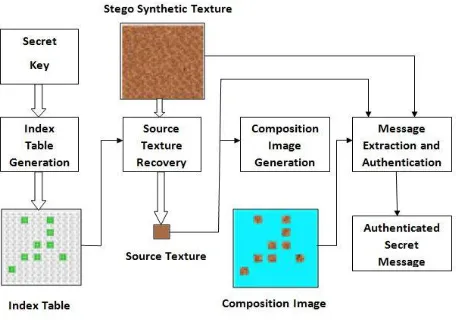
The message removing for the recipient side includes creating the file table, recovering the source surface, playing out the surface blend, and separating and verifying the mystery message disguised in the stego manufactured surface. The separating method contains four stages, as appeared in Fig. 3.5.1.
Given the mystery enter held in the collector side, a similar record table as the implanting methodology can be produced. The following stage is the source surface recuperation. Every part locale with the measure of Kw×Kh and its relating request concerning the span of Sw×Sh source surface can be recovered by alluding to the record table with the measurements Tpw×Tph. We would then be able to orchestrate part pieces in view of their request, therefore recovering the recouped source surface which will be precisely the same as the source surface. In the third step, we apply the piece picture era to glue the source patches into a workbench to create a structure picture by alluding to the list table. This creates an arrangement picture that is indistinguishable to the one delivered in the installing strategy.
The last stride is the message extraction and verification step, which contains three sub-steps. The principal sub-step develops an applicant list in light of the covered region by alluding to the present working area. This sub-step is the same as the implanting strategy, creating a similar number of competitor records and their relating positions.
Fig. 2flowchart of the four-step message extracting proc
lines, we can confirm and separate the greater part of the mystery messages that are hidden in the stego manufactured surface fix by fix.
IV.RESULTS Matlab Version-R2013a
32Bit (Win32)
1: Secret Key: It is a command which used to hide the text message
2: Generate Empty Index Table
The first process is the index table generation where I produce an index table to record the location of the source patch set SP in the synthetic texture. The index table allows us to access the synthetic texture and retrieve the source texture completely. Such a reversible embedding style reveals one of the major benefits are proposed algorithm offers. The index table has the initial values of -1 for each entry, which shows that the table is blank.
3: Source Patch ID
The basic unit used for our steganographic texture synthesis is referred to as a “patch.” A patch represents an image block of a source texture where its size is user-specified. I can denote the size of a patch by its width (Pw) and height (Ph). A patch contains the central part and an outer part where the central part is referred to as the kernel region with size of Kw×Kh, and the partsurrounding the kernel region is referred to as the boundary region with the depth (Pd).
4: Source Texture
Given the number of patches SPn subdivided from thsource texture, the strategy of patch distribution is to distribute patches perfectly on the first-priority positions before posting patches on the second-priority positions. Based on the resolution of the synthetic texture,
5: Patch Composition
The index table has the initial values of -1 for each entry,which shows that the table is blank. Now, I need to re-assign values when we distribute the source patch ID in the synthetic texture. In my implementation, I employ a random seed for patch ID distribution, which increases the security of my steganographic algorithm making it more difficult for malicious attackers to extract the source texture.
6: Composite Image
7: Encode Message
8. Hide Message
9. Decode Message
V. CONCLUSION
Steganography is a solitary strategy for data concealing strategies. It implants messages into a host medium keeping in mind the end goal to cover mystery messages so as not to stimulate doubt by a listened stealthily. The inserting limit that is relative to the measure of the stego surface picture. A stenographic framework, the data concealing procedure is begun by distinguishing a cover medium's excess bits. The inserting procedure replaces these repetitive bits with information from the shrouded message to frame a stego medium. The calculation covers the source surface picture and implants mystery messages through the procedure of surface combination, with complexity to utilizing a current cover picture and to conceal the messages.
REFERENCES
[1]Steganography Using Reversible Texture Synthesis Kuo-Chen Wu and Chung-Ming Wang, Member, IEEE Transactions.Image processing, vol: 24 NO: 1 YEAR 2015
[2] I.-C. Dragoi and D. Coltuc, “Local-prediction-based difference expansion reversiblewatermarking,” IEEE Trans. Image Process., vol. 23, no. 4, pp. 1779-1790, 2014.
[3]Y. Guo, G. Zhao, Z. Zhou, and M. Pietikäinen, “Video texture synthesis with multi-frame LBP-TOP and diffeomorphic growth model,” IEEE Trans. Image Process., vol. 22, no. 10, pp. 3879-3891, 2013.
[4]S.-C. Liu and W.-H. Tsai, “Line-based cubism-like image—A new type of art image andits application to lossless data hiding,” IEEE Trans. Inf. Forensics Security, vol. 7, no. 5, pp.1448-1458, 2012.
[5] K. Xu, D. Cohen-Or, T. Ju, L. Liu, H. Zhang, S. Zhou, and Y. Xiong, “Feature-aligned shape texturing,” ACM Trans. Graph., vol. 28, no. 5, pp. 1-7, 2009.
[6] H. Otori and S. Kuriyama, “Texture synthesis for mobile data communications,” IEEEComput. Graph. Appl., vol. 29, no. 6, pp. 74-81, 2009. [7] C. Han, E. Risser, R. Ramamoorthi, and E. Grinspun, “Multiscale texture synthesis,”ACM Trans. Graph., vol. 27, no. 3, pp. 1-8, 2008.
[8] H. Otori and S. Kuriyama, “Data-embeddable texture synthesis,” in Proc. of the 8thInternational Symposium on Smart Graphics, Kyoto, Japan, 2007, pp. 146-157.
[9] Y.-M. Cheng and C.-M. Wang, “A high-capacity steganographic approach for 3D polygonal meshes,” The Visual Computer, vol. 22, no. 9, pp. 845-855, 2006.