ABNORMALITY DETECTION AND LOCALIZATION USING
MODIFIED SFM
Wan Nur Azhani W. Samsudin and Kamarul Hawari Ghazali
Vision and Intelligent System Research Lab, Faculty of Electrical & Electronic Engineering, Universiti Malaysia Pahang, Pekan, Pahang, Malaysia
E-Mail: [email protected]
ABSTRACT
Social Force Model (SFM) is commonly used in crowd analysis. In this paper, modified SFM is proposed to detect and localize the abnormality in crowd scene. This task is done by estimating the interaction forces in image frames based on SFM theory. The algorithm is jointly used with optical flow, which provides flow vector to be used in particle advection. The moving particles are treated as a main cue instead of particle tracking. Some modifications of SFM algorithm has been proposed here in order to capture the particles which carry significant information of the crowd. The interaction forces are being selected based on Fisher’s equation. The computed interaction forces determine the synergy between the advected particles, whereby high magnitude of interaction force has high possibility of abnormal behaviour happened.
Keywords: Optical flow, social force model, crowd behaviour.
INTRODUCTION
Crowd behaviour analysis is one the trendy topics in video surveillance technology. Commonly, this technology is aimed to detect disordered actions in a crowd scene. It can be divided into two types, which is passive video surveillance system and intelligent video surveillance system. Passive surveillance system requires human as an observer to monitor the closed-circuit televisions (CCTVs) system.
According to Hospedales et al. [23] human able to extract important information of behaviour patterns in surveillance area, monitor the scene for the anomaly in real time and also provides immediate response if there is potential of anomaly occurred. However, in a large area, which is covered by hundreds CCTVs, it seems impossible for human to observe all the monitors of CCTVs simultaneously. Psychophysical research indicates that there are a few limitations in their ability to monitor simultaneous signals. It also caused a high cost if they were hired for each monitor per person. A few number of operators in the control room make this monitoring task become more complicated and impractically for them to interpret data manually from the monitors. In extreme crowd scenes, it becomes worse because monitoring a great number of individuals is challenging even for a human observer. Over a past decade, automated crowd analysis has attracted much attention in computer vision community .This automated system replaced the traditional video surveillance system, which is also called passive video surveillance. Although many algorithms have been developed to recognize and understand the crowd behaviour, there are still the gaps in the research since they were mainly designed for different scenes with different criteria.
The remainder of this paper is organized as follows. Section 2 describes some background knowledge and physical models of SFM. In Section 3, the proposed method is presented. Section 4 provides result analysis and
discussion. We conclude the paper in Section 5 and end this paper by providing recommendation for future directions.
RELATED WORKS
The main algorithm in this work is SFM, which is used in detecting anomaly in crowd scene. SFM first proposed by Helbing et al. [1]. This model assumes that each individual has a force that motivated him/her to move to a desired direction. This force is known as interaction force, which includes two other forces, repulsive and attractive force. These two forces are based on psychological tendency to keep a distance between individuals and an environment force to avoid hitting walls, buildings, and other obstacles. The visualization of the force and velocities in SFM is depicted in Figure-1. SFM has been proven to be capable to reproduce crowd phenomena by assuming that the interaction force between individuals is a significant feature to analyze crowd behaviours [2]. Several works based on SFM have been explored in many ways, especially in automated surveillance system [3-17] and emergency evacuation applications [18-21].
SFM was first introduced in computer vision field in 2009 by Mehran et al. [4]. They novel a method to detect and localized abnormal behaviours in crowd using SFM. They implemented the earlier framework by Ali et al. [22] to compute particle flows by using particle advection. The interaction forces are estimated using SFM and then is mapped into the image plane to get the force flow for each pixel in every frame. They model the normal behaviour of the crowd by randomly selects the spatio-temporal volumes of force flows. Finally, the frames are classified as normal or abnormal using bag of words method. The region of anomaly is localized using the interaction forces.
to optimize the interaction force computed using SFM. The PSO acts to drift the population of particles towards the region of the main image motion. This action is driven by the PSO fitness function, which aims to minimize the interaction force.
Figure-1. Visualization of force and velocities in SFM [2].
METHODS
Figure-2 illustrated the proposed framework for this experiment. Firstly, the video feeds are extracted into image frames, with the rate 50 frames/second. Next, the optical flow is obtained for every frames by distinguish between frame (t+1) to frame (t) using HS optical flow. In order to eliminate the scattered optical flow, the flow vector needs to be refined and average using Gaussian Kernel methods. This is important to eliminate noises, which can affect the detection results.
Figure-2. Proposed framework.
The next step is particle advection as shown in Figure-3. This method is done by putting a grid of particles on the image frames with flow vector underlying them. It is the way to track the flow instead of tracking each individual and it is good enough applied in a crowd scene. The more number of particles advected on the image frames will provide better result on detection. Since the size of image frame is 240x320, the particles created are 88. So, all these particles will be advected according to its flow field vector by using linear interpolation method. For instances, a particle at coordinate (x,y) is advected to new coordinate (x1,y1). The movement of the particle from x to x1 is calculated as follows;
(1)
(2)
where (u,v) = optical flow vector.
Figure-3. Particle advection.
As results, all the particles will have their own new coordinates. Then, interaction force for each particle is estimated using Equation. (3) with some modification on the algorithm.
Estimation of interaction force
In estimating the interaction force of individuals, it needs to consider the personal motivations and environmental constraints. In this model, each of individual, i with mass of mi changes his/her velocity vi as
(3)
which result the actual force, Fa due to
environments and personal individual constraints. This force consists of two main parts: (1) personal desire force Fp, and (2) interaction force Fint. People in crowds
generally seek certain goals and destinations in the environment. Thus, it is reasonable to consider each pedestrian to have a desired direction and velocity vp
i .
However, the crowd limits individual movement and the actual motion of pedestrian vi would differ from the
desired velocity. Furthermore, individuals tend to approach their desired velocity vp
ibased on the personal
desire force
(4) τ = relaxation parameter.
The interaction force, Fint consists of attraction
and repulsive force Fpedbased on psychological to keep a
distance between pedestrians and an environment force Fw
to avoid hitting any obstacles. Therefore, the interaction force, Fintcan be defined as
(5) Generally, SFM considers the effect of panic whereby herding behaviours occurred in risky incident. Here, personal desire velocity, vpi is replaced with
(6) where 𝑝𝑖 is the panic weight parameter and <𝒗𝒊𝒄>
Overall, generalized social force model can be summarized as
(7) The pseudo-code of the modified algorithm is shown as follows;
Algorithm 1: Modified SFM based on Fisher’s Equation
Input: O and Oavg % Optical flow and average optical
flow computed for the whole set of video frames. Initialization: {vi}ki =1, {xi}ki=1 % Initialize particle
velocity and position. k is the number of particles.
for i=1:k ActualVelocityk
i=1 = Oavg k i=1
OpticalFlowk
i=1 = uv k i=1
Calculate DesiredVelocity using Equation. (6) Calculate Fint using Equation. (7)
% Find the best Fint based on Fisher’s equation
Find class unique ‘name’ for Fint and class indexes x = sum(Fint)k
i=1
% Estimate significant values of Fint sig = (meanClassA-meanClassB)2 /
(variance(ClassA)+variance(ClassB) End
RESULT ANALYSIS AND DISCUSSIONS
Optical flow field
Figure-4 illustrated the result of HS optical flow. The left side figure illustrated the flow field for corresponding image frame in the right side. The moving pixels are highlighted by a red bound box, which indicates the pixel movements with its direction. The optical flow vector is made up of two components, which are component u and v. The u vectors are along horizontal path while v vectors are along vertical path. The arrows in the bound box represent the direction of the moving pixels.
Figure-4. Optical flow field for corresponding video
frame.
The flow vectors then are used in particle advection, as shown in Figure-3. The initialized particles will be advected to a new location based on their underlying flow vectors.
Interaction force estimation
To estimate the interaction forces between individuals, the moving particles are treated as a main cue instead of individual tracking. As a result, this method does not rely on particle tracking.
In order to estimate the interaction forces, the crowd is treated as a group of interacting particles. The moving particles are treated as the main cue instead of individual tracking. As described before, a group of grids is placed over the image frame. Next, the particles are moved based on flow field computed in the optical flow step. As a result, this method does not rely on object tracking so it is effective and robust for the high density crowd as well as the low density crowd.
To compute the interaction force, some modifications are applied to the original Social Force Model in particle advection. In this circumstance, the modified Social Force Model drives on the particles instead of pedestrians.
Equation. (6) is modified in particle advection by defining the actual velocity of the particle vi as
(8)
where Oave(xi, yi) is the effective spatio-temporal
average of optical flow for the particle i at coordinate (xi,
yi). We write the desired velocity of the particle vqias
(9)
where O(xi, yi) is the optical flow of particle i
with coordinate (xi, yi).
Each particle has a desired velocity towards its desired direction, which depends on the current optical flow. So, the difference between the desired velocity of the particle and its actual velocity relates to the interactions of the particle with its neighbours.
Figure-5. Interaction force in abnormal scene.
can be seen, all the particles in the frame have its own interaction force, even though it has slight differences in the current optical flow value. This is due to the illumination changes and inconsistency in the image frame.
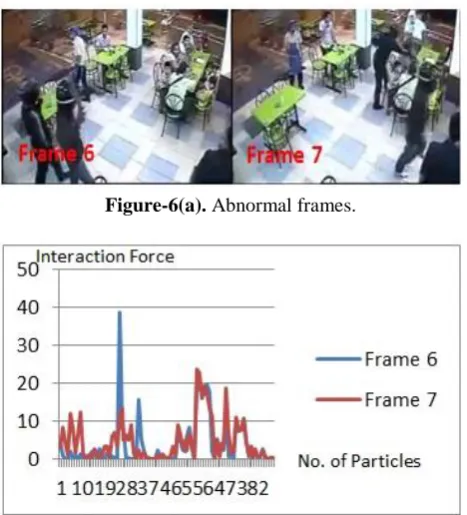
Figure-6(a). Abnormal frames.
Figure-6(b). Magnitude of interaction force for abnormal
frames.
[image:4.595.53.287.176.434.2]Figure-6(b) illustrated the graph plot for interaction force for Frame 6 and 7, as shown in Figure-6(a). Both frames depicted are abnormal. According to the graph plot, the magnitudes of interaction force for abnormal frames exceed value 10 and get higher to value 40. Compare the abnormal results with the normal ones in Figure-7. The magnitudes of forces for normal frame are less than 4. Based on the analysis, the forces between values 0.6 to 3.5 are representing the movement of the two workers in the restaurant while the maintained low value depicted the customers eating and do have little movement. This is the difference between normal and abnormal frames.
Figure-7. Magnitude of interaction force for normal
frames.
By applying Fisher’s equation to the interaction force, each frame is tagged with an estimated significant value, which then be used to threshold the frames. The threshold value is pre-set to 15.0. Frames with interaction force greater than 15.0 are classified as abnormal.
Classification
[image:4.595.309.544.227.374.2]Using the threshold, the frames are classified into normal and abnormal behaviour.
Figure-8. Qualitative results.
Figure-8 portrayed the qualitative results for the abnormal behaviour detection. The two bars below the figure represent the ground truth and detection results for this experiment. The number of frames tested is 20. The ground truth results show that the anomaly detected in Frame 6. However, the detection result shows a slightly different compared to the ground truth. The algorithm detects anomaly in Frame 5 and Frame 7 and so forth. The detection in Frame 5 is considered as early detection, however the detection in Frame 6 is called false positive because it detect the anomaly as a normal pattern.
Percentage error = 1 frames/20 frames x 100% = 5 %
Efficiency = 100% - Percentage error = 95%
CONCLUSIONS
Interaction force is successfully estimated based on modified SFM algorithm. The anomaly or abnormality can be localized in the video sequence. Experiment show some false positive results, which can be improved in the future by fine-tuning the algorithm to achieve better detection.
REFERENCES
[1] Helbing, D. and P. Molnar. 1995. Social force model for pedestrian dynamics. Physical review E. Vol. 51, No. 5. p. 4282.
[image:4.595.54.287.638.751.2][3] Werner T. and D. Helbing. 2003. The social force pedestrian model applied to real life scenarios. Pedestrian and Evacuation Dynamics. CMS Press.
[4] Mehran R., A. Oyama and M. Shah. 2009. Abnormal crowd behavior detection using social force model. IEEE Conference on Computer Vision and Pattern Recognition.
[5] Hui X., S. Young-Jun and L. Seungho. 2010. An integrated pedestrian behavior model based on extended decision field theory and social force model. Simulation Conference (WSC).
[6] Jing Z. et al. 2011. Crowd instability analysis using velocity-field based social force model. IEEE Visual Communications and Image Processing (VCIP).
[7] Raghavendra R. et al. 2011. Optimizing interaction force for global anomaly detection in crowded scenes. IEEE International Conference on Computer Vision Workshops (ICCV Workshops).
[8] Raghavendra R. et al. 2011. Abnormal crowd behavior detection by social force optimization. Human Behavior Understanding. Springer Berlin Heidelberg. pp. 134-145.
[9] Ratsamee P. et al. 2012. Modified social force model with face pose for human collision avoidance. 7th
ACM/IEEE International Conference on Human-Robot Interaction (HRI).
[10] Saboia P. and S. Goldenstein. 2012. Crowd simulation: applying mobile grids to the social force model. The Visual Computer. Vol. 28, No. 10. pp. 1039-1048.
[11] Yanhao Z. et al. 2012. Abnormal crowd behavior detection based on social attribute-aware force model. Image Processing (ICIP), 2012. 19th IEEE
International Conference.
[12] Zhaofeng L. and J. Yichuan. 2012. A friction based social force model for group behaviors. IEEE/WIC/ACM International Conferences on Web Intelligence and Intelligent Agent Technology (WI-IAT).
[13] Bang G. and I.S. Kweon. 2013. Multi-target tracking using social force model in discrete-continuous optimisation framework. Electronics Letters. Vol. 49, No. 21, pp. 1331-1333.
[14] Yuan G. et al. 2013. A modified social force model considering relative velocity of pedestrians. in IEEE International Conference on Automation Science and Engineering (CASE).
[15] Zhu X. et al. 2013. Weighted interaction force estimation for abnormality detection in crowd scenes. Computer Vision – ACCV 2012. K. Lee, et al., Editors., Springer Berlin Heidelberg. pp. 507-518.
[16] Zeng W. et al. 2014. Application of social force model to pedestrian behavior analysis at signalized crosswalk. Transportation Research Part C: Emerging Technologies. Vol. 40, (0), pp. 143-159.
[17] Yanhao Z. et al. 2015. Social attribute-aware force model: Exploiting richness of interaction for abnormal crowd detection. Circuits and Systems for Video Technology. IEEE Transactions. Vol. 25, No. 7, pp. 1231-1245.
[18] Zhang H., Jin M. and Liu H. 2013. A modified social force model under different psychological conditions for room evacuation. ICTIS 2013. pp. 1262-1267.
[19] Hou L. et al. 2014. A social force evacuation model with the leadership effect. Physica A: Statistical Mechanics and its Applications. Vol. 400, (0), pp. 93-99.
[20] Wan J., J. Sui and H. Yu. 2014. Research on evacuation in the subway station in China based on the Combined Social Force Model. Physica A: Statistical Mechanics and its Applications. Vol. 394, pp. 33-46.
[21] Lei C. and W. Lin. 2015. Analysis and intervention in pedestrian evacuation via a modified social force model. in Control and Decision Conference (CCDC), 2015 27th Chinese.
[22] Saad Ali and Mubarak Shah. 2007. A lagrangian particle dynamics approach for crowd flow segmentation and stability analysis. In IEEE Conference on Computer Vision and Pattern Recognition. CVPR'07.
[23] Hospedales, Timothy Gong, Shaogang Xiang, Tao. 2012. Video behaviour mining using a dynamic topic model. International Journal of Computer Vision. Volume 98. p. 303-323.