CIA Framework Designed for Confirming
Culpability of Information in Cloud
Karthika.RN
1Vijay Anand.P
21PG Student 2Assistant Professor
Department of Information Technology
Veltech Multitech Dr. Rangarajan Dr. Sakunthala Engineering College, Chennai
ABSTRACT- Cloud computing alludes to the conveyance of adaptable IT assets over the Internet on an as-required support. Clients' information is normally transformed remotely in obscure machines that clients don't possess or work is the real characteristic of cloud administrations. While appreciating such a comfort carried by this engineering, clients' feelings of trepidation of losing control of their own information. To take care of this issue, we propose a quite decentralized data responsibility structure which stays informed concerning the genuine use of the clients' information in the cloud. An item focused approach that empowers encasing the logging component together with clients' information and approaches are proposed. The JAR programmable competencies influence both to make a dynamic and voyaging article, and to guarantee that any right to gain entrance to clients' information will trigger confirmation and robotized logging neighborhood to the Jars. Additionally furnish circulated examining systems to guarantee clients' control over the information.
Index Terms- Cloud computing, accountability, data sharing.
1INTRODUCTION
CLOUD registering introduces another approach to supplement the present utilization and conveyance model for IT administrations dependent upon the Internet, by accommodating alertly versatile and frequently virtualized assets as an administration over the Internet. Parts of the administrations gave are inattentive from the clients who require not be a master in the framework. Clients may not know the machines which really process and host their information. While getting a charge out of the accommodation carried by this new engineering, clients likewise begin stressing over losing control of their own information. The information prepared on mists is regularly outsourced, expediting various issues identified with responsibility, incorporating the treatment of directly identifiable data. Consider the circumstances that, client’s requirement to have the capacity to guarantee that their information are took care of as per the administration level assertions set aside a few minutes they sign on for administrations in the cloud. So it got key to furnish a successful instrument for clients to screen the utilization of their information in the cloud to relieve clients' concerns.
Customary access control methodologies created for shut spaces, for example, databases and working frameworks, on the other hand methodologies utilizing an unified server as a part of appropriated situations, are not suitable, because of the accompanying trademark characteristics of cloud situations. To begin with, information taking care of might be outsourced by the cloud administration supplier (CSP) to different substances in the cloud and these elements can additionally appoint the undertakings to others, et cetera. Second, elements are permitted to join and leave the cloud in an adaptable way. Accordingly, information taking care of in the cloud experiences an unpredictable and element progressive administration chain which does not exist in traditional situations.
A novel methodology, named Cloud Information Accountability (CIA) system, taking into account the thought of data responsibility is proposed to defeat the aforementioned issues. Data responsibility concentrates on keeping the information utilization transparent and tractable. Our proposed CIA schema gives close to-end responsibility in an exceedingly disseminated design. One of the principle innovative characteristics of the CIA structure lies in its capability of administering lightweight and influential responsibility that joins parts of access control, utilization control and verification. Connected with this responsibility characteristic, we additionally improve two unique modes for examining: push mode and force mode. The push mode alludes to logs being occasionally sent to the information manager while the draw mode alludes to an elective methodology whereby the client (or an alternate approved gathering) can recover the logs as required.
arrangements, for example, access control approaches and logging strategies that they need to implement, encased in JAR indexes, to cloud administration suppliers. Any right to gain entrance to the information will trigger a mechanized and validated logging instrument nearby to the Jars. The arrangements and the logging component go with the information and this exists actually when duplicates of the Jars are made therefore, the client will have control over his information at any area. Such decentralized logging instrument meets the dynamic nature of the cloud additionally forces challenges on guaranteeing the uprightness of the logging. To adapt to this issue, we furnish the Jars with a main issue of contact which structures a connection between them and the client. It records the mistake redress data sent by the Jars, which permits it to screen the misfortune of any logs from any of the Jars. Additionally, if a JAR is not fit to contact its essential issue, any right to gain entrance to its encased information will be denied.
In short, our fundamental commitments are as takes after:
• We propose a novel immediate and enforceable logging instrument in the cloud. Therefore a methodical methodology to information responsibility through the novel use of JAR records is proposed.
• Our proposed building design is stage autonomous and quite decentralized, in that it doesn't oblige any committed confirmation or space framework set up.
• We go past accepted access control in that we give a certain level of use control for the ensured information after these are conveyed to the beneficiary.
II ALLIED WORK
In this section, we first review related works addressing the privacy and security issues in the cloud.
2.1 Cloud Privacy and Security
Cloud figuring has raised a reach of essential protection and security issues. Such issues are because of the way that, in the cloud, clients’ information and requisitions dwells in any event for a certain measure of time on the cloud group which is possessed and upheld by an alternate gathering. Concerns emerge following in the cloud it is not dependably clear to people why their particular data is asked for or how it will be utilized or passed on to different gatherings. Pearson et al. have proposed responsibility components to address protection concerns of finish clients and afterward advance a security chief . Their essential thought is that the client's private information are sent to the cloud in a scrambled structure, and the preparing is carried out on the encoded information. The yield of the handling is DE obfuscated by the protection supervisor to uncover the right come about. Notwithstanding, the protection supervisor furnishes just restricted characteristics in that it doesn't ensure assurance once the information are, no doubt uncovered.
III CLOUD INFORMATION ACCOUNTABILITY FRAMEWORKS
In this segment, we display a review of the Cloud Information Accountability skeleton and examine how the CIA structure meets the outline prerequisites talked about in the past area. The Cloud Information Accountability system proposed in this work behaviors computerized logging and conveyed examining of applicable access performed by any element, did some time or another of time at any cloud administration supplier. It has two significant segments: lumberjack and log harmonizer.
3.1 Major Components
There are two significant segments of the CIA, the first being the lumberjack, and the second being the log harmonizer. The lumberjack is the part which is emphatically coupled with the client's information, so it is downloaded when the information are gained entrance to, and is duplicated at whatever point the information are replicated. It handles a specific occurrence or duplicate of the client's information and is answerable for logging access to that case or duplicate. The log harmonizer structures the focal part which permits the client access to the log records. The lumberjack is firmly coupled with client's information (either single or different information things). Its principle errands incorporate immediately logging access to information things that it holds, scrambling the log record utilizing people in general key of the substance possessor, and occasionally sending them to the log harmonizer. It might additionally be designed to guarantee that right to gain entrance and use control strategies connected with the information are respected. Case in point, an information possessor can define that client X is just permitted to view not to alter the information. The lumberjack will control the information access considerably after it is downloaded by client X. The lumberjack requires just negligible backing from the server (e.g., a good Java virtual machine introduced) with a specific end goal to be sent. The tight coupling between information and lumberjack brings about an exceptionally circulated logging framework. Besides, since the lumberjack does not have to be introduced on any framework or require any unique backing from the server, it is not extremely meddling in its activities. At long last, the lumberjack is answerable for creating the slip remedy data for each one log record and sends the same to the log harmonizer. The slip remedy data joined together with the encryption and validation system gives a strong and dependable recuperation component.
once again to the information holder occasionally in a robotized manner. The draw mode is an on-interest methodology, whereby the log record is gotten by the information manager as frequently as asked. On the off chance that there exist different lumberjacks for the same set of information things, the log harmonizer will consolidation log records from them before sending once more to the information possessor. The log harmonizer is additionally answerable for taking care of log document defilement. Moreover, the log harmonizer can itself complete logging notwithstanding examining. Dividing the logging and inspecting capacities enhances the execution. The lumberjack and the log harmonizer are both actualized as lightweight and transportable JAR records. The JAR document execution furnishes programmed logging capacities.
3.2 Data Flow
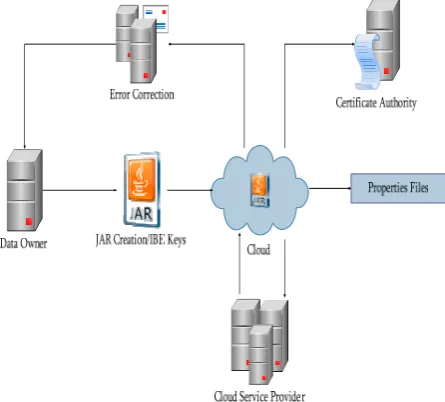
The generally speaking CIA skeleton, consolidating information, clients, lumberjack and harmonizer is portrayed in Fig. 1. At the starting, every client makes a couple of open and private keys dependent upon Identity-Based Encryption [4] (step 1 in Fig. 1). This IBE plan is a Weil-blending based IBE plan, which secures us against a standout amongst the most common assaults to our construction modeling. Utilizing the produced key, the client will make a lumberjack segment which is a JAR record, to store its information things. The JAR document incorporates a set of basic access control guidelines detailing if and how the cloud servers, and conceivably other information stakeholders (clients, organizations) are commissioned to enter the substance itself. At that point, he sends the JAR document to the cloud administration supplier that he subscribes to. To validate the CSP to the JAR (steps 3-5 in Fig. 1), we utilize Open ssl based authentications, wherein a trusted testament power guarantees the CSP. In case the right to gain entrance is asked for by a client, we utilize SAML-based confirmation [8], wherein a trusted character supplier issues endorsements confirming the client's personality dependent upon his username. When the confirmation succeeds, the administration supplier (or the client) will be permitted to gain entrance to the information encased in the JAR. Contingent upon the setup settings characterized around then of creation, the JAR will give utilization control co-partnered logging, or will furnish just logging practicality. With respect to the logging, each one opportunity there is a right to gain entrance to the information, the JAR will immediately produces a log record, encode it utilizing the general population key disseminated by the information possessor, and store it plus the information (step 6 in Fig. 1). The encryption of the log record averts unapproved progressions to the document by aggressors.
The information possessor could pick to reuse the same key pair for all Jars or make diverse key sets for differentiate Jars. Utilizing differentiate keys can improve the security without presenting any overhead aside from in the instatement stage. Moreover, some lapse remedy data will be sent to the
log harmonizer to handle conceivable log index debasement (step 7 in Fig. 1).
Fig 1 Overview of Cloud Information Accountability Framework
To guarantee dependability of the logs, each one record is marked by the element gaining entrance to the substance. Further, distinct records are hashed together to make a chain structure, fit to rapidly identify conceivable lapses or missing records. The scrambled log indexes can later be decoded and their respectability confirmed. They might be gained entrance to by the information holder or other approved stakeholders at whenever for examining purposes with the help of the log harmonizer (step 8 in Fig. 1).
IV AUTOMATIC LOGGING MECHANISMS
In this section, we first elaborate on the automated logging mechanism and then present techniques to guarantee dependability.
4.1 The Logger Structure
Fig.2. Structure of JAR file
For instance, a strategy may state that Server X is permitted to download the information assuming that it is a space server. The external JAR might additionally have the right to gain entrance control usefulness to authorize the information possessor's requirements, specified as Java arrangements, on the utilization of the information. A Java approach points out which consents are accessible for a particular bit of code in a Java nature's domain. The consents communicated in the Java arrangement are regarding File System Permissions. Nonetheless, the information manager can determine the authorizations in client driven terms rather than the normal code-driven security offered by Java, utilizing Java Authentication and Authorization Services. In addition, the external JAR is additionally responsible for selecting the right internal JAR consistent with the character of the element who demands the information. Every internal JAR holds the encoded information, class documents to encourage recovery of log indexes and showcase encased information in a suitable configuration, and a log index for each one scrambled thing. We support two options:
• Immaculate Log: Its primary errand is to record each right to gain entrance to the information. The log documents are utilized for unadulterated inspecting reason.
• Access log: It has two capacities: logging movements and upholding access control. In the event that a right to gain entrance solicitation is denied, the JAR will record the time when the appeal is made. Assuming that the right to gain entrance solicitation is truly, the JAR will furthermore record the right to gain entrance data plus the span for which the right to gain entrance is permitted. The two sorts of logging modules allow the data holder to actualize certain right to addition door conditions either proactively in the occasion of Access Logs or reactively. For example, organizations like charging May as of late need to use Pure Logs. Access Logs will be crucial for organizations which need to maintain organization level affirmations, for instance, compelling the deceivability to some fragile substance at a given territory. To do these limits, the inward JAR holds a class record for creating the log records, a substitute class file which identifies with the log harmonizer, the mixed data, an inferior class report for demonstrating or downloading the data and general social order key of the IBE
key match that is key for encoding the log records. No riddle keys are ever spared in the schema. The outside JAR may hold one or more interior Jars, despite a class record for affirming the servers or the customers, an interchange class file running across the right internal JAR, a menial class report which checks the JVM's genuineness using careless hashing. Further, a class record is used for managing the GUI for customer check and the Java Policy.4.2 LOG RECORD GENERATION Log records are produced by the lumberjack segment. Logging happens at any right to gain entrance to the information in the JAR, and new log passages are affixed successively, in place of creation LR = < r1,. . . , rk>. Each one record ri is scrambled separately and affixed to the log index. Specifically, a log record takes the accompanying structure:
ri=<ID, Act, T, Loc, h((ID, Act, T, Loc)|ri-1|….|r1),sig>
Here, ri demonstrates that a substance recognized by I D has performed an activity Act on the client's information at time T at area Loc. The part h((id,act,t,loc)|ri-1|… .|r1) compares to the checksum of the records going before the recently embedded one, linked with the primary substance of the record itself. The part sig means the signature of the record made by the server. In the event that more than one index is taken care of by the same lumberjack, an extra Obji D field is added to each one record. A sample of log record for a solitary document is appeared.
4.3 Dependability of Logs
In this section, we discuss how we ensure the dependability of logs. In particular, we aim to prevent the following two types of attacks. First, an attacker may try to evade the auditing mechanism by storing the JARs remotely, corrupting the JAR, or trying to prevent them from communicating with the user. Second, the attacker may try to compromise the JRE used to run the JAR files.
4.3.1 Jars Availability
records are redundant and irrelevant to the new copy of the data.
To present the data owner an integrated view, the harmonizer will merge log records from all copies of the data JARs by eliminating redundancy. For recovering purposes, logger components are required to send error correction information to the harmonizer after writing each log record. Therefore, logger components always ping the harmonizer before they grant any access right. If the harmonizer is not reachable, the logger components will deny all access. In this way, the harmonizer helps prevent attacks which attempt to keep the data JARs offline for unnoticed usage. If the attacker took the data JAR offline after the harmonizer was pinged, the harmonizer still has the error correction information about this access and will quickly notice the missing record. The log harmonizer is located at a known IP address. Typically, the harmonizer resides at the user’s end as part of his local machine, or alternatively, it can either be stored in a user’s desktop or in a proxy server.
4.3.2 Log Correctness
For the logs to be rightly recorded, it is crucial that the JRE of the framework on which the lumberjack segments are running remain unmodified. To check the honesty of the lumberjack part, we depend on a two-stage handle: 1) we repair the JRE before the lumberjack is started and any sort of access is given, to give sureties of uprightness of the JRE. 2) We embed hash codes, which figure the hash qualities of the system hints of the modules being executed by the lumberjack part. This helps us distinguish adjustments of the JRE once the lumberjack segment has been started, and are functional to confirm if the definitive code stream of execution is modified. These assignments are changed out by the log harmonizer and the lumberjack parts in pair with one another.
V END-TO-END AUDITING MECHANISM
In this section, we describe our distributed auditing mechanism including the algorithms for data owners to query the logs regarding their data.
5.1 Push and Pull Mode
To allow users to be timely and accurately informed about their data usage, our distributed logging mechanism is complemented by an innovative auditing mechanism. We support two complementary auditing modes:
• Push mode
• Pull mode
Push mode. In this mode, the logs are intermittently pushed to the information holder (or examiner) by the harmonizer. The push activity will be triggered by either sort of the accompanying two occasions: one is that the time slips by for a certain period as per the worldly clock embedded as a feature of the JAR index; alternate is that the JAR document surpasses the size stipulated by the substance possessor around then of creation. After the logs are sent to the information holder, the log documents will be dumped, to free the space for future access logs. In addition to the log
records, the failure adjusting data for those logs is additionally dumped. Concerning the recent capacity, we recognize that the reviewer, after appropriating the log index, will check its cryptographic assurances, by checking the records' trustworthiness and genuineness. By development of the records, the inspector will have the capacity to rapidly locate phony of sections, utilizing the checksum added to every single record.
Pull mode. This mode permits inspectors to recover the logs whenever when they need to check the later access to their information. The force message comprises basically of a FTP draw order, which might be issues from the charge line. For guileless clients, a wizard embodying a group document might be effectively constructed. The solicitation will be sent to the harmonizer, and the client will be educated of the information's areas and get a joined duplicate of the bona fide and fixed log index.
VI EXPERIMENTAL SETUP
We tried our CIA structure by setting up a little cloud, utilizing the Emulab Testbed [22]. Specifically, the test environment comprises of some Open SSL-empowered servers: one head hub which is the endorsement power, and a few processing hubs. Each of the servers is introduced with Eucalyptus [23]. Eucalyptus is an open source cloud execution for Linux-based frameworks. It is approximately dependent upon Amazon Ec2, in this manner carrying the compelling functionalities of Amazon Ec2 beyond all detectable inhibitions source area. We utilized Linux-based servers running Fedora 10 OS. Every server has a 64-digit Intel Quad Core Xeon E5530 processor, 4 GB RAM, and a 500 GB Hard Drive. Each of the servers is furnished to run the OpenJDK runtime environment with Icedtea6 1.8.2.
VII CONCLUSION
REFERENCES
[1] P. Ammann and S. Jajodia, “Distributed Timestamp Generation in Planar Lattice Networks,” ACM Trans. Computer Systems, vol. 11, pp. 205-225, Aug. 1993.
[2] G. Ateniese, R. Burns, R. Curtmola, J. Herring, L. Kissner, Z. Peterson, and D. Song, “Provable Data Possession at Untrusted Stores,” Proc. ACM Conf. Computer and Comm. Security, pp. 598-609, 2007. [3] E. Barka and A. Lakas, “Integrating Usage Control with SIP-Based
Communications,” J. Computer Systems, Networks, and Comm., vol. 2008, pp. 1-8, 2008.
[4] D. Boneh and M.K. Franklin, “Identity-Based Encryption from the Weil Pairing,” Proc. Int’l Cryptology Conf. Advances in Cryptology, pp. 213-229, 2001.
[5] R. Hasan, R. Sion, and M. Winslett, “The Case of the Fake Picasso: Preventing History Forgery with Secure Provenance,” Proc. Seventh Conf. File and Storage Technologies, pp. 1-14, 2009.
[6] J. Hightower and G. Borriello, “Location Systems for Ubiquitous Computing,” Computer, vol. 34, no. 8, pp. 57-66, Aug. 2001
[7] J.W. Holford, W.J. Caelli, and A.W. Rhodes, “Using Self- Defending Objects to Develop Security Aware Applications in Java,” Proc. 27th Australasian Conf. Computer Science, vol. 26, pp. 341-349, 2004. [8]Trusted Java Virtual Machine IBM, http://www.almaden.ibm.
com/cs/projects/jvm/, 2012.
[9]P.T. Jaeger, J. Lin, and J.M. Grimes, “Cloud Computing and Information Policy: Computing in a Policy Cloud?,” J. Information Technology and Politics, vol. 5, no. 3, pp. 269-283, 2009.
[10] R. Jagadeesan, A. Jeffrey, C. Pitcher, and J. Riely, “Towards a Theory of Accountability and Audit,” Proc. 14th European Conf. Research in
Computer Security (ESORICS), pp. 152-167, 2009.
[11] R. Kailar, “Accountability in Electronic Commerce Protocols,” IEEE Trans. Software Eng., vol. 22, no. 5, pp. 313-328, May 1996.
[12] W. Lee, A. Cinzia Squicciarini, and E. Bertino, “The Design and
Evaluation of Accountable Grid Computing System,” Proc. 29th IEEE
Int’l Conf. Distributed Computing Systems (ICDCS ’09),pp. 145-154, 2009.
14] S. Pearson and A. Charlesworth, “Accountability as a Way Forward for Privacy Protection in the Cloud,” Proc. First Int’l Conf. Cloud Computing, 2009.
[15] S. Pearson, Y. Shen, and M. Mowbray, “A Privacy Manager for Cloud Computing,” Proc. Int’l Conf. Cloud Computing (CloudCom), pp. 90-106, 2009.
[16] NTP: The Network Time Protocol, http://www.ntp.org/, 2012. [17] S. Roman, Coding and Information Theory. Springer-Verlag, 1992. [18] B. Schneier, Applied Cryptography: Protocols, Algorithms, and Source
Code in C. John Wiley & Sons, 1993.
[19] T.J.E. Schwarz and E.L. Miller, “Store, Forget, and Check: Using Algebraic Signatures to Check Remotely Administered Storage,” Proc. IEEE Int’l Conf. Distributed Systems, p. 12, 2006.
[20] A. Squicciarini, S. Sundareswaran, and D. Lin, “Preventing Information Leakage from Indexing in the Cloud,” Proc. IEEE Int’l Conf. Cloud Computing, 2010.
[21] S. Sundareswaran, A. Squicciarini, D. Lin, and S. Huang, “Promoting Distributed Accountability in the Cloud,” Proc. IEEE Int’l Conf. Cloud Computing, 2011.
[22] Eucalyptus Systems, http://www.eucalyptus.com/, 2012.
[23] Emulab Network Emulation Testbed, www.emulab.net, 2012