HMAC-SHA-1&Proof of Ownership Protocol on Cloud Data Storage
T. MADHUKAR REDDY1& P. SANJEEVA2
1M-Tech Dept. of CSE, Malla Reddy Engineering College (A), Secunderabad
Mail Id: - [email protected]
2Associate Professor, Dept. of CSE, Malla Reddy Engineering College(A), Secunderabad
Mail Id: - [email protected]
Abstract
A Hybrid cloud is a coalescence of public and private clouds bound together by either standardized or proprietary technology that alters information plus application movability. Proposed system aiming to expeditiously resolving yequandary from deduplication on derivative favors in remote location computing. An hybrid remote locationstructure lying of a populace remote locationplus a individual remote locationplus ye information owners simply source their information storage by utilizing public cloud while the information operation is managed in private cloud. To build information management scalability in cloud computing, deduplication has been a very well-kenned technique recently is use. Deduplication reduces your bandwidth requisites, expedites the data transfers, and it keeps your cloud storage needs to a minimum. Proposed system demonstrate respective incipient deduplication expressions fortifying sanctioned duplicate assure inside hybrid remote locationstructure. To hold the secrecy of informationye convergent encoding proficiency holds made up used to encrypt ye information afore source. Sanctioned deduplication system support differential sanction duplicate check. As a proof of concept, a prototype is implemented in sanctioned duplicate check scheme and conduct test bed experiments utilizing prototype, sanctioned duplicate check scheme incurs minimal overhead compared to mundane operations.
Keywords:
Deduplication, Proof of Ownership, Convergent Encryption, Key Management.1. Introduction
To makeinformation management scalable in cloud computing, deduplication has been a well-kenned technique plus has magnetized more plus more care recently. Information deduplication is a specialized information compression method for rejecting duplicate replicas of reiterating information in memory. The method is used to ameliorate memory
utilization plus can withal be used to network information transfers to reduce ye number of bytes that must be sent. In lieu of keeping numerous information copies with yesimilar
content, deduplicationexcretes
superfluousinformation by holding only
level or yechunk level. For data records level
deduplication, infotech rejects repeat
facsimiles from yelike data records.
Deduplication can adscititiouslychoose home astatine yechunk level, which excretes double chunksfrom information that occur in non-identical data records.
Albeit information deduplication brings an plethora of profits, protection plussecrecy pertains stand up while utilizer’s sensitive information are sensitive to some insider plus foreigner approaches .Traditional encoding, while supplying information confidentiality, is uncongenial with information deduplication. Concretely, naturalencoding desires different utilizer’s to encipher their information with their possess keys. Thus, very information replicas of different utilizers will lead to different ciphertexts, building deduplication infeasible. Convergent encryption has been
suggested to enforce information
confidentiality while building deduplication feasible. Infotech cipher text/normal text a information copy with a confluent key, which
is incurred throughcalculating the
cryptanalytic hash measure from yemessage
fromyeinformationimitate.Afterward key
propagation plusinformationencoding,
utilizer’shold yekey valuesplussend
outyeciphertext to yeremote location.
Afterwards ye encryption procedure is
deterministic plus is derived from the information content, identical l information copies will engender the same convergent key plus hence the same ciphertext. To avert wildcat access, a insure proof of ownership protocol is withal needed to supply the proof that the utilizer indeed owns yeLapp data filewhenever a double is detected. Afterward yeproofread, subsequent utilizer’son yeLapp data file volition be supplied anarrow of yewaiter less wanting to transfer yelike data file. A utilizer can download yecipher textrecords with yearrow of yehost, which can
alone be decoded by yerepresenting
information owners with their focused keys.
Hence, convergent encryption sanctions
yeremote location to perform deduplication on yeciphertextsplus ye proof of ownership obviates ye unauthorized utilizer to get at yedata files.
2. Related Work
Hybrid cloud can be built utilizing any technology it changes granting to unlike vendors. Key constituents In many of the situations, implementation of the hybrid cloud has a comptroller that will hold track of all placements of private and public clouds, IP address, servers and other resources that can run systems efficiently.
Data deduplication be solitary of
consequential information compression
techniques for rejecting duplicate replicas of reiterating information, and has been widely used in cloud memory to reduce the sum of memory space plus preserve bandwidth. To
forfendye confidentiality of sensitive
information while fortifying deduplication,
Cloud computing provide ostensibly
illimitable “virtualized” resources to users as accommodations across the whole Internet,
while obnubilating platform and
implementation details. Today’s cloud
accommodation providers offer both highly
useable storage plus massively parallel
calculating resources at relatively low costs.
As remote location computing turns
prevailing, a incrementing number from
information makes up restored in yeremote location and shared by utilizer’s with designated favors, which determine the approach corrects of yememoryinformation. Disadvantages of Existing System:
One critical challenge of cloud
memory accommodations is the
management of ye ever-incrementing volume ofinformation.
2.2 Proposed System:
Hybrid Cloud can be built utilizing any technology it changes granting to unlike vendors. Key components In many of the
situations, implementation of the hybrid cloud has a comptroller that will hold track of all positions of private and public clouds, IP address, servers plusearlyresources that can run systems efficiently.
Some of the key components include
Orchestration manager plus cloud
purveying for storage, populace cloud
resources which includes virtual
machines and networks, the private and public clouds, which are not compulsorily compatible or identical.
Synchronization element and Data
transfer expeditiously replace
information among private plus public clouds.
Changing configurations of storage,
network and some early resources are constituting crossed by configuration monitor.[1]
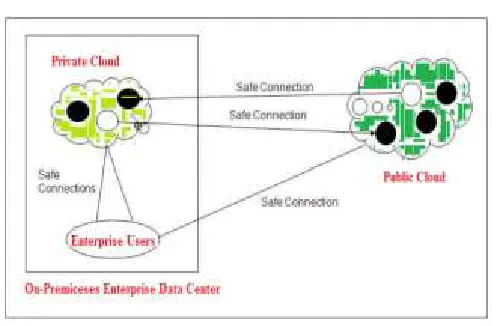
Fig 1: Hybrid Cloud Environment.
The ebony circles shows active virtual server images and white circles shows virtual server images which have been migrated by utilizing safe connections. The arrows designate that the direction of migration. Utilizing safe connections initiative utilizers are linked to ye clouds, which can be secure HTTP browsers or virtual private networks (VPNs) .A hybrid cloud could additionally can consist of multiple public or/and private clouds. [3] Data de-duplication has many patterns. Generally, there is no one best way to enforce information de-duplication across an entire an organization. Instead, to maximize the gains, systems may spread more than one de-duplication strategy. It is very essential to understand the backup and backup challenges, when culling de-duplication as a solution.
We have introduced a hybrid cloud
architecture in our aimed
deduplicationscheme. The private keys for exclusive right will not be supplied to
plus led by ye private cloud server rather. In this manner, the utilizer’s cannot contribution these private keys of favors in this suggested structure, which betokens that it can avoid ye privilege key distributingamongst utilizers in the over straight structure. To get a data filekeys, ye utilizer inevitably to ship a call for to yeindividual remote locationwaiter. Ye suspicion fromsuch building can be reported as follows. To perform the duplicate check for some data file, the utilizer wants to get yedata file keysonyeindividualremote locationwaiter.
The Individualremote locationwaiter will
additionally assure yeutilizer’sindividuality
afore publishing ye representing data file keys to ye utilizer. The sanctioned double assure as such information data file bum be did
throughye utilizer on yepopulateremote
location afore transferring this data records. Predicated on yeanswers of double assure, ye utilizer either uploads this data file or runs PoW.
3. Implementation
Afore affording our construction of
yededuplicationscheme, we determine an
binary cognation R = f((p, p′)g because comes. Given 2 privileges p plus p′, we verbally show that p corresponds p′ if plus only if R(p, p′) = 1.
An identification protocol _ = (Proof, Verify) is additionally determined, where Proof plus swear constitute ye proof plus check algorithm severally. Moreover, for apiece one utilizer U exists surmised to have a mystery key skU to
execute ye identification with waiters.
Postulate that utilizer U features yefavor adjust PU. It additionally formats a PoWset of rules POW for yedata records ownership proof. The private cloud server will control a table which shops each utilizer’s public information pkuplus its representing privilege set PU.
3.2 File Uploading:
Suppose that ainformation proprietor requires to transfer plus apportion an data records F on user’s whose privilege belongs toye set PF = fpjg. The information owner demands act with yesecret remote location afore doing duplicate assure with ye S-CSP. Information owner does
anrecognition to try out infoteches
individuality on secret tokensskU. If it is
communicated, yesecreteremote
locationwaitertestamentget yerepresenting
favors PU of ye utilizer of its memory table list. The utilizer calculates plus sends ye
information data records tag ϕF = TagGen(F)
to yesecreteremote locationwaiter, who will
return fϕ′ F;p_ = TagGen(ϕF , kp_ )g back to
the utilizer for total p_ gratifying R(p, p_ ) = 1
plus p 2 PU. Then, the utilizer will actplus
ship ye file token fϕ′ F;p_ g to y S-CSP.
If andouble data is detected by ye
S-CSP, ye utilizer continues proof of ownership of this data file with ye S-CSP. If the cogent evidence is passed, the utilizer will be assigned a pointer, which approves him to access ye file.
Otherwise, if no duplicate is found, the
utilizer computes the encrypted file CF = EncCE(kF , F) with ye convergent key kF = KeyGenCE(F) plus uploads
(CF , fϕ′ F;p g) to ye cloud server. The
convergent key kF is stored by the utilizer locally.
3.3 File Retrieving:
Guess a utilizer requires to getting a data records F. It beginning sends out ancall for plusyedata records name to the S-CSP. Upon getting the request plus data file designation, the S-CSP will assure whether ye utilizer is worthy to download F. If failed, the S-CSP sends back anterminate signal to the utilizer to denote yedata getting from networkloser. Differently, ye S-CSP affords the representing ciphertextCF .on experiencing yeciphered information from ye S-CSP, the utilizer
utilizes ye key kFmemorytopically to
4. Experimental Work
Fig:-2 New Account Opening
Fig:-3 Secure Login
Fig:-4 Data upload
Fig:-5 Data
Fig:-5 Access Permissions
Fig:-5 Editing File Permissions
5. Conclusion
The cerebration of sanctioned information
deduplicationbesuggested to ascertain the
disparity gains of clients in yeduplicate replica check. The presentation of aelite incipient
deduplicationgrowths fortifying sanctioned
duplicate re-create in hybrid cloud
architecture, in that ye duplicate assure tokens of documents are caused via ye private remote locationwaiterholding secrete keys. Security check presents that ye methods are assure
regarding insider plus outsider assaults
detailed in the suggested security model. As an issue verification of conception, the developed model of the proposed sanctioned duplicate copy check method and tested the model. That showed the sanctioned duplicate copy check method experience minimum overhead comparing convergent encryption and data transfer.
6. References
[1] Bugiel, Sven, et al. "Twin clouds: Secure
cloud computing with low latency."
Communications and Multimedia
Security.Springer Berlin Heidelberg, 2011. [2] Anderson, Paul, and Le Zhang. "Fast and Secure Laptop Backups with Encrypted De-duplication." LISA. 2010.
[3] Bellare, Mihir, SriramKeelveedhi, and Thomas Ristenpart. "DupLESS: server-aided
encryption for deduplicated storage."
Proceedings of the 22nd USENIX conference on Security.USENIX Association, 2013. [4] Bellare, Mihir, SriramKeelveedhi, and
Thomas Ristenpart. "Message-locked
encryption and secure
deduplication."Advances in Cryptology–
EUROCRYPT 2013.Springer Berlin
Heidelberg, 2013.296-312.
[5] Bellare, Mihir, ChanathipNamprempre, and Gregory Neven. "Security proofs for
identity-based identification and signature
schemes." Journal of Cryptology 22.1 (2009): 1-61.
[6] M. Bellare, S. Keelveedhi, and T.
Ristenpart.Dupless: Serveraided encryption
for deduplicated storage. In USENIX Security
Symposium, 2013.
[7] K. Zhang, X. Zhou, Y. Chen, X.Wang, and Y. Ruan.Sedic: privacyaware data intensive
computing on hybrid clouds. In Proceedings of
the 18th ACM conference on Computer and communications security, CCS’11, pages 515– 526, New York, NY, USA, 2011. ACM. [8] S. Halevi, D. Harnik, B. Pinkas, and A. Shulman-Peleg.Proofs of ownership in remote storage systems. In Y. Chen, G. Danezis, and
V. Shmatikov, editors, ACM Conference on