Papers presented in NCIICT-2017 Conference can be accessed from https://edupediapublications.org/journals/index.php/IJR/issue/archive
P a g e | 65 Abstract
OSPF (Open Shortest Path First) allows the routers to select shortest path dynamically based upon the current state between the two networks. It uses link state routing algorithm, and also larger network than RIP (Routing Interface Protocol).
This paper describes the development of OSPF by additionally implementing cost based routing and policy based routing and also improving the quality of service by using throttling concept.
I.INTRODUCTION
Open Shortest Path First (OSPF) protocol is a Link State protocol that handles routing for IP traffic. OSPF send updates when there is change to one of its links, and will only send the change in the update, LSA (Link State Advertisements) LSA are refreshed every 30 minutes. Open Shortest Path First (OSPF) uses the Shortest Path First (SPF) algorithm, developed by Dijkstra, to provide a loop-free topology. order to calculate the shortest path, the network is considered as a graph, with each router being a node and the links between them being edges.
The OSPF process builds and maintains three separate tables:
A neighbor table - contains a list of all neighboring routers.
A topology table - contains a list of all possible routers to all know networks within an area
A routing table – contains the best route for each known network.
These weights are then applied to each link between hardware, with a low weight corresponding to a desirable path, and a high weight signifying an undesirable path. By default, upon start-up before OSPF has initialised, each path will be assigned a value of 10.
OSPF communication is based around 5 different types of packets, using IP protocol number 89. The packet types are as follows
o Hello
o Database description o Link State Request o Link State Update
Link state acknowledgement.
OSPF features includes
Fast convergence
Supports VLSM( Variable Length Subnet Masking)
Efficient use of bandwidth – Routing changes trigger routing updates(no periodic updates)
Supports large network size
Routing based on the best path selection
Grouping based of members into areas
Policy Based Routing:
Policy based routing can used to force network traffic to paths that are different from the ones in the normal path forwarding provided in the routing
Improving Quality of Service in OSPF Interface by
Dynamic Adaptation on Network traffic
HIREN VIKHRAM. S
1& JAIKUMAR. V
2& KANNAN K.
3Papers presented in NCIICT-2017 Conference can be accessed from https://edupediapublications.org/journals/index.php/IJR/issue/archive
P a g e | 66 tables. Policy Based Routing provides the following
benefits:
Forwarding decision not based on the destination
Cost Based routing:
Cost based routing is also called as least cost routing (LCR) is the processes of selecting the path of outbound communications traffic based on cost. Within a telecoms carrier, an LCR team might periodically choose between routes from several or even hundreds of carriers for destinations across the world. This function might also be automated by a device or software program known as least cost router.
The main aim of this research is to change the way OSPF costs are assigned and then assign a cost based routing to the router based on the cost of the network line. The cost of the network can be easily calculated by using the formula,
Cost =10^8/bandwidth (in bytes per second)
We are interfacing the cost based routing concept in R3 router and then we are assigning the cost to each path, the paths that we changed the cost are fast Ethernet port 2/0 to 11, fast Ethernet pot 0/1 to 11, fast Ethernet port 0/0 to 11and Ethernet port 1/0 to 11 and finally we made Ethernet port1/1 to 10 or something below 11 so that the routers can able to take the path based on the lower cost. Default speed of the Ethernet and fast Ethernet 10mbps/sec and 100mbps/sec. The problem here is that the interface speed may not accurately represent the actual maximum speed available across the link between the two routers.
The cost being normally set based on the interface speed on the router but here by applying the cost based routing there will be dynamic and change according to amount of traffic flowed in the R3 router ,by using this concept we can able to prevent the link saturation and congestion in the network making overall improvement in the network.
In order to have a very fast network we have implemented the concept of throttling in this paper , The OSPF Shortest Path First Throttling feature makes it possible to configure SPF scheduling in millisecond intervals and to potentially delay shortest path first (SPF) calculations during network instability. SPF is scheduled to calculate the Shortest Path Tree (SPT) when there is a change in topology. One SPF run may include multiple topology change events.
The interval at which the SPF calculations occur is chosen dynamically and is based on the frequency of topology changes in the network. The chosen interval is within the boundary of the user-specified value ranges. If network topology is unstable, SPF throttling calculates SPF scheduling intervals to be longer until topology becomes stable.
II.RELATED RESEARCH
Papers presented in NCIICT-2017 Conference can be accessed from https://edupediapublications.org/journals/index.php/IJR/issue/archive
P a g e | 67 concept to enhance the congestion in the OSPF
network.
One of the papers said about the concept of smart OSPF which is modified to simulate the Multiprotocol label switching.
In another paper OSPF uses flooding to spread link-state information throughout the network. Flooding incurs unnecessary communication and processing overheads in control plane since nodes may receive
multiple copies of the same advertisement. Flooding is
a simple computer network routing algorithm in which every incoming packet is sent through every outgoing link except the ones it arrived these overheads become significant in protocols for quality-of-service (QOS) routing.
In one another paper they have they have tried to
solve the maximum throughput problems there exists
a related
Inverse shortest-path problem yielding optimal OSPF link weights. It also shows that in any network, optimal link weights are guaranteed to exist, and will produce routes that maximize the throughput of the network.
III. PROPOSED WORK
A. Testing platform
Graphical network simulator 3(GNS3) is our simulation of our work is going to exist.GNS3 is a flexible platform we can able to perform many operation easily in GNS3. It’s easy to operate when compared to other simulation tools. As the cost of making the physical network is high so we decided to work on network simulator, we are using a Cisco 7200 router which may not be the best but very efficient for this work.
The Cisco 7200 Series Router delivers exceptional performance and price, modularity, and scalability in a compact form factor with a wide range of deployment options. With processing speed up to 400,000 packets per second. We are using a Ethernet wires and fast Ethernet wire to connect to the different nodes so that the speed of the work can be differentiated. Routers has its own API (Application Programming Interface) to allow third party applications and services to access the router and run the same commands as you would if using Routers directly through a console.
GNS3 is used by many large companies including Exxon, Wal-Mart, AT&T and NASA. GNS3 is a network software emulator first released in 2008. It allows the combination of virtual and real devices, used to simulate complex networks. It uses dynamic emulation to simulate.
B. Algorithm
We use the Dijkstra's algorithm to make the shortest path. Dijkstra's algorithm is an algorithm for finding the shortest
Papers presented in NCIICT-2017 Conference can be accessed from https://edupediapublications.org/journals/index.php/IJR/issue/archive
P a g e | 68 Changing the cost of the network will make the
Dijkstra’s algorithm to re run the program. If there is traffic by 80% then the cost will be increased above 10, if the traffic is between 30% and 80% then there will be no change in the cost.
C. Building the Test Network
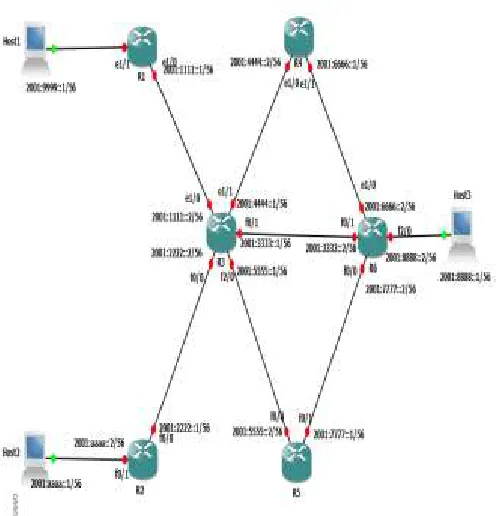
Initially in order to implement the concept any network topology with routers and hosts is created in GNS3 simulation tool and these are connected using either fast Ethernet or ordinary Ethernet and this topological deign may vary.
Each and every router have to be configured with unique IPV6 address because routers works mainly on the principle of IP addressing, In case of switches and host the IP configuration is made at the execution stage. And OSPF is implemented in each and every
router, which enables the router to choose the shortest path to achieve the destination.
But by using this OSPF only some particular path are engaged, only the routers which lie the shortest path is used thus during heavy network traffic the packets which is to be sent to the destination will wait until the traffic is clear in the shortest path routers so this leads to latency and overload the only some particular path here in this
topology the path between router R3 and R6 is overloaded.
Thus in order to avoid these overloading of path some routing policies like Cost Based Routing and Policy Based Routing is employed in the topology which redirect the packets to destination with less network traffic, Here the cost based routing is employed over the upper half and the policy based routing is employed over the lower half of the topology.
In cost based routing the cost for the path is varied based on the user need thus OSPF routing is altered. It like manipulating the feature of OSPF, In policy based routing the routing is altered based upon the source node it’s like guiding or redirecting the packet to destination in particular path and this redirecting path are implemented in the router and these path are employed while routing based the packet source. And this policy is mainly employed mainly in the central node.
Papers presented in NCIICT-2017 Conference can be accessed from https://edupediapublications.org/journals/index.php/IJR/issue/archive
P a g e | 69 Further in order to improve the QOS(Quality Of
Service) the latency in the network while transporting the packets can be reduced by using the throttling concept over each and every nodes in the network.
IV. RESULTS
A . For OSPF
Scenario 1:
Initially the packets are transferred from source to destination by any random path as per the RIP (Routing Information Protocol) but it’s not efficient and this RIP is not suited for the network which has many routers for example in topology (fig 2) for transferring packets from host 1 to host 3 they may randomly follow as host1R1R3R4R6host3 or host1R1>R3R6host3 in this only one path is efficient the other one is long path
Scenario 2:
After implementing OSPF the packets are transferred from source to destination through the shortest between them the information about shortest path between the two nodes are maintained by the router in the routing table, In this if the shortest path fail due to network error or fault then the packets are automatically transferred using the next shortest path which available in the network, for example in topology (fig 2) for transferring packets from host1 to host3 the shortest path is host1R1R3R6host3 which will be automatically assigned by OSPF protocol.
.
B. For Implementing the Policies
Scenario 1:
After implementing the OSPF only the shortest path is used without considering the Network Traffic thus leads to overload of path and decrease the efficiency of the network .Thus cost based and policy based routing is employed in the network topology
Scenario 2:
Papers presented in NCIICT-2017 Conference can be accessed from https://edupediapublications.org/journals/index.php/IJR/issue/archive
P a g e | 70 the network is altered as per wish of user making use
of all the nodes in the network here in the topology (fig 2) the cost are altered thus for transferring packets from host1 to host3 the shortest path is host1R1R3R6host3 is altered to host1R1>R3R6host3 when the network traffic is high across the router 3
Scenario 3:
After implementing the policy based routing the transferring of packets across the network is altered and this policy can be formulated as per user wish thus all the routers can be used in routing during heavy network traffic. For example in the topology (fig 2) the transferring of packet from host 2 to host 3 with only OSPF is host2R2>R3R6host3 thus after implementing policy based routing it is altered to host2R3R5R6host3.
C. Saturation
While the purpose of this program is to prevent network saturation by modifying route costs, under certain circumstances link saturation can occur. If this happens, the control program may no longer be able to communicate with
a router or routers, resulting in unintended behavior, some of which are detailed below.
If a router is completely unreachable, OSPF costs will not be modified at all. Assuming that routers sharing links with that router are reachable and are modifying costs, asymmetric paths will occur.
Traffic data is by default collected every second. If a situation occurs where a router is reachable intermittently, only a small amount of traffic readings may be recorded over the five minute window. When averaged, the measured overall traffic will be a lot lower than the actual traffic, and an incorrect OSPF weight change may occur, possibly leading to an asymmetric path.
D. Throttling
Scenario 1:
Initially the time taken for transferring the packets across the network is very high that is the transferring speed is low which will affect the efficiency of the network tremendously
0 50 100 150 200 250 300 350
100 500 750 1000 1250 1400
L A T E N C Y
P ACKET SIZE IN BYTES
SPEED OF PACKET TRANFERING
FROM HOST 1 TO HOST 3
AFTER THROTTLING( sec)
Papers presented in NCIICT-2017 Conference can be accessed from https://edupediapublications.org/journals/index.php/IJR/issue/archive
P a g e | 71 Scenario 2:
Thus speed of the packet transfer is increased by using the concept of throttling, by which the time for transmission is cut off tremendously
V. CONCLUSION
The efficiency of the network can be improved by employing OSPF thus the disadvantage of the OSPF is also overcome by implementing the concept of cost based and policy based routing and further the QOS of the network is improved by implementing throttling concept of packet by using this latency can be reduced. The disadvantage of this paper while employing security over packets the delay is increased which can be overcome by further development in throttling
VI. REFERENCES
[1] Dynamic adaptation of OSPF interface metrics based on network load by cian o’halloran, 2005 IEEE
[2] Cisco, “Open Shortest Path First,” 2012. [Online].
Available:
http://docwiki.cisco.com/wiki/Open_Shortes t_Path_Fi rst.
[3] V. S. K. P. S. Lateef Ahmad Bhat, “Review: Interior Gateway Protocols,” April 2013.
[Online]. Available:
http://www.iject.org/vol4/spl3/c0111.pdf
[4] J. Morris, “Dijkstra's Algorithm,” 1998. [Online].
Available:https://www.cs.auckland.ac.nz/ software/AlgAnim/dijk
stra.html.
[5] N. Bhagat, “OSPF Packet Types,” [Online].
Available:
https://sites.google.com/site/amitsc isco zone/home/im portant-tips/ospf/ospf-packet-types.
[6] S. A. K. Mishra, “S-OSPF: A Traffic Engineering
Solution for OSPF Based Best Effort Networks,”
Global Telecommunications Conference, 2007. GLOBECOM '07. IEEE, pp. 1845 - 1849, 2007.
[7] T. C. Gábor Rétvári, “Practical OSPF Traffic Engineering,” IEEE
Communications Letters, vol. 8, no. 11, pp. 689-691, 2004.
[8] M. K. J. G. Turgay Korkmaza, “OSPF-based hybrid approach for scalable dissemination of QoS parameters,” Computer Networks, vol. 46, no. 2, pp. 273-293, 2004
[9] G. LeGrange, “mikrotik-java,” [Online]. Available: