An Expert System of Determining Diabetes
Treatment Based on Cloud Computing Platforms
Dr. Abdullah Al-Malaise Al-Ghamdi, Majda A.Wazzan, Fatimah M. Mujallid, Najwa K.Bakhsh Faculty of Computer Sciences and Information Technology,
King Abdulaziz University, Jeddah, KSA
Abstract-- It is well known that the incidence of diabetes in Saudi Arabia is increasing. The statistics show that 17% of the citizens are diabetics and 28% of them are vulnerable to be diabetics. Also Saudi Arabia is the third country around the world in which is where diabetes is most prevalent among the adult population worldwide.
In this paper, the authors survey some of the state of the art of researches on expert systems for the purpose of determining the treatment of the diabetes. Then by exploiting the cloud computing technology, the authors introduce a design and an implementation of a novel expert system for diabetes treatment which depends on cloud computing platform, "Google App Engine".
Keywords – Diabetes Expert System, Cloud computing, Google App Engine.
I.INTRODUCTION
Expert Systems are computer programs that perform in an expert manner in a domain for which no human expert exists. One of the area in which we can take the advantage of expert system is determining the treatment of diabetes. Diabetes is a disease in which levels of Blood Glucose, (blood sugar), are above normal. People with diabetes have problems converting food to energy because the pancreas does not make enough insulin or because the cells in the muscles, liver, and fat do not use insulin properly, or both. Some families have a history with diabetes, once one of the parents is diabetic, and then some of sons as well as the grandchildren are diabetic. Diabetes does not distinguish between adult and young. It is one of the major chronic illnesses prevailing today. This disease has many complications. It causes severe damage for the body organs. These serious degenerative complications are such as retinopathy, neuropathy and nephropathy. Furthermore, diabetes affects an estimated 2-4% of the world's population.
Sometimes diabetics underestimate the diabetes which needs daily dealing with it. Thanks to the development of technology, diabetics can test the Blood Glucose anywhere in their houses, their offices etc. They can use small measurement tools which are designed for that. But they do not have an expert to advice them in which is the best way to manage diabetes.
All of the above explains the importance of designing and implementing expert systems for diabetes. In this paper, the authors survey some of the state of the art of researches on expert systems for the purpose of determining the treatment for the diabetes. Then by exploiting the cloud computing technology, the authors introduce a design and an implementation of their novel expert system for diabetes treatment which depends on cloud computing platform, "Google App Engine"[15].
The rest of this paper is organized as follows: Section II gives a background. Section III introduces the literature review while Section IV introduces the author’s solution
for the diabetes expert system. Section V demonstrates the design and the implementation of the authors system and Section VI explains the future work. Section VII concludes the paper.
II.BACKGROUND a) Diabetes
Diabetes is a disease in which levels of blood glucose, also called blood sugar, are above normal. People with diabetes have problems converting food to energy. Normally, after a meal, the body breaks food down into glucose, which the blood carries to cells throughout the body. Cells use insulin, a hormone made in the pancreas, to help them convert blood glucose into energy [22, 27].
The main Types of diabetes are Type1, Type2 and Gestational [23, 26]. Type 1 is developed because the body fails to produce insulin. Treatment requires the person to inject insulin, calculated diet, planned physical activity, and home blood glucose testing a number of times per day. Type2 results from insulin resistance where the cells fail to use insulin properly. Treatment includes diet control, exercise, home blood glucose testing, and in some cases, oral medication and/or insulin [24]. Gestational diabetes is developed when a pregnant woman, who have never had diabetes before, have a high blood glucose level during pregnancy. Treatment requires diet plan that provides the growing baby with sufficient calories and nutrients also reasonable exercise. Some may have to take insulin injections [25].
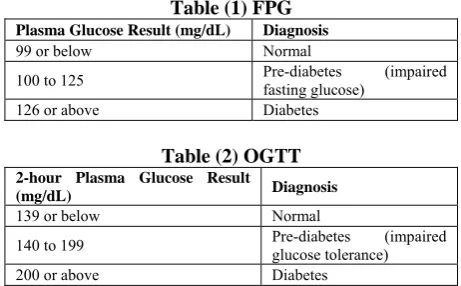
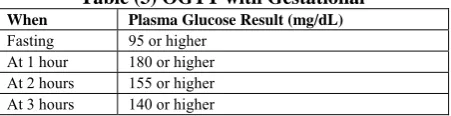
Fasting plasma glucose (FPG) test and Oral glucose tolerance test (OGTT) are used for diagnosing diabetes. They measure blood glucose after a person fasts at least eight hours. In OGTT the person must drink a glucose containing beverage two hours before the test. FPG and OGTT detect diabetes and pre-diabetes. OGTT can be used to detect Gestational diabetes where the glucose levels are measured four times during the test [21].
Table (1) presents FPG, Table (2) presents OGTT and Table (3) presents OGTT with Gestational.
Table (1) FPG Plasma Glucose Result (mg/dL) Diagnosis
99 or below Normal
100 to 125 Pre-diabetes (impaired fasting glucose)
126 or above Diabetes
Table (2) OGTT 2-hour Plasma Glucose Result
(mg/dL) Diagnosis
139 or below Normal
140 to 199 Pre-diabetes (impaired glucose tolerance)
Table (3) OGTT with Gestational When Plasma Glucose Result (mg/dL)
Fasting 95 or higher At 1 hour 180 or higher At 2 hours 155 or higher At 3 hours 140 or higher
b) Cloud Computing Platforms
Cloud computing represents the new revolution in IT world. This area and its related technology are worthy to be used in IT solutions. One of these technologies is the cloud computing platforms, in which the users can access the services through web browsers [16]. Cloud computing offers three kinds of services [17], Infrastructure-as-a-Service (IaaS), in which providers like, Amazon [18], provide machine instances to developers. Platform-as-a-Service (PaaS), in which providers like, Google App Engine [19], provides a programming environment that abstracts machine instances and other technical details from developers. Software-as-a-Service (SaaS) like, Microsoft’s (Windows Live) Hotmail [20], dose not interfaces with user information (e.g. documents).
In this paper the authors choose using cloud computing platform "Google App Engine".
c) Google App Engine
Google App Engine is “a system that exposes various pieces of Google’s scalable infrastructure so that you can write server-side applications on top of them” [28]. Also we can define Google app engine as a platform which allows host web applications on Google’s infrastructure and run it. Google App Engine offers scalable and deployment environments whenever traffic and data storage needed. Developers can access Google’s BigTable database, storage, and the same technologies for access control, security, and Web-services integration. Google app engine supports Python scripting language and Java [29]. In addition, it includes an authentication system to validate the identity of programmers participating in the development process. By using Google App Engine, there are no servers to maintain and no administrators needed. The idea is that the user just uploads his application and it is ready to serve its own customers [28].
Google app engine is applying a dynamic web serving, with full support for common web technologies such as HTML, XML and CSS. Google can storage data with queries, sorting and transactions by using MSQL query. And as mentioned before all applications can automatic scaling and load balancing. APIs for authenticating users and sending email using Google Accounts these services guarantee a high level of security [28, 30].
III. LITERATURE Review
Expert Systems are computer programs that perform in an expert manner in a domain for which no human expert exists. Expert systems for diabetes use many technologies, neural network, fuzzy logic, and web applications.
The concept of neural networks has its own background in the biological nervous system. It is a very complicated structure consisting of neurons (nerve cells) and connections between them. Artificial neural networks, as it is easily predicted, consist of artificial neurons. From a technical point of view, is the element of which the features
match the chosen features of the biological neuron? The artificial neuron is not a faithful copy of the biological neuron, but the element that should fulfill particular functions in the artificial neural network. Such an artificial neuron is in a sense a transducer with the signal at the entrance, and it is then multiplied by the particular for each transducer, weighting kit and summed up. We receive the new signal at the way out, which defines the neuron activity. The most important feature of the neural networks is their ability to learn to adjust the weighting factors. Learning is done in particular cycles, so each task to solve for the neural networks is at the same time a new stimulus, causing the increase of knowledge of a particular network. The neural networks represent the sphere of the artificial intelligence [6].
Artificial neural networks (ANNs) have been used very successfully over the past seven years for a variety of pattern recognition and expert system applications. They require to be trained on sets of patterns which display typical features of the system and, once trained, can then be generalized using a variety of other data. The knowledge acquired through training is embedded in the weight matrices of the ANN. Further, through a dynamic learning process, they can assimilate information on a continuous basis [1].
In [1], the longer-term aim of this study is to investigate the feasibility of using an artificial neural network (ANN), in conjunction with a neuro-fuzzy expert system, for educating and advising Type 1 diabetic patients regarding their optimum short-term therapy. In this paper the authors described the use of an artificial neural network (ANN) which is able to predict blood glucose levels BGL for a specific patient. This predicted BGL may then be used in a neuro-fuzzy expert system to offer short-term therapeutic advice regarding the patients’ diet, exercise and insulin regime (for insulin-dependent or Type 1 diabetics). They discussed the ANN training requirements and they compared BGL predictions for two Type 1 diabetic patients with actual BGL measurements which they found that Most of the ANN predictions are very close to the measured values provided by the patient’s BGL meters (difference of 1.5mmoYl or less).
In [2], this paper designed and developed a hybrid Decision Support System (DSS) which consists of a Feed-forward Neural Network (FNN), a Classification and Regression Tree (CART) and an improved Hybrid Wavelet Neural Network (iHWNN) in order to predict the risk of a T1DM patient to develop diabetic retinopathy. The proposed system is able to store a wealth of information regarding the clinical state of the T1DM patient and continuously provide health experts with predictions regarding the possible future complications that they may present. The system has been evaluated and tested using data from the medical records of 55 T1DM patients. The DSS showed an excellent performance resulting in an accuracy of 98%. The results indicate that the proposed DSS can provide a valuable tool for the physicians towards the classification of a T1DM patient as a high risk case to develop diabetic retinopathy.
pressure, diabetes, blood sugar, body fat diet with management and measurement of stress etc, by both wired and wireless and further portable mobile connections. They implemented user interface module of U-Health System for Biometric Data sensing & Expert System for automatic Diagnosis and comprehensive diagnosis system in association with hospital DBs. Only four results out of a 100 total evaluation data differ from Doctor’s diagnosed results, resulting in about 96% accuracy. It is found that the proposed algorithm predicts the diagnosis strength that outperforms the efficiency of expert system with the knowledge base.
In [4], a neural network based predictive control structure is proposed and applied to treat the problem of diabetes management. The control approach is to predict future plant behavior; hence it specifies accurate control actions necessary to stabilize slow process systems such as physiological systems. The controller adapts to a specific plant and to any changes in its behavior during the control process. When the system was trained using experimental data its overall performance improved continuously during its work. The system proved to be applicable to this particular problem, managing efficiently all selected test cases. It was noticed during the controller test that the diabetic patient is affected by a far history of his blood glucose concentration and insulin treatment profiles, and the controller was able to deal successfully with this phenomena in the control process.
In [5], this paper describes the design of a novel fuzzy neural network estimator algorithm (FNNE) for predicting the glycaemia profile and onset of hypoglycemia in insulin-induced subjects, by modeling the changes in heart rate and skin impedance parameters. Hypoglycemia was induced briefly in 12 volunteers (group A: 6 non-diabetic subjects and group B: 6 Type 1 IDDM patients) using insulin infusion. Their skin impedances, heart rates and actual blood glucose levels (BGL) were monitored at regular intervals. The FNNE algorithm was trained using all subjects from group A and validated tested on the remaining subjects from group B. The mean error of estimation of BGL profile for the training data set (group A) was 0.107 (p < 0.05) and for the validated/tested data set (group B) was 0.139 (p < 0.05). Furthermore, the FNNE algorithm was able to predict the onset of hypoglycemia episodes in group A and group B with a mean error of 0.071 (p 0.03) and 0.176 (p < 0.05) respectively.
In [7], the authors present the Intelligent Diabetes Assistant (IDA) to help diabetics and care providers manage diabetes. They use the machine learning approach with telemedicine. In IDA they monitor the behavior and health of the diabetics frequently and instantaneously through mobile phone and with an armband that measures exercise. They found out that using IDA makes data collection from patients easier and faster. The system makes the data analysis more efficient for the physician and improves the therapy advice.
In [8], the authors discuss the AIDA diabetes simulator which simulates glucose-insulin interaction using a compartmental model, and recommends further appropriate simulations via a rule-based inference engine. They consider using artificial neural network to present a blood glucose level simulation system.
In [9], the authors present a system for real time monitoring and management of diabetes. They use GPRS, HTTP, IP-based networks to provide continuous monitoring of the patients. The authors implement an appropriate storage using remote database, warehouse and WEB server. The system provides a novel medical record management of diabetes using smart data acquisition and visualization technologies to automate decision support system and facilitate treatment design.
In [10], the authors present an expert-telemedicine system. In this system the diabetes patient can store blood glucose measurements, insulin injection doses, hypoglycemic events, dietary intakes and exercise activities through his laptop by using internet connection. The system depends on a rule-base system to give the patient a recommendation of insulin dosage.
“A fuzzy expert system is an expert system, which consists of fuzzification, inference, knowledge base, and defuzzification subsystems, and uses fuzzy logic instead of the Boolean logic to reason about data in the inference mechanism”[11]. In other words, a fuzzy expert system is an expert system that uses fuzzy logic instead of Boolean logic. A fuzzy expert system is a collection of membership functions and rules that are used to reason about data. Unlike conventional expert systems, which are mainly symbolic reasoning engines, fuzzy expert systems are oriented toward numerical processing. This perfect way to solve decision making problems, which has no exact algorithms, but instead the problems solution can be satisfactorily approximated heuristically relying on human expertise in form of If-Then rules.
The rules in a fuzzy expert system are usually of a form similar to the following:
If x is low and y is high then z = medium
where x and y are input variables (names to know data values), z is an output variable (a name for a data value to be computed), low is a membership function (fuzzy subset) defined on x, high is a membership function defined on y, and medium is a membership function defined on z. The part of the rule between the "if" and "then" is the rule's _premise_ or _antecedent_. This is a fuzzy logic expression that describes to what degree the rule is applicable. The part of the rule following the "then" is the rule's _conclusion_ or _consequent_. This part of the rule assigns a membership function to each of one or more output variables. Most tools for working with fuzzy expert systems allow more than one conclusion per rule. A typical fuzzy expert system has more than one rule. The entire group of rules is collectively known as a rule base or knowledge base.
In [12], the main purpose of Diabetes Care Decision Support System is to use artificial intelligence techniques to generate personalized diabetes care plan. To build a personalized care plan, this paper combined case-based reasoning and ontology technology from artificial intelligence to solve this problem. The Knowledge that’s been collected in this paper such as health information, pharmaceutical care, diet care, sports care and other knowledge, help to build diabetes care ontology directly and structurally.
I f f c d s I d te w a c b p d tr A r a u f tr a A c d o T te o th b c C f a c p in s T te s W s th d b p th T p w ta a te a f g
n [13], This p for diagnosis o for mining am colony optimi data mining systems.
n [14], this diagnose expe echnology an working wi accurate/inacc composed by base, database practical exper diabetes diagn reatment of di
After we sur researches hav and determinin use several tec for the purpo reatment. Th applications to As we menti chronic illnes degenerative c of designing an The authors echnologies in of the most im he best of ou been designed cloud computi Cloud compu fastest growin aroused the c computing pl providers and nformation. F system throug Therefore, the echnologies to state to their ca
We designed system for the he diabetes an do. Also care benefit of thi process of ma
herapy for the The inputs to t patient like hi which are Typ
akes as an in and dinner. Th est. A1C is m an index of av four months. I glucose stickin
paper is to util of diabetes di mong Pima zation (ACO) field to ext
paper introdu ert system (D nd integrated
ith forward urate reaso
the human-, interpreterhuman-, r rt system can nosis, and he
iabetes.
IV. PROBL rveyed the l ve been cond ng the treatme chniques to p ose of diagn
hese technol o neural netwo oned above, sses prevailin complications
nd implement recommend n designing e mportant techn
ur knowledge, d or implemen
ing.
uting is an e ng area in i concern of th latforms will d guarantee t Furthermore, gh mobile ph e diabetics ca o send inform are providers.
V.S and impleme e purpose of h
nd give them providers as s system in aking the deci e diabetes.
the system are s age, gender pe 1, Type 2 a nput three blo here is anothe measured for p verage blood g It tells what pe ng to it. The
ize ACO to ex isease and us
Indian diabe ) has been us tract rule ba
uced how to DES) by mea rule reasonin d/backward
ning. The -machine inte reasoning mac reduce the m lp promote th
LEM SOLUTIO literature, we ducted in the ent of diabetes produce efficie osis and det logies vary ork and fuzzy
diabetes is ng today wh s. This explai
ting a diabetes using mor expert systems nologies is clo , no diabetes nted using we
emerging tech information t he whole wo l decrease th the availabili
it facilitates hones, smart p an take the ad mation about t
SYSTEM ented a cloud
helping the di advises abou
well as phys helping them isions for wh
e personal info r, weight etc. and Gestationa ood sugar test er input which people with d glucose for th ercentage of th
less glucose t
xtract a set of ing a Fuzzy L etes data set.
sed successful ased classific
find the dia ans of inform ng implement reasoning
system m erface, know chine. A devel misdiagnosis ra he prevention
ON
e found a lo area of diagn s. These resea
ent expert sys termining dia
from web-b logic. one of the m hich have se ins the impor s expert system re new evo s for diabetes. oud computin
expert system eb technology
hnology. It i technology w orld. Using c he cost for ity of the pa the access to phones and I dvantages of their daily dia
computing e iabetics to ma t what they sh sicians can ge m to speed up hich is the sui
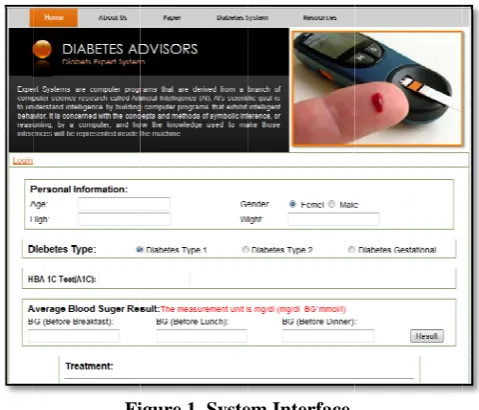
formation abou and diabetes al. Also the sy ts breakfast, l h is HBA1C (A diabetes to pro
e previous thr he hemoglobi that remains i
f rules Logic Ant lly in cation abetes mation tation and mainly ledge loped ate of n and ot of noses arches stems abetes based major erious rtance m. olving . One g. To m has y with s the which cloud care atient o the Ipads. these abetes expert anage hould et the p the itable ut the types ystem lunch A1C) ovide ree to in has in the bloo The appr the s Afte syste comp rang if it i The diab A1C treat mult testin suga or c inclu oral 7.5 % patie gesta dieti will grow reaso body bloo Ther to sto there retrie
dstream the b normal level roximately 4% system.
Fi
r the patient em calculates pares the res es from 80 to is below 80 th system gives etes type and C test) that t tment will be tiple daily ins ng a number o ar test the insu
ould be the s ude diet contr
medicines. If % plus averag ent must tak
ational then tr tian to help d address the g wing baby wit onable exerci y use insulin d sugar levels
Figure 2.a T re are two situ ore a record o efore, the sys eve it. If the p
better diabetic l of A1C in % to 6%. Figur
igure 1. Syste
enters all th s the averag sult with the o 140, if it is a hen it is low.
s the appropr d the two test the patient e calculated die sulin injection of times per d ulin doses cou same. If it is rol, exercise, h f the A1C test ge blood test g ke insulin i reatment requ design a reaso gestational dia th sufficient ise four to fi n more effici
s.
Treatment fo uations in the or not. If he w
stem stores h patient does no
’s health will people witho re (1) shows t
em Interface
he informatio ge of the th normal bloo above 140 the
riate treatmen ts (average bl entered. If it
et, planned ph ns and home day. Based on uld be increase
s Type 2 the home blood g
is over 10% glucose is ove injections. If uires consultin
onable diet p abetes but sti calories and ive times a w iently, which
r anonymous system, if th wants a record his informatio
ot want a reco
continue to b out diabetes the interface o
on needed, th hree tests an d sugar whic n it is high an
nt based on th ood sugar tes is Type1 th hysical activity blood glucos n average bloo ed or decrease treatment wi glucose test an or A1C is ove er 324, then th f the type
ng a registere plan -- one th
ill provides th nutrients. Als week helps th helps contro
s diabetic e patient wan
h g tr r d W O a a im O g b c T d u v f s th th s n a b F e p b th e a p r s r a a s T d
he simply ent give him the reatment for record, where diabetic with a
Figure 2.b T
V We introduced Our system is available onlin and can be te mplemented u Our system ha glucose by 15 by the help o correct treatme The presented diabetic's info using diabetic view his info flexible and a service withou he system is herefore he stored record. need experien applications. T browser and do For future wo electronic reco plan to add so between the d
hese facilities enable the dia and other inf physician thro record. Furthe system for sma
In this pape researches in and determini authors introd system for dia This system developers can
ters all the in appropriate t
an anonymo eas; Figure ( a stored record
reatment for
VI. Discussion d the initial st s uploaded ov ne through htt
ested. It is an using Python a as already bee diabetics with of two physic
ents for these d system gu ormation by u e-mail, so no ormation. At any anonymo ut logging in a
s more usefu can retrieve
Also, our sy ce to use it m The user can oesn't need to ork, the autho
ord in more s me facilities t diabetics and s are exchang abetic to send formation to ough the syste
ermore, we w art phones and
VII. CO er, the authors expert system ing the treatm duce a new
abetes treatm is an open n add to it. It
nformation an treatment. Fig ous diabetic 2.b) shows a d.
r a diabetic w
n and Future tage of our sy ver Google A tp://cs662-diab n open sourc and HTML. en tested throu
h different typ cians. The sy
diabetics. uarantees the
using the aut o one other tha
the same tim us can take and without a ful when the
his previous ystem is easy more than fam
n use the sy o install any ot ors will imple
sophisticated to facilitate th
their care pr ging SMS mes d his blood su the care pr em to be store will provide d I-pads.
ONCLUSION s survey the ms for the pur ment of the d cloud compu ment using Go n source so t is web-based
nd the system gure (2.a) sho without a s a treatment f
ith stored rec
work ystem in this p App Engine a betes.appspot. ce application
ugh entering b pes of diabete ystem results
e security of thentication l an the diabeti me, the syste the benefit o stored record diabetic log s profile from to use and do miliarity with
ystem through ther software. ement the dia
manner. Also he communica roviders. Som ssages, E-mai ugar measurem
rovider or to ed in his elect a version of
state of the a rpose of diag diabetes. Then uting based e oogle App En researchers d, flexible, ea
m will ows a stored for a cord paper. and is .com/ n and blood es and show f the log-in ic can em is of the d. But gs in m his oesn't web-h web-his abetic o, we ations me of ils, to ments o the tronic f our art of gnosis n the expert ngine. and asy to use, their versi
[1] W
[2] M
[3] B
[4] M
[5] N
[6] G
[7] D
[8] S
[9] S
[10]
[11] A
[12] J
[13] B
[14] G
[15]
[16] J
[17]
and guarante r system in s ion for smart p
W.A. Sandham, D Network and Therapy,” Procee of the ZEEE Eng No 3, 1998. Marios Skevofilaka
Konstantina S. N Risk Assessmen complication o International Co Argentina, Augu Byoung-Ho Song System with S Conference on Technology, 200 MALIK F. ALAM
Approach in D IEEE Electron D N. Ghevondian, H
Neural network Induced Subjec International Con Galina Setlak, Ma Mazur and Tom Diabetes Diagn Science and Com Duke, D.L.; Tho Diabetes Assist diabetes," Compu IEEE/ACS Intern April 4 2008. Sandham, W.A.; L
"Simulating and diabetes healthca Processing, 2008 pp.1-4, 14-16 Jul Skevofilakas, M.; E.; Pavlopoulos, "A Communicat Real Time Mo Patients," Engin EMBS 2007. 29 pp.3685-3688, 22
Rudi, R.; Celle telemedicine sys and Pharmaceut Conference, pp.5 AGRIC. ECON.
modeling of fuzz Jian-xun Chen; S support system," International Co 2010
Bo Hang; , "Th Expert System," Agriculture Eng On , vol.2, no., p Ganji, M.F.; Aba for diagnosis of 2010 18th Irania 2010
Google, "G http://code.googl Junjie Peng; Xue Qing Li; , "Com Information Sci International Sy 10.1109/ISISE.2
Alexandros M Computing", CoR
ees the securit sophisticated
phones and
I-REFERE
D.J. Hamilton, A Neuro-Fuzzy S edings of the 20t gineering in Med
as, Konstantia Za Nikita, “A hybrid nt of retinopath f Type 1 Di onference of th ust 31 - Septembe g, Jang-Jae Lee Statistical Neural Computer Scien 09.
MAIREH, “A P iabetes Managem Device Lett., pp. 1
H. T. Nguyen a Estimator for Pr cts,” Proceeding nference, October ariusz Dąbrowski masz Kożak, “A nostics,” Internat mputing" pp.209-orpe, C.; Mahmo
tant: Using ma uter Systems and national Confere
Lehmann, E.D.; H d predicting blo
are," Advances in 8. MEDSIP 2008 ly 2008 ; Mougiakakou, S , S.A.; Vazeou, A tion and Informa onitoring and M neering in Medi 9th Annual Intern 2-26 Aug. 2007 er, B.G. , "Desig
tem for diabetes tical Engineering 595-599, 11-14 D – CZECH, 52, 2 zy expert systems hih-Li Su; Che-H Industrial and I onference on , v
he research and " Computer and gineering (CCTAE pp.412-415, 12-13
adeh, M.S.; , "Us f diabetes disease an Conference on
oogle App le.com/intl/ar-SA ejun Zhang; Zho mparison of Sev ience and Eng ymposium , pp
009.94 Marinos, Gerard
RR Journal, abs/0
ty. The author manner and pads.
ENCES
A. Jappx and K. ystems for Im th Annual Intern dicine and Biolog
arkogianni, Basil d Decision Supp hy development
abetes Mellitus he IEEE EMBS
r 4, 2010. and Mike Lee, l Network,” Fo ces and Conver
Predictive Neural ment by Insulin 618–1623, 2006. and S. Colagiuri redicting Hypogl gs of the 23rd r 25-28, Istanbul, i, Wioletta Szajn Artificial Intellige tional Book Se -214.
oud, M.; Zirie, achine learning d Applications, 20 ence , pp.913-914
Hamilton, D.J.; S ood glucose lev
n Medical, Signa 8. 4th IET Interna
S.G.; Zarkogiann A.; Bartsocas, C ation Technology Management of icine and Biolo national Confere
gn and impleme management at h g, 2006. ICBPE 2 Dec. 2006
006 (10): 456–46 s: a survey Ha Chang; , "Diab Information Syste vol.1, no., pp.32
implement of D d Communication E), 2010 Interna 3 June 2010
sing fuzzy ant co e," Electrical En n , vol., no., pp.50
Engine", [Onl A/appengine/
ou Lei; Bofeng Z eral Cloud Com gineering (ISISE p.23-27, 26-28
d Briscoe: "C 0907.2485, 2009
rs will develo will provide
Pattersod, “Neur mproving Diabet ational Conferen gy Society, Vol. 2
G. Karamanos an ort System for th as a long ter s,” 32nd Annu S, Buenos Aire
“U-health Expe ourth Internation rgence Informatio
l Network Contr n Administration .
, “A Novel fuzz lycemia in Insuli d Annual EMB , Turkey, 2001. nar, Monika Piró
ence Approach eries "Informatio
M.; , "Intellige to help manag 008. AICCSA 200
4, March 31 200
Sandilands, M.L. vels for improv al and Informatio ational Conferenc
ni, K.; Aslanoglo C.S.; Nikita, K.S.
y Infrastructure f Type 1 Diabet gy Society, 200 ence of the IEEE
entation of exper home," Biomedic 2006. Internation
60Toward efficie
betes care decisio ems (IIS), 2010 2n 23-326, 10-11 Ju
Diabetes Diagnos n Technologies ational Conferen
olony optimizatio ngineering (ICEE 01-505, 11-13 M
line]. Availabl
Zhang; Wu Zhan mputing Platforms E), 2009 Secon Dec. 2009, do
[18] Amazon, “Amazon Elastic Compute Cloud (EC2),” Amazon Web Services LLC, Tech. Rep., 2009. [Online]. Available: http://aws.amazon.com/ec2/
[19] Google, “Google App Engine: Run your web apps on Google’s infrastructure.” Google, Tech. Rep., 2009. [Online]. Available: http://code.google.com/appengine
[20] Microsoft, "Microsoft’s (Windows Live) Hotmail", [Online]. Available: http:// www.hotmail.com
[21] “Diagnosis of Diabetes,” National Diabetes Information Clearinghouse, U.S. Department of Health and Human Services, National Institutes of Health NIH Publication No. 09- 4642, October 2008.
[22] “X-Plain: Diabetes-Introduction Reference Summary,” The Patient Education Institute, Inc.www.X-Plain.com, 1995-2010, last reviewed: 05/05/2010.
[23] (2010) Wikipedia, the free encyclopedia website. [Online]. Available: http://en.wikipedia.org/wiki/Diabetes_mellitus
[24] (2011) The Global Diabetes Community website. [Online]. Available: http://www.diabetes.co.uk/treatment.html
[25] (2011) WebMD website. [Online]. Available:
http://diabetes.webmd.com/guide/understanding-gestational-diabetes-treatment
[26] (2011) MedicineNet website. [Online]. Available: http://www.medicinenet.com/diabetes_mellitus/article.htm
[27] (2011) MediLexicon International Ltd website. [Online]. Available: http://www.medicalnewstoday.com/info/diabetes/
[28] Alexander Zahariev, “Google App Engine” TKK T-110.5190 Seminar on Internetworking, 2009.
[29] George Lawton,” Developing Software Online with Platform-as-a-Service Technology” Published by the IEEE Computer Society, June 2008