Available online: https://edupediapublications.org/journals/index.php/IJR/ P a g e | 1535
The Study on the Relationship between Change Leadership
and Employee Commitment for Organizational Change
*Anthony Andrew;**S. Mohankumar;
*Senior Lecturer, Department of Management, Eastern University, Sri Lanka.
**Assistant Professor, Department of Business Administration, Annamalai University, India. [email protected]
Abstract
The existence of organizations is paramount important for the survival of living being in
the globe. The environment in which Organizations operate is increasingly critical and
dynamic in nature. Due to increasingly critical and dynamic environment, organizations
are continuously forced with the need to implement changes in strategy, structure,
process, policies, operations, technology, and culture. Successful, organizations must be
responsive to the needs of constantly evolving business environment (Leana & Barry,
2000, p. 754). Modern organizations in the business world today have to prepare
themselves to face high competition, make quick decisions, introduce innovations and
develop the will and competency to cope with constant change (D’Aveni, 1998, p. 183).
The implementation of organizational change is a considerable challenge for public
sector organizations. The public sector organizations in Sri Lanka are large in size,
providing more variety and volume of services to the citizens. Recent studies have
highlighted the importance of leadership in change processes in public sector
organizations, but limited empirical evidence exists. Moreover, the contribution of
change leadership in organizational change is likely to be dependent on the particular
characteristics of public sector organizations. This study concerns the relationship
between change leadership and the employee commitment to organizational change. The
findings indicate that change leadership contributes to employee commitment for
organizational change by providing high quality change communication and stimulating
employee participation in the implementation of change.
Available online: https://edupediapublications.org/journals/index.php/IJR/ P a g e | 1536
1. Introduction
The aim of this study was to examine the relationship between change leadership and
employee commitment for organizational change in Divisional Secretariat, Eravurpatru in
Batticaloa District, Sri Lanka where various change reforms has been introduced recent
past. Most of the population in Sri Lanka depends heavily on the public sector services
for their living. The level of socio economic status of the people in most part of Sri Lanka
is at moderate. The government of Sri Lanka allocates and spend larger share of its
finance to provide adequate services to its citizens. In times of financial severity and
downturns, there is a great need for public sector organizations to implement
organizational change. However, the implementation of organizational change is
generally a challenge for organizations (Burke, 2002). The implementation of change is
much more complex and unpredictable than the initiation and planning for organizational
change (Brunsson, 2009). This may be especially the case in public sector organizations,
as their environmental and structural characteristics arguably further increase the
difficulties that are associated with implementing organizational change (McNulty &
Ferlie, 2004; Van der Voet, Groeneveld & Kuipers, 2014). Many studies have highlighted
the importance of leadership in order to overcome the difficulties of organizational
change in the public sector (Fernandez & Rainey, 2006; Stewart and Kringas, 2003;
Hennessey, 1998). Some studies have examined to what extent change leadership may
contribute to employee commitment for organizational change (e.g. Oreg & Berson,
2011; Herold et al., 2008). This study aimed at examining the relationship between
change leadership and employee commitment for organizational change.
2. Literature Review
2.1 Change Leadership
Changes become an everyday process in the present highly competitive business
environment. Every organization has to adapt to these changes for its survival and
Available online: https://edupediapublications.org/journals/index.php/IJR/ P a g e | 1537 a result of the urgency and severity of the competitive nature in the environment,
employees may experience increased level of uncertainty, fear of failure, and/or loss of
control. Mangundjaya & Facruddin (2012) expressed that employee felt uncertainty and
ambiguity about the condition of the organization during the process of merger; it was
further expressed that the process of merger lead to low trust, which leads to anxiety and
stress. Since the main engine to effect successful implementation of change is employees,
this kind of anxiety and stress will create negative perceptions and attitude toward
change, and affecting final results of organizational transformation process. Therefore, it
is important to provide organizational supports for the employee, and one of the supports
comes from the leader as the change agent to face organizational transformation
effectively.
Moreover, leader as a change agent is also important to lead, direct and managing the
change process. The role of leader in organizational change cannot be denied in
organizational change, as leader has to take initiative and accommodate all stakeholder
ideas (Randall & Coakley, 2007). Furthermore, Tobias (1993), and Fulan (2008) stressed
that leader can have an impact on organizational performance and/or the effectiveness of
organizational change. In relation to the role of leader in organizational change, the
previous research shows that:
a. With an accurate leadership of the leader, employee can be more involved in the
organizational change (Reinhard, 2007).
b. One of the leader role is to direct and guide employee and organization to achieve
the planned change (Chew et al., 2006; Hawkins, 2005).
c. Leader is perceived as a key success/failure in organizational change. (Drucker,
1999; Gill, 2003),
d. Leader is perceived as the one that responsible for the success of organizational
change as the role of a leader as a Change Agent (Ahn, Adamson, & Donsbusch,
Available online: https://edupediapublications.org/journals/index.php/IJR/ P a g e | 1538 e. Leader should be able to guide, and encourage his/her follower to achieve the
organizational change (Jones, 2011). As a result, as a leader, he/she should be able
to influence his/her follower to perform desirable positive behavior toward
organizational change. (Gibson et al., 2012, Antoni, 2004, Roda 2007).
2.2 Dimensions of Change Leadership
2.2.1 Change selling behavior
The change-selling dimension reflects leaders’ efforts to promote and sell a particular
change to participants, and the change-implementing dimension includes leadership
behavior designed to move the change forward and consolidate success throughout the
change processes (Burke, 2002). The exploration of the two-factor model of change
leadership also uncovered the empirical link between change leadership and affective
change commitment that previous researches failed to reveal. The change-selling
behavior was positively associated with affective commitment to change, while a direct
effect was not found with the change-implementing behavior.
While leaders’ change-selling behavior and transformational leadership style are found to
directly relate to commitment to change, this is only part of the story. Therefore, need to
consider the extent to which employees are emotionally attached to the organization and
how well the change is led. If the employees couldn’t care less about the organization,
then either form of leadership will have limited effects on employees’ commitment to
change. Second, along with leaders’ change-selling behavior, the more enduring influences of transformational leadership and employees’ affective commitment to the
organization also had direct effects on attitudes toward a specific change (i.e.,
commitment to change). Apparently, what pre-exists the actual launch of a change sets
the tone for the change implementations. In other words, whether an employee is going to
be affectively committed to a particular change has been partially determined before a
change is actually implemented. As leaders’ change-selling behavior had different
psychological effects on affective commitment to change, it is possible that
Available online: https://edupediapublications.org/journals/index.php/IJR/ P a g e | 1539
2.2.2 Change Implementing Behavior
Studies related to change leadership behavior branched mainly from the literature of
change implementation, and it focuses on prescribing the processes or successfully
implementing organizational change (Woodman, 1989; Porras & Robertson, 1992;
Armenakis & Bedeian, 1999). Martins, (2008) expressed that the change implementation
literature has been regarded as one of the more developed areas in the field of
organizational change and development compared to other areas, such as change content
and change context (Pettigrew, 1987; Porras & Robertson, 1992; Armenakis & Bedeian,
1999). Lewin, 1947; Kotter, 1996; Amenakis, Harris & Field, 1999 expressed that, the
organizational change and development literature has provided numerous
recommendations on strategies and behaviors that leaders can employ to implement
change effectively by responding to the need for change and effective change
implementation.
Caldwell et al., 2009 expressed that research findings during the 21st century has begun
to stress the critical role played by managers as change leaders and has explored the links
between leadership behaviors and change implementation. It is within this more recent
literature that the term “change leadership” was coined (e.g., Higgs & Rowland, 2000;
2005; Caldwell, 2004; Herold et al., 2008)
In their review of the pre-1990 change implementation theories, Porras and Robertson
(1992) posited that, although there was a considerable amount of overlap on the core
stages/phases/steps of change implementation theories, little agreement had been reached
on the less fundamental parts of these models. This observation is also apt in the
post-1990 change implementation models reviewed by Amenakis and Bedeian (1999) in
which visioning, communication, elicitation of participation, monitoring, and
consolidation are central. Lack of agreement on an overarching definition of the concept
of change leadership has made it difficult to apply further theoretical development and
quantitative tests on the effectiveness of this construct in relation to organizational
Available online: https://edupediapublications.org/journals/index.php/IJR/ P a g e | 1540 Apart from the research studies that focused on change leadership, research studies that
focuses on change-related attitudes and behaviors of employees’ has signaled the benefits
of leadership activities for successful implementation of change. Many researchers have
recommended activities and strategies to promote changes, reduce resistance and
guarantee successful change implementation. For example, procedural justice (Konovsky
& Folger, 1991; Greenberg, 1994; Brockner, Konovsky, Cooper- Schneider, Folger,
Martin, & Bies, 1994; Caldwell et al., 2004); management support (Amenakis et al.,
1999; Caldwell et al., 2004); leader-member exchange (LMX) (Furst & Cable, 2006; Self
et al., 2008); perceived organizational support (Self et al., 2008); managerial influence
tactics such as sanction, legitimization and ingratiation (Furst & Cable, 2006); and
employee participation (Wanberg & Banas, 2000). It is noted that poor consideration was
given by the change leaders for these recommendations.
The activities and strategies recommended as change-implementation models often argue
that, if change leaders execute the proposed strategies and activities, they will be
successful in implementing change (i.e., Lewin, 1947; Kotter, 1996). But, the study of
change leadership behaviors should be investigated in context as change does not take
place in a vacuum (Porras & Robertson, 1992; Pettigrew et al., 2001). Because, the
meta-analysis suggests, a successful change effort depends on the similarity or fit between the
change and content, contextual, and process factors (Damanpour, 1991).
Past studies indicate that, with regard change leadership there is a shortage of empirical
investigation and theoretical development is mainly due to the absence of testable
measures that capture the recommended change leadership behaviors (Herold et al.,
2008). Though there are considerable amount of literature on change leadership, no
testable construct has been presented until recently to cover the key aspects of change
leadership (Herold et al., 2008). Due to the lack of testable construct, researchers and
scholars have found little base for further theoretical development and empirical testing.
In order to rectify the shortcoming in the theoretical foundation Herold et al. (2008)
developed a change-specific leadership measure that incorporated such actions as
Available online: https://edupediapublications.org/journals/index.php/IJR/ P a g e | 1541 participation in the change; helping with individual adaptation to the change; and
providing feedback as an effort to better understand the effects of change-specific
leadership behaviors. However, the efforts of Herold et al (2008). provided some of the
important phenomena underlying leadership processes related to organizational change,
important theoretical gap to be filled.
The unfilled theoretical gap, a more complete and comprehensive theoretical
development of the change leadership construct is still needed. The study conducted by
Herold et al. (2008) was one of the first to investigate change leadership and its
relationship to the more enduring transformational leadership. The relationship between
these two forms of leadership is required to establish the discriminate validity of change
leadership as a means for further elaboration. Further, Herold and colleagues did not find
the expected relationship between change leadership and commitment to change. This
may be due to the fact that change leadership has been broadly defined in the change
literature (e.g., Lewin, 1947; Kotter, 1996; Amenakis et al. 1999) and the measure used
by Herold et al. (2008) attempts, in part, to assess this breadth in a single scale. As such,
a multidimensional scale would help better encompass change leadership behaviors and
could provide additional insights on its effects on employees’ responses to change.
This literature has advocated that by implementing certain strategies and activities change
leaders can bring out positive responses and create supportive behaviors from employees
and as a result these behaviors will then lead to successful change implementation. The
leadership behaviors suggested by the change literature of the various authors include
creating a change vision, enlisting and encouraging employee participation in the change
process, providing feedback regarding the change (Herold et al., 2008), communicating
regarding the change (Armenakis et al., 1999), being fair (Greenberg, 1994; Caldwell,
Herold & Fedor, 2008), providing change-related support (Caldwell et al., 2004), and
consolidating the change successes (Lewin, 1947; Kotter, 1996; Burke, 2002; Higgs &
Rowland, 2005) .
The stock of knowledge revealed that, although it has been widely accepted that such
Available online: https://edupediapublications.org/journals/index.php/IJR/ P a g e | 1542 well tested until Herold et al. (2008). Herold and colleagues were the first to empirically
test the direct effects of change leadership on commitment to change; they did not find
the expected direct effect of change leadership. As a result of the theoretical gap of
establishing link between the practitioners oriented recommendations on change
implementations and change-related outcomes, a more valid change leadership measure
is created to better capture change leadership behavior. Compared to the scale forwarded
by Herold et al. (2008), the new measure not only includes efforts of the change leaders
to consolidate the change successes, but also reflects previously ignored aspects such as
procedural fairness (Konovsky & Folger, 1991; Greenberg, 1994; Caldwell et al., 2004),
communication (Armenakis et al., 1999), and change support (Armenakis et al. 1999;
Caldwell et al., 2004) (4.1).
Even though the large amount of literature developed by Herold et al (2008), for a change
leadership construct based upon practice-oriented recommendations, including specific
leadership behaviors such as visioning, enlisting, empowering, monitoring, and helping
with individual adaptation there has been no testable measure that captures the key
elements of change leadership behaviors until recently. Further these leadership
behaviors are targeted at implementation of a particular change at hand, rather than at
other organizational events.
The different effects of these two sub dimensions of change leadership are consistent
with a classic distinction made in the management literature (i.e., Hersey & Blanchard,
1982, O’Reily & Caldwell, 1981). Specifically, the selling efforts (i.e., visioning and
creating the need for change) work to create intrinsic needs and valence of change
(Burke, 2002). Such intrinsic needs and valence are the “motivators” for change, which in
turn, were expected to lead to positive change-related outcomes such as affective
commitment to change (Herzberg, 1964; O’Reily & Caldwell, 1981; Evans & Price,
1999). In contrast, leaders’ implementing behaviors (i.e., feedback, monitoring, and
providing change-related support) are more likely to be perceived as transactional and
external drivers to move the change forward (Burke, 2002; Herold & Fedor, 2008). Such
Available online: https://edupediapublications.org/journals/index.php/IJR/ P a g e | 1543 1964). While the lack of hygiene factors may lead to dissatisfaction, their presence does
not necessarily generate motivation (Hackman & Oldham, 1976) to support the change.
2.3 The Notion of Commitment
Commitment is defined as one’s motivation to work in a particular vocation or as an act
of commitment to trust or pledge to something or someone, (Hall, 1971; Merriam
Webster, 1999). The concept of commitment has widely been used to find out individual
attitudes and behaviours in the workplace. Over the past three decades’ commitment has
been dominated in the literature as behaviour and used in terms of careers, organizations,
norms, identification, morals, work, jobs, and job involvement (Reilly and Orsak, 1991).
In organization and social fields the term is recognized as a predictor of much behaviour
including absenteeism, turnover, job satisfaction, employee readiness and organizational
citizenship behaviour.
It is important to note that commitment and organizational change became antecedents of
each other thus further research in the area is warranted (Coleman et al., 1999; Madsen et
al., 2005). In organizational change, employee of an organization can create new sets of
expectations to meet changing situations, attitudes and behaviours that are outcomes of a
process in which individual compare realities and expectations. Employee commitment is
attitudes and behaviours to the organization because of privileges like fringe benefits,
salary, tenure, promotion, employee identity. On the basis of these privileges employee
integration increases and they become more loyal to an organization. Employee who
receives encouragement and rewards for change are more likely to act voluntarily in
support of organizational change goals contributing to overall organizational
effectiveness (Organ, 1988; Van yperen et al., 1999). In the academic literature of
commitment, employee commitment to the organization and career commitment seem
often to run in parallel.
2.3.1 Employee Commitment for the Organization
The important component of commitment is organizational commitment which has
Available online: https://edupediapublications.org/journals/index.php/IJR/ P a g e | 1544 term has been treated as a pattern of behaviours or attitudes towards an organization
(Liou and Nyhan, 1994). It creates employee beliefs and willingness towards the goals of
organization. It is widely accepted that the degree of organizational commitment and job
performance are positively related (Mowday et al., 1974), whereas tardiness,
absenteeism, and turnover (Steers, 1977; Hom et al., 1979) are inversely related.
According to Zangaro (2001) a person who is committed to an organization should be
dedicated and have a strong belief in the organization goal and values. Penley and Gould
(1988) focused on organizational commitment from two viewpoints, instrumental and
affective. The instrumental view is concerned with the system of compensation and
rewards received by an individual in return for that person’s accomplishment within an
organization. The affective view relates to a person’s emotional attachment, feeling of
pride and personal sense of obligation to perform their duties within the organization. It
can be developed by work experience such as job challenge, degree of autonomy, and a
variety of skills. These job characteristics have been found to be strongly and positively
associated to affective commitment among employees from a wide variety of
organization (Dunham et al., 1994).
Moreover, employee and organization have mutual interests based on certain needs,
desires, and expectations. Organization provides an environment to employee related to
expectations and demands that induce employee to utilize their knowledge, skills and
experiences. This environment creates commitment to the organization because the
employee needs can be fulfilled by the organization. Most studies related to commitment
have been conducted in developed economies but few attempts have been made in less
developed and developing countries (Alvi & Ahmed; 1987; Chang, 1999; Madsen et al.,
2005). It is to be noted that no studies have been conducted in Sri Lanka related to
commitment for organizational change. According to Chang (1999); Goulet and Singh
(2002), employee commitment is enhanced by fulfilling the psychological and financial
needs. This study focuses on employee in an underprivileged and developing economy
(Sri Lanka), where individuals expect only the satisfaction of their needs from their
Available online: https://edupediapublications.org/journals/index.php/IJR/ P a g e | 1545
2.4 The relationship between change leadership and employee commitment for organizational change.
Leadership is often highlighted as a central factor in processes of change in public
organizations (Stewart and Kringas, 2003; Hennessey, 1998). The literature on change
management contains many prescriptive models of how change leaders can contribute to
the implementation of organizational change (Kotter, 1996; Fernandez & Rainey, 2006).
Although such models are different in details and emphases, most models are similar in
the sense that they stress formulating a change vision, communication, empowering
employees and consolidating or institutionalizing the change. Typical change leadership
activities include developing a vision and implementation plan, communicating the vision
of change, being a good role model and motivating employees to implement the change
(e.g. Fernandez & Rainey, 2006).
In both the practitioner and scientific literature on change management, authors argue
that change leadership may contribute to ‘successful’ organizational change (e.g. Kotter,
1996; Self & Schraeder, 2009; Higgs & Rowland, 2011).
However, prescriptive change leadership models are seldom based on a systematic
comparison of successful and unsuccessful changes. There is relatively little empirical
evidence concerning the contribution of change leadership (Burke, 2002; Herold et al.,
2008), especially in the public sector (Kuipers et al., 2014; Fernandez & Pitts, 2007). An
associated problem is that change success is a subjective and multi interpretable term.
Because change will be little without the support of employees, many studies therefore
focus on employee attitudes toward change (e.g. Wright, Christensen and Isett, 2013; Van
der Voet, 2014). This study examines the relationship between change leadership and
employees’ commitment for organizational change. Commitment to change is defined as
“a desire to provide support for the change based on a belief in its inherent benefits”
(Herscovitch & Meyer, 2002: 475).
Change leadership is aimed at inducing favorable attitudes among employees concerning
Available online: https://edupediapublications.org/journals/index.php/IJR/ P a g e | 1546 to change. By engaging in change leadership behaviors, direct supervisors contribute to
two change process characteristics that are positively related to support for change among
employees. These characteristics are high quality change information and employee
participation in the implementation of change (Walker et al., 2007; DeVos, Buelens &
Bouckenhooghe, 2007; Rafferty & Restubog, 2010). Herold et al. (2008) argue that
communicating about the change and providing individuals the opportunity for inputs are
important aspects of change leadership.
Rather than a direct relationship, change leadership contributes to commitment to change
among employees by improving the quality of change communication and the degree of
employee participation in the implementation of change. Change leadership approaches
typically stress communicating the sense of urgency, vision of change and
implementation plans (e.g. Fernandez & Rainey, 2006). Walker et al. (2007: 762) state
that “change agents must prepare employees for change through open, honest communication.” By explaining to employees why change is necessary, employees may
better understand and support the implementation of change. Moreover, the
implementation plan must be clearly communicated to employees, so that employees are
aware of the scope and time planning of the implementation process (Van Dam, Oreg &
Schyns, 2008). When the implementation process is based on high quality
communication, there are little surprises and uncertainty concerning the changes being
implemented. High quality change communication ideally 1) addresses why the change
is necessary by demonstrating that the organization is not where it should be, 2) expresses
that employees can succeed in implementing the change, 3) successfully argues that the
measures that are being taken are appropriate, 4) convinces employees that they will be
supported during the implementation of change, and 5) emphasizes that an employee’s
self-interest is not at stake because of the change (Armenakis & Harris, 2002). By
improving the quality of change information that is available to change recipients, change
leadership is thus expected to be positively related to change recipients’ commitment to
Available online: https://edupediapublications.org/journals/index.php/IJR/ P a g e | 1547 Change leadership models also stress stimulating and empowering employees to
participate in the change (Herold et al., 2008). Employee participation is often seen as an
important way of creating support for change among employees. Participation may give
employees a feeling of ownership and control over the change, thereby making the
change less threatening (DeVos et al., 2007). Participation may also contribute to the
quality of the change that is being implemented (DeVos et al., 2007; Lines, Selart,
Espedal & Johansen, 2004). Senior managers may have a good birds-eye view of the
organization, but frontline employees are often more knowledgeable about the operations
of the organization. Their expertise may thus be used as important input in designing and
implementing the organizational change. Organizational change theorists have also been
critical about employee participation in organizational change. Organizational change in
the public sector often emanates from higher level reforms and top-down policies
formulated at the political level. Although examples of far-reaching employee
participation in public sector change can be found (e.g. Van der Voet, Kuipers &
Groeneveld, 2014), Dunphy and Stace (1988) argue that employee participation is often
limited to determining the sub goals of a larger change effort that is being directed by
senior managers. Moreover, many contemporary organizational changes in the public
sector are primarily concerned with cost reduction and efficiency gains rather than
improvement of service delivery (e.g. Wright et al., 2013). Such circumstances are
ill-suited for employee participation, since decision-making is likely to be centralized to the
higher management levels (Mintzberg, 1979).
Finally, while it has been argued that employee participation may improve commitment
to change because of its emphasis on shared vision, it may also prevent the emergence of
radically new ideas and innovations (Dunphy & Stace, 1988). Despite these
apprehensions, change leadership is expected to positively affect the commitment to
change of employees by stimulating their participation in the implementation of change.
Available online: https://edupediapublications.org/journals/index.php/IJR/ P a g e | 1548 This study examines the relationship between Change leadership and employee
commitment for organizational change in Eravurpatru Divisional Secretariat in Batticaloa
District.
1. What is the level of Change leadership in Eravurpatru Divisional Secretariat in
Batticaloa District?
2. What is the level of employee commitment for organizational change in Eravurpatru
Divisional Secretariat in Batticaloa District?
3. What is the relationship between Change leadership and employee commitment for
organizational change?
4. Objective of the Study
Given the importance of Change leadership for organizational change, it is important to
investigate its relationship with employee commitment for organizational change. The
primary aim of this study is to develop a conceptual framework that explains how Change
leadership in Eravurpatru Divisional Secretariat in Batticaloa District develop employee
commitment for organizational change.
This study has three main research objectives.
1. Estimate the level of Change leadership in Eravurpatru Divisional Secretariat in
Batticaloa District.
2. Estimate the level of employee commitment for organizational change in Eravurpatru
Divisional Secretariat in Batticaloa District.
3. Examine the relationship between Change leadership and employee commitment for
organizational change
Available online: https://edupediapublications.org/journals/index.php/IJR/ P a g e | 1549 The conceptual approach for this research study is based on a broad theoretical framework and
the study examines the Relationship between change leadership and employees’ commitment for
organizational change in the Eravurpatru Divisional Secretariat in Batticaloa Sri Lanka.
Change Leadership Employees’ Commitment for
Organizational Change
6.Methodology
6.1 Study Setting
For the study of the relationship between change leadership and employees’ commitment for organizational change, data were collected based on primary and secondary sources. Primary data collected by issuing questionnaire and secondary data collected from past research papers, literature, reports, and internet.
The data was collected from a sample of 100 Employee from Divisional Secretariat, Eravurpatru in Batticaloa district by using a survey questionnaire on a simple random sampling method from other than the administrative leaders involved in the change process
6.2 Unit of Analyses
The unit of analysis refers to the level of aggregation of the data collected during the subsequent data analysis stage. This study is concerned the unit of analysis will be the individual staff of selected Divisional Secretariat in Eravurpatru.
6.3 Time Horizon
This study was a cross sectional one in the time horizon, because data were collected in a one single time from the respondents.
6.4 Sample Size, Sampling Distribution
Available online: https://edupediapublications.org/journals/index.php/IJR/ P a g e | 1550 sample is common for whole population. In this research, researcher considers the divisional secretariat of Eravurpatru. There are 186 employees working in the divisional secretariat of Eravurpatru. Out of these staff, only 100 were selected as sample to conduct this research by using simple random sampling method.
6.5 Method of Measurement
Likert scale of 1-5 which ranges from “Strongly Disagree” to “Strongly Agree” was applied in the questionnaire to evaluate responses. The numerical values was given for the purpose of quantification of variable as follows:
1. Strongly disagree
2. Disagree
3. Neither Agree nor Disagree
4. Agree
5. Strongly agree
6.6 Data presentation, analysis and evaluation
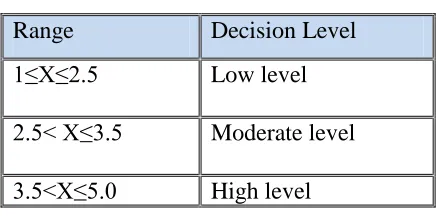
Data was presented using tables, and pie charts. Meanwhile Inferential and descriptive analysis was used for data analysis. Hence under the descriptive analysis, mean and standard deviation was derived from the analysis of samples. In inferential analysis, correlation was applied. Statistical package of SPSS 21.0 was used for this purpose. Furthermore criteria shown in table was adopted to evaluate mean values.
Table 6.1 Evaluation criteria for mean values
Range Decision Level
1≤X≤2.5 Low level
2.5< X≤3.5 Moderate level
3.5<X≤5.0 High level
Source- Formed for this research
Available online: https://edupediapublications.org/journals/index.php/IJR/ P a g e | 1551
7.1 Personal Information
7.1.1 Gender perspective of staff
Among the total respondents, 64% of respondents were found to female category, and remaining
36% represents are male category.
Figure 7.1 Gender perspectives of staff
7.1.2 Age distribution of staff
Age distribution was categorized into three classes. Among the total respondents, 51% of
respondents were found in between to 25 – 35 years old, 37 % were founded in between 36 to 45
years of age, and remaining 12% represents are above 46years.
Figure 7.2 Age distribution of staff male
36%
female 64%
Gender perspective of staff
25 - 35 51% 36 - 45
37% Above 45
12%
Available online: https://edupediapublications.org/journals/index.php/IJR/ P a g e | 1552
7.1.3 Level of Educational Qualification of Staff
The educational level of respondents were classified by four categories from the questionnaire,
14% of the respondents had G.C.E Ordinary level qualification, 34% of the respondents had
G.C.E Advanced level qualification, and 29% of the respondents had diploma qualification and
remaining 23% of them were found with degree and higher diploma qualifications.
Figure 7.3 Level of Educational Qualification of Staff 7.1.4 Level of Work Experience of Staff
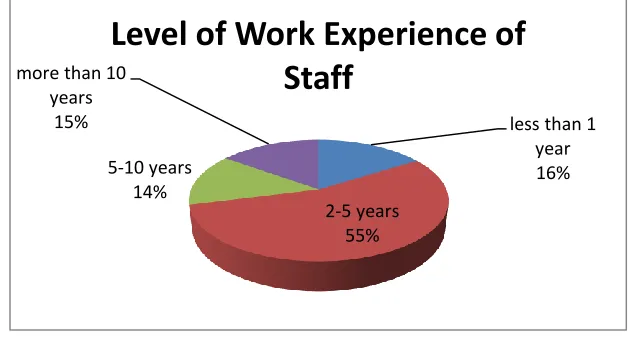
Experience has been divided into four categories and 16 % of the respondents with less than
1year working experience, 55% were 2- 5 years working experience, 14% were 6-10 years
working experience, 15% and were more than 10 years working experience.
Figure 7.4 Level of Work Experience of Staff
7.1.5. Descriptive statistics
G.C.E.O/L 14%
G.C.E.A/L 34% Diploma
29% Degree
23%
Level of Educational Qualification of Staff
less than 1 year 16%
2-5 years 55% 5-10 years
14% more than 10
years 15%
Available online: https://edupediapublications.org/journals/index.php/IJR/ P a g e | 1553 This section presents mean and standard deviation for the variables of change leadership. Mean
values have been distributed based on Liket’s scale of between 1-5 which represent “Strongly
Disagree” to “Strongly Agree”. Meanwhile mean values were evaluated based on already established evaluative criteria which range from “Low level” to “High level”.
Table 7.1 Mean and standard deviation for the variables of Change Leadership
Variables Mean Standard Deviation
Change Leadership 3.99 0.36
As presented in Table 7.1, the mean value for Change Leadership was more than 3.5, which fall
under the evaluative category of high level. It could be noted that the mean value for change
leadership is 3.99 which is more than the moderate level as noted above, reveals that there is
high level of change leadership in the selected organization
Table 7.2 Mean and standard deviation for the variable of Employee Commitment for
organizational change
Variables Mean Standard Deviation
Employee Commitment for organizational change 3.66 0.42
As highlighted in Table 7.2, the mean value for Employee Commitment for organizational
change was more than 3.5 and said to be high level. It could be noted that the mean value for
Employee Commitment for organizational change is 3.66 which is more than the moderate level
as noted above, reveals that there is high level of Employee Commitment for organizational
change in the selected organization.
7.1.6 Correlation analysis
Correlation values were found to determine relationship between change leadership and
Available online: https://edupediapublications.org/journals/index.php/IJR/ P a g e | 1554 Table 7.3 Correlation between change leadership and Employee Commitment for
organizational change.
Variables Employee Commitment for organizational change
change leadership 0.762*
* Correlation is significant at the 0.05 level (2-tailed)
As in table 7.3, the correlation value is positive and the value has been significant at 5%
significant level (P<0.05). This reveals that change leadership are positively correlated with
Employee Commitment for organizational change. Hence there is a positive relationship between
change leadership and Employee Commitment for organizational change.
The statistical mean of change leadership scale showed leaders willingness and positive attitudes
towards creating and promoting employee commitment for organizational change. Thus, the
scale can be applied to ascertain leaders’ attitudes and behaviours regarding employee
commitment for organizational change. The results of this study also show that change
leadership scale is significantly and positively correlated with Employee Commitment for
organizational change.
8. Conclusion
The results indicate that change leadership contributes to support for enhancing employee
commitment for organizational change. However, it needs to be known about, how different
levels and types of leadership are interrelated to employee commitment for organizational
change.
The findings of this study reveal that employees of government sector organizations can develop
positive attitudes and behaviours towards commitment for organizational change as a result of
effective change leadership practices. Higher the effectiveness of the change leadership leads to
higher the level of employee commitment for successful organizational change.
Available online: https://edupediapublications.org/journals/index.php/IJR/ P a g e | 1555 1. Ahn, Adamson, & Donsbusch (2004), From leaders to leadership: managing change.
Journal of Leadership and Organizational Studies, Vol. 10, No 4, 112-123.
2. Antoni, C.H (2004). Research note: A motivational perspective on change processes and
outcomes. European Journal of Work and Organizational Psychology, 13, 197-216.
3. Armenakis, A.A. & Bedeian, A.G. 1999, "Organizational Change: A Review of Theory
and Research in the 1990s", Journal of Management, vol. 25, no. 3, pp. 293-315.
4. Armenakis, A.A. & Harris, S.G. 2002, "Crafting a change message to create
transformational readiness", Journal of Organizational Change Management, vol. 15, no.
2, pp. 169.
5. Brockner, J., Konovsky, M., Cooper-Schneider, R., Folger, R., Martin, C., & Bies, R. J.
(1994). Interactive effects of procedural justice and outcome negativity on victims and
survivors of job loss. Academy of Management Journal, 37, 397-409.
6. Bouckenooghe, D. (2010). Positioning change recipients’ attitudes toward change in the
organisational change literature. Journal of Applied Behavioral Science, 46 (4), 500-531.
7. Brunsson, N. (2009). Mechanisms of hope: maintaining the dream of the rational
organization. Copenhagen: Copenhagen Business School Press.
8. Burke, W. (2002). Organization Change: Theory and practice. Thousand Oaks, CA: Sage
Publications.
9. Caldwell, S. D., Roby-Williams, C., Rush, K., Ricke-Keily, T. (2009). Influences of
Context, Process and Individual Differences on Nurses’ Readiness for Change to Magnet
Status, Journal of Advanced Nursing, Vol. 65 issue 7, pp. 1412 – 1422.
10.Caldwell, S. D., Herold, D. M., & Fedor, D. B. (2004). Towards an understanding of the
relationships between organizational change, individual differences, and changes in
person-environment fit: A cross-level study. Journal of Applied Psychology, 89,
868-882.
11.Chang, E. 1999, "Career Commitment as a Complex Moderator of Organizational
Commitment and Turnover Intention", Human Relations, vol. 52, no. 10, pp. 1257- 1278.
12.Chew, MMM, Cheng, J,S.L& Petrovic-Lazareric, S (2006). Managers’ Role in
implementing organizational change: Case of the restaurant industry in Melbourne.
Available online: https://edupediapublications.org/journals/index.php/IJR/ P a g e | 1556 13.Coleman, D. F., Irving, G. P., & Cooper, C. L. 1999, "Another look at the locus of
control-organizational commitment relationship: It depends on the form of commitment",
Journal of Organizational Behavior, vol. 20, pp. 995-1001.
14.Damanpour, F. (1991). Organizational innovation: A meta-analysis of effects of
determinants and moderators. Academy of Management Journal, 34: 555-590.
15.D’Aveni R.A. (1998). Waking up to the new era of hypercompetition. TheWashington
Quarterly, 21(1), 183 –195.
16.DeVos, G., Buelens, M. & Bouckenooghe, D. (2007). Contribution of content, context
and process to understanding openness to organizational change: Two experimental
simulation studies. The Journal of Social Psychology, 147(6), 607-630.
17.Drucker, P.F. (1999), “Knowledge worker productivity: the biggest challenge”,
California Management Review, Vol. 41 No. 2, pp. 79-94.
18.Dunham, R.B., Grube, J.A. & Castañeda, M.B. 1994, "Organizational commitment: The
utility of an integrative definition", Journal of Applied Psychology, vol. 79, no. 3,pp.
370-380.
19.Dunphy, D. C., & Stace, D. A. (1988). Transformational and coercive strategies for
planned organizational change: beyond the OD model. Organization Studies, 9(3),
317-334.
20.Fernandez, S. & Pitts. D.W. (2007). Under What Conditions Do Public Managers Favor
and Pursue Organizational Change? The American Review of Public Administration
37(3): 324–341.
21.Fernandez, S. & Rainey, H. G. (2006). Managing successful organizational change in the
public sector: An agenda for research and practice. Public Administration Review, 66(2),
168–176.
22.Fullan, M. (2008). The six secrets of change: What the best leaders do to help their
organizations survive and thrive. San Francisco: Jossey-Bass. Garcia D., Gluesing J.C,
(2013) Qualitative research methods in international organizational change research,
Available online: https://edupediapublications.org/journals/index.php/IJR/ P a g e | 1557 23.Furst, S. A., & Cable, D. M. (2008). Employee resistance to organizational change:
Managerial influence tactics and leader-member exchange. Journal of Applied
Psychology, 93, 453-463.
24.Gibson, J.L, Ivancevich, J,M. & Donnely, J.H. (2012), Organizations: Behavior,
Structure, Process, 14th Edition, USA:McGraw Hill.
25.Gill, R (2003), Change Management or change leadership? Journal of Change
Management, 3 (4), 307-321.
26.Goulet, L.R. & Singh, P. 2002, "Career Commitment: A Re-examination and an
Extension", Journal of Vocational Behavior, vol. 61, no. 1, pp. 73-91.
27.Greenberg, J. (1994). Using socially fair treatment to promote acceptance of a work site
smoking ban. Journal of Applied Psychology, 79, 288-297.
28.Hackman, J. R., & Oldham, G. R. (1976). Motivation through the design of work: Test of
a theory. Organizational Behavior and Human Performance, 16, 250–279.
29.Herold, D. M. Fedor, D. B., Caldwell, S. D., & Liu, Y. (2008). The effects of
transformational leadership and change leadership on employees’ commitment to a
change: A multi-Level study. Journal of Applied Psychology,93, 2, 346-357.
30.Hall, T.D. 1971,"A theoretical model of career subidentity in organizational settings",
Organizational Behavior and Human Performance, vol. 6, pp. 50-76.
31.Hawkins, A (2005), Leaders as Facilitators of Organizational Learning. Dissertation.
School of Leadership Studies, Regent University.
32.Hennessey, J.T. (1998). “Reinventing” government: Does leadership make a difference?
Public Administration Review, 58(6), 322-332.
33.Herscovitch & Meyer, (2002). Commitment to organizational change: Extension of a
three-component model. Journal of Applied Psychology, 87(3), 474-487.
34.Hersey, P., & Blanchard, K. (1982). Management of Organizational Behavior, 4th ed.
Englewood Cliffs, NJ: Prentice-Hall.
35.Herzberg, F. (1964). The Motivation-Hygiene Concept and Problems of Manpower,
Available online: https://edupediapublications.org/journals/index.php/IJR/ P a g e | 1558 36.Higgs, M.J., & Rowland, D. (2011) what does it take to implement change successfully?
A study of the behavior of successful change leaders. Journal of Applied Behavioral
Science, 47(3), 309-335.
37.Higgs, M., & Rowland, D. (2005). All changes great and small: Exploring approaches to
change and its leadership. Journal of Change Management, 5, 2, 121–151.
38.Higgs, M. J. & Rowland, D. (2000). Building change leadership capability: “the quest
for change competence”. Journal of Change Management, 1(2), 116–131.
39.Hom, P.W., Katerberg, R. & Hulin, C.L. 1979, "Comparative examination of three
approaches to the prediction of turnover", Journal of Applied Psychology, vol. 64, no. 3,
pp. 280-290.
40.Jones, D. C (2011), The Role of Servant Leadership in Establishing a Participative
Business Culture Focused on Profitability, Employee satisfaction and Empowerment.
Dissertation. Limited Publication. Walden University.
41. Kotter, J.P. 1996, Leading Change, Harvard Business School Press, Boston.
42.Kuipers, B.S., Higgs, M., Kickert, W.J.M., Tummers, L., Grandia, J. & Van der Voet, J.
(2014). Managing change in public organizations: A review of the literature between
2000-2010. Public Administration, 92(1), 1-20.
43.Leana, C. R. & Barry, B. (2000). Stability and Change as Simultaneous Experiencesin
Organizational Life. Academy of Management Review, Vol. 25, No. 4, 753-759.
44.Lewin, K. (1947). Frontiers in group dynamics. Human Relations, 1, 5-41.
45.Lines, R., Selart, M., Espedal, B. & Johansen, S.T. (2005). The production of trust
during organizational change. Journal of Change Management, 5(2), 221-245.
46.Liou, K. & Nyhan, R.C. 1994, "Dimensions of Organizational Commitment in the Public
Sector: an Empirical Assessment", Public Administration Quarterly, vol. 18, no. 1, pp.
99-118.
47.Madsen, S.R., Miller, D. & John, C.R. 2005, "Readiness for organizational change: Do
organizational commitment and social relationships in the workplace make a
Available online: https://edupediapublications.org/journals/index.php/IJR/ P a g e | 1559 48.Mangundjaya, W.H. (2012). The relationship between individual change readiness’s,
attitude toward change and individual commitment to change. Unpublished Publication.
Faculty of Psychology, Universitas Indonesia, Depok, Indonesia.
49.Martins, L. (2008). Organizational development and change. Manuscript prepared for S.
Zedeck (Ed.). APA Handbook of Industrial and Organizational Psychology, Volume III.
50.McNulty, T. & Ferlie, E. (2004). Process transformation: Limitations to radical
organizational change within public service organizations. Organization Studies, 25(8):
1389-1412.
51.Mintzberg, H. (1979). The structuring of organizations. Englewood Cliffs: Prentice Hall.
52.Mowday, R. T., Porter, I. W., & Dubin, R. 1974, "Unit performance, situational factors
and employee attitudes in spatially separated work units", Organizational Behaviour and
Human Performance, vol. 12, pp. 231-248.
53.Nannus, B (1992). Visionary Leadership. San Fransisco, California: Jossey-Bass, Inc.
National Education Commission – NEC (2003) Envisioning Education for Human
Development: Proposals for a National Policy Framework on General Education in Sri
Lanka, Colombo: NEC.
54.Oreg, S. & Berson, Y. (2011). Leadership and employees’ reactions to change: The role
of leaders’ personal attributes and transformational leadership style. Personnel
Psychology, 64(3), 627-659.
55.O’Reilly, C.A. and Caldwell, D.F. (1981). The commitment and job tenure of new
employees: Some evidence of post decisional justification. Administrative Science
Quarterly. 26, 4, 597-616.
56.Organ, D.W. 1988, Organizational Citizenship Behavior: The Good Soldier Syndrome,
Lexington Books, Lexington.
57.Penley, L.E. & Gould, S. 1988, "Etzioni's model of organizational involvement: A
perspective for understanding commitment to organizations", Journal of Organizational
Behavior (1986-1998), vol. 9, no. 1, pp. 43.
58.Pettigrew, A. (1987). Context and action in transforming the Urm. Journal of
Available online: https://edupediapublications.org/journals/index.php/IJR/ P a g e | 1560 59.Porras, J. L. & Robertson, P. J. (1992). Organizational development: Theory, practice,
and research. In M. D. Dunnette & L. M. Hough (Eds.), Handbook of
Industrial/Organizational Psychology (2nd Ed.), Vol. 3, 719-822. Palo Alto, CA:
Consulting Psychologists Press.
60.Randall, Linda; Coakley, Lori (2007) Applying adaptive leadership to successful change
initiatives in academia, Leadership & Organization Development Journal, Volume: 28,
Issue: 4.
61.Reinhard, Tess (2007), A grounded Theory of Investigation of Change Leadership
During Turbulent Times, Limited Publication. A Dissertation, Northern Illinois
University, USA.
62.Roda, Julianne (2007). A Multi-level Examination of employee Reactions to
Organizational Change, Dissertation. Department of Psychology College of Liberal Arts
and Sciences, De Paul University, Chicago University. Chicago, Illinois. Robbins, S. P.,
& Judge, T. (2007). Organizational behavior. Upper Saddle River, NJ: Prentice Hall.
63.Reilly, N.P. & Orsak, C.L. 1991, "A career stage analysis of career and organizational
commitment in nursing", Journal of Vocational Behavior, vol. 39, no. 3, pp. 311- 330.
64.Self, D. R., & Schraeder, M. (2009). Enhancing the success of organizational change:
Matching readiness strategies with sources of resistance. Leadership and Organizational
Development Journal, 30, 167-182.
65.Steers, R.M. 1977, "Antecedents and Outcomes of Organizational Commitment",
Administrative Science Quarterly, vol. 22, no. 1, pp. 46.
66.Stewart, J. & Kringas, P. (2003). Change management-strategy and values in six agencies
from the Australian public service. Public Administration Review, 63(6), 675-688.
67.Tobias (1993), An Evaluation of Culture Change: An Organization development and
Action Research Approach, Limited Publication, Dissertation paper, Walden University.
68.Van der Voet, J. (2014). The effectiveness and specificity of change management in a
public organization: Transformational leadership and a bureaucratic organizational
structure. European Management Journal, 32(3), 373-382.
69.VanYperen, N.W. & van den Berg, A.E. 1999, "Towards a better understanding of the
Available online: https://edupediapublications.org/journals/index.php/IJR/ P a g e | 1561 A multilevel analysis", Journal of Occupational & Organizational Psychology, vol. 72,
no. 3, pp. 377-392.
70.Woodman, R. W. (1989). Organizational change and development: New arenas for