Optimization of Recommended Lists in Social
Network Environments Generated Using
Learning-to-Rank Algorithm
Keith Ger
1, Suraj Gawas
2, Yash Mehta
3, Mohit Satarkar
4, Prof. Parth Sagar
*5BE Student, Dept. of Computer Engineering, RMD Sinhgad School of Engineering, Pune, Maharashtra, India1 BE Student, Dept. of Computer Engineering, RMD Sinhgad School of Engineering, Pune, Maharashtra, India2 BE Student, Dept. of Computer Engineering, RMD Sinhgad School of Engineering, Pune, Maharashtra, India3 BE Student, Dept. of Computer Engineering, RMD Sinhgad School of Engineering, Pune, Maharashtra, India4 Professor, Dept. of Computer Engineering, RMD Sinhgad School of Engineering, Pune, Maharashtra, India5
ABSTRACT: Due to the rise in the use of technology, and especially the use of web technology, people tend to use web services to carry out many different tasks. This has led to the rise of multiple services providing same type of service to the users. The selection of the best service from the ones available is a conundrum to predict as different users will follow different selection techniques. Selection of the web service is directly related to the quality of service (QoS) provided. This paper proposes a system combining a learning-to-rank algorithm with an ad hoc Social Spatial Union (SSU) to comprehend the decision strategy of users in choosing the specific web service. And this will be implemented in the future service selections of the user after learning from the user’s strategy specifically. With the help of this method we provide specific user with the service type he prefers.
KEYWORDS: Spatial Social Union (SSU), Quality of Service (QoS), Learning-To-Rank, Decision Strategy.
INTRODUCTION
Use of technology to carry out different daily tasks of people, some mundane while some crucial, has made the workload of the people a bit lighter. Rise of the internet has also given a rise to number of web services providing the different services we require. Users mostly choose a web service according to the different criteria of the details of the service provided. A user almost always has similar requirements when choosing a service. Understanding these recurring requirements of the user will make the job of choosing a service extremely efficient and simple.
Each service has specific QoS criteria according to which they are rated. Using a learning-to-rank algorithm, we can find out the order in which different QoS qualities are preferred. Instead of letting a user check all the different services and find out the service which matches the criteria, it is better to provide suggestions according to it beforehand. A number of models like the Multi-Criteria Decision Making (MCDM), Constraint Programming (CP) and Mixed Integer Programming (MIP), Skyline have been used in this context. One recommended way is to find the cumulative weight of the different criteria of the service, while others include comparison of specific QoS. But each one has its own advantages and disadvantages
Earlier, the service would have been chosen from a few recommendations from the description of the service itself, which might be looking at it objectively. Therefore the need of learning-to-rank algorithms was felt when multiple services were available for use.
A location-sensitive recommendation can be defined as a three dimensional space between user, location and item. For example, a location-sensitive service of restaurants for tourists or a citizen, a visitor or a group of visitor may wish to know about nearby recommended restaurants including their distance, menu, price and ambiance. In social recommendation, product recommendation and rating prediction are two most important issues. For example, if an E-customer wishes to purchase a product, so how efficiently will he/her will predict the rating of the product as well as how will he/her get recommendations about potentially similar products is a challenging task.
It is important and helpful to get the best service possible from the available list of services according to the user’s specific requirements. The user will search for the required quality of a specific service and then choose the optimum service which provides quality equal to the requirement of the user.
An algorithm is proposed for the user to get this with minimum hassle. This algorithm does not require user to specify the strategies, it generates the list of all the services according to the rank. An automated solution by using a learning to rank algorithm to find the optimal way to combine multiple strategies is found.
Learning-to-rank algorithm approaches are divided into three types: 1. List-wise
2. Point-wise 3. Pair-wise
Point-wise and pair-wise approaches do not consider the interdependence between documents, while list-wise does. Hence list-wise algorithm is the basis on which we have developed our algorithm.
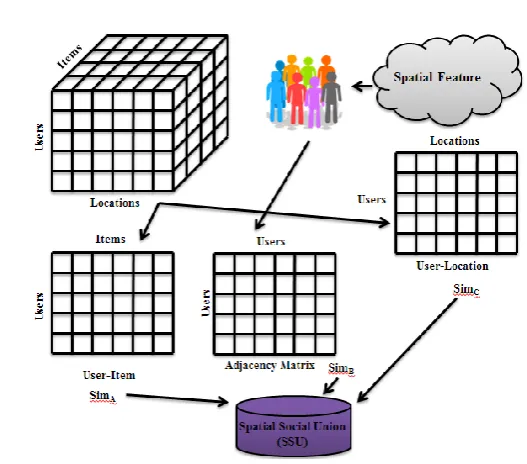
This paper focuses on generating rating prediction in an ad-hoc social network. Spatial Social Union (SSU) is an approach which is a combination of three types of identical matrices namely: user-user social graph, user-item bipartite graph and user-location bipartite graph. A SSU approach helps giving detailed information to predict ratings and give a recommendation of a product to user according to the location of the user.
As specified above, we would now elaborate the different modules of SSU individually;
1. User - User Relationship:
Sim(u,v)=
2. User – Item Relationship:
Sim(u,v)=
where r
x,i= R(x,i)
III.SYSTEM OVERVIEW
p
u,i=
3. User – Location Relationship:
Sim(u,v)=
where d
x,l= D(x,l)
p
u,i=
Fig. 1 Spatial Social Union
Fig.2 Architecture of the SSU-LTR system
IV.ALGORITHM
1) Launch App from drawer.
2) Login
Sign In
Sign Up(Email, Social Network Login) 3) Get user preferences.
4) Check if user is logged in. If yes, Display further modules. 5) Generate recommendations using SSU.
6) Sort the generated results as per user preferences using Learning-to-Rank. 7) Display results
8) Get user ratings for provided service
V.PROS and CONS
Pros
a) Recommendations are given based on the user’s social circle, user – location relationship and user – item relationship.
b) Every recommendations given to the user is stored in a repository unique to every user. c) Every time the user uses the app he/she gets more optimized results.
d) The user need not to set the preferences every time the user use the app as the preference is taken only once. e) The SSU-LTR algorithm being universal algorithm can be applied to any online domain, for eg. Online mp3 streaming, restaurant finding, online shopping, etc.
Cons
a) Use of internet connection is required to use the application as it makes use of the live status of the user’s social circle,
user’s location and item relationship as well.
VI. RESULT
The User can efficiently, successfully, and optimally use our system to receive the more relative results which apply to the needs of the user. Our system provides a few excellent features which help us achieve this goal, including:
A) SSU components are perfect for calculating the current user’s requirements and evaluating a recommended list based on more relevant parameters, regarding each user’s specific needs
B) LTR evaluation helps improve system performance more effectively, as all system functions are recursively analyzed over time and each user individually and uniquely benefits from this system optimization.
C) The attributes of our algorithm make it possible for its utilization over multiple domains, provided that the system is tweaked perfectly over each one.
The Login module is important for both user authentication and user security. Each user receives the data intended for the specific user, and no other data. This is perfected by proper user authentication. And OTP system is used for preventing unauthorized access of user account.
The system has been designed in such a way that its performance improves over each use of the user. Once an effective classification of a user has been carried out, it provides perfect results for the user with minimum input required from the user, saving much hassle of working.
GUI IMAGES
Fig. 3 Sign-up Page
This is the prototype of the sign-up page. Whenever user first accesses the site, this page is displayed.
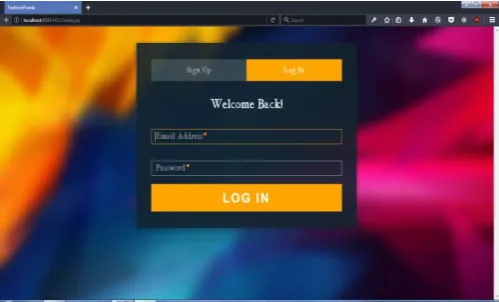
After creating an account the existing user can login into the site via this page.
Fig. 5 Home Page
This is the prototype of the home page of the site. After logging in the user can view the products on this page.
Fig. 6 View of Recommendations
This is how the user will get the optimized recommendations.
COMPARATIVE ANALYSIS
Successability measures number of requests which have been successfully completed. Our algorithm shows much better performance compared to others algorithms such as Ranking SVM, Ranknet and Rankboost.
Fig. 8 Response Time
Lesser the response time, better the system performance. Our algorithm works quicker than its contemporary alternatives. The better the response time the faster the recommendations the user gets.
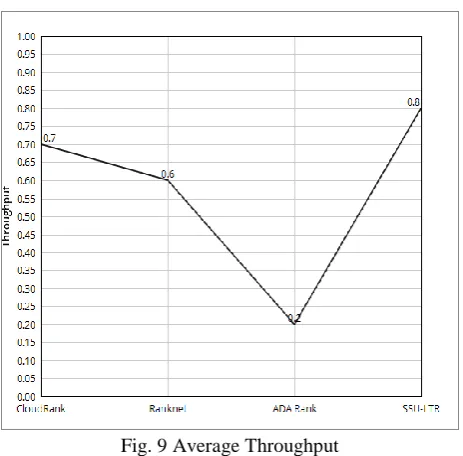
Fig. 9 Average Throughput
Fig. 10 Recommendations
Due to combination of all above factors, combined with the ingenuity of the algorithm, we are able to provide more recommendations than other services such as SU algorithm. As our algorithm makes use of three parameters wiz. User-item relationship, user-location relation and user-user social circle, for providing better quality of recommendations and better throughput.
VII.CONCLUSION
With the highly increasing use of internet today, every provider is in cut-throat competition to have the most users utilize his/her services. This has given rise to a huge number of services available and each service will persuasively try to make the user use the specific service in question.
The SSU approach when experimented provided with the results that were convincing in predicting the rating of a product and recommending a product to the user in a location-sensitive ad-hoc social network. There are many other devised approaches as well for providing similar results to a user, but very few on the basis of location-sensitive approach. By proper planning and development of this approach, it could boost the use of social networking in almost all the domains in the real-life.
Choosing the service on its face value can turn out to be a disastrous decision. Therefore the proper application of the learning-to-rank algorithms is the best way to decide what to use. By proper development and application this algorithm can prove to be instrumental to use for service selection.
REFERENCES
[1] FeiHao, Shuai Li, Geyong Min, Hee-Cheol Kim, Stephen S. Yau, Life Fellow, IEEE, and Laurence T. Yang, “An EfficientApproach to Generating Location-Sensitive Recommendations in Ad-hoc Social Network Environments”, IEEE TRANSACTIONS ON SERVICES COMPUTING, VOL. 8, NO. 3, MAY/JUNE 2015.
[2] Muhammad SulemanSaleem, Chen Ding, Xumin Liu, and ChiHung Chi, Member,”Personalized Decision-Strategy basedWeb Service Selection using a Learning-to-Rank Algorithm” IEEE Transactions on Services Computing, Vol.8, No. 5, May/June 2015.
[3] Joachims, T. (2002), "Optimizing Search Engines using Click through Data" (PDF), Proceedings of the ACM Conference on Knowledge Discovery and Data Mining.
[4] Fuhr, Norbert (1989), "Optimum polynomial retrieval functions based on the probability ranking principle", ACM Transactions on Information Systems 7 (3): 183–204,doi:10.1145/65943.65944.
[5] C. Burges. (2010).From RankNet to LambdaRank to Lambda MART: An Overview.
Symp. Reliable Distributed Syst., 2010, pp. 184–193.
[7] J. Xu and H. Li, “AdaRank: A boosting algorithm for information retrieval,” in Proc. 30th Annu. Int. ACM SIGIR Conf. Res. Develop Inform. Retrieval, 2007, pp. 391–398.
[8] Y. Freund, R. Iyer, R. E. Schapire, and Y. Singer, “An efficient boosting algorithm for combining preferences,” J. Machine Learning Res., vol. 4, pp. 933–969, 2003. Pi”, IJCAT - International Journal of Computing and Technology Volume 1, Issue 1, February 2014.
[9] M. Sarwat, J. Bao, A. Eldawy, J. Levandoski, A. Magdy, and F.Mokbel, “Sindbad: A location-based social networking system,” in Proc. ACMSIGMOD Int.Conf.Manage.Data, 2012, pp.649–652. C. R. Paul, “Introduction to Electromagnetic Compatibility,” New York: Wiley-Intersciences, 1992, pp. 402-428.
[10] M. Ye, P. Yin, and W. Lee, “Location recommendation for location-based social networks,” in Proc. 18th SIGSPATIAL Int. Conf. Adv. Geographic Inform. Syst., 2010, pp. 458–461.
[11] P. Symeonidis, E. Tiakas, and Y. Manolopoulos, “Product recommendation and rating prediction based on multimodal social networks,” in Proc. 5th ACM Conf. Recommender Syst., 2011, pp. 61–68.
[12] V. Vasuki, N. Natarajan, Z. Lu, and I. Dhillon, “Affiliation recommendation using auxiliary networks,” in Proc. 4th ACM Conf. Recommender Syst., 2010, pp. 103–110.
[13] M. Sarwat, J. J. Levandoski, A. Eldawy, and M. F. Mokbel, “LARS*: An efficient and scalable location aware recommender system,” in Proc. IEEE 28th Int. Conf. Data Eng., 2013, pp. 450– 461.
[14] T. Kurashima, T. Iwata, T. Hoshide, N. Takaya, and K. Fujimura, “Geo topic model: Joint modeling of user‟s activityareaand interests for location recommendation,” in Proc. 6th ACM Int. Conf. Web Search Data Mining, 2013, pp. 375–384.
[15] “PDCA12-70 data sheet,” Opto Speed SA, Mezzovico, Switzerland.
[16] A. Karnik, “Performance of TCP congestion control with rate feedback: TCP/ABR and rate adaptive TCP/IP,” M. Eng. thesis, Indian Institute of Science, Bangalore, India, Jan. 1999.
[17] J. Padhye, V. Firoiu, and D. Towsley, “A stochastic model of TCP Reno congestion avoidance and control,” Univ. of Massachusetts, Amherst, MA, CMPSCI Tech. Rep. 99-02, 1999.