Integration of Dependency Analysis with Semantic Analysis Referring to the
Context
Yuki Ikegaya* Yasuhiro Noguchi* Satoru Kogure†
Tatsuhiro Konishi† Makoto Kondo† Asoh Hideki‡
Akira Takagi§ Yukihiro Itoh†
*
Graduate School of Science and Engineering, Shizuoka University {cs7005@cs.,noguchi@}inf.shizuoka.ac.jp
†
Faculty of Informatics, Shizuoka University {kogure@cs,mkondo@ia,konishi@cs,itoh@
cs}.inf.shizuoka.ac.jp
‡
Information Technology Research Institute, AIST [email protected]
§
CSK Corporation/ Information Technology Research Institute, AIST
Abstract
This paper describes how to perform syntactic parsing and semantic analysis using the contextual information as a language understanding component in a dialog system. Although syntactic parsing and semantic analysis are often conducted independently of each other, correct parsing of a sentence often requires the semantic information on the input and/or the contextual information prior to the input. We therefore merge syntactic parsing with semantic analysis, which enables syntactic parsing to take advantage of the semantic content of an input and its contextual information. To use contextual information, the semantic representation of an input should have a comparable form to the semantic content of the preceding context. Accordingly, we employ a framework for semantic representations that achieves such comparison. We take dialogs of hotel search and reservation for example, and demonstrate the effectiveness of the proposed method. The experimental results confirm that the proposed system achieves high accuracy in parsing and generation of semantic representations.
1. Introduction
When we have a talk, we presuppose the situation and particular context.1 The situation/context enables us to understand utterances without talking in great detail. The situation/context also makes it possible to convey a wide variety of contents with a certain linguistic expression. This means that a language understanding component in a dialog system should not interpret a given sentence alone; rather, it should interpret a sentence using the context information.
In our previous work, we have developed a Japanese dialog system for hotel search and reservation (Noguchi et al. 2002). The system accepts free input from the keyboard. We are planning to build an audio input module into the system. Audio input raises the importance of the context information because the effective use of the context information may circumvent possible recognition errors. In this paper, we focus on how a language understanding component can perform syntactic parsing and semantic analysis using the contextual information.
It may be possible to integrate syntactic parsing with semantic analysis by taking advantage of LFG (Kaplan et al. 1982) and HPSG (Pollard et al. 1994). However, they do not consider the use of the context information. In this paper, we propose the method to integrate dependency analysis with semantic analysis referring to the context.
Recently, many researches have adopted a statistical approach toward parsing, and it has been shown that the statistical approach is effective in obtaining correct dependency structure. There are
1
some free tools available (e.g. Charniak 2000; Kurohashi 1998; Kudo et al. 2002). In the study of semantic analysis, word sense disambiguation (Charniak 2000) and analysis of case (Harada et al. 2000) have been pursued. The syntactic parsing and semantic analysis, however, are often studied independently of each other though correct parsing of a sentence often requires the semantic information on the input and/or the contextual information prior to the input. Accordingly, we propose a sequential parser that determines syntactic structure based on semantic analysis referring to the context and on relevant statistical information.
2. Fundamental Considerations
2.1.Syntactic and Semantic analysis
Japanese has the property of free word order and it raises the number of possible candidates in parsing a given sentence. If parsing and semantic analysis are performed independently, it is difficult to efficiently reduce the number of the candidates using the semantic/contextual information. If semantic analysis applies to every candidate, the calculation cost may be too high. To reduce the number of candidates using the contextual information, the system process an input word by word and, in each cycle of parsing, it gives a score to each candidate based on grammatical rules and the conformity to the context. In each cycle of parsing, the system generates possible semantic representations by referring to the context. Each representation receives a score and low-scored candidates are filtered out. To use contextual information in the process, the contextual information has to be stored in such a way that it can be formally compared to the semantic content of an input. For example, the system should realize whether an input contains something that has already been denoted in the context. If it does, the system should realize which part in the input has appeared in the context and how that part has been mentioned.
The next subsection describes the framework for semantic representations which is capable of extracting the semantic content from the context.
2.2.Semantic Representations
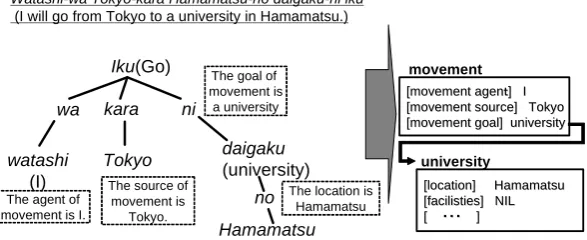
Conventional semantic representations do not achieve the goal mentioned above because they inherit syntactic dependency and have as much variety as dependency structures. Take the following sentences for example.
(1-a) watasi-wa Tokyo-kara Hamamatsu-no daigaku-ni iku. (I will go from Tokyo to a university in Hamamatsu.) -> Go (I, Tokyo, a university in Hamamatsu)
(1-b) watasi-wa Hamamatsu-no daigaku-ni iku. shuppatsuchi-wa Tokyo da. (I will go to a university in Hamamatsu. The departure place is Tokyo.) -> Go (I, NIL, a university in Hamamatsu) and Eq (the departure place, Tokyo)
(1-a) and (1-b) convey roughly the same meaning. Predicate logic gives the two examples the logical forms on the right of the arrowheads, respectively. Transformation from the natural language expressions to the logical forms retains the same dependency. The dependency between
iku and the three words, watashi, Tokyo and Hamamatsu-no daigaku, is identical to the one between Go and the arguments. The same is equally true of b). In order to judge to the equivalence of (1-a) with (1-b), we need the following specific interpretive rules.
The second argument of Go is the value of a departure place. If the value of the first argument of Eq is a departure place, the value of the second argument of Go and the one in the second argument of Eq are equivalent.
It, however, is not practical give such rules to every type of dependency structures. Semantic representations, therefore, should enable formal evaluation meanings irrespective of the number of sentences to convey a semantic content and the evaluation should not be affected by the types of dependency structures involved in the input.
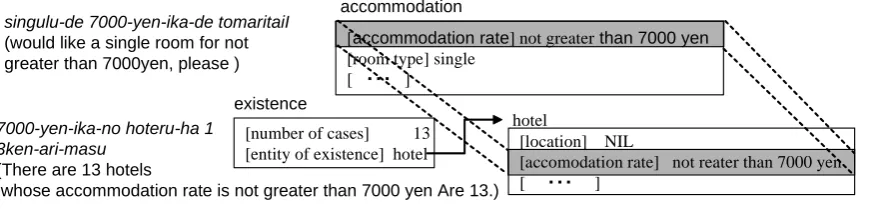
singulu-de 7000-yen-ika-de tomaritaiI
(would like a single room for not greater than 7000yen, please )
7000-yen-ika-no hoteru-ha 1 3ken-ari-masu
(There are 13 hotels
whose accommodation rate is not greater than 7000 yen Are 13.)
[accommodation rate] not greaterthan 7000 yen
[room type] single [ ・・・ ]
accommodation
[location] NIL
[accomodation rate] not reater than 7000 yen [ ・・・ ]
hotel [number of cases] 13
[entity of existence] hotel
existence
-The attribute pairs are identical, “[accommodation rate] not greater than 7000 yen” of accomodation and hotel.
-“[accommodation rate] not greater than 7000 yen” is a primary attribute and “[room type] single” is a sub-attribute to the former.
Figure 5: Comparison of attribute-value pairs (1)
Ippaku-de tyoushokutuki-de tomari-tai
(I would like to stay for one night with breakfast.)
Kikan-wa dono-gurai-desu-ka (How long will the duration be? )
Be [query ]
[stay duration] one night
[stay plan] breakfast included Stay [desire ]
[duration ] how long
The attribute “duration” and the value ”how long” are in a super-sub relation with the attribute “stay duration” and the value “one night”, respectively.
Figure 6: Comparison of attribute-value pairs (2)
In referring to the context, we should delimit the scope of the reference. This is because the calculation cost for the search in the context may be extremely high if the entire context is always the scope of reference.
In general, a phrase with a topic particle -wa or a nominative particle –wa indicates a shift of topic, and the generalization holds true for dialogs about hotel search and reservation (Noguchi et al. 2002).
Accordingly, reference to the context goes back to either of the followings. To a word with a topic particle -wa
To a word with a nominative particle –wa
Figure8 shows generation process of semantic representations for the sentence keshiki-no yoi-hoteru-ga ii-na (I prefer a scenic hotel).Although the representations are depicted in a simply form, the elements in the stacks are actually semantic representations in the form of attribute-value pairs. After the string keshiki-no yoi (be scenic) is processed, the candidates (a) and (b) are generated.
Kesiki-no modifies yoi in (b) but it doesn’t in (a). Then, hoteru (hotel) is analyzed. If grammatical rules judges that hoteru may modify the top element in the stacks (yoi) they may have dependency. Therefore, the process generates candidates in which hoteru modifies yoi and candidates where it doesn’t. If a couple of concepts may modify a retrieved concept, the process above is repeated recursively.
Input sentence
morphological analysis
The morphemes are processed one by one from the beginning of the input.
dependency parsing
&
candidate scoring
generation of semantic representations & candidate scoring based on the context
Filtering the candidates based on their scores
The context
Concept selection
All the concepts are processed and there are some morphemes to be dealt with
The concepts are processed one by one.
There are some concepts to be dealt with.
The candidate semantic representations
All the morphemes are processed
Accumulate the candidate semantic representations into the context
The candidate with the highest score is
selected
the semantic representation of the input sentence
The context made up based on an interpretation 1
Figure7: Process flow
hoteru
yoi
kesiki-no
hoteru yoi
kesiki-no
yoi
kesiki-no hoteru
yoi kesiki-no hoteru yoi
keisiki-no
yoi
kesiki-no
yoi
kesiki-no hoteru
(a) sj
(b)sj+1
kesiki/no/yoi
(scene/adnominal particle/nice )
morpheme = hoteru(hotel) concept = hoteru(hotel)
the candidates produced from (a) kesiki/no/yoi/hoteru
kesiki/no/yoi/hoteru/ga/ii/na(I prefer a scenic hotel)
E
E
(1) (2) (3) (4) (5)
3.3.Example Operation
(3-a) isoide-iru-node tikaku-ni aru mise-de kai-tai
[agent of purchase ] NIL [location of purchase] shop [ ・・・ ]
purchase desire
teaching
[object of teaching] store [agent of teaching] NIL
[ ・・・ ] [location] neighborhood [goods to sell] NIL [ ・・・ ]
store [goods to sell] map[sale location] [ ・・・ ] sale context
-(3-a) exists in the context => The phrase kono-tikaku-no(around here) may modify mise(store). -(3-b) exists in the context => The phrase kono-tikaku-nomay modify tizu (map).
[location] NIL
[goods to sell] NIL [ ・・・ ] shop
(3-a):Isoide-iru-node tikaku-ni aru mise-de kai-tai.(I want to make a purchase at a shop around here because I am in a hurry. ) (3-b):Kono-tikaku-no tizu-ga hosii (I want a map around here.)
(3-c) Kono-tikaku-no tizu-o utte-iru mise-o osiete. (“Can you tell me a shop around here that sells a map?”
or “Can you tell me a shop that sells a map around here?”) [degree of urgency] ++
[ ・・・ ] state of urgency
[ ・・・ ]
++
[degree of distance] --
[ ・・・ ] neighborhood
[entity of existence] shop [location] neighborhood [ ・・・ ]
existence
[publisher] NIL [ ・・・] map
[degree of distance] --
[source to estimate
the distance] present location [ ・・・ ]
neighborhood
[ ・・・]
--
[ ・・・]
present location
cause
× ○
(3-c) Kono-tikaku-no tizu-o utte-iru mise-o osiete
Figure9: Disambiguation of modification relation
Figure 9 shows an example in which the system disambiguates possibly ambiguous dependency structure. The sentence (3-c) Kono-tikaku-no tizu-o utte-iru mise-o osiete is two-way ambiguous if we ignore the context. The phrase kono-tikaku-no (around here) may modify either mise (shop) or
tizu (map). In the former case, the sentence would mean “Can you tell me a shop around here that sells a map?” and, in the latter case, it would mean “Can you tell me a shop that sells a map around here?” If (3-a) is contained in the context, the former should be the case. If (3-b) appears in the context, on the other hand, the latter should be the case. In either case, our context-dependent criteria give a higher score to a candidate which contains the same attribute-value pair as the one in the context. Figure 9 illustrates the former case, in which the relevant phrase should be interpreted as modifying the farther noun (i.e. mise).
4. Evaluation
4.1 Experimental design
We evaluated the proposed method by using dialogs about hotel search and reservation. The dialogs were collected from seven subjects, who are graduate and undergraduate students majoring in computer science. The experiment was designed as follows.
- Two of the subjects engaged in a conversation in which one played a role of a guest looking f or a hotel and the other played a role of an operator who actually makes hotel search/reservation for the guest.
where the system assigned the highest score to a unique candidate and the candidate had the correct dependency structure. Figure 10 shows an example involving a longer dependency that the system successfully obtained. In this example, the context contains an attribute-value pair “object to be left = baggage” and the system gives a higher score to the long dependency based on the attribute-value pair in the context.
Table 5 shows the accuracy where the system gave the highest score to a unique candidate, which was made up of correct semantic representations. When the system did not refer to the context, the accuracy was 57% (114/200). Reference to the context raised the score to 64% (128/200). It confirms that reference to the context is effective not only in parsing but also in generating correct semantic representations. Reference to the context helps the system to assign a higher score to a candidate involving correct semantic representation. Take a phrase “ikura-no hoteru (literally “how much hotel”) for example. Since the concept hoteru has more than one attribute associate with rate (e.g. hotel rate, parking rate, etc.), the system generates attribute-value pairs like “hotel rate = ?rate” and “parking rate = ?rate”. By referring to the context, the system obtains the correct semantic representation which involves the correct attribute-value pair that also appears in the context.
The system failed in generating correct dependency structure and/or semantic representations in some examples even when it referred to the context. One typical example involves meta-utterances referring to action took in the conversation.
(U3) Basu-no jikoku-hyo-o sakihodo itta denwa-bango-e okutte-kudasai. (Please send the bus schedule to the phone number mentioned previously.)
In order to generate the candidate in which jikoku-hyo-o (bus schedule) has dependency with okuru
(send), it is necessary to identify the subject/agent of itta (mentioned) and to understand who said what at which phase in the conversation. Another typical example does not require the context for disambiguation but the disambiguation requires more knowledge than our system currently has.
(U4) X hoteru-no kuruma-de iku iki-kata-o oshie-te (Tell me how to get to X Hotel by car.)
In (U4), X hoteru (X hotel) has dependency not with kuruma (car) but wih iki-kata (how to get to). In order to obtain the correct dependency, the system must have knowledge that customers may go to a hotel by car, bus, taxi, etc. This kind of ambiguity would be solved by describing relevant knowledge in the concept dictionary in the same form as the context.
5. Conclusion
We proposed the framework to analyze sentences by integrating dependency analysis with semantic analysis referring to the context. This method sequentially generates semantic representations and compares attribute-value pairs in input and the context. It has been confirmed that the method is helpful to resolve syntactic/semantic ambiguity.
The most significant feature of this method is that it does not require complicate inference rules in using context information. This is achieved by making up the context with stable semantic representations. The system needs a framework for keeping more than one interpretation and making a natural response because not every input can be disambiguated. When the context information is not sufficient to disambiguate an input, the system needs to use knowledge about the entities/events mentioned or knowledge about the domain of the dialog. How to use such knowledge remains one of the issues in the future research.
6. References
Charniak, E. 2000. A Maximum-Entropy-Inspired Parser, Proceedings 1st Meeting of the North American Chapter of the Association for Computational Linguistics, pp. 132–139.
Kaplan, R. M., and Bresnan, J. 1982. Lexical-Functional Grammar: A formal system for grammatical representation. The Mental Representation of Grammatical Relations (Joan Bresnan, ed.), The MIT Press, pp.173-281.
Kurohashi, S. 1998. Japanese Dependency/Case Struc-ture Analyzer KNP version 2.0b6. Department of Infor-matics, Kyoto University. (in Japanese).
Kudo, T., and Matsumoto, Y. 2002. Japanese Dependency Analysis using Cascaded Chunking.
Proceedings of the 6th Conference on Natural Language Learning 2002 (COLING 2002 Post-Conference Workshops),pp.63-69.
Noguchi, Y., Ikegaya, Y., Takagi, A., Nakashima, H., Konishi, T., Itoh, T., Kondo, M., and Itoh, Y. 2002. A Framework for Semantic Representations for a Natural Language Dialog System,
Proceeding of SNLP-Oriental COCOSDA, pp.231-236.
Pollard, C., and Sag, I. A. 1994. Head-Driven Phrase Structure Grammar. University of Chicago Press,.
Takagi, A. and Y. Itoh. 1987. “Natural Language Processing ”, Maruzen, (in Japanese).