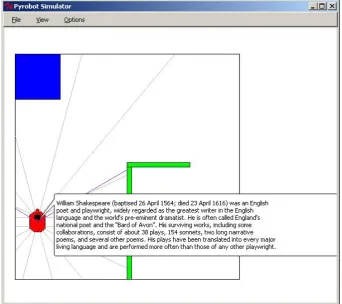
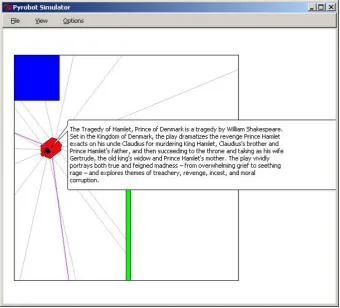
Figure 1: Starting first topic: Shakespeare.
cooperative verbal behaviour emerges when the robot mod-ifies its own verbal behaviour in response to being asked by the human to talk less or more.
The robotics framework supports different behavioural paradigms, including finite state machines, reinforcement learning, fuzzy decisions, neural networks and evolutionary algorithms. By combining finite state machines with the speech interface, spoken dialogue systems based on state transitions can be implemented for classical closed-domain form-filling dialogues such as flight reservations. These closed-domain dialogue systems exemplify emergent ver-bal behaviour that is robot-initiated: the robot asks appro-priate questions in order to achieve the dialogue goal. A demo of these different levels of emergent verbal behaviour is described by Wilcock and Jokinen (2011).
The next level of emergent verbal behaviour is open-domain conversational dialogues. Jokinen and Wilcock (2011) propose extending the robot’s capabilities by using Wikipedia as a source of world knowledge. By exploit-ing ready-made paragraphs and sentences from Wikipedia, a robot can talk about a very wide range of open-domain topics. The example in Section 5. shows how the robot can change topics according to the human’s interests. Although the specific topic will typically be human-initiated, as in the example, Wikipedia can also be used as a source of sugges-tions for new robot-initiated topics.
3.
Constructive Dialogue Modelling
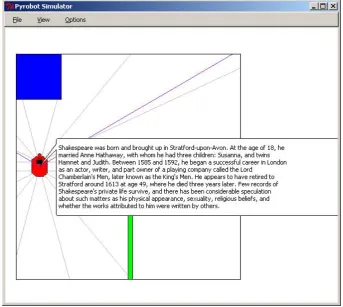
The theoretical basis of the interaction is drawn from the Constructive Dialogue Model (Jokinen, 2009), in whichFigure 2: Continuing first topic: Shakespeare.
context in which the underlying goals can be achieved, and success of interaction depends on the cognitive and emo-tional impact of the action on the hearer.
To ensure maximal impact, the agents must make new in-formation as clearly available for the partner as possible, by using suitable lexical items, prosody (pitch, stress, volume, speed), and non-verbal means (gestures, gazing, face ex-pressions), while the partner must be aware of these means in order to integrate the intended meaning in the shared con-text. Important topics in interaction management are thus related to information presentation: planning and genera-tion of appropriate responses, giving feedback, and manag-ing topic shifts.
The main challenge lies in the grounding of language: con-structing a shared knowledge of what the conversation is about and updating one’s own knowledge accordingly. The focus of the research is on verbal and non-verbal signals that regulate the flow of information. Such aspects as look-ing at the conversational partner or looklook-ing away provide indirect cues of the partner’s willingness to continue in-teraction, while gesturing can tell the partner that the item is important new information that the partner should focus their attention on. In this paper we focus especially on the agent’s ability to engage the partner in the interaction by providing interesting information and interesting topics for discussion.
4.
Topic trees and the Web
The organization of knowledge has always been one of the big questions. We can look for help with this question from
the internet, in fact we can assume that world knowledge is somehow stored in the internet and we wish to take advan-tage of this.
The organization of knowledge into related topics is often done with the help of topic trees. Originally “focus trees” were proposed by McCoy and Cheng (1991) to trace foci in natural language generation systems. The branches of the tree describe what sort of shifts are cognitively easy to process and can be expected to occur in dialogues: random jumps from one branch to another are not very likely to occur, and if they do, they should be appropriately marked. The focus tree is a subgraph of the world knowledge, built in the course of the discourse on the basis of the utterances that have occurred so far. The tree both constrains and en-ables prediction of what is likely to be talked about next, and thus provides a top-down approach to dialogue coher-ence. The topic (focus) is a means to describe thematically coherent discourse structure, and its use has been mainly supported by arguments regarding anaphora resolution and processing effort.
Previously, topic trees were hand-coded which of course is time-consuming and subjective, or automatic clustering programs were used which have not been entirely satisfac-tory. Our approach to topic trees exploits the organisation of domain knowledge in terms of topic types found in the web, and more specifically in Wikipedia.
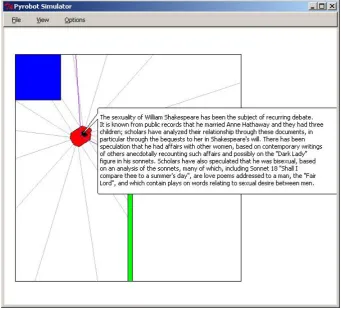
Figure 3: Changing to a second topic: Shakespeare’s sexuality.
tracing salient entities in the dialogue and providing heuris-tics for different shifts of attention, we seek a formalisation of the information structure of utterances in terms of the new information that is exchanged.
Wikipedia provides an extensive, freely available, open-domain and constantly growing knowledge source. We therefore use Wikipedia to produce robot contributions in open-domain dialogues, continuing the previous work de-scribed in (Jokinen and Wilcock, 2011).
Instead of attempting any kind of deep processing of the Wikipedia texts involving information extraction, question answering or summarization techniques, we prefer a shal-low processing approach in which selected chunks of the texts are read out aloud, with a minimum of reformatting and clean-up necessary for spoken contributions. This shal-low approach alshal-lows us to concentrate on identifying the new information and on managing the topic chains and topic shifts.
5.
Topic chains: an example
A concrete example of topic chains using Wikipedia is shown in Figures 1 to 6, using the robot simulator described in (Wilcock and Jokinen, 2011). The robot simulator can produce speech bubbles as well as actual speech, enabling these illustrative screenshots to be produced.
This specific sequence is initiated by the human asking the robot to talk about Shakespeare. The robot downloads the Wikipedia article about Shakespeare from the internet and starts reading the first paragraph as shown in Figure 1.
The most appropriate chunk size for a robot’s spoken con-tribution will vary from a short phrase to a full sentence or a whole paragraph. This depends on several factors including the individual user (adult, child, expert, etc.), the commu-nicative environment (quiet, noisy, etc.), and the previous interaction history (smooth, difficult, etc.). In these exam-ples the chunk size is a whole paragraph, which may be suitable for a robot conversation with an adult in a quiet environment with a smooth previous interaction history. In the example sequence, when the robot has spoken the first paragraph as shown in Figure 1, the human gives some feedback that is evaluated by the robot as sufficiently en-couraging to continue the topic, so the robot decides to con-tinue with the next paragraph as shown in Figure 2. Shakespeare’s physical appearance, sexuality and religious beliefs are all introduced as items of new information (NewInfos) near the end of the paragraph in Figure 2. As the human is relatively likely to ask about one of these NewInfos if any of them arouse sufficient interest, they are added to the list of specific items that the speech recognizer will listen for and be specifically ready to recognize. Notice that the robot does not explicitly ask the user if they want to continue with one of these topics. It is assumed that the user will select the next topic as a natural continu-ation in the dialogue i.e. since the human is engaged in the dialogue.
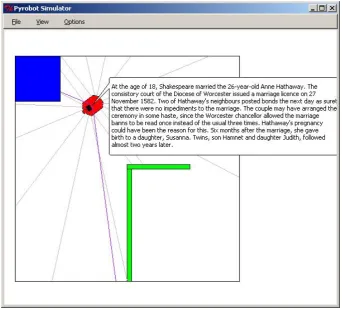
Figure 4: Continuing second topic: Shakespeare’s sexuality.
robot therefore does not continue reading the main article about Shakespeare, but instead downloads a new Wikipedia article about Shakespeare’s sexuality and starts reading the first chunk as shown in Figure 3.
The topic has now shifted to Shakespeare’s sexuality. The human next gives feedback that is evaluated as showing suf-ficient interest in the new topic, so the robot continues with the next paragraph about Shakespeare’s sexuality as shown in Figure 4.
Shakespeare’s children Susanna, Hamnet and Judith are all introduced as NewInfos near the end of this paragraph. These NewInfos are therefore added to the list of items that the speech recognizer will be ready to recognize.
Now the human asks about Shakespeare’s son Hamnet and this is recognized as one of the NewInfos that was likely to be selected for a topic shift. The robot therefore quits the article about Shakespeare’s sexuality, and downloads another Wikipedia article about Shakespeare’s son Hamnet and starts reading the first chunk as shown in Figure 5. Next the human asks about “Hamlet” which is mentioned in the text about Hamnet and is recognized as one of the NewInfos likely to be selected for a topic shift. The robot therefore stops talking about Hamnet, downloads a new Wikipedia article about Hamlet (Shakespeare’s play) and starts reading the first chunk as shown in Figure 6.
6.
Assessing the level of interest
An important factor in developing systems that can talk about interesting topics is assessing the level of interest of the user. There are two sides to this: first, how to detectwhether the human conversational partner is interested in the topic or not, and second, what should the system do based on this feedback.
The approaches to detecting the level of interest are part of the system’s external interface, and the decisions about what to do based on this feedback are part of the system’s internal management strategy. The external interface must clearly not be limited to purely verbal feedback, but must include intonation, eye-gaze, gestures, body language and other factors in order to assess the interest level correctly. The internal strategy for reacting appropriately to this feed-back must decide what to do if the user is clearly interested, or is clearly not interested, and how to continue when the user’s interest level is unclear.
in-Figure 5: Changing to third topic: Shakespeare’s son Hamnet.
terest in a piece of new information that is mentioned. This feedback is then used by the system, which switches topics smoothly to the new information of greater interest.
7.
Future work
As future work, we plan to export the dialogue system from the Pyrobot simulator to a real robot. We then expect to be able to integrate speech and gesture so as to support the presentation of information.
For example, beat gestures are small hand movements that do not change the content of the accompanying speech but rather they serve a pragmatic function, and emphasise and give rhythm to the speech. Often beats are synchronized with the spoken emphasis, i.e. the stroke (the most ener-getic part of the gesture) occurs at the intonationally most prominent syllable of the accompanying speech segment (Kendon, 2004).
Gestures can also mark discourse structure. The prag-matic gesture, or what Jokinen and Vanhasalo (2009) called “stand-up gesture”, signals to the partner that something important is to come next, and thus they direct the listener’s attention to what is going to be said. Moreover, beat ges-tures usually occur with the new information, i.e. they serve a similar role as the intonation to distinguish new and not expected information from the topic, or old and expected information. In this way, the communication is managed in a multimodal way and the visual management by gestures is to emphasise the least known elements to the partner so that the partner surely will notice and understand the new information. There will of course be other multimodal
sig-nals as well but the synchrony of gestures and intonation has a particular significance (Jokinen, 2010).
One notable signal is the manner and frequency of feedback in conversation (Misu et al., 2011): whether one provides frequent verbal and non-verbal feedback concerning the ba-sic enabling aspects of communication (contact, perception and understanding), or whether one tends to assume that the enablements hold as long as the actual interaction takes place, and thus no backchannelling is necessary in an ex-plicit manner. Also the way feedback particles are used to express evaluation and acceptance of the given informa-tion or how the partners fill in each others’ utterances vary a lot. Much of the conversational information exchange relies on the assumptions and presuppositions that are not neces-sarily made explicit in the course of the interaction. The context is an important source of information, and one of the necessary conversational skills is to know how to en-able the right type of contextual reasoning: the participants should observe each others’ reactions and changes in emo-tional and cognitive states.
Figure 6: Changing to a fourth topic: Shakespeare’s play Hamlet.
8.
References
Elisabeth Andr´e and Catherine Pelachaud. 2010. Interact-ing with embodied conversational agents. In F. Cheng and K. Jokinen, editors,Speech Technology: Theory and Applications, pages 123–150. Springer.
Nick Campbell and Stefan Scherer. 2010. Comparing mea-sures of synchrony and alignment in dialogue speech timing with respect to turn-taking activity. In Proceed-ings of 11th Annual Conference of the International Speech Communication Association (Interspeech 2010), Makuhari, Japan.
Kristiina Jokinen and Minna Vanhasalo. 2009. Stand-up gestures - annotation for communication management. In C. Navarretta, P. Paggio, J. Allwood, E. Ahls´en, and Y. Katagiri, editors,Proceedings of the NoDaLiDa work-shop on Multimodal Communication - from Human Be-haviour to Computational Models. NEALT Proceedings Series, Vol. 6, pages 15–20, Tartu.
Kristiina Jokinen and Graham Wilcock. 2011. Emergent verbal behaviour in human-robot interaction. In Pro-ceedings of 2nd International Conference on Cognitive Infocommunications (CogInfoCom 2011), Budapest. Kristiina Jokinen. 2009. Constructive Dialogue
Mod-elling: Speech Interaction and Rational Agents. John Wiley & Sons.
Kristiina Jokinen. 2010. Gestures and synchronous com-munication management. In A. Esposito, N. Campbell, C. Vogel, A. Hussein, and A. Nijholt, editors, Devel-opment of Multimodal Interfaces: Active Listening and
Synchrony, pages 33–49. Springer.
Kristiina Jokinen. 2011. Turn taking, utterance density, and gaze patterns as cues to conversational activity. In Proceedings of the International Conference on modal Interaction (ICMI-2011) Workshop on Multi-modal Corpora for Machine Learning (MMC), Alicante, Spain.
Adam Kendon. 2004.Gesture: Visible action as utterance. Cambridge University Press.
Kathleen F. McCoy and Jeannette Cheng. 1991. Fo-cus of attention: Constraining what can be said next. In W.R. Swartout C.L. Paris and W.C. Mann, editors, Natural Language Generation in Artificial Intelligence and Computational Linguistics), pages 103–124. Kluwer Academic Publishers.
Teruhisu Misu, Etsuo Mizumaki, Yoshinori Shiga, Shinichi Kawamoto, Hisashi Kawai, and Satoshi Nakamura. 2011. Analysis on effects of text-to-speech and avatar agent on evoking users’ spontaneous listener’s reactions. In Proceedings of the Paralinguistic Information and its Integration in Spoken Dialogue Systems Workshop, pages 77–89, Granada.