Building Large Corpora from the Web Using a New Efficient Tool Chain
Roland Schäfer, Felix Bildhauer
German Grammar, SFB 632/A6 Freie Universität Berlin
Habelschwerdter Allee 45, 14195 Berlin
[email protected], [email protected]
Abstract
Over the last decade, methods of web corpus construction and the evaluation of web corpora have been actively researched. Prominently, the WaCky initiative has provided both theoretical results and a set of web corpora for selected European languages. We present a software toolkit for web corpus construction and a set of siginificantly larger corpora (up to over 9 billion tokens) built using this software. First, we discuss how the data should be collected to ensure that it is not biased towards certain hosts. Then, we describe our software toolkit which performs basic cleanups as well as boilerplate removal, simple connected text detection as well as shingling to remove duplicates from the corpora. We finally report evaluation results of the corpora built so far, for example w. r. t. the amount of duplication contained and the text type/genre distribution. Where applicable, we compare our corpora to the WaCky corpora, since it is inappropriate, in our view, to compare web corpora to traditional or balanced corpora. While we use some methods applied by the WaCky initiative, we can show that we have introduced incremental improvements.
Keywords: web corpora, corpus evaluation, web crawling
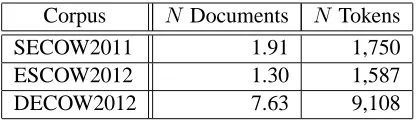
Corpus N Documents N Tokens
SECOW2011 1.91 1,750
ESCOW2012 1.30 1,587
DECOW2012 7.63 9,108
Table 1: Document and token counts (million) for se-lected COW corpora
1. Introduction
In this paper, we describe a new tool chain for the processing of web data for the purpose of web corpus construction. Furthermore, a growing set of very large web corpora, which we constructed using the afore-mentioned tools, is introduced and evaluated (Table 1 lists a selection of these corpora and their respective sizes). We proceed by discussing the methods of data collection in 2., describing the methods implemented in the software in 3. before reporting results of the evaluation of the final corpora and the quality of the software in 4.
2. Data Collection
The purpose of the project described here is the con-struction of very huge comparable web corpora in a large number of languages. Although we share with Kilgarriff and Grefenstette (2003, p. 340) a more or less agnostic position towards the question of repre-sentativeness of web corpora, we still consider it cru-cial to define the population of which a corpus is
in-tended to be a sample. We sample from all WWW documents under a given national TLD, written in an official language of the respective country and con-taining predominantly connected text. From each doc-ument, we attempt to extract all paragraphs of con-nected text, finally making sure that the majority of the text within the document occurs only once in the final corpus (cf. 3.4.). Since the given population is unknown to a large extent, proportional sampling is out of the question, and large random samples are the only valid option. How a random sample from the web can be approximated is not a settled question. In web corpus construction, it is customary to send large num-bers of requests to search engines using tuples of mid-frequency word forms as search strings (Baroni and Bernardini, 2004). Either only the URLs returned are then harvested (BootCaT method), or they are used as seed URLs for a crawler system. We apply the second method, since corpora of roughly 1010
engines is generally an unsafe strategy, we would like to point out some problems with search engine results and argue for much stronger reliance on very large web crawls for linguistic purposes.
The randomness of web corpora was examined suc-cessfully in the BootCaT/WaCky community from a linguistic viewpoint. For example, Ciamarita and Ba-roni (2006) evaluate randomness of corpora based on linguistic features. The most basic measure of ran-domness of both seed URLs retrieved from a search engine and documents downloaded by a crawler, how-ever, is its bias towards certain hosts. Even though a web corpus (or a set of search engine results) might never be called balanced, it should count as biased if it proportionally contains a huge number of documents from only a few hosts. It is known from papers such as Bar-Yossef and Gurevich (2006) that obtaining ran-dom samples from search engines is not a simple mat-ter, especially when there is only one major search en-gine left which allows free API access for large num-bers of queries. To our knowledge, nobody has ever constructed web corpora making efforts such as de-scribed by Bar-Yossef and Gurevich (2006). Since the method described in that paper only approximates ran-dom samples from search engine indices and not from the web itself, even following the procedure would not ensure random samples in the desired sense. The cus-tomary method, however, does not even ensure bias-free sampling from a search engine’s index.
Our experiments so far have shown that a large num-ber of hosts which never occur in search engine re-sults can be discovered through long-term crawling. In Figures 1 and 2, experiments for the de and se
domain are evaluated with respect to their host bias. The graphs cumulatively plot for a random sample of 10,000 URLs from either a set of unique seeds gath-ered from the search engines (Yahoo forse, Bing for
de) and the document URLs of a final corpus derived from these seeds (which has undergone the cleaning procedures explained in 3.) how large a proportion r
of the total URLs comes from to the n most popu-lar hosts in the whole sample. The seed URLs were queried using 3-tuples of content word forms (nouns, verbs, adjectives, adverbs) ranked 1,001 through 6,000 in frequency lists either from existing corpora or from previous crawl experiments. A maximum of 10 re-sults per tuple were requested from the search engine. The crawler ran for approximately seven days for the
sedomain, and for 28 days in the decase. The to-tal sizes of the seed sets Nseeds and the total number of document URLs in the corpus Ncorpusis given for each experiment. The third curve in each graph plots the proportion of documents in the final corpus which
stem from the topnhosts from the seed set. It is obvi-ous that the experiments were successful to different degrees.
0 2000 4000 6000 8000 10000
0.2
0.4
0.6
0.8
1.0
n
r
Bing Corpus
Bing proportion in Corpus 258
1276
0.58
Figure 1: Host bias for DECOW2012 with Bing seeds,
Ncorpus= 7,759,892,Nseeds= 912,243
Using an extremely large set of unique seed URLs (over 900,000) causes the seed set to be comparatively less biased: in the DECOW2012 seeds (Figure 1), 50% of the URLs come from the 258 most popular hosts, while in the SECOW2011 (Figure 2) seed set, figures is much lower: 29 hosts contribute 50% of the seed URLs.1 A longer crawling time helped to bring down the host bias of DECOW2012 significantly, such that in the final corpus, 50% of the documents in the sample come from 1,276 hosts. Also, the 10,000 most prominent hosts in the DECOW2012 seed set con-tribute only 58% of the documents from the top 10,000 hosts in the final corpus.
The graph for SECOW2011 (Figure 2) in fact shows a completely unsuccessful crawl experiment, where an already heavily biased seed set resulted in even more biased crawl results. The seeds as returned by Yahoo were extremely biased to begin with, and the crawl, using a breadth-first strategy, got stuck trying to ex-haustively harvest the few hosts strongly represented in the seeds. This resulted in an interesting corpus, but definitely not in a general-purpose corpus. It contains 1,443,452 documents (75.5% of the total documents) from the hostblogg.se. Since in this case, the host is strongly tied to a certain type/genre of text and com-munication (blog posts), it is obvious that host bias can be directly linked to linguistic biases.
To illustrate further that the seed set and the crawl-ing process both play a role, we now compare the
re-1Due to the shutdown of Yahoo’s API access, it is now
0 2000 4000 6000 8000 10000
0.2
0.4
0.6
0.8
1.0
n
r
Yahoo Corpus
Yahoo proportion in Corpus 29
1
0.95
Figure 2: Host bias for SECOW2011 with Yahoo seeds,Ncorpus= 1,912,757,Nseeds= 204,872
sults to a version of the deWaC corpus from which we removed near-duplicates using our shingling tools (as described in 4.2.) in Figure 3. Only 8,631 hosts are considered, because the seed set contains only this many hosts. The deWaC crawl was based on a seed set where each host was represented only once, resulting in a linear host bias graph. During the 10 day crawl us-ing a breadth-first strategy, however, the crawler har-vested mainly the hosts from the seed set, leading to a much stronger bias. This corroborates our view that both the seed sets and the crawling strategies have to be chosen with greater care than is customary.
0 2000 4000 6000 8000
0.0
0.2
0.4
0.6
0.8
1.0
n
r
Yahoo Corpus
Yahoo proportion in Corpus 3751
407
0.84
Figure 3: Host bias for shingled deWaC with Yahoo seeds,Ncorpus= 1,501,076,Nseeds= 8,631
Finally, host bias is reflected also in the average number of documents per host, which is 20 for DECOW2012, 30 for ESCOW2012 and 158 for the shingled deWaC. Since we can safely assume that the population of hosts in the respective TLDs is
much larger than the number of hosts represented the corpora, we consider strong host biases unacceptable.
In our view, these results allow at least the following preliminary conclusions:
1. Relying solely on search engine queries might in-troduce severe bias towards certain hosts and thus to certain types of document or register. Rely-ing on search engines is also unwise because it is foreseeable that no search engine provider will allow free API access in the long run.
2. Long, extensive web crawls can help to alleviate a host bias in the seeds.
3. Crawler software should be adapted or rewrit-ten to offer crawling strategies optimized for bet-ter randomness of corpus crawls. Simply imple-menting a per-host quota in the crawler (a limit tondocuments per host) is not a wise idea, since the limit should be imposed on n good docu-ments coming from a host, but the quality of the documents can currently only be assessed after post-processing.
Since specific crawler software for corpus crawls has not been written, and our own crawler is still in plan-ning stage, we suggest to provisionally use existing crawler software and doing very long crawls to create corpora like DECOW2012.
3. Post-Processing
In this section, we describe the function of our own tool chain, which fills the gap between the crawler and linguistic post-processing and indexing tools. The in-put is typically a file (or directory containing multiple files) which contain(s) HTML/XML documents. The tools are preconfigured for ARC files as created by the Heritrix 1.4 crawler, but they can be reconfigured to deal with alternative file formats and to apply external pre- and post-processing commands to the input files. They are written in a modern variant of ObjectPas-cal2, which also allows for parallelization of the more demanding algorithms.
3.1. Basic Cleanup
Under basic cleanup, we subsume the trivial tasks of HTML and script removal, codepage conversion, etc. as performed by the texrex tool. HTML input is read from a stream, parsed on the fly, cleansed from markup and scripts, and buffered for further process-ing. Since the tool chain is optimized for ISO-8859
languages, a simple conversion from UTF-8 multi-byte characters to corresponding ISO-8859 characters as well as a complete HTML entity conversion is also performed on the fly. The software deals with faulty markup by favoring cleanliness of output over conser-vation of text and discards the whole document in case of serious unrecoverable errors.
Based on a configurable list of markup tags, a sim-ple paragraph detection is performed, inserting para-graph breaks wherever one of the configured tags oc-curs. Optionally, the results of basic cleansing are then subjected to a second pass of markup removal, since many web pages contain literal markup pieced together with entities (<br>as<br>etc.). Perfectly identical subsequent lines are also removed, and excessively repeated punctuation is compressed to reasonable sequences of punctuation tokens.
3.2. Boilerplate Removal
The removal of navigational elements, date strings, copyright notices, etc. is usually referred to as boil-erplate removal. The WaCky method (Baroni et al., 2009), simply speaking, selects the window of text from the whole document for which the ratio of text-encoding vs. markup-text-encoding characters is maximal. This has the advantage of selecting a coherent block of text from the web page, but also has the disadvantage of allowing intervening boilerplate to end up in the corpus. Also, many web pages from blog and forum sites contain several blocks of text with intervening boilerplate, of which many can be lost if this method is applied.
Therefore, we decided to determine for each para-graph individually whether it is boilerplate or not. The decision is made by a multi-layer perceptron as imple-mented in the FANN library (Nissen, 2005). The in-put to the network is currently an array of nine values which are calculated per paragraph:
1. the ratio of text encoding characters vs. markup encoding characters,
2. the same ratio for a window extended by one paragraph in both directions,
3. the same ratio for a window extended by two paragraphs in both directions,
4. the raw number of text (non-markup) characters, 5. the ratio of uppercase vs. lowercase characters, 6. the ratio of non-letters vs. letters in the text, 7. the same ratio for a window extended by one
paragraph in both directions,
8. the same ratio for a window extended by two paragraphs in both directions,
9. the percentile of the paragraph within the text mass of the whole document.
It is obvious that value 5 is language-dependent to some extent. However, after training, the feature turned out to be weighted so lightly that the network performed equally well for English, German, French, Spanish, and Swedish and we decided to use one net-work for all languages. This pre-packaged netnet-work was trained on decisions for 1,000 German paragraphs coded by humans using the graphical tool textrain in-cluded in the package. As the only coding guideline which turned out to be practical, we defined:
1. Any paragraph containing coherent full sen-tences is text,
2. any heading for such text (i. e., not page headers etc.) is text,
3. everything else is boilerplate.
Networks can be trained with user-coded data using the included texnet tool. The network must use a sym-metric Gaussian output activation function, which pro-duces real numbers between 0 and 1. The user can then evaluate the results and determine a cutoff point in[0..1]below which a paragraph will actually be con-sidered boilerplate in a production run.3 The mea-sures of accuracy for the pre-packaged network de-pending on the selected cutoff are shown in Figure 4, which measures the results of an application of the pre-packaged network to 1,000 unseen German para-graphs coded using identical guidelines. The over-all accuracy is quite adequate compared to the ap-proaches described in (Baroni et al., 2008). For the COW corpora, we selected the cutoff with the high-est F-score (harmonic mean of precision and recall), which is0.48.
3.3. Detecting Connected Text
Language identification on the document level has been around since the 1960s, and detecting a known language is a simple text-book matter. Since our cor-pora are designed mainly for research in theoretical linguistics, we were not satisfied with simple language detection, for example based on character n-grams. Many documents on the web contain some text in a specific language, but it is often not connected text but tables, tag clouds, or any other non-sentence material. For example, we ran lists of German content words without function words (artificial tag clouds) through standard language identifiers such as the one included
3The texrex tool provides functions to create evaluation
0.0 0.2 0.4 0.6 0.8 1.0
0.0
0.2
0.4
0.6
0.8
1.0
Cutoff Precision Recall F
% correct classifications
Figure 4: Quality of boilerplate removal depending on cutoff value (pre-packaged network on 1,000 unseen German paragraphs)
in the LingPipe software.4 For any such list, it recog-nized German withP(Category|Input) = 1. This is clearly undesirable for the intended kind of corpus. The WaCky corpora were cleaned by allowing only documents which contain ten types and 30 tokens of function words from the target language (Baroni et al., 2009). This is simple and effective in detecting connected text, but it makes the result depend heav-ily on the length of the input documents and fails to remove long documents with a mix of languages of which the target language represents a large but still not the largest portion. We use the same approach, but without the dependence on absolute token frequencies of certain types. A separate tool (texprof ) is avail-able which generates a profile for a given language. It takes a specifiable number m of training documents and applies a minimal tokenizer to them (anything in between two non-letters in ISO-8859 is a token). For a specifiable numbernof the most token-frequent typest1,..,nacross all training documents, it calculates the weighted arithmetic mean of the relative frequen-cies of these types and the weighted standard devia-tion (weighted by document length). If µ(t) is the weighted mean for type tin the training documents,
σ2(t)the corresponding weighted standard deviation, andf(t, d)the relative frequency oftind, then we can (in a production run) for each documentdcalculate a standardized summed negative deviation B(d) (from
4See http://alias-i.com/lingpipe/. The
method implemented is based on (Tehan, 2000) according to the manual.
the mean in the training documents) for alltn.
z(t, d) = µ(t)−f(t, d)
σ2(t) (1)
b(t, d) =
z(t, d) ifz(t, d)>0
0 else (2)
B(d) =
n X
i=1
b(ti, d) (3)
Finally, all documents are removed for which B(d) exceeds a certain threshold. As training documents for the COW corpora, we used a hand-selected subset of the downloaded documents withm≈400,n= 10. We discarded documents withB(d)>10.
3.4. Perfect and Near Duplicate Removal
Duplicate removal is done in two steps. The texrex tool performs perfect duplicate removal by creat-ing for each document an array of 128 characters, which are evenly distributed over the whole document. These arrays are stored using a fast string hash table in memory, and documents corresponding to known ar-rays are discarded.
To perform near duplicate removal, there is a sep-arate tool chain providing a native implementation of w-shingling (Broder et al., 1997) without cluster-ing. Documents are tokenized by the parallelized teshi tool, which then forms the set of token-n-grams (or w-shingles) for each document. The shingles are hashed with m 64-bit Rabin hash functions (Rabin, 1981), each seeded with a 64-bit representation of a differ-ent irreducible polynomial to approximate the ran-dom permutations of the hashes required according to Broder et al. (1997). The document’s w-shingling is the set of minimal hashes for each m. The tender tool then sorts the shingle database and calculates the number of shingles shared between each document. From document pairs with a number of shared shin-gles higher than a controlable threshold t · m, the shorter one is finally removed by a separate tool. For the COW corpora: n= 5,m= 100,t= 0.05.
3.5. Software Performance
The partly parallelized shingling tools ran for a total of 2.3 CPU days (using eight shingling threads) on the same machine as above, processing the 16,935,227 documents left over by the previous tools (85 input documents per second).
4. Corpus Evaluation
4.1. Effect of the Different Algorithms
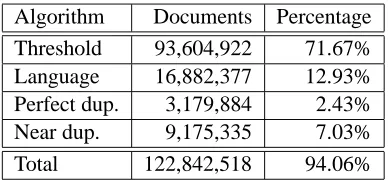
First, we report the amount of data filtered (as the number of documents discarded) by the different al-gorithms described in 3. The figures are for DE-COW2012, for which a total of 130,602,410 docu-ments was crawled. To keep the processing demands of the more costly algorithms like duplicate detec-tion and boilerplate removal down, we added a sim-ple threshold filter after the basic cleanup (cf. 3.1.), which in the case of the COW2012 corpora caused documents with less than 2,000 characters to be dis-carded right away.
Algorithm Documents Percentage Threshold 93,604,922 71.67% Language 16,882,377 12.93% Perfect dup. 3,179,884 2.43% Near dup. 9,175,335 7.03% Total 122,842,518 94.06%
Table 2: Number of documents discarded by the con-secutive post-processing algorithms and percentage discarded from the total number of crawled documents (DECOW2012)
4.2. Duplication
Although w-shingling removes more than half of the documents left over from previous post-processing steps (see Table 4), we still have some amount of duplication in our corpora. In order to roughly esti-mate the magnitude of the remaining duplication, we are considering keywords in context (KWIC), using the following procedure: (1) Choose a frequent word form. (2) Extract all its occurrences from the corpus, plus a context ofncharacters to its left and right. (3) Count the repetitions. The results reported below were obtained withn= 60, corresponding to approx. 7 – 9 words on either side of the keyword. Thus, the stretch of text is, in almost all cases, larger than the 5-shingles used in duplicate detection. This approach is not di-rectly indicative of the number duplicated documents, both because it is likely to yield more than one rep-etition in the case where two documents are actually
DECOW2012 DEWAC
9.1 G tokens 1.6 G tokens
keyword % keyword %
und 9.25 der 11.40 die 5.70 die 11.19 der 6.11 und 11.09
ESCOW2012 FRWAC
1,6 G tokens 1.6 G tokens
keyword % keyword %
de 7.15 de 17.38 la 5.99 la 17.33 que 7.28 et 17.80
Table 3: Duplicated strings: keyword plus 60 charac-ters to left and right
Corpus Before After %Reduction DECOW2012 16.94 7.63 54.9 ESCOW2012 3.50 1.30 63.0
DEWAC 1.75 1.50 14.3
FRWAC 2.27 1.47 35.0
Table 4: Reduction in millions of documents by w-shingling (5% or higher w-shingling overlap; same criteria applied to the WaCky corpora).
duplicated, and because it will not only count dupli-cated documents, but also all sorts of quotations oc-curring in documents, which represent an unavoidable kind of duplication. In short, the method is likely to overestimate the actual amount of duplication rather than to underestimate it. Table 3 shows the amount of duplication that remains in the published versions of both the COW and the WaCky corpora detected by the KWIC method. For each corpus, the three most frequent types were chosen as keywords.
Finally, Table 4 shows the number of documents be-fore and after w-shingling, both for our German (DE-COW2012) and Spanish (ES(DE-COW2012) corpora, and for the German and French WaCky corpora. Note that the WaCky corpora had already passed through a weaker process of duplicate detection (Baroni et al., 2009), and the counts shown illustrate the remaining amount of duplication which our tools (cf. 3.4.) re-moved.
4.3. Quality of Connected Text Detection
preliminarily evaluated on 120 randomly selected Ger-man Wikipedia documents, 100 GerGer-man literary texts from the twentieth century, 5 German blog posts, and 15 Wikipedia documents in Dutch, English, and 5 dif-ferent German dialects. The minimal loss in recall comes from the negative classification of a few of the literary documents which, admittedly, could be con-sidered stylistically marked.
To make the algorithm work as a connected text detector, the threshold has to be lowered consider-ably, and it then achieves (e. g., for DECOW2012):
P recision > 0.95, Recall < 0.8. These last val-ues were obtained in an evaluation with 1,100 artificial documents consisting of a mix of sentences from con-nected German text and non-concon-nected content words in varying proportions. These figures, however, are rough estimates, mainly because we lacked a satisfy-ing answer to the question of what defines a “doc-ument containing a significant amount of connected text in language L”, which is why we chose to use artificial documents. Only with a proper operational-ization of this notion would a report of the precision and recall of the connected text filter make true sense. Future work will therefore involve the definition of a gold standard set of training and evaluation documents for each language.
4.4. Text Types and Genres
It is not our goal to build corpora which parallel any existing balanced corpora. Given this goal, providing information on the text type composition of our cor-pora is rather a matter of characterization than one of evaluation. Although Sharoff (2006) is slightly differ-ent in his goals, we build on the taxonomy suggested there, which is itself derived from an EAGLES speci-fication. He examines a set of experimental web cor-pora and established general-purpose corcor-pora with re-gard to authorship, mode, audience, aim, domain. We refer the reader to the paper (Sharoff, 2006, 77ff.) for the details. In a test coding of two random samples of 200 documents from the DECOW2011 test corpus, two coders were satisfied with the available categories for authorship (with some necessary clarifications), mode, audience, and aim, but amendments were felt to be necessary for domain. We therefore introduced one new value for mode and completely re-grouped domain. The mode quasi-spontaneous is a relabel-ing of Sharoff’s electronic. The full revised codrelabel-ing guidelines are omitted here for space reasons, but can be downloaded from the project web page.5 We are aware that there is an active research community on web genres including interest in automatic detection
5http://hpsg.fu-berlin.de/cow/
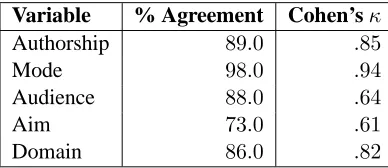
Variable % Agreement Cohen’sκ
Authorship 89.0 .85
Mode 98.0 .94
Audience 88.0 .64
Aim 73.0 .61
Domain 86.0 .82
Table 5: Inter-rater agreement for document classifi-cation categories (DECOW2012,n= 200)
and involving special fields such as sentiment analy-sis. However, at this point we are only interested in a preliminary overview of the balance of the major gen-res in our corpora.
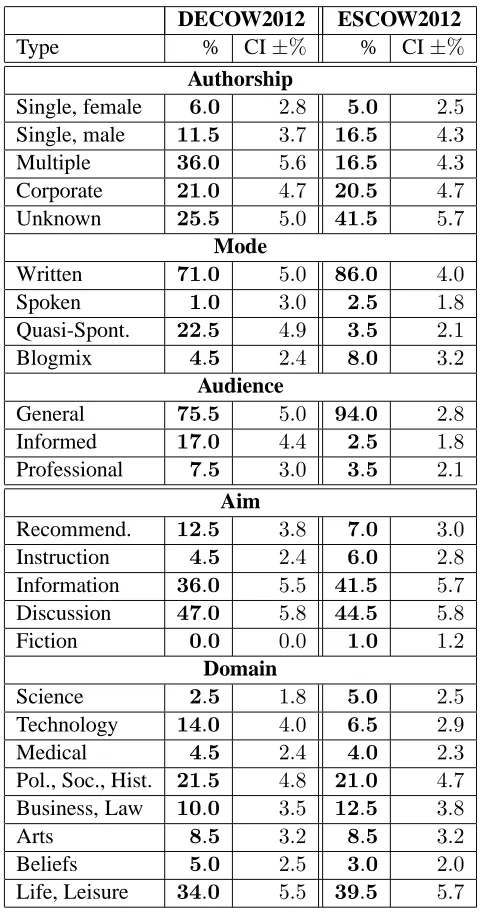
A major problem was how to deal with possible mul-tiple categorizations. For example, a blog post can be aim: information, but the comments can turn the whole web page into predominantly aim: discussion. The problem manifests itself even more strongly in the coding decisions for domain. Since such conflicts were unresolvable in the given time frame and for the given purpose, we interpreted the lists of possible val-ues for most categories as hierarchical in the sense that, in case of doubt, the topmost value should be se-lected. For the very frequent mix of blog posts (mode: written) and comments (mode: quasi-spontaneous) we introduced the new value mode: blogmix. In Ta-ble 5, the inter-rater agreement (raw agreement and Cohen’sκ) per category for two independent coders of a DECOW2012 sample is shown. Table 6 provides the categorization results for DECOW2012 (percentages are consistently those of one of the coders, namely the first author of this paper) and ESCOW2012 (second author). The sample size wasn= 200as suggested by Sharoff (2006), and we explicitly give the confidence intervals at a90% confidence level. While the inter-rater reliability is very good, the confidence intervals show that taking a larger sample would be preferable.
5. Outlook
DECOW2012 ESCOW2012
Type % CI±% % CI±%
Authorship
Single, female 6.0 2.8 5.0 2.5 Single, male 11.5 3.7 16.5 4.3 Multiple 36.0 5.6 16.5 4.3 Corporate 21.0 4.7 20.5 4.7 Unknown 25.5 5.0 41.5 5.7
Mode
Written 71.0 5.0 86.0 4.0 Spoken 1.0 3.0 2.5 1.8 Quasi-Spont. 22.5 4.9 3.5 2.1 Blogmix 4.5 2.4 8.0 3.2
Audience
General 75.5 5.0 94.0 2.8 Informed 17.0 4.4 2.5 1.8 Professional 7.5 3.0 3.5 2.1
Aim
Recommend. 12.5 3.8 7.0 3.0 Instruction 4.5 2.4 6.0 2.8 Information 36.0 5.5 41.5 5.7 Discussion 47.0 5.8 44.5 5.8 Fiction 0.0 0.0 1.0 1.2
Domain
Science 2.5 1.8 5.0 2.5 Technology 14.0 4.0 6.5 2.9 Medical 4.5 2.4 4.0 2.3 Pol., Soc., Hist. 21.5 4.8 21.0 4.7 Business, Law 10.0 3.5 12.5 3.8
Arts 8.5 3.2 8.5 3.2
Beliefs 5.0 2.5 3.0 2.0 Life, Leisure 34.0 5.5 39.5 5.7
Table 6: Text category/genre distribution in DE-COW2012 and ESDE-COW2012 with 90% confidence in-terval (n= 200)
meta data are also primary goals in our further re-search.
6. Acknowledgements
We would like to thank Sarah Dietzfelbinger for her help in training neural nets and evaluating the COW corpora. Felix Bildhauer’s work on this project is supported by the Deutsche Forschungsgemeinschaft through the Sonderforschungsbereich 632, project A6.
7. References
Ziv Bar-Yossef and Maxim Gurevich. 2006. Random sampling from a search engine’s index. In Proceed-ings of WWW 2006, Edinburgh.
Marco Baroni and Silvia Bernardini. 2004. Bootcat: Bootstrapping corpora and terms from the web. In Proceedings of LREC 2004, pages 1313–1316. Marco Baroni, Francis Chantree, Adam Kilgarriff, and
Serge Sharoff. 2008. Cleaneval: A competition for cleaning webpages. In Proceedings of LREC 2008, pages 638–643, Marrakech. ELRA.
Marco Baroni, Silvia Bernardini, Adriano Ferraresi, and Eros Zanchetta. 2009. The wacky wide web: A collection of very large linguistically processed web-crawled corpora. Language Resources and Evaluation, 43(3):209–226.
Andrei Z. Broder, Steven C. Glassman, Mark S. Man-asse, and Geoffrey Zweig. 1997. Syntactic clus-tering of the web. Technical Note 1997-115, SRC, Palo Alto, July 25.
Massimiliano Ciamarita and Marco Baroni. 2006. Measuring web-corpus randomness: A progress re-port. In Marco Baroni and Silvia Bernardini, edi-tors, Wacky! Working papers on the Web as Corpus. GEDIT, Bologna.
Thomas Emerson and John O’Neil. 2006. Experience building a large corpus for chinese lexicon construc-tion. In Marco Baroni and Silvia Bernardini, edi-tors, Wacky! Working papers on the Web as Corpus. GEDIT, Bologna.
Adam Kilgarriff and Gregory Grefenstette. 2003. In-troduction to the special issue on the web as corpus. Computational Linguistics, 29:333–347.
Christopher D. Manning, Prabhakar Raghavan, and Hinrich Schütze. 2009. An Introduction to Infor-mation Retrieval. CUP, Cambridge.
Steffen Nissen. 2005. Neural Networks made simple. Software 2.0, 2:14–19.
Michael O. Rabin. 1981. Fingerprinting by ran-dom polynomials. Technical Report TR-CSE-03-01, Center for Research in Computing Technology, Harvard University, Harvard.
Serge Sharoff. 2006. Creating general-purpose corpora using automated search engine queries. In Marco Baroni and Silvia Bernardini, editors, Wacky! Working papers on the Web as Corpus. GEDIT, Bologna.