Translation Divergence Analysis and Processing for
Mandarin-English Parallel Text Exploitation
Shun-Chieh Lin, Jia-Ching Wang, and Jhing-Fa Wang
Department of Electrical Engineering, National Cheng Kung University.
701 No.1, Ta-Hsueh Road, Tainan City Taiwan R.O.C.
Tel: 886-6-2757575 Ext. 62341, Fax: 886-6-2761693
E-mail: [email protected]
Abstract
Previous work shows that the process of parallel text exploitation to extract transfer mappings between language pairs raises the capability of language translation. However, while this process can be fully automated, one thorny problem called “divergence” causes indisposed mapping extraction. Therefore, this paper discuss the issues of parallel text exploitation, in general, with special emphasis on divergence analysis and processing. In the experiments on a Mandarin-English travel conversation corpus of 11,885 sentence pairs, the perplexity with the alignments in IBM translation model is reduced averagely from 13.65 to 5.18 by sieving out inappropriate sentences from the collected corpus.
1. Introduction
Over the past decade, research has focused on the automatic acquisition of translation knowledge from parallel text corpora. Statistical-based systems build alignment models from the corpora without linguistic analysis [1,2]. Another class of systems analyzes sentences in parallel texts to obtain transfer structures or rules [6]. Previous work shows that the process of parallel text exploitation to extract transfer mappings (models or rules) between language pairs can raise the capability of language translation.
3. Translation Divergence Analysis and Processing
3.1 Analysis of Divergence Problems
Dorr’s work [3] of divergence analysis is based on English-Spanish and English-German translations. Based on these two language pairs, 5 different categories have been identified. In this section, we discuss more multiform examples among the 5 types of divergences in Mandarin-English parallel texts. For each example, three sentences are given: e means an original English sentence in parallel texts, m means a Mandarin sentence, and ẽ means an amended English sentence which is better for translation parameter training with m.
3.1.1 Identification of Thematic Divergence
Thematic divergence often involves a “swap” of the subject and object position and obtains unpredictable word-level alignment. For example,
e: (Is)1 (credit card)2 (acceptable)3 (to)4 (them)5 ? m: ( )1 ( )2 ( )3 ( )4 ?
ẽ: (Do)1 (they)2 (accept)3 (credit card)4 ?
Here, credit card appears in subject position in e and in object position (“ ”) in m; analogously, the object them appears as the subject they (“ ”). Therefore, for the thematic divergence, the position alignments of 2↔3 and 5↔1 are obtained in a sentence pair [m, e]. However, if a sentence pair [m, ẽ] can be provided, the position alignments of 1↔2, 2↔3, and 3↔4 are better for straightforward parameter estimation of
p
(
j
|
i
,
l
m,
l
e)
.3.1.2 Identification of Morphological Divergence
Morphological divergence involves the selection of a target-language word that is a morphological variant of the source-language equivalent and it raises the ambiguity of lexical-semantic lexicography.
e: (May)1 (I)2 (have)3 (your)4 (signature)5 (here)6 ? m: ( )1 ( )2 ( )3 ( )4 ( )5 ( )6 ?
ẽ: (Could)1 (you)2 (sign)3 (here)4 ?
In this example, the predicate is nominal (signature) in e but verbal (“ ”) in m. While
inputting two sentence pairs [m, e] and [m, ẽ], the parameter estimation of
p
(
m
j|
e
i)
should bereformulated with two morphological translation conditions:
p
(
m
j,
m
j∈
V
|
e
i,
e
i∈
N
)
and(
m
m
V
e
e
V
)
conditions would raise more complexity of lexicon transfer parameter estimation and cause more ambiguity of lexical-semantic lexicography.
3.1.3 Identification of Structural Divergence
In structural divergence, a verbal argument has a different syntactic realization in the target language and the appearance of the divergence causes additional syntactic structural mapping constructions.
e: (About)1 (the)2 (center)3 . m: ( )1 ( )2 ( )3 .
ẽ: (About)1 (in)2 (the)3 (center)4 .
Observe that the place object is realized as a noun phrase (the center) in e and as a prepositional phrase (“ ”) in m. For this example, the divergence causes the alignment of 0←2, which is a null mapping for Mandarin lexicon “ ”. In addition, the divergence also causes alignments of 2↔3 and 3↔3, which result in non-equal mapping number q-to-n (q>1, n>1, and q≠n). For a raised null mapping, the parameter estimation of
p
(
j
|
i
,
l
m,
l
e)
andp
(
l
m|
l
e)
become more complicated by further considering translation of lexicon insertion (i=0) and deletion (j=0). More raised non-equal mapping number in parallel texts, more parameter estimation ofp
(
l
m|
l
e)
and more length generation condition for translation.3.1.4 Identification of Conflational Divergence
Conflation is the incorporation of necessary participants (or arguments) of a given action. A conflational divergence arises when there is a difference in incorporation properties between two languages. In addition, there are word compounds in Chinese language by embedding some semantic contiguity. For this divergence, the complexity of training process for transfer mapping extraction is extremely increased.
e: (Please)1 (have)2 (him)3 (call)4 (me)5 .
m: ( )1 ( )2 ( )3 ( )4 ( )5 ( )6 ( )7 ( )8 .
ẽ: (Please)1 (tell)2 (him)3 (to)4 (give)5 (me)6 (a)7 (call)8 .
This example illustrates the conflation of a constitution in e that must be overly realized in m: the effect of the action (give me a call) is indicated by the word “ ” whereas this information is incorporated into the main verb (call me) in e. Therefore, this divergence causes most complexity on parameter estimation of translation including p
(
mj|ei)
, p(
lm|le)
, and(
j
i
l
ml
e)
the translation of
e
i found in the bilingual dictionary is the same tom
j,τ
(
m
j,
e
i)
is assigned to 1;otherwise,
τ
(
m
j,
e
i)
is assigned to 0. And we can obtain the direct lexical mapping sequence{
i | 0 and 0}
M aj i I j J
∆ = ≤ ≤ ≤ ≤ (3)
where
a
ij is a mapping referred to as the alignmenti
→
j
ifτ
(
m
j,
e
i)
=
1
ori
→
0
and
0
→
j
ifτ
(
m
j,
e
i)
=
0
.If the lexical mapping sequence ∆M contains more than a particular number, named
ε
n, of null mappings (i
→
0
and0
→
j
), then the degree of divergence between the sentence pairs [m, e] becomes significant. Hence, the content of m or e should be updated to improve the accuracy and effectiveness of exploration of mapping order between word sequences and derivation of transfer mappings. In this paper, we choose to sieve out the divergent sentence pairs from the parallel texts.4. Experimental Results
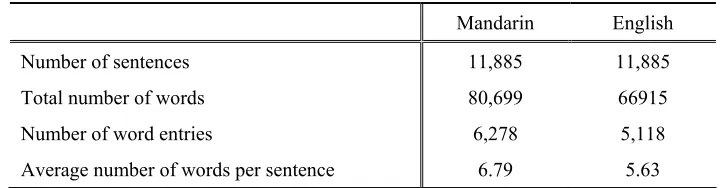
Table 1 shows the basic characteristics of the collected parallel texts extended by travel conversation [11]. The Mandarin words in the corpora were obtained automatically using a Mandarin morphological analyzer at CKIP [10] and an English morphological analyzer referred to LinkGrammar [12].
Table 1. Basic characteristics of the collected parallel texts
Mandarin English
Number of sentences 11,885 11,885
Total number of words 80,699 66915
Number of word entries 6,278 5,118
Average number of words per sentence 6.79 5.63
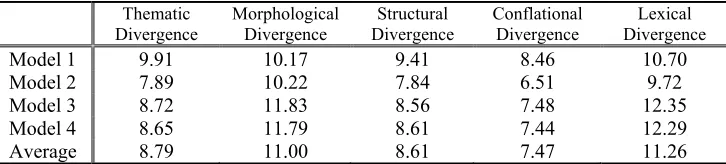
designed by the Statistical Machine Translation team [9]1. Based on segmented Chinese, we use the original GIZA for testing in this paper. In relation to the IBM models in GIZA, this study uses models 1-4 and ten iterations of each training models for the collected corpus. The parallel sentences with various types of divergences are sieved out from the collected corpus and perplexity in IBM original GIZA training model with comparison of sieving various types of divergences is shown on Table 2. The perplexity with sieving thematic divergence is similar to that with sieving structural divergence and the perplexity with sieving morphological divergence is similar to that with sieving lexical divergence. For sieving conflational divergence, a noticeable perplexity reduction is obtained among other types of divergence but the cost is that almost two out of three parallel sentences (65 percent) are sieved out from the collected corpus. Table 3 lists the perplexity of the original parallel sentences and that of the evaluated parallel sentences from GIZA. The results demonstrate that more null mappings can result in higher perplexity, i.e. more translation choices for a lexical item, thus increasing the translation ambiguity and lowering the accuracy of lexical mapping extraction. Two amended translation probabilities with evaluation of
ε
n<1 are shown in Table 4. The number of translation choices of “have” and “back” are reduced from 7 to 4 and 7 to 3, respectively. After evaluating the divergence of each sentence pair in parallel texts and retaining those withε
n<1, i.e. no null mappings in a sentence pair, the perplexity in the alignment training model can be reduced from 13.65 to 5.18 on average.33%
46%
26%
65%
19%
0% 10% 20% 30% 40% 50% 60% 70% 80% 90% 100%
Thematic Morphological Structural Conflational Lexical Divergence Type
Percen
tage o
f Div
erg
en
ces
Fig. 2. The percentage of the various types of divergences for the collected parallel texts
Table 2. Perplexity in IBM original GIZA training model with comparison of sieving various types of divergences.
Thematic
Divergence Morphological Divergence Divergence Structural Conflational Divergence Divergence Lexical
Model 1 9.91 10.17 9.41 8.46 10.70
Model 2 7.89 10.22 7.84 6.51 9.72
Model 3 8.72 11.83 8.56 7.48 12.35
Model 4 8.65 11.79 8.61 7.44 12.29
Average 8.79 11.00 8.61 7.47 11.26
Table 3. Perplexity in IBM original GIZA training model with comparison of original (
ε
n<∞) /evaluated parallel sentences.n
ε
<∞ε
n<4ε
n<3ε
n<2ε
n<1 No. of (m, e) 11,885 10,976 9,874 8,618 7,639Model 1 10.94 10.09 8.26 6.79 5.98
Model 2 12.92 8.52 6.57 5.24 4.43
Model 3 15.39 9.47 7.13 6.21 5.16
Model 4 15.33 9.45 7.11 6.20 5.15
Average 13.65 9.38 7.27 6.11 5.18
Table 4. Examples of two amended English word translation probabilities.
Have
Translation probability trained
with original parallel sentences Translation probability trained with evaluated parallel sentences
0.4312746 0.4612446
0.346279 0.398176
0.1231011 0.1035049
0.0975747 0.0370745
0.00146905 0.000294352 2.95704e-08
Back
Translation probability trained
with original parallel sentences Translation probability trained with evaluated parallel sentences
來 0.937283 來 0.9392834
0.0379813 0.042981
0.01650713 0.01871713
0.00786959
2.5874e-06 0.000294352
1.66024e-07
5. Conclusion
English with the travel conversation corpus of 11,885 sentence pairs. The experimental results show that the analysis and evaluation of divergence for retaining low divergent parallel sentences can reduce the perplexity in IBM translation model averagely from 13.65 to 5.18. For sieving conflational divergence, a noticeable perplexity reduction is obtained among other types of divergence but the cost is that almost two out of three parallel sentences (65 percent) are sieved out from the collected corpus. Future studies will attempt to implement a translation decoder to assess the influence of divergence evaluation on BLEU sore.
References
[1] H. Ney, S. Nießen, F. J. Och, H. Sawaf, C. Tillmann, and S. Vogel, “Algorithms for statistical translation of spoken language,” IEEE Trans. Speech and Audio Processing, vol. 8, no. 1, pp. 24–36, Jan. 2000.
[2] P. F. Brown, S. A. Della Pietra, V. J. Della Pietra, and R. L. Mercer, “The mathematics of statistical machine translation: Parameter estimation,” Computational Linguistics, vol. 19, no. 2, pp. 263–311, 1993.
[3] B. J. Dorr, P. W. Jordan and J. W. Benoit, “A survey of current paradigms in machine translation,” in Advances in Computers, vol. 49, M. V. Zelkowitz, Ed. Academic Press, 1999.
[4] B. J. Dorr, Machine translation: A view from the lexicon. Cambridge, MA: The MIT press, 1993. [5] B. J. Dorr, “Machine Translation Divergences: A Formal Description and Proposed Solution,”
ACL Vol. 20, No. 4, pp. 597–631, 1994.
[6] A. Menezes and S. D. Richardson, “A best-first alignment algorithm for automatic extraction of transfer mappings from bilingual corpora,” in Proc. Workshop on Data-driven Machine Translation at 39th Annual Meeting of the Association for Computational Linguistics, 2001, pp. 39–46.
[7] J. F. Wang and S. C. Lin, “Bilingual corpus evaluation and discriminative sentence vector expansion for machine translation,” in Proc. ICAIET, 2002, pp.117–120.
[8] D. Gupta and N. Chatterjee, “Study of divergence for example based English-Hindi machine translation,” in Proc. STRANS, 2002, pp. 132-140.
[9] EGYPTtoolkit, developed by the Statistical Machine Translation team, Center for Language and Speech Processing, Johns-Hopkins University, MD, 1999.
[10] L. L. Chang, “The modality words in modern Mandarin,” Chinese Knowledge Information Processing Group, Institute of Information Science Academia Sinica, Taiwan, Tech. Rep. 93-06, 1993.
[11] , 旅 Easy Go, 讀 , 2001.
[12] D. D. Sleator and D. Temperley, “Parsing English with a Link Grammar,” Carnegie Mellon University, Pittsburgh, PA, Tech. Rep.CMU-CS-91-196, 1993.