Computational Linguistics and Chinese Language Processing
Vol. 9, No. 2 , August 2004, pp. 77-94 77 The Association for Computational Linguistics and Chinese Language Processing
An Innovative Distributed Speech Recognition
Platform for Portable, Personalized
and Humanized Wireless Devices
Yin-Pin Yang
*Abstract
In recent years, the rapid growth of wireless communications has undoubtedly increased the need for speech recognition techniques. In wireless environments, the portability of a computationally powerful device can be realized by distributing data/information and computation resources over wireless networks. Portability can then evolve through personalization and humanization to meet people’s needs. An innovative distributed speech recognition (DSR) [ETSI, 1998],[ETSI, 2000] platform, configurable DSR (C-DSR), is thus proposed here to enable various types of wireless devices to be remotely configured and to employ sophisticated recognizers on servers operated over wireless networks. For each recognition task, a configuration file, which contains information regarding types of services, types of mobile devices, speaker profiles and recognition environments, is sent from the client side with each speech utterance. Through configurability, the capabilities of configuration, personalization and humanization can be easily achieved by allowing users and advanced users to be involved in the design of unique speech interaction functions of wireless devices.
Keywords: Distributed, speech recognition, configurable, wireless, portable, personalized, humanized.
1.
Introduction
In the current wireless era, cellular phones have become daily-life necessities. People carry their own handsets and make phone calls anytime, everywhere, while public payphones have
* Ph.D, Senior Researcher, Advanced Technology Center, Computer and Communications Research
Laboratories, Industrial Technology Research Institutes
E-mail: [email protected] TEL: 886-3-5914830 FAX: 886-3-5820098 Address: E000 CCL/ITRI Rm.712, Bldg.51, 195 Sec.4, Chung Hsing Rd., Chutung, Hsinchu 310,
An Innovative Distributed Speech Recognition Platform for Portable, 79 Personalized and Humanized Wireless Devices
the sample utterances used for training or adaptation can seriously dominate the performance of a speech recognizer. If a wireless network is used, speech data acquisition can be done in a much more efficient and systematical way. More importantly, the acquired speech data, labeled by means of a speaker profile, recognition environment, and device/microphone type, can be kept on the server. Speech data will thus not be abandoned when particular applications or services are discontinued.
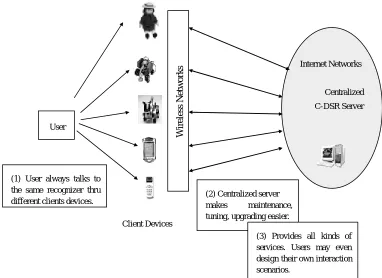
From the above, we can conclude that we need a centralized speech recognition server embedded in the wireless infrastructure. When we say “talking to a machine”, the “machine” is actually an entire wireless network. People talk to the same lifetime recognizer, and the recognizer evolves continuously. This speech recognition server can provide any types speech recognition services (computation distributed) for all classes of wireless mobile devices. These services continuously acquire speech data from all locations (data distributed), and adapt the engine performance all the time. For each recognition task, there is a “configuration file” (or, say, a tag) to record all of the information regarding types of services, speaker profiles, recognition environments, etc. We call this type of server a configurable distributed speech recognition (C-DSR) server.
In the following, the history of DSR developed by ETSI/Aurora will be briefly described. Then, the innovative C-DSR platform will be introduced.
Distributed Speech Recognition (DSR) developed by ETSI/Aurora
Instead of squeezing the whole recognizer into a thin device, it seems more reasonable to host recognition tasks on a server and exchange information between the client and server. However, due to the low bit-rates of speech coders (note that coders are designed for humans, not recognizers), the speech recognition performance can be significantly degraded. The DSR, proposed by ETSI Aurora, overcomes these problems by distributing the recognition process between the client and server, by using an error protected data channel to send parameterized speech features.
From DSR to Configurable DSR (C-DSR)
80 Yin-Pin Yang
obtain its own coder in order to increase the overall recognition task completion rate. To achieve these goals, C-DSR maximizes the advantages of data channels and centralized servers by means of its “configurable” capability - configurability. The configurability can be considered from two points of views.
The C-DSR Client
From the client side viewpoint, speech recognition processing is configurable to work with: (1) various kinds of thin to heavy mobile devices, ranked according to their computational power, noting that most of devices do not have sufficient computational power to perform the feature extraction process proposed by ETSI Aurora; (2) various types of recognition environments, such as offices, homes, streets, cars, airports, etc; this information about recognition environments can help recognition engines achieve greater accuracy; (3) various types of recognition services, such as command-based, grammar-based, speaker independent/ de- -pendent mixed mode, and dialogue style services; (4) various speaker profiles since speaker information can help recognizers achieve higher recognition rates1and are required by recognition applications, such as speaker adaptation [Lee et al.1999][Chen et al.1990], speaker verifications identification [Siohan et al.1998]. The C-DSR platform provides a faster and more flexible way to construct various speech recognition functions for various mobile devices used in various recognition environments. One of the major missions of C-DSR is to increase the frequency of speech recognition use in daily life.
The C-DSR Server
From the viewpoint of the centralized server, the C-DSR server collects from all of the registrant clients speech utterances or formatted speech feature arrays along with their configuration tags. The basic idea is to formalize the life cycle of a speech recognition product/task from the deployment phase, to the diagnostic phase, tuning phase, and upgrading phase. Also, similar tasks can share corresponding information and adaptation data located on the server. The C-DSR server offers the following mechanisms to fully take advantage of these categorized speech and configuration data: (1) the C-DSR server can decide which recognition engine or which acoustic HMM model to employ according to the history log; (2) the C-DSR server can balance the trade-offs among communication bandwidth, system load and recognition accuracy; (3) the categorized and organized speech database can be utilized to create diagnostic tools that can be used to tune-up recognition engines and to perform all kinds
1
For example, if we may provide gender information from speaker profile to speech recognizer, even a
An Innovative Distributed Speech Recognition Platform for Portable, 81 Personalized and Humanized Wireless Devices
of adaptation, such as speaker adaptation, channel adaptation [Siohan et al.1995] and background noise adaptation [Kristjansson et al.2001].
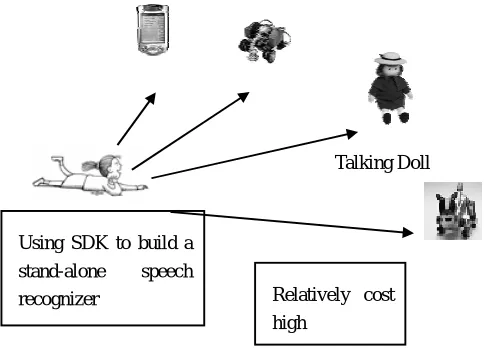
In summary, C-DSR is a generic speech recognition engine, in which all of the information, or parameters, concerning application-dependent user profiles and device profiles are kept in a configuration file which is initiated at the client side. In technical terms, C-DSR is a platform, while from customer’s point of view, C-DSR is a personally owned, lifetime speech recognition engine. The C-DSR platform is embedded in the wireless network in contrast to conventional speech recognizers that are treated as input interfaces for portable devices (see Figure 1).
Overview
In the following, the architecture of C-DSR is described in section II. Then in section III, a demo system is presented to demonstrate the unique capability, that is, configurability, of C-DSR. Some conclusions are drawn in the final section.
Figure 1(A). Conventionally, speech recognition is simply one of the available input interfaces for portable devices.
R
Talking DollUsing SDK to build a stand-alone speech
recognizer Relatively cost
An Innovative Distributed Speech Recognition Platform for Portable, 83 Personalized and Humanized Wireless Devices
(HLC), resulting in a formatted package, or a database. The package is then passed to the Diagnostic Center (DC), where, diagnostic tools are used to tune-up the engines and provides adaptation data for various kinds of adaptation schemes, such as speaker/channel adaptation.
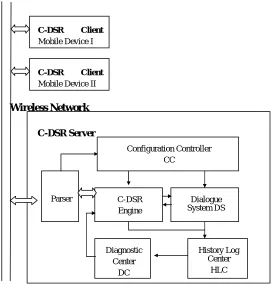
Figure 2. The function blocks of the C-DSR Platform.
A. Configuration File and Configuration Controller, CC
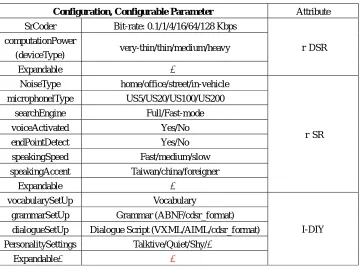
The configuration of the C-DSR platform is stored in a Configuration File (CF). Each field in the CF can be categorized into three attributes, rSR, rDSR, and Interactive Design-It-Yourself (I-DIY), which are explained below.
i. rSR is the difference between the perfect and a current practical state-of-art speech recognition engine. The SR engine is never perfect. However, if we can restrict the speaking styles of the users, the recognition accuracy will be higher.
ii. rDSR refers to those configurable parameters which can minimize the degradation due to wireless transmission loss.
iii. IDIY means Interactive Design-It-Yourself. We can never expect a machine to act Parser
Configuration Controller CC
C-DSR Engine
Dialogue System DS
Diagnostic Center
DC
History Log Center
HLC Wireless Network
C-DSR Client Mobile Device II C-DSR Client Mobile Device I
An Innovative Distributed Speech Recognition Platform for Portable, 85 Personalized and Humanized Wireless Devices
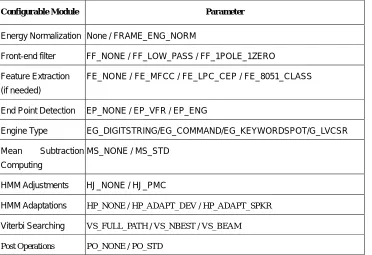
the engine, which is a generalized SR engine on which state-of-art SR techniques can be employed. These typical modules (in a traditional/generalized SR engine) are listed below:
Table 2. Configurable modules in the C-DSR Engine with their parameters
Configurable Module Parameter
Energy Normalization None / FRAME_ENG_NORM
Front-end filter FF_NONE / FF_LOW_PASS / FF_1POLE_1ZERO
Feature Extraction
(if needed)
FE_NONE / FE_MFCC / FE_LPC_CEP / FE_8051_CLASS
End Point Detection EP_NONE / EP_VFR / EP_ENG
Engine Type EG_DIGITSTRING/EG_COMMAND/EG_KEYWORDSPOT/G_LVCSR
Mean Subtraction
Computing
MS_NONE / MS_STD
HMM Adjustments HJ_NONE / HJ_PMC
HMM Adaptations HP_NONE / HP_ADAPT_DEV / HP_ADAPT_SPKR
Viterbi Searching VS_FULL_PATH / VS_NBEST / VS_BEAM
Post Operations PO_NONE / PO_STD
As shown in Table 2 above, each module has a well-defined interface and, for a particular module, several implementations are available. To each implementation, one CF name is attached, and it can be switched or configured. For instance, in the End Point Detection (EPD) module, there are three options, EPD_NONE, EPD_VFR and EPD_ENG, each representing a different algorithm used to implement the EPD function. The C-DSR platform also allows the system maintainer to adopt a new method for each module.
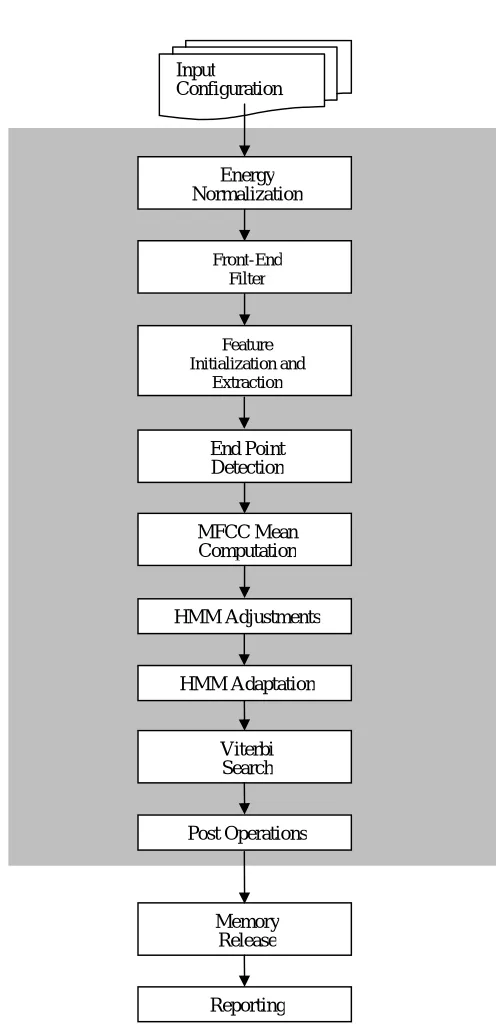
Intermediate data between modules are also generated to provide “symptoms” useful for diagnostic purposes. These symptoms include:
§ speech segmentation boundaries,
§ the Viterbi resulting path,
§ likelihood trajectories along the time axis on the resulting path,
§ a histogram of observations (feature vectors) for a particular Gaussian mixture,
86 Yin-Pin Yang
Figure 3. Modules of the C-DSR engine. Input
Configuration
Energy Normalization
Front-End Filter
Feature Initialization and
Extraction
MFCC Mean Computation
HMM Adjustments End Point Detection
Reporting Memory
Release HMM Adaptation
Viterbi Search
An Innovative Distributed Speech Recognition Platform for Portable, 87 Personalized and Humanized Wireless Devices
C. The Dialogue System, DS
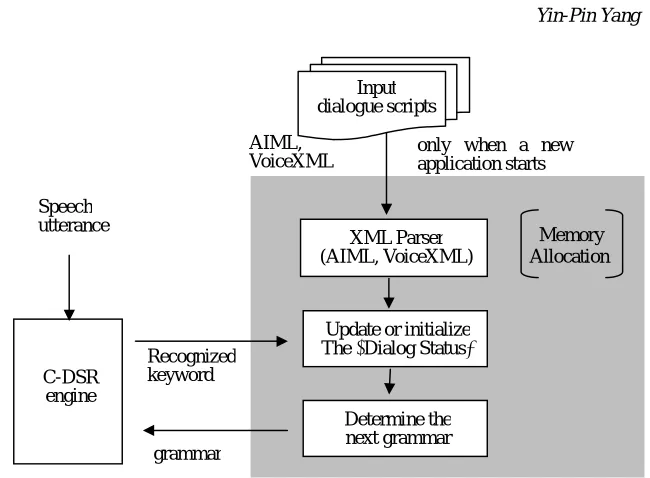
A generic DS is, firstly, responsible for preparing a grammar, including vocabulary needed for the next speech recognition process. Then, the grammar with the incoming utterance is fed to the recognizer. The recognition result, a recognized key word, is then sent back to the DS. The DS then updates the “dialog status” records and determines the grammar for the next recognition.
Currently, we support AIML (Artificial Intelligence Markup Language,
www.alicebot.org) and the simplified VoiceXML format used to describe dialogue scripts (see Figure 4).
D. The Diagnostic Center, DC
As described earlier, the so-called symptoms are intermediate data obtained while the engine is running and sent to the DC. The main purpose of the DC is to analyze and diagnose these symptoms in order to make suggestions. Thus, the C-DSR server is faced with various types of services, various environment configurations, and various types of client devices and speakers, so we want to make the engine core to be as generalized as possible. Currently, all of the diagnostics are done manually, which means that the DC only display to users or C-DSR server maintainers. We plan to make the DC automatically in the next generation of C-DSR.
E. The History Log Center (HLC)
An Innovative Distributed Speech Recognition Platform for Portable, 89 Personalized and Humanized Wireless Devices
Figure 5. Illustration of the C-DSR implementation.
Each application uses its own configuration, specified according to (1) the device type: from thin to heavy, 8-bit 8051 class, DSP, PDA class; (2) the recognition style: command-based, natural, or dialogue; (3) the recognition environment: in a car, home, or open space. Two configuration files are presented below to illustrate how configuration files are used to realize a speech recognition application. Note that, normally, there are two types of speech recognition applications: voice command-based and dialogue style.
[Example 1] Voice-controlled home appliances
[Scenario] The user may use his wireless portable device with the installed C-DSR client to control a TV, lamp, or other home appliances within a WLAN environment.
[Configuration Settings]
1. Speech Feature Compression Format: this may be PCM, 8051-class, LPC-based Cepstrum, or MFCC (Mel-Frequency Cepstral Coefficients), depending on the computational cost and communication bandwidth (bit-rates) of the client device. 2. Environmental noise: this can be Quiet or Noisy. If this is skipped, the C-DSR Server
will make a decision according to the history log.
C-DSR Server
At
Home
C-DSR Client
GPRS
WLAN
PDA IrDa-Control Home
Appliances
AIBO using C-DSR Home Appliances
C-DSR Server
At Public Area
Mobile Stock/Weather Inquiry System
Robot Talking
Doll
90 Yin-Pin Yang
3. Speaking speed: the speaking speed of a normal person is around five words per second. The user can determine his range of speaking speed, for instance, from three words per second to six words per second. If this is skipped, the C-DSR server will use default values.
4. Gender/Age/Accent: gender, age and accent information are very helpful for improving recognition performance. The C-DSR Client will retrieve and pass these pieces of information from the user/speaker profile to C-DSR Server for reference purposes. If this is skipped, the C-DSR Server will employ default models.
5. The Number of Results: the user may configure the number of recognition results, say N. The C-DSR Client will then display the first most likely candidates to the user. 6. Recognition Style: this can be Command-based or Dialogue. The grammar format for
the Command-based style uses the ABNF format shown in the following:
[The Setup at the C-DSR Server]
When the configuration file and speech data are received from the client, the C-DSR Server performs recognition tasks according to the configuration. In the grammar example shown above, exactly one keyword from the $action1 group (open/close) and $keyword1 (light/fan/tv/radio) group will be generated. The Action Center on the C-DSR Server will perform a corresponding action, such as “turn on light.”
[Example No.2] Tourist Information Guide of Yu-Shan National Park
[Scenario] Users may use their own PDAs or smart phones to access this service when entering the area covered by the WLAN.
[Configuration Settings]
As in the previous case, we only need to change the field RecognitionStyle from Command-based to Dialogue-ProvidedByServer.
[The Setup at the C-DSR Server]
This example shows a dialogue system for a tourist guide. The content was provided by #ABNF 1.0
$prefiller= 請 | 麻煩 | 你 | 我要
$action1= 開{open} | 關{close}
An Innovative Distributed Speech Recognition Platform for Portable, 93 Personalized and Humanized Wireless Devices
Lee, C. H. , “On stochastic feature and model compensation approaches to robust speech recognition,” Speech Communication, 25:29-47, 1998.
Digalakis, V. , L. Neumeyer and M. Perakakis, “Quantization of Cepstral Parameters for Speecg Recognition Over the World Wide Web,” IEEE Journal on Selected Areas in Communications, Jan. 1999, volume 17, pp 82-90.
Lee, C. H. , C. H. Lin, and B. H. Juang, “A study on speaker adaptation of continuous density HMM parameters,” Proc. IEEE Int. Conf. on Acoustics, Speech and Signal Processing, pages 145-148, Albuquerque, New Mexico, April 1990. ICASSP'90.
Chen, K. T. and Hsin-min Wang, “Eigenspace-based Maximum A Posteriori Linear Regression for Rapid Speaker Adaptation,” in Proc. IEEE Int. Conf. Acoustics, Speech, Signal processing (ICASSP'2001), Salt Lake City, USA, May 2001.
Siohan, O. , A. E. Rosenberg and S. Parthasarathy, “Speaker identification using minimum classification error training,” In Proc. IEEE Int. Conf. on Acoustics, Speech and Signal Processing, Seattle, Washington, USA, May 1998.
Siohan, O. , Y. Gong, and J. P. Haton, “Channel adaptation using linear regression for continuous noisy speech recognition,” IEEE Workshop on Automatic Speech Recognition, Snowbird, Utah, USA, December 1995.