strength in variables setup and logic controls in fulfilling the needs of multiple flow paths for supporting adaptive learning, and such characteristics are contrast to those in Flash or Director, which is good at rich multimedia presentation and graphic motion control.
Functions of learners’interaction with material includes the content browsing and quiz taking, and they are made through some information technologies to make the material more attractive to students. The program is described logically to demonstrate how the fundamental sequencing mechanism is implemented. Type of responses available in Authorware 6.0 are Button, Hot Spot, Hot Object, Target Area, Pull-down Menu, Conditional, Text Entry, Key-press, Tries Limit, Time Limit, and Event. Integrating the above user responses with predefined control logic, the implemented material can provide fundamental passively adaptive learning for individual learner. One of the goals in future study is to include the learner profile into the sequencing and navigation of learning activities actively and dynamically.
In this study, the material was designed for“Freshman English Writing”course for English-major students at a university in northern Taiwan. Because this project was carried out in the second semester of an academic year, the researchers used the already-used textbook, Developing Composition Skills by Mary K. Ruetten, as a major source of material development in order not to confuse students’learning. The content of three chapters, which represent three writing genres, digitalized as computer assisted language learning materials. Every genre includes phases of prewriting activities, readings, writing step explanations, language usage, and writing assignments. In addition to the revised textbook contents, some extra writing tasks were also inserted. The goal of these writing tasks is to provide learners more authentic materials as well as more authentic contexts to write. For the purpose of illustration, some examples of the chapter related to analyze a process are illustrated below.
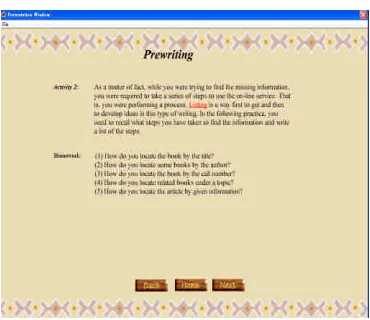
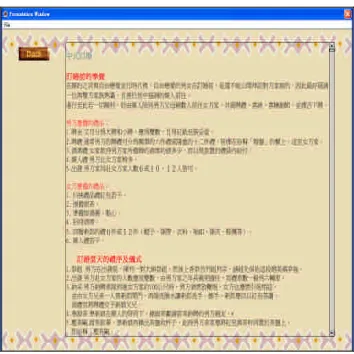
Because the reading in this chapter is about how to do a library searching operation on a computer, the prewriting activities the researcher designed are asking students to do some library searches at their school library and list the procedure step by step. The purpose of these activities is to help students relate to their schemata for their future writing. The activities are shown in Figure 1 and Figure 2.
Figure 1. Presented learning activities for CALL
In order to motivate students’learning, the model essay for students to analyze the writing styles, the content of one of the essays are divided into different sections for students’comprehension check. In addition, the sentence order of the other model essay was scrambled for students to find the right process of the action. Furthermore, students can choose to listen to the texts being read by recorded voice.
With regard of writing assignment, the researchers designed a series of activities as prelude to the process analyzing writing. This was done due to the fact that students always complained about not knowing what to write. These activities offered students some vocabulary words and ideas for their writing assignment. In this case, they needed to write some procedures of traditional Chinese or Taiwanese wedding. One of the activities was done as an information gap activity. Students read some gapped texts related to the traditional western wedding and listen to the recorded voice to read the complete version of the text. Then they have to fill in the gaps by selecting words from the word bank offered on the computer screen. In this way, they may learn some vocabulary words related to wedding (see Figure 3). The text was adopted from the Cultural dictionary, and has been revised. They also can try to find some websites to provide them information about Chinese or Taiwanese wedding traditions (Figure 4). Moreover, they could click the viewing buttons to view some video clips of a Taiwanese wedding (Figure 5). When the student learned several marriage related vocabulary and customs, they were required to write the essay. The material here is intended to promote students’interest in the wedding procedure, and motivate their intentions in using rich and various terminologies in their writing.
Figure 3. Portal for supplementary CALL material -“wedding”
Figure 5.
The v
ideo clips of CALL materialAs shown in the Figure 5, the buttons are made with the Authorware program to support the function of sequencing program.
4 Preliminary Survey Result
Subjects
Two classes with 24 and 25 freshman students majoring in English were presented with the experimental material. . The learning content is Freshman English Writing course presented in the multimedia form described in the previous section. Due to the limitation of time and available computers, all learners are seated as in the computer lab with computer projector during the learning activity. The instructor (author of this study) used a computer connected to the projector to present the CALL material. All learners were encouraged to ask questions as a normal classroom course, and they also had their own textbooks for reference.
Instrument
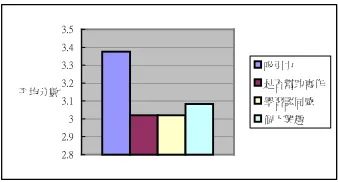
Learners’feedbacks toward the designed learning material were surveyed by a Likert questionnaire as shown in Appendix 1. The topic is divided into four categories: attractiveness of presentation mode, helpfulness of presentation media, personal preference toward presentation style, and overall acceptance. There are five questions for each category, and each question has 5-point scale. The total questions are 20.
Survey Results
2.8 2.9 3 3.1 3.2 3.3 3.4 3.5
平均分數
吸引力 是否幫助寫作 學習認同感 個人興趣
Figure 6. Summary result of learners’feedback upon the designed CALL material
5 Conclusions
The role of computer has changed from the facilitator of learning into activate learners into deep thinking. However, misunderstanding regarding the attractiveness of learning material and interactivity of learner with material is the richness of display and plenty of menu buttons in the user interface. As a matter of fact, the effectiveness of learning is best achieved through the construction of learner’s internal reflection and thinking due to the external multimedia stimulus, which should be able to activate learners into the engagement of deep thinking and constructing their own mental entities and corresponding representations and concepts. This paper reveals some fundamental theories related to the up-to-date instruction and learning theory, especially those related to the Computer Assisted Language Learning. In addition to the challenge faced by computer multimedia material designers, how the learning material should play as an effective one is clarified from the perspective of multiple external representations. Followed with studies related with the effect of various ITs upon the development of learning material, learners’feedback upon different technologies are also briefed. Along with the above literature review, this paper addressed the design of multimedia presentation of language learning material for an English Writing course offered at an University in Taiwan. The material was used to assist teacher’s instruction, and serve as the preliminary step regarding the implementation of instructional strategies in the language learning course for digital learning materials. Feedback from students were collected to reflect learners’preferences over the current status of multimedia learning
Further study will concentrate on three issues in sequences. The first one is the integration of Authorwaring program with the instructional strategies. The next step will be the incorporation of dynamic learner profile into the navigation and sequencing of learning material. The third step is to examine the effect of the above function’s performance from the perspective of social and cultural interaction between learners and learning material. It is expected to achieve the effective learning by coordinating external and internal stimulus to the learners’cognitive activities through well-designed digital learning material.
Acknowledgements
This study’s financial support is given by Yuan-Ze University in developing the computer assisted teaching materials, and research grant is also partly provided by Oriental Institute of Technology. Appreciation is give to research assistants of
Ssu-Chia Chen
(陳思嘉) at Yuan-Ze university and Chun Ting Chen (陳俊廷) at Oriental Institute of Technology for their helps in the graphics, and computer program presented in this paper.References
Allen, M. W. (2003)Michael Allen’s Guide to e-learning, John Wiely & Sons, Inc., New Jersey.
Ainsworth, S. E., Bibby, P. A., & Wood, D. J. (1997) Evaluating principle for multi-representational learning environments. 7thEARLI Conference, Athens.