The Influence of the Utterance Length on the Recognition of Aged Voices
Alexander Schmitt
1, Tim Polzehl
2, Wolfgang Minker
1, Jackson Liscombe
31Institute for Information Technology, University of Ulm, Germany
2Quality and Usability Lab TU Berlin / Deutsche Telekom Laboratories, 10587 Berlin, Germany 3SpeechCycle Inc., Broadway 26, New York, USA
[email protected], [email protected], [email protected], [email protected]
Abstract
This paper addresses the recognition of elderly callers based on short and narrow-band utterances, which are typical for Interactive Voice Response (IVR) systems. Our study is based on 2308 short utterances from a deployed IVR application. We show that features such as speaking rate, jitter and shimmer that are considered as most meaningful ones for determining elderly users underperform when used in the IVR context while pitch and intensity features seem to gain importance. We further demonstrate the influence of the utterance length on the classifier’s performance: for both humans and classifier, the distinction between aged and non-aged voices becomes increasingly difficult the shorter the utterances get. Our setup based on a Support Vector Machine (SVM) with linear kernel reaches a comparably poor performance of 58% accuracy, which can be attributed to an average utterance length of only 1.6 seconds. The automatic distinction between aged and non-aged utterances drops to random when the utterance length falls below 1.2 seconds.
1.
Introduction
Spoken dialogue technology has reached such a sophis-ticated level that it enables a growing complexity of telephone-based speech applications. Richer speech input possibilities allow for another generation of the so-called Interactive Voice Response (IVR) applications: the auto-mated troubleshooters (Acomb et al., 2007). Unlike pvious generations of IVR systems being of information re-trieval or transactional character, these systems provide au-tomated technical support and guide callers jointly towards a solution of their problem. By that, thousands of Internet-or television-related problems are solved every day through automation.
The complexity of those systems has risen substantially. While early IVR systems consisted of only few dialogue steps, problem solving applications may contain several dozen and frequently up to 50-100 dialogue steps in one call. Both, customers and providers have a substantial inter-est that the call in which they invinter-ested a substantial amount of time and money ends up successfully. While the cus-tomer is at risk of uselessly spending time with a system that might not solve her problem, the provider in return has running costs for each call that blocks a port on his rented telephone platform. Even more severe may be the loss of corporate image for the carrier when the system dissatisfies the caller.
Task completion is the highest precept in this structure and every situation has to be avoided where callers prematurely and unsatisfied put down the receiver.
2.
Motivation
In earlier work we have presented a problematic dialogue predictor (PDP), i.e. a statistical classifier, being able to detect problematic dialogues based on interaction logs (Schmitt et al., 2008). The target application is that of an automated Internet troubleshooter. The classifier’s predic-tion is entirely based on log data such as the number of Au-tomatic Speech Recognition (ASR) errors, average number of times the user did not respond in time, average
barge-in rate etc. An extensive set of lbarge-inguistic and discourse information available from the log data is included in the classification. An anger detection system (Schmitt et al., 2009a) is envisioned to be incorporated and will potentially raise the PDP’s accuracy. However, further details that can be exploited from the caller’s voice such as age and gender have been neglected so far.
Analyzing the task completion rate of the automated In-ternet troubleshooter, an IVR application helping callers to resolve Internet-related problems, we found out that non-senior callers had a 33% higher task completion rate than senior callers. An adaption of the dialogue to elderly callers, could potentially rise their task completion rate, e.g. by introducing more explicit confirmations or in case of ad-ditional problems detected by the PDP, an immediate trans-fer to an operator who can help out.
Other application scenarios for a distinction between senior and non-senior callers are:
• A shifting of the acoustic ASR models to models that are especially trained on aged voices to raise the rec-ognizer’s accuracy.
• Self-service applications that employ advertisements tailored to the specific user group while the caller is on hold for a live operator.
3.
Related Work
Humans are able to estimate the age of speakers in rough di-mensions (Minematsu et al., 2002). Certainly, distinguish-ing between e.g. males bedistinguish-ing aged 35 or aged 45 is virtually impossible, but a reasonable distinction between children, young adults and seniors is feasible.
30.0% 40.0% 50.0% 60.0% 70.0%
cc
u
rra
cy
intensity MFCCs formants pitch tmax speechrate jitter speechrate
w/o pause harmonicity shimmer male 63.8% 53.3% 55.5% 52.0% 52.7% 51.1% 46.8% 47.0% 35.4% 31.5% female 54.0% 53.6% 53.6% 55.0% 52.6% 51.0% 50.6% 44.1% 33.8% 22.1% mixed 58.6% 53.6% 53.5% 52.7% 51.8% 51.2% 47.6% 44.9% 34.4% 27.3% 0.0%
10.0% 20.0%
A
c
Figure 3: Average accuracy values of LOSO classification for respectivefeature groupson a SVM with linear kernel
0 1000 2000
0 500 1000 1500 2000
Number of callers labeled as "Under 60" 0 1000 2000
0 50 100 150 200 250 300 350
Number of callers labeled as "Above 60" 0 1000 2000
0 100 200 300 400
Number of callers where rater unsure
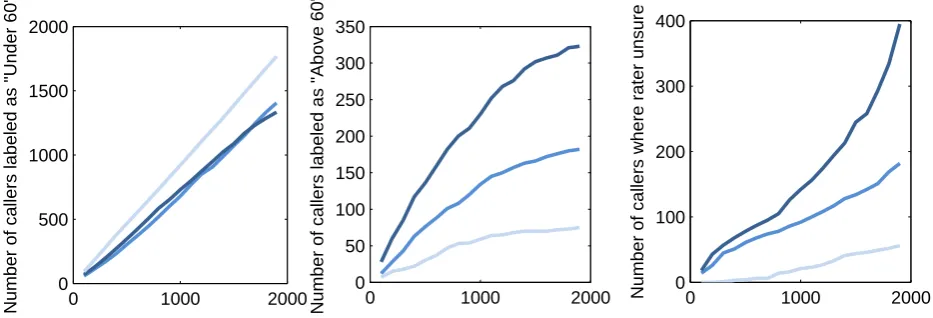
Figure 4: 3 Raters annotating age of 1,911 callers choosing between “>60”, “<=60” and “unsure”. First plot: number of calls the rater annotated with ’<=60’. Second plot: number of calls each rater annotated with ’>60’, third plot: number of calls where the raters were unsure. Note that the length of the presented sample decreases. As can be seen, with decreasing utterance length the uncertainty increases and the raters favor for ’unsure’ instead of ’>60’.
achieved a performance of 58.09% +/- 6.54%, which ap-pears rather weak. Considering the fact that the average du-ration of the classified utterances amounts to 1.6s, however, this can be still considered as acceptable. The approach of operating on very short utterances when classifying speaker age has to be questioned in general, instead the certainty would substantially rise when concatenating several turns.
8.
Conclusion and Discussion
In this study we analyzed the performance of acoustic and prosodic feature groups when applied in a senior-/non-senior recognition task using short utterances of narrow-band quality from an Interactive Voice Response system. The study has been carried out on a completely balanced and comparably large dataset and was evaluated speaker-independent with LOSO evaluation.
The findings are:
• The employed discriminative classifier, a SVM with linear kernel performs best when trained on pitch and intensity and not, as expected on jitter and shimmer.
• The speech rate fails on short utterances. The speech rate determined when including pauses outperforms the speech rate determined without pauses.
• Human annotators have big difficulties in estimating the speaker age with decreasing utterance length, par-ticularly when rating senior voices.
• The classifier had similar problems as the annotators: a strong influence of the utterance length on the over-all performance could be observed. The classifier’s performance dropped to random when the utterance length was shorter than 1.2s.
30.00% 40.00% 50.00% 60.00%
A
cc
ura
cy
jitter harmonicity power shimmer formants
0‐1s 40.66% 37.36% 7.69% 28.57% 52.75%
1‐2s 48.94% 32.65% 11.40% 25.53% 53.95%
3‐4s 44.95% 41.04% 24.10% 31.60% 49.51%
4‐5s 38.46% 40.00% 41.54% 47.69% 52.31%
0.00% 10.00% 20.00%
A
30 00% 40.00% 50.00% 60.00% 70.00% 80.00%
Ac
cur
acy
speechrate w/o
pause speech_rate intensity pitch tmax MFCCs
0‐1s 48.35% 53.85% 60.44% 60.44% 62.64% 57.14%
1‐2s 45.33% 50.50% 57.95% 51.50% 52.06% 52.45%
3‐4s 37.13% 50.81% 58.63% 53.09% 42.02% 53.75%
4‐5s 58.46% 64.62% 64.62% 67.69% 69.23% 73.85%
0.00% 10.00% 20.00% 30.00%
Figure 5: Percentage of correctly classified utterances within selected feature groups analyzed according to the utterance length. Jitter, harmonicity and formants don’t gain performance with increasing utterance length. In contrast, substantial increase can be observed when the utterance lasts at least 4 seconds which affects particularly power, shimmer, intensity, pitch, tmax and MFCCs.
Given the results from Figure 5 we may carefully conclude that a performance boost can be expected with turns that last at least 4 seconds.
It has to be clarified to which extent the narrow-band qual-ity has an influence on the performance of the single fea-tures. To foster these findings, a larger study with multiple corpora is necessary.
9.
Acknowlegdements
This research has been carried out in the context of the Transregional Collaborative Research Centre SFB/TRR 62 “Companion-Technology for Cognitive Technical Sys-tems” funded by the German Research Foundation (DFG).
10.
References
Kate Acomb, Jonathan Bloom, Krishna Dayanidhi, Phillip Hunter, Peter Krogh, Esther Levin, and Roberto Pier-accini. 2007. Technical support dialog systems:issues,
problems, and solutions. In Proceedings of the Work-shop on Bridging the Gap: Academic and Industrial Re-search in Dialog Technologies, pages 25–31, Rochester, NY, April. Association for Computational Linguistics. Tobias Bocklet, Andreas Maier, Josef Bauer, Felix
Burkhardt, and Elmar N¨oth. 2008. Age and gender recognition for telephone applications based on gmm su-pervectors and support vector machines. In IEEE Com-puter Society Press, editor, Proceedings of the Interna-tional Conference on Acoustics, Speech, and Signal Pro-cessing (ICASSP), volume 1, pages 1605–1608.
Paul Boersma and David Weenink. 2009. Praat: doing phonetics by computer (version 5.1.04), April.
N. H. De Jong and T. Wempe. 2009. Praat script to detect syllable nuclei and measure speech rate automatically.
Behavior Research Methods, 41(2):385–390, May.
Hi-rose. 2002. Automatic estimation of one’s age with his/her speech based upon acoustic modeling techniques of speakers. InProc. of ICASSP, volume 1, pages 137– 140.
Christian M¨uller, Frank Wittig, and J¨org Baus. 2003. Ex-ploiting speech for recognizing elderly users to respond to their special needs. InProceedings of the Eighth Eu-ropean Conference on Speech Communication and Tech-nology (Eurospeech 2003), pages 1305 – 1308.
Alexander Schmitt, Carolin Hank, and Jackson Liscombe. 2008. Detecting Problematic Calls With Automated Agents. In 4th IEEE Tutorial and Research Workshop Perception and Interactive Technologies for Speech-Based Systems, Irsee (Germany), June.
Alexander Schmitt, Tobias Heinroth, and Gregor Bertrand. 2009a. Towards emotion, age- and gender-aware voicexml applications. In5th International Conference on Intelligent Environments (IE09), July.