HSSA Tree Structures for BTG-based Preordering in Machine Translation
Yujia Zhang
1,2, Hao Wang
1and Yves Lepage
1 1Graduate School of Information, Production and Systems
Waseda University, Kitakyushu, Fukuoka 808-0135, Japan
2
School of Computer Engineering and Science,
Shanghai University, Shanghai 200444, China
{
ashley.zhang@moegi., oko ips@ruri., yves.lepage@
}
waseda.jp
Abstract
The Hierarchical Sub-Sentential Alignment (HSSA) method is a method to obtain aligned binary tree structures for two aligned sen-tences in translation correspondence. We pro-pose to use the binary aligned tree struc-tures delivered by this method as training data for preordering prior to machine translation. For that, we learn a Bracketing Transduction Grammar (BTG) from these binary aligned tree structures. In two oracle experiments in English to Japanese and Japanese to English translation, we show that it is theoretically possible to outperform a baseline system with a default distortion limit of 6, by about 2.5 and 5 BLEU points and, 7 and 10 RIBES points respectively, when preordering the source sen-tences using the learnt preordering model and using a distortion limit of 0. An attempt at learning a preordering model and its results are also reported.
1
Introduction
One of the major common challenges for machine translation (MT) is the different order of the same conceptual units in the source and target languages. In order to get a fluent and adequate translation in the target language, the default phrase-based statis-tical machine translation (PB-SMT) system imple-mented in MOSES has a simple distortion model using position (Koehn et al., 2003) and lexical in-formation (Tillmann, 2004) to allow reordering dur-ing decoddur-ing. Other solutions exist: e.g., the distor-tion model in (Al-Onaizan and Papineni, 2006) han-dles n-gram language model limitations; Setiawan et al. (2007) propose a function word centered syntax-based (FWS) solution; Zhang et al. (2007) propose
a reordering model integrating syntactic knowledge. Also, other models than the phrase-based model have been proposed to address the reordering prob-lem, like hierarchical phrase-based SMT (Chiang, 2007) or syntax-based SMT (Yamada and Knight, 2001).
Preordering (Xia and McCord, 2004; Collins et al., 2005) has been proposed primarily to solve the problems encountered when translating between languages with widely divergent syntax, for in-stance, from a subject-verb-object (SVO) language (like English and Mandarin Chinese) to a subject-object-verb (SOV) language (like Japanese and Ko-rean), Preordering is a pre-processing task that aims to rearrange the word order of a source sentence to fit the word order of the target language. It is separated from the core translation task. Recent approaches (DeNero and Uszkoreit, 2011; Neubig et al., 2012; Nakagawa, 2015) learn a preordering model based on Bracketing Transduction Grammar (BTG) (Wu, 1997) from parallel texts to score per-mutations by using tree structures as latent variables. They build the needed tree structures and the pre-ordering model (i.e., a BTG) at the same time us-ing word alignments. However it is needed to check whether a given sentence can fit the desired tree structures.
a preordering model without checking the validity by modifying the top-down BTG parsing method introduced in (Nakagawa, 2015). Oracle experi-ments show that if we reorder source sentences ex-actly, translation scores can be improved by around 2.5 BLEU points and 7 RIBES points in English to Japanese) and 5 BLEU points and 10 RIBES points in Japanese to English. Experiments with our tree structures show that better RIBES scores can be eas-ily obtained.
The rest of this paper is organized as follows: Section 2 describes related work in preordering and BTG-based preordering. Section 3 shows how to obtain tree structures using word-to-word associa-tions. Section 4 reports oracle preordering experi-ments. Section 5 gives a method to build a preorder-ing model uspreorder-ing tree structures. Section 6 presents the results of our experiments and their analysis.
2
Related Work
2.1 Preordering for SMT
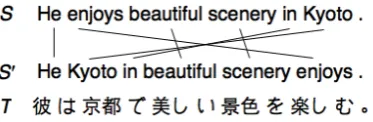
Preordering in statistical machine translation (SMT) converts a source sentenceS, before translation, into a reordered source sentenceS, where the word or-der is similar to that of the target sentenceT (Fig-ure 1).
Preordering can be seen as an optimization prob-lem, where we want to find the best reordered source sentence that maximizes the probability among all possible reordering of the sentence.
ˆ
S= argmax S∈γ(S) P(S
|S) (1)
ˆ
Srepresents the best reordered source sentence, and
generated rules (Xu et al., 2009; Isozaki et al., 2010). Another trend of research is to try to solve the preordering problem without relying on parsers. Tromble and Eisner (2009) propose sophisticated re-ordering models based on the Linear Ordering Prob-lem. Visweswariah et al. (2011) learn a preorder-ing model by similarity with the Travelpreorder-ing Sales-man Problem. Lerner and Petrovs (2013) present a source-side classifier-based preordering model. Several pieces of research (DeNero and Uszkoreit, 2011; Neubig et al., 2012; Nakagawa, 2015) are mainly about using tree structures as latent variables for preordering models. This is detailed in the next subsection.
2.2 BTG-based Preordering
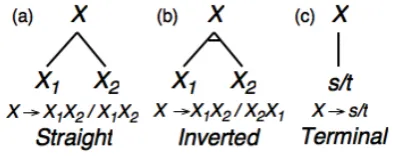
BTG-based preordering is based on Bracketing Transduction Grammar (BTG), also called Inversion Transduction Grammar (ITG) (Wu, 1997). Whereas Chomsky Normal Form of context-free rules has two types of rules (X → X1X2 andX → x) and the grammar is monolingual, BTG has three types of rules, Straight, Inverted and Terminal, to cope with the possible correspondences between a source lan-guage and a target lanlan-guage.
Figure 2: The difference between previous methods (Neubig et al., 2012; Nakagawa, 2015) and our proposed method when building a preordering model. In previous work, the tree structures and the preordering model should be deduced at the same time from the parallel text. Our work firstly produces the tree structures from parallel text, and then computes a preordering model.
Figure 3: Tree structures related to bracketing transduc-tion grammar.
read the type of rules applied, straight or inverted. Neubig et al. (2012) present a discriminative parser using the derivations of tree structures as un-derlying variables from word alignment with the parallel corpus. However, the computation complex-ity is O(n5)for a sentence length ofnbecause the method guesses the tree structure using the Coke-Younger-Kasami (CYK) algorithm, which complex-ity isO(n3). In order to reduce complexity, Naka-gawa (2015) proposes a top-down BTG parsing ap-proach instead of the bottom-up CYK algorithm. The computation complexity reduces toO(kn2)for a sentence length ofnand a beam width ofk.
Both methods need to predict the possible tree structures for each sentence when building the pre-ordering model. Word alignments are used to check whether a pair of sentences can yield a valid tree structure.1 Predicting tree structures while building
1A sentence pair which cannot be represented by a BTG tree
the preordering model at the same time is difficult. In the present paper, we propose to directly gener-ate the tree structures from the word-to-word asso-ciation matrices, and to use these tree structures to build the preordering model afterwards. Figure 2 il-lustrates the differences between the two previous methods and our proposed method.
3
Obtaining HSSA Tree Structures
In our proposed method, the tree structures are obtained by using soft alignment matrices and recursively segmenting these matrices with Ncut scores (Zha et al., 2001) using the hierarchical sub-sentential alignment (HSSA) method (Lardilleux et al., 2012).
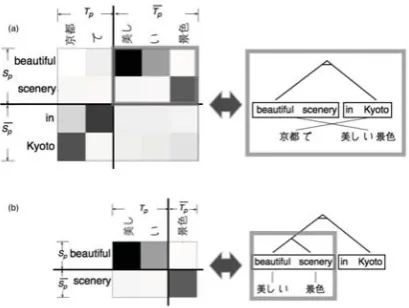
The HSSA method delivers tree structures which are similar to parse trees obtained by the application of a BTG. Figure 4 shows that segmenting along the second diagonal with the HSSA method corre-sponds to an Inverted rule in the BTG formalism and that segmenting according to the first diagonal corre-sponds to Straight. The columnSp.Sp2and the row Tp.Tpof the matrix in Figure 4 are related to part of the source sentence and part of the target sentence respectively.
The HSSA method uses soft alignment matrices
structure is:B2D4A1C3toA1B2C3D4.
2
The symbol “.” stands for the concatenation of word strings.
eration of tree structures. (a) a best segmentation accord-ing to the second diagonal in the soft alignment matrix using the HSSA method coresponds to an Inverted rule in the BTG formalism; (b) a best segmentation according to the main diagonal corresponds to a Straight rule. (b) is a sub-part in (a) to illustrate recursivity.
where each cell for a source word s and a target wordthas a scorew(s, t)computed as the geomet-ric mean of the word-to-word translation probabil-ities in both directions (see Equation (2)). In Fig-ure 4, the saturation of the cells represents the score
w(s, t): the darker the color, the higher the score.
w(s, t) =p(s|t)×p(t|s) (2)
Each segmentation iteration segments the soft alignment matrix in both horizontal and vertical di-rections to decompose the matrix recursively into two corresponding sub-parts. There are two cases: the two sub-parts follow the main diagonal, (Sp, Tp) and (Sp, Tp), this is similar to the BTG rule Straight
(see Figure 4(b)); or they follow the second diago-nal, (Sp, Tp) and (Sp, Tp), this is similar to the BTG rule Inverted (see Figure 4(a)). In order to decide for the segmentation point and for the direction in a submatrix (X, Y)∈ {Sp,Sp} × {Tp, Tp}, Ncut
scores (Zha et al., 2001) of crossing points in the matrix (Sp.Sp, Tp.Tp) are calculated in both direc-tions.
W(X, Y) =
s∈X,t∈Y
w(s, t) (3)
cut(X, Y) =W(X, Y) +W(X, Y) (4)
HSSA approach allows to get tree structures easily and rapidly, by using only a parallel corpus and the word-to-word associations obtained from it. No fur-ther annotation is needed.
4
Oracle Experiments: Upper Bounds
So as to check whether our proposed method is promising, in a first step, we perform oracle ex-periments. The purpose is to determine the upper bounds that can be obtained in translation evaluation scores. This will offer a judgment on the theoretical effectiveness of utilizing tree structures generated by the hierarchical sub-sentential alignment method.
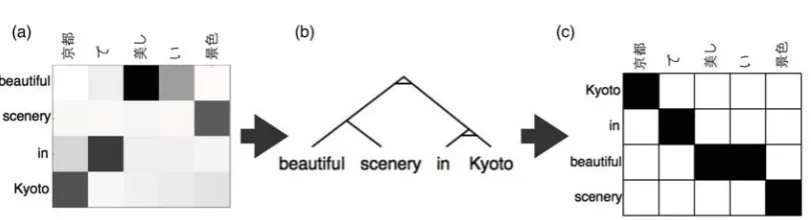
In the oracle experiments, we apply the HSSA method on the sentence pairs of the test set to obtain their tree structures and then use these tree structures to reorder the source sentences of the test set. In a real experiment, this is impossible, because the tar-get sentence, and hence the soft alignment matrices are unknown.
Figure 5: Example for oracle experiment. (a) a soft alignment matrix between a source sentence (left) and a target sentence (above); (b) a tree structure with Straight or Inverted nodes; (c) the alignment between the reordered source sentence and the target sentence. The arrow from (a) to (b) represents the generation of tree structures from word-to-word associations by use of the HSSA method; the arrow from (b) to (c) is reordering. In the oracle experiment, this is applied on test data. In a real experiment, this is applied on test data and development data, while the scheme given in Figure 6 is applied on the test data.
After reordering all source sentences in the train-ing, tuntrain-ing, and test sets, a standard PB-SMT system is built as usual with the reordered source sentences in place of the original sources sentences, and with their corresponding target sentences.
5
Building and Applying a Preordering
Model
A preordering model is built by using the tree struc-tures obtained on the parallel corpus used as train-ing data for machine translation, as its traintrain-ing data. On test data, i.e., source sentences alone, the role of the pre-ordering model is to guess a new order for the words of the source sentences in the absence of corresponding target sentences. Figure 6 illus-trates the process of building the preordering model with the tree structures obtained as explained in Fig-ure 1 from the sentence pairs of the training data of a machine translation system. We now present a method to learn and apply a preordering model. This method is a modification of the top-down BTG parsing method presented in (Nakagawa, 2015). The main difference is that, in our present configuration, tree structures are available from a parallel corpus.
In Nakagawa’s method, word alignments are used to predict the tree structures, so that, after segment-ing one span into two, whether a word in one of two spans aligns to another word in the other span is checked in each iteration. However, in our con-figuration, we are able to directly get the separating points because we know the tree structure produced by the HSSA method.
The best derivationdˆfor a sentence is important for both learning and applying a preordering model. Because one derivation leads to one parse tree, find-ing the best derivation can be regarded as findfind-ing the best parse tree. To assess the quality of a parse tree, we compare it with the tree structure output by the HSSA method. The best parse tree is the tree with the maximal score defined by the following formula:
ˆ
d= argmax
d∈D(T)
m∈Nodes(T)
σ(m) (6)
where d represents one derivation in the set of all possible derivations D(T) for the tree structureT;
mrepresents one node in the set of nodes Nodes(T) of the tree structure T, and σ(m) represents the score of the node.
The score of a node in a tree structure is computed by applying the perceptron algorithm (Collins and Roark, 2004), i.e., by taking each node of trees as a latent variable (Nakagawa, 2015). This algorithm is an online learning algorithm, and processes nodes in an available tree structure one by one, by using the following formula to calculate the score of each nodeσ(m):
σ(m) = Λ·Φ(m), m∈Nodes(T)
learn the feature vectors and adjust their weight vec-tors by using the Expectation–Maximization (EM) algorithm on the training data. In the end, we obtain a preordering model with features and correspond-ing weights.
We then apply the preordering model on all the source sentences of all three data sets, training, tun-ing, and test, to reorder their words. A standard PB-SMT system is then built as usual with reordered source sentences in place of the original sources sentences, and with their corresponding target sen-tences.
6
Experiments
6.1 Experimental Settings
We build our PB-SMT systems in a standard way us-ing the Moses system (Koehn et al., 2007), KenLM for language modelling (Heafield, 2011), and stan-dard lexical reordering model (Koehn et al., 2005). This lexical reordering model allows local reorder-ing with a given distortion limit durreorder-ing decodreorder-ing. The default of the distortion limit in Moses is 6. When set to 0, the system does not perform any lex-ical reordering.
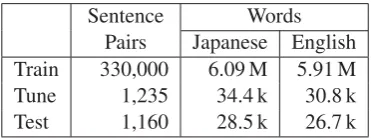
The language pair we work on is Japanese– English in both directions. The data sets are the training, tuning and test sets from the Kyoto Free Translation Task (KFTT) corpus.3 In this corpus, Japanese sentences have been segmented and tok-enized by KyTea.4 Table 1 gives statistics on these data sets.
For the generation of tree structures, word-to-word associations are extracted from the training set andused to the hierarchical sub-sentential alignment method, are extracted only from the training set.
For our preordering model, we carried out exper-iments by following the experimental settings re-ported in (Nakagawa, 2015) with a beam search of 20, a number of iteration of 20 and 100,000 sen-tences pairs as preordering training extracted at ran-dom from the training set. We use three kinds of features, LEX, POS, and CLASS. LEX consists in the lexical items inside a given window around the current word in the source language. POS are the parts-of-speech of the lexical items of the LEX
fea-3
http://www.phontron.com/kftt/index.html
4
modified Fuzzy Reordering Score; normτ is normalized Kendall’sτ; dl stands for distortion limits). Baseline is a default PB-SMT system; Tree-based is our proposed preordering model; Top-down is the top-down BTG parsing-based reordering model; Oracle is an oracle system that uses HSSA tree structures obtained for the test set. The gray cells indicate the results to compare in translation: systems with preordering methods and with a distortion limit of 0 should be compared with the corresponding baseline system with a default distortion limit of 6; other results are given for completeness.
to English. However, the comparison is in favor of our system (preordering, distortion limit 0) in RIBES by 1 point. This seems natural as RIBES is a metric for machine translation which takes reorder-ing into account.
The reasons for these mitigated results are listed below. Firstly, our preordering models do not simu-lates the HSSA method so well, because this method considers all words in the two parts at hand, while the learning models we used rely only on the fea-tures of two words in the beginning and the ending position of each part. Secondly, there may be several segmentation points with similar Ncut values when building the tree structures. We choose only one. To memorize other alternatives, the use of forests in-stead of trees would be required. Memorizing these alternatives may lead to larger increases in evalua-tion scores.
7
Conclusion
In this paper, we firstly automatically generate tree structures using the hierarchical sub-sentential alignment (HSSA) method. These tree structures are equivalent to parse trees obtained by Bracketing Transduction Grammars (BTG). Secondly, based on these tree structures, we build a preordering model. Thirdly, using this preordering model, source sen-tences are reordered. In an oracle experiment, we
show that we may expect to outperform a baseline system with the default distortion limit of 6 by 2.5 (English to Japanese) or 5 (Japanese to English) BLEU points if we are able to reorder the text sen-tences exactly, without the need of any distortion limit. Other experiments show that tree structures generated by the HSSA method help in getting better RIBES scores than a baseline system without pre-ordering.
In future work, we will try different features, times of iteration and sizes of beam. In addition, we would also like to try to the use of forest structures instead of tree structures.
Acknowledgements
The second author is supported in part by China Scholarship Council (CSC) under CSC Grant No. 201406890026. We would like to thank Tetsuji Nakagawa for his most helpful comments on the ex-periment setting details.
References
tional Linguistics (ACL), pages 311-318, Philadelphia, PA, USA, July. Association for Computational Lin-guistics.
Hendra Setiawan, Min-Yen Kan and Haizhou Li. 2007. Ordering Phrases with Function Words. In Proceed-ings of the 45th Annual Meeting of the Association of Computational Linguistics, pages 712-719, Prague, Czech Republic, June. Association for Computational Linguistics.
David Talbot, Hideto Kazawa, Hiroshi Ichikawa, Jason Katz-Brown, Masakazu Seno, and Franz J Och. 2011. A Lightweight Evaluation Framework for Machine Translation Reordering. In Proceedings of the 6th Workshop on Statistical Machine Translation, pages 12-21, Edinburgh, Scotland, UK, July. Association for Computational Linguistics.
Christoph Tillmann. 2004. A unigram orientation model for statistical machine translation. InProceedings of the 2004 Human Language Technology Conference of the North American Chapter of the Association for Computational Linguistics (Short Papers), pages 101-104, Boston, MA, USA, May. Association for Com-putational Linguistics.
Roy Tromble and Jason Eisner. 2009. Learning Linear Ordering Problems for Better Translation. In Proceed-ings of the 2009 Conference on Empirical Methods in Natural Language Processing, pages 1007-1016, Sin-gapore, August. Association for Computational Lin-guistics.
Yoshimasa Tsuruoka, Yusuke Miyao, and Junichi Kazama. 2011. Learning with Lookahead: Can History-Based Models Rival Globally Optimized Models?. InProceedings of the Fifteenth Conference on Computational Natural Language Learning, pages 238-246, Portland, Oregon, USA, June. Association for Computational Linguistics.
Karthik Visweswariah, Rajakrishnan Rajkumar, and Ankur Gandhe. 2011. A Word Reordering Model for Improved Machine Translation. InProceedings of
Xianchao Wu, Katsuhito Sudoh, Kevin Duh, Hajime Tsukada, and Masaaki Nagata. 2011. Extracting Pre-ordering Rules from Predicate-Argument Structures. InProceedings of the 5th International Joint Confer-ence on Natural Language Processing, pages 29-37, Chiang Mai, Thailand, November.
Fei Xia and Michael McCord. 2004. Improving a sta-tistical MT system with automatically learned rewrite patterns. InProceedings of the 20th international con-ference on Computational Linguistics, pages 508-515, Geneva, Switzerland, August. Association for Com-putational Linguistics.
Peng Xu, Jaeho Kang, Michael Ringgaard, and Franz Och. 2009. Using a Dependency Parser to Improve SMT for Subject-Object-Verb Languages. InHuman Language Technologies: The 2009 Annual Conference of the North American Chapter of the ACL, pages 245-253, Boulder, Colorado, June. Association for Com-putational Linguistics.
Kenji Yamada and Kevin Knight. 2001. A Syntax-based Statistical Translation Model. InProceedings of the 39th Annual Meeting on Association for Compu-tational Linguistics, pages 523-530, Toulouse, France, July. Association for Computational Linguistics. Hongyuan Zha, Xiaofeng He, Chris Ding, Horst Simon,
and Ming Gu. 2001. Bipartite Graph Partitioning and Data Clustering. InProceedings of the tenth in-ternational conference on Information and knowledge management, pages 25-32, Atlanta, Georgia, USA, November. Association for Computational Linguis-tics.