How fashion startups build strong brands:
Exploring
industry-specific factors most influential when branding
fashion startups.
Author: Daan Caspar Wijdeveld
University of Twente
P.O. Box 217, 7500AE Enschede
The Netherlands
ABSTRACT
This research explores factors unique to the fashion industry which play an important role in
the process of branding fashion startups. In order to reveal these factors, this research took an
explorative approach by analyzing existing literature on (startup) branding and analyzing
fashion startups. This paper highlights (1) the factors which the existing body on (startup)
branding deems most relevant, and uses this as a foundation for exploring how fashion startups
go about incorporating these. Besides, this research explores (2) the factors which existing
literature has drawn little attention to. Moreover, this research has analyzed three major fashion
brands to find out whether (3) particular factors incorporated by established fashion brands may
be applicable to the branding process of fashion startups too.
Graduation Committee members:
Dr. M. de Visser and Dr. M. Ehrenhard
Keywords
Branding, Startups, Fashion, Industry-level, Practices.
Permission to make digital or hard copies of all or part of this work for personal or classroom use is granted without fee provided that copies are not made or distributed for profit or commercial advantage and that copies bear this notice and the full citation on the first pa ge. To copy otherwise, or republish, to post on servers or to redistribute to lists, requires prior specific permission and/or a fee.
11th IBA Bachelor Thesis Conference, July 10th, 2018, Enschede, The Netherlands.
Just do it™ is arguably one of the most well-known slogans of the 21st century and Nike’s® logo one of the most recognizable
logos in existence. However, what exactly is it that makes this slogan and logo so successful? As a matter of fact, neither the logo or the slogan provide the name of Nike® or suggest the
products that it offers, but nevertheless, many are familiar with what the two stand for. Strong brands create a story around a business which extends far beyond the quality and functionality of its products. Nike understands this, and responds to the fact that every single person has been, or will be, in the situation where they face a challenge and tell themselves to “Just Do It”, cleverly targeting customers on an emotional level. Its brand is so strong because we want someone to tell us that we can do it, and we want someone to understand that it is not easy to achieve our goals.
In contrast to the success of Nike®, Abercrombie & Fitch has
continuously been performing worse in the past few years (Wahba 2016). Some may know it for its well-trained male models which walk around shirtless, but as one may argue, the story that A&F aims to convey is not consistent. Its most recent “This Is the Time” campaign portrays the story of the average twenty to twenty-four-year-old who faces the challenges of entering the grown-up world, something far out of line with its well-trained models. Weak brands fail to align their values and views with those of its target audience. As a result, it may be difficult for consumers to assess which values the brand stands for and can potentially switch to a brand which does create a consistent image that enhances this alignment. Regardless of how great the quality of their products or its functionality, if not branded correctly, a business may experience difficulties staying in the game.
1 Introduction
Entrepreneurs can increasingly outsource more tasks due to the emergence of a wide range of online tools and services which facilitate the growth of a startup. Amongst these are Shopify® and WebFlow® which allow one to build a web-shop within a matter of hours (Tenebruso 2018), YouTube® which is increasingly used to consume educational videos (Hua 2015), Facebook® and Instagram® which can effectively generate traffic to web-shops based on large amounts of consumer data
(Curran 2018) and moreover, Oberlo® has made it even easier for entrepreneurs to automatically forward web-shop orders to their factory or supplier, who then ship the product straight to the end customer, eliminating the need for entrepreneurs to serve as intermediate in the fulfilment process or manage inventory (Business-dictionary 2018, Ayanso, Diabi and Nair 2006). As a consequence of these services, entrepreneurs appear to dedicate more time and money to other matters, in particular to branding (Ruzzier & Ruzzier 2015, Froelings 2016).
Recent scholars acknowledge that branding as such is becoming a bigger determinant of a startup’s success, as discussed by Isaksson (2015), Freeman (2017) and Zwilling (2012). This may be attributed to increased customer expectations towards businesses (McGovern 2016) or the increased power of customers (i.e. customer have access to more information) (KPMG 2016).
The topic of branding has been extensively studied by scholars, and as a result, a large number of academic findings on how to build strong brands exists. As early as 1965, Marquardt concluded based on a survey, that 75% of people prefer products from well-known brands over products which are lower-priced. After the importance of branding had become evident (Smith 1956, Yankelovich 1964, Marquardt 1965)
Doyle (1989) stressed that brands are not only sole identifiers of a product or business (e.g. a logo, a catchy slogan) but that value can be created by increasing the congruence between a brand’s identity and the identity of its customers. He states this can be achieved via real and objective attributes (e.g. the quality of products, the value-for-money) but also via abstract and emotional attributes (e.g. a lifestyle, a status, or youthfulness). Many studies have demonstrated the positive effects that a strong brand can deliver. Strong brands can allow businesses to charge a premium price to customers, compared to business with a less strong brand (Khermouch, Holmes and Ihlwan 2001). Besides, Jamal and Goode (2001) confirmed that the congruence between a brand image and the customers’ self-image will enhance customer satisfaction and brand preference. Not only do strong brands thus reap benefits as a result of increased attractiveness to the customer. Internal benefits can also be observed. For example, Clifton and Simmons (2003) find that businesses with a strong brand positioning are benefiting from clarity of focus that provides them with “more effectiveness, efficiency and competitive advantage across operations”.
Even though (1) entrepreneurs can dedicate more time to branding in an era where (2) studies confirm the increased importance of branding as a determinant for a startup’s success and (3) a large base of academic literature on building strong brands is available, the failure rate of startups in America and Europe remains 75% (Harvard Business School 2012). These facts appear to be ambiguous, and raise the question how applicable the existing base of academic literature on branding is to particular startups.
1.1 Knowledge gap and research contribution:
Ambimola (2001) explored how SME’s should go about branding by developing a set of guidelines that SME’s should follow. Amongst these is the recommendation to “make sure maximum attention is directed at a single source”, implying that a brand should convey a single clear message with one obvious value proposition. Petkova, Rindova and Gupta (2008) suggests startups need to build two sorts of reputations to create a strong brand (i.e. a local reputation which appeals to a small range of customers, who share the startup’s passion for the product and a general reputation to appeal to a wide audience, which is entirely new to the product, including investors or potential business partners). Ruzzier and Ruzzier (2015) stress the importance for startups to focus on the brand-market fit, rather than only the product-market fit. “The brand is an evolving entity” and so “startups need to understand in which direction to evolve their brand”. They developed four stages (i.e. the investigation, the development, the implementation and the validation of the brand) enabling startups to assure this brand-market alignment. Kwiatowski (2017) explored a wide range of branding practices startups may need to consider. She highlights startups should use various media to convey a brand. This includes using separate formats for entertainment, for practical tips, or for education.
specific industry was selected, which may benefit most from such a study. The fashion industry has been identified to suit this study as (1) it experiences a failure rate of 53% (Statistic Brain Research Institute 2018), (2) purchases in this industry are highly characterized by the congruence between the identify and lifestyle of customers and the identity (i.e. brand attributes) of a fashion brand (Azevedo & Farhangmehr 2005) and (3) not a lot attention has been given by previous studies to branding in the context of fashion.
This study aims to explore factors that are characteristic and distinctive for the fashion industry, which play an important role in the branding process of fashion startups. Moreover, by doing so, this study aims to create a set of best-practices on how fashion startups should build strong brands which incorporates these industry-specific factors. These findings expand existing literature on startup branding and further narrow the focus on an industry-level. Such a set may proof to be advantageous, as it potentially enables fashion startups to build stronger brands which may increase their chances of succeeding, and reduces the high failure-rate amongst startups.
2 Theoretical background
Aaker (2004) defines brands as “representing an organization and reflecting its heritage, values, culture, people and strategy”. Whereas this definition as such focusses very much on the attributes which one may associate with a brand, other scholars incorporate the notion that a brand is an asset which may create value: Svedberg (2014) defines a brand as “a strategic asset, which could be seen as a promise that constantly needs to be delivered”. However, there appears to be a clear difference in how older studies perceive a brand, compared to more recent ones. Whereas initially, little was known about the different attributes (Hampf & Lindberg-Repo 2011), more recent studies highlight the wide range of attributes which can be associated with a brand such as the lifestyle a brand conveys (Doyle 1989) or a brand’s personality (Aaker 1996). Moreover, recently it has been increasingly acknowledged that the customer experience is also part of a brand (Bonchek & France, 2016). In this view, all touch points which customers have with the business pose an opportunity for the business to not just convey its attributes and values, but to actively demonstrate and proof these, hence the notion by Svedberg (2014) that brand’s promise constantly needs to be delivered. In line with previous studies (Aaker 1996, Doyle 1989) this research will define a brand as “the collection of attributes which a business conveys to its stakeholders, which all together make up the stakeholders’ perception of the business, its intentions, and its values.” Moreover, this definition is in line with the notion by Cohen (2018) that brands derive value by appealing to all its different stakeholders, not only its customers.
Defining a brand: Aaker (1996) has developed an extensive framework which incorporates all factors which need to be considered in order to build a strong brand. The model is comprised of four dimensions and twelve perspectives: the brand as a product (e.g. product scope, attributes and quality), the brand as an organization (organizational attributes, scale of activities), the brand as a person (e.g. customer-brand relationship and brand personality) and fourthly the brand as a symbol (e.g. a logo, metaphorical symbol and the brand’s heritage). The model has seen a few changes in more recent years (Aaker and David, 2004a) but its principles remain the same and Aaker (1996) has been cited over eleven-thousand times, according to Google scholar (2018). Whereas other scholars focus more on the function of branding (Kapferer 1997), it can be argued that such findings fall within the
dimensions of the model by Aaker (1996). For example, the nine functions of a brand developed by Kapferer in 1997 are all said to have the purpose of satisfying particular customer needs. Aaker did, however, incorporate the customer-brand relationship element as part of the ‘brand-as-a-person’ dimension, and the nine functions by Kapferer arguably can be seen as a further exploration or expansion of this element.
This research will define branding as the process via which businesses create and convey the attributes of, views on, and associations with their business and products, which it wants its stakeholders to perceive, as a mean to increase its shareholders’ value. This definition is in line with the definition used by Svedberg (2014) in that it incorporates the commercial interest many fashion businesses have (McKinsey 2017).
As the term ‘successful’ and ‘strong’ have been used several times throughout this paper, it is important to understand that in the context of this study, they refer to the realization of benefits which a successful or strong brand may provide to a startup or established business (Holmes and Ihlwan 2001, Jamal and Goode 2001, Clifton and Simmons 2003).
3 Research Question
The following research question has been asked:
Which factors unique to the fashion industry are most influential for fashion startups in order to build a successful brand?
To answer this, the following sub questions have been asked:
• Which factors do academic findings deem most important for building strong brands and how exactly do fashion startups incorporate these?
• Which factors do academic findings not address, that play an important role in the branding process of fashion startups?
• Which factors do established fashion brands incorporate that may also be applicable to branding fashion startups?
3.1 Elaboration on the independent and depended variable
The independent variable, namely the industry-specific factors, encompasses all aspects distinct to the fashion industry which are being – or should be – considered by fashion startups, when designing and building their brand, and when communicating this with their audiences.
The dependent variable, namely successful brands, encompasses the effects of branding (that is, benefits) which incorporating the industry-specific factors may result in. The term success has been elaborated in section two, and refers to benefits which a brand may provide.
4 Methodology
Selection of Startups
Detailed information on branding activity at startups was needed to reveal the industry specific factors. Thus, three startups were approached through the network of the author. Moreover, two more startups were selected to analyze through online means. The five startups together represent three different nationalities (Germany, The Netherlands and The United States), target different niches (sports clothes, leisure clothes, formal clothes) and mainly target audiences no older than fifty years old. Though this is a limited sample size, their characteristics are representative for the fashion industry in that the largest buying force in the fashion industry are millennials (aged between 22 – 40) who spend between $1510 and $1820 on fashion per year (Statista 2018) and the fact that the fashion industry in mainly dominated by western brands (Apparel 50 Brand Finance Report 2017).
4.1 Sub research question 1
In order to answer sub-question one, a clear overview was needed of the most important factors to consider when branding a startup, backed up by academic research. For this reason, 29 academic papers and articles released between 1956 and 2018 on branding were reviewed, and the most important findings were extracted based upon (1) consensus amongst scholars on the finding, (2) the extent to which subsequent studies built upon the findings and (3) the extent to which the findings may be applicable to startups – that is, the findings are not solely applicable to firms with extensive resources or those making use of economies of scale.
Hence, the intention was not to list all practices, but rather, summarize some of the most significant causes for success with regard to building strong brands for startups. Academic papers and articles were retrieved from Scopus and Google Scholar. Keys words used to retrieve literature included “branding techniques” “startups” “fashion” and other words related to these terms.
Information was collected by reviewing the startups’ visual appearance online (e.g. web shop, social media, and other online mediums) to summarize their brand story and learn which industry-specific factors the fashion startups incorporate in their branding practices. Moreover, product reviews, founder interviews from online sources, and articles were analyzed to further enhance our understanding on how the fashion startups go about branding.
An interview was held with three startups. Closed questions, which were based on the factors revealed through the literature review were asked, to identify which factors that are distinctive to the fashion industry were incorporated by the fashion startups while building their brand. As section 4.2 will explain, open questions were asked during the interview as well, to reveal as many factors as possible which the literature did not draw attention to.
In order to conclude on the practices which are most important for fashion startups to consider, we compared the information which was retrieved through our analysis, with the theories and recommendations revealed through our literature review. As indicated before in section three, rather than taking a strictly qualitative approach, we use the theory to validate the successful practices which we observe, as well as to explain the causes for failure which we observe. Through this approach, we develop a set of recommendations for the fashion startups which are backed up by existing studies on branding.
4.2 Sub research question 2
In order to identify new factors, and answer sub-question two, a much more open approach was needed. First of all, additional branding practices had to be revealed, after which, their impact on success had to be assessed to decide whether or not these branding practices may be beneficial for other fashion startups.
To reveal additional practices which had not surfaced in our efforts to answer sub research question one, (1) the researchers evaluated which practices the reviewed literature appeared to miss or not put significant weight on, and (2) evaluated if, and how, such practices where undertaken at the fashion startups.
First of all, the interviews were structured so that the open questions were covered first. Section one was open, in that we encouraged the founders to share their views on branding, its perceived contribution to their startup’s success, their own brand, and which challenges the fashion industry posed with regard to building a strong brand, so that we did not limited the thoughts and views of the interviewees.
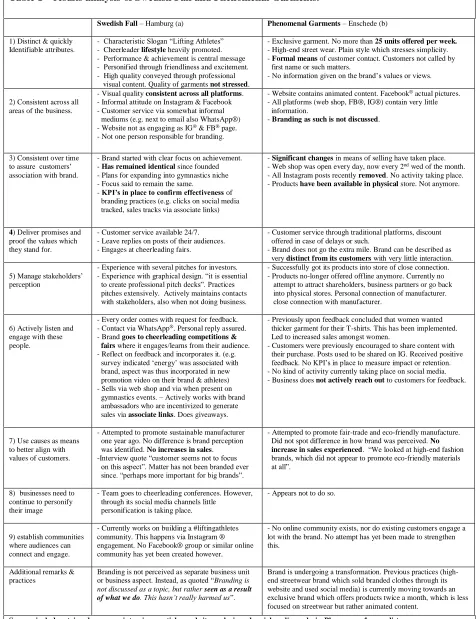
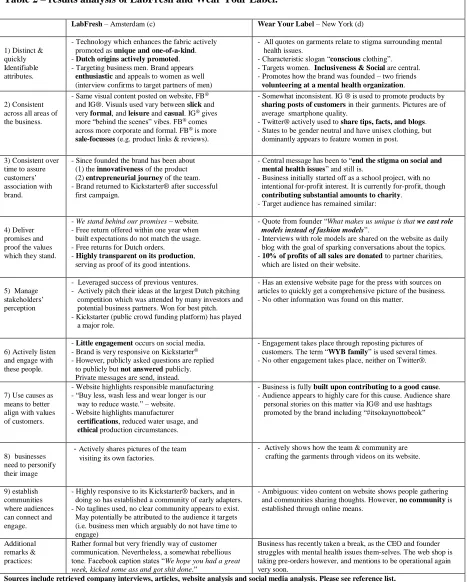
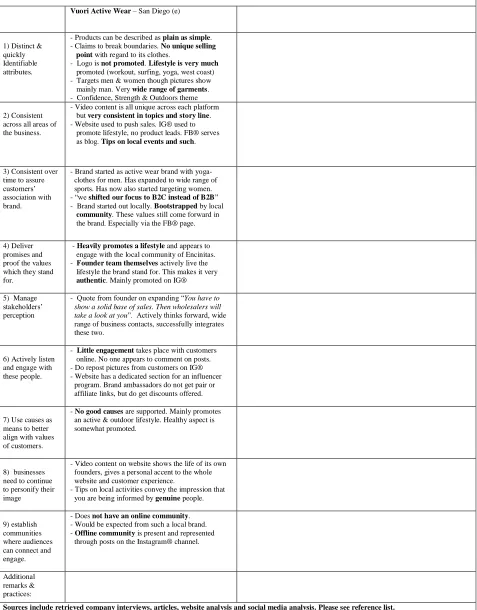
Besides having open questions in the interview, we also – similar in the approach for sub-question one – reviewed the startups’ online presence, and used other online sources such as web shop, social media, and other online mediums, product reviews, founder interviews from online sources, and articles to include as many as possible fashion-related factors. All observations can be viewed in table 1, 2, 3 (Appendix A) combined with the findings of sub-question one.
The final selection of new factors was based upon two criteria, namely (1) whether or not the startup founder could confirm and demonstrate the benefits realized from incorporating particular factors (via our interviews or retrieved interviews online) and (2) whether all other information obtained via our analysis provided sufficient evidence to argue that incorporating a particular factor may be beneficial for other fashion startups too.
4.3 Sub research question 3
The three fashion brands with the largest company value as of 2017 (Brand Finance, 2017) were selected for further analysis, to reveal additional branding practices which may be valuable for fashion startups. As of December 2017, the largest brands in their respective order were Nike®, H&M® and ZARA®. We
acknowledge that these firms vary significantly from startups in that they have much larger resources and can make use of economies of scale, but are nonetheless relevant to further investigate as they (1) have successfully tackled and overcome the difficulties of branding a startup themselves, (2) successfully managed to adapt their brand to changing customer expectations in the past decades and (3) have established such a reputation that they arguably successfully sell a lifestyle and idea, rather than the product (Suvi 2015).
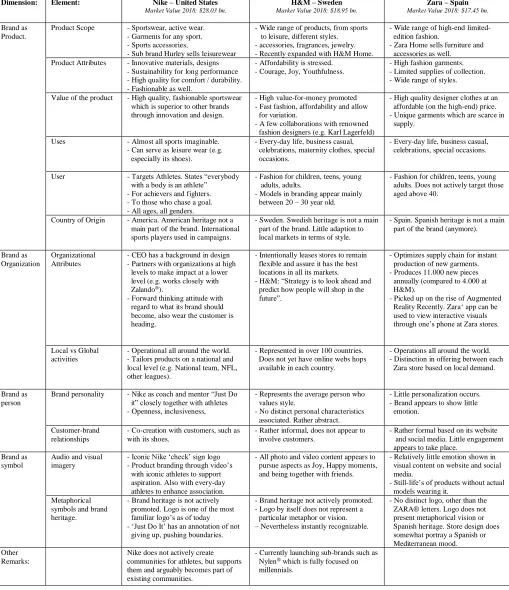
In order to answer sub-question 3, a framework had to be selected by which to analyze the established fashion brands. The literature review aimed to reveal branding factors which are applicable to startups, hence it was not appropriate to copy this approach for the established brands. Given the wide range of aspects that it takes into account, the brand-building model by Aaker (1996) has been used to analyze the established firms. All elements have been laid out in a matrix to evaluate each established brand based on the four dimensions and each of the twelve elements of the model.
information, company websites, their social media accounts, blogs from renowned journalists, interviews with management retrieved via YouTube® or newspapers, company reports,
company statements, and business reviews were analyzed.
After retrieving information via the online analysis, the revealed practices and factors were evaluated to assess whether the observed branding practices and factors may be applicable and valuable to fashion startups. We did so by excluding the factors bound to extensive resources, economies of scale or the established reputation of these huge brands, and including those factors which we deemed less-dependent on the company size and which can be controlled and managed by fashion startups.
5 Literature review
5.1 Significant findings from the 1950’s – 1990’s
After Smith (1956) founded the concept of segmentation, which suggests markets consist of consumers with diversified demands, Yankelovich (1964) expanded this notion by introducing additional variables with regard to how these demands could be sorted. This included “buying behavior”, “motives”, “values” or “aesthetic preferences” (Hampf & Lindberg-Repo 2011). The field of branding started to get more attention, and Marquardt (1965) confirmed the relevance of brands through his study, in which 75% of the respondents indicated to prefer products from well-known brands over products which may be priced more affordably. Throughout the following decades, academic literature increasingly stressed the importance of what brands may mean to customers (Kapferer 1997) and as a consequence immaterial values were started to be promoted much more. Alignments had to be sought between the brand and the personality of the customer. As mentioned prior in this paper, Doyle (1989) highlights that band attributes may be real and objective (e.g. the quality and value for money) but can also be abstract and emotional (e.g. a status or youthfulness). The perception of what a brand was started to encompass more aspects over time, and Aaker (1996) developed a model which sorted this wide range of aspects into four dimensions, also explained prior in this paper, which incorporates most of the research on branding from as early as the 1950’s into one framework. That same year Kapferer developed nine functions of the brand, which can be seen as an expansion of one of the twelve elements of Aaker’s model, as we have argued before.
5.2 Significant findings from the 2000’s – 2010’s
Around the 2000’s, branding practices for SME’s started to get more attention, and it became clear that startups may benefit from approaching branding in a different way. Prior in this paper we highlighted the contributions by Ambimola (2001), Jamal and Goode (2001), Petkova (2008) and Ruzzier and Ruzzier (2015), who further explored branding in the context of SME’s and startups. Unlike before, however, it was increasingly acknowledged thatin order to create congruence between the brand’s attributes and the customer’s identity (Jamal and Goode 2001) brands should directly engage with the customer. As Zyman (2004) states: “A brand is not something you manage over time. It’s something you deliver in the moment.” The latter part was supported by Bonchek & France (2006), who also indicated that branding is becoming increasingly more about a customer’s experience with a business. The notion that a brand “is not something you manage over time” had little support, on the contrary. Building customer loyalty or strengthening customer retention, for example, are processes which do actually require time (Keller, 2001). Recently, in line with views by Petkova (2008) on how
startups need to build two reputations, Cohen (2018) made the point that a startup’s brand not only needs to appeal to customers, but also to more distant stakeholders, like investors or potential business partners (i.e. startups need to appeal to potential investors to accumulate funds). The way brands interact with customers continues to change these days, and the past few years have been seeing increased customer expectations with regard to what brands should do. The 2015 Cone Communications Global CSR study showed that 91% of consumers expect brands to do more than simply push a sale and that “simply getting a message out there – whether it is the offerings’ attributes or the perception businesses ought to convey – and waiting for customers, is not enough”. This trend is confirmed by the Digital Branding Institute, whose study on millennials revealed that 91% of millennials would rather endorse a brand that stands up for a cause. Moreover, customers these days ‘meet’ brands in different places. The Influencer Orchestration Network (2017) found that 71% of customers indicate “they are more likely to purchase an item based on social media references”, which has clearly been recognized by brands, hence their increased presence on social media platforms (McKinsey 2017). “Tied to the prevalence of social media usage are branded communities”, which smart brands recognize as an opportunity (Influencer Orchestration Network 2017). Brands which establish such online communities can benefit tremendously, because it enables them to connect with audiences, share their audience’s passions and interests, learn about customers and moreover, receive valuable feedback on their products or services (Barron 2018).
5.3 Predictions for the 2020’s
When assessing what branding in the coming years will be like, it is essential to reflect on the socio-dynamic changes which will take place. For the coming years, this implies that the oldest members of Generation Z (those born after the mid 1990’s) are 22 years old and start entering the workforce, hence their buying power will increase (Bureau of Labor Statistics 2013). 29% of this generation declares “hearing about a brand on social media” as the most influential factor in the buy-decision process (Digital Branding Institute 2018). Moreover, 81% of Generation Z watches at least one hour of video content each day (Digital Branding Institute 2018). These statistics, along with the fact that branding has become an experience, suggest that video consumption – which also implies engagement with the video content such as sharing and commenting on it – will become an important mean to engage with audiences (Bowden, Conduit & Hollebeek 2017). Arguably, the emergence of virtual reality may successfully combine the increased video consumption and the perception of branding as an experience. Bonchek & France (2016) predicted that the next wave of branding will be “branding as a relationship”. This builds on the concept of branding as an experience, though it enhances the fact that companies are increasingly incorporating personal-traits into their brand to appeal to the customer. Deloitte (2014) predicts that, as a consequence of this, customers are likely going to have more control over businesses and how businesses should conduct operations in the next decade.
5.4 The most significant causes of success
The above-mentioned perspectives and research contributions have been summarized in to nine hypotheses which appear to be the most dominant in the reviewed branding literature. Each of these has been deduced from academic studies and findings surfaced in the literature review. The sources on which these statements are based and which provide evidence for their validity have been mentioned in their respective order after each one. Despite the studies which back them up, these hypotheses, as such, have not been tested.
1) Because the majority of customers choose known brands over more affordable brands, businesses may benefit from conveying product attributes – real or abstract – which are distinct from competitors and can be quickly identified. (Doyle 1989, Marquardt 1965).
2) Because congruence between a brand-image and the customer’s self-image enhances satisfaction and brand preference, a startup’s brand needs to have a single focus with consistent attributes across all areas of the business (Abimola 2001, Jamal and Goode 2001).
3) Because customer loyalty is built over time and branding may satisfy customer needs by portraying the image a customer wants to be or represent to others, a startup’s brand needs to stay consistent over time to assure this confirmation and strengthen customers’ brand association. (Keller 2001, Kapferer 1997).
4) As the consumers’ experience has gotten increasingly important, rather than solely creating and communicating a coherent brand story, brands need to actively deliver promises and proof the values which they stand for when interacting with the customer. (Concheck & France 2016, Aaker 1996).
5) Because a startup’s success not only depends on its customers, startups need to actively manage how all stakeholders – such as investors – perceive the brand, to enhance the chances of potential investments or other growth opportunities. (Petkova, Rindova, Gupta, 2008, Cohen 2018).
6) Because customers increasingly share brand experiences via social media and recommendations on social media are highly influential in the buy-decision process, brands need to actively listen to and engage with people on social media, and incorporate feedback they receive by doing so (McKinsey 2017, CSR 2015).
7) Because customers increasingly expect business to do more than simply push a sale, businesses may use the support of a good causes to their advantage, as a mean to enhance the congruence between their brands’ identity and that of its customers. (McGovern 2016, Jamal and Goode 2001).
8) Because branding increasingly appears to head in the direction of a personal relationship between the customer and brand, businesses need to continue to personify their image. (Concheck & France 2016).
9) Because humans inherently associate with a lifestyle, group or culture, brands need to establish communities and growingly build their brand around a particular lifestyle, in order to become an extension of the customer’s lifestyle and engage in new and upcoming ways (Influencer Orchestration Network 2017).
5.5 Using these principle for the startup analysis
With these principles, we were able to provide a structure in the analysis of the branding practices at fashion startups. Rather than strictly verifying whether the above-mentioned branding principles were executed at fashion startups, we approached the startup evaluation with an open perspective, and used these principles to provide a direction in the search for factors which are specific to the fashion industry, which fashion startups took into consideration when branding their startup, and by doing so finding answers to the research question.
6 Results and discussion
Table 1, 2 & 3 (Appendix A) provide the outcomes of the startup analysis, whereas Table 4 (Appendix B) provides the outcomes on the established brands analysis. The following three sections highlight the most significant findings on the factors retrieved via the analysis and interviews. We summarize the findings per sub research question and conclude by combining all findings of this study to provide an answer to the main research question.
6.1 Results sub-research question 1:
For all specific findings from the startup analysis, we refer to table 1, 2 and 3 (Appendix A). Hence, the following section highlights the most significant findings and factors unique to the branding process of fashion startups, in the same respective order as the findings from the literature review in section 5.
• For most startups (A, C, D, E) we observe distinct brand attributes consistent throughout their online presence, giving a clear impression of what each fashion brand stands for. Interestingly, startup D appears to sell very simple garments (e.g. plain shirts, sweaters, tops) but fully focusses on the texts which they print on their shirt. Arguably, rather than expression their lifestyle through the looks, its customers express it through the quotes on the shirts. Whereas printing texts on shirts has been around for decades, it may very well be possible that due to how customers increasingly perceive brands as extensions of their lifestyle (Cătălina and Andreea 2014), such quotes are becoming an increasingly effective way to appeal to audiences. We argue that fashion startups can enhance brand preference in an effective manner by embroidering text with a strategic meaning, implying its meaning aligns with the lifestyle and values of its target audience (Jamal and Goode 2001; Guzman 2004).
• At startup B, in contrast, we observe inconsistencies amongst its brand attributes. Whereas its website stresses exclusivity of its garments, its Facebook®page reveals little to
• We observe that the fashion startups predominantly use Instagram® to show off their clothes. We do not find this
extraordinary, but what is interesting, however, is that only one startup (C) appears to use professional models, whereas all others use people from either their own team (A) their community (D) or their own customers (A, B and E) to promote its clothes. As the founder of startup D states: “What makes us unique is that we cast role models, instead of fashion models”. Although we do not find sufficient evidence to claim that such an approach leads to a stronger brand, these observations are in line with the views by Aaker (1996), and Concheck & France (2016) that startups should actively proof what they stand for, to reduce customers’ sceptics about a brands’ sincereness.
• Expanding on the notion of being sincere, we observe that most startups (A, C, D and E) take on very encouraging attitudes. This includes the focus on achievement (A), professional success (C), personal happiness (D), and personal health (E). We observe that these personality traits are properly aligned with the main function of the garments each startup creates: that is sportswear (A), formal shirts (C), garments with uplifting quotes (D) and sportswear (E). It can be argued that fashion startups can benefit from such a personality-functionality fit, as it strengthens (i.e. clarifies, makes more evident) the values a brand conveys. Falling back on the findings of Jamal and Goode (2001), this fit may enhance the customers’ satisfaction and brand preference for the fashion startup. We acknowledge this fit not solely applies to fashion startups alone, and similar phenomena can be observed at established fashion brands (e.g. Nike® sells
sportswear and highly promotes achievement, whereas H&M®
sells leisure wear and highly promotes happiness).
• A distinct feature of the fashion industry is that the customer – arguably more than in any other industry – serves as free advertisement anytime and anywhere (e.g. pictures shared online while wearing it, wearing it in public, wearing logos on garments, word-to-mouth). We observe that startup A and D actively embrace this. The founder of startup A states that he aims to get its customers to refer to the brand in as many places as possible, and does so via promoting taglines. Its tagline #liftingathletes has been used in over 1214 individual posts as of June 2018 on Instagram® alone. Doing so not only
serves as a mean to significantly expand the reach towards people who are unfamiliar with the brand. It provides the customer with a sense that he or she is part of a group of athletes with similar ambitions, states the founder. We observe a similar notion at startup C which uses the tagline #itsokaynottobeokay. Although we cannot conclude on the exact impact that this expanded online reach has had, we urge fashion startup to embrace the creation of such brand extensions, as 71% of customers indicate social media references to be the most influential factor in the buy-decision process (The Influencer Orchestration Network 2017) and social media usage is expected to continue to grow (Statista 2018), hence the increased social references (through tags) this may result in and the increased impact that these have on the buy-decision process reinforce one another.
6.2 Results sub-research question 2:
• Literature on startup branding draws little attention to how startups should go about assessing whether or not their branding efforts are actually delivering positive results. In contrast, at both startup A and B, we observe the use of clear KPI’s to assess how well their branding efforts are working. Startup A tracks the number of sales that each of its brand ambassadors generates (i.e. through affiliate links) and uses Instagram® Stories (i.e. public posts which disappear after a
24-hour period) to track the clicks on tags of people in its pictures. From this information, it learns which ambassadors
best align with their audience, and it incorporates this when selecting new ambassadors. We argue that fashion startups can benefit from using KPI’s, and can do so by using the theory on branding (e.g. the theories highlighted in section five) to develop KPI’s which track the branding performance of the fashion startup.
• Whereas literature has put little emphasize on how exactly different (social) media channels should be used by startups, we conclude that fashion startups have designated functions for the different media used. We observe that Instagram® is predominantly used to place garments in a social
context – rather than promoting qualitative or functional attributes – and portrays the lifestyle that its audiences may have. Facebook® is consistently used to provide audiences with fashion blogs, tips and tricks. Moreover, the fashion startup’s web-shops are predominantly conveying attributes pertaining to value-for-money, functionality and quality. With regard to Instagram® we observe that startup A shows its
products worn during cheerleading shows, startup C shows videos of its products worn by ‘frequent flyers’ to convey a business setting, and startup E shows athletes taking on challenges to push their physical boundaries. Interestingly, these findings are in line with the statistics that video engagement on Instagram® is on average double as high as on other social media (Comnicore 2017). This leads us to believe Instagram® is a highly effective medium for fashion startups to convey the lifestyle they aim to represent. With regard to Facebook® we observe that it is consistently used to enhance
the personification of the brand (i.e. coming across as a real person rather than a for-profit business), but we did not succeed to find sufficient evidence to explain this consistency. Other fashion startups may benefit from applying this approach, but it may well be that this observed consistency can be attributed to our limited sample size.
6.3 Results sub-research question 3:
• Unlike the literature review and the startups analysis have revealed, we observe that Nike®, H&M®, and ZARA®
take on a very innovative attitude in their branding efforts. For example, ZARA® has recently enriched its brand by incorporating augmented reality (i.e. users can view models walking around with the garments in selected Zara® stores through their smartphone lens). Besides, as stated by H&M, “the strategy is to look ahead, and predict how people will shop in the future” (Hanbury 2018). We argue that fashion startups can benefit from taking on a more innovative approach in how they brand themselves. Within the fashion industry, startups may enhance their brands by for example the use of artificial intelligence to enhance the design and fit of garments (i.e. IBM has recently developed such technologies in collaboration with fashion brands, reported by Business Insider 2018), the use of neuro-branding (i.e. targeting audiences on a psychological level, rather than an emotional level) which is increasingly used by large fashion brands (Mull and Lee, 2014) or, as observed at Zara®, introduce augmented reality, which is becoming increasingly accessible via products such as the Arizon® (i.e. a cardboard augmented reality goggle) to let audiences view clothes in totally new ways, before they are to purchase these.
‘exclusive’, ‘limited’, or attributes that are season-bound. The fashion industry is characterized by a very short shelf life of its products (Avins, 2006), and so this way, fashion brands can continue to sell older inventory as well, even when a new clothing line may have been released already. As a matter of fact, we observed that startup A has previously held an unsold inventory valued at around €30.000,00, which it could not sell anymore, because it had already released a new clothing line, branded as its newest line. Hence, we argue that choosing the correct branding attributes (i.e. avoiding those pertaining to exclusivity) can save fashion startups from this pitfall.
7 Conclusion
7.1 Research limitations
7.1.1 Limitations of the Research Methodology. Due to the fact that this research was bound to a ten-week timeframe, little could be done to correct the mistakes which have been made early on during the construction of the methodology. Amongst these, the most significant flaw concerns the way in which an answer to sub-question was to be found. In contrast to sub research question one and three, no solid (theoretical) framework had been developed for sub question two. Consequently, no structure was available through which to reveal additional practices. Instead, this research simply deduced conclusions from all the retrieved information (presented in Table 1, 2 and 3). It therefor remains unclear how many additional factors may have been left unrevealed by this research.
7.1.2 Limitations of the sample and its representativeness. Due to the very limited number of fashion startups that have been analyzed, the statements made in this paper which are based on consensus amongst observations hold not as much strength as they would have done, had the researchers analyzed a larger sample size with fashion startups from more different fashion niches. Moreover, as a consequence of the limited sample size, no statistical analysis has been undertaken, as the reliability of its outcomes would have been dubious. Finally, this study has mainly focused on fashion startups which are doing well. However, an analysis of fashion startups which have failed could have served as an additional mean to validate good and bad practices.
7.1.3 Limitations of the evaluation and conclusion. As a result of the flaws in the methodology of sub question two, less than expected additional factors have been revealed in our attempt to answer sub question two. It is unclear whether or not many more industry-specific factors are very influential besides the ten described in section six, and it is plausible that the conclusion is not complete as a result of this.
7.2 Future research:
7.2.1 Future research based on limitations: Although it has been acknowledged in the methodology that little qualitative measures would be used, as a result of not analyzing these (i.e. increased sales, increased customer retention) little has been concluded on the exact impact of the factors. It would be interesting for future research to explore this, so that a ranking can be provided on how fashion startups should prioritize our findings. A similar matter counts for the nine hypotheses which have been constructed in section five. It may be interesting to measure the causality of these, so that future researchers can use these to support or validate future findings.
7.2.2 Future research based on findings: We have argued that fashion startups can benefit from incorporating KPI’s to assess how their branding efforts are paying off. Although we have only touched the surface of which KPI’s may be useful (i.e. we indicated the alignment of brand ambassadors with the target audience) it may proof to be advantageous for fashion startups if more research is undertaken in this area to provide a clearer framework by which fashion startups can reflect on their branding practices. Moreover, this study has focused on the fashion industry, and it is likely that other industries possess, in a similar way, their own unique factors which influence how startups should go about building a brand. Depending on how limited the branding literature in a given industry is, it may be interesting to see how a similar study as ours, given the notion that a much larger sample size will be used, may unfold when undertaken in a different industry.
7.3 Conclusion
This paper has provided an industry-level perspective on the branding process at fashion startups and has highlighted some of the most important factors pertaining to branding in the context of the fashion industry. We hope that our findings may provide guidance to fashion entrepreneurs in order to build stronger brands and successfully grow their fashion startups into successful fashion businesses.
8 Acknowledgement
9.0 References
1. Aaker, D. A. (1996). Building strong brands: Building, measuring, and managing brand equity.
2. Aaker, D. A. (2004). Leveraging the corporate brand. California management review, 46(3), 6-18. Quote retrieved from Guzman, F. (2005). A brand building literature review. The ICFAI Journal of Brand Management, 2(3), 30-48. 3. Ayanso, A., Diaby, M., & Nair, S. K. (2006). Inventory rationing via drop-shipping in Internet retailing: A sensitivity
analysis. European Journal of Operational Research, 171(1), 135-152.
4. Azevedo, A., & Farhangmehr, M. (2005). Clothing branding strategies: Influence of brand personality on advertising response. Journal of Textile and Apparel, Technology and management, 4(3), 1-13.
5. B. Barron (2018) Branding Trends to Look for in 2018. Retrieved from www.elegangthemes.com on June 4th 2018.
6. B. Groyberg & R Abrahams (2014). What Does Success Mean to You? Retrieved from the February 2014 issue of Harvard Business Review on June 2nd 2018.
7. Bonchek, M., & France, C. (2016). Build your brand as a relationship. Harvard Bus. Rev, 9.
8. Bowden, J. L. H., Conduit, J., Hollebeek, L. D., Luoma-aho, V., & Solem, B. A. (2017). Engagement valence duality and spillover effects in online brand communities. Journal of Service Theory and Practice, 27(4), 877-897
9. Brand finance (2017) Apparel 50 Brand Finance Report 2017. Retrieved on June 11th, 2018 from http://brandfinance.com/knowledge-centre/reports/brand-finance-apparel-50-2017/
10. Bureau of Labor Statistics 2013. Money spend on fashion per age group. Retrieved on June 5th 2018 from https://www.bls.gov/opub/btn/volume-4/consumer-expenditures-vary-by-age.htm
11. Business-dictionary (2018). Definition on “Drop-shipping” retrieved from http://www.businessdictionary.com/definition/drop-shipment.html
12. Clifton, R. S., & SIMMONS, J. (2003). J. (2003), “Brands and Branding”. The Economist Newspapers & Profile Books,
230-243.
13. Comnicore (2017) Statistics on Instagram users. Retrieved on June 12th 2017 from https://www.omnicoreagency.com/instagram-statistics/
14. Cone (2015) Cone Communications/Ebiquity Global CSR Study. Report Retrieved on June 4th,2018 from http://www.conecomm.com/research-blog/2015-cone-communications-ebiquity-global-csr-study.
15. Deloitte (2014) The Deloitte Consumer Review. The growing power of consumers. Retrieved on June 2nd, 2018 from
https://www2.deloitte.com/content/dam/Deloitte/uk/Documents/consumer-business/consumer-review-8-the-growing-power-of-consumers.pdf
16. Digital Branding Institute (2018) Digital Branding Trends to Watch Out For in 2018. Retrieved from https://digitalbrandinginstitute.com/digital-branding-trends-2018/on June 4th 2018.
17. Doyle, P. (1990). Building successful brands: the strategic options. Journal of consumer Marketing, 7(2), 5-20. 18. Dylan Curran. “Are you ready? Here is all the data Facebook & Google have on you” in the guardian. Retrieved May
8th from https://www.theguardian.com/commentisfree/2018/mar/28/all-the-data-facebook-google-has-on-you-privacy 19. Freeman (2017). Brand experience. A new era in marketing. Retrieved on May 28th2018 from www.freeman.com. 20. Google Study (2016) Information retrieved from.
https://socialmediaweek.org/blog/2016/05/study-suggests-businesses-spending-content-marketing-ads/
21. Google Scholar (2018). Number of citations retrieved on June 2nd 2018 via
https://scholar.google.com/scholar_lookup?title=Building%20strong%20brands&author=D.%20Aaker&publication_yea r=1996
22. Guzman, F. (2005). A brand building literature review. The ICFAI Journal of Brand Management, 2(3), 30-48. 23. H. Cohen (2018). An actionable marketing guide - thirty definitions of branding. Retrieved from
http://riversidemarketingstrategies.comon on June 2nd 2018.
24. Hanbury (2018). Fashion is undergoing a massive change – and H&M’s struggles are proof. Retrieved on June 12th 2018 from https://www.businessinsider.nl/hm-struggles-as-fashion-changes-2018-4/?international=true&r=US 25. Harvard Business School (2012) The Venture Capital Secret: 3 out of 4 startups fail. Retrieved from:
https://www.hbs.edu/news/Pages/item.aspx?num=487
26. Isaksson, F. (2015). Brand Building in New Ventures. A subconscious process or an integrated activity?
27. IBM (2017). IBM teamed up with FIT to show how AI is changing the future of fashion design. Retrieved from: http://www.businessinsider.com/sc/ibm-fashion-fit-design-ai-2018-2?international=true&r=US&IR=T
28. Jamal, A., & Goode, M. M. (2001). Consumers and brands: a study of the impact of self-image congruence on brand preference and satisfaction. Marketing Intelligence & Planning, 19(7), 482-492. Information retrieved from Achouri, M. A., & Bouslama, N. (2010). The Effect of the Congruence between Brand Personality and Self-Image on Consumers' Satisfaction and Loyalty: A Conceptual Framework. IBIMA Business Review. Page 10.
29. Joe Tenebruso (2018) Shopify delivers 73% revenue growth in 2017. In The Motley Fool. Data retrieved from shopify via https://investors.shopify.com/Investor-News-Details/2018/Shopify-Announces-Fourth-Quarter-and-Full-Year-2017-Financial-Results/default.aspx
30. Kapferer, J. N. (1997). Strategic brand management: creating and sustaining brand equity long term, 2. Auflage, London. Model retrieved on May 20th, 2018 from Guzman (2004) A brand building literature review, (Excerpt from PhD Thesis “Brand Building Towards Social Values: Associating to Public Goods”) Page 3.
31. Karen Hua (2015) Education as Entertainment, YouTube sensation teaching the future. Forbes (2015).
32. Khermouch, G., Holmes, S., & Ihlwan, M. (2001). The best global brands together with leading brand consultant inter-brand. Business Week, 50.
33. Kasouf, C. J., Darroch, J., Hultman, C. M., & Miles, M. P. (2009). Service dominant logic: Implications at the marketing/entrepreneurship interface. Journal of Research in Marketing and Entrepreneurship, 10(1), 57-69.
9.0 References
35. L. Froelings (2016): Study suggests businesses are spending more on content marketing over adds
36. KPMG (2017). The truth about online consumers. 2017 Global online consumer report. Retrieved on May 4th 2018.
https://assets.kpmg.com/content/dam/kpmg/xx/pdf/2017/01/the-truth-about-online-consumers.pdf
37. Lee, J. J., & Lee, S. J. (2017). The Differences of Asian and Western Consumers' Attitudes towards Brand Extensions by Information Types: Attribute-Related vs. Non-Attribute-Related Information. International Review of Management and Marketing, 7(1). 281 – 290.
38. MBA knowledge base (2017) https://www.mbaknol.com/marketing-management/limited-editions-as-a-marketing-strategy/
39. M. Paker (2012). Interview with Nike CEO on innovation and design. Retrieved on June 12th 2018 from https://www.youtube.com/watch?v=oSWEd4o-BdE
40. McGovern (2016) Customers want more: 5 expectations you must meet now. Article retrieved on June 4th, 2018 from
http://www.customerexperienceinsight.com/customer-expectations-you-must-meet-now/ 41. McKinsey (2017) The State Of Fashion 2017. Retrieved on June 8th 2018 via
https://www.mckinsey.com/~/media/McKinsey/Industries/Retail/Our%20Insights/The%20state%20of%20fashion/The-state-of-fashion-2017-McK-BoF-report.ashx
42. Mull, Ian and Lee, Seung-Eun (2014). "Neuro-marketing: A New Approach for Fashion Marketing?". International Textile and Apparel Association (ITAA) Annual Conference Proceedings. 57.
43. P. Rubble (2010) Interview peter rubble, previous head of basketball at Nike. Retrieved on June 11th 2018 from https://www.risingabovethenoise.com/nike-branding-after-27-years-with-david-brier/
44. Petkova, A. P., Rindova, V. P., & Gupta, A. K. (2008). How can new ventures build reputation? An exploratory study.
Corporate Reputation Review, 11(4), 320-334.
45. R. W. Smith (1956): Product Differentiation and Market Segmentation as Alternative Market Strategies. Journal of Marketing. 21(1), pg. 3-8. Information retrieved from A. Hampf & K. Lindberg-Repo (2011). Branding: The Past, Present, and Future: A Study of the Evolution and Future of Branding. Page 2.
46. R. Marquardt, R., Makens, J., & Larzelere, H. (1965). Measuring the utility added by branding and grading. Journal of Marketing Research, 45-50. Information retrieved from Hampf, A., & Lindberg-Repo, K. (2011). Branding: The past, present, and future: A study of the evolution and future of branding. Page 2.
47. Statista (2018). Retail e-commerce sales in the United States from 2016 to 2022. Retrieved on May 2nd2018 from https://www.statista.com/statistics/272391/us-retail-e-commerce-sales-forecast/
48. Statista (2018). Value of the leading 10 apparel brands worldwide in 2018. Retrieved on June 10th 2018 from https://www.statista.com/statistics/412567/value-of-the-leading-global-apparel-brands/
49. Svedberg (2014) Nine arguments about brands and brand communication. Page 11. Translated from the original Swedish title Nio resonemang om varumärken och varumärkeskommunikation. Retrieved from Isaakson, 2015 Brand Building in New Ventures A subconscious process or an integrated activity? on May 20th2018.
50. Vinhas Da Silva, R., & Faridah Syed Alwi, S. (2006). Cognitive, affective attributes and conative, behavioral responses in retail corporate branding. Journal of Product & Brand Management, 15(5), 293-305. Retrieved from Zhang, Y. (2015). The impact of brand image on consumer behavior: a literature review. Open journal of business and management, 3(1). Page 60.
51. Vroom, V. H. (1964). Work and motivation. Definition retrieved from Bonner, S. E., & Sprinkle, G. B. (2002). The effects of monetary incentives on effort and task performance: theories, evidence, and a framework for research. Accounting, Organizations and Society, 27(4-5), 303-345.Page 308.
52. Yankelovich, D. (1964). New criteria for market segmentation. Harvard Business Review, 42(2), 83-90. Information retrieved from Hampf, A., & Lindberg-Repo, K. (2011). Branding: The past, present, and future: A study of the evolution and future of branding. Page 2.
53. Zwilling (2012). Entrepreneurs need to brand themselves first. Retrieved on June 2nd from
https://www.forbes.com/sites/martinzwilling/2012/06/16/entrepreneurs-need-to-brand-themselves first/#69198af84677 54. Zyman, S., Leonard-Barton, D., & Sway, W. C. (1999). The end of marketing as we know it. New York: Harper
Business. Information retrieved from Bonchek, M., & France, C. (2016). Build your brand as a relationship. Harvard Bus. Rev, 9.
55. Statistic Brain (2018). 53% of fashion startups fail: https://www.statisticbrain.com/startup-failure-by-industry/ 56. Anttonen, S. (2015). Branding a Lifestyle: Case: Nike.
57. Keller, K. L. (2001). Building customer-based brand equity: A blueprint for creating strong brands. P. 23 58. Cătălin, M. C., & Andreea, P. (2014). Brands as a mean of consumer self-expression and desired personal
lifestyle. Procedia-Social and Behavioral Sciences, 109, 103-107.
59. H&M (2018) https://about.hm.com/en/media/news/financial-reports/2017/1/2441626.html
60. Ries, E. (2011). The lean startup: How today's entrepreneurs use continuous innovation to create radically successful businesses. New York: Crown Business.
61. Statista (2018). Social network users worldwide. Retrieved from https://www.statista.com/statistics/278414/number-of-worldwide-social-network-users/
62. Avins (2006) Retailer Capitalizes on Fashion's Short Shelf Life. Retrieved from http://articles.latimes.com/2006/sep/20/entertainment/et-H-M20
Appendix A (1/3)
Table 1 – results analysis of Swedish Fall and Phenomenal Garments.
Swedish Fall – Hamburg (a) Phenomenal Garments – Enschede (b)
1) Distinct & quickly Identifiable attributes.
- Characteristic Slogan “Lifting Athletes” - Cheerleader lifestyle heavily promoted. - Performance & achievement is central message - Personified through friendliness and excitement. - High quality conveyed through professional visual content. Quality of garments not stressed.
- Exclusive garment. No more than 25 units offered per week. - High-end street wear. Plain style which stresses simplicity. - Formal means of customer contact. Customers not called by first name or such matters.
- No information given on the brand’s values or views.
2) Consistent across all areas of the business.
- Visual quality consistent across all platforms. - Informal attitude on Instagram & Facebook - Customer service via somewhat informal mediums (e.g. next to email also WhatsApp®) - Website not as engaging as IG® & FB® page.
- Not one person responsible for branding.
- Website contains animated content. Facebook® actual pictures.
- All platforms (web shop, FB®, IG®) contain very little information.
- Branding as such is not discussed.
3) Consistent over time to assure customers’ association with brand.
- Brand started with clear focus on achievement. - Has remained identical since founded - Plans for expanding into gymnastics niche - Focus said to remain the same.
- KPI’s in place to confirm effectiveness of branding practices (e.g. clicks on social media tracked, sales tracks via associate links)
- Significant changes in means of selling have taken place. - Web shop was open every day, now every 2nd wed of the month.
- All Instagram posts recently removed. No activity taking place. - Products have been available in physical store. Not anymore.
4) Deliver promises and proof the values which they stand for.
- Customer service available 24/7. - Leave replies on posts of their audiences. - Engages at cheerleading fairs.
- Customer service through traditional platforms, discount offered in case of delays or such.
- Brand does not go the extra mile. Brand can be described as very distinct from its customers with very little interaction.
5) Manage stakeholders’ perception
- Experience with several pitches for investors. - Experience with graphical design. “it is essential to create professional pitch decks”. Practices pitches extensively. Actively maintains contacts with stakeholders, also when not doing business.
- Successfully got its products into store of close connection. - Products no-longer offered offline anymore. Currently no attempt to attract shareholders, business partners or go back into physical stores. Personal connection of manufacturer. close connection with manufacturer.
6) Actively listen and engage with these people.
- Every order comes with request for feedback. - Contact via WhatsApp®. Personal reply assured.
- Brand goes to cheerleading competitions & fairs where it engages/learns from their audience. - Reflect on feedback and incorporates it. (e.g. survey indicated ‘energy’ was associated with brand, aspect was thus incorporated in new promotion video on their brand & athletes) - Sells via web shop and via when present on gymnastics events. – Actively works with brand ambassadors who are incentivized to generate sales via associate links. Does giveaways.
- Previously upon feedback concluded that women wanted thicker garment for their T-shirts. This has been implemented. Led to increased sales amongst women.
- Customers were previously encouraged to share content with their purchase. Posts used to be shared on IG. Received positive feedback. No KPI’s in place to measure impact or retention. - No kind of activity currently taking place on social media. - Business does not actively reach out to customers for feedback.
7) Use causes as means to better align with values of customers.
- Attempted to promote sustainable manufacturer one year ago. No difference is brand perception was identified. No increases in sales. -Interview quote “customer seems not to focus on this aspect”. Matter has not been branded ever since. “perhaps more important for big brands”.
- Attempted to promote fair-trade and eco-friendly manufacture. Did not spot difference in how brand was perceived. No increase in sales experienced. “We looked at high-end fashion brands, which did not appear to promote eco-friendly materials at all”.
8) businesses need to continue to personify their image
- Team goes to cheerleading conferences. However, through its social media channels little
personification is taking place.
- Appears not to do so.
9) establish communities where audiences can connect and engage.
- Currently works on building a #liftingathletes community. This happens via Instagram ® engagement. No Facebook® group or similar online community has yet been created however.
- No online community exists, nor do existing customers engage a lot with the brand. No attempt has yet been made to strengthen this.
Additional remarks & practices
Branding is not perceived as separate business unit or business aspect. Instead, as quoted “Branding is not discussed as a topic, but rather seen as a result
of what we do. This hasn’t really harmed us”.
Brand is undergoing a transformation. Previous practices (high-end streetwear brand which sold branded clothes through its website and used social media) is currently moving towards an exclusive brand which offers products twice a month, which is less focused on streetwear but rather animated content.
Appendix A (2/3)
Table 2 – results analysis of LabFresh and Wear Your Label.
LabFresh – Amsterdam (c) Wear Your Label – New York (d)
1) Distinct & quickly Identifiable attributes.
- Technology which enhances the fabric actively promoted as unique and one-of-a-kind. - Dutch origins actively promoted. - Targeting business men. Brand appears enthusiastic and appeals to women as well (interview confirms to target partners of men)
- All quotes on garments relate to stigma surrounding mental health issues.
- Characteristic slogan “conscious clothing”. - Targets women. Inclusiveness & Social are central. - Promotes how the brand was founded – two friends volunteering at a mental health organization.
2) Consistent across all areas of the business.
- Same visual content posted on website, FB®
and IG®. Visuals used vary between slick and very formal, and leisure and casual. IG® gives
more “behind the scenes” vibes. FB® comes
across more corporate and formal. FB® is more
sale-focusses (e.g. product links & reviews).
- Somewhat inconsistent. IG ® is used to promote products by sharing posts of customers in their garments. Pictures are of average smartphone quality.
- Twitter® actively used to share tips, facts, and blogs. - States to be gender neutral and have unisex clothing, but dominantly appears to feature women in post.
3) Consistent over time to assure customers’ association with brand.
- Since founded the brand has been about (1) the innovativeness of the product (2) entrepreneurial journey of the team. - Brand returned to Kickstarter® after successful first campaign.
- Central message has been to “end the stigma on social and mental health issues” and still is.
- Business initially started off as a school project, with no intentional for-profit interest. It is currently for-profit, though contributing substantial amounts to charity.
- Target audience has remained similar:
4) Deliver promises and proof the values which they stand.
- We stand behind our promises – website.
- Free return offered within one year when built expectations do not match the usage. - Free returns for Dutch orders.
- Highly transparent on its production, serving as proof of its good intentions.
- Quote from founder “What makes us unique is that we cast role
models instead of fashion models”.
- Interviews with role models are shared on the website as daily blog with the goal of sparking conversations about the topics. - 10% of profits of all sales are donated to partner charities, which are listed on their website.
5) Manage stakeholders’ perception
- Leveraged success of previous ventures.
- Actively pitch their ideas at the largest Dutch pitching competition which was attended by many investors and potential business partners. Won for best pitch. - Kickstarter (public crowd funding platform) has played a major role.
- Has an extensive website page for the press with sources on articles to quickly get a comprehensive picture of the business. - No other information was found on this matter.
6) Actively listen and engage with these people.
- Little engagement occurs on social media. - Brand is very responsive on Kickstarter®
- However, publicly asked questions are replied to publicly but not answered publicly. Private messages are send, instead.
- Engagement takes place through reposting pictures of customers. The term “WYB family” is used several times. - No other engagement takes place, neither on Twitter®.
7) Use causes as means to better align with values of customers.
- Website highlights responsible manufacturing - “Buy less, wash less and wear longer is our way to reduce waste.” – website. - Website highlights manufacturer certifications, reduced water usage, and ethical production circumstances.
- Business is fully built upon contributing to a good cause. - Audience appears to highly care for this cause. Audience share personal stories on this matter via IG® and use hashtags promoted by the brand including “#itsokaynottobeok”
8) businesses need to personify their image
- Actively shares pictures of the team visiting its own factories.
- Actively shows how the team & community are crafting the garments through videos on its website.
9) establish communities where audiences can connect and engage.
- Highly responsive to its Kickstarter® backers, and in doing so has established a community of early adapters. - No taglines used, no clear community appears to exist. May potentially be attributed to the audience it targets (i.e. business men which arguably do not have time to engage)
- Ambiguous: video content on website shows people gathering and communities sharing thoughts. However, no community is established through online means.
Additional remarks & practices:
Rather formal but very friendly way of customer communication. Nevertheless, a somewhat rebellious tone. Facebook caption states “We hope you had a great week, kicked some ass and got shit done.”
Business has recently taken a break, as the CEO and founder struggles with mental health issues them-selves. The web shop is taking pre-orders however, and mentions to be operational again very soon.