in categorizing Tagalog documents. Tagalog exhibits morphological phenomena that makes it a little different than the English language. Thus, this study aims to investigate the factors and explore on different methods that will affect the process of building a Tagalog document classifier. Specifically, this study intends to:
· Collect Tagalog news articles and label them according to their category
· Represent and extract features from documents using NLP techniques
· Build an SVM Classifier
· Evaluate classification performance and present results
2
Related Studies
2.1 Document Categorization and Machine Learning
Different researchers have already explored on automatic document categorization to help manage documents efficiently. Over the years, many approaches have already been adopted to such research problem — from data mining techniques to machine learning models.
Although many approaches have been proposed, text categorization is still a major area of interest since these classifiers have been devoted and focused on English documents and can still be improved.
Several studies used different machine learning models in document categorization. McCallum and Niggam (1998) compared two different types of naïve bayes which assumes that all attributes of the examples are independent of each other. Eyheramendy et. al (2003) used multinomial naïve bayes but found out that it is often outperformed by support vector machines. The use of decision trees for multi-class categorization was explored by Weiss et. al (1999). K-Nearest Neighbors algorithm is also applied in text categorization such as that in a study by Soucy and Mineau (2001) where the model performed better with only few features. Zhang and Zhou (2006) experimented on the use of neural networks for
Although there were several researches on document categorization, none had replaced Support Vector Machines as the state-of-the-art method in this research area. A study by Joachims (1998) showed that Support Vector Machines are suited for text categorization, and has consistently showed good performance in all experiments. Yang and Liu (1999) conducted a controlled study and re-examined five of machine learning text categorization methods where SVM outperformed all other methods.
2.2 Support Vector Machines
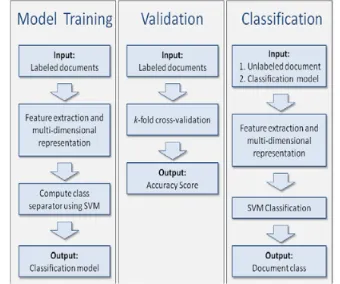
This type of classifier, proposed by Vladimir Vapnik and Alexey Chervonenkis, began to establish as the state-of-the-art method for text categorization in 1992. Figure 1 shows the framework for SVM on text categorization.
Figure 1. Classification Infrastructure of SVM on Text Categorization (Mertsalov and
McCreary, 2009)
Joachims (1998) concluded that SVM will work well for text categorization since (1) it uses overfitting protection which gives it the potential to handle large feature spaces, especially that learning text classifiers deal with more than 10000 features, (2) document vectors are sparse which means that only few entries in it have non-zero values.
2.3 Existing Classifiers in Other Languages
3.2 Document Representation and Feature Extraction
After the preprocessing method, a Bag-of-Words model, containing all words in the documents, was created. This is used as the basis for extracting features.
3.3 Feature Vectorization
Typically, the feature space consists of an m×n
matrix where m is equal to the number of documents and n is equal to the number of tokens in the Bag-of-Words.
In this study, three schemes in numerical representation were used, namely: Binary Representation, Word Counts, and the TF-IDF.
3.4 Classification of Documents
After vectorizing the documents into different numerical representations, they were then shuffled and divided into two: the training set and testing set. 80% of the dataset went to the training set while the remaining 20% went to the testing set. Sklearn’s train_test_split was used.
In this study, two classifiers were experimented, namely: Naïve Bayes and Support Vector Machines. Both were implemented using Python’s sklearn.
Support Vector Machines
In this study, a linear kernel and a one-vs-all strategy were used where a single classifier per class is trained, with the samples of that class as positive samples and all other samples as negatives The OneVsRestClassifier, together with the LinearSVC of sklearn were utilized.
Multinomial Naïve Bayes
For the second classifier in this study, a Multinomial Naive-Bayes, which estimates probabilities of a given document to belong to a specific category, was used. The MultinomialNB of sklearn was used in this study.
4.
Results and Discussions
classifiers were conducted. Out of the 2,121 news articles, 1,696 news articles (80%) went to the training set. The remaining 425 news articles (20%) went to the testing set.
4.1 Dataset
The dataset is comprised of Tagalog news articles retrieved from Philippine news websites from August 2016 to January 2017 using scrapy (https://scrapy.org/). The collected data comprised of 2,121 manually annotated news articles. Table 1 summarizes the distribution of data for each category.
4.2 Document Representation
In this study, three document representations were used for the experiments that were conducted — Binary Feature Representation, Word Count Representation, TF-IDF Representation. From the training set, 22,824 total terms/words were retrieved and stored in the Bag-of-Words.
Some words included in the Bag-of-Words are not part of the Tagalog vocabulary. These includes frequently occurring foreign words and proper nouns such as are city and duterte. Some proper nouns were also stemmed such as philippe which is originally philippine but -in- was removed because the stemmer thought it is an infix.
documents. The overall accuracy of this classifier is 92%. Table 2 summarizes the performance metrics of the classifier.
Based on Table 2, the classifier was able to yield relatively high F-Scores, except that of Terrorism which yielded an F-Score of only 78.78%. This was expected since the amount of news articles that belong to this category was relatively low compared to that of other categories. On another note, it can be seen in the table that the Entertainment category got a recall of 100%, Health and Sports categories both got a precision of 100%. Also, Economic and Political categories both got an F-score below 90%. This could stem from the nature of the two categories — both talk about the government or the status of the country, which makes it hard for the classifier to distinguish the difference between the two.
4.4 Validation and Evaluation
Based on the core experiment, the performance measure of the classifier is already acceptable. To ascertain the contribution of Tagalog language processing in the classification of Tagalog document, the following experiments were conducted:
Effect of Stemmer
To show the contribution of stemming to the whole process of building the classifier, an unstemmed dataset was fed to the SVM classifier.
As seen in Figure 2, the classifier with the stemmed data performed better than that with unstemmed data. Although the stemmer wasn’t perfect, the process of reducing words to their word stems has helped significantly in improving the performance of classifier.
A Multinomial Naïve Bayes (MultiNB) classifier was tested to see if stemming data still achieves high performance, like in the SVM classifier. Both datasets were fed to the MultiNB classifier. Using TF-IDF, the classifier with the stemmed data yielded an F-Score of 83.55% while the other yielded only 81.41%.
Effect of Document Representation
Table 3 summarizes the performance measures of the SVM classifier for the three different document representations where TF-IDF resulted to the highest F-Score of 91.99%.
For the sake of comparison, all three document representation were fed to the MultiNB classifier.
Table 4 shows the performance measures for the MultiNB classifier. It can be seen that, unlike in SVM, TF-IDF yielded the lowest F-Score of 83.55% while Word Count yielded 91.41%. The Multinomial Naive Bayes implements the Naive Bayes algorithm for multinomially distributed data, which means that it models the data based on probability counts. Since multinomial distribution normally requires integer feature counts, TF-IDF representation is likely to produce poor results.
Furthermore, TIDF with SVM yields a higher F-score compared to that of Word Count with Naïve Bayes, and it in fact outperformed all other combinations of document representation with the classifiers.
Cross-Validation
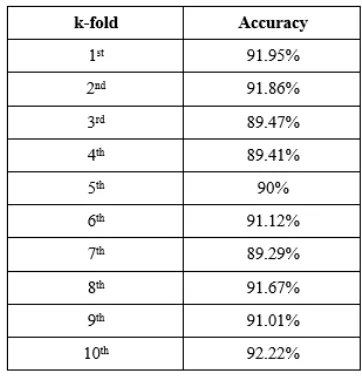
A 10-fold cross validation scheme was used to validate the performance of the multinomial SVM classifier. Training and testing were repeated 10 times on stratified folds for the whole dataset. Table 5 summarizes the result of the performance of all categories averaged at each fold.
The ten-fold cross validated classifier yielded an average accuracy of 90.8%. The test shows that although randomness was introduced to the experiment by means of the folds, the performance is generally the same.
5
Conclusion and Recommendations
5.1 ConclusionTagalog document categorization, like in other languages, is affected by many factors. Such includes the size of the corpus, the classifier type, the feature selection and feature reduction method, and the weighting scheme. In this study, stemming each document, representing it with TF-IDF values and using it to train an SVM classifier yielded the highest F-Score of 91.99% among all other combination of methods and experiment setups.