Highlights from STAR heavy ion program
Vitalii Okorokov1,⋆(on behalf of the STAR Collaboration)
1National Research Nuclear University MEPhI (Moscow Engineering Physics Institute), Kashirskoe avenue 31, 115409 Moscow, Russian Federation
Abstract. Recent experimental results obtained in STAR experiment at the Relativis-tic heavy-ion collider (RHIC) with ion beams will be discussed. Investigations of dif-ferent nuclear collisions in some recent years focus on two main tasks, namely, detail study of quark-gluon matter properties and exploration of the quantum chromodynamics (QCD) phase diagram. Results at top RHIC energy show clearly the collective behav-ior of heavy quarks in nucleus-nucleus interactions. Jet and heavy hadron measurements lead to new constraints for energy loss models for various flavors. Heavy-ion collisions are unique tool for the study of topological properties of theory as well as the magneto-hydrodynamics of strongly interacting matter. Experimental results obtained for discrete QCD symmetries at finite temperatures confirm indirectly the topologically non-trivial structure of QCD vacuum. Finite global vorticity observed in non-central Au+Au
col-lisions can be considered as important signature for presence of various chiral effects
in sQGP. Most results obtained during stage I of the RHIC beam energy scan (BES) program show smooth behavior vs initial energy. However certain results suggest the transition in the domain of dominance of hadronic degrees of freedom at center-of-mass energies between 10–20 GeV. The stage II of the BES at RHIC will occur in 2019–2020 and will explore with precision measurements in the domain of the QCD phase diagram with high baryon densities. Future developments and more precise studies of features of QCD phase diagram in the framework of stage II of RHIC BES will be briefly discussed.
1 Introduction
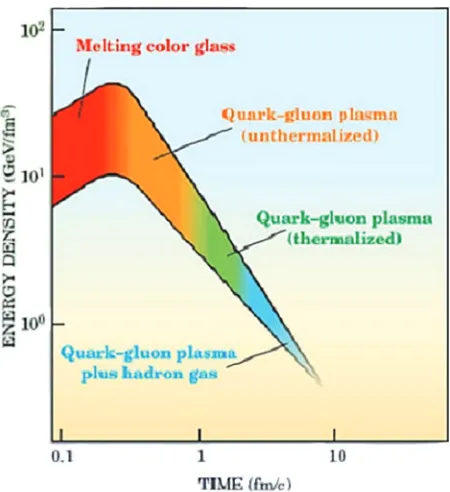
Numerous experimental results have suggested that nucleus-nucleus collisions produce hot matter consisting of deconfined quark and gluons. This new state of matter behaves like (quasi)ideal quark-gluon liquid and the matter is called strongly-coupled quark-quark-gluon plasma (sQGP). The sQGP is observed in wide energy domain, at least for√sNN 39 GeV, where √sNNis the collision energy per nucleon-nucleon pair. The study of the transition from hadronic matter to the quark-gluon state as well as properties of sQGP is one of the most important and debated problems of modern physics of strong interactions. The final state created in nucleus-nucleus collision evolves through several stages [1]. The intensive investigations within relativistic nuclear physics during last decades provided the some general framework for space-time evolution of nuclear collisions called also "Standard Model" for (heavy) ion collisions (Fig. 1). According to this conception nucleus-nucleus collisions at relativistic energies can be considered as the collision of two sheets of strongly interacting matter appeared
Figure 1.Cartoon for evolution of strongly interacting matter in nuclear collisions. Picture is taken from [1].
due to Lorentz contraction [2]. The initial state matter characterized by high energy density and high degree of coherence is the coherent limit of QCD at high energies. Thus this gluonic matter is called color glass condensate (CGC) [3]. At high energies, these sheets pass through one another, the fields become singular and CGC melts with production of the glasma [2, 4] which eventually materializes as quarks and gluons. It involves many strongly interacting and highly coherent color electric and color magnetic longitudinal flux lines at relatively low baryon densities. It is important to emphasize that because there are both longitudinal color electric and longitudinal color magnetic fields, there is a non-zero density of topological charge,E⃗·B⃗[5]. A non-zero average of such a quantity would signal the breaking of fundamental QCD symmetries (PandCP). The one of the possible mechanisms for violation of these symmetries are the dynamical topological sphaleron transitions which may result in observable metastableCP-violating domains. The glasma is a transient state of matter that connects the CGC to the QGP. As indicated above it has coherent fields, like the CGC, but it has properties similar to a plasma with strong background fields, and these fields evolve in time with the natural time scaleτs ∼1/Qswhich is also the proper formation time scale,τqfg, for quarks and gluons. HereQsis the saturation scale and at RHICQs ∼1 GeV/c[6],τs ∼0.2 fm/c[7]. Then through some as yet not completely understood mechanism, the glasma eventually thermalizes into a sQGP [6] with a "thermalization" time, estimated between 0.15 fm/cand 1 fm/cafter the nuclei cross. Thus the total duration of pre-equilibrium stage is estimated as∆τp−e ≃1 fm/cfor nucleus-nucleus collisions at RHIC energies, i.e. this is time for thermalized sQGP creation after the nuclei collision atτ0=0. Experimental results (see, for instance, [8]) confirm the short duration of the
pre-equilibrium stage with respect to the later thermodynamically pre-equilibrium stages which characterized by total duration∆τe ∼ 20 fm/c, where the high border of the last stage correspond to the kinetic freeze-out of the hadronic gasτf r ∼ 20 fm/c. Each of these principal periods,τ0 < τ ≤ τp−e and
τp−e< τ≤τf r, contains several sub-stages and detailed description is model-dependent for evolution
Figure 1.Cartoon for evolution of strongly interacting matter in nuclear collisions. Picture is taken from [1].
due to Lorentz contraction [2]. The initial state matter characterized by high energy density and high degree of coherence is the coherent limit of QCD at high energies. Thus this gluonic matter is called color glass condensate (CGC) [3]. At high energies, these sheets pass through one another, the fields become singular and CGC melts with production of the glasma [2, 4] which eventually materializes as quarks and gluons. It involves many strongly interacting and highly coherent color electric and color magnetic longitudinal flux lines at relatively low baryon densities. It is important to emphasize that because there are both longitudinal color electric and longitudinal color magnetic fields, there is a non-zero density of topological charge,E⃗·B⃗[5]. A non-zero average of such a quantity would signal the breaking of fundamental QCD symmetries (PandCP). The one of the possible mechanisms for violation of these symmetries are the dynamical topological sphaleron transitions which may result in observable metastableCP-violating domains. The glasma is a transient state of matter that connects the CGC to the QGP. As indicated above it has coherent fields, like the CGC, but it has properties similar to a plasma with strong background fields, and these fields evolve in time with the natural time scaleτs ∼1/Qs which is also the proper formation time scale,τqfg, for quarks and gluons. HereQsis the saturation scale and at RHICQs ∼1 GeV/c[6],τs ∼0.2 fm/c[7]. Then through some as yet not completely understood mechanism, the glasma eventually thermalizes into a sQGP [6] with a "thermalization" time, estimated between 0.15 fm/cand 1 fm/cafter the nuclei cross. Thus the total duration of pre-equilibrium stage is estimated as∆τp−e ≃1 fm/cfor nucleus-nucleus collisions at RHIC energies, i.e. this is time for thermalized sQGP creation after the nuclei collision atτ0=0. Experimental results (see, for instance, [8]) confirm the short duration of the
pre-equilibrium stage with respect to the later thermodynamically pre-equilibrium stages which characterized by total duration∆τe ∼ 20 fm/c, where the high border of the last stage correspond to the kinetic freeze-out of the hadronic gasτf r ∼20 fm/c. Each of these principal periods,τ0 < τ ≤ τp−eand
τp−e< τ≤τf r, contains several sub-stages and detailed description is model-dependent for evolution
of strongly interacting matter during each of these two principal periods.
Table 1.Data samples obtained by STAR during RHIC runs.
Species √sNN, GeV
p+pa 22.0b, 62.4, 200, 410b, 500, 510
p+Al 200
p+Au 200
d+Au 19.6, 39.0, 62.4, 200 He3+Au 200
Al+Au 4.9b,c,200 Cu+Cu 22.4b, 62.4, 200
Cu+Au 200
Au+Au 4.5b,c,7.7, 9.2b, 11.5, 14.5, 19.6, 27.0, 39.0, 54.4, 55.8b, 62.4, 130, 200
U+U 193
awith unpolarized (√s=62.4 GeV) and with longitudinal/transverse polarized beams; brun with small integral luminosity
crun for STAR fixed target mode
Jet and leading hadron measurements are believed to probe the early stages of the dense medium while soft hadronic observables deliver information on the initial state and hydrodynamic evolution of the system. But the cleanest and most sensitive probes to the pre-equilibrium phase of the nucleus-nucleus collision are photons and leptons, since they do not interact with the concurrently forming QGP medium after their production [9]. The key questions discussed here are (i) properties of sQGP and (ii) features of QCD phase diagram.
The scientific complex with RHIC was designed and was built for investigations in QCD field specially. There were 17 successful physical runs since 2000 year. At present the only large exper-iment STAR continues to collect new data. The STAR setup is characterized by uniform and large acceptance, good particle identification and stable operation of the main subsystems, for instance, the main tracker – time projection chamber (TPC) – since first physics run in 2000 year [10]. Table 1 shows the data samples collected by STAR experiment during 17 runs at RHIC.
2 Hard physics
Jet quenching is considered as one of the most promising signatures of formation of sQGP and sen-sitive probe for transport properties of final- state matter. Study of jet quenching with various type triggers is considered as important tool for detailed investigation of transport properties of sQGP. There are two main experimental techniques for jet studies: with help of azimuthal correlations and via full jet reconstruction. The presence of a “trigger” particle, havingpT greater than some selected value, serves as part of the selection criteria to analyze the event for a hard scattering. Within the first approach the trigger particle with highpTis selected in event, then pairs "trigger particle+associated particle" are formed and∆x=xt−xaare calculated, wherext(a)≡ηt(a), ϕt(a)is the kinematic
param-eter (ϕ– azimuthal angle,η– pseudorapidity) of trigger (associated) particle. As expect, correlations appear at∆ϕ ≈0 the peak corresponds to jet in which the both trigger and associated particles are fragmentation products of one parton and at∆ϕ ≈πthe peak corresponds to jet in which the trigger and associated particles are fragmentation products of different (back-to-back) partons. The following quantities are calculated for particle pairs:
C2(∆ϕ)=N1 trig
∫
d∆ηN(∆ϕ,∆η), Y = ∫
Figure 2.zT–dependence ofIAAforπ0and γdirtriggers (the points are slightly shifted for
visibility) in most central Au+Au collisions.
The vertical lines are statistical errors, vertical extent of the boxes – systematic uncertainties. The curves represent the model predictions. Figure is taken from [13].
whereC2(∆ϕ) is the two-particle azimuthal correlation function,Y– the per-trigger yield of particle
pairs. The development of experimental technique and data analysis results in the possibility for full reconstruction of hadron jets in nucleus-nucleus collisions. At present fully reconstructed jets are one of the main tools to constrain the medium transport parameters.
2.1 Neutral probes
It was pointed out that direct photons (γdir), real or virtual, are penetrating probes for the bulk matter produced in hadronic collisions, as they do not interact strongly and they have a large mean free path [11]. The recent STAR physics analyses are focused on azimuthal correlations with neutral triggers (γdirandπ0) produced in nucleus-nucleus collisions and on theγdiryield.
The azimuthal angular correlation of charged hadrons with respect to a direct-photon trigger was proposed as a promising probe to study the mechanisms of parton energy loss [12]. The ratioIAA(zT)= YAu+Au(z
T)/Yp+p(zT) in Au+Au at √sNN = 200 GeV has been studied with help ofπ0/γdir −h± azimuthal correlations, wherezT = paT/ptT and it is expected IAA = 1 in the absence of medium modification. Results are shown in Fig. 2. As seen IAA(zT) for both π0 andγdir triggers show indication on less suppression at lowzT ∈ (0.1; 0.2) than at highzT as well as similar levels of suppression for both trigger types [13]. There is no manifestation of the expected differences due to the color-factor effect and the difference in average path lengths betweenπ0andγdir triggers (path-length dependence).
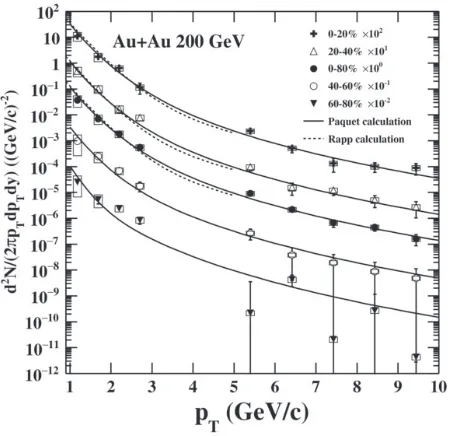
Also theγdir invariant yields are derived at midrapidity in the ranges 1 < pT < 3 GeV/cand 5 < pT < 10 GeV/cfor Au+Au collisions at √sNN = 200 GeV [14]. In Fig. 3 a clear excess in theγdirinvariant yield is observed in comparison with the nuclear overlap functionTAAscaled p+p reference in the firstpT. For pT >6 GeV/cthe production followsTAAscaling. Model calculations with contributions from thermal radiation and initial hard parton scattering are consistent within ex-perimental uncertainties with theγdir invariant yield in 0–20%, 20–40% and 40–60% centrality bins. In 60–80% collisions there is systematic excess data over model curve at 2<pT <3 GeV/c.
2.2 Hadronic jets
Figure 2.zT–dependence ofIAAforπ0and γdirtriggers (the points are slightly shifted for
visibility) in most central Au+Au collisions.
The vertical lines are statistical errors, vertical extent of the boxes – systematic uncertainties. The curves represent the model predictions. Figure is taken from [13].
whereC2(∆ϕ) is the two-particle azimuthal correlation function,Y – the per-trigger yield of particle
pairs. The development of experimental technique and data analysis results in the possibility for full reconstruction of hadron jets in nucleus-nucleus collisions. At present fully reconstructed jets are one of the main tools to constrain the medium transport parameters.
2.1 Neutral probes
It was pointed out that direct photons (γdir), real or virtual, are penetrating probes for the bulk matter produced in hadronic collisions, as they do not interact strongly and they have a large mean free path [11]. The recent STAR physics analyses are focused on azimuthal correlations with neutral triggers (γdir andπ0) produced in nucleus-nucleus collisions and on theγdiryield.
The azimuthal angular correlation of charged hadrons with respect to a direct-photon trigger was proposed as a promising probe to study the mechanisms of parton energy loss [12]. The ratioIAA(zT)= YAu+Au(zT)/Yp+p(z
T) in Au+Au at √sNN = 200 GeV has been studied with help ofπ0/γdir −h± azimuthal correlations, wherezT = paT/ptT and it is expected IAA = 1 in the absence of medium modification. Results are shown in Fig. 2. As seen IAA(zT) for both π0 andγdir triggers show indication on less suppression at lowzT ∈ (0.1; 0.2) than at high zT as well as similar levels of suppression for both trigger types [13]. There is no manifestation of the expected differences due to the color-factor effect and the difference in average path lengths betweenπ0 andγdir triggers (path-length dependence).
Also theγdir invariant yields are derived at midrapidity in the ranges 1 < pT < 3 GeV/cand 5 < pT < 10 GeV/cfor Au+Au collisions at √sNN = 200 GeV [14]. In Fig. 3 a clear excess in theγdirinvariant yield is observed in comparison with the nuclear overlap functionTAAscaled p+p reference in the firstpT. For pT >6 GeV/cthe production followsTAAscaling. Model calculations with contributions from thermal radiation and initial hard parton scattering are consistent within ex-perimental uncertainties with theγdir invariant yield in 0–20%, 20–40% and 40–60% centrality bins. In 60–80% collisions there is systematic excess data over model curve at 2<pT<3 GeV/c.
2.2 Hadronic jets
In STAR the anti-kT algorithm withR=0.2−0.5 (R2=(∆ϕ)2+(∆η)2) and a low IR-cutoff(pT >0.2 GeV/c) is used for full jet reconstruction from charged tracks in Au+Au collisions. STAR measures
Figure 3.The directγinvariant yield as a function ofpTin comparison with model
predictions. The statistical and systematic errors are shown by bars and boxes, respectively. Figure is taken from [14].
the semi-inclusive distributions of reconstructed charged particle jets recoiling from a highpTtrigger hadron [15]
1 Ntrig
d2N jet
dpch
T,jetdηjet
= 1
σA+A→h+X
d2σA+A→h+jet+X dpch
T,jetdηjet
, (2)
whereηjetis the pseudorapidity of jet centroid,pchT,jet– transverse momentum of jet,σA+A→h+Xis the
cross-section to generate a trigger hadron, andd2σA+A→h+jet+X/dpch
T,jetdηJ is the double differential
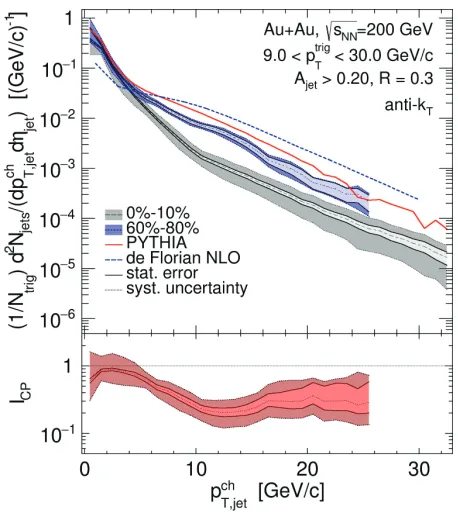
cross-section for coincidence production of a trigger hadron and a recoil jet, A+A≡p+p, Au+Au. The combinatorial background is removed by mixed-event technique. This allows the access for low-pT jets. The STAR has measured theICPratio of jet yields in central to peripheral Au+Au events at √sNN =200 GeV [15]. Results for jet cone radiusR=0.3 is shown in Fig. 4 for invariant yield (upper panel) and forICP(lower panel) depends onpchT,jet. TheICPshows a clear suppression of yields in central events forpch
T,jet >10 GeV/cfor all cone radiiR=0.2, 0.3, 0.4 and 0.5 under study. The
horizontal shifts in the range where theICPis flat (10<pchT,jet<20 GeV/c) are−6.3±0.6±0.8 GeV/c and−3.8±0.5±1.8 GeV/cforR=0.3 andR=0.5, respectively. The suppression and shift, and their reduction for larger cones might indicate an out-of-cone energy transport by interaction of the jet with the medium, averaged over the recoil jet population.
The first dijet imbalance measurement at RHIC was made by STAR for central Au+Au collisions at √sNN =200 GeV [16], thus allowing a more direct comparison to jet quenching measurements at the Large Hadron Collider (LHC). The imbalance observable is defined as
AJ= pT,lead−pT,sublead
pT,lead+pT,sublead (3)
wherepT,leadandpT,subleadare the transverse momenta of the leading and subleading jet, respectively,
Figure 4.Fully corrected distributions of
Y(pch
T,jet) (upper) and its ratioICP(lower) for
central and peripheral Au+Au collisions, for
anti-kTjets withR=0.3 and areaajet>0.2.
The upper panels also show yield forp+p
collisions, calculated using PYTHIA at the charged-particle level and NLO pQCD transformed to the charged-particle level. The uncertainty of the NLO calculation is not shown. Figure is taken from [15].
Figure 5.NormalizedAJdistributions for
Au+Au HT data (filled symbols) andp+p
HT⊕Au+Au MB (open symbols). The
circles are for jets found using only constituents withpCutT >2 GeV/cand the
squares for matched jets found using constituents withpCut
T >0.2 GeV/c. In all
casesR=0.4. Statistical errors may be smaller than symbol size forp+pHT⊕
Au+Au MB. Figure is taken from [16].
Figure 4.Fully corrected distributions of
Y(pch
T,jet) (upper) and its ratioICP(lower) for
central and peripheral Au+Au collisions, for
anti-kTjets withR=0.3 and areaajet>0.2.
The upper panels also show yield forp+p
collisions, calculated using PYTHIA at the charged-particle level and NLO pQCD transformed to the charged-particle level. The uncertainty of the NLO calculation is not shown. Figure is taken from [15].
Figure 5.NormalizedAJdistributions for
Au+Au HT data (filled symbols) andp+p
HT⊕Au+Au MB (open symbols). The
circles are for jets found using only constituents withpCutT >2 GeV/cand the
squares for matched jets found using constituents withpCut
T >0.2 GeV/c. In all
casesR=0.4. Statistical errors may be smaller than symbol size forp+pHT⊕
Au+Au MB. Figure is taken from [16].
calorimeter (BEMC) tower. It was shown that Au+Au HT leading jets are similar top+pHT leading jets embedded in an Au+Au minimum bias (MB) background [24]. In Fig. 5 theAJdistribution from central Au+Au collisions for anti-kT jets withR = 0.4 (solid points) is compared to the p+p HT embedding reference (p+pHT⊕Au+Au MB, open symbols) for a jet constituents withpCutT >2 GeV/c. Dijets in central Au+Au collisions are significantly more imbalanced than the corresponding p+pdijets. The calculation in accordance with a Kolmogorov–Smirnov test on the unbinned data [25] supports the hypothesis that theAu+Auandp+pHT⊕Au+Au MB data are not drawn from the same parentAJdistributions.
3 Soft physics
In relativistic nuclear physics the event shape is usually studied with help of the Fourier expansion of particle distribution [17]. Then with taking into account possible influence of QCD fundamental symmetries violation at finite temperature the invariant distribution of final state particles with certain type can be written as following
Ed3N d⃗p =
1 2π
d2N
pTdpTdy {
1+2 ∞ ∑
n=1 2
∑
j=1
knjFj[n(ϕ−ΨRP)]}, {F}2j=1(x)≡
(sin
cos )
(x). (4)
Hereϕis an azimuthal angle of particle under study,ΨRP– azimuthal angle of reaction plane,k1n ≡ vn =⟨cos[n(ϕ−ΨRP)]⟩– collective flow of n-th order, the parametersk2n ≡an =⟨sin[n(ϕ−ΨRP)]⟩
describe the possible effect ofP/CPviolation in strong interactions.
3.1 Collective flows and QCD phase diagram
Up to the present time, the main efforts are focused on the study of the low-ordervn coefficients due to their sensitivity to the key features of the final-state matter.
Thev2(ϕ)/v2(p) ratios are larger than unity at pT ∼ 0.5 GeV/cfor most central 0–30% bin of the Au+Au collisions at √sNN = 200 GeV showing an indication of breakdown of the expected mass ordering in that momentum range. This could be due to a large effect of hadronic rescattering on the protonv2. The hypothesis has been verified by comparison with model results. The AMPT
calculations show the increase ofv2(ϕ)/v2(p) with growth hadronic cascade time. This is attributed
to a decrease in thev2(p) due to an increase in hadronic rescattering, while theϕ-mesonv2 remains
unaffected. On the other hand the ratio under discussion from UrQMD is much smaller than unity because UrQMD model lacks partonic collectivity and therefore does not fully develop theϕ-meson v2[18].
Similar to hadrons over the measured pT range (0.5 pT <4 GeV/c), light (anti)nucleiv2(pT)
show a monotonic rise with increasingpT, mass ordering at low pT, and a reduction for more cen-tral collisions. It is observed thatv2 of nuclei and antinuclei are of similar magnitude for Au+Au
collisions in domain √sNN ≥39 GeV. In general the light-nucleiv2follow an atomic mass number
scaling indicates that the coalescence of nucleons might be the underlying mechanism of light-nuclei formation in HIC. This fact is corroborated by model calculations [19].
For sufficiently central Au+Au collisions (Npart > 50), the triangle flowv3 persist down to the
lowest energies studied. For more peripheral collisions, however, the correlation appears to be absent at low energies forNpart < 50, in agreement with AMPT model. This non-QGP model predicts a
smallerv3 value than the data, suggesting that a QGP phase may exist in more central collisions at
√s
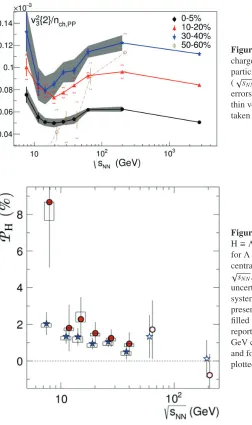
NN = 7.7 GeV. When divided by multiplicity, v3 shows a local minimum in the range √sNN = 15−20 GeV in centrality range from 0% to 50% (Fig. 6). This feature has not been shown in any known models of HIC and could indicate an interesting trend in the pressure developed inside the system [20].
A finite difference inv1between positive and negative charged particles (∆v1) was observed in the
kinematic domain of 0.15<pT <2 GeV/cand|η|<1. The∆v1 seems to increase withpT. Thev1
results from Au+Au collisions show much smaller values compared to those in Cu+Au. These results are consistent with the presumption of a strong, initial electric field in asymmetric collisions. ThepT dependence of∆v1is qualitatively described by the parton–hadron–string–dynamics (PHSD) model at
pT <2 GeV/c. However, the magnitude of∆v1is smaller by a factor of 10 than the model predictions
Figure 6.v23{2}divided by the midrapidity, charged-particle multiplicity density per participant pair in Au+Au and Pb+Pb
(√sNN=2.76 TeV) collisions. Systematic
errors are shown either as a shaded band or as thin vertical error bars with caps. Figure is taken from [20].
Figure 7.The average polarization for H≡Λ( ¯Λ) in Au+Au collisions. The results
forΛ(stars) and ¯Λ(circles) from 20-–50%
central collisions are plotted as a function of
√s
NN. Error bars represent statistical
uncertainties only, while boxes represent systematic uncertainties. The results of the present study (√sNN<40 GeV), indicated by
filled symbols, are shown together with those reported earlier [23] for 62.4 GeV and 200 GeV collisions, indicated by open symbols and for which only statistical errors are plotted. Figure is taken from [22].
3.2 Hyperon polarization and rotating sQGP
Non-central nuclear collisions have angular momentum on the order of 103, and shear forces
Figure 6.v23{2}divided by the midrapidity, charged-particle multiplicity density per participant pair in Au+Au and Pb+Pb
(√sNN=2.76 TeV) collisions. Systematic
errors are shown either as a shaded band or as thin vertical error bars with caps. Figure is taken from [20].
Figure 7.The average polarization for H≡Λ( ¯Λ) in Au+Au collisions. The results
forΛ(stars) and ¯Λ(circles) from 20-–50%
central collisions are plotted as a function of
√s
NN. Error bars represent statistical
uncertainties only, while boxes represent systematic uncertainties. The results of the present study (√sNN<40 GeV), indicated by
filled symbols, are shown together with those reported earlier [23] for 62.4 GeV and 200 GeV collisions, indicated by open symbols and for which only statistical errors are plotted. Figure is taken from [22].
3.2 Hyperon polarization and rotating sQGP
Non-central nuclear collisions have angular momentum on the order of 103, and shear forces
gener-ated by the interpenetrating nuclei may generate a clear vortical structure. TheΛand ¯Λare used to measure the global hyperon polarization in non-central Au+Au collisions because they are “self ana-lyzing”, i.e., for instance, in the decayΛ→ p+π−theptends to be emitted along the spin direction of the parentΛ. At present due to the limited statistics collected by STAR, only the average projection of polarization on overall angular momentum was extracted. In Fig. 7 the average polarization forΛ( ¯Λ) hyperons is shown as a function of √sNN for semi-central Au+Au collisions [22]. At √sNN <200 GeV, a positive polarization is observed forΛ( ¯Λ) hyperons. The data are statistically consistent with the hypothesis of energy-independent polarizations of 1.08±0.15 (stat)±0.11 (sys) and 1.38±0.30
(stat)±0.13 (sys) per cent forΛand ¯Λ, respectively [22]. The√sNN-averaged polarizations indicate a vorticity magnitude ofω=(9±1)×1021s−1, which is estimated using the hydrodynamic relations and takes into account the “feed-down” contributions. This extremely large estimation ofωevidences the sQGP is characterized by complex and developed vortical structure.
4 Heavy quarks in hot environment
Heavy quark masses are mostly uncharged by chiral symmetry restoration. Heavy flavor (HF) par-ticles are produced early in collisions due to hard scattering processes. Therefore they allow the study of whole space-time evolution of sQGP. Study of heavy quark diffusion is essential for better understanding of transport properties of sQGP and underlying fluid of light partons. Precise measure-ments ofc- andb-quarks energy loss are crucial for understanding of parton interactions with the hot environment.
4.1 Bottomonia in sQGP
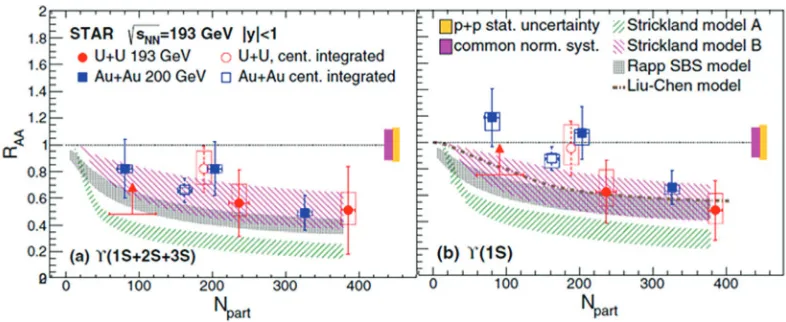
The novel results have been obtained by STAR for production ofΥstates in heavy ion collisions. The nuclear modification factorRAAdepends on number of participantsNpartis shown in Fig. 8 for various Υstates, where
RAA=T1 AA
d2NA+A/dpTdη
d2σp+p/dp
Tdη. (5)
The trend marked by the pointsRAA(Npart) for Au+Au is confirmed by the U+U data. There is strong suppression of theΥ(2S+3S) states in U+U as well as in Au+Au collisions at highest available RHIC energies. There is neither a significant difference between the results in any of the centrality bins, nor any evidence of a sudden increase in suppression in central U+U compared to the central Au+Au data. But one can note the precision of the current measurement does not exclude a moderate drop inRAA. These STAR data have been compared with several models for upsilon behavior in hot environment (Fig. 9). As seen the Rapp model included CNM effects, dissociation of bottomonia in the hot (T =330 MeV) medium and regeneration for strongly bound scenario (SBS) for the internal-energy-based heavy quark potential describe the STAR data within uncertainties as well as other internal-energy-based models with an initial central temperature 428 < T < 442 MeV (noted as “model B” in Fig. 3) andT =340 MeV (“Liu-Chen model”). The “model A” with the free-energy-based potential corresponding to a more weakly bound scenario (WBS) tends to underpredict theRAA especially for theΥ(1S).
4.2 Collectivity for heavy flavor hadrons
The heavy flavor tracker (HFT) is the newest member of the STAR detector subsystems. It is made using thinned monolithic active pixel sensor technology. STAR HFT includes pixel detector (PXL), intermediate silicon tracker (IST) and silicon strip detector (SSD). The HFT is characterized by low material budget and large acceptance coverage (|η|<1, 0< ϕ <2π). The HFT makes it possible for the first time to directly track the decay products of hadrons comprised of charm and bottom quarks with high pointing resolution (∼30µm for particles withp≥1.5 GeV/c).
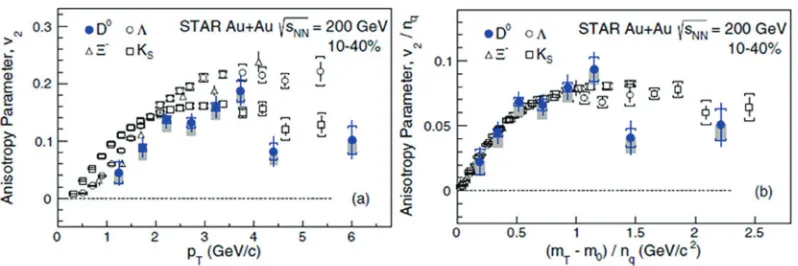
The clear mass ordering is obtained for elliptic flow in domainpT <2 GeV/cfor various hadrons includingD0mesons (Fig. 10). For largerp
T >2 GeV/c, theD0mesonv2follows that of other light
mesons indicating a significantc-quark flow at highest RHIC energy. The elliptic flow forD0 falls
Figure 8.Υ(1S+2S+3S) (a) andΥ(1S) (b) nuclear modifi- cation factorRAAas a function ofNpartin relativistic
heavy ion collisions. The data points in the 30—60% centrality bin have large statistical and systematical uncer-tainties, providing little constraint onRAA. Therefore the 95% lower confidence bound is only indicated for the
30—60% centrality U+U data. Data are from [26].
Figure 9.Υ(1S+2S+3S) (a) andΥ(1S) (b)RAAdepends onNpartin √sNN=193 GeV U+U collisions, compared
to different models. The 95% lower confidence bound is indicated for the 30-–60% centrality U+U data. Data
and model results are taken from [26].
GeV/c2. This suggests thatc-quarks have gained significant flow through interactions with the sQGP in the collisions under consideration. The comparison between STAR results and phenomenological calculations is shown in Fig. 11. The TAMU model describes the data only with noc-quark diffusion. A 3D viscous hydrodynamic simulation withη/s=0.12 tuned to describev2for light hadrons predicts
elliptic flow values forD0that is consistent with data forp
Figure 8.Υ(1S+2S+3S) (a) andΥ(1S) (b) nuclear modifi- cation factorRAAas a function ofNpartin relativistic
heavy ion collisions. The data points in the 30—60% centrality bin have large statistical and systematical uncer-tainties, providing little constraint onRAA. Therefore the 95% lower confidence bound is only indicated for the
30—60% centrality U+U data. Data are from [26].
Figure 9.Υ(1S+2S+3S) (a) andΥ(1S) (b)RAAdepends onNpartin √sNN=193 GeV U+U collisions, compared
to different models. The 95% lower confidence bound is indicated for the 30-–60% centrality U+U data. Data
and model results are taken from [26].
GeV/c2. This suggests thatc-quarks have gained significant flow through interactions with the sQGP in the collisions under consideration. The comparison between STAR results and phenomenological calculations is shown in Fig. 11. The TAMU model describes the data only with noc-quark diffusion. A 3D viscous hydrodynamic simulation withη/s=0.12 tuned to describev2for light hadrons predicts
elliptic flow values forD0that is consistent with data forp
T <4 GeV/c. This suggests thatc-quarks have achieved thermal equilibrium in these collisions. The statistical significance test was performed for the consistency between data and each model quantified byχ2/ndf. The 3D viscous hydro models shows the bestχ2/ndf=0.73 for the measuredpTregion. The models that can describe both theRAA
Figure 10.(a)v2as a function ofpTand (b)v2/nqdependence on (mT−m0)/nqforD0compared with earlier
mea-surements for strange particles. The vertical bars and brackets represent statistical and systematic uncertainties, respectively, and the gray bands represent the estimated nonflow contribution. Data are from [27].
Figure 11.v2as a function ofpTforD0in
minimum bias Au+Au collisions compared
with model calculations. Figure is taken from [27].
andv2data include the temperature-dependent charm diffusion coefficientκ=2πT Dsin the range of ∼2−12. Theκpredicted by lattice QCD calculations fall in the same range [27].
5 Future plans
The STAR Collaboration works intensively under development the physics program and detector up-grades for nearest RHIC runs (2018–2020) as well as for future studies of strong interactions after 2020 year. Especially, STAR’s highest scientific priority for run 18 is the successful realization of the isobaric collision program (Rb+Rb, Zr+Zr at √sNN=200 GeV) for clarification the interpretation of measurements related to chiral effects, in particular chiral magnetic effect (CME).
5.1 Nearest upgrades for stage II of the BES program at RHIC
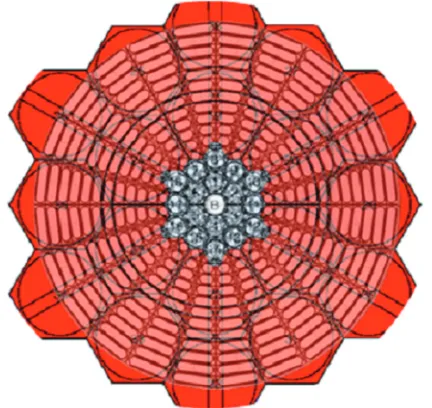
Figure 12.Schematic view of EPD with respect to the existing beam-beam counter (BBC) subsystem (central part). There will be 372 channels for EPD instead of 16 present channels for BBC.
4.5 GeV) for heavy (Au+Au) ion collisions. Upgrade for STAR promises several improvements for physics analyses like significant decrease of statistical and systematics uncertainties, advanced particle identification (PID) capability, broader kinematic coverage etc. The three detector subsystems will be made for stage II of BES at RHIC: upgrade of inner sectors of TPC (iTPC), event plane detector (EPD) and endcap for time-of-light (eTOF).
Replace all inner sector of TPC will improve the continues coverage (40 pad rows instead of 13 at present) and the dE/dx on 15–30%. Also coverage on|η|will be extended from 1.0 to 1.5. As planed, iTPC will be characterized by better momentum resolution and lowerspTcut from 125 MeV/c to 60 MeV/c. Beam-beam counter (BBC) will be replaced by new EPD with significantly higher azimuthal and radial segmentation (Fig. 12). The EPD is crucially important for study ofΛ( ¯Λ) polarization in nuclear collisions as well as for BES physics due to independent event plane measurement. As expected, the EPD will provides better trigger and background reduction, extends|η|coverage from 3.3<|η|<5.0 for present BBC to 2.1<|η|<5.1. The EPD will allows the measurement the centrality and event plane at forward rapidity and improvement for event plane resolution. During the Run 17 the first 1/8 part of EPD was installed and tested successfully. The eTOF is the joint project between STAR and CBM. This detector is important for fixed target program and complements the existing barrel TOF. The major improvements for eTOF installation are following: midrapidity particle identification in fixed target mode, extension of identification capabilities forπ,pandK, additional for barrel TOF (|η|<0.9) coverage:−1.5< η <−1.1.
5.2 Towards cold QCD: STAR after 2020
Figure 12.Schematic view of EPD with respect to the existing beam-beam counter (BBC) subsystem (central part). There will be 372 channels for EPD instead of 16 present channels for BBC.
4.5 GeV) for heavy (Au+Au) ion collisions. Upgrade for STAR promises several improvements for physics analyses like significant decrease of statistical and systematics uncertainties, advanced particle identification (PID) capability, broader kinematic coverage etc. The three detector subsystems will be made for stage II of BES at RHIC: upgrade of inner sectors of TPC (iTPC), event plane detector (EPD) and endcap for time-of-light (eTOF).
Replace all inner sector of TPC will improve the continues coverage (40 pad rows instead of 13 at present) and the dE/dx on 15–30%. Also coverage on|η|will be extended from 1.0 to 1.5. As planed, iTPC will be characterized by better momentum resolution and lowerspT cut from 125 MeV/c to 60 MeV/c. Beam-beam counter (BBC) will be replaced by new EPD with significantly higher azimuthal and radial segmentation (Fig. 12). The EPD is crucially important for study ofΛ( ¯Λ) polarization in nuclear collisions as well as for BES physics due to independent event plane measurement. As expected, the EPD will provides better trigger and background reduction, extends|η|coverage from 3.3<|η|<5.0 for present BBC to 2.1<|η|<5.1. The EPD will allows the measurement the centrality and event plane at forward rapidity and improvement for event plane resolution. During the Run 17 the first 1/8 part of EPD was installed and tested successfully. The eTOF is the joint project between STAR and CBM. This detector is important for fixed target program and complements the existing barrel TOF. The major improvements for eTOF installation are following: midrapidity particle identification in fixed target mode, extension of identification capabilities forπ,pandK, additional for barrel TOF (|η|<0.9) coverage:−1.5< η <−1.1.
5.2 Towards cold QCD: STAR after 2020
The sQGP created in the final state of high energy nucleus-nucleus collision can be considered as the incoherent thermal limit of QCD matter at high temperatures while the CGC in the initial state is the coherent limit of QCD at high energies. Since the sQGP has to be created at modern colliders from the interaction of initial nuclear enhanced coherent chromo electric magnetic fields through glasma, both limiting forms of QCD matter as well as transient glasma state should be studied in detail. The forward heavy ion collisions provide the unique opportunity to study the various saturation regimes. The RHIC cold QCD plan requires an upgrade to the forward rapidity (2.5 < η < 4.5) detection
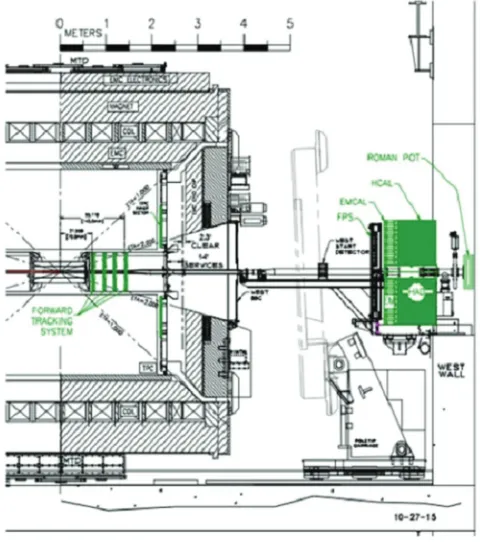
Figure 13.Scheme for location of the forward calorimeter system (FCS) at the west side of the STAR detector. Figure is taken from [28].
capabilities of STAR. According to the [28] it is suggested the development of the STAR calorimeter and tracking subsystems for forward region (Fig. 13). This upgrade allows the exploration of cold QCD physics in very high and low regions of BjorkenxBas well as the longitudinal structure of the initial state and the temperature dependent transport properties of matter in nuclear collisions with help of measurements of azimuthal asymmetries, dihadron andh/γ-jet correlations, asymmetries in production of hadrons and jets,RpAforγdirand Drell–Yan process.
6 Summary
the qualitative statements to the quantitative understanding in relativistic nuclear physics.
There are detailed plans for both the nearest runs (18 and 19) at RHIC and the future investigations after 2020 year. For the first case detector upgrades are in progress for precise study of sQGP within stage II of the BES. The future modification of the STAR setup after 2020 aims on the study of effects of QCD cold matter, longitudinal structure of initial conditions.
References
[1] T. Ludlam and L. McLerran, Phys. Today56, 48 (2003).
[2] A. Kovner, L.D. McLerran, H. Weigert, Phys. Rev. D52, 6231 (1995); 3809 (1995); A. Krasnitz, R. Venugopalan, Phys. Rev. Lett84, 4309 (2000); A. Krasnitz, R. Venugopalan, Nucl. Phys. B557, 237 (1999); A. Krasnitz, Y. Nara, R. Venugopalan, Phys. Rev. Lett.87, 192302 (2001).
[3] E. Iancu, R. Venugopalan, arXiv: hep-ph/0303204 (2003).
[4] A. Krasnitz, R. Venugopalan, Phys. Rev. Lett.86, 1717 (2001); T. Lappi, Phys. Rev. C67, 054903 (2003); T. Lappi, L. McLerran, Nucl. Phys. A772, 200 (2006).
[5] L. McLerran, arXiv: 0911.2987 [hep-ph] (2009).
[6] R. Baier et al., Phys. Lett. B502, 51 (2001);ibid539, 46 (2002). [7] M. Gyulassy, L. McLerran, Nucl. Phys. A750, 30 (2005).
[8] I. Arsene et al. (BRAHMS Collaboration), Nucl. Phys. A757, 1 (2005); K. Adcox et al. (PHENIX Collaboration), 184; B.B. Back et al. (PHOBOS Collaboration), 28; J. Adams et al. (STAR Collab-oration), 102.
[9] M. Martinez, M. Strickland, Phys. Rev. C78, 034917 (2008); Eur. Phys. J. C61, 905 (2009). [10] K. H. Ackermann et al. (STAR Collaboration), Nucl. Inst. & Meth. A499, 624 (2003). [11] E. L. Feinberg, Nuovo Cim. A34, 391 (1976).
[12] X.-N. Wang, Z. Huang, and I. Sarcevic, Phys. Rev. Lett.77, 231 (1996). [13] L. Adamczyk et al. (STAR Collaboration), Phys. Lett. B760, 689 (2016). [14] L. Adamczyk et al. (STAR Collaboration), Phys. Lett. B770, 451 (2017). [15] L. Adamczyk et al. (STAR Collaboration), Phys. Rev. C96, 024905 (2017). [16] L. Adamczyk et al. (STAR Collaboration), Phys. Rev. Lett.119, 062301 (2017). [17] S. A. Voloshin and Y. Zhang, Z. Phys. C70, 665 (1996).
[18] L. Adamczyk et al. (STAR Collaboration), Phys. Rev. Lett.116, 062301 (2016). [19] L. Adamczyk et al. (STAR Collaboration), Phys. Rev. C94, 034908 (2016). [20] L. Adamczyk et al. (STAR Collaboration), Phys. Rev. Lett.116, 112302 (2016). [21] L. Adamczyk et al. (STAR Collaboration), Phys. Rev. Lett.118, 012301 (2017). [22] L. Adamczyk et al. (STAR Collaboration), Nature548, 62 (2017).
[23] B. I. Abelev et al. (STAR Collaboration), Phys. Rev. C76, 024915 (2007). [24] V. Khachatryan et al. (CMS Collaboration), J. High Energy Phys.02, 156 (2016).
[25] I. M. Chakravarti, R. G. Laha, and J. Roy,Handbook of Methods of Applied Statistics(John Wiley & Sons, New York, 1967), V.1, pp. 392–394.
[26] L. Adamczyk et al. (STAR Collaboration), Phys. Rev. C94, 064904 (2016). [27] L. Adamczyk et al. (STAR Collaboration), Phys. Rev. Lett.118, 212301 (2017).
![Figure 2. z T–dependence of IAA for π0 andγdir triggers (the points are slightly shifted forvisibility) in most central Au+Au collisions.The vertical lines are statistical errors, verticalextent of the boxes – systematic uncertainties.The curves represent the model predictions.Figure is taken from [13].](https://thumb-us.123doks.com/thumbv2/123dok_us/8127422.1354340/4.482.41.277.79.249/dependence-forvisibility-collisions-statistical-verticalextent-systematic-uncertainties-predictions.webp)