1
Title: Pastoral resilience among the Maasai pastoralists of Laikipia County, Kenya
1st Author:
Edwin Ambani Ameso
University of Nairobi
Institute of Anthropology, Gender and African Studies
P.O. BOX 30197-00100,
Nairobi.
Email: [email protected]
2nd Author:
Dr. Salome Atieno Bukachi
Senior Research Fellow/Lecturer
University of Nairobi
Institute of Anthropology, Gender and African Studies
P.O. BOX 30197-00100,
Nairobi.
Email: [email protected]
3rd Author:
Prof. Dr. Charles Owuor Olungah
Senior Research Fellow/Lecturer
University of Nairobi
Institute of Anthropology, Gender and African Studies
2
P.O. BOX 30197-00100,
Nairobi.
Email: [email protected]/ [email protected]
4th Author:
Prof. Dr. Tobias Haller
Universitat Bern
Institute of Social Anthropology
Lerchenweg 36
3000 Bern 9, Switzerland
Email: [email protected]
5th Author:
Prof. Simiyu Wandibba
Senior Research Fellow/Lecturer
University of Nairobi
Institute of Anthropology, Gender and African Studies
P.O. BOX 30197-00100,
Nairobi.
3
6th Author:
Dr. Steve Nangendo
Senior Research Fellow/ Lecturer
University of Nairobi
Institute of Anthropology, Gender and African Studies
P.O. BOX 30197-00100,
Nairobi.
Email: [email protected]
Competing Interest.
Not applicable.
Funding
Not Applicable.
Authors’ contributions.
I, Edwin Ambani Ameso, a masters’ student from the University of Nairobi, identified the research site, recruited the informants, collected and analyzed data.
Dr. Salome Bukachi was my first supervisor from the initial conceptualization of the study topic to data collection and editing and reviewing of the manuscript.
Prof. Dr. Charles Owuor Olungah was my second supervisor from the proposal writing stage to data collection and editing and reviewing of the manuscript. Moreover, as the director of the Institute of Anthropology, Gender and African studies, he also provided administrative support.
4
Edwin Ambani Ameso is a masters’ student from the Institute of Anthropology, Gender and African studies, University of Nairobi.
Salome Bukachi and Charles Owuor Olungah are senior research fellows in Anthropology. They work as senior lecturers at the University of Nairobi at the Institute of Anthropology, Gender and African Studies. They supervise many students at both masters and PhD levels.
Tobias Haller is a professor of Anthropology at the Universitat Bern in Switzerland. He also read, edited and reviewed the manuscript.
Simiyu Wandibba is a professor of Anthropology at the University of Nairobi. He also works as a senior research fellow and lecturer at the University of Nairobi at the Institute of Anthropology, Gender and African studies. He has supervised numerous students at both masters and PHD levels.
Steve Nangendo is a senior Research fellow and Lecturer at the University of Nairobi at the Institute of Anthropology, Gender and African Studies. He has also supervised many students at both masters and PHD levels.
Acknowledgements.
5
Title: Pastoral resilience among the Maasai pastoralists of Laikipia County, Kenya Abstract.
This paper addresses pastoral resilience by drawing out the coping strategies and mechanisms utilized by the Maasai Pastoralists through a food system approach, based on the study findings of an anthropological study of pastoralism in Laikipia County, Rift Valley, Kenya. This paper is guided by the specific objectives aimed at establishing actors and their roles, and describing the institutional settings and changes in pastoralism. Using a new institutionalism approach, the paper focuses not only on the actors and their roles in pastoralism but also on how internal and external forces regulate access and use of common pool resources (CPRs) resulting in sustainability of the food system. We argue that this has an impact on the practice of pastoralism that continually defines and redefine the actors’ roles as well as elicit the value of pastoral economies and benefits accrued to a wide range of actors hence reinforcing pastoral resilience. The study also identified institutional settings and changes that lead to pastoral survival resulting from the country’s devolved system of governance. Data collection was through in-depth interviews, key informant interviews, focus group discussions and unstructured observations in the pastoral regions. The findings reveal that actors at the household, state, non-state, and service providers have developed varied coping strategies and mechanisms that sustain pastoralism. The study also identified institutional settings and changes that promote pastoral resilience; notably, private land ownership patterns, co-management of livestock markets, commercialization of herding, decentralization of livestock services, holistic management of pasturelands and the use of water-shed management plans. As a result, increased scholarship and advocacy in regards to the concept of co-management of livestock markets, is recommended as a means of understanding pastoral resilience that the food system exhibits.
Keywords: Pastoral resilience, co-management concept, decentralization, holistic management, water-shed management plan, commercialization of herding, Common Pool Resources.
Introduction.
6
especially water and pasturelands (Reid et al. 2014; Dong et al. 2011). Pastoral cultures relies heavily on livestock rearing which play a very important role in terms of livelihoods, social capital, and as an insurance against disaster (World Initiative for Sustainable Pastoralism, WISP, 2007:2). Previously, pastoralism was understood as a stepping-stone in socio-economic evolution between hunter-gatherers and a sedentary agricultural lifestyle. However, it has proved a highly innovative production system and a livelihood that has evolved to adapt to climatic and environmental conditions that limit agricultural expansion and other impacts and stressors (Norwegian Refugee Council, NRC, 2014:10). Currently, pastoralism continues to survive and remain productive within the rangelands in the midst of environmental stresses such as droughts and floods through various actor roles, institutions and knowledge systems that showcase pastoral resilience (Hesse, 2009). Mobility among the pastoralists allows for extensive utilization of rangelands as common pool resources through the full use of culture and its attributes (Kaye-Zwiebel and King, 2014).
In Africa, pastoralism takes up 66 per cent of the continent’s lands for pastoral production as it is considered to be the most efficient use of rangelands such as the Arid and Semiarid lands (ASALs) of Kenya (NRC, 2014; Idris, 2011). According to Little and McPeak (2014) pastoral resilience as a concept draws special concerns and relevance to pastoralism on two issues; climate change with a particular concern for how to build resilient communities in the face of increasingly extreme weather events and humanitarian crises, especially those that can be traced to the most recent drought-and conflict-induced disasters experienced in the Horn of Africa. The WISP (2007:2) acknowledges that the rangelands in the Horn of Africa support a pastoral economy that is based mainly on the production of milk, meat, blood, hides and skins as well as provision of services such as traction and transportation. In Kenya, the pastoral groups such as the Maasai pastoralists inhabit Arid and Semiarid Lands like Laikipia County which are geographically located in the north, East and South of the country and in total account for 36 per cent of the total population which is around 14 million people (GOK, 2014). The pastoralists continuously face environmental stresses as they constantly navigate the hot and dry climate of the ASALs in search of pasturelands and water sources (Pavanello, 2009).
7
that over 60 per cent of all livestock in Kenya is found in the ASALs and pastoralism employs 90 per cent of the local populations in the ASALs and accounting for nearly 10 per cent of the Gross Domestic Product (GDP) nationally (GOK, 2008). Farmer and Mbwika (2012) also acknowledge that the market for meat consumption is not only structured in regards to income with a majority coming from the middle class but also pastoral meat and other livestock products find their way into markets of the two large cities in Kenya due to the high demand of the livestock and its products. Moreover, Kenyan meat supplies from pastoralists have been able to reach the Tanzanian market within the East African region and, internationally, the United Arabs Emirates (UAE) and current trends show that new markets are coming up in Qatar, Oman, Kuwait, Somalia and Egypt.
Study Site.
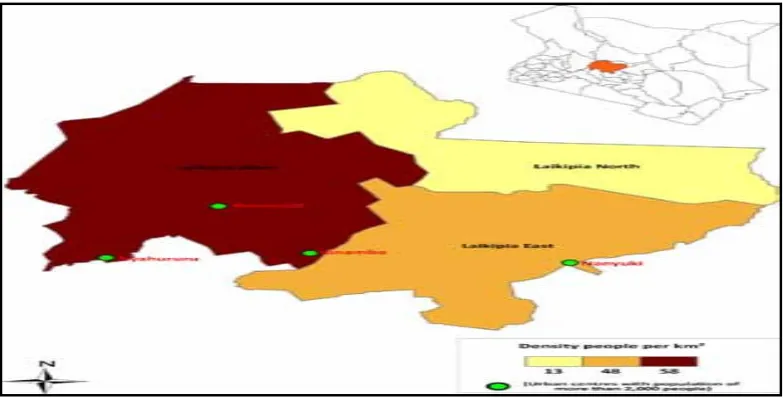
This study was conducted in Laikipia County, Rift Valley, Kenya. The county is located in the central part of Kenya and it is roughly demarcated by Mount Kenya to the East and South-east, the Aberdares Range to the south and south-west, eastern rift valley to the west, Karisia Hills to the northwest, Mathews Range to the north, and Buffalo Springs National Reserve and Samburu National reserves to the Northeast (Butynski and De Jong, 2014). It is also one of the 14 counties in the rift valley region and it’s bordered by Samburu county to the north, Isiolo County to the north-east, Meru county to the East, Nyeri County to the south-east, Nyandarua and Nakuru counties to the south-west and Baringo county to the west (GOK, 2013). As shown in Figure 1.
8
Geographically, the county has five administrative units; namely, Laikipia East, Laikipia North, Laikipia Central, Laikipia West, and Nyahururu sub-counties and it is the 15th largest county in
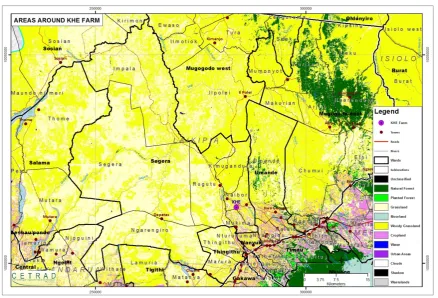
the country by land size covering an area of 9,700 square kilometres (GOK, 2014). In Laikipia County 90 per cent of the land is deemed too dry and thus unfit for cultivation, less than 2 per cent of land is deemed highly viable for agriculture, 65 per cent of land is defined as wildlife habitat while 38 per cent of land is comprised of relatively intact, contiguous, and natural habitat (Butynski and De Jong, 2014). In addition, the county also consists of a rangeland plateau with a varying altitude of 1,500 to 2,611 metres above sea level at Ewaso Nyiro basin in the north and Marmanet forest. In the North the mean annual rainfall is estimated to be 40 cm while in the south-west it is 120 cm (GOK, 2014). This county’s scarce and unreliable rainfall patterns, notably in Laikipia North and Laikipia East sub-counties make it difficult to practice large-scale agriculture (Ameso et al. 2017). As a result, the two sub-counties are largely pastoral zones with where nomadic pastoralism is a major source of livelihood for the inhabitants as shown in figure 2.
9
Methods.
Study Population and Sampling Procedure.
The study population consisted of Maasai pastoralists as the Household level actors, state actors, non-state actors, service providers as actors and organizations and associations as value chain actors in the food system. The unit of analysis was the community that was actively involved in pastoral activities and gained part of their household livelihood through pastoralism.
The sample consisted of 20 men and 30 women. The proportion of women was more because they were readily available at the household level. This study collected purely qualitative data and relied on convenient sampling in selecting informants. Secondary data was collected from available literature on the Maasai pastoralists in Laikipia County, actors and their roles in pastoralism, and institutional settings and changes of pastoralism.
Interviews using In-depth Interview guides were conducted with the Maasai pastoralists as actors at the household level. This elicited information on the specific objectives establishing actors and their roles in pastoralism. Other interviews with state, non-state, service providers and organizations and associations as actors were carried out using key informant interview guides to educe information on the specific objectives, establishing actors and their roles in pastoralism and describing the institutional settings and changes in pastoralism. Other data collection methods used were focus group discussions and unstructured observations to draw out information on actors and their roles in pastoralism and also unstructured observations to give insights into the organizations and structures of the pastoral regions and level of physical interactions teasing out the coping strategies and mechanisms that sustain pastoralism.
Data Processing and Analysis.
The qualitative data obtained was sorted and interpreted in relation to the research objectives, to provide general interpretations of the findings, indicating how thematic areas and issues interrelated.
Findings and Discussions.
Pastoral resilience among the Maasai pastoralists of Laikipia County.
10
other natural hazards in the country with a huge impact on livestock rearing, small-holder agriculture and tourism, which are the most dominant sources of livelihoods in these areas. According to Idris (2011:26) pastoralism is practiced in 75 per cent of the ASALs which are largely populated by nomadic pastoral communities like the Maasai pastoralists of Laikipia County in the rift valley region, who rely primarily on their livestock as a source of livelihood and collectively these regions constitute the most marginalized parts of the country. Ouma et al (2012:91) add that the root causes to most of the crises facing the pastoralists who inhabit the ASALs, in the recent past, has been occasioned by climate variability and change and as well as natural and man-made related factors which have led to recurrent droughts thus leading to water shortages, conflicts over land access and use, and the disruption of the vegetation cycle in these regions that they occupy with limited common pool resources (CPRs).
Bobadoye et al (2016) allude to the depletion of CPRs within the ASALs as occasioned by prolonged dry spells, drought events and other hazards have for a long time been the lead to severe economic and food security risks as the hazards make it difficult for pastoral communities such as the Maasai pastoralists to maintain their assets and have timely responses to disasters leading to food sustainability of pastoralism as a food system. Ouma et al (2012) thus argue that, as a result of these repeated severe droughts pastoralists continue to endure catastrophic losses of livestock, which is their capital and savings, during the drought events.
11
Actors and their roles in pastoralism at the household level.
The household among the Maasai pastoralists is the basic unit of production, distribution, packaging and consumption in the pastoral value chain. It is also responsible for age and gender division of labour in pastoralism to guarantee food sustainability, risk management and resilience. At the household level, various actors have varied roles that they play in pastoralism that guarantee pastoral resilience. Household heads are one such group of actors in pastoralism. They are the men among the Maasai pastoralists who are considered to be the sole owner of the pastoral livestock and the overall-decision makers hence have full control of livestock activities as the main source of livelihood. They are tasked with the overall role of herding livestock thus they have the power to define access to pasture and water for livestock. As the overall decision makers they are capable of delegating their herding role to morans and instructing them on where to graze and water the livestock especially in the commons.
12
Irkinyango clan among the Maasai pastoralists of Laikipia values the brown coloured cattle as a source of endless wealth and thus cannot be sold off quickly without having reproduced at least five times.
13
formal employment. The women hire and pay the herdsmen, purchase veterinary drugs and inject, and spray the livestock.
In the community group ranches, where CPRs are shared communally most men are polygamous and thus have more than one household and several compounds that they call home. In most cases, these men as tradition dictates, with time, move from their first wives households into newly established younger wives households. As a result, the study established that first wives guarantee the continued practice of pastoralism in their households by assuming the household head’s roles. They also delegate livestock rearing activities from production, distribution, processing and packaging to their household members based on age and gender. They are also bestowed with the overall decision of whether or not household livestock should be sold and who among the male children will inherit which type of livestock.
Other actors at the household who carry out various roles but lack decision making capacity in livestock rearing that guarantee the continued production, processing, distribution, packaging and consumption of livestock and its products are morans. The morans herd the livestock, provide security to the livestock during the day and night against wild animals and intruders, slaughter livestock meant for household consumption and also administer veterinary drugs to livestock as part of the livestock health management role. As a result of, the commercialization of herding, herdsmen make certain that livestock have access to proper pasture and water. The herdsmen also administer veterinary drugs to household livestock in the absence of the men of the household, help in fencing the livestock sheds and also slaughter household livestock. The young boys who are about 8-10 years of age begin to herd small stocks (calves, lambs and kids) and they also assist their mothers in milking livestock. The study learnt that young girls mostly complement the woman of the household in dispensing their duties. They separate the small stocks from the larger stocks to allow for milking. They also fetch water and clean the livestock sheds as well as count the livestock as they are brought back from the grazing fields.
Organizations and Associations as actors in pastoralism
14
allowed for increased participation of pastoralists in livestock marketing and management of the markets’ infrastructure in the pastoral counties of Isiolo, Samburu, and Laikipia. In the County of Laikipia, the Laikipia Livestock Marketing Authority (LLMA), a community-led organization was found that liaises with the County government of Laikipia to collect livestock sales tax and encourages equitable distribution of the said tax during market days in the ratio of 1:1. The organization through its branch leadership which includes; a chairman, supervisor, and other senior members of the community selected to serve in the organization’s leadership, is found in every available livestock market in Laikipia County acts as the custodian of the sales tax left to the community.
The LLMA leadership in its wisdom retains the revenue allocation left in its possession and later ploughs it back into agreed upon and prioritized community projects that have received public acceptability. For instance, the study established that in Kimanjo market the LLMA had agreed to plough back the revenue allocation into bee keeping projects, hay production projects, building of slaughterhouses in the market, rehabilitation of run-down cattle dips, building market stalls, educating the pastoralists on the adoption of new drought resistant breeds of livestock and rehabilitation of the roads leading to the livestock market in Kimanjo.
Community ranch management groups are another set of actors that encourage the practice of pastoralism in the commons. They are associations founded by members of the available 13 community group ranches found in Laikipia North sub-county of: Ilpolei, Kijabe, Lekuruki, Makurian, Ilgwesi, Morupusi, Kurikuri, Munichoi, Musul, Tiamut, Koija, Ilmotiok and Nkilorit. The community group ranches were registered in the late 1970s such as Ilpolei community group ranch that was registered in 1976. The role of the community ranch management groups is to regulate the use of available common pool resources especially pasture and water through advocating for the adoption and utilization of the concept of holistic management of grazing lands locally referred to as the Olopoleli concept.
15
seasons the grazing lands that had previously been in use should be enclosed and set aside to allow grass to grow.
The community ranch management groups also take up the lead role in providing alternatives to limited CPRs. The study was informed that the management groups like that of Ilpolei community group ranch led by the chairman, are authorized to make agreements with private ranches such as Oljogi during the dry seasons to allow for pastoral livestock to graze in the private ranches that have access to permanent river waters and constant pasture availability. This is done at a fee of 200 shillings per cow or bull after a grazing zone within the private ranches has been identified and terms such as the provision of three herdsmen from the community group ranch to herd the livestock have been agreed upon. The agreements struck for access to pasture and water also allow pastoral livestock to gain access to constant vaccination drives, livestock health management plans and also pay the herdsmen a monthly fee of 7,000-8,000 Kenyan shillings that will be done at the expense of the private ranch owners.
Livestock trade which is the back of the pastoral economy in Laikipia County has found support from pastoral initiated credit associations. These community-led financial institutions, notably, Nasaruni rural Sacco provides money transfer services and loans to actors who frequent the livestock markets. Nasaruni rural Sacco an initiative of pastoral women in Kijabe community group ranch began in 2008 as a financial service organization for pastoral women but by 2013 it had grown into a fully fledged Sacco. In its current position as a Sacco it provides financial services to the Maasai pastoralists in Laikipia County, as well as to other pastoral groups found in the neighbouring counties of Isiolo and Samburu. The financial institution offers development, educational and emergency loans to pastoralists with livestock being used as collateral. The Sacco takes a picture of the said livestock as evidence of the available collateral before disbursing the loans.
16
January to cater for tuition fees of pastoral children, when livestock trade is low and the prices of livestock are unfavorable. In instances, where urgent medical care and other unforeseen circumstances occur, the Sacco issues emergency loans. Laikipia Permaculture Centre (LPC) is another organization as an actor in pastoralism that the study found to be advocating for holistic management of pastoral lands and strict observation of the carrying capacity of the rangelands. State actors in pastoralism
The continued practice of pastoralism in Laikipia County as a food system is also pegged on to the involvement of national and county government actors who: regulate, process, distribute, provide services and add to the number of users and beneficiaries of pastoral trade and products. Police officers are national government employees found in the pastoral regions and mandated with providing security to pastoral actors especially in livestock markets. Their sole responsibility is to guarantee free and fair trade for livestock buyers and sellers. Through the County Market officials, the county government of Laikipia is represented in the pastoral economy. They are employees of the county government, previously of the municipal council of Laikipia. They are charged with the sole responsibility of collecting sales tax in livestock markets from livestock buyers and sellers.
The study was informed that they collect 30 Kenyan shillings from livestock buyers and sellers per sheep and per goat; and they also collect 200 Kenyan shillings per cattle bought or sold. They also sit down with the Laikipia Livestock Marketing Authority management and share the sales tax collected and make certain that the half that is meant for the county government of Laikipia is safely secured and taken to the County coffers. The County market officials are aided by Livestock counting clerks in sales tax collection in livestock markets. The livestock counting clerks are employees of the LLMA.
17
In livestock health management, the veterinary officers conduct livestock disease surveillance in the pastoral regions along two main stock routes and within the livestock markets where buying and selling of pastoral livestock takes place. In Laikipia north sub-county, the study was informed that the two main stock routes were those used by the Maasai pastoralists in search of water and pasture for their livestock during the dry seasons. The first stock route moved from Kirimon to Kimanjo then to Ilpolei in the pastoral commons into Kimkandura and Endana and finally reaching Mount Kenya or the Arbedare ranges. The second stock route began in Kirimon and moved to Rumuruti outside the pastoral commons and from their into Nyahururu sub-county of Laikipia before ending up in the much greener Arbedare ranges.
Livestock production officers of the county government of Laikipia train pastoralists on proper animal husbandry methods and ensure that the carrying capacity of the rangelands is observed. They also advise the pastoralists on which drought resistant breeds to keep, and the better veterinary drugs to use. When it comes to the livestock trade among food system actors, the livestock production officers advise the pastoralists on the need to form Livestock Marketing Authorities (LMAs) to ensure they get better prices for their livestock. They also work with the Maasai pastoralists on rangeland management to ensure they deal with the menace of receding rangelands caused by the invasive plant species of Opuntia.
Another national actor is the Agricultural Sector Development Support Programme (ASDSP). They work with the Maasai pastoralists to ensure that their products value chains are created with their input. They also advice the Maasai pastoralists on how to increase the market value of their livestock and livestock products through the use of quality inputs in livestock rearing like dewormers. They also discourage the pastoralists from having an overreliance on purchasing inputs from stockists and other open air market vendors of veterinary drugs with poor storage. They also talk with the pastoralists on formation of marketing associations like LLMA and promote electronic marketing of livestock and their products as a measure of guaranteeing a better market value for the sale of pastoral livestock and products.
Non-state actors in pastoralism
18
pastoralists to strengthen their financial position by helping the pastoralists save money from their pastoral activities. The two organizations have worked with the pastoral women of Kijabe community group ranch and led to the growth of Nasaruni rural Sacco from a financial service organization in 2008 to a full-fledged Sacco in 2013.
The Regional Pastoral Livelihood Resilience Project (RPLRP) is a World Bank funded resilience project hosted by the department of Livestock production in the County government of Laikipia that works to eliminate the invasive plant genus of Opuntia. The study was informed that the project was initiated in late 2015 and began full operations in 2016 with an aim of establishing the hazards that pastoralism in 14 arid and semi-arid counties such as Laikipia, Isiolo, Turkana, Samburu and Wajir face. The project uses the Community Managed Disaster Risk Reduction Assessment (CMDRRA) to get Maasai pastoralists to identify the hazards that they face. The study was informed that CMDRRA listed Opuntia invasive plant genus as one of the main hazards that limits pastoralism and needs to be dealt with.
The African Conservation Centre (ACC) is another actor in pastoralism that encourages the practice of livestock rearing and trade. It focuses on livelihood projects aimed at improving the livestock breeds that the Maasai pastoralists keep in Laikipia and Narok Counties as well as Amboseli and Maasai Mara conservancies. In Laikipia County and predominantly in the Maasai reserves, the organization is working towards improving availability of pasture by emphasizing on the adoption of the Olopoleli concept. Moreover, the organization is on the forefront, working with women groups such as Twala women group to build gabions to reduce soil erosions in the commons and encourage the retention of water through the water-shed management plan.
Service providers as actors in pastoralism
Agro-vets are one type of service providers who contribute to the health of the pastoral livestock by providing ready veterinary drugs to Maasai pastoralists within and outside the commons. They are found in livestock markets of Doldol, Kimanjo, and Naibor with stalls in which they operate in. others are peripatetic and frequent county of Laikipia from neighbouring counties of Nyeri and Meru to sell off their veterinary drugs during market days.
19
frequent actors in livestock markets who make stopovers in the town centers of Juakali and Naibor outside the pastoral commons and in Ilpolei town centre in the pastoral commons.
Livestock brokers are another group of actors whose goal in pastoralism is purely profit-maximization. These young pastoral men and women are actively involved in livestock trade by purchasing livestock from fellow pastoralists at a lower price and rearing the livestock for awhile before reselling them at a higher price in livestock markets, to butchers within the town centres or butchers at the slaughterhouses such as Nanyuki Slaughterhouse in Laikipia County and, Huruma and Dagoretti slaughterhouses in Nairobi City county.
Livestock buyers are business persons who frequent the livestock markets in Laikipia County to purchase pastoral livestock. These livestock buyers are non-pastoralists who come from as far as Nyeri, Murang’a, Meru and Nairobi counties. They purchase livestock from the Maasai pastoralists in livestock markets with profit-maximization as a motivational factor. They process and package the livestock products through slaughterhouses and distribute the meat and other livestock products to their customer base in butcheries, supermarkets, food outlets, hotels, and security, health and education institutions with which they have pre-existing business agreements. Some of the products have specific markets based on the concentration of consumers. The study was informed of Eastleigh, South B and South C as designated markets for camel meat consumption inhabited by residents of the Somali ethnic group in Nairobi City County. Livestock buyers work hand-in-hand with livestock transporters who provide transport services to the former. They ferry the purchased livestock from the pastoral regions to desired designations like Endana and Nanyuki town in Laikipia County as well as to Nyeri, Murang’a and Nairobi City Counties and towns like Karatina.
20
of formal employment while education for the morans changed their primary role in herding livestock. However, in order to cope with these changes in primary actor roles that threaten the survival of pastoralism, institutional changes within the Maasai pastoralists have allowed for the outsourcing of herding roles to herdsmen at the household level for a monthly fee. Other leadership household head roles’ have also been delegated to women who have taken control as livestock owners and authority figures. In Maasai pastoral households that cannot afford the services of herdsmen, women have also taken up the role of herding as well as livestock health management.
Coping strategies and mechanisms by the Maasai pastoralists have also been witnessed in regards to pasture. The pastoral regions occupied by the Maasai have over the years been vulnerable to prolonged drought spells and other hazards such as the outgrowth of the invasive Opuntia plant species in the commons. To bounce back, from limited pasture supply in the commons, the Maasai pastoralists are relying on set down formal and informal rules and regulations established in their community group ranch constitutions. The constitutions have zoned pastoral lands into; grazing, settlement, and conservation zones and this guarantees preservation of given pasture lands for future use through the emphasis on the use of and adoption of holistic management of pasturelands. Moreover, to ensure that the enshrined rules and regulations are followed, the community group ranch management and elders have sanctions and punishments in place for offenders. The study found that for first time offenders who take their livestock into the restricted and reserved pasturelands for grazing they are given a warning but for second time offenders they are forced to part away with a he-goat as a fine for grazing in restricted zones and reserved pasturelands. For third time and repeat offenders legal actions which involves notifying the local administration is taken and a jail term is a possible outcome. In the pastoral commons, the Maasai pastoralists also hire pasture fields from neighbouring private ranches like Oljogi, Impala, Olgarama, Olpajeta, Lenaisho and Oldega. Other Maasai pastoralists are re-investing the money from livestock trade into private land ownership outside the commons to guarantee continued access to pasture for their livestock in areas like Mutirithia in Segera ward.
21
one after the other on a rotational basis for grazing. In other areas such as Karionga in Segera ward, the pastoralists hire grazing plots available from non-pastoralists at a monthly fee of between 7,000- 8,000 Kenyan shillings. Other pastoralists sneak their livestock into neighbouring privately-owned ranches to graze as a coping strategy and mechanism. The large livestock is sneaked into privately-owned ranches at night while the small stocks are sneaked into these ranches during the day. This is done to avoid the small stocks from being predated upon by the wildlife found in private ranches.
Water shortage is also another hindrance to the practice of pastoralism. To cope with water shortage, the Maasai pastoralists in the commons who rely on seasonal rivers like Twala River make informal agreements with private ranches through their group ranch chairmen for their livestock to have access to water when they are grazing in the private ranches. Another strategy is the dependence on dams constructed through private-public partnerships between private ranch owners and; county and national government departments. The study found that Oljogi private ranch had partnered with the Ministry of Irrigation and built a dam for the Ilpolei community group ranch. Other partnerships between the community group ranch management and conservation based non-governmental organizations such as the African Conservation Centre, has allowed for the building of gabions to reduce soil erosion within the community group ranches through the water-shed management plan.
Outside the commons, the Maasai pastoralists rely on water dams to meet the water needs for their livestock in areas such as Mutirithia. In other regions of Segera ward such as Karionga, pastoralists rely on boreholes dug by their agricultural neighbours and they purchase water at a fee of 50 Kenyan shillings per 20 litre jerican. However, other pastoralists rely on the permanent water supply of river Nanyuki to meet their livestock water demands.
22
23
References.
Ameso, E.A., S.A. Bukachi, C. O. Olungah and T. Haller. (2017). Ethnography of the slaughterhouse: A case of Nanyuki slaughterhouse in Laikipia county, Rift Valley, Kenya. Pastoralism: research, policy and practice, 7:32.
Bobadoye, A.O., W.O. Ogara., G.O. Ouma and J.O. Onono. (2016). Assessing climate change adaptation strategies among rural Maasai pastoralists in Kenya. American journal of rural development, Vol. 4 (6): 120-128.
Butynski, M. T and Y. De Jong. (2014). Primate Conservation in the rangeland agro-ecosystem of Laikipia County, Central Kenya. Primate Conservation, 28:117-128.
CETRAD (2017). Map of Laikipia North sub-county: showing the study areas of Mukogodo East, Mukogodo West and Segera Wards. Nanyuki: CETRAD.
Dong, S., L.Wen., S. Liu., X. Zhang., P.J. Lassoie., S.Yi., X.Li., J. Li and Y. Li. (2011). Vulnerability of worldwide pastoralism to global changes and interdisciplinary strategies for sustainable pastoralism. Ecology and Society, 16 (2):10.
Farmer, E. and J. Mbwika (2012). End market analysis of Kenyan livestock and meat: A desk study. USAID micro report No. 184. Nairobi: USAID.
GOK (2014). County Assembly of Laikipia: Strategic Plan, 2013-2018. Vol. 1. Draft 3. Nairobi: Government Printers.
GOK (2014). The 2014 long rains season assessment report: Kenya Food Security steering group, KFSSG. Nairobi: Government Printers.
GOK (2013). Laikipia County: First County Development Integrated Development Plan, 2013-2017. Nairobi: Government Press.
GOK (2008). Sessional paper No. 2 of 2008 on National Livestock Policy. Nairobi: Government Printers.
Hesse, C (2009). Generating wealth from environmental variability: The economics of pastoralism in East Africa’s drylands. Pastoralism: Indigenous Affairs, IWGIA, 3-4.
24
ILRI (2008). Livestock market access and opportunities in Turkana Kenya. Research report 3. Nairobi: ILRI.
Kaye-Zwiebel, E. and King, E. (2014). Kenyan pastoralist societies in transition: varying perceptions of the value of ecosystem services. Ecology and Society, 19(3):17-37.
Little, D. P. and J.G. McPeak. (2014). Pastoralism and resilience south of the Sahara: Building resilience for food and nutrition security. 2020 conference brief 9.
NRC (2014). On the margin: Kenya’s pastoralists: From displacement to solutions: A conceptual study on the internal displacement of pastoralists. Geneva: Internal Displacement Monitoring Centre.
Ouma, C., J. Obando and M. Koech. (2012). Post drought recovery strategies among the Turkana pastoralists in Northern Kenya. Scholarly Journals of Biotechnology, vol. 1(5): 90-100.
Pavanello, S. (2009). Pastoralists’ vulnerability in the horn of Africa: Exploring political marginalization, donors’ policies and cross-border issues- Literature review. Humanitarian Policy Group Report. London: ODI.
Reid, S. R., M.E. Fernandez-Gimenez and K.A. Galvin (2014). Dynamics and Resilience of Rangelands and Pastoral peoples around the globe. The Annual review of environment and resources. 39:217-242.