International Journal of Real Estate Studies, Volume 11 Number 3 2017
EXPLORING COMPETENCIES FOR GREEN BUILDING PROJECT MANAGER
Muhamad Amir Afiq Lokman*, Mat Naim Abdullah@Mohd Asmoni* and Nursyamimi Shaari
Department of Real Estate,
Faculty of Geoinformation and Real Estate,
Universiti Teknologi Malaysia (UTM), 81310 Skudai, Johor, Malaysia. *Corresponding author: [email protected], [email protected]
Abstract
Sustainability concept has grown in recognition and importance since the last 10 to 15 years and the issues of achieving sustainability, climate change as well as environmental protection have been addressed by the construction players. While many studies have examined the competency of project managers, there is little attention given for green building construction. Therefore, this study aims at identifying a list of competencies for green building project manager. Through literature review, a total of 49 competencies have been identified from previous studies and this search is limited with the year of published article ranging from 2000 to 2015 using Google Scholar, which were then analysed using content analysis. This study can help in creating further knowledge and skills for project managers to be more relevant and effectively execute sustainable projects.
Keywords: Sustainability; Competency; Project Manager; Project Management; Knowledge and Skill; Green Building.
1.0 INTRODUCTION
Sustainability concept has gained its recognition and importance since the last 10 to 15 years (Silvius et al., 2012) and the issue of achieving sustainability, climate change together with environmental protection have been addressed by the construction players either researchers or practitioners. This consciousness arise when construction gave many environmental issues such as atmospheric and water pollution (Pasquire, 1999). Apart from that, Perez-Lombard, Ortiz and Pout (2008) mentioned that both commercial and residential building are responsible for between 20% and 40% of the world’s energy consumption, which are steadily rising every year. Besides consuming a large amount of energy, these buildings are also the culprits behind substantial carbon dioxide emissions, which can be detrimental to the environment and play a huge role in the world’s climate change (Yudelson, 2007). Taking this as evident, construction of the buildings may result in environmental burden. Green concept and
First, it introduces the definition and meaning of green building. This is followed by the explanation on the competency concept and its theory. Then, the overview of a project manager is presented. Then, the methodology adapted for this study is demonstrated. Subsequent section presents the data analysis as well as the findings. Meanwhile, the final section concludes the article, summarises and suggests a way forward regarding this topic.
2.0 GREEN BUILDING
There is no single, widely accepted definition for GB (Robichaud & Anantatmula, 2010). Nonetheless, it was revealed by many common threads reflecting GB as a philosophy and associated project as well as construction management practices that seek to: (1) minimise or eliminate impacts on the environment, natural resources and non-renewable energy sources to promote the sustainability of the built environment; (2) enhance health, wellbeing and productivity of occupants and the whole communities; (3) cultivate economic development and financial returns for developers and whole communities; and (4) apply life cycle approaches to community planning and development. As described by Kubba (2010), Wedding (2008) and Richard (2008), GB is a building designed, constructed and operated to be resource-efficient. Meanwhile, Zhang (2013) defined GB as a structure using process that is environmentally responsible and resource-efficient throughout a building’s life cycle from siting to design, construction, operation, maintenance, renovation and demolition. Furthermore, Glavinich (2008) presented that GB’s terminology according to American Society of Testing Materials (ASTM) is a building that provides specified building performance requirements while minimising disturbance and improving the functioning of local, regional and global ecosystems both during and after construction and specified service life. Although there are multiple definitions, GB is actually referred to a resource-efficient building with minimal interference to the environment and is often mentioned interchangeably with sustainable construction (Hwang & Tan, 2012) and green
construction or sustainable building (Zhang, 2013). Therefore, the GB term used in this reflects the sustainable or green constructions and/or sustainable building.
Landman, 1999; Richardson & Lynes, 2007). According to Korkmaz, Riley, and Horman (2010) and Enache-Pommer and Horman (2009), these barriers occur because GB is quite new with many complex processes. On top of that, there are lots of participant in the construction industry who have no clear ideas to effectively and efficiently manage GB projects. In order to maximise the project’s success consistently, an organisation should recruit, develop, maintain and preserve superior project managers (Hwang & Ng, 2013) so that the project can be completed within established time and cost limitation according to the planning, scheduling and controlling as well as the responsibility held by project managers (Sears, Sears, & Clough, 2010). Thus, one of the solutions is to appoint a competent project manager in managing green or sustainable building construction (Hwang & Ng, 2013; Lippaiová & Sebestyén, 2006; Robichaud & Anantatmula, 2010; Sharif et al., 2014).
3.0 COMPETENCY CONCEPT AND
THEORY
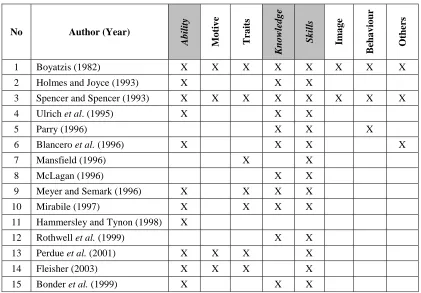
The competency concept was first introduced by Federick W. Taylor in the early 20th century, followed by studies by McClelland (1973), Boyatzis (1982) as well as Spencer and Spencer (1993). After that, it grows into an intention among researchers especially in the US. Studies on competency have been also conducted by various researchers from multi-disciplines with human resource management discipline being the most active discipline in studies related to competency (Mohd Derus, Karim, & Qusoiri, 2008). According to Parry (1996), competency is defined as a collection of knowledge, skills and attribute that influences individual performance. Competency is also referred to motive, personal characteristic, skill and ability shown through consistent behaviour (Fleisher, 2003; Perdue, Woods, & Ninemeier, 2001). Meanwhile, Blancero, Boroski, and Dyer (1996) defined competency as knowledge, skills, ability and other characteristics demonstrating the desired behaviour in the future. On top of that, it was also defined by Ulrich, Brockbank, Yeung, and Lake (1995), which lays into individual knowledge,
skills and ability. Mansfield (1996) mentioned that competency is a series of skills and traits needed by workers to do their work effectively. According to McLagan (1996), competency consists of knowledge and skills that underlie effective performance. On the other hand, Mirabile (1997) suggests that core competencies are related to skill, ability or characteristic with a relationship or influence on highly performance works. Rothwell, Sanders and Soper (1999) also defined competency as a field of knowledge or skills required in producing identified output. Output in this context refers to the product or services that fulfil the need of human resources development towards organisation. In the study of Rifkin, Fineman and Ruhnke (1999), the easiest way to understand competency is by referring it to anything that is required by a person to do a job perfectly. Competence is also defined by Holmes and Joyce (1993) as an action, behaviour or results exhibited by individuals that is linked with the ability to transfer skills and knowledge to new situations within his or her career. Within this definition, Meyer and Semark (1996) added “trait” and “value orientation” when they describe the meaning of competency. Moreover, Hammersley and Tynon (1998) defined the definition of competency from “The Council on Hotel, Restaurant and Institutional Education” as an ability to implement activities within the scope of works. According to Klein (1996), core competencies are the behaviour of individuals who consistently demonstrate superiority over ordinary performers. Apart from that, Bonder, Hollands, and Miles (1999) stated that core competencies are any knowledge, skills, abilities or personal qualities expressed through behaviour that can result in excellence in a service.
Table 1: Ideas in defining competency
Figure 1: Iceberg Theory by Spencer and Spencer (1993)
No Author (Year)
A
b
ilit
y
M
o
tiv
e
T
ra
it
s
K
no
w
led
g
e
Sk
ills
Ima
g
e
B
eha
v
io
ur
O
thers
1 Boyatzis (1982) X X X X X X X X
2 Holmes and Joyce (1993) X X X
3 Spencer and Spencer (1993) X X X X X X X X
4 Ulrich et al. (1995) X X X
5 Parry (1996) X X X
6 Blancero et al. (1996) X X X X
7 Mansfield (1996) X X
8 McLagan (1996) X X
9 Meyer and Semark (1996) X X X X
10 Mirabile (1997) X X X X
11 Hammersley and Tynon (1998) X
12 Rothwell et al. (1999) X X
13 Perdue et al. (2001) X X X X
14 Fleisher (2003) X X X X
15 Bonder et al. (1999) X X X
Knowledge Skill
Interpersonal Motive/Trait/Concept
Value/moral
Visible
Although there are various definitions found, ‘competency’ in this paper only refers to skills and knowledge, which is the visible part of the iceberg since it is easy to be formed compared to hidden part (Sail, 2010). Knowledge is awareness, information, or understanding about facts, rules, principles, guidelines, concepts, theories, or processes needed to successfully perform a task (Marrelli, 2001; Mirabile, 1997). Knowledge can be concrete, specific and easily measurable, or can be more complex, abstract and difficult to be assessed (Lucia & Lepsinger, 1999). A skill is a capacity to perform mental or physical tasks with a specified outcome (Marrelli, 1998). Similar to knowledge, skills can range from highly concrete and easily identifiable tasks such as filing documents alphabetically to those that are less tangible and more abstract such as managing a quality improvement project (Hoge, Tondora, & Marrelli, 2005; Lucia & Lepsinger, 1999).
4.0 PROJECT MANAGER’S
COMPETENCIES
Project manager is an individual with the responsibility to ensure the flow of a project from planning, constructing and getting the approval for each construction project (Meredith & Mantel, 1989). Among the construction parties, project manager is important and vital to project success (Hwang & Ng, 2013) and has direct influence over 34-47% of project success (Toney, 2001). According to Sharif et al. (2014), there will be no project without project manager. Many researchers mentioned the importance of a competent project manager to the success of a project (Baker, Fisher, & Murphy, 1983; Belassi & Tukel, 1996; Locke, 1984; Salleh, 2009; Sayles & Chandler, 1971; Turner & Zolin, 2012) with several researchers such as Avots (1969), Belassi and Tukel (1996), Crawford (2001) as well as Sayles and Chandler (1971) emphasizing on project manager’s critical skills through their studies. Parallel with the findings from Ahadzie (2007), there are growing awareness among industries on the relationship between reaching project success and the competencies of construction project management. Now, successful construction organizations are
focusing on ensuring that the project manager possesses the core competencies required to fulfil their assignments in achieving customers’ satisfaction. It is believed that project managers play a crucial role in completing a project.
With the aim to manage projects accordingly, a project manager should acquire several skills and knowledge. Many published studies have identified that managerial skills such as social skills, decision-making skills, problem handling skills, the skill to recognize opportunities and manage changes are necessary for efficient project performance as the key personal attributes affecting project success (Fryer, 1985). Project Management PMI (2008) has highlighted essential knowledge that project managers should possess, which are schedule management and planning, cost management, quality management, human resource management, risk management, supply chain management and communication management.
5.0 METHODOLOGY
To gain an in-depth understanding on the various competencies for green building’s project manager directly or indirectly identified by other researchers, content analysis was used as an appropriate analysis approach of this study. Content analysis is a method of analysing written, verbal or visual communication messages (Cole, 1988), which was first used as a method for analysing hymns, newspaper and magazine articles, advertisements and political speeches in the 19th century (Harwood & Garry, 2003). As recommended by Silverman (2013), it is the most common technique utilised to analyse texts. Content analysis is divided into two categories, which are ‘inductive content analyses and ‘deductive content analyses. Thus, this paper has selected ‘deductive content analysis’ for the published research papers on the current subject and area since the researcher decided to retest existing data in the new context as suggested by Catanzaro (1988).
Other than that, ‘deductive content analysis’ is generally based on earlier works such as theories, models, mind maps and literature reviews (Hsieh & Shannon, 2005; Polit & Beck, 2004; Sandelowski, 1993). A total of 648 papers were found during literature search using Google Scholar published between the year 2000 and 2015. To clarify the suitable published paper for this study, a search strategy using keywords offered by authors through their previous study during preliminary literature review was done. The keywords used are green_building AND
project_manager AND competencies OR
competence OR competency. From these selected papers, a total of 75 abstracts were further reviewed concerning the identification of competencies for GB project manager. This has resulted in the exclusion of 53 publications, leaving 22 publications. All the competencies from these 22 papers were recorded in Table 2.
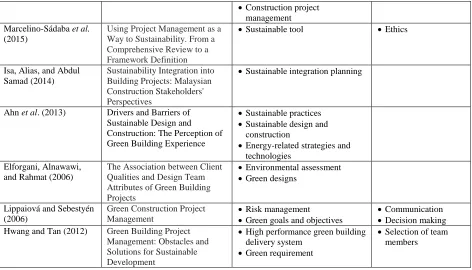
Table 2: Publications in relation to competencies for GB’s project manager
Author Title Competencies
Knowledge Skills
Hwang and Ng (2013) Project Management Knowledge and Skills for Green
Construction
Cost management
Communication management
Schedule management and planning
Health and safety management
Risk management
Conflict and dispute managements
Stakeholder management
Material resource management
Claim management
Human resource management
Decision making
Delegation
Analytical
Team working
Problem solving
Leadership
Negotiation
Human behaviour
Chairing meeting
Presentation
Lam et al. (2009) Factors Affecting the Implementation of Green Specifications in Construction
Green specifications Riley, Pexton, and
Drilling (2003)
Procurement of Sustainable Construction Services in the United States: the Contractor's Role in Green Buildings
Estimation
Green building materials
Waste minimisation and recycling
Indoor air quality management Robichaud and
Anantatmula (2010)
Greening Project Management Practices for Sustainable Construction
Sustainable building practices
LEED requirement
Sustainability goals
Familiarity with product type and market
Pricing and developing cost-saving strategies
Planning and strategy meeting
Communication and document sharing
Communication
Procuring specialised software for sustainable project
Budgeting and scheduling Li et al. (2013) Project Management Factors
Affecting Green Building Projects: Case Study of Singapore
Communication
Leadership
Problem solving Hwang, Leong, and Huh
(2013)
Sustainable Green Construction Management: Schedule Performance and Improvement
Planning and scheduling
Familiarity with green technologies
Hojem, Sørensen, and Lagesen (2014)
Designing a 'Green' Building: Expanding Ambitions through Social Learning
Green design
Green building contract (requirement)
Senaratne and Hewamanage (2015)
The role of Team Leadership in Achieving LEED Certification in a Green Building Project
Leadership (proactive planning and visualization, collective implementation, teamwork, and continuous learning and knowledge sharing) Wang et al. (2015) Critical Factors for Sustainable
Project Management in Public Projects
Process control (risk management)
Resource management
Stakeholder management
Team management
Objective management
Information management
Leadership
Communication
Evaluation
Project result
Innovation
Sim and Putuhena (2015) Green Building Technology Initiatives to Achieve Construction Quality and Environmental Sustainability in the Construction Industry in Malaysia
Holistic thinking
Decision making
Goedknegt (2012) Sustainability in Project Management: A case study at University of Applied Sciences Utrecht
Decision making
Son et al. (2011) Implementing Sustainable Development in the Construction Industry:
Constructors' Perspectives in the US and Korea
Sustainable material
Water efficiency
Site management
Sustainable procurement Elforgani and Rahmat
(2010)
An Investigation of Factors Influencing Design Team Attributes in Green Buildings
Green design
Life cycle assessment
Fortunato III, Hallowell, Behm, and Dewlaney (2011)
Identification of Safety Risks for High-Performance Sustainable Construction Projects
Sustainable standards (LEED)
Safety and health management
Lapinski, Horman, and Riley (2006)
Lean Processes for Sustainable Project Delivery
Environmental
Sustainable objectives
Budgeting
Sustainable material
Teamwork
Shi et al. (2014) Improving the Competence of Construction Management Consultants to Underpin Sustainable Construction in China
Construction cost planning and control
Civil engineering and construction
Engineering contract and law
Onsite practical skill
Personnel quality
Continuing
Construction project management Marcelino-Sádaba et al.
(2015)
Using Project Management as a Way to Sustainability. From a Comprehensive Review to a Framework Definition
Sustainable tool Ethics
Isa, Alias, and Abdul Samad (2014)
Sustainability Integration into Building Projects: Malaysian Construction Stakeholders' Perspectives
Sustainable integration planning
Ahn et al. (2013) Drivers and Barriers of Sustainable Design and Construction: The Perception of Green Building Experience
Sustainable practices
Sustainable design and construction
Energy-related strategies and technologies
Elforgani, Alnawawi, and Rahmat (2006)
The Association between Client Qualities and Design Team Attributes of Green Building Projects
Environmental assessment
Green designs
Lippaiová and Sebestyén (2006)
Green Construction Project Management
Risk management
Green goals and objectives
Communication
Decision making Hwang and Tan (2012) Green Building Project
Management: Obstacles and Solutions for Sustainable Development
High performance green building delivery system
Green requirement
Selection of team members
6.0 ANALYSIS FOR GREEN BUILDING
PROJECT MANAGER’S
COMPETENCY
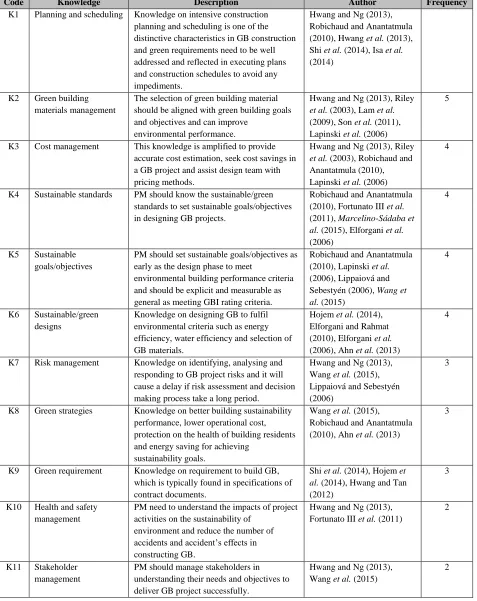
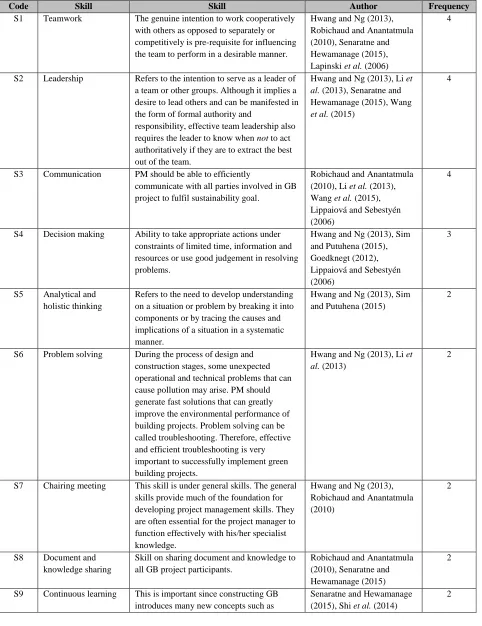
As mentioned before, competency is referred to knowledge, skills or ability to deliver tasks or assignments successfully. Thus, these findings demonstrated the above definitions that were categorised into knowledge and skill. Overall, 28
knowledge and 21 skills were identified as the findings of this study, which are believed to be reflected as the competencies for green building project manager. Figure 2 demonstrates the research findings together with the further explanation on each competency in Table 3 and Table 4.
Table 3: Explanation on Knowledge for GB’s project manager
Code Knowledge Description Author Frequency
K1 Planning and scheduling Knowledge on intensive construction planning and scheduling is one of the distinctive characteristics in GB construction and green requirements need to be well addressed and reflected in executing plans and construction schedules to avoid any impediments.
Hwang and Ng (2013), Robichaud and Anantatmula (2010), Hwang et al. (2013), Shi et al. (2014), Isa et al.
(2014)
K2 Green building materials management
The selection of green building material should be aligned with green building goals and objectives and can improve
environmental performance.
Hwang and Ng (2013), Riley
et al. (2003), Lam et al.
(2009), Son et al. (2011), Lapinski et al. (2006)
5
K3 Cost management This knowledge is amplified to provide accurate cost estimation, seek cost savings in a GB project and assist design team with pricing methods.
Hwang and Ng (2013), Riley
et al. (2003), Robichaud and Anantatmula (2010), Lapinski et al. (2006)
4
K4 Sustainable standards PM should know the sustainable/green standards to set sustainable goals/objectives in designing GB projects.
Robichaud and Anantatmula (2010), Fortunato III et al.
(2011), Marcelino-Sádaba et al. (2015), Elforgani et al.
(2006)
4
K5 Sustainable goals/objectives
PM should set sustainable goals/objectives as early as the design phase to meet
environmental building performance criteria and should be explicit and measurable as general as meeting GBI rating criteria.
Robichaud and Anantatmula (2010), Lapinski et al.
(2006), Lippaiová and Sebestyén (2006), Wang et al. (2015)
4
K6 Sustainable/green designs
Knowledge on designing GB to fulfil environmental criteria such as energy efficiency, water efficiency and selection of GB materials.
Hojem et al. (2014), Elforgani and Rahmat (2010), Elforgani et al.
(2006), Ahn et al. (2013)
4
K7 Risk management Knowledge on identifying, analysing and responding to GB project risks and it will cause a delay if risk assessment and decision making process take a long period.
Hwang and Ng (2013), Wang et al. (2015), Lippaiová and Sebestyén (2006)
3
K8 Green strategies Knowledge on better building sustainability performance, lower operational cost, protection on the health of building residents and energy saving for achieving
sustainability goals.
Wang et al. (2015), Robichaud and Anantatmula (2010), Ahn et al. (2013)
3
K9 Green requirement Knowledge on requirement to build GB, which is typically found in specifications of contract documents.
Shi et al. (2014), Hojem et al. (2014), Hwang and Tan (2012)
3
K10 Health and safety management
PM need to understand the impacts of project activities on the sustainability of
environment and reduce the number of accidents and accident’s effects in constructing GB.
Hwang and Ng (2013), Fortunato III et al. (2011)
2
K11 Stakeholder management
PM should manage stakeholders in understanding their needs and objectives to deliver GB project successfully.
Hwang and Ng (2013), Wang et al. (2015)
K12 Human resource management
PM should select all parties involved in GB projects based on their knowledge in GB construction.
Hwang and Ng (2013), Wang et al. (2015)
2
K13 Sustainable practices PM should perform sustainable practices during GB construction
Robichaud and Anantatmula (2010), Ahn et al. (2013)
2
K14 Familiarity with green products and their market
PM should be familiar with green products and their market to align with sustainability goals.
Robichaud and Anantatmula (2010), Hwang et al. (2013)
2
K15 Sustainable procurement
Knowledge on meeting organisation needs for goods, achieving value for money for organisation, society and economy while minimising damage to the environment.
Robichaud and Anantatmula (2010), Son et al. (2011)
2
K16 Sustainable construction PM should select proper construction method that it will result in quite different outcomes in terms of sustainability
Shi et al. (2014), Ahn et al.
(2013)
2
K17 Communication management
PM needs to ensure the information is delivered effectively to all parties involved in GB project to align with sustainability goals.
Hwang and Ng (2013) 1
K18 Conflict and dispute management
PM must be prepared to manage conflicts effectively without affecting GB project progress.
Hwang and Ng (2013) 1
K19 Claim management GB construction involves many parties; thus, it is conducive for conflicts. PM should avoid it with very clear stated contractual terms, early communication and good
understanding on the causes of claims.
Hwang and Ng (2013) 1
K20 Indoor air quality management
Knowledge on managing indoor air quality in GB project.
Riley et al. (2003) 1
K21 Team management PM should select new members by
identifying and classifying their abilities and needs, coordinating and delegating tasks based on their competency.
Wang et al. (2015) 1
K22 Information management
PM should know on how to record data completely using data recording mechanism (information of suppliers and experts, summarising and recording best practices, standardised document and codes).
Wang et al. (2015) 1
K23 Water efficiency Knowledge on how to use water efficiently during GB construction.
Son et al. (2011) 1
K24 Site management Knowledge on impacts of GB construction on soil and landfill.
Son et al. (2011) 1
K25 Life-cycle assessment Knowledge on life-cycle assessment when designing GB project.
Elforgani and Rahmat (2010) 1
K26 Environmental knowledge
PM should be able to obtain environmental knowledge and adopt them as early as designing phase of GB project.
Lapinski et al. (2006) 1
K27 Civil engineering and construction
Knowledge on civil engineering and construction in the sustainability manners to prevent impacts of construction on
environment.
Shi et al. (2014) 1
K28 Green building delivery system
Knowledge on how to deliver GB projects with respect to sustainability.
Table 4: Explanation on Skills for GB’s project manager
Code Skill Skill Author Frequency
S1 Teamwork The genuine intention to work cooperatively with others as opposed to separately or competitively is pre-requisite for influencing the team to perform in a desirable manner.
Hwang and Ng (2013), Robichaud and Anantatmula (2010), Senaratne and Hewamanage (2015), Lapinski et al. (2006)
4
S2 Leadership Refers to the intention to serve as a leader of a team or other groups. Although it implies a desire to lead others and can be manifested in the form of formal authority and
responsibility, effective team leadership also requires the leader to know when not to act authoritatively if they are to extract the best out of the team.
Hwang and Ng (2013), Li et al. (2013), Senaratne and Hewamanage (2015), Wang
et al. (2015)
4
S3 Communication PM should be able to efficiently
communicate with all parties involved in GB project to fulfil sustainability goal.
Robichaud and Anantatmula (2010), Li et al. (2013), Wang et al. (2015), Lippaiová and Sebestyén (2006)
4
S4 Decision making Ability to take appropriate actions under constraints of limited time, information and resources or use good judgement in resolving problems.
Hwang and Ng (2013), Sim and Putuhena (2015), Goedknegt (2012), Lippaiová and Sebestyén (2006)
3
S5 Analytical and holistic thinking
Refers to the need to develop understanding on a situation or problem by breaking it into components or by tracing the causes and implications of a situation in a systematic manner.
Hwang and Ng (2013), Sim and Putuhena (2015)
2
S6 Problem solving During the process of design and construction stages, some unexpected operational and technical problems that can cause pollution may arise. PM should generate fast solutions that can greatly improve the environmental performance of building projects. Problem solving can be called troubleshooting. Therefore, effective and efficient troubleshooting is very important to successfully implement green building projects.
Hwang and Ng (2013), Li et al. (2013)
2
S7 Chairing meeting This skill is under general skills. The general skills provide much of the foundation for developing project management skills. They are often essential for the project manager to function effectively with his/her specialist knowledge.
Hwang and Ng (2013), Robichaud and Anantatmula (2010)
2
S8 Document and knowledge sharing
Skill on sharing document and knowledge to all GB project participants.
Robichaud and Anantatmula (2010), Senaratne and Hewamanage (2015)
2
S9 Continuous learning This is important since constructing GB introduces many new concepts such as
Senaratne and Hewamanage (2015), Shi et al. (2014)
lifecycle management and building
information modelling that will penetrate the minds of construction practitioners.
Therefore, PM should be able to keep learning new knowledge and update their knowledge structure constantly.
S10 Delegation Ability to effectively distribute tasks to other members of organisation or assign true decision making authority to qualified subordinates.
Hwang and Ng (2013) 1
S11 Negotiation Negotiation skills of the project manager are called for i) Scope, cost and schedule objectives, ii) Changes to scope, cost or schedule, iii) Contract terms and conditions, iv) Resource availability and utilisation.
Hwang and Ng (2013) 1
S12 Human behaviour Project manager has to see general functions associated with the project. These include managing human systems, logistics, information flows and organisational relationships.
Hwang and Ng (2013) 1
S13 Presentation PM should be able to present all information (and related to GB) understandably to all project participants.
Hwang and Ng (2013) 1
S14 Proactive planning and visualisation
PM should be able to predict and visualise one step ahead in managing GB project.
Senaratne and Hewamanage (2015)
1
S15 Collective implementation
Skill on interdependency, good communication and client facilitation.
Senaratne and Hewamanage (2015)
1
S16 Evaluation PM should be able to evaluate all circumstances in GB project construction.
Wang et al. (2015) 1
S17 Innovation PM should be innovative since GB projects acquire new technologies and use different materials.
Wang et al. (2015) 1
S18 Onsite practical skill Information and technology skills, learning skills and application skills
Shi et al. (2014) 1
S19 Personnel quality Consists of teamwork potential, creativity, ownership, management and delivery of solutions to clients, interpersonal
communication skills and organisation skills.
Shi et al. (2014) 1
S20 Ethics Ability to analyse both the project results and processes under classic ethic perspectives (Virtue, ethics/utilitarianism,
deontology/social contract).
Marcelino-Sádaba et al.
(2015)
1
S21 Select team member PM should select team members based on their knowledge or understanding on GB.
Hwang and Tan (2012) 1
7.0 CONCLUSION AND
RECOMMENDATION
From the present review of literature, 49 important competencies consisting 28 knowledge: planning and scheduling, green building materials management, cost
procurement, sustainable construction, communication management, conflict and dispute management, claims management, indoor air quality management, team management and information management, water efficiency, site management, life cycle assessment, environmental knowledge, civil engineering and construction and green building delivery system along with 21 skills known as teamwork, leadership, communication, decision making, analytical thinking, problem solving, chairing meeting, document and knowledge sharing, continuous learning, delegation, negotiation, human behaviour, presentation, proactive planning and visualisation, collective implementation, evaluation, innovation, onsite practical skill, personnel quality, ethics and selection of team members were identified.
However, the findings of this study are dissimilar to previous studies related to the identification of competencies for GB project manager that identified different number of competencies as well as some other competencies that were not found in the present outcomes. This inconsistency may be due to several reasons with some of them are due to:
Different online databases subscribed
Limitation of the research methodology adopted in the study
Limitation of year published between 2000 and 2015
After going through all 22 studies, it was found that two studies were conducted in Singapore (limited to the Project Management Book of Knowledge (PMBOK) and differentiated the knowledge and skill between traditional building and green building) and Netherlands (focusing on literature from “Education for Sustainable” field) only. This study is also in line with several writers’ suggestions (in Hwang and Ng (2013), Marcelino-Sádaba, González-Jaen, and Pérez-Ezcurdia (2015) and Hamid et al. (2012)) to provide new knowledge and skill areas that are not included in their study to further nourish the existing body of knowledge for managing green construction projects. These competencies may be vary from country to country depending on the evolution of GB in the respective country.
For future studies, it would be interesting to identify the critical competencies of project manager for managing GB projects and how these competencies will influence the successful of the GB project. Besides, it is beneficial if the study can be done on how to improve and strengthen the competencies identified by this study. In addition, establishing training module for each competency will give benefits to project managers to improve their competency in managing green construction projects as well as increasing the probability of producing a successful green construction project in the future.
REFERENCES
Ahadzie, D. K. (2007). A model for predicting the performance of project managers in mass house building projects in Ghana.
Ahn, Y. H., & Pearce, A. R. (2007). Green construction: Contractor experiences, expectations, and perceptions. Journal of Green Building, 2(3), 106-122.
Ahn, Y. H., Pearce, A. R., Wang, Y., & Wang, G. (2013). Drivers and barriers of sustainable design and construction: The perception of green building experience. International
Journal of Sustainable Building
Technology and Urban Development, 4(1), 35-45.
Avots, I. (1969). Why does project management fail?(Project management systems failure analysis, discussing cost, products quality and project objectives). California Management Review, 12, 77-82.
Baker, B. N., Fisher, D., & Murphy, D. C. (1983). Project management in the public sector: success and failure patterns compared to private sector projects. Project Management Handbook, Second Edition, 920-934.
Belassi, W., & Tukel, O. I. (1996). A new framework for determining critical success/failure factors in projects.
International Journal of Project
Management, 14(3), 141-151.
study. Human Resource Management, 35(3), 383-403.
Bond, S. (2011). Barriers and drivers to green buildings in Australia and New Zealand. Journal of Property Investment & Finance, 29(4/5), 494-509.
Bonder, A., Hollands, D., & Miles, J. (1999). A blue-print for the future: Competency-based management in the Public Service of Canada. Ottawa. The Treasury Board Secretariat/Public Service Commission Working Group on Competency—Based management.
Bowman, R., & Wills, J. (2008). Valuing green: How green buildings affect property values and getting the valuation method right. Green Building Council of Australia, Sydney.
Boyatzis, R. E. (1982). The competent manager: a model for effective performance (Bound). Brown, K. A. (2006). Incorporating
Green-Building Design Principles into Campus
Facilities Planning: Obstacles and
Opportunities. Ohio University.
Catanzaro, M. (1988). Using qualitative analytical techniques. Nursing research: Theory and practice, 437-456.
CBRE. (2009). Who Pays for Green? The Economics of Sustainable Buildings. EMEA Research. Retrieved May, 7, 2010. Chappell, T., & Corps, C. (2009). High Performance Green Building: What's It Worth? Investigating the Market Value of High Performance Green Buildings: Cascadia Foundation.
Cole, F. L. (1988). Content analysis: process and application. Clinical Nurse Specialist, 2(1), 53-57.
Crawford, L. (2001). Project management competence: the value of standards. Henley Business School.
Doyle, J., Brown, R., De Leon, D., & Ludwig, L. (2009). Building green-potential impacts to the project schedule. International Transactions.
Edum-Fotwe, F. T., & McCaffer, R. (2000).
Developing project management
competency: perspectives from the construction industry. International Journal of Project Management, 18(2), 111-124.
doi:http://dx.doi.org/10.1016/S0263-7863(98)90075-8
Edwards, B. (2003). Green buildings pay: Taylor & Francis.
Eichholtz, P., Kok, N., & Quigley, J. M. (2010). Doing well by doing good? Green office buildings. The American Economic Review, 2492-2509.
Elforgani, M. S., & Rahmat, I. (2010). An investigation of factors influencing design team attributes in green buildings. American Journal of Applied Sciences, 7(7), 976.
Elforgani, M. S. A., Alnawawi, A., & Rahmat, I. B. (2006). The association between client qualities and design team attributes of green building projects.
Enache-Pommer, E., & Horman, M. (2009). Key processes in the building delivery of green hospitals.
Fleisher, C. S. (2003). The development of competencies in international public affairs. Journal of Public Affairs, 3(1), 76-82.
Fortunato III, B. R., Hallowell, M. R., Behm, M., & Dewlaney, K. (2011). Identification of safety risks for high-performance sustainable construction projects. Journal
of construction engineering and
management, 138(4), 499-508.
Fryer, B. G. (1985). The practice of construction management.
Glavinich, T. E. (2008). Contractors Guide to
Green Building Construction:
Management, Project Delivery,
Documentation, and Risk Reduction: John Wiley & Sons.
Goedknegt, D. (2012). Sustainability in Project Management; A case study at University of Applied Sciences Utrecht. PM World Journal, I (IV).
Hamid, Z. A., Ali, M. C., Kamar, K. A. M., Zain, M. Z. M., Ghani, M. K., Rahim, A. H. A. & Kilau, N. M. (2012). Towards a sustainable and green construction in Malaysia.
Harwood, T. G., & Garry, T. (2003). An overview of content analysis. The Marketing Review, 3(4), 479-498.
Hayles, C., & Kooloos, T. (2010). The challenges and opportunities for sustainable building practices.
Hoge, M. A., Tondora, J., & Marrelli, A. F. (2005). The fundamentals of workforce competency: Implications for behavioral health. Administration and Policy in Mental Health and Mental Health Services Research, 32(5-6), 509-531.
Hojem, T. S., Sørensen, K. H., & Lagesen, V. A. (2014). Designing a ‘green’building: expanding ambitions through social learning. Building Research & Information(ahead-of-print), 1-11.
Holmes, L., & Joyce, P. (1993). Rescuing the useful concept of managerial competence: from outcomes back to process. Personnel Review, 22(6), 37-52.
Hsieh, H.-F., & Shannon, S. E. (2005). Three approaches to qualitative content analysis. Qualitative health research, 15(9), 1277-1288.
Huat, N. B., & Akasah, Z. A. B. (2011). Building performance analysis model using Post Occupancy Evaluation for energy-efficient building in Malaysia: A review. Paper presented at the National Postgraduate Conference (NPC), 2011.
Hwang, B.-G., Leong, L. P., & Huh, Y.-K. (2013). Sustainable green construction management: Schedule performance and
improvement. Technological and
Economic Development of Economy, 19(sup1), S43-S57.
Hwang, B.-G., & Ng, W. J. (2013). Project management knowledge and skills for
green construction: Overcoming
challenges. International Journal of Project Management, 31(2), 272-284. Hwang, B. G., & Tan, J. S. (2012). Green
building project management: obstacles and solutions for sustainable development. Sustainable Development, 20(5), 335-349. Isa, N., Alias, A., & Abdul Samad, Z. (2014). Sustainability integration into building projects: Malaysian construction stakeholders' perspectives. The Macrotheme Review, 3(3), 14-34.
Kansal, R., & Kadambari, G. (2010). Green Buildings: An Assessment of Life Cycle Cost. The IUP Journal of Infrastructure, 8(4), 50-57.
Kats, G., Alevantis, L., & Capital, E. (2003). The costs and financial benefits of green buildings: a report to California's sustainable building task force: Capital E. Kats, G., & Capital, E. (2003). Green building
costs and financial benefits: Massachusetts Technology Collaborative Boston, MA. Keeping, M., & Shiers, D. (1996). The “green”
refurbishment of commercial property. Facilities, 14(3/4), 15-19.
Klein, A. L. (1996). Validity and reliability for competency-based systems: Reducing litigation risks. Compensation & Benefits Review, 28(4), 31-37.
Korkmaz, S., Riley, D., & Horman, M. (2010). Piloting evaluation metrics for sustainable high-performance building project delivery. Journal of construction engineering and management, 136(8), 877-885.
Kubba, S. (2010). Green construction project management and cost oversight: Taylor & Francis.
Lam, P. T., Chan, E. H., Chau, C., Poon, C., & Chun, K. (2009). Integrating green specifications in construction and overcoming barriers in their use. Journal of
Professional Issues in Engineering
Education and Practice, 135(4), 142-152. Landman, M. (1999). Breaking through the
barriers to sustainable building. Tufts University Mater of Arts in Urban and Environmental Policy Thesis.
Lapinski, A. R., Horman, M. J., & Riley, D. R. (2006). Lean processes for sustainable project delivery. Journal of construction engineering and management, 132(10), 1083-1091.
Li, Y. Y., Chen, P. H., Chew, D. A. S., Teo, C. C., & Xu, Y. Q. (2013). Project Management Factors Affecting Green Building Projects: Case Study of Singapore. Applied Mechanics and Materials, 357, 2346-2352.
Locke, D. (1984). Project Management, St. Martins, New York, NY.
Lucia, A. D., & Lepsinger, R. (1999). Art & Science of Competency Models: Jossey-Bass San Francisco, CA.
Mansfield, R. S. (1996). Building competency models: Approaches for HR professionals. Human Resource Management, 35(1), 7-18.
Marcelino-Sádaba, S., González-Jaen, L. F., & Pérez-Ezcurdia, A. (2015). Using project management as a way to sustainability. From a comprehensive review to a framework definition. Journal of cleaner production, 99, 1-16.
Marrelli, A. (2001). Introduction to competency modeling. New York: American Express. Marrelli, A. F. (1998). An introduction to
competency analysis and modeling. Performance Improvement, 37(5), 8-17. McClelland, D. C. (1973). Testing for
competence rather than for" intelligence.". American psychologist, 28(1), 1.
McKee, W. (2003). Green buildings and the UK property industry. Green Buildings Pay, 32.
McLagan, P. (1996). Great Ideas Revisited. Competency Models. Creating the Future of HRD. Training and Development, 50(1), 60-65.
Meredith, J. R., & Mantel, S. J. (1989). Project management a managerial approach. Meyer, T., & Semark, P. (1996). A framework for
the use of competencies for achieving competitive advantage. South African Journal of Business Management, 27(4), 96-103.
Mirabile, R. J. (1997). Everything You Wanted to Know about Competency Modeling. Training and Development, 51(8), 73-77. Mohd Derus, M., Karim, S. A., & Qusoiri, S. A.
(2008). Model kompetensi pengurus projek awam: mengenal pasti kompetensi yang kritikal untuk jurutera daerah jabatan kerja raya Malaysia.
Nalewaik, A., & Venters, V. (2010). Cost benefits of building green. Engineering Management Review, IEEE, 38(2), 77-87. Ng, B.-H., & Akasah, Z. A. (2013). Post
occupancy evaluation of energy-efficient
buildings in tropical climates-Malaysia. ArchNet-IJAR, 7(2).
Parry, S. B. (1996). The Quest for Competencies. Training, 33(7), 48-54, 56.
Pasquire, C. (1999). The implications of environmental issues on UK construction management. Engineering Construction and Architectural Management, 6(3), 276-286.
Pearce, A. R. (2008). Sustainable capital projects: leapfrogging the first cost barrier. Civil Engineering and Environmental Systems, 25(4), 291-300.
Perdue, J., Woods, R. H., & Ninemeier, J. (2001). Club management competencies 2005: Updated information for the classroom.
Journal of Hospitality & Tourism
Education, 13(2), 20-33.
Perez-Lombard, L., Ortiz, J., & Pout, C. (2008). A review on buildings energy consumption information. Energy and buildings, 40(3), 394-398.
Pitts, J. M., & Jackson, T. O. (2008). Environment and the Appraiser-Green Buildings: Valuation Issues and Perspectives. Appraisal Journal, 76(2), 115.
PMI. (2008). A Guide to the Project Management Body of Knowledge: PMBOK® Guide. Polit, D. F., & Beck, C. T. (2004). Nursing
research: Principles and methods:
Lippincott Williams & Wilkins.
Richard, Z. (2008). Element analysis of the green building process.
Richardson, G. R., & Lynes, J. K. (2007). Institutional motivations and barriers to the construction of green buildings on campus: A case study of the University of Waterloo, Ontario. International Journal of Sustainability in Higher Education, 8(3), 339-354.
Rifkin, K. I., Fineman, M., & Ruhnke, C. H. (1999). Developing technical managers: first you need a competency model. Research Technology Management, 42(2), 53-57.
Robichaud, L. B., & Anantatmula, V. S. (2010). Greening project management practices for sustainable construction. Journal of Management in Engineering, 27(1), 48-57. Rothwell, W. J., Sanders, E. S., & Soper, J. G.
(1999). ASTD models for workplace
learning and performance: Roles,
competencies, and outputs: American Society for Training and Development. Sail, R. M. (2010). Kompetensi Pembangunan
Sumberdaya Manusia dan Pemindahan Teknologi (Human Resource Development and Transfer of Technology Competencies and Their Relationships to Extension Agents’ Job Performance). Akademika, 79(1).
Salleh, R. (2009). Critical success factors of
project management for Brunei
construction projects: improving project performance.
Sandelowski, M. (1993). Theory unmasked: The uses and guises of theory in qualitative research. Research in nursing & health, 16(3), 213-218.
Sayles, L. R., & Chandler, M. K. (1971). Managing large systems: organizations for the future: Transaction Books.
Sears, S. K., Sears, G. A., & Clough, R. H.
(2010). Construction Project
Management: A practical guide to field construction management: John Wiley & Sons.
Senaratne, S., & Hewamanage, P. R. (2015). The role of team leadership in achieving LEED certification in a green building project. Built Environment Project and Asset
Management, 5(2), 170-183.
doi:doi:10.1108/BEPAM-09-2013-0036 Sharif, S., Kamaruzzaman, S., & Pitt, M. (2014).
Project team perception in green building projects implementation in Malaysia. Shi, L., Ye, K., Lu, W., & Hu, X. (2014).
Improving the competence of construction management consultants to underpin sustainable construction in China. Habitat International, 41, 236-242.
Shiers, D. E. (2000). “Green” developments: Environmentally responsible buildings in the UK commercial property sector. Property Management, 18(5), 352-365.
Silverman, D. (2013). Doing qualitative research: A practical handbook: SAGE Publications Limited.
Silvius, A. G., & Schipper, R. P. (2014). Sustainability in Project Management Competencies: Analyzing the Competence Gap of Project Managers. Journal of
Human Resource and Sustainability
Studies, 2014.
Silvius, M. G., van den Brink, M. J., Schipper, M. R., Planko, M. J., & Köhler, M. A. (2012). Sustainability in project management: Gower Publishing, Ltd.
Sim, Y. L., & Putuhena, F. J. (2015). Green building technology initiatives to achieve construction quality and environmental sustainability in the construction industry
in Malaysia. Management of
Environmental Quality: An International Journal, 26(2), 233-249.
Son, H., Kim, C., Chong, W. K., & Chou, J. S. (2011). Implementing sustainable development in the construction industry: constructors' perspectives in the US and Korea. Sustainable Development, 19(5), 337-347.
Spencer, L. M., & Spencer, P. S. M. (1993). Competence at Work models for superior performance: John Wiley & Sons.
Toney, F. (2001). The Superior Project Manager: Global Competency Standards and Best Practices: Taylor & Francis.
Turner, R., & Zolin, R. (2012). Forecasting success on large projects: developing reliable scales to predict multiple perspectives by multiple stakeholders over multiple time frames. Project Management Journal, 43(5), 87-99.
Ulrich, D., Brockbank, W., Yeung, A. K., & Lake, D. G. (1995). Human resource competencies: An empirical assessment. Human Resource Management, 34(4), 473-495.
Wang, N., Yao, S., Wu, C.-C., & Jiang, D. (2015). Critical factors for sustainable project management in public projects. Wedding, G. C. (2008). Understanding
sustainability in real estate: A focus on measuring and communicating success in green building: ProQuest.
Winter, S. (2004). GSA LEED Cost Study. United States General Services Administration (GSA).
Yudelson, J. (2007). The green building revolution: Island Press.