SPATIAL-BASED SOCIO-ECONOMIC MODEL FOR ASSESSING THE IMPACT OF URBAN RIVERFRONT DEVELOPMENT
SITI ZALEHA DAUD
A thesis submitted in fulfilment of the requirements for the award of the degree of
Doctor of Philosophy
School of Electrical Engineering Faculty of Built Environment and Surveying
Universiti Teknologi Malaysia
iii DEDICATION
This thesis is dedicated to
My late father and mother
(Haji Daud Said and Hajjah Jamilah Muhammad),
My lovely siblings,
My love husband,
and
My beloved Iffah Zinnirah and Irfan Zafri
ACKNOWLEDGEMENT
In the name of Allah, the Most Gracious, the Most Merciful. All the praisesand thanks are to Allah for the precious opportunity to finish my Ph.D journey.
Alhamdulillah.
I would like to thank all those who participated, assisted and gave me encouragement and support throughout this study. Specially, I would like to express my sincere appreciation to my main supervisor and co-supervisor Assoc. Prof. Dr. Ibrahim @ Atan bin Sipan and Prof. Sr. Dr. Hishamuddin bin Mohd Ali for generously sharing their time and expertise, valuable input, critics, guidance,continuoussupport, advices and motivation throughout my Ph.Djourney. I would also like to thank all lecturers and postgraduate staffs of Real Estate Department, Faculty of Built Environment and Surveying, Universiti Teknologi Malaysia (UTM). I am also indebted to Ministry of Higher Education Malaysia for the scholarship (My-Brain15) and Fundamental Research Grant Scheme (FRGS) Vote- 4F838 for funding my Ph.D study.
Additional thanks to those who involved in this research including staffs at Perbadanan Pembangunan Sungai dan Pantai Melaka (PPSPM), Majlis Bandaraya Melaka Bersejarah (MBMB), Malaysian Centre for Geospatial Data Infrastructure (MaCGDI), Universiti Teknikal Malaysia Melaka (UTEM) as well as my ex-classmates who currently working as practitioners. Thank you for your assistance in supplying the relevant data and information.
My special thank goes to my late father and mother (Haji Daud bin Said and Hajjah Jamilah binti Muhammad). Even though you both had passed away but your spirit, advices and motivation were still alive in my heart until now. It really worked for me during this challenging journey. Thank you my dearest parents. My deepest appreciation also goes to my mother in law who always prayed for me. I would also express my appreciation to my siblings, family and in law’s family. Thank you for your moral support and always believed in me.
My absolute thanks to my husband for the love, tears and joy, constant encouragement, assistance and patiencethat have taught me so much about sacrifice and always standing by me. I also deserve special thanks to my daughter, Iffah Zinnirah and my son, Irfan Zafri who made me stronger throughout the completion of this journey.
v ABSTRACT
ABSTRAK
Urban Riverfront Development (URD) adalah infrastruktur bandar yang
vii
TABLE OF CONTENTS
TITLE PAGE
DECLARATION ii
DEDICATION iii
ACKNOWLEDGEMENT iv
ABSTRACT v
ABSTRAK vi
TABLE OF CONTENTS vii
LIST OF TABLES xvi
LIST OF ABBREVIATIONS xxii
LIST OF SYMBOLS xxiv
LIST OF APPENDICES xxv
CHAPTER 1 INTRODUCTION 1
1.1 Introduction 1
1.2 Research Background 2
1.3 Problem Statement 4
1.4 Research Gaps 7
1.4.1 Assessment tool in Malaysia 7
1.4.2 Socio-economic indicators in impact
assessment practice 8
1.4.3 Method of Analysis 8
1.4.4 Information from preliminary study 9
1.4.4.1 Iskandar Regional Development
Authority (IRDA) 9
1.4.4.2 Federal Department of Town and Country Planning (Malaysian Urban
Planning) 10
1.5 Research Questions 10
1.6 Research Aim 11
1.8 Significant of the Research 11
1.9 Scopes and Limitation of Research 12
1.10 Research Methodology 13
1.10.1 Phase One 13
1.10.2 Phase Two 13
1.10.3 Phase Three 13
1.10.4 Phase Four 14
1.11 Chapter Layout 16
CHAPTER 2 SOCIO-ECONOMIC INDICATORS FOR
URBAN RIVERFRONT DEVELOPMENT 19
2.1 Introduction 19
2.2 River within Urban Area 19
2.3 Riverfront Development: A Part of Waterfront
Development 21
2.4 Urban Riverfront Development (URD) 23
2.5 URD Supports Sustainable Urban Development 24
2.6 URD Impacts Social, Economic and Environmental
Improvement 25
2.6.1 Downtown Revitalization 26
2.6.2 River Beautification 26
2.6.3 Preserve Social andCultural Heritage 27
2.6.4 Optimize Economic Vitality 27
2.6.5 Rehabilitate Rivers' Ecology 28
2.6.6 Enhance Water Quality 28
2.6.7 Establish A Lively Environment 29
2.6.8 Stimulate Miscellaneous Healthy Events and
Activities 29
2.6.9 Encourage Property Development Along The
River 29
2.6.10 Integrate Public Space 30
2.6.11 Establish A Unique Identity on The
Downtown 30
2.6.12 Increase Property Value 31
ix
2.7 Impact Assessment Theories, Practices and Issues 32
2.7.1 Current Practice of Impact Assessment for
URD in Outside Countries 34
2.7.2 Current Practice of Impact Assessment for
URD in Asian countries 38
2.7.3 Current Practice of Impact Assessment for
URD in Malaysia 38
2.8 Theoretical Framework Based on Research Issues 39
2.8.1 Urban Economic Theory 40
2.8.2 Socio-economic Theory 40
2.8.3 Sustainability Theory 41
2.9 Socio-economic Indicators of URD 43
2.9.1 Property Market 44
2.9.2 Property Development 46
2.9.3 Economic Development 46
2.9.4 Social Development 47
2.9.5 Demographic Attributes 48
2.9.6 Government Policy 48
2.9.7 Neighborhood and Location Attributes 49
2.9.8 Environmental Attributes 50
2.9.9 Criteria for Variable Selection 51
2.9.10 Hypotheses and Conceptual Model for
Socio-economic Indicators of URD 51
2.10 Summary of Chapter 53
CHAPTER 3 APPLICATION OF GEOGRAPHIC INFORMATION SYSTEM IN SPATIAL-BASED
SOCIO-ECONOMIC MODEL 55
3.1 Introduction 55
3.2 Geographical Information System 55
3.3 The Use of GIS in Impact Assessment Studies 56
3.4 Measurement Techniques Used for Impact Assessment of Variables Related To Socio-economic
3.5 Classification and Determination of Spatial Measurements for Socio-economic Indicators and
Parameters 59
3.5.1 Accessibility Attributes Related to URD and
Appropriate Measurement’s Technique 63
3.5.2 Neighborhood Attributes Related to URD and
Appropriate Measurement’s Technique 67
3.5.3 Environmental Attributes Related to URD and
Appropriate Measurement’s Technique 68
3.6 Measuring Geographic Proximity 70
3.6.1 Overlay 71
3.6.2 Buffer 71
3.6.2.1 Buffer Size or Zone 72
3.6.2.2 Specific Buffer Size for
Accessibility Attributes 73
3.6.2.3 Specific Buffer Size for
Neighbourhood Attributes 75
3.6.2.4 Specific Buffer Size for
Environmental Attributes 81
3.6.3 Union 83
3.7 The Use of Spatial Statistics in Impact Assessment
Studies 83
3.7.1 Requirements of Spatial Statistics for This
Study 85
3.7.2 Spatial Multicriteria Analysis (SMCA) of Spatial-based Socio-economic Indicators and
its Parameters of URD 86
3.8 Spatial Data Modelling 90
3.9 Conceptual Framework of Spatial-based
Socio-economic Modelling for URD 91
3.10 Summary of Chapter 92
CHAPTER 4 RESEARCH METHODOLOGY 93
4.1 Introduction 93
4.2 Research Paradigm 93
4.3 Research Design 95
xi
4.3.1.1 General Views on Approach
Undertaken in Previous Study 96
4.3.1.2 Approach Undertaken in Present
Study 98
4.4 Research Process 98
4.4.1 Stage 1: Achievement of Objective One &
Two 100
4.4.1.1 Literature Review 100
4.4.1.2 Content Validity 101
4.4.1.3 Pilot Study Questionnaire
Preparation 101
4.4.1.4 Reliability Test 104
4.4.1.5 Case Study Questionnaire
Preparation 109
4.4.1.6 Research Sampling 111
4.4.1.7 Questionnaire Distribution 115
4.4.1.8 Data Analysis for Stage 1 116
4.4.1.9 Output of Stage 1 119
4.4.2 Stage 2: Achievement of Objective Three 119
4.4.2.1 Research Data 120
4.4.2.2 Data Analysis for Stage 2 121
4.4.2.3 Output of Stage Two 135
4.4.3 Stage 3: Achievement of Objective Four 135
4.4.3.1 Model Validation 136
4.4.3.2 Output of Stage Three 138
4.5 Summary of Chapter 138
CHAPTER 5 CASE STUDY 141
5.1 Introduction 141
5.2 Case Study Area 141
5.3 Melaka River Upgrading Project Aims and Objectives 143
5.4 Decision to Select Melaka River 144
5.6 Summary of Chapter 145
CHAPTER 6 DATA ANALYSIS AND RESULT 147
6.1 Introduction 147
6.2 Statistical Analysis 147
6.2.1 Frequency Statistics of Respondents’
Background 148
6.2.2 Frequency Statistics of
Property/PremiseBackground 150
6.2.3 Descriptive Statistics of URD impacts 153
6.2.4 Descriptive Statistics of Socio-economic
Indicators of URD 153
6.2.5 Descriptive Statistics of Socio-economic
Parameters of URD 154
6.2.6 Relative Importance Index (RII) of URD
Impacts 156
6.2.7 Relative Importance Index (RII) of
Socio-economic Indicators of URD 157
6.2.8 Relative Importance Index (RII) of
Socio-economic Parameters of URD 158
6.2.8.1 Relative Importance Index (RII) of
Property Market Parameters 158
6.2.8.2 Relative Importance Index (RII) of
Property DevelopmentParameters 159
6.2.8.3 Relative Importance Index (RII) of
Economic DevelopmentParameters 160
6.2.8.4 Relative Importance Index (RII) of
Social Development Parameters 161
6.2.8.5 Relative Importance Index (RII) of
Government PoliciesParameters 162
6.2.8.6 Relative Importance Index (RII) of
Demographic Attributes Parameters 163
6.2.8.7 Relative Importance Index (RII) of Neighbourhood & Location
Attributes Parameters 164
6.2.8.8 Relative Importance Index (RII) of
EnvironmentAttributesParameters 165
xiii
6.3.1 Conceptual Socio-economic Model for URD 167
6.3.2 Evaluation of Measurement Model 167
6.3.2.1 Internal Consistency 168
6.3.2.2 Indicator Reliability 169
6.3.2.3 Convergent Validity: Average
Variance Extracted (AVE) 169
6.3.2.4 Discriminant Validity 170
6.3.2.5 Summary of Measurement Model 171
6.3.3 Evaluation of Structural Model 172
6.3.3.1 Coefficient of Determination (R2) 173
6.3.3.2 Path Coefficient (β) 174
6.3.3.3 Effect Size 177
6.3.4 Summary of Socio-economic Model for URD 178
6.4 Importance-Performance Map Analysis (IPMA) for
Socio-economic Indicators and Parameters of URD 180
6.4.1 Summary of ROW for Socio-economic
Indicators and Parameters of URD 183
6.5 Spatial Data Analysis for Spatial-based
Socio-economic Indicators and Parameters of URD 184
6.5.1 Overlay Analysis 187
6.5.1.1 Result of Overlaying of
Accessibility Attributes 187
6.5.1.2 Result of Overlaying of
Neighborhood Attributes 189
6.5.1.3 Result of Overlaying of
Environmental Attributes 194
6.5.2 Buffer Analysis 195
6.5.2.1 Result of Buffering of NL_Access
Parameter 195
6.5.2.2 Result of Buffering of NL_Facilities
Parameters 197
6.5.2.3 Result of Buffering of
NL_Transport Parameter 203
6.5.2.4 Result of Buffering of EA_Odor
6.5.3 Union Analysis 205
6.5.3.1 Result of Union Analysis for
AccessibilityAttributes 205
6.5.3.2 Result of Union Analysis for
Neighbourhood Attributes 206
6.5.4 Viewshed Analysis 207
6.5.4.1 Result of Viewshed of EA_View
(Point1, Point2 and Point3) 207
6.6 Spatial Statistical Analysis for Spatial-based
Socio-economic Indicators and its parameters for URD 208
6.7 Summary of Chapter 211
CHAPTER 7 SPATIAL-BASED SOCIO-ECONOMIC MODELLING FOR URBAN RIVERFRONT
DEVELOPMENT 213
7.1 Introduction 213
7.2 Development of Socio-economic Model for URD 213
7.3 Development of Spatial-based Socio-economic Model
for URD 215
7.3.1 Discussion of the Spatial-based
Socio-economic Model for URD 215
7.4 Development of Spatial-based Socio-economic Index
for URD 218
7.4.1 Calculation of Socio-economic Index for URD 220
7.4.2 Proposed Socio-economic Scoring and Rating
System for URD 226
7.5 Model Validation of Developed Spatial-based
Socio-economic Model for URD 227
7.5.1 Statistical-based Assessment 228
7.5.2 Spatial-based Assessment 229
7.5.2.1 Measurement of Accessibility
Attributes of URD 231
7.5.2.2 Measurement of Neighbourhood
Attributes of URD 232
7.5.2.3 Measurement of Environmental
Attributes of URD 234
7.6 Socio-economic Impacts of URD Linked with
xv
7.7 Summary of Chapter 244
CHAPTER 8 CONCLUSION AND RECOMMENDATION 245
8.1 Introduction 245
8.2 Summary of Research Findings 245
8.2.1 Achievement of Research Objective 1 and 2: To ascertain the socio-economic indicators for URD and to determine the spatial measurements of socio-economic indicators of
URD. 246
8.2.2 Achievement of Research Objective 3: To develop a spatial-based socio-economic model
for URD in Malaysia. 247
8.2.3 Achievement of Research Objective 4: To assess significant socio-economic impacts of URD using the developed spatial-based
socio-economic model. 248
8.3 Final Conclusion of the Spatial-based Socio-economic
Model for URD 251
8.4 Contribution and Application of the Research
Findings 252
8.4.1 Contribution to the Body of Knowledge 253
8.4.2 Contribution to the Industry 255
8.5 Recommendation for Future Research 255
8.5.1 Simulating in saveral case study areas 255
8.5.2 Using variety of spatial analysis include
emphasizing of 3D visualization 256
8.5.3 Focusing on socio-economic impacts that linked with property market trends through
evaluation of spatial patterns 256
8.5.4 Emphasizing on scoring and rating system for
socio-economic impacts of URD 257
8.6 Limitation of Research 257
8.7 Concluding Remarks 258
REFERENCES 259
LIST OF TABLES
TABLE NO. TITLE PAGE
Table 2.1: Theoretical Foundation of Impact Assessment Tools 33
Table 2.2: Improvements of Property Market Value 45
Table 3.1: Measurement Techniques Used for Impact Assessment
Variables Related To Socio-economic Indicators 57
Table 3.2: Determination of Spatial Measurements for Spatial-based
Socio-economic Parameters 61
Table 3.3: Techniques for Measuring Accessibility 64
Table 3.4: Spatial-based Socio-economic indicators and its
parameters 86
Table 3.5: Decision Problems in Different Application Fields 87
Table 3.6: Technique Used in Different EIA Application Fields 88
Table 3.7: Scoring System for Distance-based Spatial Measurement
of Selected Attributes of Socio-economic Parameters 89
Table 3.8: Spatial data Modelling Process 90
Table 4.1: Previous Researches correlated to impact assessment
studies with vary of research approach undertaken 97
Table 4.2: Questionnaire Design for Pilot Study 102
Table 4.3: Reliability Statistics for Socio-economic Indicators 105
Table 4.4: Reliability Statistics for Each Socio-economic Indicator 105
Table 4.5: Reliability Statistics for Socio-economic Parameters 106
Table 4.6: Reliability Statisticsfor Each Socio-economic Parameter 106
Table 4.7: Reliability Statistics for Distances That Possibly Affect Socio-economic Development Which Reflects on Property
Market 107
Table 4.8: Reliability Statistics for Each Distance-based Spatial
Measurement 107
Table 4.9: Reliability Statistics for Distance-based Spatial
Measurements of Location and Sub-location Attributes 108
xvii
Table 4.11: Published Sample Size Table 115
Table 4.12: Response Rate in Questionnaire Survey 116
Table 4.13: Types, Data, Sources and Data Collection Methods 120
Table 4.14: Multivariate Analysis 122
Table 4.15: Basic Terms in SEM 123
Table 4.16: Approaches of SEM 123
Table 4.17: Model Evaluation Analysis 125
Table 4.18: Model Validation Techniques 137
Table 5.1: Melaka River Upgrading Project Area 142
Table 6.1: Frequency Statistics of Respondents’ Background 148
Table 6.2: Frequency Statistics of Property/Premise Background 150
Table 6.3: Descriptive Statistics of URD impacts 153
Table 6.4: Descriptive Statistics of Socio-economic Indicators of
URD 153
Table 6.5: Descriptive Statistics of Socio-economic Parameters of
URD 154
Table 6.6: Relative Importance Index (RII) of URD Impacts 156
Table 6.7: Relative Importance Index (RII) of Socio-economic
Indicators 157
Table 6.8: Relative Importance Index (RII) of Property Market
Parameters 158
Table 6.9: Relative Importance Index (RII) of Property Development
Parameters 159
Table 6.10: Relative Importance Index (RII) of economic
Development Parameters 160
Table 6.11: Relative Importance Index (RII) of Social Development
Parameters 161
Table 6.12: Relative Importance Index (RII) of Government Policies
Parameters 162
Table 6.13: Relative Importance Index (RII) of Demographic
Attributes Parameters 163
Table 6.14: Relative Importance Index (RII) of Neighbourhood &
Table 6.15: Relative Importance Index (RII) of Environment
Attributes Parameters 165
Table 6.16: Rules of thumb for evaluating reflective measurement
model 168
Table 6.17: Composite Reliability before eliminate unnecessary
socio-economic parameters 168
Table 6.18: AVE values before eliminate unnecessary socio-economic
parameters 169
Table 6.19: CR and AVE value after eliminate unnecessary variables 170
Table 6.20: Fornell-Larcker Criterion 171
Table 6.21: Rules of thumb for evaluating structural model 172
Table 6.22: The hypothesis testing result 175
Table 6.23: The result of effect size (f2) 177
Table 6.24: Hypotheses and output summary of Socio-economic
model for URD 179
Table 6.25: Output summary of ROW of socio-economic indicators
and its parameters of URD 183
Table 6.26: Classification of identified spatial-based Socio-economic
parameters 185
Table 6.27: Spatial weights calculation for each spatial-based
Socio-economic parameters 209
Table 7.1: The maximum values of socio-economic indicators and it
parameters 221
Table 7.2: Final socio-economic indicators and its parameters’
maximum values 222
Table 7.3: Socio-economic indexing developed for URD 223
Table 7.4: Spatial-based socio-economic indexing developed for
URD 224
Table 7.5: Socio-economic Index Scoring and Rating System for
URD 227
Table 7.6: Validation Result of Socio-economic of URD Model
using Holdout Samples 229
Table 7.7: Full Validation Result of Socio-economic of URD using Spatial-based Socio-economic Model for URD based on
both holdout samples and on-site assessment 236
xix
LIST OF FIGURES
FIGURE NO. TITLE PAGE
Figure 1.1 Research Design 15
Figure 2.1 Waterfront Development Concept 22
Figure 2.2 Drivers of URD 24
Figure 2.3 Sustainability and connectivity 37
Figure 2.4 Sustainability approach 41
Figure 2.5 Theoretical Framework 42
Figure 2.6 Conceptual Model for Socio-economic Indicators and its
Parameters of URD 53
Figure 3.1 Buffer Methods 74
Figure 3.2 Conceptual framework of spatial-based socio-economic
modelling for URD 92
Figure 4.1 Questions in regards research process 94
Figure 4.2 Perspectives undertaken in the research paradigm 95
Figure 4.3 Research Methodology Diagram 99
Figure 4.4 Sample SelectionProcedures 112
Figure 4.5 Geographical Zones 113
Figure 4.6 Input and Output Features Using Buffer Tool 131
Figure 4.7 Input and Output Features Using Union Tool 132
Figure 4.8 Input Surface and Output Viewshed Using DEM Tool 133
Figure 4.9 Scoring and Spatial Weighting Process 134
Figure 4.10 Observation and Evaluation Procedure 138
Figure 5.1 Case Study Area 142
Figure 6.1 The conceptual socio-economic model of URD before
analyze using PLS-SEM 167
Figure 6.2 Model after eliminate the unnecessary variables 172
Figure 6.3 The R2 value 174
Figure 6.5 Output Summary of Socio-economic Model for URD 178
Figure 6.6 Importance-Performance Map for Socio-economic
Indicators of URD 181
Figure 6.7 IPMA Outputs for Socio-economic of URD Model 182
Figure 6.8 Identified spatial-based Socio-economic indicators and its
parameters for URD 185
Figure 6.9 Conceptual design of spatial-based Socio-economic model
for URD 186
Figure 6.10 Result of Overlaying of NL_Access (Highways) 187
Figure 6.11 Result of Overlaying of NL_Access (Streets) 188
Figure 6.12 Result of Overlaying of NL_Facilities (Schools) 189
Figure 6.13 Result of Overlaying of NL_Facilities (Hospitals) 190
Figure 6.14 Result of Overlaying of NL_Facilities (Police Stations) 191
Figure 6.15 Result of Overlaying of NL_Facilities (Worships) 192
Figure 6.16 Result of Overlaying of NL_Transports (Bus and Taxi
Stations) 193
Figure 6.17 Result of Overlaying of EA_Odor (Drainage1, Drainaige2,
Drainage3) 194
Figure 6.18 Buffer zones of Highways 195
Figure 6.19 Buffer zones of Streets 196
Figure 6.20 Buffer zones of Schools 198
Figure 6.21 Buffer zones of Hospitals 199
Figure 6.22 Buffer zones of Police Stations 200
Figure 6.23 Buffer zones of Worships 202
Figure 6.24 Buffer zones of Bus and Taxi Stations 203
Figure 6.25 Buffer zones of Odor Spots 204
Figure 6.26 Union zones of Accessibility Attributes 205
Figure 6.27 Union zones of Neighborhood Attributes 206
Figure 6.28 Viewshed Points 207
Figure 7.1 Former Socio-economic Model for URD 214
xxi
Figure 7.3 Buffer Zone for URD with Different River Segments 231
Figure 7.4 Results of Measuring Accessibility Attributes
(NL_Access) 231
Figure 7.5 Results of Measuring Neighbourhood Attributes
(NL_Facilities) 233
Figure 7.6 Results of Measuring Environmental Attributes (EA_View
and EA_Odor) 234
Figure 7.7 Spatial Distribution of Socio-economic Impacts of URD 239
Figure 7.8 Result of Property Market Analysis for Residential
Properties 241
Figure 7.9 Result of Property Market Analysis for Commercial
Properties 242
Figure 7.10 Result of Property Market Analysis for Industrial
LIST OF ABBREVIATIONS
URD - Urban Riverfront Development SIA - Social Impact Assessment
EIA - Environmental Impact Assessment SEIA - Socio-economic Impact Assessment
US - United State
UK - United Kingdom
GIS - Geographic Information System
IRDA - Iskandar Regional Development Authority DPR - Development Proposal Report
SEM-PLS - Structural Equation Model-Partial Least Square NLC - National Land Code
NEPA - National Environmental Policy Act SEA - Strategic Environmental Assessment HIA - Health Impact Assessment
GNP - Gross National Product GDP - Gross Domestic Product QOL - Quality Of Life
HDI - Human Development Index
NGRBA - National Ganga River Basin Authority MWD - Monodo Waterfront Development PM - Property Market variable
PD - Property Development variable ED - Economic Development variable SD - Social Development variable GP - Government Policy variable DA - Demographic Attributes variable NL - Neighbourhood and Location variable EA - Environmental Attributes variable PIA - Participatory Impact Assessment POS - Public OPen Space
ESRI - Environmental Systems Research Institute CBA - Cost-Benefit Analysis
xxiii
SMCA - Spatial Multi-criteria Analysis MCDA - Multi-criteria Decision Analysis SMCE - Spatial Multi-criteria Evaluation
IPMA - Importance-Performance Matrix Analysis GLM - General Linear Model
CB-SEM - Co-variance Based Structural Equation Model CR - Composite Reliability
AVE - Average Variance Extracted DEM - Digital Elevation Model URD_IMPACTS - URD impacts
PROP_MAR - Property Market indicator PROP_DEV - Property Development indicator ECO_DEV - Economic Development indicator SOC_DEV - Social Development indicator GOV_POL - Government Policy indicator DEMOG - Demographic Attributes indicator NEIGH_LOC - Neighbourhood and Location indicator ENV - Environmental Attributes indicator
PPSPM - Perbadanan Pembangunan Sungai Ddan Pantai Melaka SAM - Syarikat Air Melaka
MBMB - Majlis Bandaraya Melaka Bersejarah MPHTJ - Majlis Perbandaran Hang Tuah Jaya
UNESCO - United Nations Educational, Scientific and Cultural Organization
iEco - Impact Economic variable
iSoc - Impact Social variable iEnv - Impact Environment variable RII - Relative Importance Index ROW - Rescaled Outer Weights
LIST OF SYMBOLS
n - Sample Size
N - Population
e - Precision Level
w - Weight given to each factor by the respondents
5 - Very strongly effected
1 - Not effected
A - Highest weight
N - Total number of respondent responded
w - Spatial weight
ij - Unit of variable
d - Threshold distance beyond
j - Observation
i - Observed variable
, - Value of path coefficient for individual latent variable k - Percentage distributions
i - Sub-item
- Frequency of each scale of observed sub-item
N - Total number of the observations/results
Ʃ - Summation of number of sub-item for each observed variable - Percentage distribution of the measured scale/item
( ) - Highest percentage of the individual sub-item’s scale/item
y - Constant denominator for each individual sub-item
A - SEIA of URD index
∑ - Summation of all the sub-item z
R2 - R-square
f2 - Effect size
Q2 - Predictive relevance
xxv
LIST OF APPENDICES
APPENDIX TITLE PAGE
A Questionnaire (Practitioners) 291
B Questionnaire (Property Buildings' Owner)-English 292
C Questionnaire (Property Buildings' Owner)-Malay 293
D CR and AVE Values Before and After Eliminate Socio-economic Parameters
E Impact Assessment Scoring and Rating System 297
F Socio-economic Indicators From Previous Studies
G List of Variable Used in The Conceptual Socio-economic Model of URD
H Outer Loadings
294
301
304
CHAPTER 1
INTRODUCTION
1.1 Introduction
In moving towards achieving sustainable urban development, urban
infrastructures especially related to natural resources have been protected to ensure that it could be valuable for future generations. Due to that reason, infrastructures developments within urban areas have been emphasized by many countries over the world (Economic Planning Unit, 2015b). Nowadays, economic and social infrastructures are keys to attract stakeholders’ attention due to both having tremendous impact to social and economic growth (Ansar et al., 2016). Generally, economic infrastructure is the facilities that directly affect the economy in terms of distribution and transportation such as roads, highways, railways, waterways, airways, telecommunication systems, electricity and water supplies; social infrastructure refers to amenities that indirectly affect the economy such as education, healthcare and recreation grounds (i.e. parks, gardens, open spaces, green spaces, etc.) (Esfahani and Ramírez, 2003). Ideally, the synergy between the two infrastructures can influence and support social, economic and environmental activities of urban sustainability.
Urban Riverfront Development (URD) is a nature-based social infrastructure development within the urban area which has the capability to spur socio-economic growth of a cities and regions, and is essential in encouraging growth and sustainability of local economies. According to Gross et al. (1981) and Hjerpe & Kim (2007), river recreation and beautification (i.e. URD) is a part of urban recreation that having significant positive impacts on social and economic development of the respective areas. Apart from that, URD has also been postulated
2
development of URD within the urban area affects on social and economy not only directly but also indirectly.
In this regard, these effects of URD in influencing social and economic growth have promoted its practice and awareness in Malaysia. This can be seen in the increasing numbers of URD projects, where more positive impacts can be observed in nearby neighbourhood areas, rather than the negative effects of urban
development. However, the implementation of the projects requires a strategic assessment to support efforts towards developing sustainable urban development in Malaysia; either it's affected positively or negatively. Hence, this implementation has demanded a tactical assessment model to assess the impact of URD in Malaysia; yet, little attention has been given to this subject.
1.2 Research Background
The significance of assessing the impact of infrastructure developments including URD is appreciable as practicing by numerous practitioners throughout the world. According to previous literature, the impacts of other infrastructure developments are assessed in a good manner that has a great deal of focus on sustainability. It is underpinning of social, economic and environment. For example, road or highway project (Huang and Yeh, 2008; John and Sharma, 2014); transportation or railways project (Amiril et al., 2014; Simionescu and Silvius, 2016); electricity or hydropower project (Keskinen and Kummu, 2010;Yu and Halog, 2015; Sahimi et al., 2017); airways (Lenzen et al., 2003); etc. However, within impact assessment of URD in real-world practices, these aspects are often not thoroughly evaluated. It has identified that, the assessment focuses either on only one aspect or multiple aspects, but incomprehensive manner. For example, Millennium Ecosystem Assessment (2005), Desai (2012), and Che et al. (2012) focused on ecological and social benefits; Bryson (2013) and Ahn et al. (2016) concentrated on environmental attributes; and Gross et al. (1981), Stein (2001), Development (2002),
standards of urban sustainability especially in URD projects (Satterthwaite, 1997; Dixon and Eames, 2014).
Difficulty in achieving sustainability standards has not only occured in outside countries but yet become an issue in Malaysia (Yassin and Bond, 2011; Yassin and Meryam, 2012;Yassin et al., 2012). Reviews of past literature have identified that current status of URD in Malaysia have difficulties in attaining
sustainability, further impairing efforts to achieve sustainable urban development in Malaysia. This is due to a few factors that impede URD in Malaysia which are: 1) difficulty in balancing various social, economic and environmental needs of many stakeholders, 2) insufficient financial resources, 3) lack of human expertise, and 4) difficulty in obtaining planning permission (Yassin and Eves, 2010; Yassin and Bond, 2011; Yassin et al., 2012).
On top of that, there is no specific assessment tool that could be used to specifically assess the impacts of URD. Even though, most of stakeholders and practitioners used SIA: Social Impact Assessment and EIA: Environmental Impact Assessment as assessment tools practiced in Malaysia, but it has identified that they tend to focus more on social and environmental aspects in actual impact assessment practices. Moreover, it has also acknowledged that there is still lacking of specific emphasis on socio-economic aspect especially related to property market, which is a driver of economic growth within real estate industry; and an essential in contributing towards sustainable urban development. It perceived was left behind even though it significantly important. It is in line with Shen et al. (2011) who revealed that the economic contribution is poorly highlighted in impact assessment practices and therefore, needs to be uplifted.
Hence, this study seeks to propose a strategic assessment model for assessing URD through investigation issues regarding the current impact assessment practices for URD throughout the world including Malaysia and then, finds out the indicators
4
pointed out by few researchers that there is still have weaknessess and lack of standardization in impact assessment practice in Malaysia.
1.3 Problem Statement
Urban vibrancy, and with the growth of various social and economic activities including river infrastructure development (i.e. URD) within the urban areas, positively impact the respective state and country. The tangible benefits of
URD also extend to the riverfront area as well as surrounding communities. In addition, URD affects the social and economic aspects of human well-being (Abdullah, 2002; Bogena, 2015). But, the impact assessment practices on URD in Malaysia focus more on the environmental and social aspects, and lacks emphasis on the socio-economic aspect especially on property market dimension. This however, differs from other countries throughout the world such as US, UK, Japan, China and Singapore where socio-economic aspects including property market has long been explored by researchers (Florida, 2000; Zimmerman, 2008; Huang and Kao, 2014; Dauffenbach et al.,2016).
As for the impact assessment practice of URD in Malaysia, it has been identified that there are only two assessment tools used to evaluate urban infrastructure development projects; EIA and SIA. In this regards, the Department of Environment, Ministry of Natural Resources and Environment, has declared the EIA as a well-established tool to assess the environmental impacts of development projects in Malaysia, while the Department of Town and Country Planning, Ministry of Welfare Township, Housing and Local Government has declared the SIA as an applicable tool to evaluate the social impact of development projects in Malaysia. Research findings on applicable impact assessment tools for infrastructure development projects including URD have identified that the assessments were more focused on social and environment indicators. For example, research by Findlay and Taylor (2006) had revealed that they only focused on environment aspects. While,
limitation, the economic indicators were also assessed by using the EIA and SIA tools, but it has identified that still ambiguous, insufficient and hence, need more thorough investigations.
According to Briffett et al. (2004) and Makmor and Ismail (2016), the EIA tool concentrates primarily on environmental indicators and less on the social and economic indicators. In fact, there is lacking focuses on socio-economic impacts
particularly those related to property market. Although there are several non-academic studies on the impacts of URD on property market in Malaysia, their findings may be deficient as they are not published in academic researches and the socio-economic indicators that linked with property market are ambiguous due to poor investigation procedures. Thus, it perceived needs a meticulous exploration. In this regards, findings from academic researches may be able to assist researchers and field experts in gathering useful information for future practices (Zhang et al., 2016).
Moreover, Burdge and Jonhson (1994); Burdge and Vanclay (1995); Burdge and Vanclay (1996); Barrow (1997); Doling (2007); and Abdullah Mohamad Said (2010) reported several weaknesses of the SIA tool especially in defining the scopes of impact baseline description and impact quantification, thus, causing ambiguity in determining the social and economic indicators. In this respect, most stakeholders, particularly the URD managers, have admitted confusion in assessing the economic impact of URD using the assessment tools applicable in Malaysia. This occurs when they tried to choose the best assessment tools to evaluate economic attributes, but it is questionable. Besides, it has identified that there is still no specific assessment tool withstanding of socio-economic base that also considers the property market. This problem has led towards the usage of wrong assessment tool, and consequently, produced an imprecise and incorrect assessment report. Additionally, previous study by Abdullah Mohamad Said (2010) discovered that most stakeholders prepared the SIA or EIA reports for a proposed development project simply to fulfil the
6
maker, project managers, developers, investors and property valuers in assessing and measuring the socio-economic impact indicators accurately, and producing a good and truthful assessment report.
Furthermore, the socio-economic impacts’ indicators of URD are identified uncritically measured using quantitative approach. In regard this issue, a research by Azlina et al. (2016) who assessing three waterfronts in Malaysia had proved that it is
very qualitative in nature. Moreover, previous researches have also identified several tools that has been utilized quantitative measures in assessing URD such as Cost-Benefit Analysis (CBA) (Dubgaard et al., 2002; Hitzhusen, 2006; Alam, 2008); Input-Output Analysis (Reitano and Hendricks, 1980; Hjerpe and Kim, 2007; Spörri
et al., 2007). But, the major focus is on econometric basis that calculates cost effectiveness and profitability which have different points of view and these have ascertained that not yet been firmed into real estate industry whereas it have interconnected with URD. Therefore, this research focuses on socio-economic impact of URD by considering property market to support real estate industry.
In respect to this issue, Yeh & Li, (1997), Azman Ariffin et al.(2014) and Sala et al. (2015) highlighted the importance of using spatial-based impact assessment in evaluating indicators of urban infrastructure development in order to enhance the model truthfulness. Preferably, the emphasis on spatial measurement in evaluating indicators is widely adopted within various countries throughout the world such as United State (US), United Kingdom (UK), Europe, Japan, and China. But this practice is not implemented extensively in Malaysia even though it is able to visualize the impacts evidently. It perceived less explored and lacks fundamental basis in Malaysia. According to Azman Ariffin et al. (2014), the use of spatial-based indicators in impact assessment of urban infrastructure development, encompassing URD, is still at its infancy in Malaysia. Whereas, previous studies on the spatial-based indicators of the URD has been recognized by other countries over the world
assessment of URD in other countries including Asia have already included it in the impact assessment practices on URD (Yeh and Li, 1997; Sala et al., 2015). Hence, it is imperative for researcher to explore and gather information on the concepts underlying the practice of spatial-based socio-economic indicators for URD in Malaysia.
Therefore, this research attempts to develop and establish a specific
spatial-based assessment model for URD in Malaysia. Findings of this research would be based on real problems that occur in current assessment practices on URD in Malaysia, and consequently may assist stakeholders in their role as decision makers to make the right decisions particularly in assessing the socio-economic indicators of URD in the future.
1.4 Research Gaps
This research attempts to solve the research gaps below:
1.4.1 Assessment tool in Malaysia
8
property market, employment index, land use pattern, trades or business expansion, dumping visitors and quality of living of the local community requires a systematic assessment which will rely on assessment standard (Lim and Biswas, 2015). Therefore, a strategic assessment tool needs to be developed to assess the socio-economic impacts for the URD in Malaysia.
1.4.2 Socio-economic indicators in impact assessment practice
Reviews of past literature have identified that the impact assessment of URD which emphasizes on the economic aspects including property market has long been explored by researchers particularly in developed countries such as US, UK, Japan, China, and Singapore (Florida, 2000; Zimmerman, 2008; Huang and Kao, 2014; Dauffenbach et al., 2016). However, the nature of impact assessment of URD in Malaysia focuses more on the environmental and social aspects and therefore, lacks emphasis on the economic dimension particularly related to property market.On top of that, the mechanism of socio-economic indicators on the property market in Malaysia is still unclear due to lack of research. Thus, it is necessary to ascertain the parameters of each socio-economic indicator to consolidate the assessment of URD in Malaysia.
1.4.3 Method of Analysis
In previous literature, the use of different methods of analysis has long been debated by researchers. Glasson and Heaney (1993) identified that the problem regarding the methods used to analyse SIA was due to the emphasis given on qualitative techniques in previous studies. In contrast, quantitative techniques are less emphasized by practitioners and researchers, and quantification of impact assessment indicators has lesser weighting. Moreover, Abdullah Mohamad Said (2010) reported that the depth of the analysis is inadequate. Hence, there is a need to consider a quantitative approach to improve method used in impact assessment analysis. Therefore, this research utilizes a quantitative approach to analyse socio-economic
To ensure the analysis of socio-economic indicators is also quantitatively in nature, this research attempts to use spatial data analysis and spatial statistical analysis for analysing the socio-economic indicators and parameters. Spatial data analysis is a Geographic Information System (GIS) technique that precisely measures indicators, which in this research are the socio-economic indicators of URD. According to Stillwell and Clarke (2003), the spatial analysis is an objective method
that can be used to generate a unit of spatial measurement. In Malaysia however, the emphasis of spatial-based socio-economic indicators in assessing URD is still new, and the theoretical basis of spatial measurements lacks fundamental researches. Therefore, it is necessary to study the theoretical knowledge of spatial measurements for socio-economic indicators, and determine its quantitative values. Thus, the GIS technique which employs spatial data analysis, spatial statistical analysis is chosen as the relevant tool to measure the socio-economic indicators for URD in this study.
1.4.4 Information from preliminary study
A preliminary study has been carried out to clarify the real issues involved in this research area, where several stakeholders were contacted personally for more information and industrial feedback. Findings from the preliminary study are described below:
1.4.4.1Iskandar Regional Development Authority (IRDA)
The project manager of the URD at Johor Bahru stated that the impact assessment which is being practiced does not rely on a standard and specific assessment tool that suitable for URD. He admitted to being confused as to what applicable tools can be used to best assess the economic indicators and impact of URD in Malaysia. As no specific assessment tool is available to assess economic indicators, unsuitable assessment tool is then used, thus, resulting in substandard and inaccurate assessment report. Hence, it can be concluded that there is a real gap that needs to be solved to uplift the impact assessment practice as well as achieving a
10
1.4.4.2Federal Department of Town and Country Planning (Malaysian Urban Planning)
The policy maker and planner admitted that there is still no specific impact assessment tool to evaluate the economic impacts of URD in Malaysia. In fact, the existing impact assessment tools like SIA have weaknesses in terms of scope and limitation in impact description, identification and quantification. Additionally, the
SIA for DPR focuses on the URD is still at its infancy and needs to be improved. On top of that, one of the policy makers had asserted that the development of an assessment tool which focuses on socio-economic indicators with quantitative base approach as well as spatial dimension is one of the best contributions to both knowledge and the industry. Therefore, the idea to focus on the socio-economic aspect of URD has been supported by practitioners. Hence, this research is essential in uplifting the impact assessment practice of URD in Malaysia. In this regard, Adams and Tiesdell (2010) stated that planners are market actors who are involved in framing and re-framing land and property markets. They cannot directly enhance the property market value, but they have the power to gradually change the spatial aspect of property market, and therefore plays an important role in influencing property market.
1.5 Research Questions
This research attempt to answer the questions:
(a) What are the socio-economic indicators of the URD?
(b) What are the weakness of traditional analysis and the strength of spatial measurement of socio-economic indicators of URD?
(d) How to use the developed spatial-based socio-economic model to assess the significant socio-economic indicators impacted by URD?
1.6 Research Aim
The aim of this research is to strengthen the impact assessment practice for URD in Malaysia by emphasizing on socio-economic aspect within impact
assessment practice, including clarifying the socio-economic indicators of URD particularly related to property market as well as precisely measure the socio-economic indicators and impacts of URD.
1.7 Research objectives
The objectives of this research are:
(a) To ascertain the socio-economic indicators of URD.
(b) To determine the spatial measurements of socio-economic indicators of URD.
(c) To develop a spatial-based socio-economic model for URD.
(d) To assess socio-economic impacts of URD using the developed spatial-based socio-economic model.
1.8 Significant of the Research
12
precise impact assessment analysis and making informative decision involving URD. Therefore, this research could strengthen the impact assessment practice of URD in Malaysia.
1.9 Scopes and Limitation of Research
The scope and limitation of this research are as follows:
(a) This research attempts to examine the socio-economic impact of the URD in
Malaysia. Parcipatory Impact Assessment (PIA) approach will be utilized to evaluate the impact of URD. This approach considers the residents within riverfront area. Hence, this research will be based on the case study of Melaka River in Melaka, Malaysia.
(b) The URD defined within this research is the river-and-riverfront development, redevelopment and proposed projects within the urban area. However, this research only considered the impact assessment for post-construction, which is after the completion of project development.
(c) The impact assessment of URD focuses on the socio-economic aspect only, along with the three pillars of sustainability. In addition, this research will also analyse the impact of URD on adjacent property market. Nonetheless, the ecological aspect in regards URD is not the main focus of this research which mean not investigated rigorously through this research.
(e) For assessing location and sub-location attributes which related to spatial data, it is only based on data availability, applicability as well as suitability for this research scopes.
1.10 Research Methodology
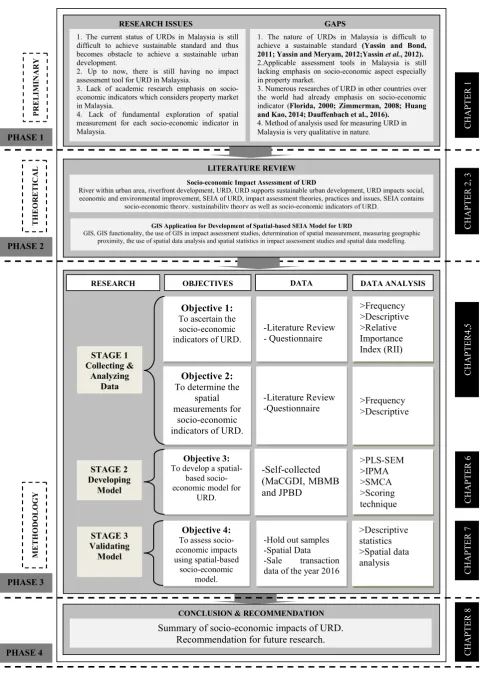
This research has four phases of methodology, and summary of each phase is explained in the sub-sections below. A quantitative approach was used for data collection and analysis. One case study, based at the Melaka River within urban area, was selected for this research. Figure 1.1 shows the complete study design of this research. Further details of the methodology are elaborated in chapter 4.
1.10.1 Phase One
This phase focused on the preliminary study. It involved the process of identifying research issues and gaps, research questions, aims, objectives, scopes and limitations, as well as significance of the research.
1.10.2 Phase Two
Phase two concentrated on the development of theoretical framework, which was designed based on literature review. Various types of sources were referred, from journals, articles, reports, books and newspapers, to extract information on URD, socio-economic assessment, socio-economic indicators and GIS application. The information was extracted from journals, articles, reports, books and newspapers.
1.10.3 Phase Three
14
Stage one focused on the first and second objectives, where information gathered from literature review and field survey was used to formulate the data collection methods. The data was analysed using frequency and descriptive analyses, and Relative Important Index (RII). As for the field survey, a total of 500 questionnaires were distributed to respondents (i.e. property buildings' occupiers) located in the property buildings along Melaka River, Melaka, Malaysia. Stage two
addressed the third objectives which involved strategies undertaken to develop a spatial-based socio-economic model for URD. In this respect, the model was derived using Structural Equation Model-Partial Least Square (SEM-PLS) modelling. The socio-economic indicators were also analysed using GIS software to evaluate their spatial elements. Stage three concentrated on the fourth objective which involved the validation process of the developed model. An assessment index for URD was developed, namely Socio-economic Assessment (SEA) of URD index. This index was used to simultaneously evaluate the impact of URD in the selected case study area and validate the developed model.
1.10.4 Phase Four
Figure 1.1 Research Design
Figure 1.1 Research Design
CHAPTER 2, 3 THEOR ET ICA L PHASE 2 CHAPTER4 ,5 CHAPTER 6 CHAPTER 7
CONCLUSION & RECOMMENDATION Summary of socio-economic impacts of URD.
Recommendation for future research.
CHAPTER 8 METHODO LOGY PHASE 3 Objective 3:
To develop a spatial-based socio-economic model for
URD. -Self-collected (MaCGDI, MBMB and JPBD >PLS-SEM >IPMA >SMCA >Scoring technique STAGE 2 Developing Model -Literature Review - Questionnaire
DATA DATA ANALYSIS
OBJECTIVES
Objective 2:
To determine the spatial measurements for
socio-economic indicators of URD.
-Literature Review
-Questionnaire >Frequency >Descriptive RESEARCH
Objective 1:
To ascertain the socio-economic indicators of URD.
STAGE 1 Collecting & Analyzing Data >Frequency >Descriptive >Relative Importance Index (RII) >Descriptive statistics >Spatial data analysis Objective 4: To assess socio-economic impacts using spatial-based
socio-economic model.
-Hold out samples -Spatial Data -Sale transaction data of the year 2016 STAGE 3 Validating Model CHAPTER 1 PRELIMINA RY PHASE 1
RESEARCH ISSUES GAPS
1. The current status of URDs in Malaysia is still difficult to achieve sustainable standard and thus becomes obstacle to achieve a sustainable urban development.
2. Up to now, there is still having no impact assessment tool for URD in Malaysia.
3. Lack of academic research emphasis on socio-economic indicators which considers property market in Malaysia.
4. Lack of fundamental exploration of spatial measurement for each socio-economic indicator in Malaysia.
1. The nature of URDs in Malaysia is difficult to achieve a sustainable standard (Yassin and Bond, 2011; Yassin and Meryam, 2012;Yassin et al., 2012).
2.Applicable assessment tools in Malaysia is still lacking emphasis on socio-economic aspect especially in property market.
3. Numerous researches of URD in other countries over the world had already emphasis on socio-economic indicator (Florida, 2000; Zimmerman, 2008; Huang and Kao, 2014; Dauffenbach et al., 2016).
4. Method of analysis used for measuring URD in Malaysia is very qualitative in nature.
LITERATURE REVIEW Socio-economic Impact Assessment of URD
River within urban area, riverfront development, URD, URD supports sustainable urban development, URD impacts social, economic and environmental improvement, SEIA of URD, impact assessment theories, practices and issues, SEIA contains
socio-economic theory, sustainability theory as well as socio-economic indicators of URD.
GIS Application for Development of Spatial-based SEIA Model for URD
GIS, GIS functionality, the use of GIS in impact assessment studies, determination of spatial measurement, measuring geographic proximity, the use of spatial data analysis and spatial statistics in impact assessment studies and spatial data modelling.
16 1.11 Chapter Layout
This thesis is structured into eight chapters. The chapters are organized to ensure achievement of desired goals and objectives, as follows:
Chapter 1 is an introduction to the research. This chapter contains the general framework of the research that includes research background, problem statement, research questions, research aims, objectives, scopes and limitations, significance of
research, and the overview of research methodology.
Chapter 2 reviews the literature on river and urban river, riverfront development, evolution of urban riverfront, URD, URD-supported sustainable urban development, and URD impacts on social, economic and environmental growth. This chapter also elaborates on SEA and socio-economic indicators, its current practices on URD in Malaysia as well as other countries.
Chapter 3 discusses the spatial-based socio-economic modelling of the URD, the importance of emphasizing spatial elements in socio-economic modelling of URD, basic concepts of the spatial assessment of URD. This chapter also highlights spatial statistical procedures undertaken for socio-economic modelling, spatial measurement of socio-economic indicators specifically on accessibility, neighbourhood and environmental measures. The GIS software procedures are also outlined in this chapter.
Chapter 4 elucidates the research methodology of this study. Details on the research approach, sampling, methods of data collection and analysis are explained.
Chapter 6 elaborates on the data analysis and results based on descriptive analysis, Structural Equation Model-Partial Least Square (SEM-PLS), spatial data analysis and spatial statistical analysis. Precisely, the SEM-PLS analysis was conducted using SmartPLS software version 3.6.2, while spatial data analysis was carried out using ArGIS software version 10.4.
Chapter 7 focuses on spatial-based socio-economic modelling for URD. This
chapter also includes indexing socio-economic of URD variables. Then, a validation of the developed model was carried out using statistical-based assessment (i.e. statistical approach-using hold-out samples) and spatial-based assessment (integrated approach-using hold-out samples and spatial data), where the both results were compared to evaluate the applicability of the model in determining the socio-economic impacts of the URD. To carry out this assessment procedures, the empirical investigation was conducted within the case study area (i.e. Melaka River, Melaka, Malaysia).
259 REFERENCES
A.Santos, J. R. (2013) ‘Cronbach ’ s Alpha : A Tool for Assessing the Reliability of Scales’, Journal of Extension.
Abdullah, K. (2002) Integtrated river basin management. Penang, Malaysia: Universiti Sains Malaysia Press.
Abdullah Mohamad Said (2010) Social Impact Assessment in Malaysia: Present
Applications and The Way Forward. Professori. Shah Alam, Selangor,
Malaysia: University Publication Centre (UPENA), Universiti Teknologi MARA (UiTM).
Abubakar, I. and Yusuf, A. A. (2018) ‘GIS and Space Syntax: An Analysis of Accessibility to Urban Green Areas in Doha District of Dammam Me’, in
International Symposium of Ecology 2018. Kastamonu, Turkey, pp. 1–8.
Adams, D. and Tiesdell, S. (2010) ‘Planners as Market Actors : Rethinking State – Market Relations in Land and Property’, Planning Theory & Practice ISSN:, 11(2), pp. 187–207.
Adegoke, O. J. (2014) ‘Critical factors determining rental value of residential property in Ibadan metropolis, Nigeria’, Property Management.
Adelle, C. and Weiland, S. (2012) ‘Policy assessment: The state of the art’, Impact
Assessment and Project Appraisal, 30(1), pp. 25–33.
Adom, A. Y., Jussem, B., Pudun, J. and Yatim, A. (2012) ‘Factors That Influence Visitors ’ Satisfaction Toward Kuching Waterfront’, Journal for The Advancement of Science & Arts, 3(2), pp. 40–48.
Afra Neitzke, A. C., Colauto, R. D. and de Almeida, V. E. (2014) ‘Victoria Grocery: Challenges and Surprises in that “Be Entrepreuner”’, Merceria Victoria: Retos Y Sorpores As Em ‘Ser Empresario’.
Ahn, K.-W., Lim, J.-C., Lee, Y.-K., Choi, T.-B., Lee, K.-S., Im, M.-S., Go, Y.-H. and Suh, J.-H. (2016) ‘Vegetation Classification and Distributional Pattern in
Damyang Riverine Wetland’, J. Environ. Impact Assess., 25(2), pp. 89–102. Alaghmand, S., Abdullah, R., Abustan, I. and Vosoogh, B. (2010) ‘GIS-based River
Alam, B. M. (2015) ‘Influence of transit accessibility to jobs on the employability of the welfare recipients: The case of Broward County, Florida’, Dissertation
Abstracts International, A: The Humanities and Social Sciences.
Alam, K. (2008) ‘Cost-benefit analysis of restoring buriganga river, Bangladesh’,
International Journal of Water Resources Development, 24(4), pp. 593–607.
Aliyu, M. and Muhammad Ludin, A. N. (2015) ‘A Review of Spatial Multi Criteria
Analysis ( SMCA ) Methods for Sustainable Land Use Planning ( SLUP )’,
Journal of Multidisciplinary Engineering Science and Technology, 2(9), pp. 2581–2590.
Amiril, A., Nawawi, A. H., Takim, R. and Latif, S. N. F. A. (2014) ‘Transportation Infrastructure Project Sustainability Factors and Performance’, Procedia -
Social and Behavioral Sciences, 153, pp. 90–98.
Anderson, S. . and West, S. E. (2006) ‘Open space , residential property values , and spatial context’, Regional Science and Urban Economics, 36, pp. 773–789. Anderson, S. and West, S. (2006) ‘Open space, residential property values, and
spatial context’, Regional Science and Urban Economics.
Ansar, A., Flyvbjerg, B., Budzier, A. and Lunn, D. (2016) ‘Does infrastructure investment lead to economic growth or economic fragility? Evidence from China’, Oxford Review of Economic Policy.
Anseel, F., Lievens, F., Schollaert, E. and Choragwicka, B. (2010) ‘Response rates in organizational science, 1995-2008: A meta-analytic review and guidelines for survey researchers’, Journal of Business and Psychology.
Anselin, L. (1992) Spatial Data Analysis With GIS: An Introduction To Application in the Social Sciences.
Anselin, L., Syabri, I. and Kho, Y. (2006) ‘GeoDa: An introduction to spatial data analysis’, Geographical Analysis.
Arora, A. and Tiwari, G. (2017) A Handbook for Socio-Economic Impact
Assessment ( SEIA ) Methodology for Future Urban Transport ( FUT ) Projects A Handbook for Socio-economic Impact Assessment ( SEIA ) of Future Urban Transport ( FUT ) Projects. Transporta. New Delhi, India: Indian Institute of Technology Delhi.
Astrachan, C. B., Patel, V. K. and Wanzenried, G. (2014) ‘A comparative study of CB-SEM and PLS-SEM for theory development in family firm research’,
261
Atkinson, S. F. and Canter, L. W. (2011) ‘Assessing the cumulative effects of projects using geographic information systems’, Environmental Impact
Assessment Review.
Awange, J. L. and Kiema, J. B. K. (2013) Environmental Geoinformatics Monitoring and Management.
Azizi Jalilian, M., Danehkar, A. and Shaban Ali Fami, H. (2012) ‘Determination of
indicators and standards for tourism impacts in protected Karaj River, Iran’,
Tourism Management, 33(1), pp. 61–63.
Azlina, M. Y., Abdul Jalil, O., Rohaizan, R. and Mohd. Najib, M. R. (2016) ‘Assessing the effect of waterfront development in Malaysia’, Social Sciences
(Pakistan), 11(11), pp. 2897–2901.
Azman Ariffin, Haziq Kamal Mukhelas, Abd. Hamid Mar Iman, Ghazali Desa, I. and Mohammad, S. (2014) ‘Spatial-Based Sustainability Assessment of Urban Neighbourhoods : A Case Study of Johor Spatial-Based Sustainability Assessment of Urban Neighbourhoods : A Case Study of Johor’, Jurnal Teknologi, (January).
Azman Ariffin, Haziq Kamal Mukhelas, Abd. Hamid Mar Iman, Ghazali Desa, I. S. M. (2014a) ‘Spatial-Based Sustainability Assessment of Urban Neighbourhoods: A Case Study of Johor Bahru City Council, Malaysia’,
Jurnal Teknologi, pp. 1–17.
Azman Ariffin, Haziq Kamal Mukhelas, Abd. Hamid Mar Iman, Ghazali Desa, I. S. M. (2014b) ‘Spatial-Based Sustainability Assessment of Urban Neighbourhoods: A Case Study of Johor Bahru City Council, Malaysia’,
Jurnal Teknologi, pp. 1–17.
Bahari, N. I., Arshad, A. K. and Yahya, Z. (2013) ‘Assessing the pedestrians’ perception of the sidewalk facilities based on pedestrian travel purpose’, in
Proceedings - 2013 IEEE 9th International Colloquium on Signal Processing
and its Applications, CSPA 2013.
Baker, G., Michalk, D., Whitby, W. and O’Grady, S. (2002) ‘Influence of sewage waste on the abundance of earthworms in pastures in south-eastern Australia’,
European Journal of Soil Biology.
Balen, M. Van, Dooms, M. and Haezendonck, E. (2012) ‘The economic impact of river toursm on ports: The case of Brussels’, in International Association of
Maritime Economists 2012 Conference, p. 14.
Balzano, S., Porzio, G. C., Trinchera, L., Balzano, S., Porzio, G. C., Trinchera, L., Path, P. L. S., Data, O., Balzano, S., Porzio, G. C. and Trinchera, L. (2010) ‘PLS Path Modeling with Ordinal Data’, in 34th Annual conference of the
German Classification Society (GFKL’10).
Barrow, C. J. (1997) Environmental and social impact assessment: an introduction, Environmental and social impact assessment: an introduction.
Bartlett, R. V and Kurian, P. A. (1999) ‘The Theory of Environmental Impact Assessment: Implicit models of policy making What makes EIA work ?’,
Policy and Politics, 27(4).
Barua, M. (2016) ‘Lively commodities and encounter value’, Environment and
Planning D: Society and Space.
Baruch, Y. (1999) ‘Response Rate in Academic Studies-A Comparative Analysis’,
Human Relations.
Beca, P. L. (2007) Odour Buffer Distances for Ballarat North, Ballarat South and Cardigan Village WWTPs.
Belka, K. M. (2005) Multicriteria analysis and GIS application in the selection of sustainable motorway corridor. Linköpings universitet.
Bender, A., Din, A., Hoesli, M. and Laakso, J. (1999) ‘Environmental quality perceptions of urban commercial real estate’, Journal of Property Investment & Finance.
Bennett, G. and Mulongoy, K. J. (2006) ‘Review of experience with ecological networks, corridors and buffer zones’, CBD Technical Series.
Bennett, R. J. (1985) ‘A reappraisal of the role of spatial science and statistical inference in geography in Britain’, Espace géographique, 14(1), pp. 23–28.
Benson, E. D., Hansen, J. L., Schwartz, Jr, A. L. and Smersh, G. T. (1998) ‘Pricing Residential Amenities : The Value of a View’, Journal of Real Estate
Finance and Economics, 16(1), pp. 55–73.
263
Bereitschaft, B. (2015) ‘Pedestrian exposure to near-roadway PM2.5 in mixed-use urban corridors: A case study of Omaha, Nebraska’, Sustainable Cities and Society.
Bertram, C., Meyerhoff, J., Rehdanz, K. and Wüstemann, H. (2017) ‘Differences in the recreational value of urban parks between weekdays and weekends: A discrete choice analysis’, Landscape and Urban Planning.
Bhat, C., Handy, S., Kokkelman, K., Mahmassani, H., Chen, Q. and Weston, L. (2000) Development of An Urban Accessibility Index: Literature Review. Austin.
Bisson, P. A., Montgomery, D. R. and Buffington, J. M. (2017) ‘Valley Segments, Stream Reaches, and Channel Units’, in Methods in Stream Ecology: Third Edition.
Bissonnette, L., Wilson, K., Bell, S. and Shah, T. I. (2012) ‘Neighbourhoods and Potential Access To Health Care : The Role of Spatial and Aspatial Factors’,
Health & Place, 18(4), pp. 841–853.
Biswas, T., Wang, T.-H. and Krishnamurti, R. (2013) ‘From Design To Pre-certification Using Building Information Modeling’, Journal of Green Building.
Bivand, R. (1998) ‘A review of spatial statistical techniques for location studies’,
Business.
Blumenberg, E., Pierce, G. and Rutgers, M. S. (2015) ‘Transportation Access, Residential Location, and Economic Opportunity: Evidence From Two Housing Voucher Experiments’, Cityscape: A Journal of Policy Development and Research.
Bogena, H. (2015) ‘Water and Sustainable development’, UN-Water Decade Programme on Advocacy and Communication (UNW-DPAC), pp. 1–6. Bond, A., Morrison-Saunders, A. and Pope, J. (2012) ‘Sustainability assessment: The
state of the art’, Impact Assessment and Project Appraisal, 30(1), pp. 53–62. Bowker, J. M., English, D. B. K. and Cordell, H. K. (1999) ‘Projections on outdoor
recreation participation to 2050’, in Outdoor recreation in American life: a
national assessment of demand and supply trends.