Direct Torque Control of Three Phase Induction Motor Using Fuzzy Logic
Mr. Rajendra S. Soni1, Prof. S. S. Dhamal21
Student, M. E. Electrical (Control Systems), K. K. Wagh College of Engg.& Research, Nasik 2
Asso. Professor, Department of Electrical Engg.,K. K. Wagh College of Engg.& Research, Nasik
ISSN: 2231-5381
http://www.ijettjournal.org
Page 161Abstract
Induction motor drives using field oriented
control (FOC) for torque and flux control have
been used in high performance industrial
applications instead of dc motors for many
years. In FOC, torque and flux of an induction
motor can be controlled independently by
decoupling the stator current into its
orthogonal components. The FOC method has
achieved a quick torque response. But in order
to achieve expected performance from FOC,
exact identification of parameters is required.
A new torque and flux control scheme called
the direct torque control (DTC) has been
introduced for induction motors. In DTC the
torque and flux of an induction motor can be
controlled directly by applying a suitable
voltage vector to the stator of an induction
motor. However, convectional DTC result in
large torque and flux ripples. In this paper, a
controller based on fuzzy logic is designed to
improve the performance of DTC and reduce
the torque and flux ripple.
Keywords
Induction Motor Drives, FOC, DTC, Fuzzy Logic,
Orthogonal Components, Torque and Flux ripples.
1.
Introduction
The Induction Motor (IM), developed in the last century, is extensively used in AC converters. However, the IM control system is much more complex and expensive. The most common scalar
control technique was the Constant Volts per Hertz (CVH) strategy, so called because it adjusts the stator voltage magnitude proportionally to the operating frequency to keep the IM stator flux approximately constant. This is a simple control technique, but it has a limited and non-accurate speed range, particularly at low speeds, and has a poor torque response. The introduction of the vector control technique partially solves the IM control problem. In the 70’s, F. Blaschke developed the IM Field Oriented Control (FOC). In this scheme, torque and flux of an induction motor are controlled independently by decoupling the stator current into its orthogonal components. The FOC method has achieved a quick torque response. In FOC, exact identification of parameters is required.
In the 80’s, new IM torque control techniques was developed. Takahasi& Noguchi presented the Direct Torque Control (DTC). It is most convenient for low and medium power applications. In the DTC scheme, the inverter bridge switch connections are directly selected using aqualitative behavior rule set in order to control the stator flux and the torque. The DTC scheme
produces a fast torque response while keeping
the IM stator flux and torque decoupled. With
this scheme the torque and flux presents a high
ripple.
The main advantages of DTC are
absence of coordinate transformation and current
regulator; absence of separate voltage
ISSN: 2231-5381
http://www.ijettjournal.org
Page 162 conventional DTC are high torque ripple andslow transient response to the step change in
torque during start-up. For that reason DTC
using fuzzy logic is used to reduce the ripple in
the torque. In this paper all three methods for
torque and flux control of induction motor i.e.
FOC, DTC and DTC using fuzzy logic are
explained.
2.
Conventional Direct Torque
Control
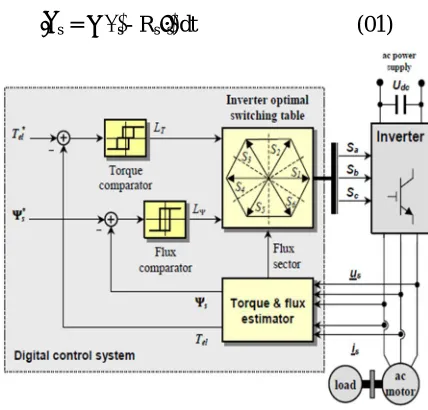
The DTC scheme is very simple in function; in its basic configuration it consists of hysteresis controllers, torque and flux estimator and a switching table. The basic concept of DTC is to control directly both the stator flux linkage (or rotor flux linkage, or magnetizing flux linkage) and electromagnetic torque of machine simultaneously by the selection of optimum inverter switching modes. The use of a switching table for voltage vector selection provides fast torque response, low inverter switching frequency and low harmonic losses without the complex field orientation by restricting the flux and torque errors within respective flux and torque hysteresis bands with the optimum selection being made. The DTC controller consists of two hysteresis comparator (flux and torque) to select the switching voltage vector in order to maintain flux and torque between upper and lower limit.The DTC scheme of induction motor drive is explained in detail.
2.1 The Basic Direct Torque Control (DTC)
Scheme
The Basic direct torque control scheme is
shown below. For implementing the control
loop, the actual stator flux (amplitude and
orientation) and electromagnetic torque are
calculated by an estimator from the statorvoltages
and currents. The stator flux is an integral of the stator EMF:
s = ∫ ( ̅s - Rs ̅s)dt (01)
Figure 01: Basic direct torque control scheme
The developed torque is obtained by the product of stator current and flux as shown below
Tel = ̅s.
j
s (02)In DTC scheme the error between the estimated torque Teland the reference torque Tel*is the input of a three level hysteresiscomparator defining the error torque state LTin modulus and sign, whereas the error between the estimated statorflux magnitude Ψsand the reference stator flux magnitude
Ψs*is the input of a two level hysteresis comparator
defining the error flux state LΨ. With this
information, a voltage selector determines the stator voltage that is required to increase or decrease the variables (torque or flux) according to the demands. The selection of the appropriate voltage vector is based on a switching table.
3.
Direct Torque Control Of
Induction Motor Using Fuzzy
Logic
ISSN: 2231-5381
http://www.ijettjournal.org
Page 163simple implementation, insensitivity to motor parameters and fast torque response. However, big torque and flux linkage ripples is a main problem associated with the conventional DTC method because of the use of two-value hysteretic controllers for the stator flux linkage. Therefore, the fuzzy logic (FL) method based on the language rules, is employed to solve this nonlinear issue.
3.1 Principle Of Fuzzy Direct Control The fuzzy controller is designed to have three fuzzy state Variables and one control variable for achieving direct torque control of the induction machine, there are three variable input fuzzy logic controllers, the stator flux error, electromagnetic torque error, and angle of flux stator respectively the output it is the voltage space vector shown in Figure 2.
Figure 2: Fuzzy Logic Controller 3.2 Flux Linkage Error
The errors of flux linkage is related to reference value of stator’s flux Ψsref and real value of
stator’s flux Ψs, they are subject to equation,
= − (03)
Voltage vector shall cause different
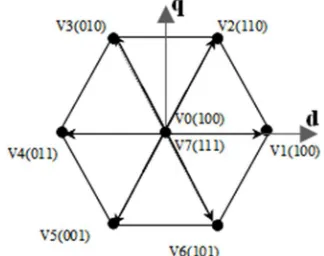
affection to stator’s flux in different flux position shown in Figure 3, given that stator’s flux θ locates in domain θ1, then V4 will make flux increase rapidly, V3 will make flux decrease rapidly, V5 and V6 will make flux increase slowly; and V1 and V2 will make flux decrease slowly, we use the three following linguistic terms: negative value, zero value and positive value denoted respectively N, Z and P. Three fuzzy sets are then defined by the delta and trapezoidal membership functions as given by Figure 4.
Figure 3: Partition of the d, q Plane into 6 Angular Sectors
Figure 4 is the membership function of flux linkage error i.e. the difference between actual stator flux and reference flux.
Figure 4: Membership Function of Flux linkage error 3.3 Electromagnetic Torque Error
The electromagnetic torque error ΔTemis related to desired torque value Tref and actual torque value Temsubject to equation 04 as shown below,
= − (04)
In domain θ1, V2 and V6 will make torque increase rapidly, V1 and V5 will make torque increase rapidly, V4 will make torque increase slowly and V3, V0 and V7 will make torque increaseslowly.
ISSN: 2231-5381
http://www.ijettjournal.org
Page 164Therefore, these rules may be described by language variable, i, e. Positive Large (LP), Positive Small (PS), Negative Small (NS), and Negative Large (NL), their membership function’s distribution is shown as Figure 5.
3.4 Angle of Flux Linkage (ΘS)
The angle of flux linkage θs is an angle between stator’s flux Ψs and a reference axis is defined by equation:
= arctan
(05)
In (05), (Ψds, Ψqs) are the component of flux linkageΨs in the plane (d, q) on the basis of voltage
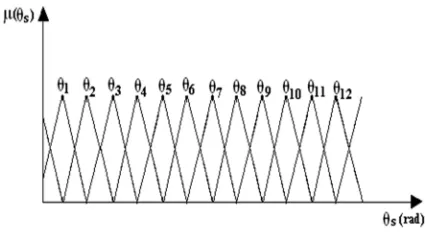
vector shown as Figure 03. The fuzzy variable θs may be described by 12 language values (θ1→θ12), its membership function’s distribution is shown Figure 6.
Figure 6: Membership Function for Flux Position 3.5 The Control Variable
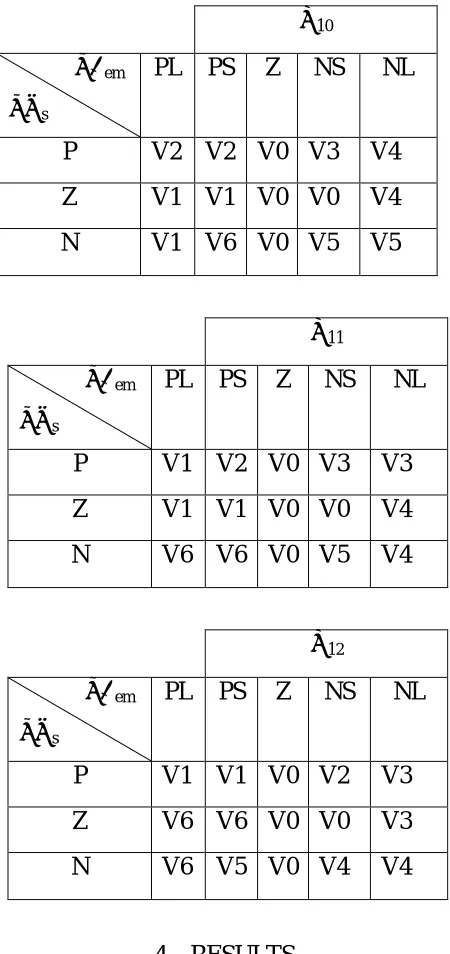
The control variable is the inverter switching state (n). In a six step inverter, seven distinct switching states are possible. The switching states are crisp thus do not need a fuzzy membership distribution. Each control rule can be described using the state variables ΔΨs, ΔTemand θs and the control variable n (characterizing the inverter switching state). The ith rule Ri can be written as:
Ri: If ΔΨs is Ai, ΔTem is Bi and θs is Ci then n is Ni These rules are established using Mamdani's procedure based on min-max decision. The membership functions of variables A, B, C and N are
given by µA, µB, µC and µN respectively. The
weighting factor αi for ith rule can be written as:
= min µ (
), µ (
), µ (
)
- - - (06)
By fuzzy reasoning, Mamdani's minimum procedure gives:
µ ( ) =
min
( , µ ( )) - - - (07)
The membership function µN of the output n is point given by,
µ ( ) =
max
= 180
( , µ ( ))
- - - (08)
In this case, the outputs are crisp; the maximum criterion is used for defuzzification. By this method, the fuzzy of output which has the maximum possibility distribution, is used as control output.
µ
( ) =
max
= 7 (µ
( ))
- - - (09)
Depending on the membership function
values of electromagnetic torque error ΔTem
,
flux linkage error ΔΨs
and stator flux
position θs
, a suitable voltage vector will be
applied to the induction motor stator so that
errors in electromagnetic torque and stator
flux will be minimized as per the following
rules tables.
TABLE 01: Fuzzy Logic Rules
θ1
ΔTem
ΔΨs
PL PS
Z
NS
N
L
P
V6 V1 V0 V2
V2
Z
V6 V6 V0 V0
V3
ISSN: 2231-5381
http://www.ijettjournal.org
Page 165Θ
8ΔT
emΔΨ
sPL PS
Z
NS
NL
P
V3 V3 V0 V4
V5
Z
V2 V2 V0 V0
V5
N
V2 V1 V0 V6
V6
Θ9
ΔT
emΔΨs
PL PS
Z
NS
NL
P
V2 V3 V0 V4
V4
Z
V2 V2 V0 V0
V5
N
V1 V1 V0 V6
V5
θ2
ΔTem
ΔΨs
PL PS
Z
NS
NL
P
V6 V6 V0 V1
V2
Z
V5 V5 V0 V0
V2
N
V5 V4 V0 V3
V3
θ3
ΔTem
ΔΨs
PL PS
Z
NS
NL
P
V5 V6 V0 V1
V1
Z
V5 V5 V0 V0
V2
N
V4 V4 V0 V3
V2
θ
4ΔTem
ΔΨs
PL PS
Z
NS NL
P
V5 V5 V0 V6
V1
Z
V4 V4 V0 V0
V1
N
V4 V3 V0 V0
V2
θ
5ΔTem
ΔΨs
PL PS
Z
NS NL
P
V4 V5 V0 V6
V6
Z
V4 V4 V0 V0
V1
N
V3 V3 V0 V2
V1
θ6
ΔTem
ΔΨ
sPL PS
Z
NS
NL
P
V4 V4 V0 V5
V6
Z
V3 V3 V0 V6
V2
N
V3 V2 V0 V1
V1
Θ7
ΔTem
ΔΨs
PL PS
Z
NS
NL
P
V3 V4 V0 V5
V5
Z
V3 V3 V0 V0
V6
ISSN: 2231-5381
http://www.ijettjournal.org
Page 166Θ
11ΔTem
ΔΨs
PL PS
Z
NS
NL
P
V1 V2 V0 V3
V3
Z
V1 V1 V0 V0
V4
N
V6 V6 V0 V5
V4
Θ12
ΔTem
ΔΨs
PL PS
Z
NS
NL
P
V1 V1 V0 V2
V3
Z
V6 V6 V0 V0
V3
N
V6 V5 V0 V4
V4
4
RESULTS
The results were obtained after performing the test on a 2HP, 400V, 50Hz, Three Phase Induction Motor. The actual torque was being estimated by the controller from sensed values of voltages and currents. The desired torque was given as a reference input to the controller and by comparing the actual and desired value of the torque; the controller selects a particular voltage vector to apply at the stator of the motor so that the desired torque is achieved.
The torque set point was varied as below:
Initially 300N-cm this is achieved by the motor in about 15 seconds. Following this a torque set point is set to 400N-cm at 25 seconds achieved at around 29 seconds. Followed by a new set point of 1000N-cm at 70 seconds and followed by a last set point at 600N-cm. From the graph it is seen clearly that these are achieved in a few seconds of the set point time.
Figure 7: Torque Control
5
CONCLUSION
In this paper, a kind of fuzzy torque control system for induction motor based on fuzzy control technique is presented. Compared to conventional DTC, fuzzy logic control method is easily implemented, and the steady performances of ripples of both torque and flux are considerably improved. The main improvements are:
Reduction of torque and current ripples.
No flux droppings caused by sector changes
circular trajectory.
Fast torque response.
Zero-steady-state torque and flux
REFERENCES
[1] “Fundamentals of Inverter Fed
AC-Motors”, Technical Manual by BALDOR. [2] “Direct Self Control (DSC) of Inverter-Fed
Induction Machine: A Basis for Speed Control without Speed Measurement”, IEEE
Θ
10ΔTem
ΔΨs
PL PS
Z
NS
NL
P
V2 V2 V0 V3
V4
Z
V1 V1 V0 V0
V4
ISSN: 2231-5381
http://www.ijettjournal.org
Page 167Transactions on Industry Applications, Vol. 28, No. 3, May-June 1992.
[3] Giuseppe Buja, Domenico Casadei and
Giovanni Serra, “Direct Torque Control of Induction Motor Drives”, Department of Electrical Engineering, University of Padova and University of Bologna, Italy, 1997. [4] “Field Orientated Control of 3-Phase
AC-Motors”, Literature Number: BPRA073 Texas Instruments, Europe, February 1998.
[5] “Direct Torque Control of Sensorless
Induction Motor Drives: A Sliding-Mode Approach”, IEEE Transactions on Industry Applications, Vol. 40, No. 2 March/ April 2004.
[6] “Sensorless Sliding Mode Direct Torque
Control (DTC) of Induction Motor”, IEEE ISIE 2005, June 20-23, 2005, Dubrovnik, Croatia.
[7] “Direct Torque Control of Induction Motors
using Fuzzy Logic with current limitation”, Marcel Ortega, Jose Restrepo, Julio Viola,
Marıa I. Gimenez, Victor Guzman,
Venezuela, ©2005 IEEE.
[8] “Assessment of Direct Torque Control for Induction Motor Drives”, Bulletin of the Polish Academy of Sciences, Technical Sciences Vol. 54, No. 3, 2006 University of Bologna, Italy.
[9] “Simulink Model of Direct Torque Control of Induction Machine”, American Journal of Applied Sciences 5 (8): 1083-1090, 2008
ISSN 1546-9239 © 2008 Science
Publications.
[10]“Direct Torque Control of Induction Motor Based on Fuzzy Logic”, Guohan Lin, Zhiwei Xu, Department of Electrical & Information, Hunan Institute of Engineering, Xiangtan, China.
[11]R. Parekh, “AC Indcution Motor
Fundamentals,” AN887, Microchip
Technology Inc., 2003.
[12]M. G. Say, Alternating Current Machines.
PITMAN INTERNATIONAL, Fourth
Edition.
[13]Jon Burroughs, “Controlling 3-Phase AC
Induction Motors Using the
PIC18F4431,”AN900, Microchip