ISSN: 0128-7702 © Universiti Putra Malaysia Press
SOCIAL SCIENCES & HUMANITIES
Journal homepage: http://www.pertanika.upm.edu.my/E-mail addresses:
[email protected] (Noorihan Abdul Rahman), [email protected] (Shamsul Sahibuddin)
* Corresponding author
Article history:
Received: 15 September 2016 Accepted: 30 January 2017 ARTICLE INFO
Improving Collaborative Activities in E-learning using Social
Presence Requirement Elicitation Process
Noorihan Abdul Rahman1* and Shamsul Sahibuddin2
1Faculty of Computer and Mathematical Sciences, Universiti Teknologi MARA Kelantan, 18500 Machang, Kelantan, Malaysia
2Advanced Informatics School, Universiti Teknologi Malaysia, 54100 Kuala Lumpur, Malaysia
ABSTRACT
In developing learning application, a social presence requirement is needed to gain a sense of connectedness albeit through user interface. Social presence is important in order to increase interaction and collaboration between users. In motivating students to actively use E-learning, the requirements elicitation process plays an important role. Multiphase mixed method design is used in this study to evaluate the usability of requirements elicitation product that can be used to extract social presence requirements. There are three artefacts
namely Technical Guide to Requirements Elicitation for Social Presence Support, Social
Presence Requirements Template and Social Presence Requirements for E-learning that are produced in this study to demonstrate their role in supporting E-learning environment.
Keywords: Artefact, collaborative application, E-learning, Requirements elicitation process, requirements, social presence requirements, users
INTRODUCTION
Requirements elicitation is an initial process in Requirements Engineering (RE) to gather stakeholders’ ideas before software
Noorihan Abdul Rahman and Shamsul Sahibuddin
202 Pertanika J. Soc. Sci. & Hum. 25 (S): 201 - 210 (2017)
resolving conflicts or disagreements is a challenge because it is generated by humans (Fournier, Kop, & Durand, 2014). Therefore, besides having technical solutions for developing collaborative applications, stakeholders should consider requirements from the human perspective (Hayat et al., 2010).
A proper requirements elicitation technique may encourage the stakeholders to obtain more accurate requirements (Dalpiaz, Giorgini, & Mylopoulos, 2013; Dzung & Ohnishi, 2009; Farfeleder et al., 2011; Kaiya & Saeki, 2006; Kitamura, Hasegawa,
Kaiya, & Saeki, 2008; Konaté, Sahraoui, & Kolfschoten, 2013; Liaskos, McIlraith, Sohrabi, & Mylopoulos, 2011; Raspotnig, Karpati, & Katta, 2012; Shibaoka, Kaiya, & Saeki, 2007; Thurimella & Maalej, 2013) of social presence in E-learning. To address RE issues in collaborative application, the authors have related to social presence to promote interaction in a collaborative application or face-to-face interaction. Figure 1 illustrates how social requirements and social presence may be understood in
the RE field and clarify the need for social
presence as a social presence requirement.
Figure 1. The Relationship between Social Presence and Social RequirementsFigure 1. The Relationship between Social Presence and Social Requirements
There is a need to prepare an accurate set of requirements specification to better
understand the users’ needs in E-learning. In this research, the requirements elicitation
process reveals an accurate set of social presence requirements. The goal for having
requirements elicitation process in this study is to ensure that users are satisfied with the
product. Effective usage of E-learning is essential to motivate the students to learn and use
the application actively. In developing E-learning as a collaborative application, the
stakeholders should gather the requirements needed by students to ensure that they can
interact and share knowledge actively in the E-learning community. Therefore, by using a
suitable requirements elicitation process, stakeholders will be able to successfully capture the
right criteria based on users’ interests and minimize requirement errors (Azadegan, Cheng,
Niederman, & Yin, 2013; Islam & Houmb, 2010; Vale, Albuquerque, & Beserra, 2010).
This paper envisions the opportunity to the RE field to investigate the knowledge of
requirements elicitation process in E-learning whereby the E-learning is an example of
application that is demonstrating the ability of collaborative activities. This paper highlights There is a need to prepare an accurate set
of requirements specification to better understand the users’ needs in E-learning. In this research, the requirements elicitation process reveals an accurate set of social presence requirements. The goal for having requirements elicitation process in this study
is to ensure that users are satisfied with the
product. Effective usage of E-learning is essential to motivate the students to learn and
203 Pertanika J. Soc. Sci. & Hum. 25 (S): 201 - 210 (2017)
(Azadegan, Cheng, Niederman, & Yin, 2013; Islam & Houmb, 2010; Vale, Albuquerque, & Beserra, 2010).
This paper envisions the opportunity to
the RE field to investigate the knowledge
of requirements elicitation process in E-learning whereby the E-learning is an example of application that is demonstrating the ability of collaborative activities. This paper highlights the importance of eliciting social presence via learning technology by using social presence requirements elicitation process. It will evaluate the usability of requirements elicitation product for supporting social presence requirements three artefacts known as Technical Guide to Requirements Elicitation for Social Presence Support, Social Presence Requirements
Template and Social Presence Requirements for E-learning. The purpose of these artefacts is to allow developers or requirements engineers to extract information related to social presence and that of E-learning users. The artefacts can also be supporting documents to elicit social presence elements for other collaborative applications besides E-learning.
METHODS
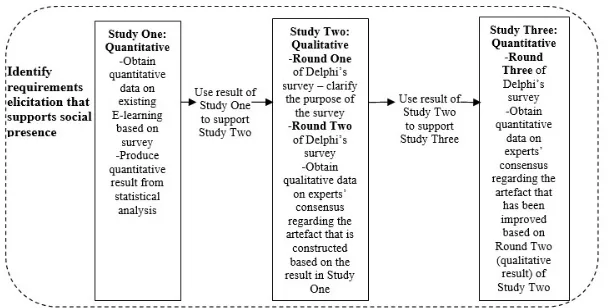
In this work, the multiphase mixed method design is used as a guide as shown in Figure 2. The author has chosen this design method in order to elaborate findings of social presence requirements and address the contribution with the Requirements Engineering (RE) body of knowledge.
Figure 2. Multiphase mixed method design
requirements elicitation process. It will evaluate the usability of requirements elicitation
product for supporting social presence requirements three artefacts known as Technical Guide
to Requirements Elicitation for Social Presence Support, Social Presence Requirements
Template and Social Presence Requirements for E-learning. The purpose of these artefacts is
to allow developers or requirements engineers to extract information related to social presence
and that of E-learning users. The artefacts can also be supporting documents to elicit social
presence elements for other collaborative applications besides E-learning.
METHODS
In this work, the multiphase mixed method design is used as a guide as shown in Figure 2.
The author has chosen this design method in order to elaborate findings of social presence
requirements and address the contribution with the Requirements Engineering (RE) body of
knowledge
Figure 2. Multiphase mixed method design
Study One in the multiphase design was conducted to investigate the existing requirements elicitation processes for supporting social presence in a collaborative application. It aims to identify the social presence factors of the E-learning domain,
Noorihan Abdul Rahman and Shamsul Sahibuddin
multiphase design. A detailed description on Study One has been revealed by Rahman and Sahibuddin (2016).
Next, the initial artefact produced in Study One was used in Study Two to demonstrate the second part in the multiphase method design. The objective of Study Two was to demonstrate the usability of social presence requirements in a collaborative application. The initial artefact was used as an initial document to develop a ‘Technical Guide to Requirements Elicitation for Social Presence Support’. In this research, a three-round Delphi survey was used to seek consensus from experts regarding the developed artefact. A Delphi survey was carried out to evaluate the usability of social presence requirement in supporting a collaborative application. The evaluation of the artefact, which has the support of social presence requirements, was initiated to the E-learning domain. Round One and Round Two of the Delphi were carried in Study Two. Meanwhile, Round Three of the Delphi was carried out in Study Three of the multiphase method design.
Study Three, which consists of Round Three of the Delphi’s survey, was conducted quantitatively to evaluate the artefacts produced from the experts’ consensus in Round Two of the Delphi. The objective of Study Three was to evaluate the usability of the produced artefacts. Box plots are used to portray the results after conducting usability evaluation for the produced artefacts.
RESULTS AND DISCUSSION
This section elaborates on the usability evaluation after completing requirements elicitation process using box plot analyses. The box plot was used to visualize the concentration of the data in the respondents’ answers (Dean & Illowsky, 2013) as well as
to explain the findings (Uusimaki, 2004).
The purpose of presenting the box plot in the Delphi results was to help understand how the artefacts are related, such as to forecast feedback from the experts regarding the quality of the document structure for each artefact, the quality of the content for each artefact, and regarding the use of the social presence factors presented in the artefacts. The feedback obtained was analysed to obtain the experts’ opinions on Artefact One, Artefact Two, and Artefact Three. Examples survey instruments for the artefacts can be seen in Appendices section.
Figure 3 shows the E-learning and software documentation experts’ response to the structure of Artefact One. The overall results revealed that the artefact is well-structured, whereby the experts’ responses reached a median value of 4 and 5. As can be seen in Figure 3, the eleven experts expressed their responses equal to or more than 3 of the 5-point Likert scale values which indicated positive responses towards the structure of Artefact One.
Social Presence Requirements Elicitation in E-learning
205 Pertanika J. Soc. Sci. & Hum. 25 (S): 201 - 210 (2017)
the clarity of figures and tables, relevance
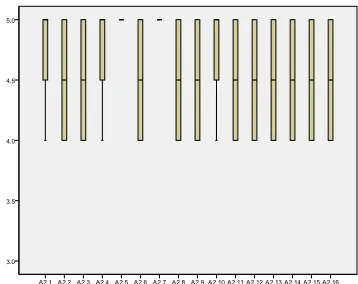
of content, documentation preciseness, documentation readability, documentation completeness, documentation accuracy, documentation consistency, being up-to-date and use examples in document were either 4, 4.5 or 5. The median results from the documentation experts were also 4.5 and 5. The median for the E-learning experts’ response towards document attributes was 4 and 5 for Artefact One. A similar response was also achieved from software documentation experts. Overall, the feedback of all experts was consistent regardless of their background. Therefore, it could be concluded that the results from the two groups are not extreme. The author also believed that the responses given by the experts contributed a positive respond, thus the artefact could be recommended for social presence requirements implementation for E-learning.
Next finding reveals the result for Artefact Two which consists of the analysis
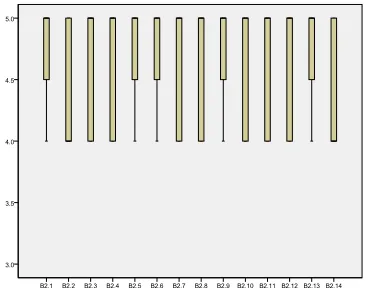
of Social Presence Requirements Template. Figure 5 depicts the box plot of the experts’ feedback for Social Presence Requirements Template. The response of the eleven experts showed a positive response, whereby the
seventy-fifth percentile is 5, which is the
highest degree in the 5-point Likert scale. Additionally, it also indicated that the use of the MoSCoW prioritization method introduced in this template was acceptable to software documentations’ experts and E-learning experts. The questions from B2.10 to B2.13, which asked the experts’ their opinions whether the template was able to give instructions on writing ‘Must Have’, ‘Should Have’, ‘Could Have’ and ‘Won’t Have’ requirements, achieved a median with a value of 5. This showed that the experts agreed on the use of MoSCoW prioritization method for classifying social presence elements as proposed earlier in the SEM analysis. In general, the experts agreed with the social presence requirements template which was represented by Artefact Two.
Figure 3. Box plot on the responses from four of the E-learning experts regarding the requirements elicitation contribution of social presence support
This section elaborates on the usability evaluation after completing requirements elicitation
process using box plot analyses. The box plot was used to visualize the concentration of the
data in the respondents’ answers (Dean & Illowsky, 2013) as well as to explain the findings
(Uusimaki, 2004). The purpose of presenting the box plot in the Delphi results was to help
understand how the artefacts are related, such as to forecast feedback from the experts
regarding the quality of the document structure for each artefact, the quality of the content for
each artefact, and regarding the use of the social presence factors presented in the artefacts.
The feedback obtained was analysed to obtain the experts’ opinions on Artefact One, Artefact
Two, and Artefact Three. Examples survey instruments for the artefacts can be seen in
Appendices section.
Figure 3 shows the E-learning and software documentation experts’ response to the
structure of Artefact One. The overall results revealed that the artefact is well-structured,
whereby the experts’ responses reached a median value of 4 and 5. As can be seen in Figure
3, the eleven experts expressed their responses equal to or more than 3 of the 5-point Likert
scale values which indicated positive responses towards the structure of Artefact One.
Figure 4. The E-learning experts’ responses towards the document attributes (Artefact One)
Figure 3. Box plot on the responses from four of the E-learning experts regarding the
requirements elicitation contribution of social presence support
As can be seen in Figure 4, a twenty-fifth percentile of the experts responded that the
attributes of Artefact One, such as the clarity of figures and tables, relevance of content,
documentation preciseness, documentation readability, documentation completeness,
documentation accuracy, documentation consistency, being up-to-date and use examples in
document were either 4, 4.5 or 5. The median results from the documentation experts were
also 4.5 and 5. The median for the E-learning experts’ response towards document attributes
was 4 and 5 for Artefact One. A similar response was also achieved from software
documentation experts. Overall, the feedback of all experts was consistent regardless of their
background. Therefore, it could be concluded that the results from the two groups are not
extreme. The author also believed that the responses given by the experts contributed a
positive respond, thus the artefact could be recommended for social presence requirements
implementation for E-learning.
Noorihan Abdul Rahman and Shamsul Sahibuddin
206 Pertanika J. Soc. Sci. & Hum. 25 (S): 201 - 210 (2017)
The authors also provide an analysis of the experts’ feedback on social presence requirements quality in E-learning using Artefact Three. Figure 6 depicts a box plot for analysing the quality of social presence requirements for the E-learning domain in Artefact Three. The quality was measured using the questions’ list from C2.1 to C2.14. Overall, the experts agreed that Artefact Three was acceptable since the documentation for social presence requirements for the E-learning domain was in the twenty-fifth percentile for all questions which were at 4 and 4.5. Question C2.9 also explained the experts’ positive
opinions with twenty-fifth percentile at 4
which revealed the experts’ feedback on the ability of factors such as Perceived Satisfaction (PS), Perceived Relevancy (PR), Perceived Confidence (PC), and
Perceived Attention (PA) to be justified as
social presence requirements in E-learning. The median reported in Figure 6 were 4 and 5 which infers that the experts gave high marks for accepting social requirements
documented for the E-learning applications in Artefact Three.
All three artefacts can be used as guide and reference in capturing social presence requirements in the E-learning domain. The features of E-learning described in the artefacts may differ from the features of social presence described in other collaborative applications. The usability evaluation performed by Delphi’s survey showed Artefact One, Artefact Two, and Artefact Three, was able to elicit the following elements: Perceived Satisfaction,
Perceived Relevancy, Perceived Confidence,
and Perceived Attention.
CONCLUSION
There is a potential to improve the elicitation process of capturing social presence requirements in E-learning. Requirements engineers and related stakeholders may face
some difficulties in obtaining requirements
related to human experience and feelings.
Figure 5. The experts’ responses towards Social Presence Requirements Template (Artefact Two)
Figure 5. The experts' responses towards Social Presence Requirements Template (Artefact
Two)
Figure 6. The experts’ feedback on Social Presence Requirements for the E-learning domain
(Artefact Three)
Figure 6. The experts’ feedback on Social Presence Requirements for the E-learning domain (Artefact Three)
Figure 5. The experts' responses towards Social Presence Requirements Template (Artefact
Two)
Figure 6. The experts’ feedback on Social Presence Requirements for the E-learning domain
207 Pertanika J. Soc. Sci. & Hum. 25 (S): 201 - 210 (2017)
Therefore, requirements elicitation products
such as Technical Guide to Requirements
Elicitation for Social Presence Support, Social Presence Requirements Template and Social Presence Requirements for E-learning are used. This research is able to expand the knowledge of RE whereby it has produced requirements elicitation products for developing requirements in collaborative application.
ACKNOWLEDGEMENTS
The work reported herein was fully supported
by the Research University Grant (RUG), Universiti Teknologi Malaysia (UTM),
Malaysia, under Vote Number 02H40. The authors would also like to thank the Ministry of Higher Education (MOHE), Malaysia
and Universiti Teknologi MARA (UiTM),
Malaysia for supporting the research.
REFERENCES
Azadegan, A., Cheng, X., Niederman, F., & Yin, G. (2013). Collaborative Requirements Elicitation in Facilitated Collaboration: Report from a Case Study. In W. M. Hi (Ed.), Proceedings of 46th Hawaii International Conference on System Sciences (HICSS). Maui: Hawaii.
Dalpiaz, F., Giorgini, P., & Mylopoulos, J. (2013). Adaptive socio-technical systems: a requirements-based approach. Requirements Engineering, 18(1), 1-24.
Dean, S., & Illowsky, B. (2013). Descriptive Statistics: Box Plot. Retrieved from http://cnx.org/content/ m16296/latest/
Dzung, D. V., & Ohnishi, A. (2009, November). Ontology-based reasoning in requirements elicitation. In 2009 Seventh IEEE International Conference on Software Engineering and Formal Methods, Hanoi, 2009, (pp. 263-272).doi: 10.1109/SEFM.2009.31.
Farfeleder, S., Moser, T., Krall, A., Stålhane, T., Omoronyia, I., & Zojer, H. (2011). Ontology-driven guidance for requirements elicitation The Semanic Web: Research and Applications (pp. 212-226), London: Springer.
Fournier, H., Kop, R., & Durand, G. (2014). Challenges to research in MOOCs. Journal of Online Learning and Teaching, 10(1), 1. Hayat, F., Ali, S., Ehsan, N., Akhtar, A., Bashir, M.
A., & Mirza, E. (2010). Requirement elicitation barriers to software industry of Pakistan (impact of cultural and soft issues). In 10 IEEE International Conference on Management of Innovation & Technology, Singapore (pp.1275-1278). doi: 10.1109/ICMIT.2010.5492816 Islam, S., & Houmb, S. H. (2010). Integrating
risk management activities into requirements engineering. In Proceedings of the 4th IEEE Research International Conference on Research Challenges in Information System (RCIS2010). France: Nice.
Kaiya, H., & Saeki, M. (2006) Using domain
ontology as domain knowledge for requirements elicitation. In 14th IEEE international conference, requirements engineering (pp 189–198). doi:10.1109/RE.2006.72.
Noorihan Abdul Rahman and Shamsul Sahibuddin
Kitamura, M., Hasegawa, R., Kaiya, H., & Saeki, M. (2008). A Supporting Tool for Requirements
Elicitation Using a Domain Ontology. Software
and Data Technologies, 128-140.
Konaté, J., Sahraoui, A. E. K., & Kolfschoten, G. L. (2013). Collaborative Requirements Elicitation: A Process-Centred Approach. Group Decision and Negotiation, 1-31.
Liaskos, S., McIlraith, S. A., Sohrabi, S., & Mylopoulos, J. (2011). Representing and reasoning about preferences in requirements engineering. Requirements Engineering, 16(3), 227-249.
Lowenthal, P. R. (2010). The evolution and influence
of social presence theory on online learning. Online education and adult learning: New frontiers for teaching practices, 124-134. Murray-Rust, D., Scekic, O., Truong, H. L., Robertson,
D., & Dustdar, S. (2014). A collaboration model for community-based Software Development with social machines. 10th IEEE International Conference on Collaborative Computing: Networking, Applications and Worksharing. (pp. 84-93) Miami: FL.doi: 10.4108/icst. collaboratecom.2014.257245
Pedreira, O., García, F., Brisaboa, N., & Piattini, M.
(2015). Gamification in software engineering–A
systematic mapping. Information and Software Technology, 57, 157-168.
Rahman, N. A., & Sahibuddin, S. (2010). Social interaction in e-learning: an overview. 2010 International Symposium on Information Technology, Kuala Lumpur. (pp. 1-4).doi: 10.1109/ITSIM.2010.5561324
Rahman, N. A., & Sahibuddin, S. (2016). Identification
of Social Presence for e-Learning: An Initial Multiphase Activities for Requirements Engineering. Envisioning the Future of Online Learning (pp. 227-239) London : Springer. Raspotnig, C., Karpati, P., & Katta, V. (2012). A
Combined Process for Elicitation and Analysis of Safety and Security Requirements Enterprise, Business-Process and Information Systems Modeling (pp. 347-361) London: Springer. Shibaoka, M., Kaiya, H., & Saeki, M. (2007). Goore:
Goal-oriented and ontology driven requirements elicitation method. Advances in Conceptual Modeling–Foundations and Applications, 225-234.
Thurimella, A., & Maalej, W. (2013). Managing Requirements Knowledge: Conclusion and Outlook Managing Requirements Knowledge. 373-392.
Uusimaki, S. L. M. (2004). Addressing Preservice
Student Teachers’ Negative Beliefs And Anxieties About Mathematics (Doctoral dissertation).
Australia: Queensland University of Technology.
Vale, L., Albuquerque, A. B., & Beserra, P. (2010). Relevant Skills to Requirement Analysts According to the Literature and the Project Managers Perspective. 2010 Seventh International Conference on the Quality of Information and Communications Technology. Porto.(pp.228-232). doi: 10.1109/
209 Pertanika J. Soc. Sci. & Hum. 25 (S): 201 - 210 (2017)
APPENDICES
Examples of evaluation instruments for the artefacts
A1.1 Section‘1. Introduction’ is well-structured A1.2 Section ‘2. Overall Description’ is well-structured
A1.3 Section ‘3. An Overview of Social Presence’ is well-structured A1.4 Section ‘4. Social Presence in E-learning’ is well-structured
A1.5 Section ‘5. Adapting Technical Guideline to E-learning Domain’ is well-structured A1.6 Section ‘6. Social Presence Requirements Element’ is well-structured
A1.7 Section ‘7. Prioritization Matrix for Social Presence Requirements’ is well-structured A1.8 The document refers to related standards to come up with its own content
A1.9 The stakeholders find it easy to follow structure and content of the document
A2.1 Clarity of figures and tables
A2.2 Relevance of content A2.3 Documentation preciseness A2.4 Documentation readability A2.5 Documentation completeness A2.6 Documentation accuracy A2.7 Documentation consistency A2.8 Being up-to-date
A2.9 Use of examples in document
A2.10 Explanation is not redundant A2.11 Achievable
A2.12 Concise
A2.13 Sections are cross-referenced A2.14 Prototypable / Implementable A2.15 Reusable
A2.16 The requirement specified is testable whereby it is able to generate test case from this
document.
B2.1 The template clearly mention a sequence of steps to be carried out
B2.2 The template explains how to classify and describe elicited social presence element
for Perceived Satisfaction, Perceived Relevancy, Perceived Confidence and Perceived
Attention
B2.3 This template shows on how to write down requirements identifier
B2.4 This template shows on how to write down element of social presence using the Technical Guide given
B2.5 This template shows on how to write down description of social presence using the Technical Guide given
B2.6 This template shows on how to write down familiar statement of social presence using the Technical Guide given
B2.7 This template provides complete guide to do elicitation based on requirements elicitation
process flow in section ‘5. Adapting Technical Guideline to E-learning Domain’
Noorihan Abdul Rahman and Shamsul Sahibuddin
B2.9 This template tells what is MoSCoW prioritization method before giving instruction to prioritize elicited requirements
B2.10 This template gives instruction on writing ‘Must Have’ requirements B2.11 This template gives instruction on writing ‘Should Have’ requirements B2.12 This template gives instruction on writing ‘Could Have’ requirements B2.13 This template gives instruction on writing ‘Won’t Have’ requirements
B2.14 This template gives instruction to make a clear statement for each requirements description
that need to be fulfilled
C1.1 The document manages to be a supporting document for E-learning development C1.2 The document describes E-learning owner and related E-learning description C1.3 The description of E-learning user is clear
C1.4 The document states clearly requirements for PS C1.5 The document states clearly requirements for PR C1.6 The document states clearly requirements for PC C1.7 The document states clearly requirements for PA
C1.8 The document gives understanding on social presence in E-learning
C1.9 This document identifies each requirement by using prioritization method
C1.10 The document helps stakeholders to specify social presence requirements in ranking order C1.11 The document is able to be used as a reference to other related collaborative application,
such as E-mail application, document sharing application and other collaborative application
C2.1 This document gives clear instruction to write down requirements element for PS, PR, PC and PA
Q2 This document organizes requirements element appropriately
Q3 This document describes related content on social presence in E-learning Q4 This document describes each section precisely
Q5 This document can be understood by the reader to explain social presence feature Q6 This document meets the criteria to support social presence in E-learning
Q7 This document presents another aspect of requirements specification whereby it emphasizes
on social presence for collaborative application
Q8 This document gives sufficient examples by using ‘Familiar Statement’ for each
requirements element in component PS, PR, PC and PA
Q9 The requirements element for each component (PS, PR, PC and PA) are achievable to be implemented in E-learning
Q10 The explanation for each ‘Element’, ‘Description’ and ‘Familiar Statement’ are concise Q11 Each section in this document is inter-related to represent social presence requirements Q12 The requirements element in this document is possible to be implemented
Q13 The requirement specified is testable whereby it is able to generate test case from this
document
Q14 This document can be used as a reference to extract social presence for other collaborative application