A MODIFIED COMPUTATIONAL MODEL OF ANT COLONY
SYSTEM IN DNA SEQUENCE DESIGN
SERI MASTURA MUSTAZA
A MODIFIED COMPUTATIONAL MODEL OF ANT COLONY SYSTEM IN
DNA SEQUENCE DESIGN
SERI MASTURA MUSTAZA
A project report submitted in partial fulfillment of the
requirements for the award of the degree of
Master of Engineering (Mechatronics & Automatic Control)
Faculty of Electrical Engineering
Universiti Teknologi Malaysia
ACKNOWLEDGEMENT
First and foremost, the deepest gratitude of all shall be bestowed to Allah the
Almighty and The Merciful for all the insight which He gave to us that lead to the
completion of this project.
I would like to express my sincere gratitude to my supervisor Dr. Zuwairie
Ibrahim for his supervision, patience, motivation, and immense knowledge which
have guided me throughout the process of completing this research. His enthusiasm
in the research area is very inspiring and has definitely enriched my growth as a
student and researcher. Without his knowledge and encouragement, this study would
not have been successful.
I convey a special thank you to my fellow friends especially Amar Faiz
Zainal Abidin, Mohd Hafiz Othman and Lai YeeYang for the knowledge that was
shared, the time the was spent and support that was provided to complete all the
work and meet all the deadline throughout my years in UTM. It would not have been
the same without you guys.
I would also like to thank my mum for always stood by me, giving me
strength and praying for my success, as well as my dad, my brother and my sisters
who always encourage me with their best wishes and prayers.
Last but not least, I would like to thank my husband whose love, support and
ABSTRACT
Major principle behind the development of computational intelligence is to
address complex problem of real world application. Over the years, numerous
computational intelligence algorithms have been developed in finding a solution to
combinatorial optimization problem. Ant colony system (ACS) algorithm is one of
the biologically inspired algorithms that have been applied to effectively solve
various combinatorial optimization problems. In this study, ACS is going to be
employed in solving DNA sequence design which is a study under the topics of
DNA computing. The dependability of DNA computation is highly influenced by the
information represents on the DNA strand and the strand reaction. We desire a set of
stable double stranded DNA to retrieve the information encoded on the DNA
sequence and to operate the computation without output error. To accomplish this,
the DNA sequence design problem requires a set of objectives to be optimized and
some constraints to be fulfilled. Therefore, DNA sequence design can be regarded as
a constrained multi-objectives design problem. The multi-objective design problem
is simplified into single-objective using the weighted sum method and objective
functions used to obtain a good DNA sequence are Hmeasure, similarity, hairpin, and
continuity. The sequence is subjected to two constraints which are Tm and GCcontent.
The problem is modeled using finite state machine where each node represents the
DNA bases {A, C, T, G}. In this study, 9 sets of studies have been conducted using
5, 7, 10, 15, 20, 25, 30, 35 and 40 agents/ants each with 100 independent runs. The
number of iterations is set to be 300 for each set. Observation and analysis of the
model with increasing number of ants was made and the performance of the model is
measured by comparing the result with existing algorithm such as Genetic Algorithm
(GA), Multi-Objective Evolutionary Algorithm (MOEA), Particle Swarm
Optimization (PSO) etc. Based on the result, the suitable number of ants used for
ABSTRAK
Prinsip utama di sebalik pembangunan pengkomputeran pintar adalah untuk
menangani masalah kompleks yang melibatkan aplikasi dunia sebenar. Sejak
kebelakangan ini, pelbagai algoritma serta perisian penkomputeran pintar telah
dibangunkan dalam mencari penyelesaian kepada masalah pengoptimuman
kombinatorik. Algoritma Ant Colony System (ACS) adalah salah satu algoritma yang
telah digunakan dengan berkesan dalam menyelesaikan pelbagai masalah
pengoptimuman kombinatorik. Dalam kajian ini, algoritma ACS telah digunakan
dalam menyelesaikan masalah rekabentuk turutan DNA. Kebolehpercayaan
pengkomputeran DNA sangat dipengaruhi oleh maklumat yang terdapat pada lembar
DNA serta tindak balas antara DNA. Set DNA yang stabil adalah sangat diperlukan
bagi mendapatkan maklumat yang tepat dan memastikan pengendalian pengiraan
tanpa ralat. Untuk mencapai tujuan ini, masalah reka bentuk jujukan DNA
memerlukan satu set objektif yang perlu dioptimumkan dan beberapa kekangan yang
perlu dipenuhi. Oleh itu, masalah turutan DNA boleh dianggap sebagai masalah
rekabentuk multi-objektif dan telah dipermudahkan menjadi masalah satu-objektif
menggunakan kaedah jumlah wajaran. Fungsi objektif yang digunakan bagi
mendapatkan turutan DNA yang baik adalah Hmeasure, similarity, hairpin, and
continuity dan tertakluk kepada dua kekangan iaitu Tm and GCcontent. Masalah ini
dimodel menggunakan mesin keaadan terhingga dimana setiap nodus mewakili asas
DNA {A, C, T, G}. Dalam kajian ini, 9 set kajian telah dijalankan menggunakan 5, 7,
10, 15, 20, 25, 30, 35 dan 40 bilangan agen/semut. Pemerhatian dan analisis dengan
peningkatan bilangan agen telah dibuat serta prestasi model diukur melalui
perbandingan dengan algoritma yang sedia ada seperti as Genetic Algorithm (GA),
Multi-Objective Evolutionary Algorithm (MOEA), Particle Swarm Optimization
(PSO) dan lain-lain. Hasil kajian ini juga digunakan bagi mencadangkan bilangan
TABLE OF CONTENTS
CHAPTER TITLE PAGE
DECLARATION ii
ACKNOWLEDGEMENTS v
ABSTRACT vi
ABSTRAK vii
TABLE OF CONTENTS viii
LIST OF TABLES xii
LIST OF FIGURES xv
LIST OF ABBREVIATIONS xviii
LIST OF SYMBOLS xx
1 INTRODUCTION 1
1.1 Background 1
1.2 Theory of DNA 2
1.3 DNA Computing 4
1.4 ACS based DNA Sequence Design 7
1.5 Objective 7
1.6 Scope of Work 8
1.7 Thesis Organization 8
2 LITERATURE REVIEW 10
2.1 Introduction 10
2.2 DNA Sequence Design Approaches 10 2.2.1 Theoretical Method 10
2.2.2 Simple Method 11
2.2.4 Evolutionary Method 13 2.2.5 Population-based search Method 14
2.3 Ant Colony System 15
2.3.1 Routing Problem 15
2.3.2 Schedulling Problem 17 2.3.3 Assignment Problem 17
2.3.4 Others 18
2.4 Chapter Summary 18
3 FORMULATION OF OBJECTIVE FUNCTIONS
AND CONSTRAIN IN DNA SEQUENCE DESIGN 19
3.1 Introduction 19
3.2 Design Criteria 20
3.3 Objective Functions in DNA Sequence Design 24
3.3.1 Hmeasure 26
3.3.2 Similarity 28
3.3.3 Continuity 27
3.3.4 Hairpin 28
3.4 Constraints in DNA Sequence Design 29
3.4.1 GCcontent 29
3.4.2 Melting Temperature 29
3.6 Chapter Summary 31
4 ANT COLONY OPTIMIZATION FOR DNA
SEQUENCE DESIGN 32
4.1 Introduction 32
4.2 Background 32
4.3 Ant Colony System Algorithms 34 4.3.1 State Transition Rule 34 4.3.2 Global Update Rle 37 4.3.3 Local Update Rule 38 4.4 Ant Colony System for DNA Sequence Design 38
5 RESULTS AND DISCUSSION 44
5.1 Introduction 44
5.2 Computer Interface 44
5.3 Results 48
5.4 Number of Ants and Computational Time 52 5.5 Comparison with Other Algorithm 54
5.6 Chapter Summary 67
6 CONCLUSIONS AND SUGGESTION FOR FUTURE
RESEARCH 69
6.1 Summary 69
6.2 Conclusion 70
6.3 Limitation 71
6.4 Suggestions for Future Research 71
REFERENCES 73 - 78
LIST OF TABLES
TABLE NO. TITLE PAGE
1.1 Encoding of the vertices of Hamiltonian Path Problem
in DNA 5
1.2 Encoding of the edges of Hamiltonian Path Problem
in DNA 6
2.1 Previous approaches used in DNA sequence design 12
2.2 Several problem solved using ACS algorithm 18
3.1 Summary of the objective functions and constraints
employed in previous works 25
3.2 Basic notations 27
3.3 ΔH and ΔS values of nearest-neighbour model 35
4.1 Initialization Parameters for Ant Colony System 62
4.2 DNA Sequence Parameter 63
5.1 Total average objective function, standard deviation,
minimum and maximum reading for each ant model. 73
5.2 Average value of each objective functions for each ant
model 73
5.3 Best result for 5-Ants model 74
5.4 Best result for 10-Ants model 74
5.5 Best result for 15-Ants model 75
5.6 Best result for 20-Ants model 75
5.8 Best result for 30-Ants model 76
5.9 Best result for 35-Ants model 79
5.10 Best result for 40-Ants model 81
5.11 Average values of computational time and convergence
results 82
5.12 Previous approaches used in DNA sequence design 84
5.13 Comparison results of sequences generated using GA
by Deaton et al. with the proposed ACS model. 86
5.14 Comparison results of sequences generated using SA
by Tanaka et al. with the proposed ACS model. 86
5.15 Comparison results of sequences generated using MOEA by Shin et al. with the proposed ACS model. 87
5.16 Comparison results of sequences generated using MOPSO by Zhao et al. with the proposed ACS model. 87
5.17 Comparison results of sequences generated using PSO
by GuangZhou et al. with the proposed ACS model 88
5.18 Comparison results of sequences generated using BinPSO by Khalid et al. with the proposed ACS model. 89
5.19 Comparison results of sequences generated using P-ACO by Kurniawan et al. with the proposed ACS model. 90
LIST OF FIGURES
FIGURE NO. TITLE PAGE
1.1 Chemical structure of DNA molecule 3
1.2 Backbone of the DNA structure 4
1.3 Hamiltonian Path Problem. The bold lines represent the only correct path that is 0→1, 1→2, 2→3, 3→4, 4→5,
5→6 5
3.1 Example of Hmeasure measure (Kurniawan et al.) 28
3.2 Example of similarity measure (Kurniawan et al.) 30
3.3 Illustration for hairpin calculation (Kurniwan et al.) 32
4.1 Setup for Double Bridge Experimen (Dorigo, Birattari,
and Stutzle, 2006) 48
4.2 The proposed model 50
4.3 Modeling of DNA sequences design 59
5.1 Graphical user interface of the DNA sequence generator 69
5.2 Parameter setting tab of the DNA sequence generator 70
5.3 Example of best sequence generated by the proposed
model which is stored under the [Best Result] tab 70
5.4 Display of the [Convergence Curve] tab in the
DNA sequence generator 71
5.5 Display of the [Pheromone Table] tab in the
DNA sequence generator 71
5.6 Plot for the average of total objective value of each ant
5.7 Comparison results of average objective measure
between Deaton et al. and proposed ACS model 72
5.8 Sample of convergence to generate 7 sequences of 20-mer 76
5.9 Comparison results of average objective measure between Tanaka et al. and proposed ACS model 77
5.10 Sample of convergence to generate 14 sequences of 20-mer 78
5.11 Comparison results of average objective measure between
Shin et al. and proposed ACS model 78
5.12 Comparison results of average objective measure between
Zhao et al. and proposed ACS model 80
5.13 Comparison results of average objective measure
between GuangZhou et al. and proposed ACS model 81
5.14 Sample of convergence to generate 20 sequences of 20-mer 83
5.15 Comparison results of average objective measure between
Khalid et al. and proposed ACS model 85
5.16 Comparison results of average objective measure
between Kurniawan et al. and proposed ACS model 88
5.17 Comparison results of average objective measure between
LIST OF ABBREVIATIONS
-PO4 - Phosphate
-OH - Hydroxyl
A - Adenine
ACO - Ant Colony Optimization
ACS - Ant Colony System
AFSA - Artificial Fish Swarm Algorithms
AS - Ant System
C - Cytosine
CTP - Course Timetabling Problem
DNA - Deoxyribonucleic Acid
G - Guanine
GA - Genetic Algorithms
MMAS-CTP - Min-Max AS version for Course Timetabling Problem
MOEA - Multi-Objective Evolutionary Algorithms
MOPSO - Multi-Objective Particle Swarm Optimization
MTTP - Minimum Tardy Task Problem
P-ACO - Population-Based Ant Colony Optimization
PSO - Particle Swarm Optimization
PSP - Project Scheduling Problem
QAP - Quadratic Assignment Problem
RLP - Resource Levelling Problem
RNA - Ribonucleic Acid
SA - Simulated Annealing
SI - Swarm Intelligence
T - Thymine
Tm - Melting Temperature
TSP - Travelling Salesman Problem
TWTS - Total Weighted Tardiness Scheduling
VRP - Vehicle Routing Problem
VRPPD Vehicle Routing Problem with Pickup and Delivery
LIST OF SYMBOLS
fDNA - the total objective functions - bases of DNA {A, C, G, T}
x, y - a DNA sequence
|x| - length of x (DNA sequences)
xi (1 ≤ i≤ |x|) - i-th nucleotide from 5’-end of sequence x
Σ - a set of n sequences with the same length l
Σi - i-th member of Σ
ā - complementary base of a l - length of sequence n - number of sequences
CT - the total oligonucleotide strand concentration
R - the universal gas constant (Boltzmann’s constant)
ΔH - enthalpy changes of the annealing reaction
CHAPTER 1
INTRODUCTION
1.1 Background
Major principle behind the development of computational intelligence is to
address complex problem of real world application. Over the years, numerous
computational intelligence algorithms have been developed in finding a solution to
combinatorial optimization problem. Most of these algorithms are nature-inspired or
biologically inspired as they have been developed based on the behaviour and
performance of the natural systems. Enormous success has been achieved through
modelling of biological and natural intelligence which is reflected in numerous
algorithms such as genetic algorithm (GA), particle swarm optimization (PSO), bee
algorithm, ant colony algorithm and many more. The establishment of these
algorithms and its application in solving various optimization problems have greatly
improved many area of our social-economic life and have been successfully applied
in complex real-world application such as pattern recognition (image, speech or
handwriting), robotics, forecast and different kind of decision-making in uncertainty
conditions.
Among the first algorithm that was developed is genetic algorithm (GA). GA
is a search method based on the abstraction of Darwin's evolution and natural
selection of biological systems and representing them in the mathematical operators:
crossover or recombination, mutation, fitness, and selection of the fittest (She Yang,
of optimization problems, many researchers have been motivated in producing
nature inspired algorithm.
Ant colony optimization (ACO) is one of the biologically inspired algorithms
that have been applied to effectively solve various combinatorial optimization
problems. It was first introduced in 1992 by Marco Dorigo. It is derived from
observation of real ants behaviour. The main idea behind the algorithm is the
self-organizing and highly coordinated behaviour of the ants which can be exploited to
solve complex computational problems (Dorigo and Struzel, 2004). Ant colony
system (ACS) is an extension of ACO which was develop by Gambardella and
Dorigo in 1997. In this study, ACS is going to be employed in solving DNA
sequence design which is a study under the topics of DNA computing.
The next subchapter will introduced the basic of DNA and its structure
followed by a review of DNA computing and the importance of DNA sequence
design.
1.2 Theory of DNA
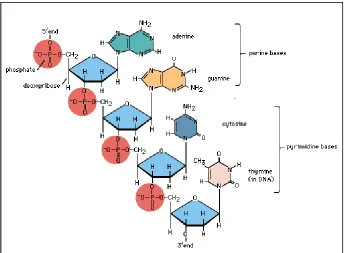
The basic building block of DNA is known to be nucleotide consisting of the
five-carbon sugar deoxyribose to which one phosphate is esterified at the 5’ position
of sugar ring and one nitrogenous base is attached at the 1’ site as illustrated in
Figure 1.1. There are two types of nitrogenous bases present in nucleic
acid. One is pyrimidines, which contain a single ring and another one is purines,
which contain two rings. There are two type of DNA pyrimidines which are thymine
(T) and cytosine (C) and the two types of purines which are guanine (G) and adenine
(A). The nucleotides are known to be covalently linked to one another to form a
linear polymer, or strand with a backbone compose of alternating sugar and
phosphate and the bases are attached to each sugar as shown in Figure 1.2. A key feature of DNA is that it has two distinctive ends: A 5’ (5-prime) end and a 3’ (3-prime) end. The 5’ end is the phosphate group (-PO4) attached to the 5th C atom of the sugar ring and the 3’ end is the hydroxyl group (-OH) at the 3rd C atom of the sugar ring. Using enzymes, the 3’ and 5’ ends can be linked. Through this process single stranded DNA is built.
Figure 1.2: Backbone of the DNA structure
The complementary base of A is T. When coming close to one another they
are kept together through 2 hydrogen bonds. The complementary base of C is G. C
and G build 3 hydrogen bonds. When two strands with complementary base
sequences are mixed together, they anneal and form double stranded DNA. A strand
5’-ATGC-3’ and its complementary strand also called Watson-Crick complement
3’-TACG-5’ would build double stranded DNA. This structure is also called “double
DNA basically has three primary functions. The first is to store genetic
information. DNA contains a stored record of instruction that determine all the
heritable characteristics that an organism exhibits. Second function is
self-duplication and inheritance. DNA contain information for its own replication
(duplication). DNA replication allows genetic instruction to be transmitted from one
call to its daughter cells and from one individual to its offspring. And the third
primary function is expression of the genetic message. DNA is more than a storage
center, it is also a director of a cellular activity. Consequently, the information
encoded in DNA has to be expressed in some form that can take part in events that
are taking place within the cell.
For application in molecular computation, some basic chemical operations
need to be implemented on the DNA. The operations are annealing, polymerase
chain reaction (PCR) and electrophoresis. Annealing refers to hybridization of DNA
to form a double stranded nucleic acid. It is often used to describe binding of primer
of DNA in PCR. PCR is a technique to replicate and amplify the DNA molecule in
creating a complementary copy of the template DNA strand. Agarose gel
electrophoresis is a technique to separate DNA macromolecules depending on their
size, and electric charge by applying electric field in moving the negatively charged
molecules through an agarose matrix. Shorter molecules move faster and migrate
farther than longer ones because shorter molecules migrate more easily through the
pores of the gel. The application of these operations in DNA computing will be
further discussed in the next subsection.
1.3 DNA Computing
DNA computing is one interdisciplinary research area that is growing fast.
Lars Schaefer (2002) describes DNA as the construction plan of all life on earth.
This capability suggests that DNA can be used as a storage of data. One of the main
objectives of this research area is to produce, in near future, a biologically inspired
computer based on DNA molecules to replace or at least beneficially complement
with a silicon based computer (Watada and Bakar, 2008). DNA computing, a new
promises massive parallelism and can potentially increase the speed in solving large
parallel combinatorial search problems.
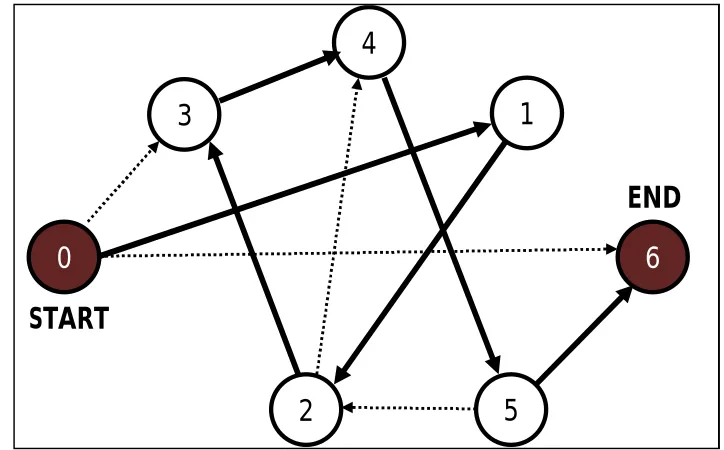
Figure 1.3: Hamiltonian Path Problem. The bold lines represent the only correct path
that is 0→1, 1→2, 2→3, 3→4, 4→5, 5→6
The area of DNA computing was initiated by Dr. Adleman in 1994 when he
discover a method of solving hard combinatorial problem using DNA. Adleman used
a method of manipulating DNA to solve seven-node Hamiltonian Path Problem
(HPP). The goal of Adleman’s experiment is to determine the existence of a path
which commence at the start city, finish at the end city and pass through each of the
remaining cities exactly once. In DNA computation, each city is assigned a DNA
sequence (Adleman, 1998). HPP is a directed graph with designated input and output vertices, vin and vout. A path from vinto voutis termed Hamiltonian if it involves every vertex
exactly one. This implies that vin vout, because vin = vout would be in the path twice. For
example the graph depicted in Figure 1.3 has the designated input vertex 0 and
output vertex 6. The path consisting of the directed edges 0→1, 1→2, 2→3, 3→4,
4→5, 5→6 is the only Hamiltonian path in this figure, which is shown bold arrows.
In general, a Hamiltonian path is present for a given graph with directed edges and a
specified start vertex and end vertex, if and only if there is a path that starts at the
start vertex, ends at the end vertex and passes though each remaining vertex exactly
once.
0
3
4
1
2
5
6
START
For Each vertex i in the graph shown in Figure 1.3, a random 20-mer DNA is
generated and denoted as Oi. Table 1.1 shows the encoding O2, O3 and O4 for
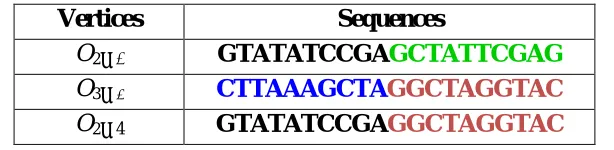
vertices 2,3, and 4, respectively. For edge ij in the graph, DNA Oij is derived
from the 3' 10-mer of Oi and from the 5' 1 0-mer of Oj. as shown in Table 1.2 for
edges O23, O34 and O24.
Table 1.1: Encoding of the vertices of Hamiltonian Path Problem in DNA Vertices Sequences
O2 5’ – TATCGGATCGGTATATCCGA – 3’ O3 5’ – GCTATTCGAGCTTAAAGCTA – 3’ O4 5’ – GGCTAGGTACCAGCATGCTT – 3’
Table 1.2: Encoding of the edges of Hamiltonian Path Problem in DNA Vertices Sequences
O2→3 GTATATCCGAGCTATTCGAG
O3→4 CTTAAAGCTAGGCTAGGTAC
O2→4 GTATATCCGAGGCTAGGTAC
The encoded DNA was amplified by polymerase chain reaction (PCR) using
O0 and complementary of O6 as primers. The two primers worked together in
signalling the PCR process. The first alerted DNA polymerase to copy complements
of sequence that had the right start city and the second initiated the duplication of
molecule that encoded the right start city. Thus, only those molecules encoding paths
that begin with vertex 0 and end with vertex 6 were amplified. Then, electrophoresis
and affinity separation is used to ensure that the molecules have the right length and
to find the shortest path.
Based on Adleman’s success, researchers around the world are currently
working to exploit the the extremely dense information storage and massive
parallelism properties of DNA in hopes of one day producing a DNA computer
1.4 ACS Based DNA Sequence Design
The reliability of DNA computation is highly dependable and influenced by
the information represents on the DNA strand and the strand reaction. But due to
technological difficulties and the nature of chemical characteristics of the molecules,
DNA reactions may result in inaccuracies of the computation. One of the main
approaches to overcome the possibilities of illegal reactions and consequently
removing the potential error due to biochemical reaction in advance is to focus on
designing a good set of independent DNA sequence. The independent DNA
sequence set means a set of DNA sequences which have minimal tendency of
cross-hybridization and maximal difference among them. In addition, they must have the
similar physical conditions such aslength and melting temperature. By removing the
error before hand, no DNA is wasted due to illegal reaction, reliability of
computation is improved and consequently ensuring high computation accuracy.
ACS algorithm in general should not limit the number of ants used in the
system and always allow a new ant to be introduced into the system in hope of
finding the optimum solution. Current method of solving DNA sequence using ACS
restricts the number of ants used because the number of ant in the system dependent
on the solution. Therefore, a new algorithm need to be developed to improve the
current method for DNA sequence design using ACS which allow flexibility in
terms of number of ants and to eliminate the dependability of solution produced by
the system and the number of ants.
1.5 Objective
The objectives of the study are:
(i) To derive DNA computational model based on ACS algorithm that
can be efficiently used for DNA sequence design and improved the
(ii) To assess the performance of the extended computational model over
original computational model
(iii) To come out with the suitable number of ants for application of ACS
algorithm in DNA sequence design
1.6 Scope of work
The boundary of the research is defined as follows:
(i) The proposed approach is developed by considering four objective
functions namely: Hmeasure, similarity, continuity, and hairpin and two
constraints, which are GCcontent and melting temperature (Tm).
(ii) The number of ants used for the ACS algorithm will be varied until
the optimum solution have been found
(iii) The performance of the system will be assessed by comparing the
sequences generated by the proposed ACS model with the sequences
generated using GA, SA, MOEA, PSO, P-ACO as well as the original
ACS model
1.7 Thesis organization
The thesis is organized as follows. First, a brief review of the previous work
DNA sequence design as well as several applications of ACS algorithms in solving
optimization problem in Chapter 2. Previous work on DNA sequence design
includes the algorithm, objective function and constraints that were employed in
solving the problem and the ACS algorithm application will discussed the type of
problem that was solved and the number of agent/ants used in solving the problem.
In chapter 3, the design criteria of DNA sequence design problem will be
outlined and the formulations of the objective functions and constraints will be
explained in detail. An introductory overview of the ACS algorithm, which includes
discuss in detail the construction steps in generating a good set of DNA sequence as
well as the improved ACS model in generating the sequences.
Chapter 5 will review the realization of DNA sequence based on ACS
algorithm, and will present all the results obtained in this study. Validation of the
model as well as the overall performance of the proposed ACS model is also
discussed in this chapter. The overall performance is analyzed and discussed based
on the comparison with other established algorithm such as GA, SA, PSO etc. The
conclusion of the thesis as well as the research direction of the work will be
REFERENCES
Adleman, L. (1994). Molecular computation of solutions to combinatorial problems,
Science, 266: 1021-1024.
Ahmmed, A., Rana, M. A. A., Mahmudul Haque, A. A. M., Al Mamun, M,. (2008),
A Multiple Ant Colony System for Dynamic Vehicle Routing Problem with
Time Window, In Proceeding of 3rd International Conference on
Convergence and Hybrid Information Technology (ICCIT 08). 28-30 Aug.
2008, Daejeon, Korea.
Alba, E.; Leguizamon, G.; Ordonez, G. (2005). Analyzing the behavior of parallel
ant colony systems for large instances of the task scheduling problem.
Proceeding of 19th IEEE International Parallel and Distributed Processing
Symposium, 4-8 April 2005, Denver, Colorado
Arita, M., and Kobayashi, S. (2002). DNA sequence design using templates. New
Generation Computing, 20: 263-277.
Ayob, M., and Jaradat, G., (2009), Hybrid Ant Colony Systems For Course
Timetabling Problems, In Proceeding of 2nd Conference on Data Mining and
Optimization, 27-28 October 2009, Selangor, Malaysia
Cui, G., Cao, X., Zhou, J., and Wang, Y. (2007a). The Optimization of DNA
Encoding Sequence Based on Improved AFS Algorithms. In Proceesings of
Cui, G., Niu, Y., Wang, Y., Zhang, X., and Pan, Liangqiang. (2007b). A new
approach based on PSO algorithms to find good computational encoding
sequences. Progress in Natural Science, 17(6):712-716.
Engelbrecht, A. P. (2005). Fundamental of Computational Swarm Intelligence.
England: Wiley.
Feldkamp, U., Saghafi, S., Banzhaf, W., and Rauhe, H. (2001). DNA sequence
generator–A program for the construction of DNA sequences. In Proc. 7th
Int. Workshop DNA Based Computer, 179–188.
Deaton, R., Chen, J., Bi, H., Garzon, M., Rubin, H., and Wood, D. H. (2002b). A
PCR-based protocol for in vitro selection of non-crosshybridizing
oligonucleotides. In Proceedings of 8th International Workshop on DNA
Based Computers, 196-204.
Deroussi, L., Barahona da Fonseca, J. (2009). A Hybrid Ant Colony System For Machine Assignment Problem In Flexible Manufacturing Systems. In
Proceedings of International Conference on Computers & Industrial
Engineering, CIE 2009. 6-9 July 2009, University of Technology of Troyes,
France
Dorigo, M., and Gambardella, M. (1997). Ant Colony System: A cooperative
earning approach to the traveling salesman problem. IEEE Transactions on
Evolutionary Computation, 1(1): 53–66.
Dorigo, M., and Stutzle, T. (2004). Ant Colony Optimization. Massachuset:
Dugardin, F., Amodeo, L., Yalaoui, F. (2011). Fuzzy Lorenz Ant Colony System to
solve multiobjective reentrant hybride flowshop scheduling problem,
International Conference on Communication, Computing and Control
Application (CCCA 2011), 3 – 5 March 2011, Hammamet, Tunisia
Frutos, A. G., Liu, Q., Thiel, A. J., Sanner, A. M. W., Condon, A. E., Simith,L. M.,
and Corn, R. M. (1997a). Demonstration of a word design strategy for DNA
computing on surfaces. Nucleic Acids Research, 25(23):4748–4757.
Garzon, M. H., and Deaton, R. J. (2004). Codeword design and information
encoding. In DNA ensembles. Natural Computing, 3:253-292.
Garzon, M., Neathery, P., Deaton, R., Murphy, R. C., Franceschetti, D. R., and
Stevens Jr., S. E. (1997). A new metric for DNA computing. In Proceedings
of Genetic Programming (GP97), 472–478.
Goss, S., Aron, S., Deneubourg, J. L., & Pasteels, J. M. (1989). Self-organized
shortcuts in the Argentine ant. Naturwissenschaften, 76:579–581.
Hartemink, A. J., Gifford, D. K., and Khodor, J. (1998). Automated Constraint-based
Nucleotide Sequence Selection for DNA Computation, In Proc. 4th DIMACS
Workshop DNA Based Computer, 227–235.
Hussini, S., Kari, L., and Konstantinidis, S. (2003). Coding properties of DNA
languages. Theoretical Computer Science, 290: 1557-1579.
Ibrahim, Z., Kurniawan, T.B., Khalid, N.K., Sudin, S., Khalid, M., (2009)
Implementation of an ant colony system for DNA sequence optimization,
Lee, K.Y.; Vlachogiannis, J.G.; (2005). Optimization of Power Systems based on
Ant Colony System Algorithms: An Overview. Proceedings of the 13th
International Conference on Intelligent Systems Application to Power
Systems, 2005. 6-10 Nov. 2005, Arlington, Virginia
Liu. J., Fang, Y., and Liu, Y., (2007) Ant Colony System Algorithm for Path
Routing of Urban Traffic Vehicles, In Proceedings of the IEEE
International Conference on Automation and Logistics, August 18 - 21,
2007, Jinan, China
Marathe, A., Condon, A. E., and Corn, R. M. (1999). On Combinatorial DNA Word
Design, In Proceedings of the 5th International Meeting on DNA Based
Computers.
Mauri, G., and Ferretti, C. (2004). Word design for molecular computing: A survey.
In Proceeding of 9th DIMACS Workshop on DNA Based Computers, 37-46.
Ono, H., and Mori, Y., (2007). The Optimal Design of Vehicle Routing Problem,
with Time Windows by Ant Colony System, In Proceedings of The SICE
Annual Conference 2007, Sept. 17-20, 2007. Kagawa University, Japan
Penchovsky, R., and Ackermann, J. (2003). DNA library design for molecular
computation. Journal Computer Bio, 10(2): 215–229.
Ramkumar, A. S., and Ponnambalam, S. G., (2006). Hybrid Ant colony System for
solving Quadratic Assignment Formulation of Machine Layout Problems,
IEEE Conference on Cybernetics and Intelligent System, 7-9 June 2006,
Bangkok
She Yang, X. (2010). Engineering Optimization. University of Cambridge, United
Shin, S. Y., Lee, I. H., Kim, D., and Zhang, B. T. (2005). Multiobjective
evolutionary optimization of DNA sequences for reliable DNA computing.
IEEE Transaction on Evolutionary Computation, 9(2): 143-158.
Tanaka, F., Nakatsugawa, M., Yamamoto, M., Shiba, T., and Ohuchi, A. (2001).
Developing support system for sequence design in DNA computing. In
Proceedings of The 7th International Workshop on DNA Based Computers,
340–349.
Vlachogiannis, J.G.; Hatziargyriou, N.D.; Lee, K.Y.; (2005). Ant Colony
System-Based Algorithm for Constrained Load Flow Problem. IEEE Transaction on
Power Systems, 20:1242-1249
Zeng, Z., and Wang, J. (2010). Advances in Neural Network Research Applications:
Lecture Notes in Electrical Engineering. The Chinese University of Hong
Kong
Zhang, K., Xu, J., Geng, X., Xiao, J., and Pan, L. (2008). Improved taboo search
algorithm for designing DNA sequences. Science Direct Progress in Natura1
Science, 18: 623-627.
Zhang, B. T., and Shin, S. Y. (1998). Molecular algorithms for efficient and reliable
DNA computing. In Proceeding of Genetic Programming (GP98), 735-742.
Zhou, S., Zhang, Q., Zhao, J., and Li, J. (2007). DNA Encodings Based on
Multi-Objective Particle Swarm. Journal of Computational and Theoretical