Honours
Repor~:
Tailoring Feedback in ITSs
Abstract
The most effective way for students to learn is face-to-face with a qualified tutor. Intelligent Thtoring Systems (ITS) aim to provide a learning expe-rience that approaches the standard of learning with a human tutor. This project looks at the factors why and how human tutors are so effective and how these factors can be implemented in SQL-Thtor. An evaluation of the
' l changes was conducted. The evaluation showed that the changes made no
Contents
1 Introduction
1.1 Report Structure
2 Background
2.1 Intelligent Tutoring Systems . 2.2 SQL and SQL-Tutor
2.3 Relevant Work . . . .
3 The Human Tutor 4 The Interviews
5
6
4.1 Possible Improvements . . . . 4.1.1 Factors that affect feedback . . . 4.1.2 Determining when help is needed 4.1.3 Population learning . . . .
Evaluation Study
5.1 Method
5.1.1 Subjects .
5.1.2 Design and Procedure 5.2 Results. 5.2.1 Pre-test 5.2.2 Student logs . 5.2.3 Post-test. 5.3 Discussion . Conclusion 2 3 4 4 5 8 10 12 12 19 21 23 24 24 24 25 26 26 27 31 31 33
Chapter 1
Introduction
Computer Aided Instruction (CAl) systems are the first systems to attempt to tutor students using computers. The conventional CAl approach is to first determine how a good teacher would respond to each possible student action and then build a branching program with each response explicitly programmed. CAl systems typically deliver their instructions in a rigid and structured manner with no regard for the differences in the way individuals assimilate information [1]. Since CAl systems lack understanding of how individuals assimilate information, they frequently mismatch the system's internal processes and the student's cognitive processes. In order for a com-puter based educational system to achieve the same kind of individualized attention that a student would receive from a human tutor, it must be able to reason about the domain and the learner. This has prompted research in the field of Intelligent Thtoring Systems (ITSs).
They began as an attempt to address the deficiencies of CAl systems by adapting to the knowledge and needs of individual students. Intelligent Thtoring Systems (ITSs) are computer based training systems that incor-porate techniques for communicating and transferring knowledge and skills to students. They provides a means to capture expert knowledge which the system uses to compose dynamic instructional interactions. The expert can program the knowledge used to make their decisions, rather than simply program the decision itself, devoid of content.
The major advantage that ITSs offer is individualized instruction with-out the expense of one-to-one tutoring. However, most ITSs are not yet able to do this as well as a human tutor. The objective of this project is to extend the capabilities of SQL-Thtor, an ITS used to tutor students in Structured Query Language(SQL), by trying to individualize feedback to match the student's level of ability.
1.1 Report Structure 3
1.1
Report Structure
Chapter 2 presents an introduction to the background work, describing ITSs related to this project, and SQL.
Chapter 3 identifies the most effective way for students to learn and examines the difficulties of trying to identify how human tutors individualize feedback to students.
In Chapter 4, four experienced tutors were interviewed. This section expands on the interview and the inferences that can be drawn from it. Based on the inferences drawn, appropriate changes are implemented.
Chapter 5 evaluates the changes to SQL-Thtor and a discussion of the results follow.
Finally, Section 6 presents the conclusion, and describes some ideas for further work.
Chapter
2
Background
There are two areas of research associated with this study: ITSs, in partic-ular SQL-Thtor, and SQL.
2.1
Intelligent
Tu~oringSystems
ITSs originated from the artificial intelligence (AI) movement of the late 1950s and early 1960s. Then, workers such as Alan Thring, Marvin Minsky and John McCarthy thought that computers that could "think" as humans were just around the corner, and it seemed reasonable to assume that once "thinking" machines were created, they could perform any task associated with human thought, such as tutoring.
Researchers developed a number of CAl systems designed to present the student with a problem, and receive and record the student's response. However, these systems did not explicitly address the issues of how people learn and did not enjoy much success. By the early 1970s, many researchers shifted the focus from knowledge transfer to knowledge communication and this led to the birth of ITS. By making use of research in the field of Artificial Intelligence, ITSs were able to employ knowledge representation strategies to model a student's cognitive processes. Using an accurate model of both the student's and expert's knowledge, ITSs are able to provide instruction at the appropriate pace and level of abstraction for the student.
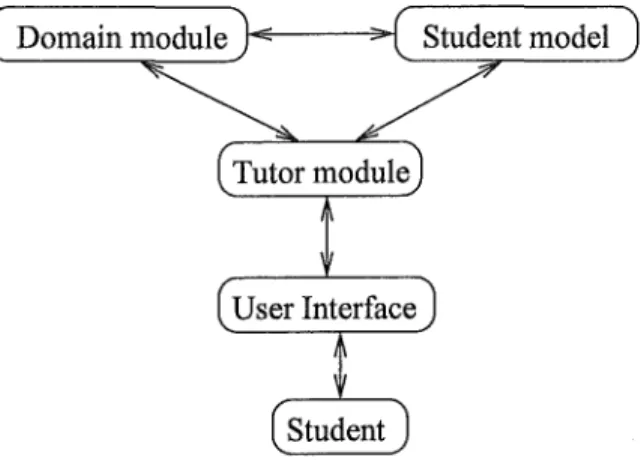
Although there is no standard architecture for ITSs, four components emerge from literature as typical of an ITS [2]. For the purpose of concep-tualization and design, it is often easier to think of an ITS as consisting of several interdependent modules. A typical architecture [3] consists of: the domain module, the student model, the tutor module and the user inter-face module, as shown in Figure 2.1. The domain module contains domain knowledge needed for the generation of problems and /or solving the prob-lem given to the student. The student model stores a model or road-map of the student's knowledge and is the most important part of an ITS, since,
2.2 SQL and SQL-Tutor 5
in the teaching process, the student has to play a central role. The tutor module determines the way in which the ITS reacts, and, finally, the user interface module allows communication between the student and the ITS. Together, these modules generate and control the interaction between the ITS and the student.
Figure 2.1: Typical architecture of ITSs
The range of programs that qualify as Intelligent 'Th.toring Systems is vast and can vary from primitive to sophisticated. In Section 2.3, a discussion of several ITSs is presented.
2.2
SQL and SQL-Tutor
Structured Query Language (SQL) is a language for accessing data in a relational database and was adopted as the industry standard in 1986 [4].
It is a simple, highly structured language. However, students are known to experience difficulties in learning it. The main problems with learning SQL by working with a database management system (DBMS) are that the error messages are limited to the syntax only, and that the DBMS is unable to deal with semantic errors [5]. With this in mind, SQL-'Th.tor has been developed for tutoring upper-level undergraduate students in SQL [6]. It is designed as a practise environment, where student are able to practise solving problems.
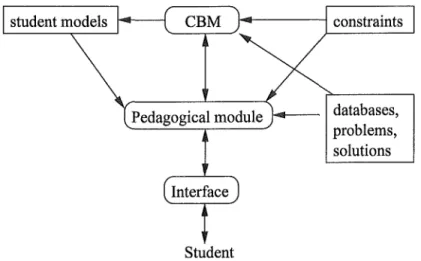
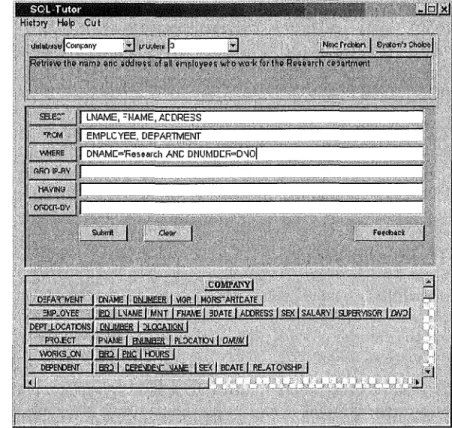
SQL-'Th.tor has a simple architecture, as shown in Figure 2.2. A screen-shot of the interface is illustrated in Figure 2.3. Domain knowledge is rep-resented as constraints. Student modelling is undertaken by the constraint based modelling (CMB) module. The pedagogical module observes every action of the student. The solution entered by the student is sent to the CBM module which determines the relevant constraints. The violated con-straints are updated to the student model (which is basically a list of violated
2.2 SQL and SQL-Tutor 6
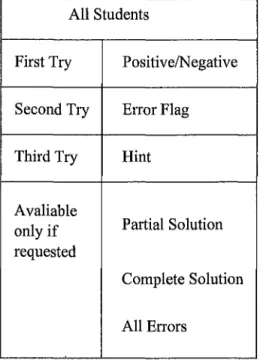
constraints). The pedagogical module then generates appropriate feedback. There are currently six levels of feedback implemented in SQL-Tutor, each determining how much information is provided to the student. The levels of feedback, arranged in increasing order of information content, are: posi-tive or negaposi-tive feedback, error flag, hint, partial solution, complete solution and all errors. A positive or negative feedback tells the students whether the solution is correct or not. An error flag informs the students about the clause in which the error occurred. A partial solution displays the correct solution for the incorrect clause. A complete solution displays the correct solution to the problem. Finally, an all errors feedback message lists the violated constraints for the problem. Figure 2.4 displays how the feedback level is selected in SQL-Tutor. When the student attempts a problem and does not provide a correct solution, he or she would receive a positive or negative feedback. If the student again attempts the same problem and gets it wrong, he or she would receive an error flag message. Finally, if the student again gets it wrong, a hint will be presented to the student. The other feedback levels (partial solution, complete solution and list all errors) are available only if the student chooses it.
Pedagogical module
Student
databases, problems, solutions
Figure 2.2: Architecture of SQL-Tutor
In SQL-Tutor, instruction can be individualized in several ways, by gen-erating feedback dynamically, selecting topics and problems, and fading the scaffolding on the basis of the student model. This project focuses on gen-erating feedback dynamically, in particular, trying to dynamically select feedback for each student based on his or her level of ability. The benefits of selecting feedback that matches the student's level of ability is that students learn better and faster.
2.2 SQL and SQL-Tutor 7
2.3 Relevant Work 8
All Students
First Try Positive/Negative Second Try Error Flag Third Try Hint
Avaliable
only if Partial Solution requested
Complete Solution All Errors
Figure 2.4: Current feedback selection method in SQL-Tutor
2.3 Relevant Work
Much research has examined issues related to modelling the student's cog-nitive processes, rather than improving (individualizing) the quality of feed-back from the tutoring system. Those that have improved feedfeed-back are briefly summarised below:
ANDES is an ITS that tutors students in classical Newtonian physics. It
has two modules that it uses to provide feedback and hints tailored to the student's knowledge and goals [7]. The helper module tries to understand which plan or goals the student is pursuing as the student does an activity, and offers help specific to what it perceives to be helpful to the student's current plan. This means that ANDES indi-vidualizes feedback with respect to the individual's plan. If it detects an important misconception or a bad learning habit, it may engage the student in extensive multimedia instructional activities. The as-sessor module uses Bayesian reasoning to maintain a long-term model of the student's level of mastery of concepts and the student's preferred methods of problem solving and learning. The integration of the two modules means that ANDES can adapt its help as the student's level of knowledge changes over time.
2.3 Relevant Work 9
students from diverse backgrounds [8]. The system is aimed at novices in Pascal programming who might have a range of computing and cul-tural backgrounds. The aim of this system is to build a tutoring sys-tem with versatile teaching strategies. RAPITS uses a meta-teaching strategy where it determines the appropriate teaching strategy based on the student's history.
CIRCSIM-TUTOR is a natural language-based intelligent tutoring
sys-tem to teach first-year medical students about the reflex control of blood pressure [9]. Students solve small problems and are tutored by Socratic dialogue with the computer. CIRCSIM-TUTOR individual-izes feedback by searching for clue words in the student's response. For example, if the student does not understand the question and types "I do not think I understand the question", the system will look up the
list of clue words and use the response associated with the particular clue word. CIRCSIM-TUTOR individualizes feedback with respect to the student's response.
MFD is an ITS that teaches arithmetic to fifth and sixth graders [10].
MFD learns the time an individual student requires to solve a prob-lem by training a neural network, and then uses the neural network to make necessary predictions. Using the predictions, MDF will de-termine whether the student is not making sufficient progress on the current problem, and if so generates an easier problem. Besides in-telligently selecting a topic on which a student should work on, and dynamically constructing problems that are appropriate for the stu-dent, MFD also provides hints that match the student's level of ability. The common link between the four ITSs described above is that all adapt their feedback based on certain aspects of the student's behaviour. Despite the years in research and development in the field of ITSs, there are not many usable tutoring systems in use. This should encourage re-examination of the objectives and approaches to developing ITSs.
Chapter
3
The Human Tutor
Empirical studies have demonstrated that the most effective way for students to learn is to work alone, face-to-face with a qualified tutor, equipped with instructional material and laboratory equipment.
The main reason why human tutors are so effective is because they are able to t~ilor fe~dback (respond to student's questions about the subject matter, determine when students need help and identify the type of help needed) to students. Unfortunately, the need for qualified tutors makes this preferred form of instruction very costly and rare. ITSs aim to provide a learning experience for each student that approaches the standard of learn-ing that he or she would receive in one-to-one tutorlearn-ing from an expert tutor equipped with all the necessary training aids. The ideal ITS would be one modelled on a human tutor. However, trying to identify how human tutors individualize feedback to students is a complex topic because the process de-pends on many different factors that the tutor takes into account on any one occasion. For example, the tutor has several different ways of responding, and chooses an appropriate one depending on:
• What model of the learning process the tutor has in mind for each outcome of the instruction, and what steps the tutor thinks the student needs to follow to reach the outcome.
• Where the tutor thinks the student is in the sequence of steps the student needs to follow.
• The tutor's diagnosis of why the student might have made a mistake (which is based on the model of the student's abilities, background knowledge, and personality, that the tutor has in mind).
All this varies with different kinds of subject matter, how easy or difficult the tutor thinks the subject matter is, and how much time and effort the tutor thinks the subject matter deserves. It also varies with the tutor's estimate of the motivational level of the student.
11
The main goal of ITSs is to provide a learning experience for each student that approaches the standard of learning that he or she would receive in one-to-one tutoring from an expert tutor. One method of achieving this is to provide indivualization of instructions (providing instructions that match the student's level of ability). Individualization of instructions is important because students may have different prior knowledge, learning experience, particular interests, motivation, or personality, and these factors affect how a human tutor interacts with the student. It is proposed that SQL-Tutor be modified so that it would better individualize feedback to different students. In order to gain a better understanding of how human tutors individualize instructions or feedback, and what factors they take into account during the process of adapting instructions or feedback, several tutors were interviewed.
Chapter
4
The Interviews
Four tutors, each with several years of tutoring in database topics were in-terviewed. Only four tutors were interviewed because they had both the tutoring experience and domain expertise. Unskilled tutors may have do-main expertise, but lack the tutoring experience that is often crucial to the successful interactions between the tutor and the student. The tutors were given a brief description of the project and its aims, before being interviewed. Each interview session lasted for approximately fifteen minutes, and a total of thirteen questions were asked. The questions centred around the interac-tions between the tutor and the student; in particular how the tutor decides what instruction or feedback to provide to the student (Appendix A). An example of a question asked is : What factors do you take into account when deciding how to reply? Section 4.1 reports the findings of the interviews and how it can apply to SQL-Tutor.
4.1
Possible Improvements
After analysing the answers given by the tutors, there emerged several pos-sible improvements that can be made to SQL-Tutor.
Using examples
Firstly, tutors usually explain by giving examples and explaining each step of the example. By providing the student with an example that is related to the question the student is trying to solve, it allows the students to analogically infer an explanation for the new situation. With the tutor ex~rijg each step of the example, students are also able to view the (analogous] solution path. SQL-Tutor does not have such a feedback and this provides motivation for this feedback method to be introduced. The best way to illustrate how this works is with an example. Figure 4.1 illustrates a situation in which problem 1 requires the student to specify a query.
4.1 Possible Improvements 13
Problem 1:
Retrieve the last name and address of all employees who work for the Research department.
Correct solution : Select lname, address From employee, department
Where dname='Research' and dnumber-dno
Feedback messages provided by SQI .-Tutor
Student solution: Select lname
From employee, department Where dname='Research'
Positive/Negative Feedback: Good try- but there are some mistakes
Error Flag : Almost there - a few mistakes though. One of them is in the where clause
Hint : Almost there - you made 2 mistakes. If there are N tables in the from clause, then there should be N-1 join conditions in the where clause.
Partial Solution : Almost there - you made 2 mistakes. One of them is in the where clause. It should be: where dname='Research' and dnumber-dno
List all errors : 1. If there are N tables in the from clause. then there should be N-1 join conditions in where clause.
2. Check the expressions in the select clause!
Complete solution: The correct solution of this problem is: select lname, address
from employee, department
where dname='Research' and dnumber-dno
4.1 Possible Improvements 14
When the student enters his/her incorrect solution, the messages gener-ated by SQL-Tutor may not be helpful, especially if the student does not understand certain concepts. In this example, if the student does not fully understand the concept of join conditions, the messages may not be of much use. In this situation, a human tutor would present to the student an ex-ample and explain each step of the exex-ample. Figure 4.2 is a log of goals, actions and results that the tutor would perform and would look for, when explaining the example to the student.
GOAL : Determine if student knows which tables are relevant to for the query. If not, point out to them which tables are and why
ACTION : Ask the student to point out the relevant tables
EXPECTED RESULT : Student learns how to select relevant tables
GOAL : Determine if student understands the join condition. If not draw example and use it to illustrate the join condition ACTION : Tutor sketches the relevant tables and uses it to illustrate
the join condition
EXPECTED RESULT : Student understands the join condition
GOAL : Determine if student knows how to select the correct attributes ACTION: Display the relevant part of the question that relates to
the selection of the correct attributes
EXPECTED RESULT : Student understands how to select the correct attributes
Figure 4.2: Log of goals, actions and expected results of a human tutor
The advantage of doing it in steps is so that it is easier for the student to understand and to allow the student to acquire the mental process of plan-ning (learplan-ning how to decompose problems into sub goals) and implementing it. By viewing each step of the example, the student is able to determine which step he/she might have gone wrong. By drawing the relevant ta-\>
bles and attributes, students are able to visualize the relevant tables and . attributes. There are also other advantages to drawing the relevant tables \ and attributes, such as, people generally prefer pictures, there are no lan-guage barriers and it eases the memory load. This method of using examples could potentially help the student learn better and will be implemented in SQL-Tutor.
4.1 Possible Improvements 15
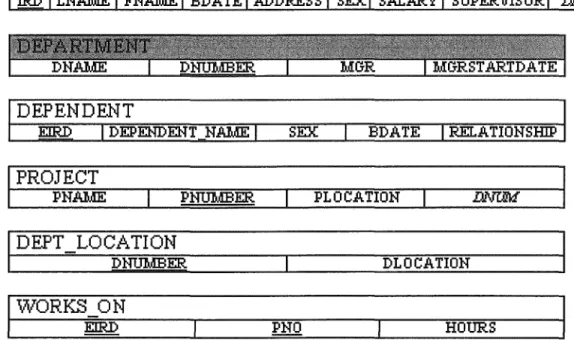
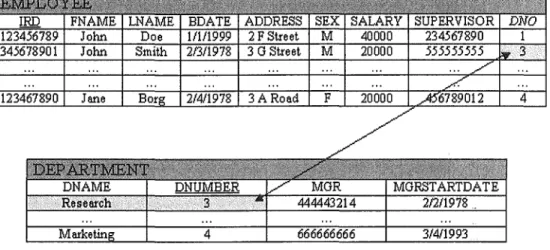
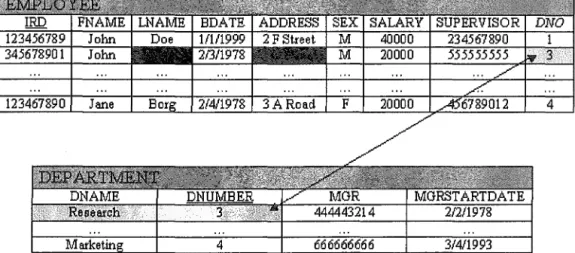
This method of using examples could be implemented in SQL-Tutor. The process in which the tutor explains the example can be shown as a se-quence of slides. Figure 4.3, Figure 4.4, Figure 4.5 and Figure 4.6 shows the same process as described in the Figure 4.2. On the top of the Figures 4.3 to Figure 4.6, a subgoal is displayed, followed by the keywords to look for highlighted in red, and finally the sketch of the relevant tables. Figure 4.3 shows the tables in the database and highlights the relevant tables. Fig-ure 4.4 identifies the keywords that would suggest to the student what the relevant tables are. Figure 4.5 displays the joining condition between the tables. Finally, Figure 4.6 highlights in red the attributes that needs to be retrieved (last name and address).
Company Database
Retrieve the last name and address of
allemployees who work for
the Research department.
I
DEPENDENT
EIRD
I
DEPENDENT NAMEI
SEX BDATEI
RELATIONSHIPI
I
PROJECT
PNAME PNUMBER PLOCATION
I
DEPT LOCATION
DNUMBER DLOCATION
PNO HOURS
Figure 4.3: Slide 1 of the example
Examples for the first twenty questions for the company database was developed. However, for complex queries (queries that involve using the group by and having clauses), there are more attributes, tables and
rela-4.1 Possible Improvements 16
Locate relevant tables
Retrieve the last name and address of all
employees
who work for the Researchdepartment.
4.1 Possible Improvements 17
Find employees with the same DNO as the Research
department's DNUMBER
Retrieve the last name and address of all employees who work for the Research department.
4.1 Possible Improvements 18
Display the names and addresses of relevant employees
Retrieve the last name and address of all employees who work for the Research department.
4.1 Possible Improvements 19
tionships between tables are involved. A novice might find it difficult to comprehend the slides and in this situation, it would be ideal to have a human tutor present to tutor the student. It was decided that until better representations for examples are found, examples would not be implemented in SQL-Tutor.
4.iJ
Factors that affect feedback
The second finding was that tutors looked at four main factors when de-ciding what reply or feedback to give. These factors are: the proficiency of the student in the subject matter, the difficulty of the subject matter, the background of the student in the subject matter, and the level of motivation the student has. There are other factors such as facial expression, gestures, voice tone, etc ... , that the tutor looks for, but is not considered as important as the main four factors. The list below explains in greater detail the four main factors.
• Proficiency : The proficiency of the student in the subject matter measures the overall level of understanding that the student has in subject matter (SQL). If the student has a low level of understanding in the subject matter, tutors tend to provide more complete feedback (perhaps the partial solution instead of a hint), and vice-versa. Hu-man tutors usually determine the proficiency of the student based on previous encounters, measuring it by how well the student knows the subject. In SQL-Tutor, the proficiency of the student can be estimated by the number of problems solved over the number of attempts taken to solve the problems.
• Problem difficulty : The level of difficulty measures how difficult the problem is. Human tutors find that as the problem difficulty increases, they tend to spend more time and effort;i' into explaining the solution and the steps needed to derive the solution. This would suggest that tutor tend to provide vague feedback for easier problems, and feedback with more information content for difficult problems. If the tutor de-cides that the problem is too difficult, the student will be recommended to try another problem. Human tutors classify problems by an ad-hoc method. In SQL-Tutor, every problem is already assigned a difficulty level, ranging from one to ten, with problems of difficulty level one being the easiest problem.
• Background : The background of the student in the subject ter refers to the prior experience the student has in the subject mat-ter. Human tutors usually determine the background of the student through informal contact. If the tutor thinks that the student has a good background in the subject matter, the tutor would provide less
4.1 Possible Improvements 20
hints compared to the number of hints a student who does not have a good background. Trying to measure the background of a student may prove to be difficult for SQL-Tutor. As mentioned above, tu-tors determine the background of the student mainly through informal contact. Currently, SQL-Tutor is not able to do this. An alternative method to gauge the background of the student is to request the stu-dent enter what he or she thinks their background level is. There are advantages and disadvantages to using this method. The advantage is that students usually have a better knowledge of their background than tutors, and this allows a more accurate way of identifying the background level. The disadvantage of this method is that it is sub-jective. Students may incorrectly assume their background and this could affect the type of feedback they receive. Currently, SQL-Tutor requires students to state (selecting one from the following three op-tions: Novice, Familiar or Experienced) their background level before interacting with the system. The background level is given a numeric value ranging from one to three, with novice having the value of one, familiar having a value Df two and experienced having a value of three. • Motivational level : Motivation is mentioned as one of the learning functions which stimulate learning [11]. The motivational level of a student depends on many factors such as confidence, curiosity, control, attention, satisfaction and relevance (of the topic to be taught)
[12].
Human tutors are able to detect the motivational state of the stu-dent and takes that into consideration when tailoring feedback. A student with a high motivational level would receive a vague feed-back that will motivate them to think. The detection of a student's motivational state is constrained by interface limitations (unable to ac-curately detect confidence, attention and so on). The simplest method to determine the motivational level of a student is by the number of problems the student attempts to solve.
The four factors mentioned above are not all of equal importance. The interviewed tutors view the proficiency and problem difficulty of equal im-portance. The background and motivational level of the student is of equal importance, but is of secondary importance when compared to the profi-ciency and problem difficulty. The following list orders the factors starting from the most important.
1. Proficiency in subject matter and Problem difficulty
2. Background and motivational level of student
By combining the~e four factors into a single variable (called ability)
[14],
tutors then split students into categories. The ability of a student is defined as:
4.1 Possible Improvements 21
ability
=
(proficiency*5)
+
problemdif ficulty +background+ motivation- ... · . (4.1)
The proficiency variable from (4.1) is multiplied by five to normalize it, so that the proficiency variable has a range from zero to ten (same as the problem difficulty). Equation (4.1) is derived via an ad-hoc attempt. It may be that this equation does not match how human tutors determine the abil-ity of the student, and should be viewed as a first step towards developing the correct equation (if there is one such equation) that human tutors use to determine the ability of students.
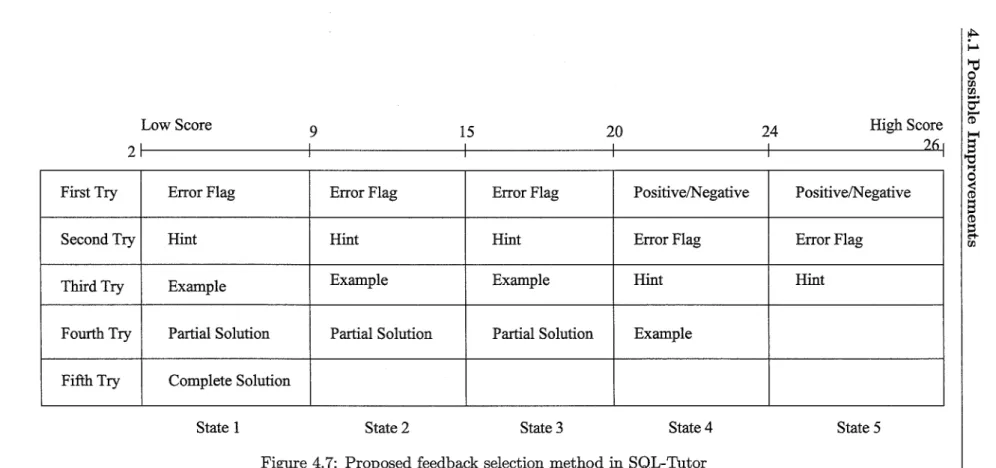
Students of roughly the same ability are grouped in the same category. Each category will receive feedback suitable for that particular category. Us-ing the model developed by Okazaki [13]. as a guide, to classify the state of a student, a model to map the student's level of ability with the appropriate feedback is developed. There are two main criteria for this model. Firstly, the students with high ability would receive less support through the infor-mation content of the feedback messages, while students with a low ability would receive more support. An example of this would be that a student with high ability would not be able to obtain the complete solution (unless he or she explicitly requests it), whereas a student with a low ability would be able to obtain the complete solution. The other criteria is that sequence of feedback messages should be given in increasing amounts of information. For example, a student will receive a hint before receiving the complete so-lution. This ensure that the student is not overwhelmed with information. The current feedback selection method in SQL-Tutor is shown in Figure 2.4. Figure 4. 7 illustrates the proposed feedback selection method.
Once the ability of the student is worked out, one can infer the state the student is in and provide appropriate feedback. For example, if a student has an ability of six (state 1), he or she would receive feedback messages in the following order: Error flag, Hint, Example, Partial solution and Com-plete solution. The other feedback messages (Positive/Negative feedback, complete solution) are available if the student requests it.
This model of determining what feedback to provide based on the ability of the student is implemented in SQL-Tutor.
4.1.2 Determining when help is needed
Tutors do sometimes initiate discussions with student when they feel that the students require assistance. How tutor know when to offer help to the student is mostly based on physical or verbal cues such as facial expression, gestures, voice tone and other cues. An example of a cue would be a student
Low Score 9 15 20 24 High Score
2r---+---+---,_ ______________ ,_ ______________ ~ First Try Error Flag Error Flag Error Flag Positive/Negative Positive/Negative
Second Try Hint Hint Hint Error Flag Error Flag
Third Try Example Example Example Hint Hint
Fourth Try Partial Solution Partial Solution Partial Solution Example
Fifth Try Complete Solution
State 1 State 2 State 3 State4 State 5
Figure 4.7: Proposed feedback selection method in SQL-Tutor
~ 1-' '"0 0 til til
0:
-
CD J-1~
'"l~
s
CDa
til t-:1 t-:14.1 Possible Improvements 23
staring blankly at a screen. By initiating a discussion, tutors hope to correct any misconceptions the student might have, setting them on the correct solution path.
Due to the limitations in the communication channel between the student and the ITS (the only feedback the ITS can receive from the student is what the student types in), it would be difficult to observe the necessary cues. A crude way of trying to estimate when to provide help is by timing how long a student takes to complete a question. If a student takes longer than average amount of time, a message will appear, prompting the student if he or she requires assistance. This is a crude way of estimating if the student requires help and is prone to problems. An example of such a problem is if a student does not interact with the system for the averageamount of time,
\-'-the system thinks that \-'-the student requires assistance and provides it when it is not needed. Another problem with this approach is the problem of trying to determine the average amount of time needed to solve a problem.
It should take into account the level of difficulty for the particular problem and adjust the average time appropriately.
Until a more accurate method of determining when students require help is discovered, this feature will not be implemented in SQL-Thtor.
4.1.3 Population learning
When a group of students encounter the same difficulty with a problem, this usually indicates that students share a common misconception or sev-eral misconceptions. In this situation, a human tutor would give a gensev-eral rundown of the question to the entire class. This general rundown of the question would provide the entire class to be aware of the possible mis-conceptions that they may have. A similar method could be implemented in SQL-Thtor, where if a certain number of students violate a same set of constraints, all students using the system will be informed of the com-mon error. In SQL-Thtor, each student has an individual student model that keeps track of what constraints the student has mastered or violated. By examining each student model, one could determine if a certain set of constraints get violated, and provide appropriate feedback to the entire pop-ulation. There are certain problems to this approach such as: How many students should encounter the same difficulty before providing appropriate feedback? The population of students using SQL-Thtor is not fixed and can vary, so no specific number of students can be chosen. Due to the problems mentioned above, this feature will not be implemented in SQL-Thtor.
Chapter 5
Evaluation Study
After implementing the changes, it is crucial to determine if they contribute to student's learning. The aim of this evaluation is to access the contribution the new feedback selection method made, in particular:
• Did the new feedback &election method select appropriate feedback? • Would the student prefer to select their own feedback or have feedback
automatically selected by the system?
The rest of this section describes the method, which constitutes the design and physical makeup of the experiment. That is followed by the results and finally the discussion which interprets the results within the context of the two questions asked.
5.1
Method
5.1.1
Subjects
The subjects were students who were enrolled in the second year Introduc-tion to Database ( COSC226) course. All students had several lectures on SQL before they were able to interact with SQL-Tutor. Some subjects may have previous exposure to SQL. The subjects were randomly assigned to either the control or experimental group. The subjects in the control group interacted with the current version of SQL-Tutor, while the subjects in the experimental group interacted with the new version of SQL-Tutor. There were a total of 55 subjects in both the control and experimental group1. The experiment was conducted in the computer laboratories of the computer sci-ence department.
1There were more than 55 subjects in the experiment. However, the data collected for
5.1 Method 25
5.1.2 Design and Procedure
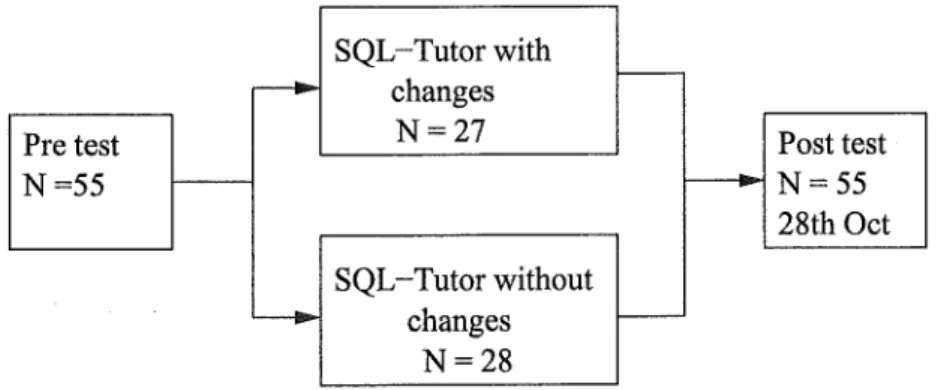
The evaluation consists of several data collection sessions, the pre-test, sys-tem interaction and post-test. Figure 5.1 illustrates the data collection ses-sions. Before students are able to interact with the system, they had to complete a pre-test. They were then allowed to interact with the system. When the evaluation period ended, the students were asked to complete a post-test. The aim of the pre-test and the post-test is to determine the
subjec~·~knowledge
of SQL and also to find out if there are any significant differences between the control and experimental group.SQL-Tutor with
1
-_____..,. changes
Pre test N=27 Post test
N=55 -
___....
N=55 28th Oct SQL-Tutor without _____..,. changes 1---N=28Figure 5.1: Experiment design
The pre-test and post-test (included in the Appendix B) each consists of three multipl,€) choice questions. These questions were designed to evaluate
the subjecf~/knowledge of SQL. The marks,.allocated for the first, second
and third questions were 1, 5 and 1 marks respectively. After answering each question, subjects recorded how confident they were of their answers using a three point Likert scale. The pre-test was given to the subjects when they logged on to the system for the first time.
After the subjects had submitted the pre-test, they were allowed to in-teract with the respective version of SQL-Thtor. The subjects were able to choose the problems they wish to solve, when they wish to log out and so on. The idea behind this is to have data collection that takes place not in an artificially created environment where subjects are constrained to act a cer-tain way, but rather in a normal enviroment, where subjects have complete freedom. Every action that the subjects made was recorded automatically by the system in the form of student logs. The time li}nrt' in which the data collection took place occurred over thirty days. Since the subjects were able to choose when they wish to interact with the system (how many problems they wished to solve), having a data collecting session starting from the 4th of September to the 28th of October. The long data collection period en-sured that the student logs were of sufficient length to perform any analysis
5.2 Results 26
on.
On the 28th of October, subjects took the post-test. The post test was included as part of the final exam for the course.
5.2
Results
The results were obtained from three separate sources: the pre-test, student logs and the post-test. The results from each source is discussed.
5.2.1 Pre-test
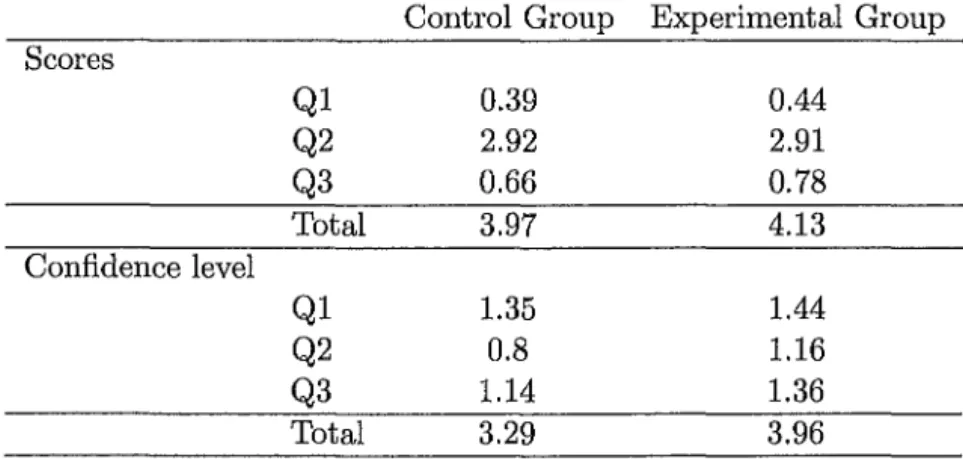
A total of 55 subjects participated in the pre-test. 28 subjects belonged to the control group, while the rest (27) belonged to the experimental group. The objective of the pre-test is to determine the knowledge level of the sub-jects. The ideal situation is that there is no significant difference in the knowledge level between both groups. As mentioned in Section 5.1.2, the pre-test consists of three questions, worth 1, 5 and 1 mark respectively. Fig-ure 5.2 shows the mean scores for the pre-test. On average, the subjects belonging to the experimental group did slightly better than the subjects in the control group for questions one and three. The mean score for the control and experimental group was 3.97 and 4.13 respectively.
Control Group Experimental Group Scores Q1 0.39 0.44 Q2 2.92 2.91 Q3 0.66 0.78 Total 3.97 4.13 Confidence level Q1 1.35 1.44 Q2 0.8 1.16 Q3 1.14 1.36 Total 3.29 3.96 Figure 5.2: Mean scores for the pre-test
Subjects in both groups were also asked how confident they were of their answers to the questions in the pre-test. Subjects are able to choose their confidence level from a scale of 0 (not confident) to 2 (very confident). Results indicate that subjects in the control group were slightly less confident than subjects in the experimental group. The mean confidence level of subjects in the control group was 3.29 and the mean confidence level of subjects in the control group was 3.96
5.2 Results 27
To determine if there is a statistical difference in the knowledge level between the two groups, a two tailed t test was carried out. The null hy-potheses for the
t
test would be that there is no difference between the means at the 0.05 level of significance. The alternative hypotheses is that there is a difference between the means at the 0.05 level of significance. The results indicate that there is no significant difference between the mean scores of the two groups (t
=
0.35, p>
0.05) and hence the null hypotheses is accepted.5.2.2 Student logs
Every action performed by a subject during the evaluation period was recorded in a log, along with a time stamp. Figure 5.3 shows a portion of a log file for a subject. It shows a subject logging on to SQL-Tutor for the first time. Problem 59 was the first problem the subject attempted. The subject solved the problem correctly on the first attempt.
Once analyzed, the log files can be used to answer the questions posed in Section 5. Figure 5.4 presents a summary of the variables that were analyzed.
5.2 Results 28
The average amount of time the subjects in the control group spent interacting with the system was 55.89 minutes. However, it is difficult to determine if subject actually spend all the time attempting to solve the problem or if they are doing something else. An example of this situation is if a student attempts a question, but leaves for a short break instead of spending the time attempting to solve the question. Subjects in the experimental group spent an average of 83.9 minutes interacting with the system. This indicates that subjects in the experimental group were more willing to spend time interacting with the system. Another possible reason why subjects in the experimental group spent more time interacting with the system was that the feedback provided was not what they expected and wasted time selecting the type of feedback they are expecting.
This issue can be clarified up by examining the number of problems at-tempted by the subjects, the number of solved problems and the attempts to solve problems that could not be solved on the first attempt. If the sub-jects in the experimental group attempted and solved more problems then the subjects in the control group, we would know that the system providing inappropriate feedback does .not really affect the amount of time the sub-ject spent interacting with the system. By examining the attempts to solve problems that could be solved on the first attempt, we are able to determine the usefulness of the feedback. If subjects in the experimental group requires more attempts to solve a problem, it suggests that the feedback provided to this group is not particularly useful.
On average, subjects in the control group attempted and solved ((es~ problems than the subjects in the experimental group. Subjects in
tM
control group attempted an average of 10.5 problems and managed to solve an average of 7.35 problems, while the subjects in the experimental group attempted an average of 15.5 problems and managed to solve an average of 11.73 problems. This shows that subjects in the experimental group attempted and learnt more about SQL than the control group. However, this conclusion may not be true in certain cases. For example, if subjects receives the complete solution or partial solution as feedback, they may not attempt to solve the problem, even though they do know the correct solution. Taking this into account, the average number of solved problems for the control group increased to 8 and 13 for the experimental group. Using this new measure of solved problems, the percentage of solved problems over attempted problems for the control and experimental groups are 0.
76
and 0.85 respectively.In order to evaluate how useful the feedback selected by the system is, we should examine the average number of attempts taken to solve problems that could not be solved on the first attempt. This figure is a good measure of the usefulness of the feedback. For example, if a subject requires many attempts before the problem is solved, this would indicate that the feedback provided to the subject is not very useful.
5.2 Results
13:52:48 2/10/2000
Log in
13:53:20 2/10/2000
first-time-user
13:53:20 2/10/2000
Mode set to 4
14:00:28 2/10/2000
changing database to registration
ProBlem number is 59
14:00:28 2/10/2000
drawing: problem is 59 its status is NEW
14:01:25 2/10/2000
Pre-process:
Help Level 0
Feedback option: Feedback
Database: registration
Problem number: 59
Their attempt :
select:
w
From: vehicle
where:
Group by:
Having:
order by:
Two-level-help?: NIL
Mode: 4
tries: 1
proficiency: 0.0
motivation: 1
ability: 0.0
14:01:25 2/10/2000
set ability to 12.0
14:01:25 2/10/2000
Answer correct
Figure 5.3: Part of a student log
Total Interaction Time ( mins) Number of attempts
Number of solved problems Attempts to solve
problems that could not solved on the first attempt
Mean Standard Deviation
Control Group Experimental Group Control Group
55.89 83.9 68.36
10.5 15.5 9.8
7.35 11.73 7.52
1.72 3.77 1.04
Figure 5.4: Mean interaction details
Experimental Group 80.59 13.96 12.29 3.58 01 ~
~
00 ~ ~ 00 Cl:l 05.3 Discussion 31
The average number of attempts taken to solve problems that could not be solved on the first attempt was 1. 72 and 3. 77 for the control and ex-perimental group respectively. This result indicates that subjects in the experimental group persisted in trying to solve problems that initially could not be solved. Another interpretation of this result could be that the back provided by the system in the control group is more useful than feed-back provided by the system in the experimental group, hence, subjects in the control group are able to solve the problem in less attempts. However, it could just be that students in the control group requests the complete solution whereas subjects in the experimental group may just wait accept feedback provided by the system, instead of requesting specific feedback. The student logs will need to be examined in greater detail to determine if this is so.
After the student logs were examined, it was found that subjects in the control group requested specific feedback less than subjects in the experi-mental group. This suggests that the feedback provided to the subjects in] the experimental group was not as useful as the feedback provided to the subjects in the control group. To determine if the t}fe~hanges contributed to the subjects' learning, a post test will be conducted to determine the knowledge the subjects have in SQL.
5.2.3 Post-test
The main objective and format of the post-test is identical to the pre-test: to determine the knowledge the subject has in SQL. We expect to find that there is a significant difference between the knowledge level of subjects from the control and experimental group, with subjects from the experimental group having a better knowledge of SQL. All 55 subjects who participated in the pre-test, completed the post-test. Figure 5.5 shows the mean scores for the post-test. Subjects in the control group scored an average of 4.64 out of a possible 7, while subjects in the control group scored an average of 5.07. A two tailed
t
test was carried out to determine if there is a statistical difference between the two groups. The results of thet
test indicates that there is no significant difference between the mean scores of the two groups(t
=
1.387, p>
0.05).5.3 Discussion
The pre-test showed that there are no significant differences in the average knowledge levels of subjects in both the control and experimental groups. Examination of the students' log revealed that subjects in the experimental group attempted and completed more problems. However, the feedback to the experimental group seemed less useful than the feedback provided to the control group. This indicates that the sequences of feedback proposed for
5.3 Discussion 32
Control Group Experimental Group Scores
Ql 0.82 0.77
Q2 3.28 3.4
Q3 0.53 0.88
Total 4.64 5.07 Figure 5.5: Mean scores for the post-test
students of different categories of ability were not the ideal sequences. The post-test revealed that after interacting with the system, both groups had a better knowledge of SQL. However, there was no significant difference in the knowledge level between the two groups.
It is evident that the selection of feedback for the experimental group failed to provide the expected individualization. Despite the lack of encour-aging results, it should be noted that this is a rough model of how human tutors individualize feedback and is possible that with a more sophisticated model of how human tutors adapt feedback, the gains of individualization will be realised.
Chapter 6
Conclusion
Since that late 1950s, computers have been used to tutor students in various domains. These early tutoring systems were not able to effectively adapt instructions to suit individual students and this led the development of ITSs. The main goal of ITSs is to provide individualized feedback. However, most ITSs are not able to do this· as well as a human tutor.
A series of interviews with tutors took place to determine what factors human tutors take into account when deciding what sort of feedback to provide. Tutors took note of how proficient the student is in the subject matter, the problem difficulty, the background of the student in subject matter and the motivation of the student, when deciding on what sort of feedback to provide.
A model of how human tutor decide what sort of feedback to provide is constructed and implemented into SQL-Tutor. An evaluation study of the changes was conducted and it revealed that the changes made did not significantly contribute to the subject's learning. If a more sophisticated model could be developed, taking into account more factors, it may possibly have a significant effect on the student's learning experience.
34
Acknowledgements
I would like to thank Dr Antonija Mitrovic for guiding and assisting with this research, Kurt J Hausler for implementing the changes to SQL-Thtor, Jane McKenzie for proof reading this report, and to the tutors who agreed to be interviewed.
Bibliography
[1] Bloom, B. S. The 2 Sigma Problem: The Search for Methods of Group Instruction as Effective as One-to-One Thtoring. Educational Researcher, 13, pp. 3-16. 1948.
[2] Burns, H. L. and Capps, C. G. Foundations of Intelligent Thtoring Systems: An Introduction. Foundations of Intelligent Thtoring Systems. Lawrence Erlbaum Associates, Hillsdale, NJ. 1988.
[3] Woolf, B. AI in EduGation. Encyclopedia of Artificial Intelligence, Shapiro, S., ed., John Wiley & Sons, Inc., New York, pp. 434-444. 1992.
[4] Elmasri, R. and Navathe, S. B., Fundamentals of database systems (2nd ed) Benjamin / Cummings, Redwood, CA. 1994.
[5] Mitrovic, A., SQL-Thtor: a Preliminary Report, Technical Report TR-COSC 08/97, Computer Science Department, University of Canterbury, 1997.
[6] Mitrovic, A., Learning SQL with a computerised tutor, Proc. 29th SIGCSE Tech. 307-311. 1998.
[7] Gertner, A, Conati, C, and VanLehn, K., Procedural help in Andes: Generating hints using a Bayesian network student model. Proc. 15th National Conference on Artificial Intelligence. Madison, Wisconsin. 1998.
[8] Pamela J. Woods and James R. Warren., Adapting Teaching Strategies in Intelligent Thtoring Systems. ITS'96 Workshop on Architectures and Methods for Designing Cost-Effective and Reusable ITSs, Montreal. 1996.
[9] Hume, Gregory D., Using Student Modelling to Determine When and How to Hint in an Intelligent Thtoring System, Ph.D. , Illinois Institute of Technology. 1995.
[10] Joseph E. Beck and Beverly P. Woolf, Using a Learning Agent with a Student Model. ITS'98, San Antonio, USA. 1998.
BIBLIOGRAPHY 36
[11] Shuell, T, J., Designing instructional computing systems for meaningful learning., Foundations and Frontiers in Instructional Computing Sys-tems (in press).
[12] Teresa, D, Soldato., Detecting and reacting to the learner's motivational state, ITS 92, Montreal, Canada, 1992.
[13] Okazaki, Y., Watanabe, K. and Kondo, H., An Implementation of the WWW Based ITS for Guiding Differential Calculations. Proc of workshop: Intelligent Educational Systems on the World Wide Web". Proc. 8th World Conference of the AIED Society, Kobe, Japan. 18-22. 1997.
[14] Akira, Takeuchi. and Setsuko, Otsuki., EXPITS: an Experimental En-vironment on ITS, ITS 92, Montreal, Canada, 1992.
Appendix A
Four tutors, selected on the basis that they had at least a few years of tutoring, were interviewed. A brief overview of the project was given to the tutors. The table below summarises the questions, reasons why the question was asked, answers and analysis of the answers. Note that the tutor responses have been combined and edited where appropriate.
QUESTION
Roughly how long have you been tutoring ?
Do you find that students have problems with the con-cepts (what it means) rather than how to go about doing the question ?
REASON
To gauge how much weight should be placed on their an-swers.
Students are assumed to know the background knowl-edge and concepts, but is this assumption actually true?
ANSWER
All the tutors had several years of experience tutoring database material.
Students are expected to know the concepts. They usually have problems with concepts rather than how to go about doing the question.
ROUGH ANALYSIS
Their answers carry roughly the same weight.
Students can roughly be di-vided into two groups. The first group of students in-clude students who have learnt and remember the background materials and key concepts. This means that unnecessary material should not be presented to this group. The other group includes students who have never really learnt the back-ground material and con-cepts, of have forgotten them. This group should be presented with basic infor-mation. t::d 1-1 t::d t-1 1-1 0
0
~
'"Cl:rl
~ ~ 00QUESTION
Do you initiate any discus-sions with students ?
REASON
To find if tutors do initi-ate discussions with students and why.
ANSWER ROUGH ANALYSIS
Sometimes, depending on In ITS, the size of the class whether the class is big or does not matter. Human tu-not. tors are able to determine
if a student is lagging be-hind and approach the stu-dent. ITS suffers from the limitations in bandwidth of the communication channel and the only feedback that it receives is what the student types in. One way of try-ing to measure if a student is behind is to time how long he or she takes to complete a question. If the student takes longer than the aver-age time (obtained by tak-ing the average time that all students take to com-plete that question), perhaps SQL-Tutor could provide a "pop-up" message asking the student is he or she needs help. This is a crude way of estimating the pace of the students and this method can be easily "fooled".
to
~to
t"'l ~ 00
~
"'d:I:
~ ~ ~QUESTION
When students request assis-tance, what are the typical statements they say ?
From the statement the stu-dent makes, do you look for certain key words that help you determine a particular way to help a student? (e.g.
If you hear the word EX-PLAIN, do you tend to ex-plain to the student the soul-tion rather than giving them a hint?)
If the student does not clearly state his or her inten-tion (i.e. does not state if he or she wishes to know if they are on the right track, or where they might have gone wrong), how do you go about trying to understand what the student wishes to gain out of the discussion?
REASON
To find if students know what they want help on.
To find out if student do state which method they prefer their feedback in.
To find out what a student wants if he or she does not mention it.
ANSWER
They usually say something like "Here is what I have done so far. Am I doing it right?" or "I do not know how to do this prob-lem. Could you help me?" Yes. For example, if they mention that they would like an explanation, the tu-tor would switch from what-ever method of feedback they planned and give an explana-tion.
Ask them questions to clarify what they want.
ROUGH ANALYSIS
SQL-Tutor would have to look at where students have gone wrong and inform the student.
SQL-Tutor should have a range of feedback methods avaliable and students want-ing a particular method of feedback can choose it. SQL-Tutor should keep a record of which feedback method a student prefers, so that when they next log on, there would be no need to ask them which feedback method they prefer. A flexible way for students to change their pre-ferred method should be pro-vided.
SQL-Tutor currently has five levels of feedback, which the student can select. If a stu-dent does not select a feed-back level, SQL-Tutor au-tomatically selects the first level of feedback (positive or negative), then the second level of feedback (error flag) and finally stopping at the third level of feedback (hint). SQL-Tutor could be modi-fied so that it does not auto-matically select the level of feedback, but decides which feedback level to use based on the student model.
1::0 loo-t 1::0 t"" loo-t 0 0
::0
>
'"dl:Il
~ ~ 0QUESTION
When you approach a stu-dent, what factors do you take into account when de-ciding how to reply?
1. Difficulty level of the problem.
2. Motivation of student. 3. Pace of student. 4. How much time you
think the problem de-serves.
5. The student's level of proficiency with the topic.
6. Other factors.
REASON
To find out what factors hu-man tutors take into account when deciding on how tore-ply.
ANSWER All of the below:
1. If the problem has a high level of difficulty, more time would be spent. If the lem is a simple prob-lem, leading questions would be asked, hoping to lead the student to the correct solution. 2. Yes. If the student is
motivated and wishes to learn more, more time would be spent. The · amount of time spent with a student also depends on how large the class is. 3. Yes. If a student
is behind, fewer lead-ing questions will be asked and straightfor-ward explanations will be given.
4. When dealing with large classes, tutors tend to move between students quickly.
5. Tend to give students
I
feedback that they are able to use. (i.e. matches their level of proficiency on the topic).
ROUGH ANALYSIS
The student model in SQL-Tutor could be extended to take note of the level of dif-ficulty of the question, the motivation and pace of a stu-dent and the level of profi-ciency of the student.
I
1:0 1-1 1:0 ~ 1-1 0 0~
'"d~
1e
QUESTION
I
REASONI
ANSWER Do you form some sort of To find if human tutors do I Yes. plan of how each student is form and keep a plan of how faring ? a student is faring.How do you determine if a student has understood what you have said to him or her?
What if a student does not understand what you have said to him or her? Do you
1. Explain in more detaiL 2. Use another method. 3. Brush off and
recom-mend another prob-lem.
4. Try another method.
Ideally, tutors should stop explaining once the student has understood the concept. This question is to find out how human tutors know when to stop explaining.
To find how a tutor should reply when a student does not understand the reply that the tutor gave.
Get the student to solve a similar problem and if he or she is able to do it, that means that they under-stood what you have said to them. Another method is to ask them some questions about what you have just told them.
If the student does not un-derstand what was said, an-other method would be used. If that does not work, the an-swer would be shown to the student, the example closed, and the student asked to work on a similar problem.
ROUGH ANALYSIS
SQL-Tutor has a student model which is the equiva-lent of a human tutor's men-tal 'plan'. However, the stu-dent model in SQL-Tutor is not as complicated as a hu-man tutor's plan and should be extended to consider fac-tors such as how well a stu-dent retains information over time, how long a student takes to master a concept, etc. The student model also has to take into account how difficult the question is, how motivated the student is, how well the student is faring and so on.
SQL-Tutor could determine if a student has understood a concept by asking the stu-dent to solve a similar ques-tion.
SQL-Tutor should have sev-eral feedback methods, so that if a student does not understand the reply, SQL-Tutor can fall back on another feedback method. Also, students tend to re-spond better if they see a visual representation (as op-posed to just a verbal repre-sentation) of how the query should be done and how it is processed. t:C 1-1 t:C t-t 1-1 0 0
~
'"C::tl
-<
~ ~QUESTION
If a few students have en-countered difficulty with the same problem, what would you do? Do you spend ex-tra time explaining the prob-lem?
Do you find that students have difficulty with more complex queries (queries that need at least two sub-skills to solve, i.e. a query that required the use of the group-by statement) ? A question usually has a con-cept or point to get across to the student. For complex queries, one has to know cer-tain sub-concepts before at-tempting the question. Sup-pose a student is attempt-ing to do a complex query and has made two mistakes: one mistake with the concept that the question is trying to get across and the other mistake is with a sub-skill, how do you go about helping the student with the prob-lem ? For this question, a problem dealing with a com-plex query and a incorrect answer was shown to the tu-tors. They were asked how they would go about helping a student with that answer.
REASON
When a few students have difficulty with a question, this usually indicates that something might have gone wrong somewhere and this question is to find out how human tutors deal with this.
To confirm that students have more difficulty with more complex queries.
To find out how human tu-tors deal with multiple er-rors.
ANSWER
If a few students encoun-tered the same problem with a question, a general run-down of the question would be given to the entire class. Extra time would be spent if
students still have difficulty with the problem.
Yes. Students tend to have more difficulty with complex quenes.
If a student has problems with a complex query, his or her previous work on that question would be examined. The basic "building blocks" would be examined first to determine that the student has all the sub-skills to solve the question. After that, the explanation will be built on those basic sub-skills and get progressively closer to the concept that the ques-tion was trying to get across (i.e. for a query that needed to use the group by clause of the select statement, they first explained how the basic clauses (select, where, from), then go on to the more com-plex clauses). Trying to visu-ally show how the query was done is also useful.
ROUGH ANALYSIS
If more that a few stu-dents have difficulties with a question, SQL-Tutor should recognise this and perhaps give a message to other stu-dents attempting the same question, informing them that other students have
dif-ficulties with this question and
This suggest that more at-tention should be paid to the feedback methods and levels of more complex queries.
Human tutors build up the basic "building blocks" and uses these "blocks" as a foundation to work on more complex queries. SQL-Tutor should follow this method when dealing with complex queries.