Open Research Online
The Open University’s repository of research publications
and other research outputs
Students’ feelings in social and collaborative learning:
some case studies
Conference or Workshop Item
How to cite:
Hilliard, Jake; Rosewell, Jon; Kear, Karen; Donelan, Helen and Heaney, Caroline (2019). Students’ feelings in social and collaborative learning: some case studies. In: The Online, Open and Flexible Higher Education Conference: Blended and online education within European university networks, 16-18 Oct 2019, UNED, Madrid.
For guidance on citations see FAQs.
c
[not recorded]
Version: Accepted Manuscript
Link(s) to article on publisher’s website:
https://oofhec2019.exordo.com/programme/presentation/57
Copyright and Moral Rights for the articles on this site are retained by the individual authors and/or other copyright owners. For more information on Open Research Online’s data policy on reuse of materials please consult the policies page.
Students’ feelings in social and collaborative learning: two case studies
Jake Hilliard
Institute of Educational Technology, The Open University, Milton Keynes, MK7 6AA, UK. [email protected]
Jon Rosewell
School of Computing & Communications, The Open University, Milton Keynes, MK7 6AA, UK. [email protected]
Karen Kear
School of Computing & Communications, The Open University, Milton Keynes, MK7 6AA, UK. [email protected]
Helen Donelan
School of Computing & Communications, The Open University, Milton Keynes, MK7 6AA, UK. [email protected]
Caroline Heaney
School of Education, Childhood, Youth and Sport, The Open University, Milton Keynes, MK7 6AA, UK. [email protected]
1.
Abstract
In HE institutions within Europe and beyond, there is considerable interest in adopting collaborative approaches to online learning. These approaches give students opportunities to learn from each other as they study online, and also to develop their employability skills in working with others. Many educators are therefore keen to adopt these new methods in their courses; however not all students are enthusiastic about them. For example, students may be anxious about the prospect of taking part in online collaborative learning activities, particularly if they do not know the other students, and if their grades are dependent upon the success of the collaboration.
Research has shown that students experience a range of different feelings in relation to online collaborative learning. Some feelings (such as anxiety or frustration) may be a largely negative experience, while others (such as a sense of achievement or enjoyment) are largely positive. Recent research has shown that the effects of these different emotions on students’ engagement and success
are not as obvious as might be assumed.
This paper presents two case studies focussed on modules from the UK Open University (UK OU) which have integrated collaborative activities: the first is a 9-month undergraduate module on Information Technology (TM255); the second is a short non-accredited module on Digital Photography (TG089). The paper considers students’ feelings about the collaborative activities and how feelings change from before they start, to during the collaboration, and finally after the activities have finished. The findings are used to identify how educators can best support their students in undertaking online collaboration with confidence and maximising the benefits gained.
2.
Introduction
In recent years, the adoption of social and collaborative learning activities in online learning environments has become increasingly more prevalent in HE institutions (Järvelä et al., 2015). These activities are aimed at encouraging active learning by creating opportunities for students to interact with one another and share their experiences, skills and knowledge. The skills and competencies that can be developed from these social learning experiences (e.g. teamwork, creative and critical thinking, and collaboration) are highly valued by employers and are viewed as essential for working in the 21st
century ‘knowledge age’ (Binkley, Erstad, Herman, Raizen, & Ripley, 2012; Harasim, 2017).
In an ideal scenario, online social and collaborative learning activities would involve students constructing shared knowledge and understanding, and ultimately accomplishing something (as a group) which is superior to that which could be achieved by one individual alone. Throughout the activity, not only would learners be fully committed to joint goals and the coordination of different perspectives, but they would also: be fully engaged in the activity; be respectful and appreciative of
each other’s contributions; feel confident in providing and receiving constructive feedback; and would all feel valued by one another. Students would experience positive feelings and emotions (such as curiosity, enjoyment and a sense of belonging) from taking part in the activity and would be highly satisfied with its outcome.
Unfortunately, online social and collaborative learning does not always generate such positive and pleasant feelings in learners. Personality clashes, differences in goals and priorities, challenges with commitment and time, worries about communicating with strangers online, and self-doubts over levels of knowledge are all examples of challenges that may disrupt online collaboration and learning. These challenges may increase conflict, reduce group cohesion, lower participation levels and lead to increased levels of negative feelings (such as frustration, anxiety, and disappointment) experienced by learners.
3.
Review of literature
Over the past two decades, much interest has been given to how students feel and the emotions they experience when learning (Pekrun, Muis, Frenzel, & Goetz, 2018). Research over this period has highlighted the inextricable links between a learners’ emotions and their cognitive processes (such as memory, attention and perception) (Tyng, Amin, Saad, & Malik, 2017). This has led to an increased awareness of the importance of emotions for student learning and academic achievement (Boekaerts & Pekrun, 2016). The terms emotion and feeling are often used interchangeably to refer to the same psychological phenomenon (Linnenbrink, 2006). Emotion can be defined as a relatively short-lived intense reaction in response to a particular object or event (Artino, Holmboe, & Durning, 2012). Emotions are thought to be multifaceted, consisting of affective, cognitive, physiological, motivational, and expressive components (Pekrun et al., 2018). The affective component here refers to the subjective feelings an individual may experience in relation to a specific object or event. For example, before undertaking an exam a student may report feeling anxious and worried. This subjective cognitive representation described by the student reflects the unique mental and physical changes experienced in this particular situation (Scherer, 2005). As Scherer (2005, p.699) states, feelings reflect ‘…the total pattern of cognitive appraisal as well as motivational and somatic response
patterning that underlies the subjective experience of an emotional episode’. Exploring the single affective component of emotion is most frequently used by researchers to explore the emotional state of individuals. For instance, much research has involved asking participants to tick or rate (usually on
a type of Likert scale) the emotions they have experienced in a specific situation from a list of emotional states, or alternatively asking participants to describe their emotional feelings more freely in interviews or surveys (Scherer, 2005). In this paper, the use of the term emotion will refer to the single affective component described above.
Interest in the affective and emotional aspects of online learning has significantly increased over the past decade. For instance, during this period highly ranked journals (such as The Internet and Higher Education and Learning and Instruction) have published special issues on the role of emotions in online and computer supported academic learning environments (Artino, 2012; Mayer, in press). Much of this work has focussed on individual learning situations rather than social and collaborative elements of online learning. However, with the pedagogical shifts in teaching and learning, and a greater emphasis being placed on social elements of online learning, more research is starting to focus on the role of emotions in online collaborative learning settings.
In these learning environments, research has found that emotions are prevalent, with learners experiencing a wide range of positive emotions (such as curiosity, enjoyment and excitement) and negative emotions (such as frustration, anxiety, and disappointment). In a recent study, Reis et al (2018) reviewed the existing literature exploring the emotions experienced in online collaborative learning. From the 58 papers reviewed, 17 listed emotions and 44 terms were used to describe the discrete emotions experienced in computer supported collaborative learning environments. The most frequently mentioned emotions were frustration and fear, and other emotions frequently mentioned included: anger, relaxation, boredom, and anxiety.
As with much emotion research in academic settings, a number of studies have used retrospective research designs to explore affect in social and collaborative online learning. Hilliard, Kear, Donelan, & Heaney (in press) specifically investigated anxiety experienced by adult learners undertaking an assessed, online, collaborative project at the UK OU. Survey and interview data revealed that this emotion was commonly experienced by many learners before and during the project. Capdeferro & Romero (2012) also found high levels of frustration experienced by adult learners undertaking online
collaborative activities on a master’s degree course. Prospective research designs have also been used to explore student emotion in online collaborative settings. Hilliard, Kear, Donelan, & Heaney (2019) used a structured online diary to explore the emotions of adult distance learners at six time points during the group activity (once before, four times during, and once after). Results revealed fluctuations in positive and negative emotions throughout the activity. Feelings of satisfaction and
relief were the most reported positive emotions and feelings of anxiety and frustration were the most frequently reported negative emotions. Webster (2019) used an emotion awareness and regulation tool during an in-class computer supported collaborative learning session to explore the emotions experienced by learners at three time points (at the beginning, mid-point and end of the activity). It was found that students reported more positive than negative emotions at all three time-points. Overall, feelings of confidence and optimism were the most commonly reported positive emotions whilst feelings of anxiety and stress were the most frequently reported negative emotions.
Although the reviewed studies highlight the prevalence of emotions in social and collaborative online learning, gaining a greater understanding of the broad range of emotions that are experienced and
how these emotions change over time is vitally important to fully understand students’ experiences of working collaboratively online. Furthermore, the exploration of adult distance learners’ emotions
is currently scarce, and it is thought the emotional experiences of these students may be vastly different to those who study at face-to-face universities. For example, many distance learners are in full-time or part-time employment, and are geographically dispersed from other students.
4.
Aims and research questions
The main purpose of this study was to explore students’ feelings when undertaking social and collaborative learning activities in two UK OU modules. The following research questions were addressed:
1. What positive and negative feelings do students experience in relation to social and collaborative learning activities in two different UK OU modules?
2. How do students’ feelings change from before they start the collaborative activities, to during
the collaboration, and finally after the activities have finished?
5.
The case studies
Two case studies are presented in this paper. For each study, a brief description of the study context, samples used, methods and findings are described first. A discussion of the findings of both studies is then presented.
5.1 Case study: developing a website in a collaborative group project 5.1.1 Context and methods
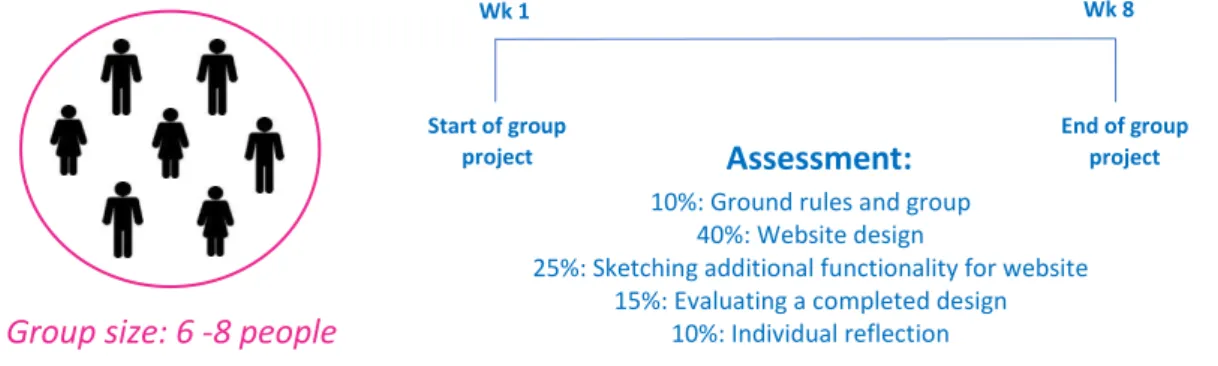
The first case study was undertaken with students from the module: TM255 ‘Communication and Information Technologies’ at the UK OU. This is a second-year undergraduate module that lasts for 9 months. The study was undertaken with students studying from October 2018 to June 2019. As part of the module, students are required to work in groups of between 6 and 8 to undertake an 8-week group project. This predominantly involves: 1) producing a website for a specific ‘client’ (e.g. a family-friendly hotel); 2) sketching out further interactive aspects of the website; and 3) evaluating another
group’s work (website and annotated sketch) (see Figure 1). To carry out the project, groups are provided with various online tools: a forum for group discussion; and WordPress for the website
development. A student’s overall grade for the project is made up of both individual and group marks.
This study used a prospective longitudinal design (Menard, 2008), where open-ended diaries (qualitative data) were completed by participants throughout the group project. For participating in the study, students received a £50 Amazon voucher.
10%: Ground rules and group 40%: Website design
25%: Sketching additional functionality for website 15%: Evaluating a completed design
10%: Individual reflection
Assessment:
Wk 1 Wk 8 Start of group project End of group projectGroup size: 6 -8 people
After gaining ethical approval from the OU Human Research Ethics Committee (HREC/3028) and Student Research Project Panel SRPP (2018/101), an invitation email stating the purpose of the study and what would be involved was sent to 151 students studying TM255. From these, 22 students responded indicating their willingness to take part. Two students failed to complete the diary entries and were therefore withdrawn from the study. The 20 participants that completed this study ranged in age from 24 years to 56 years (M = 32.10 years, SD = 7.79 years), and the majority were male (75%). The age range was representative of the student cohort, but men were slightly under-represented as the proportion studying the module was 83%.
Open-ended diaries were used for students to describe how they felt whilst undertaking the collaborative project. Diaries were created using a Microsoft Word document that was shared with participants via Microsoft OneDrive. This enabled both the participant and researcher to view the diary throughout the study. Students were instructed on how to fill out the diary entries after agreeing to take part. Although participants could make diary entries at any time, there were four compulsory diary entries that were to be completed at specific time points; once at the beginning of the activity, once in the middle, once near the end, and once one month after the project had been completed. For each of these, participants had a 5-day period to write their entries. To help direct students with the types of things they should write about, prompts were provided at the start of each entry. For example, it was suggested that students could write about the emotions they had experienced, what caused these feelings, and whether students thought these had impacted on their participation and performance. Reminder emails were sent to participants before each of the four diary entries were to be completed. In total, all 80 diary entries were successfully filled out (100% completion rate). Qualitative data from the online diaries were analysed using word count analysis (Leech & Onwuegbuzie, 2008). This process involved reading and re-reading the qualitative data to become familiar with the content and identifying emotion-related words before data were systematically worked through and emotion-related words counted. To ensure the data is not misleading about the emotions experienced by participants, only emotion-related words which expressed how the participants were feeling themselves during the diary entry period were coded. For instance, words used to describe the following were not counted: 1) emotions participants thought other students might be experiencing; 2) emotionsthey had experienced at a different time in the project (e.g. if a student discussed the emotions they had experienced at the start of the project in their final diary entry); 3) emotions they felt they may experience in future online collaborative activities; and 4) emotion-related words used in a different context (e.g. one student stated in their final diary entry that they thought the use of synchronous and asynchronous communication methods should be
“stressed” further to students in future collaborative activities).
5.1.2 Findings
In total, 218 emotion-related words were counted in the 80 online diary entries. From these, 80 words (36.7%) described positive emotions and 138 (63.3%) described negative emotions. A total of 17 positive emotions were identified. From these (frequencies provided in brackets), happiness (17),
relief (12) and confidence (10)were the most frequently recorded over the four diary entries. A total of 29 negative emotions were identified. From these, anxiety (21), frustration (18), and worry (18) were the most frequently recorded over the four diary entries.
Diary entry 1
(Beginning of collaborative project)
64 emotion words counted: 26 positive (40.6%) 38 negative (59.4%)
Diary entry 2
(Mid-way through collaborative project)
68 emotion words counted: 17 positive (25%) 51 negative (75%)
Diary entry 3
(End of collaborative project)
58 emotion words counted: 19 positive (32.8%) 39 negative (67.2%)
Diary entry 4
(1-month after collaborative project)
28 emotion words counted: 18 positive (64.3%) 10 negative (35.7%)
Word clouds were created for the frequency of reported emotions in each diary entry (see Figure 2). In diary entries 1, 2 and 3, there was a higher frequency of negative emotions counted than positive emotions. In diary entry 4, there was a higher frequency of positive emotions than negative emotions. There was also a much lower number of emotions overall in this final diary entry. The most frequently counted positive emotions in each diary entry were (frequencies provided in brackets): excitement (6) in diary entry 1; relief (4) in diary entry 2; and happiness (6) in diary entries 3 and 4. The most frequently coded negative emotions in each diary entry were: anxiety (11) in diary entry 1; frustration
and worry (both 10) in diary entry 2; frustration (6) in diary entry 3; and anxiety (3) in diary entry 4.
5.2 Case study: creating and sharing images in a digital photography module 5.2.1 Context and methods
The second case study is a short non-accredited module: TG089 ‘Digital photography: creating and sharing better images’. This is a 10-week module that is run twice a year. As part of their study, students are strongly encouraged to become part of an online community of learners. Whilst students do not produce a ‘group product’ as in TM255, they are encouraged to upload their own photos on a Figure 2: Word clouds of emotion-related words expressed by participants in each of the four
weekly basis and share them in OpenStudio, a photo-sharing environment (Lotz, Jones, & Holden, 2019). Students develop their visual and technical skills through their activity in OpenStudio, where
they are expected to give and receive comments on each other’s photos. They are assigned to groups of around 20 but can also view photos from the whole cohort (200-400 students). Students also participate in very active discussion forums which are open to the whole cohort. At the end of the module students each submit 10 photos for assessment.
This case study uses secondary data that comprises postings gathered from the module’s online
forums and qualitative responses collected from students via an end-of-module survey (which is carried out as a matter of course on all UK OU modules). Both these data sets are much broader than that gathered in the first case study, which was specifically exploring emotional aspects, as the TG089 data sets explore all aspects of students’ experiences on the module. However, an initial review of the forum postings and end-of-module survey comments identified that emotion words were being used by students to describe their experiences, and this inspired a further investigation of the data within the context of this research.
Ethical approval for using the data was gained from The OU’s Human Research Ethics Committee
(HREC/3372) and all data was anonymised so that the identity of individuals could not be compromised. The TG089 cohorts have an even gender balance, ranging from 49-52% female. Students are often older than typical OU UK students: 60% are aged 50 or older.
The end-of-module survey comprises both Likert-type scale questions and also spaces for open comments to questions that enable students to write more detail about their experiences on the module. Questions included for example “What aspects of teaching materials, learning activities or assessment did you find particularly helpful to your learning”. Open comment responses to all questions were gathered from four different presentations of the module over 2018 and 2019. The survey response rates ranged between 28-36%, and the surveys produced just over 1500 separate comments, ranging in length from a single word to several paragraphs.
This data was collected 1-4 weeks after the end of the module – however this was before students received their final grades so is equivalent to somewhere between diary entries 3 and 4 in the first case study.
Comments from the end of module survey were analysed using a similar word count analysis as described earlier (Leech & Onwuegbuzie, 2008). The process started with reading and re-reading the qualitative data to become familiar with the content, then the emotion words that had been identified in the first case study were searched for and counted. Again, only the emotions experienced by participants were included. Following this initial search, a final detailed read through was used to identify any new emotion words.
The set of emotion words that emerged from analysis of the survey was also used to analyse forum postings. Text was extracted from the 1846 posts (150,000 words) made in one presentation of the course. These were split into four periods: Before (the two weeks before the start date), Early (weeks 1 to 5 of the course), Late (week 6 to assessment deadline), and After (from assessment deadline to results). Software was used to count the emotion words; since posts were not closely read, these counts can only be indicative of the emotions expressed by students. Some words are commonly used to express politeness rather than emotion and therefore the following terms were excluded from
analysis: please, thank, hope, love, like, sorry, happy and connect. It was also not possible to be certain if students were discussing current or past emotions, or their own or others’ emotions.
5.2.2 Findings
5.2.2.1 Survey
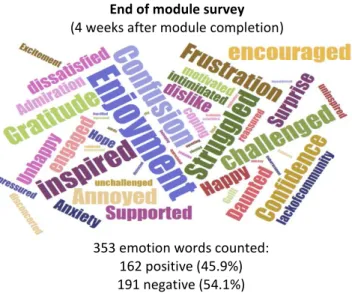
In total, 353 emotion-related words were counted in the end-of-module survey open comments. From these, 162 (45.9%) described positive emotions and 191 (54.1%) described negative emotions (see Figure 3). For positive emotions, a total of 21 emotions were identified. From these (frequencies provided in brackets), enjoyment (54), inspired or stimulated (19), gratitude (13) and challenged (13) were the most frequently recorded. For negative emotions, a total of 38 emotions were identified. From these, disappointment (36), confusion (21), struggle (15) and not confident (12) were the most frequently recorded.
The final read through to identify new emotion words was fruitful, as 35 additional words (positive and negative) were identified. For example, new positive emotion words included: inspired or
stimulated, encouraged, motivated and challenged. New negative emotion words included: daunted,
struggle, uncomfortable and intimidated.
There were also words identified in the first case study that were noticeably absent from this data. For example: pride, relief and satisfaction (positive); and anger and fear (negative). Frustration, one of the highest occurring emotions in the previous case study was also quite prevalent here, with 10 mentions. However, anxiety or worry was not mentioned as much, with only 4 comments relating to these combined. The word cloud below shows the results from all four surveys.
Figure 3. Word cloud of emotion-related words expressed by students over four end of module surveys.
5.2.2.2 Forums
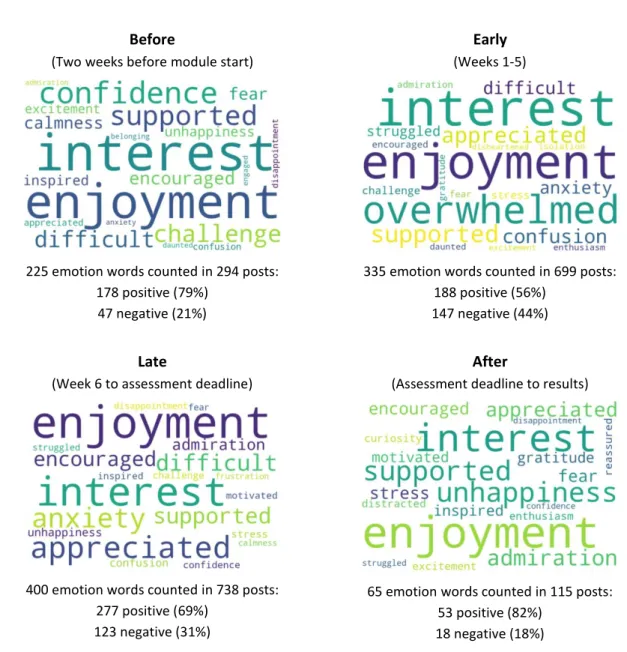
An initial 2361 emotion-related words were counted in the forum postings, but some which were frequently used in other senses (such as please and sorry) were excluded from further analysis. Of the remaining 1025, 696 (68%) described positive emotions and 329 (32%) described negative emotions. A total of 27 positive emotions were recorded, of which the most common were enjoyment (175),
interest (165), appreciated (56), supported (49), and encouraged (30). A total of 26 negative emotions were recorded, of which the most common were overwhelmed (41), anxiety (40), difficulty (38),
confusion (29) and unhappiness (25). Positive emotion terms were more prevalent than in the
end-of-353 emotion words counted: 162 positive (45.9%) 191 negative (54.1%)
End of module survey
module survey for the same module, and considerably more so than in the TM255 diaries. Nevertheless, students express a range of positive and negative emotions.
Before
(Two weeks before module start)
225 emotion words counted in 294 posts: 178 positive (79%)
47 negative (21%)
Early
(Weeks 1-5)
335 emotion words counted in 699 posts: 188 positive (56%)
147 negative (44%)
Late
(Week 6 to assessment deadline)
400 emotion words counted in 738 posts: 277 positive (69%)
123 negative (31%)
After
(Assessment deadline to results)
65 emotion words counted in 115 posts: 53 positive (82%)
18 negative (18%)
Figure 4. Word clouds of emotion expressed in forum posts in each phase of the course.
Looking at emotions over different periods of the module (see Figure 4), there is clear evidence of shifts of emotion. The majority of emotions are positive (79%) when the forums open and before the module gets underway, become less so during the module (56% in the early phase), and return to very positive emotions (82%) after the module ends.
The count of positive emotions as the forums open and the module gets underway should perhaps be higher still, since an emotion not picked out by the analysis used here is the sense of eager anticipation shown in the forums at this time. This is because anticipation is often expressed as phrases such as
looking forward which are missed because we search only for single words, or using words such as
“I'm really looking forward to chatting with you all and the challenges that this course will bring. I think it's going to be tough squeezing it in with my job and other interests but definitely will be rewarding.”
During the main weeks of the photography course, students are busy sharing and commenting on
each other’s images in OpenStudio. The emotions expressed in these weeks become more negative.
A cluster of negative terms –anxiety, difficulty, struggle, and stress– make an appearance. Students may say they are overwhelmed by the volume of images to look at, and sometimes daunted by the skill of others.
“I generally felt quite overwhelmed by the pressure to comment on so many images.”
“I've been impressed by the standard of work folks have been submitting. Feeling a tad daunted but keen to learn and enthusiastic.”
Lacking confidence in their own ability, they may feel unable to comment on the work of others.
“It can be quite intimidating posting photos alongside other students who seem to have a far
more advanced skill set, knowledge and who comment on my photos with things I don't understand. On the flipside, I also don't feel confident enough to critique their images due to
my inferior knowledge.”
However, enjoyment remains a common emotion throughout the module:
“I'm really enjoying looking at all your images on Open Studio. I'm finding that I'm learning a lot from this, I just wish I had more hours in the day!”
The final forum postings on TG089 often include an acknowledgement of the support received from module staff and fellow students. This includes emotional support as well as academic support; some students clearly feel able to express their emotions and often receive very supportive replies from their peers.
“many thanks to you all for your assistance, support and comments over the 13 weeks of the course. It has been a great experience and I will miss the 'community' and opportunity to get constant feed-back”
6.
Discussion
This paper has explored students’ emotions when undertaking online collaborative learning activities
in modules at the UK OU. Both case studies illustrate that such activities can be highly emotional, with learners reporting a wide range of positive and negative emotions. Findings from the two case studies revealed differences in the overall emotional journeys of students.
In the first case study, TM255 students were found to describe a much higher percentage of negative emotions compared to positive emotions during the collaborative project. This was the case for three out of the four online diary entries; with only the final entry (one month after the collaborative project) having a greater percentage of positive emotions described (see Figure 2). Similar to the findings of Hilliard et al (2019) and Webster (2019), anxiety was the most reported emotion at the beginning the collaborative activity. Other more frequently described emotions included worry, nervousness and the positive feeling of excitement. These future-oriented, or anticipatory, emotions make sense at this stage due to the uncertainty and unknown nature of the collaborative activity. As the activity
emotion of frustration started to become more apparent. This is an emotion that has been found to be common when undertaking online collaborative learning activities (Capdeferro & Romero, 2012) and the change of feelings of anxiety to feelings of frustration have been reported previously (Hilliard et al., 2019). During the later stage of the project, feelings of happiness were also commonly found. Another shift in feelings was observed after the project had been completed, with more positive emotions (such as happiness and satisfaction) being described. Again, such retrospective emotions would make sense at this stage, as students could reflect on what they had accomplished during the activity. Interestingly, anxiety was also still reported in this diary entry. This was, however, predominantly reported by a few students who had not received their final grade for the activity; therefore their feelings of anxiety related to the grade they might receive for the project.
In contrast to the students of TM255, students in TG089 expressed positive emotions to a much greater extent whilst undertaking the social photo-sharing activity in the module (as demonstrated by survey and forum findings). In each of the phases of the activity, a greater percentage of positive emotions than negative emotions was expressed (see Figure 4). Before the activity began, feelings of
interest and enjoyment were frequently mentioned by students. Experiencing more positive feelings before commencing online collaboration was reported by Hilliard et al (2019); however, many of the specific positive emotions reported in that study are different to those expressed by TG089 students. During the main weeks of the TG089 course, the emotions of interest and enjoyment were both still prevalent. There was, however, an increased expression of negative emotions, such as being
overwhelmed, and experiences of anxiety. As with TM255, after the completion of the TG089 module, increased expressions of positive feelings were found.
The results of these two case studies demonstrate the differing emotions that can be experienced when undertaking online social and collaborative learning. One of the main factors that could help explain the contrasting emotional experiences of students in the two modules is the differing nature of the tasks that were being undertaken. The collaborative group project in TM255 involved creating an assessed shared piece of work (a website) which directly impacted each student’s overall mark for
the assignment. Furthermore, the group interaction between TM255 students was marked and contributed to each student’s overall grade for the assignment. This is very different to the activity in
TG089, where students submitted individual photos for assessment. Student interaction was not
mandatory and did not count towards a student’s overall grade for the assignment. Therefore, the
pressure for TG089 students to interact was much less. Previous research has highlighted that assessment of online collaboration, especially interaction between learners, can increase negative emotions (Donelan & Kear, 2018; Hilliard et al., in press).
It could be thought that the assessed nature of the collaborative group project in TM255 led to perceptions of increased importance and value of activity, as well as a reduced perceived level of controllability of the task (due to others being able to impact students’ overall mark in the assignment). According to Pekrun's (2006) control-value theory of emotions, these appraisals (increased value and reduced control) would have led to an increased experience of many negative emotions (such as anxiety). Although students in TG089 may have had a similar sense of value and importance for the photo-sharing task in the module, their perceived level of control may have been higher, due to students individually submitting their own work for assessment and not relying on others to produce a shared piece of work. Such appraisals of control and value would have led to
increased positive emotions such as enjoyment (Pekrun, 2006). However, as control and value appraisals were not explored explicitly in this study, firm conclusions cannot be drawn on this theory. Another important finding from this study was that there was a higher percentage of positive emotions described by students in TM255 and TG089 (forum data) after the completion of the collaborative activities. Although moderate to high levels of satisfaction have been reported after undertaking online collaboration (Dewiyanti, Brand-Gruwel, Jochems, & Broers, 2007; Zhu, 2012), very few studies have investigated other emotions experienced after the completion of such activities. In the two case studies reported in this paper, many other positive feelings (such as happiness,
enjoyment and confidence) were mentioned by learners. The length of time after the collaboration activity has finished may also be an important consideration when exploring emotional experiences. For instance, in the TM255 case study, the final diary entry was completed a month after the group project had finished. During this time the majority of students received their grade for the assessment, which may have increased the positive feelings experienced by learners. Altogether, this finding highlights the importance of exploring students’ feelings of their online collaborative experiences after the activities have been completed. Without this exploration, a full understanding of the emotional experiences of undertaking online social and collaborative activities would not be complete. This finding may have implications for prompting students to reflect on their experiences: this is commonly done at the end of the activity but should perhaps be done at a later point to allow time for feelings to develop.
Several different data sources were used to explore the emotions of learners whilst undertaking online collaborative learning activities reported in this paper. The use of a solicited online diary proved to be an effective research method for gathering data about student emotion during the assessed collaborative project in TM255. Secondary data, in the form of postings on the TG089 module’s online
forums and qualitative responses collected from an end of module survey, also proved to be a very useful way of exploring student emotion without increasing the work load of learners during their study. In both investigations, word count analysis was undertaken to calculate the frequency of emotion-related words in data sources. This analysis method was able to identify many emotions that were experienced in relation to undertaking the online collaborative activities.
7.
Conclusion and implications
This study has made a contribution towards understanding the emotions experienced by students in a distance learning setting, where students interact with other students and contribute to collaborative activities online. Very few studies have explored students’ emotions in these settings. The study explored contrasting activities in two distance learning modules: an IT module where students work together in a small group to produce a website; and another where students on a photography module share and comment online on each other’s individual photos. Whilst the first module contributes to part of an undergraduate degree, the second is a non-accredited module; however both are assessed.
Both case studies have shown that taking part in online collaborative learning activities is a highly emotional experience for students, although differences in the emotional journey between students on the two modules were identified. Feelings about the IT module’s group project were initially more negative, with anxiety being the predominant emotion, in contrast to the photography module where
emotions of enjoyment and interest were initially expressed. Anxiety changed to frustration during the group project, and then finally positive emotions of happiness and satisfaction emerged after it had finished.
Different factors may contribute to the emotions that students experience: for example, the nature
of tasks, dependency of grades on other students, and students’ perceptions of how much control
they have over the situation. To help manage emotions it is important that students are supported at all stages of collaborative learning activities. Some of the practical implications of this work are highlighted below.
• In designing collaborative learning activities, it is important to minimise the frustration students may encounter when relying on other students’ contributions, whilst still ensuring tasks are engaging and inspire feelings of enjoyment and satisfaction.
• Prior to starting the activities, it is helpful to prepare students by openly acknowledging the emotional aspects involved and that students may experience a range of positive and negative emotions. It is important to recognise that some of the feelings they may experience cannot be avoided, but they can be managed. One suggestion would be to share feedback from students who have previously undertaken the activities (or even word clouds such as those used in this paper) that describe the emotional journey they experienced.
• During the activity it is important that students feel supported. Negative emotions do not always have a negative effect on participation and performance (Hillard et al., 2019) and can be facilitative. However, it is important to provide support for students if emotions are strong and persistent and are having negative effects on students’ well-being or performance.
• Finally, past research has shown that failure to achieve ‘closure’ after completion of
collaborative learning activities leads to extended ‘unsettled feelings’ (Melrose & Bergeron, 2007). Encouraging students to share with others what they have learned, and providing students with the opportunity to reflect on their experiences, may help bring about closure. This in turn may allow students to express positive emotions associated with closure.
We end this paper by reflecting on the data and methods used in this study, and ideas for future work. The data collected and analysed was from different sources and in different formats, including diary entries, forum data and end-of-module survey results. The same approach to analysing the different types of data was used in each case. This involved identifying emotion-related words and counting their frequency. Similar approaches have been used to explore student emotions in previous literature (Hascher, 2008; Stupnisky, Pekrun, & Lichtenfeld, 2016). There were challenges in applying the same technique to these different forms of data; for example, some were more descriptive, or voluminous than others. In addition, the diary data was specifically collected to explore emotions, whereas the forum and survey data were broader in their scope of student feedback; this breadth made it more difficult to identify emotion-related words in contexts that were significant. Finally, the work was limited to identifying instances of emotions, not the reasons for them. Whilst we have discussed possible reasons that may influence the occurrence of different emotions, exploring these in more depth is recommended for future work.
8.
Acknowledgements
The authors wish to thank our colleague Tony Hirst for help in extracting text from the forums. We also wish to thank the students whose words we have quoted.
9.
References
Artino, A. (2012). Emotions in online learning environments: Introduction to the special issue. The Internet and Higher Education, 15(3), 137–140.
Binkley, M., Erstad, O., Herman, J., Raizen, S., & Ripley, M. (2012). Defining 21st century skills. In P. Griffin, B. McGaw, & E. Care (Eds.), Assessment and teaching of 21st century skills (pp. 17–66). Heidelberg: Springer.
Boekaerts, M., & Pekrun, R. (2016). Emotions and emotion regulation in academic settings. In L. Corno & E. M. Anderman (Eds.), Handbook of educational psychology (3rd edn, pp. 76–90). Abingdon, Oxon: Routledge.
Capdeferro, N., & Romero, M. (2012). Are online learners frustrated with collaborative learning experiences? The International Review of Research in Open and Distributed Learning, 13(2), 26–
44.
Donelan, H., & Kear, K. (2018). Creating and collaborating: students’ and tutors’ perceptions of an
online group project. International Review of Research in Open and Distributed Learning, 19(2), 37–54.
Harasim, L. (2017). Learning and theory and online technologies (2nd edn). Abingdon, Oxon: Routledge.
Hascher, T. (2008). Quantitative and qualitative research approaches to assess student well-being.
International Journal of Educational Research, 47(2), 84–96.
Hilliard, J., Kear, K., Donelan, H., & Heaney, C. (in press) Students’ experiences of anxiety in an
assessed, online, collaborative project. Computers & Education.
Hilliard, J., Kear, K., Donelan, H., & Heaney, C. (2019). Exploring the emotions of distance learning students in an assessed, online, collaborative project. Connecting through Educational Technology - Proceedings of the European Distance and E-Learning Network 2019 Annual Conference, 251–259. Bruges, Belgium.
Järvelä, S., Kirschner, P. A., Panadero, E., Malmberg, J., Phielix, C., Jaspers, J., … Järvenoja, H. (2015).
Enhancing socially shared regulation in collaborative learning groups: Designing for CSCL regulation tools. Educational Technology Research and Development, 63(1), 125–142. Leech, N. L., & Onwuegbuzie, A. J. (2008). Qualitative data analysis: A compendium of techniques
and a framework for selection for school psychology research and beyond. Psychological Association, 23(4), 587–604.
Linnenbrink, E. A. (2006). Emotion research in education: Theoretical and methodological
perspectives on the integration of affect, motivation, and cognition. Educational Psychology Review, 18(4), 307–314.
Lotz, N., Jones, D., & Holden, G. (2019). OpenDesignStudio: virtual studio development over a decade. Proceedings of the DRS LearnXdesign Conference 2019. Ankara, Turkey.
Mayer, R. E. (in press). Searching for the role of emotions in e-learning. Learning and Instruction. Melrose, S., & Bergeron, K. (2007). Instructor immediacy strategies to facilitate group work in online
graduate study. Australasian Journal of Educational Technology, 23(1), 132–148. Menard, S. (2008). Handbook of longitudinal research: Design, measurement, and analysis.
Burlington, MA: Academic Press.
Pekrun, R., Muis, K. ., Frenzel, A. ., & Goetz, T. (2018). Emotions at school. Abingdon, Oxon: Routledge.
Reis, R. C. D., Isotani, S., Rodriguez, C. L., Lyra, K. T., Jaques, P. A., & Bittencourt, I. I. (2018). Affective states in computer-supported collaborative learning: Studying the past to drive the future.
Computers & Education, 120, 29–50.
Scherer, K. R. (2005). What are emotions? And how can they be measured? Social Science Information, 44(4), 695–729.
Stupnisky, R. H., Pekrun, R., & Lichtenfeld, S. (2016). New faculty members’ emotions: a mixed -method study. Studies in Higher Education, 41(7), 1167–1188.
Tyng, C. M., Amin, H. U., Saad, M. N. M., & Malik, A. S. (2017). The influences of emotion on learning and memory. Frontiers in Psychology, 8(1454).
Webster, E. A. (2019). Regulating Emotions in Computer-Supported Collaborative Problem-Solving Tasks. University of Victoria.