Implementation of Integrated Islamic Primary School (SRAI) from
Administrators’, Teachers’, and Pupils’ Perspectives
Ikhsan Othman
Sultan Idris Education University, Malaysia E-mail: [email protected]
Norila Md. Salleh
Sultan Idris Education University, Malaysia E-mail: [email protected]
Received: 30th January 2016 Revised: 15th February 2016 Accepted: 20th February 2016
Abstract
Integrated Islamic Primary School or in Malaysian Language called Sekolah Rendah Agama Integrasi (SRAI), it a type of primary school in Malaysia which is under the administration of Selangor Islamic Department. SRAI integrates curriculum implemented in Malaysia National Primary School and curriculum implemented in Selangor Islamic Primary School. The two different curriculums are normally implemented in two different sessions and in the two types of the mentioned schools. Upon the operation of SRAI, there are strenghts and weakenesses that can be identified and positively discussed for further enhancement of the schools as this type of schools might someday be proposed or looked as a model school. This paper is based on a study done on the schools. The study focusies on administrators, teachers, and pupils perspectives on the selected issues regarding SRAI. Questionnaires were given to the respondents to seek their perceptions on SRAI. Generally, the findings of the study showed that most aspects in the implementation of SRAI are recieved positively while there are others which need enhancements. Periodic review should be done to monitor the development and situation of the schools from time to time.
Keywords: National Primary School, Islamic Primary School, Integrated Islamic Primary School Abstrak
Sekolah Dasar Islam Terpadu atau dalam bahasa Malaysia disebut Sekolah Rendah Agama Integrasi (SRAI) yaitu salah satu jenis sekolah dasar di Malaysia yang berada di bawah administrasi Departemen Islam Selangor. SRAI mengintegrasikan kurikulum yang diimplementasikan di Sekolah Dasar Negeri Malaysia dan Sekolah Dasar Islam Selangor. Dua kurikulum yang berbeda dilaksanakan secara normal dalam dua sesi yang berbeda dari dua jenis sekolah tersebut. Setelah pelaksanaan SRAI, ada kelebihan dan kelemahan yang dapat diidentifikasi dan baik dibahas untuk peningkatan lebih lanjut dari sekolah sebagai jenis sekolah yang pada kemudian hari akan diusulkan atau diperlihatkan sebagai sekolah model. Makalah ini didasarkan pada kajian yang dilakukan di sekolah-sekolah. Penelitian ini memfokuskan pada perspektif administrator, guru, dan murid tentang isu-isu yang dipilih mengenai SRAI. Kuesioner yang diberikan kepada responden untuk mencari persepsi mereka tentang SRAI. Secara umum, temuan penelitian menunjukkan bahwa sebagian besar aspek dalam pelaksanaan SRAI diterima dengan baik sementara aspek-aspek lainnya membutuhkan peningkatan. Tinjauan secara periodik harus dilakukan untuk memantau perkembangan dan situasi sekolah dari waktu ke waktu.
Kata Kunci: Sekolah Dasar Negeri, Sekolah Dasar Islam, Sekolah Dasar Islam Terpadu
Introduction
At national level, common primary schools in Malaysia are of three types namely National Primary School or in Malaysian Language called Sekolah Kebangsaan (SK); National Type Chinese Primary School or in Malaysian Language called Sekolah Jenis Kebangsaan Cina (SJKC) and National Type Tamil School or in Malaysian Language
called Sekolah Jenis Kebangsaan Tamil (SJKT) beside others such as Islamic religious schools which are under the governant of State Islamic Department (Ikhsan Othman & Norila Md Salleh, 2014). In state of Selangor for example, Selangor State Islamic Department under Bahagian 10 Seksyen 120 Enakmen Pentadbiran Agama Islam (Negeri Selangor) 2003 serta Enakmen Pengawalan Sekolah-sekolah Islam 1988 (Enakmen No. 2/1988) is conducting Islamic religous primary schools called Religous Primary School or in Malaysian Language called Sekolah Rendah Agama (SRA) where by the curriculum is more towards Islamic education.
Beside that, Selangor state in Malaysia is also pioneering Integrated Islamic Primary School or in Malaysian Language called Sekolah Rendah Agama Integrasi (SRAI). SRAI was started in the year 2000 and currently there are all together elevenSRAIlocated in eight districts in Selangor; SRAI Seksyen 19 Shah Alam; SRAI Bandar Baru Bangi; Srai Taman Keramat; SRAI Sungai Manggis; SRAI Tengku Ampuan Fatimah Batu Belah; SRAI Pekan Beranang; SRAI Salak Tinggi; SRAI Sungai Cincin; SRAI Bandar Baru Kuala Selangor; SRAI Muhammadiah Pekan Sabak; SRAI Dato’ Mufti Yusoff Sahabuddin Syeksen 7 Shah Alam, (Buletin SRAI Selangor, 2015). SRAI aims to produce pupils who are fully knowledgeable, who have stronger morals and Islamic values to achieve the righteous and to get the love from Allah.
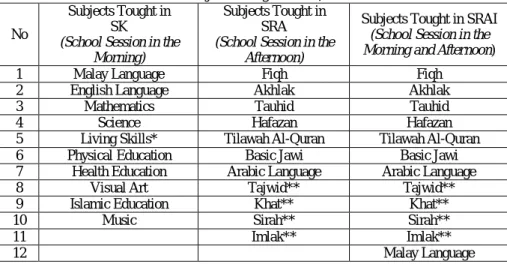
In Malaysia, especially in the state of Selangor, parents usually send their children to two different schools; SK in the morning where the children learn academic subjects and to SRA in the afternoon where the children learn Islamic subjects. Unlike in the concept of SRAI, where parents need to send their children only to a single school under single roof and single administration with academic subjects and Islamic subjects integrated together. SRAI simultaneously implements national curriculum similar to those implemented in SK; and state Islamic curriculum as currently implemented in SRA. The combination of the two types of the curriculums require SRAI to begin the school session from morning to late afternoon. Table 1 shows the basic subjects taught in SK, SRA and SRAI.
Table 1: Basic Subjects Taught in SK, SRA and SRAI No
Subjects Tought in SK (School Session in the
Morning)
Subjects Tought in SRA (School Session in the
Afternoon)
Subjects Tought in SRAI (School Session in the Morning and Afternoon)
1 Malay Language Fiqh Fiqh
2 English Language Akhlak Akhlak
3 Mathematics Tauhid Tauhid
4 Science Hafazan Hafazan
5 Living Skills* Tilawah Al-Quran Tilawah Al-Quran
6 Physical Education Basic Jawi Basic Jawi
7 Health Education Arabic Language Arabic Language
8 Visual Art Tajwid** Tajwid**
9 Islamic Education Khat** Khat**
10 Music Sirah** Sirah**
11 Imlak** Imlak**
13 English Language 14 Matemathics 15 Science 16 Living Skills* 17 Physical Education 18 Health Education 19 Visual Art 20 Islamic Education 21 Music
* Only taught in Year 4, 5 and 6 **Only taught from Year 3
Similar to those implemented in SK, at the end of Year 6, pupils in SRAI need to sit for UPSR (Malay acronym for Ujian Pencapaian Sekolah Rendah). Likewise, pupils in SRAI need to sit for PSRA (Malay acronym for Peperiksaan Sijil Rendah Agama) as pupils in SRA.
Based on the general overview, it shows that schools which employ the concept of SRAI are preferable by parents compared to SK and SRA especially among parents living in town areas. Parents in town asusual go out to work in the morning and return in the late afternoon. Therefore by sending their children to SRAI, it helps their daily routine better. In SRAI, lunch for the children is provided by the school with a little fund paid by parents. The children are also led to perform sholat Zohor and sholat Asar together
(jamaah) beside other Islamic, academic and cocuricular activities. Pupils from SRAI seems to perform better than those who are from SK or SRA. For example, there is a case where ex-pupils from SRAI Sungai Chinchin, Selangor who are capable to perform debate in both English language as well as Arabic language where pupils from SK and SRA could not do so (Buletin SRAI Selangor, 2015). In addition to outstanding performance, such achievement is among others which can attract parents to send their children to SRAI.
The implementation of SRAI is essentially parallel with Malaysia National Education Philosophy which states “Education in Malaysia is an on-going effort towards further developing the potential of individuals in a holistic and integrated manner, so as to produce individuals who are intellectually, spiritually, emotionally and physically balanced and harmonious, based on a firm belief in and devotion to God. Such an effort is designed to produce Malaysian citizens who are knowledgeable and competent, who possess high moral standards, and who are responsible and capable of achieving high level of personal well-being as well as being able to contribute to the harmony and betterment of the family, the society and the nation at large” (Malaysia Ministry of Education, 2001). SRAI apparently integrates academic as well as religious values in the curriculum. Therefore, it cannot be denied that the development of pupil’s intrinsic domain as well as instrumental domain can be integrated in SRAI.
One of the roles of education system in Malaysia is to equip young generation holistically for their success in the era of globalization with the latest global challenges and competitions. The integration of national curriculum as in SK and the state Islamic curriculum as in SRA in schools with the concept of SRAI, is of high expectation to
produce citizens who are knowledgeable and with higher competency; and who possess higher Islamic values so that they play a more effective role in the present and peaceful in the here after as in al-Quran (2: 201):
The meaning: Our Lord! Give unto us in the world that which is good and in the hereafter that which is good, and guard us from the doom of fire.
However, upon the operation of SRAI there are strenghts and weakenesses which may be indentified and viewed from different perspectives.Studies should be carried out to view and monitor the condition of SRAI from time to time. Thus, this study was carried out in the hope that the findings can be used as a basis for further enhancement of SRAI. Research Methodology
This study employ a survey research design which involved all schools with the concept of SRAI except SRAI Dato’ Mufti Yusoff Sahabuddin Syeksen 7 Shah Alam. All administrators and teachers from ten SRAI in state of Selangor were involved in this study as respondents. Administrators in this study include Headmasters, and all Senior Assisstant Teachers. A total of 41 administrators which comprises of 14 males (34.1%) and 27 females (65.9%) were selected as respondents. Among teachers, 207 were involved as respondents of this study which comprises of 40 males (19.7%) and 167 females (80.7%). Among pupils who study in SRAI, a total of 498 Year 5 pupils were selected as respondents which consists of 237 males (47.6%) and 261 females (52.4%).
Two types of questionnaires were developed for the pupose of this study. The first questionnaire is used to gather information from the administrators and teachers (Questionnaire – A) whereas the second questionnaires is used to gather information from the students (Questionnaire – B). Based on the pilot study, the analysis found that the reliability coefficients of Questionnaire - A and Questionnaire - B are = .82 and = .54 respectively.
There are 32 items in Questionnaire – A and it uses 5-point Likert scale i.e. strongly disagree (1), disagree (2), neutral (3), agree (4), and strongly agree (5). Based on the data gathered in this study, mean score and standard deviation are calculated for each item. Questionnaire – B consists of 30 items and students are required to respond to each item based on only two options namely agree and disagree. Based on the data collected, the percentage of agreement of each item are calculated.
Research Findings and Discussion
The research findings are peresented based on the stipulated research questions as metioned above.
Administrators’ and Teachers Perceptions Toward SRAI
The concept of SRAI in this study operationally includes the basic philosophy of education, rationale, and aim. It involves Item 1 to Item 5. Table 2 shows the findings of the five items.
Table 2: Administrators’ and Teachers’ Perception on the Concept of SRAI
No Items Administrator Teacher Mean Score S.D Mean Score S.D 1 SRAI is implemented based on Selangor
State Islamic Department Philosophy of Education
4.49 .506 4.29 .689
2 I understand the rationale of implementing SRAI
4.22 .577 3.94 .678 3 The objectives of SRAI are relevant to
achieve the aim of SRAI
3.93 .616 3.68 .840 4 I believe that the aim of SRAI can be
achieved successfully
4.00 .632 3.87 .754 5 The existence of schools similar to SRAI
concept should be increased
4.46 .636 4.27 .791
From Table 2, it can be concluded that the administratos and teachers do understand the concept of SRAI and they perceive positively on the concept. Respondents also agree that the existence of schools similar to SRAI should be increased in number.
b. What are administrators’ and teachers’ perception on the administration of SRAI? Administration of SRAI in this study includes the aspects of budget, manpower, cooperation, equipments and also skills needed for the operation of SRAI. Table 3 shows the administrators’ and teachers’ perceptions on the admistration of SRAI based on Item 6 to Item 12.
Table 3: Administrators’ and Teachers’ Perceptions on the Administration of SRAI
No Items Administrator Teacher Mean Score S.D Mean Score S.D 6 The administration of SRAI needs larger
budget
4.72 .510 4.50 .752 7 Budget given for the administration of
SRAI was sufficient
2.00 .707 2.31 .823 8 SRAI could acquire qualified teachers
easily
2.41 .948 2.89 .970 9 Different type of teachers’ qualification
raise problems in administration
3.15 1.509 2.90 1.370 10 I receive good cooperation from teachers
and staffs in carrying my duties
3.93 .932 4.04 .783 11 Facilities in SRAI are sufficient 2.13 .939 2.10 .861
12 I have sufficient skills to do my duties in SRAI
3.15 1.027 3.50 .812
Both parties, administrators and teachers agreed with items 6, 10 and 12. Thus, administrator’ and teachers’ believe that more budget is needed to manage SRAI. In carrying out their duties, cooperation from school staffs is not a problem among administrators’ and teachers’. Based on items 7, 8 and 11, administrators’ and teachers’ do not agree that the budget for SRAI is adequate. Thus, they also do not agree that SRAI has adequate facilities. Acquiring qualified teachers is likely an issue for SRAI. Generally, that administration of SRAI need to be reviewed for further enhancement especially regarding budget, teachers qualification and facilities.
c. What are administrators’ and teachers’ perception on teaching and learning process in SRAI?
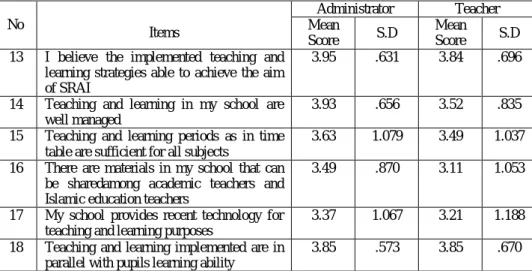
Administrators and teachers responses on the process of teaching and learning in SRAI is summarized in Table 4.
Table 4: Administrators’ and Teachers’ Perception on Teaching and Learning Process in SRAI No Items Administrator Teacher Mean Score S.D Mean Score S.D 13 I believe the implemented teaching and
learning strategies able to achieve the aim of SRAI
3.95 .631 3.84 .696
14 Teaching and learning in my school are well managed
3.93 .656 3.52 .835 15 Teaching and learning periods as in time
table are sufficient for all subjects
3.63 1.079 3.49 1.037 16 There are materials in my school that can
be sharedamong academic teachers and Islamic education teachers
3.49 .870 3.11 1.053
17 My school provides recent technology for teaching and learning purposes
3.37 1.067 3.21 1.188 18 Teaching and learning implemented are in
parallel with pupils learning ability
3.85 .573 3.85 .670
Table 4 presents the analysis of Item 13 to Item 18. Based on the data obtained, administrators and teachers collectively perceive positively regarding the process teaching and learning carried out in SRAI. They believe that the teaching and learning process implemented in SRAI are capable of achieving the aims of SRAI.
d. What are administrators’ and teachers’ perceptions on cocurriculum management in SRAI?
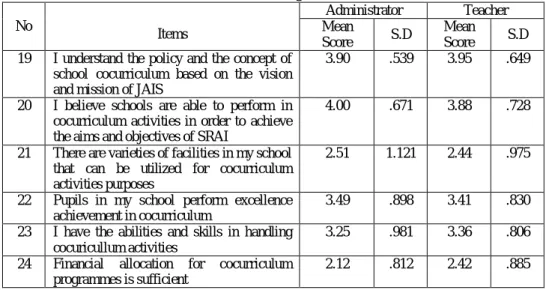
Administrators’ and teachers’ views on cocurriculum management in SRAI have also been obtained. The findings of the analysis are shown in table 5.
Table 5: Administrators’ and Teachers’ Perception on CocurriculumManagement in SRAI No Items Administrator Teacher Mean Score S.D Mean Score S.D 19 I understand the policy and the concept of
school cocurriculum based on the vision and mission of JAIS
3.90 .539 3.95 .649
20 I believe schools are able to perform in cocurriculum activities in order to achieve the aims and objectives of SRAI
4.00 .671 3.88 .728
21 There are varieties of facilities in my school that can be utilized for cocurriculum activities purposes
2.51 1.121 2.44 .975
22 Pupils in my school perform excellence achievement in cocurriculum
3.49 .898 3.41 .830 23 I have the abilities and skills in handling
cocuricullum activities
3.25 .981 3.36 .806 24 Financial allocation for cocurriculum
programmes is sufficient
2.12 .812 2.42 .885
Based on Table 5, the administrators and teachers agree that cocurriculum management in SRAI runs smoothly except on the aspects of facilities and finance. Both parties do not agree that there are varieties of facilities in their school that can be utilized for the purpose ofcocurriculum activities. Administrators’ and teachers’ also do not agree that financial allocation for cocurriculum programmes is sufficient. Therefore, it is proposed that the facilities and financial allocation for cocurriculum in SRAI need to be reviewed for the betterment of pupils’ cocurriculum activities.
e. What are administrators’ and teachers’ perceptions on local communities response on SRAI?
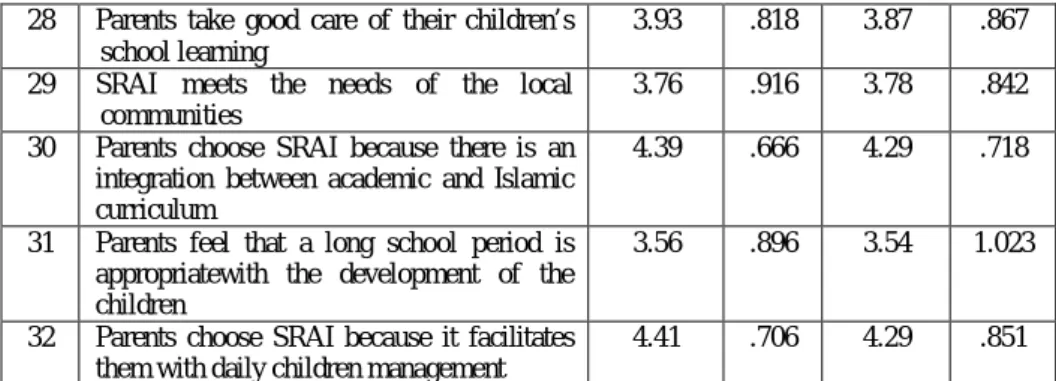
Item 25 to item 31 in the questionaire are related to local communities’ response on SRAI as percieved by administrators and teachers. Local communities in this study operationally mean the societies who live neighbourhood to the schools. This includes parents who send their children to the schools. The findings is summarized in Table 6.
Table 6: Administrators’ and Teachers’ Perception on Local Communities Response on SRAI
No Items Administrator Teacher Mean Score S.D Mean Score S.D 25 Local communities response on SRAI is
encouraging
3.98 .987 3.80 .909 26 Support given by local communities on
SRAI implementation is satisfactory
3.95 .865 3.76 .863 27 Local communities put high hopes on SRAI 4.32 .756 4.06 .776
28 Parents take good care of their children’s school learning
3.93 .818 3.87 .867 29 SRAI meets the needs of the local
communities
3.76 .916 3.78 .842 30 Parents choose SRAI because there is an
integration between academic and Islamic curriculum
4.39 .666 4.29 .718
31 Parents feel that a long school period is appropriatewith the development of the children
3.56 .896 3.54 1.023
32 Parents choose SRAI because it facilitates them with daily children management
4.41 .706 4.29 .851
From Table 6, it shows that local communities have positive perceptions toward SRAI as percieved by administrators’ and teachers’. Out of eight items, Item 32 has the highest mean score; in fact in real life parent choose SRAI because it facilitates them with daily children management.
Pupils’ Perception Toward SRAI
a. What is pupils’ perception on teaching and learning process in SRAI?
Percentage of agreement were calculated for each of ten items, and the resultsare summarized in Table 7.
Table 7: Pupils Perception on Teaching and Learning Process
No Items %
Agree
% Not Agree 1. Schedule of study time is compact 73.2 26.8 2. Most learning activities meet my interest 82.5 17.7 3. Teachers entered the classroom all the time 27.1 72.9 4. I can complete the work assigned by the teachers 56.4 43.6 5. I can revise my lesson every day. 33.1 66.9 6. Teachers use many facilities and teaching materials 45.9 54.1 7. Teachers who taught me are all kind 86.7 13.3 8. There are too many students in my classroom 23.5 76.5 9. I could use school’s computers at the school 31.1 68.9 10. There are enough chairs and desks for everyone in
my classroom
96.4 3.4
Based on Table 7, students feel that their study time is compact. This is due to the combination of two types of curriculum i.e. Malaysia National Primary School curriculum and Selangor State Islamic Primary School curriculum. The situation had restricted student from doing revision daily. In parallel to the administrators’ and teachers’ perceptions, limited facilities in SRAI might also limit teachers from using various equipment and materials during teaching and learning process. The large number of students in the classroom shows that SRAI meet the needs of parents in choosing schools for their children.However, the basic facilities in the classroom i.e. chairs and desks are sufficient. It is indeed encouraging that majority of the students admitted that their teachers in SRAI are kind.
b. Pupils’ perception on general facilities in SRAI?
Data analysis regarding pupils’ perception on general facilities in SRAI are shown in Table 8.
Table 8: Pupils’ Perception on General Facilities in SRAI
No Items %
Agree
% Not Agree 24. Classroom for learning are comfortable 69.0 31.0 25. Toilets are always clean and there is no water
problem 25.8 74.2
26. School canteen sells sufficient food for lunch 55.4 44.6 27. There are prayers room for all pupils 58.9 41.1 28. There is no transport problem to get to school 76.5 23.5 29. There is a playground for students to play 45.3 54.7 30. I can easily contact my family for an
emergency such as illness or others 75.5 24.5
Based on Table 8, it shows that SRAI has the necessary facilities such as classroom, toilet, canteen, prayers room, transportation, playground and also communication facilities. However, some facilities e.g toilets, might need better maintainence.
c. What is pupils’ overall perception on SRAI?
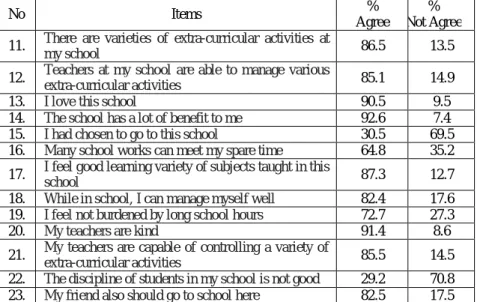
Data analysis on pupils’ overall perception on SRAI is tabulated in Table 9. Table 9: Pupils’ Overall Perception on SRAI
No Items %
Agree % Not Agree
11. There are varieties of extra-curricular activities at
my school 86.5 13.5
12. Teachers at my school are able to manage various
extra-curricular activities 85.1 14.9
13. I love this school 90.5 9.5
14. The school has a lot of benefit to me 92.6 7.4
15. I had chosen to go to this school 30.5 69.5
16. Many school works can meet my spare time 64.8 35.2
17. I feel good learning variety of subjects taught in this
school 87.3 12.7
18. While in school, I can manage myself well 82.4 17.6
19. I feel not burdened by long school hours 72.7 27.3
20. My teachers are kind 91.4 8.6
21. My teachers are capable of controlling a variety of
extra-curricular activities 85.5 14.5
22. The discipline of students in my school is not good 29.2 70.8
23. My friend also should go to school here 82.5 17.5
Overall, students showed a positive impression towards SRAI although they do not choose to attend SRAI. This includes the aspects of cocurricular, teachers, subjects taught,
school hours and pupils dicipline. In fact, students do encourage their friends to attend SRAI.
SK and SRA are two different types of primary school under two different administration. However, SRAI as implemented in Selangor is a type of primary school which is in ‘a single roof and single administration which combine both curriculums, national curriculum and Selangor state Islamic curriculum, as implemented in SK dan SRA respectively.
The implementation of SRAI brings benefits to parents whereby Malaysia is moving towards an institutionalized society. By sending their children to SRAI, parents can ensure that their children receive both academic education and Islamic education through integrated curriculum offered by SRAI. In addition, the integration of Malaysia National Primary School curriculum and Selangor State Islamic Primary School curriculum in SRAI is seen as a good action to produce future citizens who are not only knowledgeable and competent, but possess higher Islamic values so that they can function more effectively at present and in the future as well as for their peacefulness in the here after.
The implementation of SRAI is in parallel with Malaysia National Education Philosophy that can be executed with the concept of integrated curriculum. Therefore, the number of SRAI should be increased in order to meet the growing demand towards the school. It is proposed that the concept of SRAI to be extended to other states in Malaysia. It is hoped that school implementing the concept of SRAI will become a model school to be implemented for Muslim pupils education in the future.
Conclusion
The findings of this study showed that most aspects in the implementation of SRAI are percieved positively by administrators, teachers and pupils; while there are few aspects which need necessary improvement to make the school better. Further and frequent studies should be done in order to enhance the effectiveness of SRAI and to monitor the development of the school over time.
References
Al-Quran: Al-Baqarah, verse 201.
Bulletin SRAI Selangor. Retrieved December 28, 2015, from
http://sraiselangor.blogspot.my/
Langgulung, Hassan. (1981). Beberapa Tinjauan dalam Pendidikan Islam. Kuala Lumpur: Pustaka Antara.
Malaysia Ministry of Education. (2001). National Education Philosophy: Malaysia Ministry of Education Mission and Vision. Kuala Lumpur: Curriculum Development Centre.
Nordin, Abu Bakar dan Ikhsan Othman. (2008). Falsafah Pendidikan dan Kurikulum. .
Tanjong Malim: Quantum Books.
Official Website of Selangor Islamic Religous Department.
http://www.pendidikan.jais.gov.my/
Official Website of Malaysia Ministry of Education. http://www.moe.gov.my/visited December 15, 2015.
Othman, Ikhsan dan Norila Md Salleh. (2014). Aspek-aspek dalam Kurikulum dan Pengajaran Sekolah Rendah. Tanjong Malim: Quantum Books.