©Copyright 2018 proceeding of 6th AASIC 413
TEACHING WRITING THROUGH A GENRE-BASED APPROACHIN AN EFL
CONTEXT
Phirunkhana, Phichiensathien
School of Liberal Arts. Mae Fah Lung University, Chiangrai, Thailand email: [email protected]
ABSTRACT
Writing has become more demanding in the context of English as a foreign language, particularly in Thailand. Most Thai EFL undergraduates do not know how to connect ideas with lexical items, grammar, and structure when writing an academic essay. These problems occur in Thai EFL writing entirely due to a grammar-based approach to a product and process writing approaches, and even the product-process approach. Writing English grammar correctly is also taken into account for learner assessment. Currently, the innovative genre-based approach has been integrated into academic writing courses. This article aims to review the notions concerning approaches to writing in order to discuss how a writing process can be effectively designed when it is based on the written product. Particular attention in this paper is given to writing approaches that propose the intervention of a genre-based approach to academic writing courses. This article presents two linguistic genre-based approaches: systemic functional linguistics and English for specific purposes. Also, the examine-and-report-back model is proposed as a suitable practical approach for the teaching writing in English at similar stages of teaching and learning cycles. Keywords: Writing process, Genre-based approach, Examine-and-report-back, Cycle of teaching and learning.
1. INTRODUCTION
Writing seems to be one of the most challenging skills in learning English (Hyland, 2003; Pawapatcharaudom, 2007); however, it is becoming more demanding in English as a foreign language (EFL), particularly in Thailand. Thai EFL undergraduates have struggled with lexical items, grammar and structure, however, they do not know how to connect ideas when writing an academic essay. These problems occur in the EFL writing of Thai students solely due to a grammar-based approach to the product and process writing approaches, and even the product-process approach. It is clear that if a better writing product-process can be applied, a better writing product will result in university writing courses. Therefore, this article reviews the notions of different writing approaches in order to discuss how a writing process can be effectively designed when it is based on a written product.
©Copyright 2018 proceeding of 6th AASIC 414
2. TEACHING WRITING IN EFL CONTEXT
Currently, the innovative genre-based approach (GBA) has been integrated into academic writing courses. Particular attention is given in this paper to different writing approaches and a GBA intervention is proposed in academic writing courses. This article will argue that an approach to the teaching of EFL writing should be based on the two main streams of GBA, namely, Halliday’s systemic functional linguistics (SFL) and English for specific purposes (ESP). Therefore, the organization of this article is presented as follows: it begins with the traditional product approach, the process approach, and the process-product approach. Then, the SFL and ESP genres will be discussed at the levels of lexical function and textual structure of the entire text in order to demonstrate the genre-based approach. Lastly, a practical GBA model and the examine-and-report-back model will be discussed in terms of teaching and learning cycles.
2.1.Product Approach
The product approach or current-traditional rhetoric (Matsuda, 2003; Pullman, 1999) to enhance L2 writing ability has dominated the last six decades. This approach encourages learners to focus on the organization of the text with a topic provided. Learners have to memorize and thoroughly imitate the original text with an emphasis on using correct grammar, rather than understanding how the sequence of ideas should flow. Pinpointing the product-based approach as a textual sequence can guide learners to practice grammar-based sentences in a correct form and with correct syntax rather than focusing on writing skills (Badger and While, 2000; Silva, 1990). Subsequently, learners can familiarize the language features and organization based on a written product outcome with a teacher-centered approach. Although this approach seems to have a tendency to control the content and format of the text, the teacher should concentrate on other writing elements (Arndt, 1987).
As an example, a study by Pincas (1982) laid emphasis on language features (lexicon and syntax) and cohesive devices. However, this does not seem to be sufficient for the teaching of EFL writing. A fruitful discussion from Prodromou (1995) revealed that writing courses should provide learners with an interweaving of the nature of writing and teaching strategy combined in a writing-as-process approach. Therefore, teachers should give more importance to how the L1 is written rather than directing students’ attention to how to write their L2 essay to avoid grammatical errors (Myles, 2000).
2.2. Process Approach
A focus on the writing process leads to a non-linear and reactive procedure while learners create and express their own ideas. It is more likely that teachers, as facilitators, will guide students to generate their own writing. Subsequently, the process approach takes into consideration the learners’ revising stage and the teacher’s comments through a classroom-writing process and
©Copyright 2018 proceeding of 6th AASIC 415
activities for sharing and discussing ideas and editing (Steele, 1992). Both in-class and self-study tasks encourage learners to develop their language rather than correctness in form, grammar, and semantic structure. However, as further discussed by Nunan (1991), students are required to produce a text and then to revise the drafts of the text until it is substantially correct in grammatical structure and cohesion with planning, reflection, discussion, and revision. So, this approach focuses on how writers develop their writing tasks , as well as using recursive procedures comprised of prewriting, drafting, evaluating, revising, and editing (Harmer, 2004, p. ; Hyland, 2003; Seow, 2002).
The first stage of the writing process (prewriting or planning) may begin with asking questions or discussing some general and specific ideas. To introduce students to the writing process, the teacher can stimulate learners by engaging them in their own topics and writing tasks. After three drafts of the writing stage, teachers or readers can estimate the performance of the tasks and give some feedback, while the learners can discuss their work with their classmates leading them to their final drafting. In fact, these stages focus on unity and coherence in the organization of content and ideas. After the evaluation by readers, some elements will need to be rewritten or revised. Lastly, these processes can determine precisely the writing development in terms of correct grammatical structures and writing mechanics (e.g., spelling, punctuation, and parallel structures) using grading scales based on the given criteria, so that these scores will reflect the learners success in their writing assignment (Seow, 2002).
2.3. Product-Process Approach
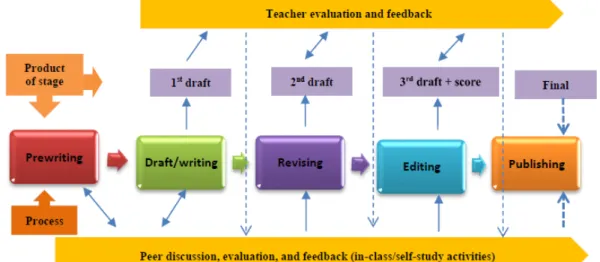
The process-product approach is a dynamic strategy challenging learners to demonstrate their language intelligence, establish their supporting ideas, and develop their writing performance. Even though planning, organizing, and prewriting in the first stage of the process approach are described in different terms, the process approach comprises the four phases of prewriting, drafting, revising, and editing (Badger and White, 2000). Learners are encouraged to produce a near perfect draft by means of repeated revisions of their tasks. As shown in Figure 1 (adapted from Seow [2002] and Tribble [1996]), the process approach involves the development of the writing process in a non-linear fashion using a dynamic model consisting of interactive stages: instructors’ feedback, evaluation, and the sharing of writing outcomes by the learners. In fact, the differences between the two main streams (product and process) are effectively interwoven to teach learners how to write effectively based on the written outcome, learners’ prior knowledge, and a writing approach based on what we write (product) from what we know (process) (McCrimmon, 1994).
©Copyright 2018 proceeding of 6th AASIC 416
Figure 1: Dynamic process-product approach
The implementation of the aforementioned writing strategies (product, process, and process-product approaches) generally stimulates learners to achieve their target genre rather than simply teaching the grammar-based approachwhich has been used now for several decades. Accordingly, our purpose is to increase the use of the innovative, dynamic strategies necessary to develop learners’ writing ability with lifelong language-learning education.
2.4.Genre-Based Approach
The Genre-based approach (GBA) was gradually introduced into EFL academic writing courses based on the concept of genre theories and text types. There were three schools of genre (New rhetoric school [NR], Sydney school [SFL], and English for Special Purposes [ESP]), while GBA is conventionally determined as a textual convention for establishing both spoken and written language and sharing a set of communication skills in a community purposively. The experts in each discipline set standard patterns for the target genre and shared their communicative purposes (Bhatia, 1993; Hyland, 2007; Swales, 1990). In the realm of linguistics, SFL and ESP genres are addressed differently in terms of genre concepts, communicative purposes, language, and the social function of textual conventions in text types.
Adopted from Michael Halliday’s (1978) social semiotics, the SFL genre has become established as a “systematic language-context connection” (Phichiensathien, 2017, p. 19). This means that people in a disciplinary community may produce spoken and written language based on communicative purposes as a social process in each text type conveying particular meanings in one community. With two levels (register and genre), theorists considered the linguistic features and social context from the field (or topic of language), tenor (relationship between speaker and listener), and mode (text organization). In fact, if learners have been assigned to write an essay (mode) by their teacher, they should consider what interesting title to select (field) in order to
©Copyright 2018 proceeding of 6th AASIC 417
determine a set of lexical worlds for their essay for a teacher-reader (tenor). This means that the SFL approach focuses on internal linguistic principles to distinguish the genre or text type from the lexical-grammatical features and cohesion pattern, i.e., such essay types as chronological, cause and effect, advantages and disadvantages. Furthermore, the SFL genre emphasizes the social goal of a genre and a textual sequence relevant to its communicative purposes (Hyland, 2007) in a larger genre unit or macrogenre (i.e., research article, e-mail, or complaint letter). It is widely known that the SFL GBA approach has been applied at elementary, high school, and adult-learner levels. Learners are encouraged to determine the typical features of a text and the sequence of the text in order to recognize a writer’s purpose in a particular genre and analyze the vital grammatical differences. Thus, they will understand how these textual sequences can share a set of purposes in the same genre by focusing on both text (linguistic features) and context (rhetorical structures). With regard to Swales’ (1990) Create-a-Research-Space (CARS) model, ESP genre is defined as
moves and steps as an analytical tool to examine textual sequences at two levels of analysis:
microstructure (lexico-grammatical features) and macrostructure (rhetorical structures). The ESP genre has been applied increasingly in US higher education (Johns, 2002). This approach is related to discourse communication and has been designed for the teaching and learning of English for Academic Purposes (EAP) (Swales, 1990). Thus, ESP scholars concentrate on genre in textual conventions and focus on published research articles. As noted, people in one community will share a set of purposes, and a standard pattern has been set based on these purposes and by the experts in a particular discipline (Bhatia, 1993; Swales, 1990). As a result, GBA is a study of the language used in a specific situation (Bhatia, 2004). Also, it is an application of genre analysis (GA) in teaching and learning with linguistic awareness. Learners are guided to recognize language features and rhetorical structures in research articles which vary according to specific disciplines. In addition, to develop in-class materials, writing assignments, and assessment tools, teachers can apply genre-based writing instruction (GBI) in academic writing courses. In fact, the authentic text produced by L1 professionals can encourage L2 learners to recognize how they should compose the target genre in their community. Therefore, GBA has become a valuable tool to encourage learners to determine the appropriate linguistic features and to master lexical choices and tenses used in their discursive community. Furthermore, GBA can enable learners to examine the textual structure for specific communicative purposes. Accordingly, GBA has become widely recognized as an authentic-analytical strategy to help L2 undergraduates and graduates create their writing tasks in academic writing courses (Hyland, 2002, 2005; Swales, 2004).
2.5.Process-Genre Approach
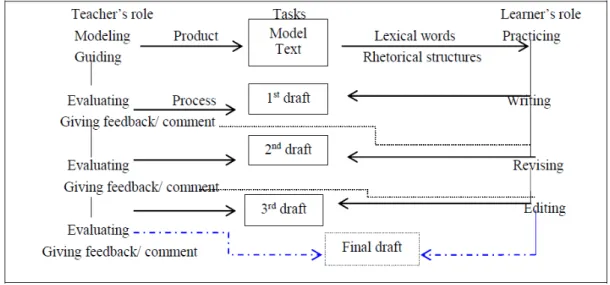
There is a tendency to think that the process-genre approach focuses on the writing process and the genre-based approach (GBA). Based on similar stages to the process approach, GBA can teach learners how to write their task in four stages: modeling, guiding, practicing, and final writing
©Copyright 2018 proceeding of 6th AASIC 418
(Cope and Kalantzis, 1993). The teacher’s role is to provide feedback or comments to their learners after the learners finish sharing their ideas in a group discussion as shown in Figure 2. Thus, teachers can guide and monitor them by acting as facilitators; meanwhile learners are participating in the class more collaboratively than with a learner-centered approach. In fact, learners can determine the linguistic features and the rhetorical structures of the target genre modeled as an example for in-class materials and also develop their own ideas. Such an approach will help learners transfer their understanding of linguistic features and rhetorical structures from a model to their own writing process. This means that learners can familiarize themselves with a model of linguistic features and textual organization of a final writing product as a target pattern. Consequently, it may be concluded that the combination of process and product of the target genre can help learners to discover and practice linguistic features and rhetorical structures or textual organization many times. Then, they can identify the lexical choices and the textual organization while composing their own task. With regard to the learners’ role, they may not only behave as a person who reads and writes, but they can also evaluate what they are reading or writing.
Figure 2: Process-genre approach
Nevertheless, based on the various outcomes of a writing course, teachers should consider what is most appropriate as the target genre for their particular situation. In fact, it is known that genres are discipline specific. Therefore, it might be better if teachers provide a more general knowledge of genre for their learners by introducing a variety of disciplines in the classroom rather than limiting students to one particular discipline (Hirvela, 1997). Furthermore, teachers ought to be aware of the effect of context on their learners due to the specificity of language used in each disciplinary. The language produced by learners in one discipline might limit a teacher’s response in terms of useful suggestions and feedbacks. This might occur if a teacher has experience in a different field from that of the students (Early, 1981). As a result, a hands-on genre based approach or examine-and-report-back model was addressed to overcome such problems (Hirvela, 1997).
©Copyright 2018 proceeding of 6th AASIC 419
2.6.Examine-And-Report-Back
The examine-and-report-back model is typically blended into the writing process and conducted in academic writing courses as a classroom activity. By focusing on critical awareness and the learner’s attention to reading and writing in particular genres, learners should become flexible enough to apply rhetorical structures in terms of discourse communication from their own discipline’s genre to a new genre (Johns, 1997). It might be claimed that genre knowledge for learners is a part of learning strategy; therefore, when they become familiar with a new genre, they will be able to identify the specificity and limitations of their own discipline, which will help them to succeed in academia (Devitt, 2004). Based on disciplinary portfolios and reading to write tasks, two tasks of a hands-on process (or examine-and-report-back model) will be provided for learners to determine language features and the rhetorical structures of the target genre (see Figure 3, adapted from Swales and Feak [1994, 2004]). The first task provides a model of one disciplinary text to introduce the notion of genre knowledge, rhetorical structures, and language features. The other is the learners’ own exemplar. In this way, learners will be encouraged to examine and produce their own task for raising-awareness of their disciplines in order to identify the general specificity and differences of the texts in various disciplinary classrooms (Kuteeva, 2013).
As established by Swales and Feak in their textbook (1994), this model could stimulate L2 graduate learners to “examine a small sample of research paper introductions from their own disciplines and report back” (p. 3) in a heterogeneous classroom. Accordingly, Carson and Leki (1993) and Johns (1997) implemented this model as literacy portfolios and reading-to-write activities to increase learners’ classroom engagement. More importantly, it seems that using authentic genres could promote learners’ literacy skills with broader and deeper ethnographies (Johns, 1997). That is because learners will be able to reflect on the knowledge they acquire from the given examples and to create their own analytical skills in their writing performance. Similarly, learning to write as one who reads as a writer could develop the learners’ awareness of lexical-grammatical features and rhetorical structures while reading and composing their own task (Hirvela, 2004). Subsequently, it is possible to determine how the approach could effectively stimulate L2 learners’ writing with a disciplinary portfolio; in addition, the reader-as-writer-approach could enhance learners’ critical, analytical, purposive reading in terms of genre awareness. Thus, some scholars have developed this hands-on process approach to academic writing courses in order to encourage learners to discover their analytical skills and reproduce their own written product.
©Copyright 2018 proceeding of 6th AASIC 420
Figure 3: Portfolio-portfolio and report-report
Accordingly, it is recognized that teaching strategies used in one class should contribute to learners’ understand of genre knowledge, and encourage them to apply their new knowledge to their own tasks, and also to obtain some feedback from their peers and instructors. As some previous studies have shown (e.g. Cheng, 2008; Kuteeva, 2010, 2013; Negretti and Kuteeva, 2011) GBA courses can raise learners’ genre awareness. Such a model encourages learners to provide their selected worksheets, examine, and share the similarities and differences of the particular disciplinary rhetorical structures and lexical-grammatical features used.
With the use of self-reports as literary portfolios, this GBA model aims to enhance learners’ genre awareness. Furthermore, by using a discovery-based approach, this model also encourages learners to discover interesting genre exemplars in their own disciplines. Instructors should guide them to select short academic genres (i.e. research article introductions) before carrying out analyses. When learners can identify the rhetorical structures and lexical-grammatical features found in a given model for the GBA tasks, they can employ their new genre knowledge to analyze their own exemplars. Using an inductive model in this GBA could motivate learners with rhetorical structures and lexical-grammatical features by examining and sharing their own tasks and discussing them with their classmates and teacher. As shown in Phichiensathien’s findings (2017), if learners are engaged in learning from a GBA model with classmates and the instructor in classroom activities, a checklist for classroom observation could positively motivate them to write their tasks more effectively and obtain higher scores.
The relationship between a teaching writing approach, the textual outcome of the course, and in-class activities are considered as a part of materials design in general. Learners’ disciplinary background is also taken into account in the target teaching approach in particular. The ESP genre and the examine-and-report-back model are mostly applied in advanced academic writing courses in
©Copyright 2018 proceeding of 6th AASIC 421
order to enhance genre awareness and develop ESL graduate theses and dissertations (e.g. Cheng, 2008; Kuteeva, 2010, 2013). Accordingly, a few studies in Thailand (e.g., Phichiensathien, 2017) have focused on the ESP genre since almost all university undergraduates have to perform their writing at essay level as the textual outcome of an academic writing course at undergraduate level. Therefore, the application of GBA in Thailand has been emphasized, particularly the concept of SFL genre.
2.7.Cycle of Teaching and Learning
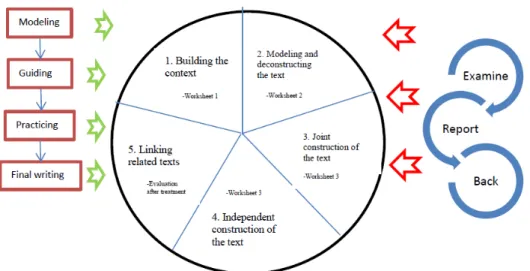
With regard to Feez’s (2002) teaching and learning cycle typically designed for the SFL genre classroom, it is possible to consider applying the sequences of teaching and learning with regard to the ESP genre. However, at the textual level, ESP and SFL genres have substantial differences. There are four stages in the GBA process approach: modeling, guiding, practicing, and final writing (Cope and Kalantzis, 1993). Particular attention is paid to the examine-and-report-back model in the ESP genre. This GBA model should be explicitly applied in writing courses as a classroom activity to enhance learners’ writing. Taking these points into account, the course objectives, course contents, and GBA model should be focused on during the writing process and then designed as a cycle of teaching and learning. According to Phichiensathien (2017), the teaching and learning cycle in her study of GBA application was designed for non-English major undergraduates in academic writing courses using Feez’s (2002) five stages. The background to the writing research report was essentially aimed at learners in stage 1. The worksheets of ESP genre concept and writing research report were given to learners in order to develop their understanding and provide a model of textual analysis in stage 2. To help learners with the construction of the text stage, they were asked to identify the structure of a research article introduction (RAI) by determining its lexical features and rhetorical structures based on Swales’ (1990 and 2004) moves and steps. Learners (here as writers) were encouraged to use the GBA worksheets which were designed to contribute to a better understanding of how to write the product outcome along with how to indicate the way to read through a text by using the examine-and-report-back model. In the 4th stage, learners were asked to examine their own exemplar (based on their selected RAIs) in order to identify the similarities and differences in the lexical features and rhetorical structures of their disciplines. Then, in stage 5, at the end of the tasks, learners must show explicitly what they have learned in a self-report. Instructors directed them to notice and appraise their writing progress resulting in the improvement of their language and interpretation skills including their motivation. Therefore, Swales’ ESP GA framework (1990, 2004), Kuteeva’s (2013) a hands-on ‘examine -and-report-back’ model, Cope and Kalantzis’s (1993) process approach should be assimilated fully into the cycle of teaching and learning.
©Copyright 2018 proceeding of 6th AASIC 422
Figure 4: A cycle of teaching and learning
3. DISCUSSION AND CONCLUSION
This paper has shown that the differences in teaching writing approaches have been considered in terms of the textual outcome of the course, learners’ disciplinary background, and the target teaching approach. If the instructor focuses on the final product, the teaching model encourages learners to practice grammar-based sentences rather than composition skills with a teacher-centered approach. Vice versa, emphasis on in-class activities and the writing process is more popular than the previous approach. With this approach, the instructor becomes a facilitator to monitor learners’ writing improvements rather than textual development in terms of correctness in form, grammar, and semantic structure. More importantly, the non-linear stages of the process-product approach become dynamically interactive for instructor and learners. This more challenging approach helps learners to produce a nearly perfect draft with their language knowledge, writing ability, and also to create supporting ideas while the writing process itself can be frequently revised.
Consequently, GBA has been increasingly applied as a tool in academic writing courses for graduate and undergraduate learners. This approach helps learners to master lexical items and to analyze textual structure as they act as both reader and examiner in writing activities before they write their tasks. Although it may be true that these activities can enhance learners’ confidence in becoming involved in the classroom, it can also be assumed that the learner’s intrinsic motivation helps to reinforce their writing ability. Consequently, it is important for them to focus on their efforts in the class. Furthermore, the process approach is supported by the fact that self-reports were implemented in the fifth stage to improve an understanding of how analytical skills are developed and to make students reflect on what they have learned. Furthermore, it might be possible that the reader’s awareness will be enhanced through class discussion.
©Copyright 2018 proceeding of 6th AASIC 423
It is, therefore, feasible and reasonable that textual sequence in each disciplinary community can be differentiated in terms of lexical choices, structures, and writing style. The examine-and-report-back model can lead to EFL undergraduates improving their Introduction section of a research report as a result of an increased awareness of lexical features and rhetorical structures and the organization of those structures based on genre-based moves and steps in various disciplines. This approach should guide learners to analyze the lexical items and rhetorical structures as well as to develop a better understanding of how to write while reading the text.
In addition to considering the approaches to writing and teaching, this innovative approach of the examine-and-report-back model is not only used with graduate and post-graduate learners to increase genre awareness. It increasingly also encourages undergraduates to pay more attention to language use. However, the teaching materials or textbook should be designed to match the course objectives, course contents, and learners’ writing outcomes. It is debatable as to what level of authentic experimental materials should be provided to undergraduates as some GBA tasks might be too demanding. This is because the GBA worksheets are simplified to provide an appropriate context that might not be too difficult or too long for undergraduates to appreciate the possible drawbacks of its application to a single discipline (education) for EFL non-English major undergraduates in a heterogeneous classroom. Therefore, the teacher should provide an assortment of teaching methods, worksheets, and in-class activities as implemented in this model, so that this model will help them develop their analytical skills through the use of a textual disciplinary genre in their educational field. In addition, they can engage in the learning strategies and apply their newly acquired knowledge to writing in the target genre. Thus, further research on the ESP genre should be implemented with EFL undergraduates to extend their knowledge of genre awareness and to develop their writing skills by focusing on the most appropriate lexical word choices and grammatical features. Even if an academic writing course principally aims to promote and assess the learners’ writing competency, teachers need to consider the textual outcomes of their courses and to take into account learners’ disciplinary backgrounds, all of which should contribute to learners being able to recognize the use of lexical and grammatical features critically and to adopt the appropriate rhetorical structures of their target genre.
4. REFERENCES
Arndt, V. (1987). “Six writers in search of texts: A protocol-based study of L1 and L2 writing.”
ELT Journal,41(4), 257-267. Retrieved from http://citeseerx.ist.psu.edu/viewdoc/ download?doi =10.1.1.464.4662andrep=rep1andtype=pdf
Badger, R., and White, G. (2000). “A process genre approach to teaching writing.” ELT Journal, 54(2), 153-160. doi: https://doi.org/ 10.1093/elt/54.2.153
Bhatia, V. K. (1993). Analysing Genre: Language Use in Professional Settings. New York: Longman. Retrieved from http://pure.au.dk/portal/ files/ 10013/ H19_20.pdf
©Copyright 2018 proceeding of 6th AASIC 424
Bhatia, V. K. (2004). Worlds of Written Discourse: A Genre-Based View. London: Springer. Cheng, A. (2008). “Analyzing genre exemplars in preparation for writing: The case of an L2
graduate learner in the ESP genre-based instructional framework of academic literacy.” Applied Linguistics, 29, 50-71. doi: 10.1093/ applin/ amm021
Cope, B., and Kalantzis, M. (1993). The Powers of Literacy: A Genre Approach to Teaching Writing. Pittsburgh: University of Pittsburgh Press.
Devitt, A. J. (2004). Writing Genres. Carbondale, IL: Southern Illinois University Press. Early, P. (1981). “The ESP teacher’s role-implications for the “knower-client” relationship.” In
J. McDonough and T. French (Eds.), ELTDocuments 112-The ESP teacher: Role, development and prospects (pp. 42-52). London, UK: The British Council.
Feez, S. (2002). Text-Based Syllabus Design. Sydney: Macquarie University/AMES.
Flowerdew, J. (2002). “Genre in the classroom: A linguistic approach.” In A. M. Johns (Ed.), Genre in the Classroom: Multiple Perspectives (pp. 91-102). Mahwah, NJ: Lawrence Erlbaum.
Harmer, J. (2004). How to Teach Writing. Harlow: Longman-Pearson.
Hirvela, A. (1997). “Disciplinary portfolios” and EAP writing instruction. English for Specific Purposes, 16, 83-100. doi:10.1016/S0889-4906(96)00037-3
Hirvela, A. (2004). Connecting Reading and Writing in Second Language Writing Instruction. Ann Arbor, MI: The University of Michigan Press.
Hyland, K. (2002). “Genre: Language, context, and literacy.” Annual Review of Applied Linguistics, 22, 113-135. doi:http://dx.doi.org/ 10.1017/ S026719502000065
Hyland, K. (2003). “Genre-based pedagogies: A social response to process.” Journal of Second Language Writing, 12, 17-29. doi:10.1016/S1060-3743(02)00124-8
Hyland, K. (2005). “Stance and engagement: A model of interaction in academic discourse.” Discourse Studies, 7, 173-192. doi: 10.1177/1461445605050365
Hyland, K. (2007). “Genre pedagogy: language, literacy and L2 writing instruction.” Journal of Second Language Writing, 16, 148-164. doi:10.1016/ j.jslw. 2007.07.005
Johns, A. M. (1997). Text, Role, and Context. Cambridge: Cambridge University Press. Johns, A. M. (2002). Genre in the Classroom: Multiple perspectives. Mahwah, NJ: Lawrence
Erlbaum.
Kuteeva, M. (2010). “Raising genre awareness and enhancing writing skills in English for academic and research purposes: Making use of ICT.” T. Bungarten (Ed.), Linguistic and didactic aspects of language in business communication: Proceedings of the 9th International Conference of the European Association of Languages for Specific Purposes. Hamburg: Arbuk.
Kuteeva, M. (2013). “Graduate learners’ approaches to genre-analysis task: Variations across and within four disciplines.” English for Specific Purposes, 32, 84-96.
©Copyright 2018 proceeding of 6th AASIC 425
doi:10.1016/j.esp.2012.11.004
Matsuda, P. K. (2003). “Second language writing in the twentieth century: A situated
historical perspective”. In B. Kroll (Ed.), Exploring the Dynamics of Second Language Writing (pp. 15-34). Cambridge: Cambridge University Press.
McCrimmon, J. (1994). Writing with a Purpose. Houghton Fifflin.
Myles, J. (2002). “Second language writing and research: the writing process and error analysis in learner texts.” Teaching English as a Second or Foreign Language, 6(2), 1- 19. Retrieved from http://www.tesl-ej.org/wordpress/ issues/ volume6 /ej22/ej22a1/?wscr Accessed.
Negretti, R., and Kuteeva, M. (2011). “Fostering metacognitive genre awareness in L2 academic reading and writing: A case study of pre-service English teachers.” Journal of Second Language Writing, 20, 95-110. doi:10.1016/j.jslw. 2011. 02.002
Nunan, D. (1991). Language teaching methodology: A Textbook for Teachers. UK: Hemel Hempstead, Prentice Hall International.
Pawapatcharaudom, R. (2007). An Investigation of Thai Learners’ English Language Problems and Their Learning Strategies in the International Program at Mahidol University. (Master’s Thesis). King Mongkut’s Institute of Technology North Bangkok, Bangkok, Thailand.
Phichiensathien, P. (2017). Genre-based approach to teaching academic writing in a Thai university. (Doctoral dissertation). Mae Fah Luang University, Chiang Rai, Thailand. Pincas, A. (1982). Writing in English 1. London: Macmillan.
Prodromou, L. (1995). “The backwash effect: From testing to teaching.” English Language Teaching Journal, 49(1), 13-25. doi: 10.1093/elt/49.1.13
Pullman, G. (1999). “Stepping yet again into the same current.” In T. Kent (Ed.), Post Process Theory: Beyond the Writing Process Paradigm (pp. 16-29). Carbondale, IL: Southern Illinois University Press.
Seow, A. (2002). “The Writing Process and Process Writing.” In J. C. Richards, and W. A. Renandya (Eds.), Methodology in Language Teaching (pp. 315-327). USA:
Cambridge University Press.
Silva, T. (1990). “Second language composition instruction: Developments, issues and
directions in ESL.” In B. Kroll (Ed.), Second Language Writing: Research Insights for the Classroom (pp. 11-23). Cambridge: Cambridge University Press.
Steele, V. (1992). Product and Process Writing: A Comparison. Rowley: Newbury House. Swales, J. (1990). Genre analysis: English in Academic and Research Settings. Cambridge:
Cambridge University Press.
Swales, J. (2004). Research Genres. New York: Cambridge University Press.
©Copyright 2018 proceeding of 6th AASIC 426
nonnative speakers of English. Ann Arbor, MI: University of Michigan Press. Swales, J. M., and Feak, C. B. (2004). Academic Writing for Graduate Learners: Essential
Tasks and Skills, 2nd Ed., Ann Arbor, MI: University of Michigan Press.
Tribble, C. (1996). “The composing processes of advanced ESL learners: Six case-studies.” TESOL Quarterly, 17, 165-187.