Agonistic and Cooperation
KATI HANNKEN-ILLJES
Institut für Germanistische Sprachwissenschaft, AG Sprechwissenschaft Philipps-Universität Marburg
35032 Marburg, Germany
INES BOSE
Institut für Musik-, Medien- und Sprechwissenschaft, Abteilung Sprechwis-senschaft und Phonetik
Martin-Luther Universität Halle-Wittenberg 06099 Halle (Saale), Germany
Abstract: In this study, we consider the ways different degrees of dissent are es-tablished in interaction, especially in in-teractions among children. One im-portant aspect in the development of the ability to argue is the framing of interac-tions as rather cooperative or agonistic. Different framings seem to allow for dif-ferent forms of argumentative activity. The focus in this paper is on the media-tion of degrees of dissensus in argumen-tation in child-child communication. It is established, we argue, through verbal as well as non-verbal means, and the ago-nistic and cooperativity can be indicators for the space argumentation has in child-child interaction.
© Kati Hannken-Illjes and Ines Bose. Informal Logic, Vol. 39, No. 4 (2019), pp. 465–495 Keywords: dissensus, agonism, child argumentation, stasis, multimodality, oral argumentation, cooperative argumentation
1. Introduction
This paper provides an analysis of oral argumentation among pre-schoolers. It is part of a larger study on the establishment of validity through argumentation in authentic child-child communication (see Bose and Hannken-Illjes 2016, 2019; Hannken-Illjes and Bose 2018). The study aims at contributing to the description and model-ing of the development of argumentation competence1 in children. It shows that one important aspect of this development could be the framing of interactions as rather cooperative or agonistic. Different framing seems to allow for different forms of argumentative activi-ties. The focus of the case study in this paper is therefore the medi-ation of degrees of dissensus in argumentmedi-ation in child-child com-munication and how this mediation is performed multimodally. The analysis offers an account of the interaction that integrates verbal and vocal-articulatory as well as bodily features and interprets the freezing of the interaction on these levels as potentially marking a stark notion of agonism. In oral argumentation, the verbal layer is always mediated by other-than-verbal forms, hence a multimodal approach allows for a more comprehensive analysis.
In this paper, we aim at refining the distinction between agonistic or cooperative argumentation by describing different forms of fram-ing argumentative interaction as rather agonistic or rather coopera-tive. In order to do this, we shall first give a brief overview of argu-mentation in child-child communication among preschoolers with a focus on the entry point for research in this area, which is oftentimes local dissensus. We shall then outline the discussion of
© Kati Haanken-Illjes and Ines Bose. Informal Logic, Vol. 39, No. 4 (2019), pp. 465–495 argumentation between agonism and cooperativity before describ-ing our methodological take as well as our data. This will be fol-lowed by the analysis of a building game between two preschoolers that considers the relation of their argumentation to agonistic and cooperative framings. We shall make a twofold argument: first, that “dissensus” is a gradual concept rather than an absolute one, and second, that in order to make statements about the development of argumentation competence, argumentation in framings that lean to-ward the cooperative pole should gain more attention.
2. Entry points into studying argumentation among children
Linguistic studies, older and more recent, have shown that children start to give reasons and thus engage in argumentation as early as in their third year, that is, from the age of 2.0 (Arendt 2015; Völzing 1982). Although these early forms of oral argumentation often lack linguistic markers of causal connection, they can be framed as proto-argumentation (for a definition of the term see Bose and Hannken-Illjes 2011; Brumark 2008)—as practices that exhibit first argumentative forms. They often lack the incorporation of counter-arguments (Crowell and Kuhn 2014; Muller-Mirza, Perret-Clermont, Tartas and Iannaconne 2009) as well as the explicit end-ing of the concludend-ing stage of the argumentative sequence (Bose and Hannken-Illjes 2011).
When Brumark uses the term proto-argumentation, however, she uses it in a specific sense that indicates a crucial point of discussion when studying the development of argumentative skills. Brumark (2008) has described sequences of contradiction and reiterated con-tradiction (for example yes-no sequences) without further argumen-tative elaboration, that is, without the giving of reasons, as proto-argumentation. In doing so, she takes a typical approach with regard to the interactional situations investigated under the heading of early argumentation; proto-argumentation is often searched for and re-searched in agonistic settings, that is, in open local dissensus. As we shall see, she is not alone in this approach.
© Kati Hannken-Illjes and Ines Bose. Informal Logic, Vol. 39, No. 4 (2019), pp. 465–495 can have different meanings in English, we will briefly lay out the definition we are starting from in our work. When talking about ar-gument, we refer to what O’Keefe has labeled argument2 (1977) and
follow Wolfgang Klein’s definition of argumentation as “transfer-ring something collectively questionable into something collec-tively valid by means of something colleccollec-tively valid” (1980, p. 19, translation ours). The strength of this definition is that it points out two main functions of argumentation: dealing with dissensus and establishing and actualizing validity. The latter one could be labeled as the epistemic function. It refers to argumentation as actualizing what can count as knowledge and thereby refers to the topoi in an argumentative exchange. Research into the development of argu-mentation competence has often focused on the first function and has taken dissensus in an interaction as the starting point of the re-search asking: when children quarrel, establishing an open, local dissensus, what means do they employ to resolve the dispute? Do they make use of argumentative procedures and reasoning?
Many studies found that for preschoolers, argumentation is not the main instrument to resolve disputes, especially in child-child in-teraction2. This is reflected also in self-report data from children. In a study, Valtin (1991) asked children of different ages what they would do in order to resolve a dispute (Streit). Younger children (age five to eight) named several strategies: using physical force, calling adults, leaving or just saying sorry. They did not name argu-mentation, as opposed to older children (age ten to twelve). This finding from interview data is mirrored in observational, interac-tional data. Arendt (2014, 2015) reports that although preschoolers in her data engage in argumentation in an arising quarrel, they do not seem to trust it as a means to finally resolve the conflict. After brief argumentative exchanges, they resort to other verbal and non-verbal means like physical force or calling upon an adult to sort things out (2014, pp. 30-31). For the children in her data, argumen-tation seems to be a means they try out in case of a dispute, but
© Kati Haanken-Illjes and Ines Bose. Informal Logic, Vol. 39, No. 4 (2019), pp. 465–495 without trusting it to carry them all the way to a resolution. A study conducted by Komor (2010) has similar findings. She shows that five-year olds are not able to resolve a dispute by means of argu-mentation despite making several attempts to do so (p. 117). Alt-hough the children in her data give arguments, these arguments are directed to the hierarchy within the relationship rather than the con-troversial standpoints. Thus, in this study also, children were found to resolve disputes by non-argumentative means like fading out and resorting to other activities (p. 320).
However, the fact that children do not exhibit elaborate argumen-tative abilities in disputes should not lead to the conclusion that they do not have them at their command. Our own studies have shown that preschool children are able to engage in argumentation in either fictional disputes in role play (Bose 2003; Bose and Hannken-Illjes 2016), or in cooperative interaction in play settings (Hannken-Illjes and Bose 2018). There are further studies that support these findings and that shall be referred to in the following section. The finding that cooperative situations offer a privileged site for the study of argumentation among preschoolers leads to the question of how ag-onism and cooperation are marked and performed in child-child dis-course. This is not only relevant for developmental aspects of argu-mentation, but it also touches on a bigger issue in argumentation theory: the form of dissensus in argumentation and its relevance for the argumentative exchange. We will lay out this discussion in ar-gumentation in general and then concentrate on arar-gumentation among children, before proceeding to the analysis of our case.
3. Agonism, cooperation, and in-between
© Kati Hannken-Illjes and Ines Bose. Informal Logic, Vol. 39, No. 4 (2019), pp. 465–495 Argumentation in interaction may also lack a local dissensus, even when it is clearly not explanatory in nature. Doury (2012) points out that in interaction, participants might argue although they agree on the issue at hand and are not trying to persuade one another. In these instances, argumentation can serve other functions, like cognitive development, identification, or emotional appeal. However, one could argue that although the partners in interaction agree, they have to have at least implicitly constructed a sense of opposition against which they direct their concerted argumentation (as Doury points out also, see pp. 106-107). Similarly, Micheli (2012) suggests a non-persuasive definition of argumentation (which is not to say that argumentation cannot be aimed at persuasion).
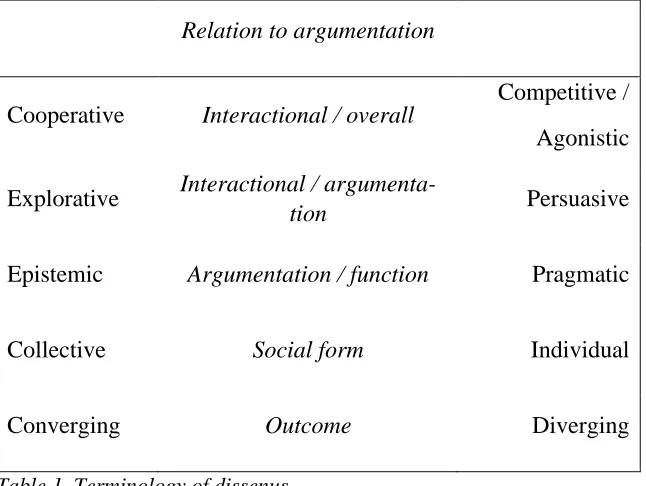
Before we launch into this discussion, we would like to clarify some terms (with no claim to arrange the entire field). There are already several concepts in our discussion now: persuasion, coop-eration, (local) dissensus. The topic of different degrees of dissensus has produced a variety of dichotomous terms, and the ways in which dissensus is established in interaction may differ considerably from open agonism to cooperative situations in which the dissensus can only be reconstructed implicitly. Hence those may be the endpoints of a continuum rather than discrete concepts.
© Kati Haanken-Illjes and Ines Bose. Informal Logic, Vol. 39, No. 4 (2019), pp. 465–495 understands epistemic argumentation as relating to validity claims of truth. When we speak of the epistemic dimension of argumenta-tion, we refer to the fact that while arguing, arguers will not only establish what is controversial but also what is taken to be valid, whether that be fact or value based. Positioning the different terms in relation to each other can lead to a list like the following as a starting point for our empirical work:
Relation to argumentation
Cooperative Interactional / overall
Competitive /
Agonistic
Explorative Interactional /
argumenta-tion Persuasive
Epistemic Argumentation / function Pragmatic
Collective Social form Individual
Converging Outcome Diverging
Table 1. Terminology of dissenus
© Kati Hannken-Illjes and Ines Bose. Informal Logic, Vol. 39, No. 4 (2019), pp. 465–495 argumentation. Following Wolf (2010, p. 31), agonistic argumenta-tion is conceptualized here as competitive argumentaargumenta-tion, which in the sophistic refutations often aligns with eristic argumentation, whereas dialectic argumentation can be viewed as explorative rather than persuasive, and less agonistic.
This distinction is taken up and elaborated in Walton’s (2010) seven types of dialogue. Walton also presents a rather fine-grained theoretical distinction between the initial situation, the goals of the participants, and the goal of dialogue. In his discussion of the seven types, he also introduces the notion of cooperativity stating that the inquiry, with its overarching goal to prove or disprove a hypothesis, is “cooperative in nature” (p. 14) as opposed to the adversarial types of persuasion. Deliberation, on the other hand, he identifies as col-laborative (not cooperative). In this paper, we shall situate distinc-tions with respect to the interpersonal framing of an argumentative situation on the continuum of cooperation and agonism.
© Kati Haanken-Illjes and Ines Bose. Informal Logic, Vol. 39, No. 4 (2019), pp. 465–495 knowledge, abilities and interests (Fiehler, 1999, pp. 55-56). In this sense argumentation in a cooperative framework would be charac-terized, for instance, by naming reasons brought forward with re-spect to a quaestio as a shared argument and credit given to the oth-ers for their argumentative as well as overall communicative contri-butions. Makau (1999) argues from a normative perspective for co-operative argumentation as argumentation aiming at shared decision making by contrasting it with argumentation that aims to gain ad-herence of others. She defines cooperative argumentation as “the process of advancing, supporting, modifying, and criticizing claims so that appropriate decision makers may grant or deny adherence.” (Makau, 1999, p. 57) She insinuates that the non-cooperative argu-mentation implies closed-mindedness towards other opinions and arguments.
4. Cooperation and agonism in child-child argumentation
In our study, we are interested in the ways in which different grades of dissent are established in interaction, especially in interactions among children. With respect to the development of argumentation competence as well as the teaching of argumentative skills in school, Ehlich (2014) distinguishes between persuasive and explor-ative argumentation. For Ehlich, persuasive argumentation aims at establishing divergence, whereas explorative argumentation estab-lishes convergence. This distinction seems especially important when studying argumentation and proto-argumentation in child-child interaction.
© Kati Hannken-Illjes and Ines Bose. Informal Logic, Vol. 39, No. 4 (2019), pp. 465–495 discuss more aspects of the question at hand” (Domberg et al. 2018, p. 76).
Other works have also focused on cooperative argumentation among children. Clark et al. (2003) studied cooperative argumenta-tion among children in elementary school as an alternative to the IRE (intervention–response–evaluation) format of classroom dis-course. They found that settings that foster cooperative reasoning open up new forms of meaning and also allow for new forms of participation, enabling more children to engage in the classroom. Bose and Kurtenbach (2019) study the argumentation in conversa-tion circles in the kindergarten directed at problems the children in-troduce themselves. The children search collaboratively for solu-tions to the problem at hand and follow up on the outcome of the solution. In these conversation circles, the children take up formal topoi in a very structured way, similar to the search formulas in clas-sical Roman forensic rhetoric, when engaging in problem solving (Bose, Hannken-Illjes, and Kurtenbach, under review).
A special case in point is the work on argumentation in mathe-matical education for elementary school children. Krummheuer (1995), for instance, focuses on the way children reason their way towards the solution of mathematical problems and do so collabo-ratively. In a similar vein, Fielding-Wells (2016) introduces argu-mentation as a method of mathematical problem solving in the classroom for children ages eight to ten.3 The distinction taken up by Littleton and Mercer (2013) between disputational, cumulative, and exploratory talk is important to this line of study. Disputational talk refers to stating positions without reasoning or relating them to a common cause; cumulative talk refers to doing non-agonistic work on an issue without attending to others; and exploratory talk refers to doing work on an issue by engaging each other’s opinions and searching collaboratively for a joint solution (Littleton and Mer-cer, 2013). However, in our data the children do not have an exter-nally set task but rather deal with problems that present themselves within their play.
© Kati Haanken-Illjes and Ines Bose. Informal Logic, Vol. 39, No. 4 (2019), pp. 465–495 In our study, we treat the question of different forms of dissensus in child-child argumentation as a question of degree between ago-nism and cooperation. Also, we assume, on the basis of earlier case studies, that the notion of cooperation or agonism is not only de-pendent on the quaestio, but that the vocal-articulatory and bodily framing plays a crucial role in determining the degree of agonism in an interaction. That is, irrespective of the sort of problem under discussion, an interaction can be framed according to different de-grees of cooperativity. The degree of agonism or cooperativity is, we think, interactively performed by the participants. For child-child discourse, situations marked as rather cooperative allow for more extended and elaborate forms of argumentation. Hence, the framing of an interaction and the form of argumentation are in a reciprocal relationship. We are interested in the framing of argu-mentative situations as cooperative as we think that argumentation competence in children can best be studied in those situations. Of-ten, the argumentation will be what we call the “epistemic dimen-sion of argumentation” (Hannken-Illjes and Bose 2018).
5. Method and Data
© Kati Hannken-Illjes and Ines Bose. Informal Logic, Vol. 39, No. 4 (2019), pp. 465–495 Kallmeyer (1985) distinguished six levels constitutive of interaction that are simultaneously attended to by participants during the inter-action, although one in particular may be in the foreground. The six levels include: organization of interaction, presentation of issues, acting, social relationships and identities, modality, and the estab-lishment of reciprocity. While argumentation brings the presenta-tion of issues to the fore, our study found that attending to the social relationship between the two participants is also crucial.
In our analysis we do not focus solely on the verbal portion, but also consider the other-than-verbal. Given this, we take a multi-modal approach to argumentative interaction with a special focus on vocal and prosodic features as well as bodily movement. One of the reviewers for the submissions process to the Argage Conference remarked that it was ironic that a paper submitted to a conference on argumentation and language (emphasis ours) would focus its analysis on the non-verbal aspects of argumentation. We think, however, that analyzing oral argumentation without taking into ac-count the non-verbal layers of the exchanges runs the risk of missing crucial aspects of argumentation. This is especially true for argu-mentation among younger children, as they will often substitute vo-cal-articulatory and bodily gestures for verbal utterances. When pushing for communicative goals, especially for smaller children, vocal, paraverbal, and bodily means of expression are equal to ver-bal means (Andresen 2002, 2005; Bose 2003; Bose and Kurtenbach 2014; Garvey 1984; Kirsch-Auwärter 1985; Klein 1985).
© Kati Haanken-Illjes and Ines Bose. Informal Logic, Vol. 39, No. 4 (2019), pp. 465–495 interest in the role modalities beyond the verbal play in argumenta-tion.
When it comes to multimodality in argumentation, visual argu-mentation is probably the best theorized and analyzed. Other mo-dalities are rather new to the analysis of argumentation, with some exceptions like the work by Bose and Gutenberg (2003), Jaquin (2015, 2018) and Kreuz and Mundwiler (2016). Perret-Clermont et al. (2019) point to the role of elements in argumentation that func-tion as non-verbalized premises (or context knowledge) that are vis-ually available to the participants. When we refer to multimodality in this paper, we follow Schmitt (2005) who states: “multimodal communication refers to a conception of communication as holistic process that ultimately cannot be separated from the bodily aspects of the participants” (p. 18-19, our translation). A modality in this sense is a form or level of expression that contains, or may contain, communicative relevance. For conversation analysis, Schmitt (2005) lists verbality, prosody, gaze, mimic, gesture, position, bod-ily constellations, and bodbod-ily movements as relevant modalities (p. 19).
© Kati Hannken-Illjes and Ines Bose. Informal Logic, Vol. 39, No. 4 (2019), pp. 465–495 (Kim 2015, p. 28). As an effect of synchronization, Pfänder et al. (2017) include, alongside producing understanding, a sense of emo-tional understanding (p. 77).
The project this paper stems from works with two longitudinal corpora of child-child communication (3.0 – 7.0), one older (50 hours of data), one still being built (10 hours of data). Both corpora focus on the free play of children, the older one videographing chil-dren mainly in the private sphere, the newer one in the kindergarten. In the latter case, the kindergarten is taken as an entrance to the field rather than as a field of study itself. The kindergarten this material has been collected from is a rather small (less than 40 children) and allows for a lot of free play during the day. The children are video-graphed in play interaction including role-play, play with props or building games. In the analysis, we also include field-notes from participant observation. The talk-in-interaction is transcribed using GAT II (Selting et al. 2009). For this paper, we provide the English translation beneath the original German transcript.
6. Who is to decide—the case study
The case study for this paper consists of a longer building game (overall 30 minutes) that engages two boys (Nathanel 5.6 and Onno 5.8). Prior to this sequence, Onno was playing on his own before Nathanel joined him in constructing a compound for animals. Both boys play together often. Their conversation in this play is mainly empractical; they comment on their actions while building, with longer pauses in conversation. In the analysis, we will focus on the sequences that entail reason-giving and will analyze them with re-spect to the degree of cooperativity and agonism. In the following section, we will present three instances of argumentation during this play sequence. The recording ends at minute 31, and shortly after-wards the play ends as well because the children need to go to the kindergarten’s morning circle. The extracts analyzed are presented here in sequential order.
6.1 Wolves next to lions—cooperation
© Kati Haanken-Illjes and Ines Bose. Informal Logic, Vol. 39, No. 4 (2019), pp. 465–495 an enclosure for a variety of small, plastic animals. The enclosure is constructed mainly of wooden bricks of different sizes.
(00:15:00)
008 O: A:Lso ICH würde jetzt(.)n MITTleren nur noch NEHM;||
well I would now only take a middlelong one
009 N: (-)(DANN)
then
010 O: (-)die WÖLfe-|
the wolves
011 (.)die MUSST du(.)NEben die löwen machen;|
you need to make them next to the lions
012 also HIER hin.||
thus here
013 (.)weil DA(.)da bau ICH grad für die EISbären.||
because there I am just building for the polar bears
014 N: ja MACH [ich]
yes I will do that
015 O: [so ] musst du HIER machen.||
here you have to do it this way
016 die LIEgen schon in dem (kasten dann da DRIN.||)
they are already lying in the box
© Kati Hannken-Illjes and Ines Bose. Informal Logic, Vol. 39, No. 4 (2019), pp. 465–495 Onno brings two new bricks to the enclosure, looks at it and stops briefly before taking out two animals, presumably wolves, and re-locating them. While he does so, he instructs Nathanel on where to place the wolves. He backs this instruction up with a reason: the wolves need to be moved because he is constructing a section for the polar-bears where the wolves were originally placed. Nathanel accepts both the instruction and the reason and follows the demand. It seems to go without saying that wolves and polar bears cannot live next to each other, which is the underlying premise of the argu-ment made by Onno. Prosodically, the situation displays symmetry and calmness—both children take turns in the discussion, and with respect to the dynamic, the volume of their voices is moderate and the articulatory tension is relatively low. Hence, although Onno ex-tra-verbally expresses a potential dissensus when he briefly stops and looks at the wolves, the rest of the sequence is marked as coop-erative. Onno gives a reason for his demand, and Nathanel neither questions the instruction nor the reason. The children act in syn-chronicity besides the brief stop in action.
At the same time, the two children seem to establish a certain hierarchy in this exchange that will become important for the later sequences under consideration. Onno seems to be in charge of the construction and play, and Nathanel, at least in the beginning, fol-lows suit. Of course, Onno has been there longer and had started the play.
(00:18:21)
101 O: <<rufend> HIER is die EISbärenhöhle-|
here is the cave of the polar bears
102 s KLEInere land-|>
the smaller land
103 und JETZT bau ich das GRÖßere;|
and now I will build the bigger one
© Kati Haanken-Illjes and Ines Bose. Informal Logic, Vol. 39, No. 4 (2019), pp. 465–495 with this thing
105 dem LETZten GROßen [KLOTZ.|| ]
the last big brick
106 N: [ICH stell] die besser AUCH mal rauf;|
I’d better put them up as well
107 (.)ERSTmal auf die MAUer;|
first on the wall
108 O: beVOR du das geBIRge geBAUT hast NE,||=
before you have built the mountains right
109 N: =JA;||
Yes
The play continues in quite a harmonious fashion, as can be seen in this short exchange. Onno backs up an action and the accompanying utterance with a reasoned statement; Nathanel states that he will put “them” (line 106: not visible in the video, but presumably the wolves) up on the wall. Onno backs this statement up by expanding it with a reason, followed with a tag question “ne” that Nathanel answers with “yes” (line 108 and 109). Throughout, the children continue building.
In some sequences one could even argue that both interactants put their cooperation on display to each other when they refer to their abilities as being special. In this case they also exhibit them to Juno, a girl who for some time plays along with the two boys (line 251) but never engages in a conversation with them.
(00:27:26)
251 N: ((zu Juno) <<theatralisch> DAS können wir ^AUCH.||>)
<theatrically> that we can as well
© Kati Hannken-Illjes and Ines Bose. Informal Logic, Vol. 39, No. 4 (2019), pp. 465–495 we can do everything easy peasy
253 N: (.)ja.||
Yes
254 (2.2)
255 O: denn für UNS is das(.)(unser) SPIElen.||
because for us it is our play
Interestingly, we find similar sequences in play situations and situ-ations that involve reasoning by other children (Hannken-Illjes and Bose, 2018). Here the children will point out to each other that they are very competent together in what they are doing. This is relevent to the notion of pointing out joint accomplishments when framing an interaction as cooperative (see above).
6.2 It is not up to you to decide!—Agonism
The first instance of agonism can be found at 28:40. Nathanel no-tices a passage under one of the walls, and Onno responds with the instruction: close it or shut it down (line 287).
(00:28:40) 284 N: HÄ:::?||
Hä
285 (.)ich WUSSte noch gar nich dass da unten_n <<sehr leise> (DURCHgang is;|)>
I did not even know that there is a pas-sage down there
286 ((lacht)HÄhähä)
((laughs) hähähä)
287 O: MACH BAU_s ZU;||
© Kati Haanken-Illjes and Ines Bose. Informal Logic, Vol. 39, No. 4 (2019), pp. 465–495 288 N: (wieso)
why
289 O: (ja)
yes
290 N: (--)aber ONno:,| ich hab [ne iDEE.||]
but Onno I have an idea
291 O: [ja wir ] wir SPIElen einfach-|
yes we’ll just
play
292 (.)wir KÖNNten das mit diesen KRALlen WEGschieben;|
we could move it with these claws
293 oKAY?||
okay
294 (aber es WÄR da drinne;|)
but it would be inside there
295 und du kannst es auch DAhinschieben.||
and you can move it there
296 oKAY?||
okay
297 (--)oKAY nathanel?||
okay nathanel
298 N: (.)(WOLLte ja) Aber-[((richtet sich auf,frontal zu O)) ]
© Kati Hannken-Illjes and Ines Bose. Informal Logic, Vol. 39, No. 4 (2019), pp. 465–495 299 O: [((richtet sich auf,frontal zu
N)wie^SO:;||)
(gets up,position in front of N) why
300 N: ´BIT^TE:;||
please
301 O: ich habs ge^BAUT;|
I have built it
302 ALso?|
so
303 (.)^DARF ichs ent^SCHEIden;|
I may decide
304 N? (möcht)ICH entscheiden.||
I want to decide
305 O: <<sehr schnell>(deshalb hab ich das nicht)> [geBAUT.||]
<very fast> that is not why I built it
306 N: [(ALso ich]
well I
307 hab schon) das geHÖRT daZU (...)
have already that belongs
308 O: du darfst aber nicht be^STIMM(.)daDRÜber;||
but you may not decide on this
© Kati Haanken-Illjes and Ines Bose. Informal Logic, Vol. 39, No. 4 (2019), pp. 465–495 Yes
310 (-)du AUCH nich;|| [((guckt an O vorbei))
]
you neither ((looks past O))
311 O: [((guckt an N vorbei)ICH find_s(...)
nicht ^SO:;||)]
((looks past N ) I find it not so)
312 N: (.)ich AUCH nich;||
me neither
313 (-)<<lauter> ONno ich hab ne iDEE.||>
<louder> Onno I have an idea
© Kati Hannken-Illjes and Ines Bose. Informal Logic, Vol. 39, No. 4 (2019), pp. 465–495 tension with respect to voice and prosody, however, is still rather low, with both children falling into a nagging tone.
The standstill is then overcome by Nathanel saying in a louder, non-nagging tone, “I have an idea” (line 313). This wording—I have an idea—will be used repeatedly from this point on. For the next few minutes, the children alternate posing new ideas on how to pro-ceed with the building of the enclosure saying: “Oder, nein, ich hab eine Idee” (“or, no, I have an idea”) thereby rejecting the other’s idea while at the same time promoting the play. In this sequence, the children are searching for a resolution to their problem (not knowing how to proceed). They do so by posing more and more new ideas, all of which are rejected by the other. None of them are elaborated argumentatively. Hence, the confrontation and local dis-sensus about who is to decide is overcome through the introduction of a new thematic focus, not through the brief argumentative ex-changes. At the same time, the exchange of ideas constitutes a form of parallelism and thereby a form of synchrony, although with a much higher tension than in the earlier sequences.
This sequence leads to a last, more agonistic situation shortly be-fore the end of the recording (and the play).
6.3 I can do anything?—Agonism and argumentation
(00:31:30)
376 N: NEIN.| wir müssen ERSTmal alles wieder(.)zerSTÖRN,|
no we first need to destroy everything
377 [(und DANN wei) ]
and then furth
378 O: [((lässt sich theatralisch auf Boden gleiten)NEI:ein-||)]
((slides to the floor dramatically)
no)
© Kati Haanken-Illjes and Ines Bose. Informal Logic, Vol. 39, No. 4 (2019), pp. 465–495
yes
380 O: <<gehaucht, leise-eindringlich> NEI:N.||>
<breathy, low-intensive> no
381 (2.6) ((gucken sich an))
((look at each other))
382 N: <leise> ich MACHS aber jetzt.||>
but I’ll do it now
383 O: NEE;|
no
384 DARFST du nich ent^SCHEIden.||
you may no decide
385 (1.8) ((gucken sich an))
((look at each other))
386 N: <<geknarrt, leise> ja;|>
<creeky, low> yes
387 (--)aber es IS ja auch nich ^DEINS;|
but it is also not yours
388 und ich DARF
and I can
389 (.)und ich darf MAchen was ich ^WILL.||
and i can do what I want
390 O: <<eher laut> oKAY.||>
<rather loud> okay
391 dann DARF ich auch (DICH),|
then I can you
© Kati Hannken-Illjes and Ines Bose. Informal Logic, Vol. 39, No. 4 (2019), pp. 465–495
then I can hurt you
393 (-) ich darf MAchen was ich ^WILL.||
I can do what I want
394 (1.4) ((gucken sich an))
((look at each other))
395 ich darf ALles [machen-| ]
I can do everything
396 N: [ONno oKAY.||]
Onno okay
397 (-)wir BAUN (-)n BISSchen ab.|
we’ll deconstruct a little
398 oKAY?||
okay
399 O: (-)oKAY.||
okay
© Kati Haanken-Illjes and Ines Bose. Informal Logic, Vol. 39, No. 4 (2019), pp. 465–495 whatever he wants, referencing a topos of personal freedom (line 389)4. Onno now takes up this topos and uses it for his own cause saying, if that is so, I too can do whatever I want, for example, I can hurt you (line 390-393). Onno here employs an argument from the same material topos of personal freedom. The formal topos could be framed in two ways: either as an argumentum ad absurdum de-picting hurting as so out of the range of possible options for actions as to show that the topos of personal freedom is not entirely valid when taken to its extremes; or as an argumentum ad bacumlum, an actual threat; a threat at least to the interaction, but maybe also to the bodily integrity of Nathanel. In the latter case, which does not seem entirely unreasonable to us, the exchange seems to be dealt with argumentatively—if one is willing to ascribe argumentative value to the argumentum ad baculum—but constitutes at the same time the resolution of a dissensus through physical threat. Prosod-ically, the sequence is faster and louder, with higher tension than the previous one. Also, the playful tone that both children employed before is gone. After another pause (line 394: 1.4 seconds), Na-thanel gives in (line 396-398). Throughout the play, the underlying question the children work on is who is to decide. Besides address-ing the main question, how to proceed with the play, the children also work out aspects of their relationship. Hence, it becomes clear that while engaged in argumentation, the children also work on other levels of interaction.
7. Conclusion
Agonism and cooperativity can be indicators of the role argumenta-tion has in child-child interacargumenta-tion. Agonism and cooperativity are established not only through verbal means of reasoning, but also
© Kati Hannken-Illjes and Ines Bose. Informal Logic, Vol. 39, No. 4 (2019), pp. 465–495 through vocal and bodily expressions in the interaction. Specifi-cally, in cooperative situations, the children exhibit a high degree of synchronicity with respect to loudness, temporal organization of talk, and bodily relation to one another. In agonistic situations, the children display unrhythmical interpersonal coordination and the in-teraction freezes—the children stare at each other, stop their own movements, and introduce long pauses. This phenomenon can be witnessed in other instances of child-child interaction as well.
This notion of freezing finds its counterpart in argumentation theory in the concept of stasis as a point in a confrontation where discourse comes to a standstill. As Willard (1991) puts it, instances of stasis are “argumentative points we reach where the action cannot continue unless something happens” (p. 96). Willard goes on to state that “cooperative discourse cannot proceed until the stasis is breached” (1991, p. 96). Spranz-Fogasy puts it in similarly stating that participants start to argue when their conversational action comes to a halt (2006, p. 31). This does not mean that stasis needs to be absolute. On the contrary, we argue that in argumentative in-teraction we can find different forms or strengths of stasis independ-ent of the question under consideration. Agonism and cooperativity do not necessarily relate to the scope of the problem under consid-eration but can change in degree within the same interaction. Fur-thermore, agonism is a phenomenon that can be bodily exhibited. In our case study, the two children deal with the same thematic issue when engaging in argumentation: who is to decide. The degrees of agonism and cooperativity differ, however, between the two and throughout the session.
References
Andresen, Helga. 2002. Interaktion, Sprache und Spiel. Zur Funktion des
Rollenspiels für die Sprachentwicklung im Vorschulalter. Tübingen: Narr.
Andresen, Helga. 2005. Vom Sprechen zum Schreiben.
Sprachentwicklung zwischen dem vierten und siebten Lebensjahr. Stuttgart: Klett-Cotta.
Arendt, Birte. 2014. Konfliktbearbeitung von Kindergartenkindern -
verbale resp. argumentative und nonverbale Muster. Mémoires de la
© Kati Haanken-Illjes and Ines Bose. Informal Logic, Vol. 39, No. 4 (2019), pp. 465–495 Arendt, Birte. 2015. Kindergartenkinder argumentieren - Peer-Gespräche
als Erwerbskontext. Mitteilungen des Deutschen
Germanistenverbandes, 62(1), 21-33.
Aristoteles. 1995. Philosophische Schriften. Sophistische Wiederlegungen
(E. Rolfes, Trans. Vol. 2). Hamburg: Felix Meiner Verlag.
Bose, Ines. 2003. doch da sin ja nur muster // Kindlicher Sprechausdruck
im sozialen Rollenspiel. Frankfurt am Main: Peter Lang.
Bose, Ines and Norbert Gutenberg. 2003. Enthymeme and prosody: A contribution to empirical research in the analysis of intonation as well
as argumentation. In Proceedings of the Fifth Conference of the
International Society for the Study of Argumentation, eds.Frans van Eemeren, J. Anthony Blair, Charles A. Willard, & A. Francisca Snoeck Henkemans, 139-140. Amsterdam: Sic Sat.
Bose, Ines, and Kati Hannken-Illjes. 2011. Protorhetorik. In Historisches
Wörterbuch der Rhetorik, ed. Gert Ueding, 966-975. Berlin: de Gruyter.
Bose, Ines, and Kati Hannken-Illjes, Kati. 2016. Wie Vorschulkinder
Geltung etablieren. Studia Linguistica der Universität Wroclaw, 35:
119-136.
Bose, Ines, and Kati Hannken-Illjes. 2019. Die Entwicklung von
argumentativen Fähigkeiten bei Vorschulkindern: Zwischen
Agonalität und Kooperativität. In Kinder im Gespräch - mit Kindern
im Gespräch, eds. Ines Bose, Kati Hannken-Illjes and Stephanie Kurtenbach, 11-31. Berlin: Frank + Timme.
Bose, Ines, Hannken-Illjes, Kati, and Stephanie Kurtenbach, under
review. Vordrängeln – Förderung von argumentativer Kompetenz in
einem Gesprächskreis-Projekt der Kindertagestätte.
Bose, Ines and Stephanie Kurtenbach. 2014. Stimmlich-artikulatorischer Ausdruck in der Kita. Erzieherinnen betrachten mit zwei- und
vierjährigen Kindern ein Bilderbuch. In Prosodie und Phonetik in der
Interaktion. Prosody and Phonetics in Interaction, eds. Dagmar Barth-Weingarten and Beata Szczepek-Reed, 136-161. Mannheim: Verlag für Gesprächsforschung.
Bose, Ines, and Stephanie Kurtenbach. 2019. "Stolpersteine und Wunschsterne". Förderung von Partizipation und Gesprächsfähigkeit
in der Kita. In Kinder im Gespräch - mit Kindern im Gespräch, eds.
Ines Bose, Kati Hannken-Illjes and Stephanie Kurtenbach, 113-147. Berlin: Frank + Timme.
Breyer, Thiemo, Buchholz Michael, B., Hamburger, Andreas, Pfänder,
Stefan and Elke Schumann. 2017. Resonanz - Rhythmus -
© Kati Hannken-Illjes and Ines Bose. Informal Logic, Vol. 39, No. 4 (2019), pp. 465–495 Brumark, Asa. 2008. "Eat your hamburger!" - "No, I dont't want to!"
Argumentation and argumentative development in the context of
dinner conversation in twenty Swedish families. Argumentation, 22,
251-271.
Clark, Ann-Marie, Anderson, Richard C., Kuo, Li-jen, Kim Il-Hee, Archodidou, Anthi and Kim Nguyen-Jahiel. 2003. Collaborative reasoning. Expanding ways for children to talk and think in school. Educational Psychology Review, 15(2), 181-198.
Crowell, Amanda and Deanna Kuhn. 2014. Developing dialogic
argumentation skills: A 3-year intervention study. Journal of
Cognition and Developmeent, 15(2), 363-381.
Deppermann, Arnulf, and Lucius-Hoene, Gabriele. 2006. Argumentatives
Erzählen. In Argumentieren in Gesprächen, eds. Arnulf Deppermann
and Martin Hartung, 130-144. Tübingen: Stauffenburg.
Domberg, Andreas, Köymen, Bahar and Michael Tomasello. 2018. Children's reasoning with peers in cooperative and competetive
contexts. British Journal of Developmental Psychology, 36, 64-77.
Doury, Marianne. 2012. Preaching to the converted. Why argue when
everyone agrees? Argumentation, 26(1), 99-114.
Eemeren van, Frans and Francisca A. Snoeck Henckemans. 2017. Argumentation. Analysis and evaluation. New York & London: Routledge.
Ehlich, Konrad. 2014. Argumentieren als sprachliche Ressource des
diskursiven Lernens. In Diskursive und textuelle Strukturen in der
Hochschuldidaktik, eds Antonie Hornung, Gabriella Carobbio and Daniela Sorrentino, 41-54. Münster: Waxmann.
Fiehler, Reinhard. 1999. Was tut man, wenn man 'kooperativ' ist? Eine gesprächsanalytische Explikation der Konzepte 'Kooperation' und
'Kooperativität'. In Kooperation in der Kommunikation. Festschrift für
Elmar Bartsch, eds. Annette Mönnich and Ernst W. Jakolski, 52-58. München / Basel: Reinhardt.
Fielding-Wells, Jill. 2016. "Mathematics is just 1+1+=2, what is there to argue about?" Developing a framework for argument-based
mathematical inquiry. In Opening up mathematics education research,
eds. Bruce White, Mohan Chinnappan and Sven Trenholm, 214-221. Aledlaide: MERGA.
Garvey, Catherine. 1984. Children's talk. London: Fontana.
Gilbert, Michael A. 1997. Coalescent argumentation. Mahwah: L.
Erlbaum Associates.
Grice, Paul. 1989. Studies in the way of words. Cambridge: Harvard
© Kati Haanken-Illjes and Ines Bose. Informal Logic, Vol. 39, No. 4 (2019), pp. 465–495
Hannken-Illjes, Kati. 2003. Gute Gründe geben – Ein
sprechwissenschaftliches Modell argumentativer Kompetenz und seine methodischen und didaktischen Implikationen. Frankfurt: Peter Lang. Hannken-Illjes, Kati and Bose, Ines. 2018. Establishing validity among
preschool children. Argumentation in Context, 7(1), 1-17.
Jacquin, Jerome. 2015. Multimodal counter-argumentation in the workplace: The contribution of gesture and gaze to the expression of
disagreement. GESPIN, 4, 155-160.
Jacquin, Jerome. 2018. Multimodal positioning and reference in argumentative talk-in-interaction: Balancing context-dependency and
context-independency. International Review of Pragmatics, 10(2),
198-218.
Kallmeyer, Werner. 1985. Handlungskonstitution im Gespräch. Dupont
und sein Experte führen ein Beratungsgespräch. In Grammatik,
Konversation, Interaktion. Beiträge zum Romanistentag 1983, eds. Elisabeth Gülich and Thomas Kotschi, 81-122. Tübingen: Niemeyer. Kim, Young Yun. 2015. Achieving synchrony: A foundational dimension
of intercultural communication competence. International Journal of
Intercultural Relations, 48, 27-37.
Kirsch-Auwärter, Edit. 1985. Die Entwicklung von Sprachspielen in
kindlicher Kommunikation. In Kommunikationstypologie, ed. Werner
Kallmeyer, 154-171. Düsseldorf: Schwann.
Klein, Josef. 1985. Vorstufen der Fähigkeit zu BEGRÜNDEN bei knapp
2-jährigen Kindern. In Argumente. Argumentation, eds. Josef
Kopperschmidt and Helmut Schanze. 261-271. München: Fink. Klein, Josef. 2001. Erklären und Argumentieren als interaktive
Gesprächsstrukturen. In Text- und Gesprächslinguistik: ein
internationales Handbuch zeitgenössischer Forschung, eds. Klaus Brinker, A. Burkhardt, G. Ungeheuer, H. E. Wiegand and H. Steger, 11309-11329. Berlin: de Gruyter.
Kock, Christian. 2017. Deliberative rhetoric. Arguing about doing. In
Windsor Studies in Argumentation, ed. Hans V. Hansen.
Komor, Anna. 2010. Miteinander kommunizieren - Kinder unter sich.
Münster: Waxmann.
Kreuz, Judith, and Mundwiler, Vera. 2016. "verbAndskasten !MÜS!sen wir haben" Zum argumentativen Potenzial von Prosodie am Beispiel
von Einigungsdiskussionen bei Grundschulkindern. Studia Linguistica
der Universität Wroclaw, XXXV, 99-118.
Krummheuer, Götz. 1995. The ethnography of argumentation. In The
© Kati Hannken-Illjes and Ines Bose. Informal Logic, Vol. 39, No. 4 (2019), pp. 465–495 Lakens, Daniel. 2010. Movement synchrony and perceived entitativity.
Journal of Experimental Social Psychology, 46(5), 701-708.
Littleton, Karen and Neil Mercer. 2013. Interthinking. Putting talk to
work. London: Routledge.
Makau, Josina M. 1999. The case for cooperative argumentation. In Proceedings of the Fourth International Conference of the International Society for the Study of Argumentation, eds. Frans van Eemeren, Rob Grootendorst, J. Anthony Blair and Charles A. Willard, 548-551. Amsterdam: SIC SAT.
Micheli, Raphael. 2012. Arguing without trying to persuade? Elements
for a non-persuasive definition of argumentation. Argumentation,
26(1), 115-126.
Morek, Miriam. 2012. Kinder erklären: Interaktionen in Familie und
Unterricht im Vergleich. Tübingen: Stauffenburg.
Muller-Mirza, Nathalie, Perret-Clermont, Anne Nelly, Tartas, Valerie and Antonio Iannaconne. 2009. Psychosocial processes in argumentation. In Argumentation and education. Theoretical foundations and practices, eds. Nathalie Muller-Mirza and Anne Nelly Perret-Clermont, 67-90. Berlin: Springer.
O'Keefe, Daniel J. 1977. Two concepts of argument. The Journal of the
American Forensic Association, 8(3), 121-128.
Perret-Clermont, Anne-Nelly, Schär, Rebecca, Greco , Sara, Convertini,
Josephine, Iannaconne, Antonio and Andrea Rocci. 2019. A
contribution from argumentation theory to the study of young children's reasoning in play activities.
Pfänder, Stefan, Herlinghaus, Hermann and Carl E. Scheidt. 2017. Synchronisation in Interaktion: Eine interdisziplinäre Annäherung an
multimodale Resonanz Resonanz – In Rhythmus – Synchronisierung
Interaktionen in Alltag, Therapie und Kunst, eds. Thiemo Breyer, Michael B. Buchholz, Andreas Hamburger, Stefan Pfänder and Elke Schumann, 65-83. Bielefeld: transcript.
Schmitt, Reinhold. 2005. Zur multimodalen Struktur von turn-taking.
Gesprächsforschung - Online-Zeitschrift zur verbalen Interaktion, 6, 17-61.
Schwarze, Cordula. 2010. Formen und Funktionen von Topoi im
Gespräch. Frankfurt am Main: Peter Lang.
Selting, Margareth, Auer, Peter, Barth-Weingarten, Dagmar, Bergmann, Jörg, Bergmann, Pia, Birkner, Karin, . . . and Susanne Uhmann. 2009.
Gesprächsanalytisches Transkriptionssystem 2 (GAT 2).
© Kati Haanken-Illjes and Ines Bose. Informal Logic, Vol. 39, No. 4 (2019), pp. 465–495 Spranz-Fogasy, Thomas. 2006. Alles Argumentieren, oder was? Zur
Konstitution von Argumentation in Gesprächen. In Argumentieren in
Gesprächen, eds. Martin Hartung and Arnulf Deppermann, 27-39. Tübingen: Stauffenburg.
Valtin, Renate. 1991. Mit den Augen der Kinder. Freundschaft,
Geheimnisse, Lügen und Strafen. Hamburg: Rowohlt.
Völzing, Paul-Ludwig. 1982. Kinder argumentieren. Die Ontogenese
argumentativer Fähigkeiten. Paderborn, München, Wien, Zürich: Ferdinand Schöningh.
Walton, Douglas. 2010. Types of dialogue and burden of proof. In Computational models of argument: Proceedings of COMMA 2010,
eds. Pietro Baroni, Federico Cerutti, Massimiliano Giacomin and
Guillermo Simari, 13-24. Amsterdam: IOS Press.
Willard, Charles A. 1991. Adaptation to context. Argumentation, 5(1),
91-107.
Wolf, Simon. 2010. A System of Argumentation Forms in Aristotle. Argumentation, 24(1), 19-40.
Zima, Elisabeth. 2017. Zum Konzept der Gestenresonanz in der
Dialogischen Syntax. In Rhythmus – Synchronisierung Interaktionen