T
echnology executives tend not to con-sider the integration of emerging information technologies (EITs)— innovations with incomplete stan-dardization or limited commercial accessibility (such as beta versions of software or prototypes of hardware)—when plan-ning an IT strategy. A survey of 212 CIOs from For-tune 1000 firms revealed that only 31% of the respondents evaluated an EIT during a recent IT strategic planning session [3]. Of the responding CIOs who had not explored the possibilities of EITs in their IT strategic planning phase, 68% indicated they lacked sufficient time during strategy planning to explore and acquire knowledge regarding EITs as potential components of their respective IT strategy [3]. This is unfortunate, since more than half of those CIOs who did not consider EITs in theirrecent strategic planning sessions stated that such consideration might have contributed to the devel-opment of a more timely IT strategy [3].
Given these survey results, we offer several insights and an evaluation model that CIOs can uti-lize to organize an expedient investigation of an emerging technology’s potential fit into organiza-tional IT strategy.
The surveyed executives indicated unanimously that access to information regarding EITs and the time resources required to evaluate the new tech-nologies are critical preliminary evaluation factors [1, 3]. In order to expedite the data collection process and subsequent evaluation process, the study participants offered the following recommendations: • Review new technologies on a continuous basis.
Each week allocate time to investigating what’s new.
• Create lasting resource files. A new technology may not provide potential value to your organization today, but tomorrow may be a different story.
• Define your existing business processes and
A model for quickly sifting through emerging technologies to
find the best organizational fit.
C
ASEYG. C
EGIELSKI, B
RIANJ. R
EITHEL,
AND
C
ARLM. R
EBMANEmerging Information Technologies:
D
EVELOPING A
supporting IT for each process. One executive says “drawing a diagram [of your systems] works because it creates a ‘drag and drop’ overview of your entire infrastructure. From that drawing I know what might work for each process.” • Create a collection of
trade journals and online publications for quick references. “I can find most of my preliminary information at two sites: CIO.com and ZDNet.com,” says the CIO of a public utility in the southeastern U.S.
• Listen to your people in the trenches. Your organization’s frontline programmers, ana-lysts, and other techies are
valuable sources of insight into emerging tech-nologies.
• Collect data in a preliminary fashion, not as if to prepare a final analysis. Get an overview of the new technology. After a cursory review suggests the new technology applicable for your organiza-tion, do additional research.
• Ask questions. When collecting data on a new technology, corre-spondence with the product’s developers is often the most expedi-tious means of getting the facts.
BEGIN AT THEBEGINNING
T
o groundour
evalu-ation model, we conducted a four-round Web-based Delphi study. Seventy-five senior IT executives, who classified their organization’s IT strategy as “innovative” based on their previous use of EITs, participated in the study. Initially, each executive read three separate vignettes describing a different technology (Bluetooth, XML, and Virtual Retinal Display) that qualified, per the definition described herein, as an EIT. Next, each executive contributed, via the study Web pages, his or her thoughts regarding the potential integration of the sample EIT into corporate strategy. Finally, the
exec-utives reviewed all 169 of the unique comments and for-mulated a set of 23 unique issues they perceived as important with respect to
integrating EITs into corporate strategy. In subse-quent rounds, the group ranked and re-ranked the issues to produce a con-sensus of the most important issues to con-sider when contemplat-ing the integration of EITs into IT strategy (see Table 1).
Qualitative feedback collected via a series of online chat sessions with the study participants revealed that the over-whelming majority of the participating executives believe the integration decision of EITs is stratified into two separate but interrelated assessment areas: business alignment issues and technical alignment issues. Interestingly, alignment, in numerous facets, was noted as a key issue in IT strategy in several previous research stud-ies [2]. According to a global IT firm CIO, whose sentiments were widely supported by the group, the two areas differ in that “business issues address the general ways and means that a particular technology will support an organization’s objectives,” while
Cegielski fig 1 (8/05) Business Alignment Examples
Gain/Sustain Competitive Advantage
General Questions: Can the technology foster greater organizational efficiencies in areas such as production cycle time or inventory control? Can the technology provide additional useful information to those who
need to make timely decisions? Specific Application: What is the estimated payback period for our ERP implementation if we are able to
reduce our inventory carrying cost by $1 million per quarter?
Compatible with Current/Future Business Operations
General Questions: Can we continue to conduct business in our current fashion? Will this technology
support our planned future objectives? Specific Questions: Is the technology able to support
current product distribution process? Will the technology support the business’s planned
development of a South American production division?
Appropriate for Use by External Entities
General Questions: Will the technology disrupt current client/supplier/regulatory relationships? Specification Application: Will the EPA accept
our reports in XML?
Technical Alignment Examples
Current/Future Uses for Technology
Performance Aspects of Technology
General Questions: What aspects of the technology are usable today? Tomorrow? Specific Questions: Will the new Open Source
Office Suite support our current document standards? In the future, we will require integration with our project management software.
Is it possible with the new Open Source Office Suite?
General Questions: How secure, robust, and reliable is the technology? Specific Questions: For e-transmission of our patient records, we must use 128-bit encryption.
Does the wireless network allow such a configuration?
Systems Compatibility of Technology
General Questions: Can the technology be seamlessly integrated with our existing systems? Specific Questions: Our transaction processing system runs on a AS/400. Will the proposed Web
portal software be capable of querying data from that system?
Business Alignment Examples
Gain/Sustain Competitive Advantage
General Questions: Can the technology foster greater organizational efficiencies in areas such as production cycle time or inventory control? Can the technology provide additional useful information to those who
need to make timely decisions?
Specific Application: What is the estimated payback period for our ERP implementation if we our able to
reduce our inventory carrying cost by $1 million per quarter?
Compatible with Current/Future Business Operations
General Questions: Can we continue to conduct business in our current fashion? Will this technology
support our planned future objectives?
Specific Questions: Is the technology able to support current product distribution process? Will the
technology support the business’s planned development of a South American
production division?
Appropriate for Use by External Entities
General Questions: Will the technology disrupt current client/supplier/regulatory relationships?
Specification Application: Will the EPA accept our reports in XML?
Technical Alignment Examples
Current/Future Uses for Technology
Performance Aspects of Technology
General Questions: What aspects of the technology are useable today? Tomorrow?
Specific Questions: Will the new Open Source Office Suite support our current document
standards? In the future, we will require integration with our project management software.
Is it possible with the new Open Source Office Suite?
General Questions: How secure, robust, and reliable is the technology?
Specific Questions: For e-transmission of our patient records, we must use 128 bit encryption.
Does the wireless network allow such a configuration?
Systems Compatibility of Technology
General Questions: Can the technology be seamlessly integrated with our existing systems?
Specific Questions: Our transaction processing system runs on a AS/400. Will the proposed web
portal software be capable of querying data from that system?
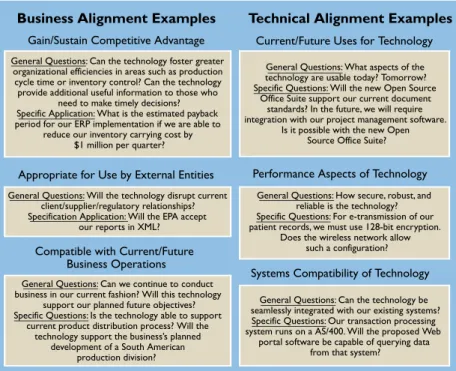
Figure 1. Examples of business and technical alignment issues (adapted from online chat sessions with participating CIOs).
Cegielski table 1 (8/05)
Italicized issues relate to Business Alignment Non-italicized issues relate to Technical Alignment
Issue
Ability to gain competitive advantage through the use of the EIT Ability to sustain competitive advantage provided by the EIT Security aspects involved with using the EIT Appropriateness of EIT for use by customers/clients Reliability of the technology
Compatibility of EIT with existing information systems Supports current business operations/processes
Capable of supporting future business process/operations Standardization of technical specifications of the EIT
Rank 1 2 3 4 5 6 7 8 9
Table 1. Consensus ranking of top issues from final Delphi round (1 = most important).
technical alignment issues focus on “the nuts and bolts of a partic-ular technology like compatibility with existing systems.” Generally, the business alignment issues reflect concerns that are universal to all organiza-tions: competitive advantage, customer relationship management, and organizational fit. Conversely, the technical alignment issues are firm specific, as the study group described. The group provided specific examples of both business alignment and technical alignment issues during an online chat session (see Figure 1). From the context of the online chat, con-cise definitions of the alignment categories were developed (see Figure 2).
The consensus ranking of the top issues presented in Table 1 illustrates a clear distinction between busi-ness and technical alignment. Particularly, Issues 1, 2, 4, 7, and 8 represent business alignment issues while Issues 3, 5, 6, and 9 pertain to technical align-ment issues. While the group saw both areas as “equally important,” a consensus formed among the executives that the integration decision regarding EITs must focus initially on business alignment issues in order to ensure support for organizational
objectives. A CIO from an inter-national petrochemical con-glomerate summarized the group sentiment as follows:
“It is easy to become fasci-nated by cutting-edge technolo-gies, but we all know the bottom line. If it [an emerging informa-tion technology] won’t make us better at what we do, than it has no place in our organization.”
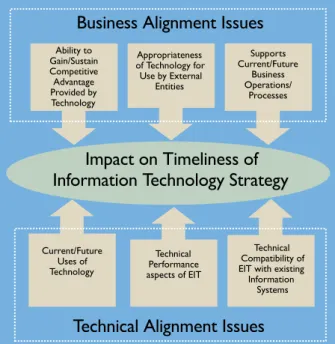
From the initial listing of 23 unique issues and the subsequent executive classifications solicited during the online chat sessions, we developed the EIT evaluation model presented in Figure 3.
BUSINESSALIGNMENTISSUES
M
any practitioners andresearchers have long held the popular opinion that competi-tive advantages derived from using IT are often short-lived because of the ability of com-petitors to replicate, and subsequently eliminate, the advantage [4, 5]. The participating CIOs unani-mously agreed that gaining and subsequently sus-taining a competitive advantage via the integration of an EIT into strategy are paramount concerns in the EIT evaluation process. Interestingly, most of the participants expressed competitive advantage not in terms of a single application of technology that pro-duces a benefit for a finite amount of time, but rather as a continuous effort to manage the integra-tion of technologies as they develop. Given this information, we have modularized competitive advantage into the single components shown in the model.
According to the executive respondents, the
sec-Cegielski fig 2 (8/05)
Gain/Sustain Competitive Advantage
To continuously identify and integrate emerging technologies that contribute to a more
effective/efficient firm
Appropriateness of Technology for Use by External Entities
To consider technology preferences of customer/clients/supplies when evaluating emerging technologies
Compatibility of Technology with Current/ Future Business Operations
To establish a “fit” between the core competencies of the business and emerging technologies
Current/Future Uses of Technology
To identify specific existing/future applications of emerging technologies within an organization
Performance
To assess the quantifiable operations aspects of an emerging technology within an
organizational context
Systems Compatibility
To evaluate the implementation impact of an emerging technology into existing
information systems Business Technical Figure 2. Definitions of EIT business alignment and technical alignment issues.
Most of the participants expressed competitive advantage
not in terms of a single application of technology that produces a
benefit for a finite amount of time, but rather as a continuous effort
ond business alignment issue to consider when evaluating an EIT is the appropriateness of the technology for the orga-nization’s customers or clients. The former CIO of an international wom-en’s fashion retailer explained his perception of appropriateness of technology with the fol-lowing example:
“We evaluated an e-commerce plan prior to 1996. It was a compre-hensive plan we had on the table and it would have been costly. We learned from
prelimi-nary market studies that our customers would not purchase our clothes online. For them, there is a need to see and feel a garment before they buy. They like to come into the store and try it on, see it in the mirror, and get some opinions on how it makes them look. Because of that, we decided not to incor-porate an e-commerce platform in our Web pres-ence. I’ll also tell you that watching all of our competition move to e-commerce platforms made us all worry. We wondered if we had made the right decision. Five years after, we know our assessment of our customers was right on. I know that our com-petitors haven’t experienced the kind of return on their sites that they expected. We know it all boils down to our customers’ preferences.”
Within the domain of business alignment, the respondents defined business operations compatibil-ity as the final qualitative issue to consider when evaluating an EIT. One CIO suggested that by appropriately evaluating the compatibilities of an
EIT with current and future organizational operations, an IT strate-gist can avoid the diffi-cult lesson learned by so many adopters of ERP systems in the late 1990s: integrating tech-nology for the sake of technology is a poor approach to developing an IT strategy. The over-riding theme expressed by the group regarding EITs and operations compatibility is the para-mount importance of ensuring that organiza-tional operations are not altered solely to allow for technology integration. While all agreed that it is completely acceptable to utilize technology to facilitate organizational change, attempts to conform organizational processes around an EIT are tantamount to placing the cart in front of the horse [6].
TECHNICALALIGNMENTISSUES
A
ccording to the study group, oncean IT strategist has completely assessed the business alignment issues regarding an EIT, it is appro-priate to explore the relevant techni-cal issues of the emerging technology. Initially, the technical analysis should focus on the current and future uses of the EIT within the organization. The CIO of an interna-tional paper products manufacturer explained the analysis of potential uses of an EIT as a “proactive”
Cegielski fig 3 (8/05)
Business Alignment Issues
Technical Alignment Issues Impact on Timeliness of Information Technology Strategy
Ability to Gain/Sustain Competitive Advantage Provided by Technology Appropriateness of Technology for Use by External Entities Supports Current/Future Business Operations/ Processes Current/Future Uses of Technology Technical Performance aspects of EIT Technical Compatibility of EIT with existing Information
Systems
Figure 3. EIT evaluation model.
Most of the executives indicated that the key to future use of
an emerging technology is the analysis of the wealth of information
activity. Several of the group participants suggested that identifying future uses of an EIT is very difficult because of the nature of technology evolution. The CTO of an international logistics firm summarized the problem as follows:
“One problem with anticipating future uses of technologies is that developments can take place like an explosion, but it usually takes time for support to catch up. Look at ISDN. The technology was devel-oped long before the rules were ever worked out. By the time everybody finally agreed on the standards, ISDN was an afterthought for broadband.”
Although the identification of future uses of an EIT requires some forecasting, most of the execu-tives in the study indicated that the key to future use assessment of an emerging technology is the analysis of the wealth of information available from technol-ogy developers.
The final two assessment areas in the EIT evalua-tion model are components of technical alignment: performance issues and systems compatibility issues. Performance issues collectively reflect the myriad of technology specifications of an EIT. For example, many of the participating executives were particu-larly concerned about the technical security factors associated with new technologies. Given the events of Sept. 11, 2001, the concern for security is under-standable. However, performance issues also include other technical areas such as product reliability, par-ticularly with respect to hardware and end-user training for new software. Systems compatibility issues, on the other hand, center on the specifics of integrating an EIT into an organization’s existing IT infrastructure. Most of the systems compatibility issues focused on specific areas such as cross-plat-form connectivity, software application integration, deployment, and product support.
CONCLUSION
G
iven the rate of technologicalevolu-tion, the exclusive use of currently available commercial technologies often creates a rapidly outdated IT strategy. It may be useful for tech-nology executives to apply the model presented herein to remedy this problem. In doing so, a CIO should first focus on the business alignment issues and conduct exploratory research to identify whether an EIT can be leveraged into a competitive advantage through enhanced operating efficiency, greater access to markets, or otherwise. Typically, this task requires the CIO to visualize his or her organization as it competes with its rivals in the global marketplace. Next, and assuming some
competitive advantage may be obtained via integrat-ing an EIT, a CIO must determine whether the tech-nology is appropriate for his or her user base. One can accomplish this through a formal or informal survey. Finally, the CIO considering the EIT must subjectively decide if the new technology will fit within the current as well as long-range operational plan of the firm. Often, this step requires the CIO to discuss operational objectives with other executive directors as well as operations level managers. After the business alignment issues have been addressed, the CIO, with the help of IT staff, may assume the responsibility of conducting a technical fit analysis for the EIT.
Using the model presented herein, IT executives can work toward the creation of a more timely IT strategy by quickly assessing the potential fit of emerging information technologies within a firm-specific context. As a result, forward-looking IT strategies that capitalize on early innovation are developed. The net effect is a longer useful life for an IT strategy.
References
1. Benamati, J. and Lederer A.L. Coping with rapid changes in IT. Com-mun. ACM 44, 8 (Aug. 2001), 83.
2. Brancheau, J. and Janz, B. Key issues in information systems manage-ment: 1994–1995 SIM Delphi Results. Management Information Systems Quarterly 20, 2 (June 1996), 225–243.
3. Cegielski, C.G. and Rebman, C.M. Building a timely information tech-nology strategy: A process to efficiently acquire decision useful informa-tion regarding emerging informainforma-tion technologies. Issues in Information System 4, 1 (Fall 2003), 52–58.
4. Clemons, E. and Row, M. Sustaining IT advantage: The role of struc-tural differences. Management Information Systems Quarterly 15, 3 (Sept. 1991), 275–292.
5. Davenport, T. The new, new IT strategy. CIO Magazine(May 1, 2001); www.cio.com/archive/050101/davenport.html.
6. Low, L. Co-Evolving Business and IT Strategies. CIO Perspectives @ 25—Different Voices, Shared Visions: Getting Alignment Right. (Oct. 14–16, 2001), www2.cio.com/conferences/october2001/cover-age33_content.html.
Casey G. Cegielski ([email protected]) is an associate professor of MIS in the College of Business at Auburn University.
Brian J. Reithel ([email protected]) is the dean of the School of Business and a professor of MIS at the University of Mississippi.
Carl M. Rebman ([email protected]) is an assistant professor of Information Systems and Electronic Commerce at the University of San Diego.
Permission to make digital or hard copies of all or part of this work for personal or classroom use is granted without fee provided that copies are not made or distributed for profit or commercial advantage and that copies bear this notice and the full citation on the first page. To copy otherwise, to republish, to post on servers or to redistribute to lists, requires prior specific permission and/or a fee.
© 2005 ACM 0002-0782/05/0800 $5.00