THESIS
Submitted by: YULIANA ROLANDA
NIM. 140203126
Student of Faculty of Education and Teacher Training Department of English Language Education
FACULTY OF EDUCATION AND TEACHER TRAINING AR-RANIRY STATE ISLAMIC UNIVERSITY
DARUSSALAM - BANDA ACEH 2019 M/ 1440 H
i THESIS
Submitted to Faculty of Education and Teacher Training of UIN Ar-Raniry Darussalam Banda Aceh as a Partial Fulfillment
Of the Requirement for Sarjana Degree (S-1) On Teacher Education
By:
YULIANA ROLANDA
The Student of English Language Education Department Faculty of Education and Teacher Training
Reg. No. 140203126
Approved by:
Main Supervisor, Co Supervisor,
ii
It has been defended in Sidang Munaqasyah in front of the council of Examiners for Working Paper and has been accepted in Partial Fulfillment
of the Requirements for Sarjana Degree (S-1) on Teacher Education On: Tuesday, January 15 th , 2019 M Jumadil Awal 7th, 1440 H
Darussalam - Banda Aceh
Chairman, Secretary,
Habiburrahim, S.Ag., M.Com., MS, Ph.D Ikhwanna Dhivah , S. Pd
Member, Member,
Nidawati, S.Ag., M.Ag Dr. T. Zulfikar, M.Ed
Certified by:
The Dean of Faculty Education and Teacher Training Ar-Raniry State Islamic University
Dr. Muslim Razali, S.H., M.Ag NIP. 195903091989031001
iii
SURAT PERNYATAAN Saya yang bertanda tangan dibawah ini :
Nama : Yuliana Rolanda
NIM : 140203126
Tempat/Tgl. Lahir : Sinabang / 29 Juli 1996 Alamat : Ulee Kareng, Banda Aceh
Judul Skripsi : An analysis of students‟ problems in designing lesson plans during microteaching class
Menyatakan bahwa sesungguhnya skripsi tersebut adalah benar karya asli saya, kecuali lampiran yang disebutkan sumbernya. Apabila terdapat kesalahan dan kekeliruan didalamnya akan menjadi sepenuhnya tanggung jawab saya. Demikian surat pernyataan ini saya buat dengan sebenar-benarnya.
Banda Aceh, 18 Desember 2018 Saya yang membuat surat pernyataan,
iv
ACKNOWLEDGEMENT
First of all, Alhamdulillah, I would like to praise Allah, God the Almighty, who gives me His mercy and blessing to successfully finish writing this thesis. Peace and blessing be upon our beloved prophet Muhammad SAW, all his companions, the last of all prophets to proclaim the message of Allah, who has guided us from bad traditions into modern traditions.
Additionally, I would like to convey the deepest gratitude to my first supervisor, Habiburrahim, S.Ag, M.Com, MS, Ph.D, and my second supervisor, Nidawati, M.Ag. for their wilingness to spend plenty of their precious times and energy to give me useful advices and suggestions in writing my thesis. My gratitude also goes to all of my lecturers who have taught and given their valuable knowledge for me during the time I studied at the English Language Education Department.
From the bottom of my heart, I would like to express my deepest gratitude and endless love to my family especially for my beloved father, Khairuddin and my beloved mother, Titin Sumarotin who have given me support, and love during my study. Then, My special gratitude for my sister, Yosita Kartina and my brothers, Muhammad Isa Daud and Rabbil Imam Samudera. My special thanks for my beloved friends, Anita Siregar, Rizkina Putri, Cut Melfi Yuelanda, Israk Vuardi and Rismayanti who always support in my high and low condition. Then, I
v
also thanks for all my friends from Unit 04 who always help and support me to finish my thesis and study. May Allah always give us His mercy in our life.
Banda Aceh, December 23th, 2018 Yuliana Rolanda
vi
TABLE OF CONTENTS
APPROVAL LETTER ... i
MUNAQASYAH LETTER ... ii
DECLARATION OF ORIGINALITY ... iii
ACKNOWLEDGEMENT ... iv
TABLE OF CONTENTS ... vi
LIST OF TABLES ... vii
LIST OF APPENDICES ... ix
ABSTRACT ... x
CHAPTER I : INTRODUCTION ... 1
A. Background of study ... 1
B. Research Questions ... 5
C. The Aim of Study ... 6
D. The Significance of Study ... 6
E. Terminology ... 6
CHAPTER II : LITERATURE REVIEW ... 9
A. Lesson Plan ... 9
1. Perspective of the lesson plan ... 9
2. The basic principles of designing the lesson plan ... 10
3. Component of the lesson plan ... 10
4. The format of the lesson plan ... 12
5. Steps in designing lesson plan ... 14
6. The benefit of the lesson plan ... 17
7. Problems in designing the lesson plan ... 18
B. Microteaching ... 19
1. Definition of microteaching... 19
2. Problems in microteaching ... 20
vii
CHAPTER III : RESEARCH METHODOLOGY ... 24
A. Research Design ... 24
B. Population and sample ... 24
C. Research Instrument ... 25
D. Data collection ... 26
E. Data Analysis ... 27
F. Brief Description Criteria of Subjet ... 29
CHAPTER IV : RESEARCH FINDINGS AND DISCUSSION ... 31
A. Research Findings ... 31
1. The Document Analysis Result ... 31
2. The result of Interview ... 37
B. Discussion ... 44
CHAPTER V : CONCLUSIONS AND SUGGESTIONS ... 47
A. Conclusions ... 47
B. Suggestions ... 48
viii
LIST OF TABLES
Table 2.1 Format of lesson plans ... 12
Table 2.2 New teachers need to be addressed in the Education Program ... 20
Table 3.1 Criteria assessment ... 28
ix
LIST OF APPENDICES
Appendix 1 : Instrument (Document analysis) Appendix 2 : Instrument (Interview Protocol) Appendix 3 : Interview Transcript
x ABSTRACT
To carry out a succesful teaching in the microteaching class, students needs to develop a good lesson plan. The lesson plan functions as a guideline in the teaching in order to achieve the learning objectives and the successful teaching. As a matter of fact, some students still faced various difficulties in designing lesson plan during microteaching class. Therefore, the researcher carried out a study to analyze students‟ problems in designing lesson plans during microteaching class and find out the students‟ perspectives on the lesson plans of microteaching class. This study employed a qualitative research design. The population was the English Department students batch 2015, in academic year 2017/2018 in UIN Ar-Raniry who have already taken the microteaching class in the seventh semester. They were selected by purposive sampling. The data were collected through document analysis and interview. The researcher analyzed 20 students‟ lesson plans and interviewed 20 students. The findings revealed that the students‟ perspective on the lesson plan of microteaching class was as a teaching guideline, teaching planning, and crucial aspect of teaching and the students‟ problems in designing lesson plan were in terms of formulating indicator/objectives, analyzing basic competence (KD) to the indicator, and selecting the evaluation/assessment.
1 CHAPTER I INTRODUCTION
A. Background of Study
Recently, the development in teacher education emphasizes in creating teachers who are not only knowledgeable but also have the ability in transferring their pedagogical skills. One of the methods and approaches to measure students‟ understanding of pedagogical knowledge and theories taught is through microteaching. Microteaching is one of the effective ways for students to enhance their skill in teaching and producing good lesson plans. In addition, one of the crucial elements in microteaching is the preparation and implementation of the lesson plan.
Brown (2001) stated that the successful teaching and learning process is influenced by the lesson plan. He added that in designing lesson plan, teachers should be well-known with the curriculum, recognize students‟ language needs, decide the terminal objective and purposes of the lesson, choose suitable methodology and techniques cautiously, decide suitable exercises, and etc. Badriah (2013) stated that the important part of successful teaching also depends on good planning skill. Therefore, a teacher should determine what and how he or she teaches in the class.
Moreover, lesson plan is an important aspect in teaching for the teachers and students in learning process. It helps teachers to convey the learning
materials, arrange the teaching activities systematically, and expect the effectiveness of teaching.
Harmer (2007) said there are two important points in planning a lesson plan. Firstly, lesson plan is a guide for teachers in teaching process. Although the activities in the classroom might be not actually happened as the lesson plan, the lesson plan is still a guide for the teachers. Secondly, it relates to the relationship between teachers and students. Basically, lesson plans is needed in teaching since the lesson plan has significant role in a teaching such as providing the guideline to students during their teaching practice, providing teaching awareness in the objective of teaching and structure of contents and giving direction for the teacher in the teaching process to achieve the objectives.
Thornbury (1999) argued the lesson plan is considered as problematic area especially for student teacher to profesional teacher. Therefore, there are some students still faced some problems in designing lesson plan while it has a big role for students candidates in microteaching class. Furthermore, the lesson plan is one of the main factors which is evaluated during microteaching class. Thus, the students have to able to design the lesson plan properly.
Additionally, one of the problems in the microteaching is instructional aspect which related to the lesson plan. As my experience, my friends still faced some problems in designing lesson plan in the microteaching class. The frequently problems are the lack of knowledge on the various components in the lesson plan, selecting the appropriate learning materials, deciding the indicators and
objectives, setting the time allocation for teaching, and determining the evaluation/assessment. Thus, in this study the researcher wanted to investigate the students‟ problems in designing lesson plans during microteaching class. Particularly, it also can be a reflection of the students to improve their lesson plan as suggested by the recent curriculum, in this case, 2013 Curriculum.
Previously, there are some studies conducted to explore significant information on the lesson plans. First, a study was conducted by Ayşegül Zıngır Gülten (2013) in Uludağ University, Bursa, Turkey. The purpose of this study was to explore the first lesson planning experience of the teacher trainees‟ and identify their reactions. The researcher found that when planning, teacher trainees face with problems like formulating objectives and selecting appropriate activities for certain stages. The main challenges include teacher trainees‟ hesitations about the process, timing problems, problems in sequencing and selecting activities, providing effective transitions and finding sources.
Sahin- Taskin (2017) in his journal with the title “Exploring pre-service teachers‟ perception of lesson planning in primary education” conducts a study about pre-service teachers‟ lesson planning experience in designing lesson plan”. Furthermore, the research design is qualitative approach. The findings reveal that most of the pre-service teachers are aware of the importance of lesson plan, they found that it is difficult to develop a lesson plan. In addition, they do not have enough time to gain experiences to get to know students so that they can consider their levels of learning, needs, and expectations to develop lesson plans.
Ghanaguru, Nair & Yong (2013) in their journal with the title “Teacher trainers' beliefs in microteaching and lesson planning in a Teacher Training Institution” have viewed microteaching as beneficial in establishing a good experience among the student teachers in the teacher training institutions. This study used qualitative research design. In addition, they focus on establishing lesson planning. The aim of this study investigates how educators from one teacher training institution view microteaching and lesson planning. The results show that the respondents viewed learning objectives, stages of the lesson and types of activities for the lesson as three important elements in lesson planning. Student centered and teacher centered approaches were used to teach microteaching.
Another previous study was conducted by Jasmi in Indonesia University of Education. The title is “English teacher difficulties in designing lesson plan based on 2013 curriculum. This study wants to investigate the teachers‟ difficulties in designing lesson plan based on the curriculum 2013. The researcher used a qualitative design in the form of semi-structured interviews. In the result states that the teacher did not get enough contextual training of 2013 curriculum.
The prior study also was conducted by Puspita (2015) in Universitas Pendidikan Indonesia. In her research, she found that the teacher has some problems in designing lesson plans, in selecting the materials, developing learning activities, and assessing the students.
Based on several previous studies above, I conducted the study with the title “An analysis of students‟ problems in designing lesson plans during microteaching class” at Islamic state university of Ar-Raniry (UIN Ar-Raniry). The smilarity between my research and those above previous studies are focused on designing lesson plans while the differences, I focused to investigate the Students‟ problems in designing lesson plans during their microteaching class. In addition, the third previous study has the differences with my research which conducted by Ayşegül Zıngır Gülten (2013). He focuses on exploring the first lesson planning experience of the teacher trainees‟ and identify their reactions. Furthermore, the second journal focuses in the aspect of pre-service teachers‟ perception of lesson plan and creating in designing lesson plan, and the third journal emphasizes in the perception of educators on microteaching and lesson planning.
B. Research Questions
The research questions for this study are as follow below:
1. What are students‟ perspective on the lesson plan of microteaching class?
2. What are problems faced by the students in designing lesson plan during microteaching class?
C. The Aim of Study
To know students‟ perspective on the lesson plan of microteaching class.
To investigate the problems faced by students in designing lesson plan during microteaching class.
D. The Significance of Study
a. For the students
This research helps students in designing lesson plan and give the reflection for them in designing lesson plan. In addition, this research can make the students more comprehend in designing lesson plans.
b. For the lecturer
The lecturer can suggest and solve the students‟ problems in designing lesson plans during microteaching class. Furthermore, the lecturer can enhance and focus on training the students in designing the lesson plan.
c. For the researcher
For other researcher, this study can give information for the next researcher related to this research in other aspects. Moreover, this reserach can motivate the next researcher to conduct further research in order to increase the quality of English teaching learning.
E. Terminology 1. Lesson plan
Singh (2008) stated that the lesson plan is something that the teacher has to prepare a pratical outline of a topic to be taught in a period before enter to the
classroom. In addition, Farrel (2002) defined the lesson plan as a written description of how students will move toward attaining specific objective.
Mishra (2009) argued “ A lesson plan is a teacher‟s detailed description of the course of instruction for an individual lesson” (p. 2). Savage (2001) stated that “ lesson plan is a process of thinking and writing down a plan for the teaching in a spesific group of students, specific place, and specific time. In this research, the lesson plan is a detailed guide in teaching lesson which constructed by the students and it consists of step-by-step guide activities, learning objectives, goals, media and assessment.
2. Microteaching
Lakshmi (2009) stated that microteaching is a concept of training that applies at the pre-service and in- service stages in developing professional teachers and provides skilled supervision to get a constructive feedback.
Kalaimathi and Julius (2015) argued that microteaching is a good way to build up skills and confidence, to train teaching behaviour in a small groups, to have tutoring styles, and to learn and practice giving useful comments. Additionally, Sharma (1981) defined microteaching as “a specific teacher training technique trough which trainee practices the various teaching skill in a specific situation with the help of feedback with a view to increase the student‟s involvement (as cited in Kalaimathi and julius, 2015).
In this study, microteaching is a teaching training where the candidates of teacher (students) and lectures are in a limited and controlled classroom environment.
9 CHAPTER II LITERATURE REVIEW
A. Lesson Plan
1. Perspective of the lesson plan
Spratt, Pulverness, and Williams (2005) pointed out that the lesson plan is a series of course plan which provides a guideline for a teacher of what kind of materials of study to be taught and how to teach them. Coppola et al. (2004) stated that the lesson plan is the main foundation of educational structure and it is the core of education. Faculty members should not be present in class without a lesson plan because it is required for a successful teaching.
Amininik, Amami, Jalalpour, and Azodi (2000) believes that lesson plan preparation by faculty members is one of the appropriate ways for the promotion of education quality; it can help the lecturers in teaching as guidance. Yildirim (2003) stated that lesson planning is an important process in teacher trainees to gain experience since it forces them to reflect on what to teach, how to teach and how to evaluate.
Brown (2001) argued “Writing a lesson plan is a must for student-teachers for their preparation for the following teaching and learning process in the real class and student-teachers who have never been teaching before, it is very often useful to first write a script or scenario of the lesson plan” (as cited in Wahyuningsih, 2015 p. 6).
Based on the definition above, the lesson plan can be defined as a guideline for the teacher in the learning process in order to achieve successful teaching.
2. The basic principles of designing the lesson plan
Government rules of Republik Indonesia No.65/2013 (n.d) stated that planning of the learning process is spelled from syllabus to direct student learning activity to reach basic competence (KD).
3. Component of the lesson plan
A lesson plan importantly consists of several components, i.e KI, KD, indicators, materials and media, teaching and learning activities, and evaluation/assessment (BPMSDMPK-PMP, 2014). Those components above will be described in the following below:
a) Identity
The identity includes; The school‟s name, subject, subject matter, class/semester, and time allocation.
b) KI (Core competence)
KI or core competencies has been stated in the school syllabus. There are four competencies in the KI has to be reached by the students, including spiritual (KI 1), social (KI 2), knowledge (KI 3) and skill (KI 4) competencies.
c) KD ( Basic competence)
Basic competence is derived from KI. In addition, KD is the manifestation of the KI. KI and KD usually stated in the syllabus.
d) Indicators
Indicators should be made by referring to the KI and KD which have been chosen. In 2013 curriculum, for example, the indicators refer to knowledge competence points 3.1 to 3.11 and skill competence points 4 to 4.13 (BPMSDMPK-PMP, 2014).
e) The learning materials and media of teaching
The learning material is factual (an example of material), conceptual (definition), and procedural. The material of teaching can be used from textbooks, teacher-module, and another learning sources. Moreover, the supporting materials in the lesson plan are student-worksheet, modules and etc. Additionally, The computer, internet, video cameras, mobile phone are the general sources of instructional materials and media (kitao & Kitao, 1997).
f) The teaching and learning activities
The learning activities are the real action of the teacher as well as the student in the class.
1. Pre- Activity: the teacher introduces the learning material with students initial learning experiences, and does the apperception and motivation.
2. Main Activity: it contains steps of main learning activities. in addition, a scientific approach should be described clearly and systematically.
3. Post activity: it contains some learning activities such as concluding the result of the learning process , and reflection.
g) Evaluation/ Assessment
Evaluation/ Assessment is the last component in the syllabus which determines the success of the teaching and learning process.
4. The format of the lesson plan.
According to the combination rules of the Minister of Education and Culture No. 103/2014 and No. 22/2016, the format of lesson plan realized in the following format below:
Table 2.1 Format of the lesson plan
RENCANA PELAKSANAAN PEMBELAJARAN
Mata Pelajaran : Kelas/semester : Materi pokok :
Alokasi waktu :
A. Kompetensi Inti
B. Kompetensi Dasar/ KD dan Indikator Pencapaian Kompetensi/ IPK 1. __________ (KD pada KI 1) 2. __________ (KD pada KI 2) 3. _________ (KD pada KI 3) Indikator:______________ 4. __________ (KD pada KI 4) Indikator:_____________ C. Materi Pembelajaran
D. Pendekatan /Model/ Metode Pembelajaran E. Media/ Alat dan Bahan Pembelajaran F. Sumber Belajar G. Langkah-Langkah Pemebelajaran Pertemuan Pertama: (...JP) 1. Kegiatan Pendahuluan 2. Kegiatan Inti 3. Kegiatan Penutup Pertemuan kedua: (...JP) 1. Kegiatan Pendahuluan 2. Kegiatan Inti 3. Kegiatan Penutup
H. Penilaian Proses dan Hasil Belajar
Lampiran-lampiran RPP:
1. Materi pembelajaran pertemuan 1 (Jika diperlukan) 2. Instrumen penilaian Pertemuan 1
3. Materi Pembelajaran Pertemuan 2 (Jika diperlukan) 4. Instrumen Penilaian Pertemuan 2
Dan seterusnya tergantung banyaknya pertemuan.
5. Steps in designing lesson plan a) Analyzing Syllabus
Commonly, there are four core competencies in the syllabus which are aspect attitude to God (KI 1), attitude to self and environment (KI 2), knowledge (KI 3), and skills (KI 4). To achieve these basic competencies, in syllabus it is explained that student‟s activity in the learning process based on process standard. This student‟s activity is consisting of exploration, elaboration, and confirmation, there are: observing, questioning, experimenting, associating and communicating. These activities have to be explored in lesson plan and teacher must make their student actively. In addition, analyzing of syllabus also consist of formulating indicator and assessment.
b) Deciding learning aims
Learning aims refer to the indicator and those are formulated based on basic competency (KD) and decided with the operational verb that observed and measured the attitude, knowledge, and skills.
c) Identifying learning material
The learning material is the development of the indicator or basic competencies (KD). In it must include factual, conceptual, and procedural. Furthermore, Some aspects have to be considered in identifying learning material are:
a) Students‟ potential
b) Relevancy to local characteristic
c) Physical, intellectual, emotional, social, and student‟s spiritual d) Usefulness for student
e) Knowledge structure
f) Actual, deep, wide learning material
g) Relevancy between students‟ needs and environment h) Time allocation
d) Developing the learning activity
1) The learning activities are described and arranged to make easy the teacher.
2) The steps of learning activities emphasize in active learning to make students active.
e) Determining the suitable approaches/ model/ teaching method.
f) Determining the media, tool, and material used in the learning process. g) Formulating assessment
a) Assessment is purposed to measure the competence achievement, KI-3, and KI-4
b) The criteria of assessment are based on what students achieve in the learning process.
c) The result of the assessment is used to decide the next step d) Assessment has to be suitable with the learning experiences
that done in the learning process.
h) Deciding time allocation
In deciding time allocation for each KD, it is based on the effective week and time allocation for each subject.
i) Deciding learning sources
Widyastono (2014) stated that learning sources are object or thing used in learning activity such as nature, culture, social, physical environment and etc.
6. The benefit of the lesson plan
Jensen (2001) pointed out the benefits in designing lesson plan are giving the opportunities to the teacher in deciding the lesson objectives, arranging the types of activity that will meet these objectives, developing learning material, and setting the time allocation.
The lesson plan gives the benefits for the teacher because it provides a framework for instruction and it guides the implementation of standards-based education. Additionally, the lesson plan establishes a guideline for the teachers of what has been taught and needs to be taught, (The Teaching Excellence in Adult Literacy [TEAL], 2010).
Airasian (2005) stated that the lesson helps teachers in five basic ways, there are:
a) By helping they feel comfortable about instructional and giving them a sense of understanding and ownership over the teaching planning.
b) By establishing a sense of purpose and subject matter focus
c) By affording the chance to review and become familiar with the subject matter before actually beginning to teach.
d) By ensuring that there are ways in place to get instruction started, activities to pursue, and a framework to follow during the actual delivery of instruction.
e) By linking daily lesson to broader integrative goals, units, or curriculum topics.
7. Problems in designing the lesson plan
Bob Kizlik (2004) stated some mistakes that students make most often in designing lesson plans, the following mistakes are below:
a) The objective
The objective of the lesson does not specify what the student will actually do. An objective is a description of what a students do that forms the basis for making an inference or conclusion about learning. Poorly written objectives lead to faulty inferences.
b) The lesson assessment
An assessment in a lesson plan is simply a description of how the teacher evaluates the students and determine whether the objectives have been accomplished.
c) The materials
The materials specified in the lesson are extraneous to the actually described learning activities. This means keep the list of materials in line with what you actually plan to do.
d) The instruction
The instruction in which the teacher does not give the clear instruction in the learning activities, for example, the instructions in students-worksheet. Thus, the instruction is important in the lesson plan.
e) The students‟ activities
The activities which described in the lesson plan are not in accordance with the lesson objectives/indicator.
B. Microteaching
1. Definition of microteaching
Singh (2004 p.69) argued, “ microteaching is a training technique, which requires pupil teachers to teach a single concept, using specified teaching skills to a small number of pupils in a short duration of time”. According to Arsal (2014) stated that microteaching is an effective way to train pre-service teachers confidence, to give reinforcement and feedback by providing a chance to perform of what they may plan to teach with a small group of students in a limited duration as cited in Abdullah (2016).
Venkateswarlu (2007) as cited in Singh (2004) argued that microteaching is a plan of action in teacher education/ teaching which aims at modifying teacher‟s behavior by facilitating the complexities of the traditional regular training process.
Furthermore, Microteaching is a significant guideline for the pre-service teachers that mediates between theory and practices (Benton- Kupper, 2001). From the definition above it can be concluded that microteaching is a teaching practice which has a limited duration, students, and classroom situation.
2. Problems in Microteaching
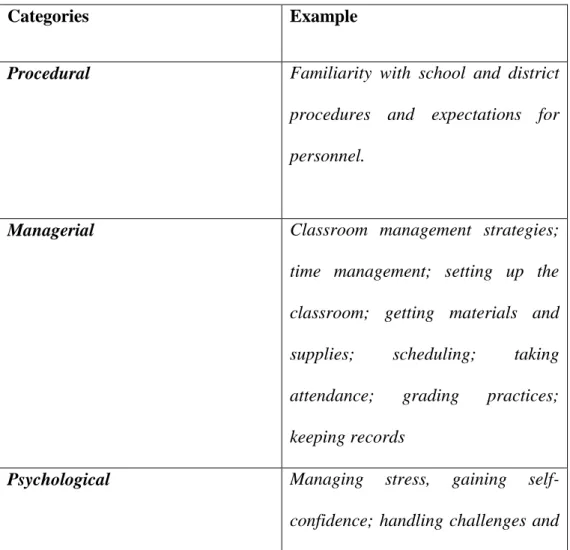
Bartell (2004) reviewed the challenges that faced by students in the microteaching class and categorized the challenges into seven categories. Those categories are procedural, managerial, psychological, instructional, professional, cultural, and political. Along with those categories, Bartel also stated the example of the problems in the form of the table below.
Table 2.2 New teachers need to be addressed in the Education Program (Bartell, 2004)
Categories Example
Procedural Familiarity with school and district procedures and expectations for personnel.
Managerial Classroom management strategies;
time management; setting up the classroom; getting materials and
supplies; scheduling; taking
attendance; grading practices;
keeping records
Psychological Managing stress, gaining
disappointments; transitioning from student to teacher role; attending to physical and emotional well-being
Instructional Grade-level curriculum standards
and expectations; lesson planning; instructional resources; assessing student progress and using results to shape instruction; using a variety of
instructional practices; adapting
instruction to meet individual student needs.
Professional Teaching norms and practices;
appropriate boundaries and relationships between faculty and students; legal issues; the role of professional organizations; professional development opportunities
Cultural Developing rapport with students
and parents; understanding and
appreciating environment; using
community resources; valuing
proficiency
Political Getting to know colleagues;
contributing to the extracurricular program; building relationships with colleagues, staff, and administrators; understanding the broader context of teaching and reform efforts
3. The benefit of Microteaching
Microteaching is a program for beginner teachers to improve teaching competencies. Reddy (2017) pointed out some benefits of microteaching below:
1. Elasticity of practice
Microteaching helps in encouraging various skill in trainees, improving the managing skill of the teachers, providing a good opportunity due to small-scale teaching. Furthermore, it broadens the knowledge of teaching skill and technique.
2. Confidence booster
Microteaching can increase the confidence level of the teachers due to several microteaching activities and practices. Moreover, it gives more experiences in teaching and classroom management.
3. Budget oriented
Microteaching is different from other programs and seminars which is costly. Microteaching program is budget oriented. Teachers can practice within the real class or other places.
4. More learning and less damage
Microteaching program is conducted with a small- scale of the students. This makes the possibility to gain a better teaching experience. Additionally, it decreases the possibilty of mistakes.
5. Improves attitude
The purpose of the microteaching is to guide the trainees to achieve a positive attitude towards feedbacks and comments. As a result, negative feedbacks also motivate the trainees to strive for betterment.
6. Promotes systematic lesson planning
Lesson planning is one of the skills that a teacher needs to master. Microteaching program helps the trainees to prepare the systematic lesson plan.
7. Instant feedback
Microteaching program allows the trainees to gain instant feedback from the supervisor or lecturer. An instant feedback gives more potential for rectifying mistakes.
8. Mastering skill
Microteaching program helps in mastering types of microteaching skills and strategies such as lecturing, questioning, probing and initiating discussions. Furthermore, it helps in improving teaching style.
24 CHAPTER III
RESEARCH METHODOLOGY
A. Research Design
This study employed a qualitative research design. Hancock, Okleford and Windiridge (2007) argued that qualitative research is concerned with explaining opinions, experiences, and feelings of individuals producing subjective data. The methodology of this research was descriptive qualitative. The descriptive qualitative can obtain a general overview of phenomenology in social context study.
B. Population and sample
As conducting the research required data collection, the researcher needed to select individuals or groups who are representated to draw conclusion effectively. Creswell (2008) stated that a population is a group of individuals with the same characteristic. In this study, the researcher chose the population from English Department students batch 2015, in academic year 2017/2018 in UIN Ar-Raniry
Dhivyadeepa (2015 p.3) “Sample is a subset of population to which the researcher to intends to generalize the results”. In addition, the purposive sampling was applied in this research. Singh (2006 p.91) stated “the idea of purposive sampling is to pick out the sample in relation in some criterion, which
is considered important for the particular study”. In addition, Donald (2010) explained that purposive sampling means the researcher uses the experience and knowledge to select a sample of participants that can provide the relevant information about the topic or setting. Therefore, the researcher chose the students with some criteria; the students who were taking the microteaching class and the students designed the lesson plan by themselves.
The sample was 17 microteaching classes in English Language Education Department, but the researcher only took 2 classes/unit of the microteaching class which consist of 20 students. The sample was students from unit 14 and 6 of English Language Education Department of UIN Ar-Raniry Banda Aceh which were taking the microteaching class in the seventh semester, in academic year 2017/2018.
C. Research Instrument
To obtain the data the researcher employed two instruments which are document analysis and interview.
1. Document Analysis
The researcher used the document analysis to obtain the data. The document was obtained from the students‟ lesson plans (typed form). In the document analysis, the researcher adopted a content analysis checklist to search variables. The content analysis checklist consisted of components in the lesson plan in accordance with the Ministerial Regulation No. 22/2016; identity, core competencies (KI), basic competencies (KD), indicators, learning materials,
method/ model of learning, learning sources, learning media, Teaching activity, time allocation, and evaluation/assessment.
2. Interview
Wengraf (2001 p.5) argued, “semi-structured interview is designed to have a number of interviewer questions prepared in advance but such prepared questions are designed to be sufficiently open that the subsequent questions of the interviewer cannot be planned in advance but must be improvised in a careful and theorized way”. The researcher used the semi-structured interview in order to get the information about students‟ perspective on the lesson plan of microteaching class and students‟ problems in designing lesson plans during microteaching class. The numbers of questions are six (6) questions. In addition, the researcher used a recorder to record the participants‟ responses.
D. Data Collection
As stated above, the data are collected from interview and document analysis. Each data collection explained briefly below:
1. Document Analysis
Nana Syaodih (2007 p.221) stated, “documentation as a technique to collect the data by assembling and analyzing the documents, either written documents, pictures or electronic ones”. The document was collected from students‟ lesson plans in the typed form. There were twenty (20) lesson plans that the researcher analyzed based on the guideline of lesson plan analysis. Alwasilah, Nunan& Bailey stated that the lesson plans become the document that functioned
as natural sources that provided real information in lesson plans development and its implementation (as cited in Badriah 2013, p. 30). In the document analysis, the researcher adopted and modified the content of analysis lesson plan from UIN Ar-Ranirys‟ microteaching assessment sheet.
2. Interview
The interview involved the data collection through direct interaction between the researcher and the participants. There were 20 students interviewed. Before the interview, the students were given a list of question of interview and the researcher followed a guide list questions of interview but the researcher had the option to follow-up or additional questions to ask to the respondent. Then, the researcher recorded the participants‟ answer using hand-phone or digital recorder.
E. Data Analysis
The researcher analyzed the students‟ lesson plans designed by them, which were in line with the second research question in order to know the problems that faced by the students in designing lesson plan during microteaching class.
The researcher analyzed the lesson plan by matching and analyzing it to the guideline of lesson plan content analysis. The researcher focused on ten aspects in the lesson plan components. They are; Identity, core competence (KI), basic competence (KD), indicators, learning material, learning media, learning sources, teaching activity (pre-activity, main activity and post activity), and
evaluation/assessement. After that, the researcher analyzed the lesson plan refer to the rubric content analysis of lesson plan (see appendix 1) by analyzing and giving scoring for each component of lesson plan with checking (√) on the scoring column (score = 1), (score = 2), (score = 3), and (score= 4) based on the criteria of analysis from the guideline of lesson plan content analysis.
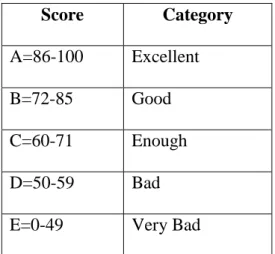
In addition, the result of students‟ lesson plan content analysis was ranged into four criteria assessment, adapted from UIN Ar-Ranirys‟ micro teaching assessment. The criteria were described in the table below:
Table 3.1 Criteria assessment
Score Category
A=86-100 Excellent B=72-85 Good C=60-71 Enough D=50-59 Bad E=0-49 Very Bad
The researcher conducted the interview to find out the students‟ perspective on the lesson plan of microteaching class and to gain some additional and supporting information about the second research question. The data gained from the interview analyzed it by using qualitative data analysis. Creswell (2008 p, 236- 237) described six steps of qualitative data analysis. These are the following steps:
1. Preparing and organizing the data (transcripts). 2. Exploring and coding the database.
3. Describing findings and forming themes. 4. Representing and reporting findings. 5. Interpreting the meaning of the findings. 6. Validating the accuracy of the findings.
F. Brief Description Criteria of Subject
The researcher tended to accomplish the research at State Islamic University of Ar- Raniry in the Department of English Language Education of Tarbiyah and Teacher Training Faculty. State Islamic University of Ar- Raniry called as UIN Ar- Raniry. The location is in Jln. Syeikh Abdul Rauf Kopelma Darussalam Banda Aceh. UIN Ar-Raniry administered by Ministry of Religious Affair of the Republic of Indonesia and under the supervision of the General Directorate of Islamic Institutes through the Directorate of Islamic Higher Institutions.
UIN Ar-Raniry has nine faculties with 43 departments. They are; Faculty of Syariah and Law, Faculty of Education and Teacher Training, Faculty of Ushuluddin and Philosophy, Faculty of Adab and Humanities, Faculty of Sociology and Governance, Faculty of Economics and Islamic Business, Faculty of Psychology, and Faculty of Science and Technology.
This research conducted in the Education and Teacher Training Faculty especially in the Department of English Language Education. English Department is a department which specifically teaches English as a Foreign Language and trained to be a good teacher in the future.
Microteaching is one of the programs to increase teachers‟ candidate ability in teaching. It was in limited time, limited materials, and has a small number of students. In addition, Microteaching is an important major that obligated in Tarbiyah Faculty, especially in the English Department. The purpose of this program is preparing the teachers‟candidates to be a professional teacher in the future. In microteaching, they learned in designing lesson plan, classroom management, and others that related to teaching.
31 CHAPTER IV
RESEARCH FINDING AND DISCUSSION
This chapter described the findings and analysis of the data gathered through document analysis and interview. It consisted of the analysis of the students‟ lesson plans content, the problems faced by students in designing lesson plans during microteaching class, and students‟ perspective on the lesson plans of microteaching class.
A. Research Findings
The result of this study was discussed below. The findings were divided into two categories. The first category was the document analysis result and the second was the interview result.
1. The Document Analysis Result
The researcher analyzed students‟ lesson plans based on the guideline of lesson plan content analysis with some criteria of analysis for each component of the lesson plan. To make it clear, the researcher provided the following table below :
Table 4.1 The result of document analysis No Students’ Initials Total Score Category 1 AA 77.5 Good 2 PI 72.5 Good 3 CM 65 Enough 4 SF 52.5 Bad 5 AY 72.5 Good 6 LZ 77.5 Good 7 HR 55 Bad 8 RR 85 Good 9 EN 80 Good 10 SC 85 Good 11 ZR 87.5 Excellent 12 ZF 80 Good 13 AF 80 Good 14 IR 80 Good 15 FM 82.5 Good 16 QN 87.5 Excellent 17 DA 80 Good 18 SYF 67.5 Enough 19 SAT 65 Enough 20 ARD 82.5 Good
The table above illustrated the result of students‟ lesson plans content analysis. Furthermore, based on the result, the researcher found that 13 student‟s
lesson plans indicated good category in designing lesson plans. Additionally, the researcher found 2 student‟s lesson plan indicated execellent category. However, there were 3 student‟s lesson plans indicated enough category. Furthermore, there were 2 student‟s lesson plans indicated bad category.
On the other hand, when the researcher analyzed the content of the students‟ lesson plans, the researcher found two problems that the most students faced in designing lesson plans. The problems were described as following:
1.1 Indicator
In term of formulating the indicators, some of the indicators of students‟ lesson plans did not match with operational verbs. Students used the operational verbs that were not suitable with the competence that wants to be measured. It can be seen from the example of students‟ lesson plans in the following below:
Example 1:
The example above was taken from HR‟s lesson plan. It can be seen in the example that the word “menghibur” was immeasurable verb. In addition, the indicators above referred to skill competence. On the other hand, the sentence “
mampu menggunakan unsur kebahasaan yang benar dalam teks narrative yang
sesuai dengan konteks” was knowledge competence where the operational verb
was not suitable with the competence that wants to be measured. Example 2:
The example above was taken from AY‟s lesson plan. It can be seen that all the indicators were same. In addition, the operational verb was not used and the indicators were incorrect.
Example 3:
The example above was taken from PI‟s lesson plan. It can be seen the topic of basic competence (KD) discussed about “teks interaksi interpersonal
terimakasih, dan meminta maaf” but in the indicators discussed about “teks yang
melibatkan tindakan memberi dan meminta informasi terkait tindkan/kejadian
yang akan, sedang dan telah dilakukan/terjadi di waku yang akan datang”. It can
be concluded that the indicators were not corresponding with basic competence. 1.2 Assessment/evaluation
Furthermore, the researcher also found the problem in term of selecting evaluation/assessment. It can be seen from the example of students‟ lesson plan in the following below
The example above was taken from HR‟s lesson plan. The evaluation instrument and the rubric was not corresponding each other. Moreover, the form of evaluation was essay but the form of assessment rubric/scoring was fill in blank. Thus, it can be seen that the evaluation/assessment instrument was not accordance with the scoring/ assessment rubric.
The example above was taken from RR‟s lesson plan. She only attached the instrument of evaluation/assessment without key answer and assessment rubric. From the examples above, it can be considered that the students also faced a problem in designing the evaluation/assessment.
2. The result of the interview
The researcher found out the students‟ perspective on the lesson plan of microtaching class and got some additional and supporting information about the second research question by having the interview. Furthermore, the interview was conducted on November 8th – December 20th2018 with those twenty students as the interviewees. The selected students were marked as Int. 1 to Int. 20. To analyze the data the researcher used Creswell (2008 p, 236- 237). The findings are explained as follow:
2.1The students’ perspective on the lesson plan of microteaching class
According to the interview result, the interviewees realized that the lesson plan has an important role in their teaching, especially in the microteaching class. Furthermore, based on the interview result, the researcher concluded in several aspects about their perspective on the lesson plan of microteaching class. Those were a teaching guideline, teaching planning, and crucial aspect of teaching.
2.1.1 Teaching guideline
The interviewees recognized that the lesson plan is as a guideline in teaching. Thus, the teaching will be run well.
In this case, Int. 1 argued “In my opinion, the lesson plan is as a guideline,.... Mainly, the lesson plan helps the teacher or students in the teaching. ... and it can be more systematically and also it is as guide for the teacher”.
(Int.1, November8th, 2018).
Additionally, Int. 2 also stated “Firstly, as a guideline... Then, the lesson plan is our reference in the teaching and it organize systematically. We feel more
easier because the lesson plan has organized well”. (Int.2, November 8th, 2018).
Moreover, Int. 5 said “in my opinion, it is as a guideline in teaching. and
also the lesson plan as a concept before teaching” (Int. 5, November 16th, 2018). Int. 7 also said “The lesson plan is as a guidance and it’s really helpful for the student-teacher in the microteaching class” (Int. 7, December 17th,, 2018).
Int. 10 had the same thought “I think, the lesson plan absolutely as a
guideline in our teaching. it provides benefits for us and helps us when we’re teaching” (Int. 7, December 17th, 2018).
Int. 17 mentioned “I think that the role of the lesson plan is a guideline for
the teacher when they will teach the students, the teacher will know what they teach to the students based on the lesson plan” (Int.17, Decmber 18th, 2018).
Based on the interviewee‟s responses above, the interviewees revealed that the lesson plan guides them in teaching systematically. in addition, the interviewees showed by having the lesson plan, they knew how to teach, how to evaluate, and what kind of material that would be taught in teaching.
2.1.2 Teaching planning
The interviewees revealed that the lesson plan is as a teaching planning. This is proven by the interviewee‟s responses.
Additionally, Int. 1 said “In my opinion, the lesson plan is the plan of the teaching”. (Int. 1, November8th, 2018).
In addition, Int. 2 mentioned “Personally, I think the lesson plan is a set of teaching planning....”(Int. 2, November 8th, 2018).
Similarly, Int. 3 also stated “In my opinion, the lesson plan is something that
we want to do in the class, how we teach in the class, our learning material, and
for example what are activities that we want to do in the class” (Int. 3, November
12th , 2018).
Int. 5 said the same way “Lesson plan is steps in teaching or our planning.
So we know how to start the teaching and the steps in the teaching....” (Int. 5, November 16th, 2018).
Moreover, Int. 6 mentioned “The lesson plan is set of an outline that has
description about what teacher want to do in the class....” (Int. 6, November 17th , 2018).
In addition, Int. 8 also said “lesson planis our planning for the teaching. In
the lesson plan we can prepare what we will do in the class” (Int. 8, December
17th, 2018).
Int. 12 mentioned “In my opinion, lesson plan is teaching planning in the
learning. When we want to teach we should plan the learning material, indicator,
teaching activity and many others”(Int. 12, December 17th, 2018).
Int. 13 also argued “In my opinion, lesson plan is a plan or instruction from the teacher to the students from the material and activities what the teacher and the students do in the class” (Int. 13, December 18th, 2018).
Additionally, Int. 17 said “....the lesson plan is a set of plan activity that will
be include during learning process so that’s based on my opinion” (Int. 17, December 17th, 2018).
By giving the responses above, the interviewees argued that the lesson plan is a set of teaching planning which has been planned before. Furthermore, the interviewees also had the same thought that the lesson plan is a teaching planning of what they want to do in the class.
2.1.3 The crucial aspect of teaching
The interviewees realized that the lesson plan was as the crucial aspect of teaching. Moreover, the interviewees argued that the lesson plan really helps them in the microteaching class.
In addition, Int. 1 argued “For me, it’s important because not all the teachers have a good memory for what they want to teach in the class so with the lesson plan, the teaching or lesson is more systematically,....” (Int.1, November 8th, 2018).
Furthermore, Int. 2 mentioned “... the lesson plan helps us in the microteaching class because like sometimes, we forget.... . The point is the lesson plan is really helpful” (Int. 2, November 8th , 2018).
Moreover, Int. 3 Also stated “The lesson plan helps us, because not all the students have a teaching practice before, by the lesson plan, we get a direction when we are teaching.... . The main point is a lesson plan very helpful and important (Int. 3, November 12th, 2018).
Int. 4 also said “... The lesson plan help me when I’m teaching in the
microteaching class because I know what material that should be taught and what the activity should we do” (Int. 4, November 16th, 2018).
Int. 11 stated:
Lesson plan helps me a lot in the class especially in the microteaching class because lesson plan is like the most crucial things before we’re teaching in the class. and so we need to know all about the lesson plan (Int. 11, December 17th, 2018).
Int. 14 opined:
Lesson plan is very important in teaching because if we don’t have lesson plan the teacher does not know what they want to teach and because lesson plan also a significant element of teaching learning system. so that’s why the lesson plan is very essential in teaching
(Int. 14, December 18th, 2018).
Int. 18 argued “... the lesson plan is really important in teaching because if the teacher doesn’t use or design a lesson plan when they’re teaching it will make them difficult to....”(Int. 18, December 19th, 2018).
Int. 20 opined “in my opinion, the lesson plan is very important because it
helps the teacher to prepare theirself before teaching” (Int. 20, December 20th, 2018).
Based on the interview results above, the interviewees believed that the lesson plan was a crucial aspect in the teaching especially in the microteaching class. It showed from the Int. 1 and Int. 2, and Int. 11 believed that the lesson plan was important in teaching where the lesson plan reflected their teaching planning and helps them to achieve the learning objective. Moreover, Int. 3 and Int. 4 stated that the lesson plan aids the student-teacher who have never had a teaching practice before and also helps in their microteaching class.
2.2The students’ problems in designing the lesson plan
According to the interview result, all the interviewees were still confused and they had less understanding about the lesson plan. Therefore, they faced some problems in some terms. Those were formulating indicator, analyzing basic competence (KD), selecting learning media and selecting evaluation/assessment.
2.2.1 Formulating indicator
The interviewees have a problem in formulating indicator. They also admitted that formulating indicator was one of the most difficult components of the lesson plan.
It was proven by Int. 1 stated “The problems that I faced in designing a lesson plan is formulating the indicator.... . In formulating the indicator is so difficult because we have to know the topic in the KD first” (Int. 1, November 8th, 2018).
Similarly, Int. 2 also mentioned “In deciding the indicator is so difficult because we have to decide the proper indicator, what indicators that is suitable and the indicator is more specific than KD.... So it is so difficult in making the indicator (Int. 2, November 8th, 2018).
Int. 5 also argued “The problems that I faced when I design it, first is formulate the indicator....”(Int. 5, November 16th, 2018).
Moreover, Int. 7 opined the same way “the problem that i faced in
designing lesson plan is indicators. so the indicator is very difficult because we have to decide the operational verb” (Int. 7, December 17th, 2018).
Int. 8 also mentioned “In designing lesson plan the most difficult to design
is indicator. Because we have to know what “kata kerja operasional” that suitable for the indicator” (Int.8, December 17th, 2018).
Aditionally, Int. 13 said “The kind of problem that I faced when I design the lesson plan is when designing the indicator.... I mean why it’s difficult for me or I got the problem when I design the indicator....” (Int. 13, December 18th, 2018).
Int. 14 also said “and then,the problems that I faced when I design it in
making the indicator. I don’t really understand it to formulate the indicator, I also really confused about that” (Int. 14, December 18th, 2018).
Int. 16 said “the problem in designing it for me is in identifying the indicator
and I’m still confuse in deciding which indicator that appropriate for the basic
competence from the syllabus” (Int. 16, December 18th, 2018).
Int. 17 argued “I have two problems that I faced in lesson plan. for the first
I’m little bit confuse when I created the indicator in the lesson plan because I
have to adjust the indicator with the “kompetensi dasar” (Int. 17, December 18th,
2018).
Int. 19 mentioned “during my microteaching class is about KI and KD. My
problems are in adjusting the indicator with basic competencies” (Int. 19,
December 19th, 2018).
Furthermore, Int. 20 also said “in designing the lesson plan, the problem I
faced is to determine the indicator that taxonomy bloom and other choices are a little bit difficult to choose because I need to high analysis” (Int. 20, December 20th, 2018).
Based on the interviewee‟ responses above, they revealed that formulating the indicator was their main problem when they designed the lesson plan. The interviewees showed that in formulating indicator, they had to understand the KD first. In addition, Int. 2 also argued that indicator is more specific than KD. Then, she had to decide the proper and suitable indicator. Additionally, others
interviewee have the same problem with both of Int. 1 and Int. 2 in formulating indicator which should decide the appropriate operational verbs in formulating indicator.
2.2.2 Analyzing basic competence (KD)
Besides the problem in formulating indicator, the interviewees acknowledge in analyzing basic competence (KD) which was also the problem faced by them.
In this case, Int. 3 opined “Firstly, we have to analyze KD, we get the
difficulties to analyze the KD because that was my first time to do that”(Int. 3,
November 12th , 2018).
Moreover, Int. 4 also said“The problems that I feel so difficult is when we
decide the KD then we should develop again the KD into Indicator. I think that part is so difficult for me” (Int. 4, November 16th, 2018).
She added her opinion, Int. 4 argued “Firstly, we should decide the KD first.
When we analyze the KD, we feel so hard and so difficult....” (Int. 4, November
16th, 2018).
Int. 9 also stated the same problem “it’s so difficult to analyze basic
competencies or we say KD” (Int. 9, December 17th, 2018).
Additionally, Int. 12 also mentioned “I also have problem in basic
competence or the term in Bahasa is “kompetensi dasar”. We have to analyze the
KD which so general into indicator” (Int. 12, December 17th, 2018).
The interview result above showed that Int. 3 felt difficult in analyzing basic competence (KD) since it was her first time to do that. Furthermore, Int. 4 also felt the same way as Int. 3 that she faced problem in analyzing basic competence (KD) because the topic was not written specifically in KD. Moreover, Int. 9 and 12 also faced the same problem in analyzing basic competence (KD).
2.2.3 Selecting evaluation/assessment
Selecting evaluation/ assessment was also one of the problems faced by the interviewees. It showed from:
Int. 5 response which stated “... the evaluation because we have to look for the suitable evaluation for the teaching....I think, it makes me confuse and it’s a little bit so hard for me” (Int. 5, November 16th, 2018).
Moreover, Int. 14 stated the same way “I think in designing lesson plan is
really difficult for me. I really don’t understand in making assessment for the students so I still confused” (Int. 14, December 18th, 2018).
In addition, Int. 18 argued:
The difficulties that I faced when I design the lesson plan is when I have to make a rubric assessment because there are many kinds of rubric assessment so I still confused what kind of rubric assessment that I need to use when I have to design lesson plan (Int. 18, December 19th, 2018).
Regarding the response by Int. 5, she revealed that selecting evaluation/ assessment was complicated. She had to design the evaluation in which appropriates with the learning material that would be taught. Additionally, she also should design it properly which is equipped with the scoring and put the key answer. Furthermore, the Int. 14 also had a problem in evaluation. She said that she was still confuse to design the evaluation/assessment. Int. 18 also revealed that she faced problems to decide the suitable rubric assessment.
B. Discussion
This study focused on investigating students‟ problems in designing lesson plan during microteaching class. furthermore, this study also focused on the students‟ perspective on the lesson plan of microteaching class. The data were collected through document analysis and interview, all these instruments were needed to find out the two research questions.
The first research question is „what are students‟ perspectives on the lesson plan of microteaching class?‟. The students pointed out that the lesson plan was as
a teaching guideline in the microteaching class. Moreover, regarding the interview result, the students also opined that the lesson plan guides them in teaching. It facilitates them in teaching and organizes the teaching systematically. Additionally, the students argued that the lesson plan is as a teaching planning. The students believed that the lesson plan gives them the opportunity to prepare the teaching that would be taught in the class especially in the microteching class. Those finding are corresponding with what Spratt, Pulverness, and Williams (2005) argued that lesson plan is a series of course plan which provides the guideline for a teacher of what kind of materials of study to be taught and how to teach them.
Furthermore, the students‟ perspective of the lesson plan was as a crucial aspect in teaching which benefits them as a student-teacher in the microteaching class. They also felt that the lesson plan aids the students who never have a teaching practice before. This is in line with the theory of (Yildirim, 2003) stated that Lesson planning is an important process in teacher trainees to gain experience since it forces them to reflect on what to teach, how to teach and how to evaluate. Then, it is also in line with the theory of Brown (2001) argued “Writing a lesson plan is a must for student-teachers for their preparation for the following teaching and learning process in the real class and student-teachers who have never been teaching before, it is very often useful to first write a script or scenario of the lesson plan (as cited in Wahyuningsih, 2015 p. 6).
The second research question is „What are problems faced by students in designing lesson plan during microteaching class?‟. Based on the findings of
document analysis and the interview result, the students had problems in term of formulating indicator/ objectives, analyzing basic competence (KD) to the indicator, and selecting evaluation/assessment which in line with Kizlik‟s theory that has been explained in the previous chapter.
In formulating indicator/ objectives, the students had problems in selecting operational verbs. Additionally, the indicator must be more specific than basic competence (KD) by using operational verbs. Furthermore, the students used an immeasurable verb. Moreover, the students also had problems in analyzing basic competence (KD) to the indicator. They faced the difficulty in analyzing basic competence (KD) to the indicator which was one of the factors causing the students had problem in formulating indicator. In this case, those problems were proven by interview result that the students admitted that the most problem faced by them in designing lesson plan was formulating indicators/objectives and analyzing basic competence (KD).
Moreover, the students had problem in selecting evaluation/assessment. The students faced a problem in establishing an authentic evaluation/assessment, such as oral assessment, written assessment, and etc. There were many aspects in the evaluation/assessment that had to be analyzed. Those are cognitive and psychomotor (skill) aspect. In addition, the students also had a problem in scoring, detail rubric, and attaching key answer in evaluation/assessment. Those problems were strengthened by interview result that they revealed that they faced a problem in designing the evaluation/assessment.
In conclusion, the students faced some problems in designing the lesson plan in term of formulating indicator/objectives, analyzing basic competence (KD) to the indicator, and selecting evaluation/ assessment.