CRANFIELD UNIVERSITY
JEREMY GARDINER
DELAYED FAILURE OF SOFTWARE COMPONENTS USING STOCHASTIC TESTING
CRANFIELD DEFENCE AND SECURITY
CRANFIELD UNIVERSITY
CRANFIELD DEFENCE AND SECURITY
DEPARTMENT OF INFORMATICS AND SYSTEMS ENGINEERING
PhD THESIS
Academic Year 2011-2012
Jeremy Gardiner
Delayed Failure of Software Components Using Stochastic Testing
Supervisor: Dr. Graham Fletcher
October 2011
© Cranfield University, 2011. All rights reserved. No part of this publication may be reproduced without the written permission of the copyright holder.
ABSTRACT
The present research investigates the delayed failure of software components and addresses the problem that the conventional approach to software testing is unlikely to reveal this type of failure. Delayed failure is defined as a failure that occurs some time after the condition that causes the failure, and is a consequence of long-latency error propagation. This research seeks to close a perceived gap between academic research into software testing and industrial software testing practice by showing that stochastic testing can reveal delayed failure, and supporting this conclusion by a model of error propagation and failure that has been validated by experiment. The focus of the present research is on software components described by a request-response model. Within this conceptual framework, a Markov chain model of error propagation and failure is used to derive the expected delayed failure behaviour of software components. Results from an experimental study of delayed failure of DBMS software components MySQL and Oracle XE using stochastic testing with random generation of SQL are consistent with expected behaviour based on the Markov chain model. Metrics for failure delay and reliability are shown to depend on the characteristics of the chosen experimental profile. SQL mutation is used to generate negative as well as positive test profiles. There appear to be few systematic studies of delayed failure in the software engineering literature, and no studies of stochastic testing related to delayed failure of software components, or specifically to delayed failure of DBMS. Stochastic testing is shown to be an effective technique for revealing delayed failure of software components, as well as a suitable technique for reliability and robustness testing of software components. These results provide a deeper insight into the testing technique and should lead to further research. Stochastic testing could provide a dependability benchmark for component-based software engineering.
ACKNOWLEDGMENTS
I would like to thank the following people for their support and guidance on the long winding road of my PhD research. My supervisor, Dr. Graham Fletcher. Former supervisors and members of the thesis committee, Dr. Stuart Reid, Ian Whitworth, Ray Burcham, Dr. Lindsey Gillies, Prof. Peter Hill, Dr. Jacob Mulenga, and Dr. John Pryce. Colleagues in the wider world of software engineering, Dr. Steve Counsell, Dr. Cem Kaner, Pat McGee, Dr. Alex Milton, Robin Murison, and Ian Smith. Lastly, I would like to thank my wife, Caroline, without whose support this undertaking would not have been possible.
CONTENTS
1 INTRODUCTION 19
1.1 Introduction 19
1.2 Software Component Testing 20
1.2.1 Fundamental Approaches to Software Testing 21
1.2.2 Component-Based Software Engineering 22
1.2.3 Software Component Reliability 23
1.2.4 Reliability Measures 23
1.2.5 Software Component Robustness 24
1.2.6 Dependability 25
1.2.7 Stochastic Testing 26
1.3 Terminology 27
1.3.1 Fault, Failure, and Error 27
1.3.2 Error Propagation and Latency 28
1.4 Motivation 28
1.4.1 A Fundamental Problem in Software Testing 29
1.4.2 High Volume Automated Testing 29
1.4.3 Stateless Request-Response Model 30
1.4.4 Delayed Failure 30
1.4.5 The Conventional Approach To Software Testing 31
1.5 Delayed Failure 32
1.5.1 Failure Delay Systems 32
1.5.2 Delayed Software Failure 33
1.5.3 Delayed Failure of Brittle Materials 33
1.6 Research Problem 34
1.6.1 Problem Statement 34
1.6.2 Why Investigation of this Problem Is Worthwhile 35
1.6.3 Extended Random Regression 35
1.7.2 Introduction to DBMS and SQL 38
1.7.3 MySQL 39
1.7.4 Oracle XE 40
1.7.5 Experimental Approach 41
1.8 Key Elements and Focus of the Research 42
1.8.1 Key Elements of the Research 42
1.8.2 Research Focus 43 1.9 Contributions to Knowledge 43 1.10 Thesis Structure 44 1.11 Summary 47 2 LITERATURE REVIEW 48 2.1 Introduction 48
2.2 Software Component Testing Techniques 48
2.2.1 The Test Space Problem 49
2.2.2 The Oracle Problem 51
2.2.3 High Volume Automated Testing 52
2.2.4 Fault Taxonomies 53
2.2.5 Empirical Studies of Test Techniques 54
2.2.6 Fault Detection Effectiveness and Efficiency 56
2.2.7 Identifying Failing Input Requests 57
2.2.8 Models of Error Propagation and Failure 58
2.3 Software Component Reliability 60
2.3.1 Composition of Component Reliability 60
2.3.2 MTTF and F-Measure 60
2.3.3 Statistical Testing 61
2.3.4 Operational Profiles 61
2.4 Software Component Robustness 62
2.4.1 Negative Testing 63
2.4.2 Fuzz Testing 63
2.4.3 Measures of Robustness 64
2.5.1 Overview of Stochastic Testing 65
2.5.2 Monte Carlo Methods 65
2.5.3 Test Run Length and Test Effectiveness 66
2.5.4 Random Search of Software States 66
2.5.5 Limitations of Undirected Random Testing 66
2.6 Alternative Approaches to Stochastic Testing 67
2.6.1 Exhaustive High-Volume Testing 67
2.6.2 Quasi-Random Testing 67
2.6.3 Adaptive Testing 68
2.6.4 Directed Random Testing 68
2.6.5 Genetic Algorithms 69 2.7 Experimental Studies of DBMS 70 2.7.1 DBMS Testing 70 2.7.2 Random Generation of SQL 71 2.7.3 SQL Mutation 72 2.7.4 Database Creation 73 2.7.5 Random Databases 73 2.8 Delayed Failure 74
2.8.1 Failure Delay Systems 74
2.8.2 Delayed Software Failure 74
2.9 Summary 76
3 CONCEPTUAL FRAMEWORK 77
3.1 Introduction 77
3.2 Stateless Request-Response Model 77
3.2.1 Simple Request-Response Model 78
3.2.2 Partitioned Request-Response Model 79
3.3 State Transition Model 80
3.3.1 Description of the State Transition Model 80
3.3.2 Markov Chain Model 84
3.3.3 The Process of Delayed Failure 86
4 RESEARCH QUESTION AND HYPOTHESES 87
4.1 Introduction 87
4.2 Statement of the Research Question 87
4.3 Hypothesis H1 88
4.3.1 Hypothesis 88
4.3.2 Null Hypothesis 89
4.3.3 Expected Values of F-measure and Failure Delay 89
4.4 Hypothesis H2 91
4.4.1 Hypothesis 91
4.4.2 Null Hypothesis 92
4.4.3 Expected Values of F-measure and Failure Delay 92
4.5 Why Answering this Question is Worthwhile 93
4.6 Summary 93
5 METHODOLOGY AND EXPERIMENTAL PROCEDURE 94
5.1 Introduction 94
5.2 Research Goals 94
5.2.1 Primary Research Goal 94
5.2.2 Secondary Research Goal 95
5.3 Generic Procedure for Testing the Hypotheses 95
5.3.1 Generic Procedure Part I 95
5.3.2 Generic Procedure Part II 96
5.3.3 Generic Procedure Part III 96
5.3.4 Generic Procedure Part IV 96
5.4 Experimental Design 97
5.4.1 Abstract Design 97
5.4.2 Instantiation of the Design 98
5.5 Experimental Configurations 98
5.5.1 MySQL Data Files 99
5.5.2 MySQL Program Files 99
5.5.4 Oracle XE Program Files 100
5.6 Random Generation of SQL 100
5.6.1 Automatic Generation of SQL 101
5.6.2 ‘Valid’ experimental profiles for MySQL 103
5.6.3 ‘Valid’ Experimental Profile for Oracle XE 104
5.7 SQL Mutation 105
5.7.1 Approaches to SQL Mutation 106
5.7.2 ‘Invalid’ Experimental Profile for MySQL 107
5.7.3 Syntax Parser 107
5.8 DBMS Initialisation 108
5.8.1 MySQL 108
5.8.2 Oracle XE 109
5.9 Database Creation 110
5.9.1 Database Creation Approach 110
5.9.2 Exponential Saturation Model 110
5.9.3 Justification of the Approach 111
5.10 Method for Identifying Minimal Test Sequences 112
5.10.1 Method for MySQL 112
5.10.2 Method for Oracle XE 112
5.11 1st Experiment - MySQL (Invalid and Valid SQL) 112
5.11.1 General Procedure 113
5.11.2 Procedure for ‘Invalid’ Experimental Profile 114
5.11.3 1st Experiment Part I 114
5.11.4 1st Experiment Part II 116
5.11.5 Possible Outcomes of the Experiment 117
5.11.6 Procedure for F-Measure 118
5.11.7 Procedure for Response Profile and Time Constant 119
5.12 2nd Experiment - Oracle XE (Valid SQL) 121
5.12.1 Introduction to the Procedures 121
5.12.2 Procedure for F-Measure 121
5.12.3 Procedure for F-Measure and Failure Delay 123
5.12.4 Procedure for Response Profile and Time Constant 127
5.13 Methodological Challenges 129
5.13.1 BNF Specification 129
5.13.2 Separation of Valid and Invalid Values 130
5.13.3 Reproducibility of Failures 130 5.14 Experimental Questions 131 5.14.1 F-Measure 131 5.14.2 Failure Delay 131 5.14.3 Time Constant 131 5.15 Data Analysis 132
5.15.1 Confidence Intervals for the Mean 132
5.15.2 Robust Statistical Estimators 132
5.15.3 Handling of Outliers 133
5.16 Summary 133
6 RESULTS 134
6.1 Introduction 134
6.2 1st Experiment - MySQL (Invalid and Valid SQL) 134 6.2.1 Summary of Results for the 1st Experiment 134
6.2.2 ‘Invalid’ Experimental Profiles 136
6.2.3 F-Measure 137
6.2.4 Response Profile and Time Constant 138
6.2.5 MySQL Database Creation 140
6.3 MySQL Bugs Reported 142
6.3.1 MySQL Bug Report #4046 142
6.3.2 MySQL Bug Report #38696 142
6.3.3 MySQL Bug Report #39144 143
6.3.4 MySQL Bug Report #45639 143
6.4 2nd Experiment - Oracle XE (Valid SQL) 143
6.4.1 Summary of Results for the 2nd Experiment 144
6.4.2 F-Measure and Failure Delay 146
6.4.3 Response Profile 151
6.4.4 Time Constant 153
7 ANALYSIS 157
7.1 Introduction 157
7.2 Analysis of Results for P1 and P2 157
7.2.1 F-Measure 157
7.3 Analysis of Results for S1 and S2 158
7.3.1 F-Measure 158
7.3.2 Failure Delay 159
7.3.3 Time Constant 159
7.4 Accuracy of Response Profile Regression Analysis 160
7.5 Statistical Distribution of Results 161
7.6 Summary 161 8 DISCUSSION 162 8.1 Introduction 162 8.2 Stochastic Testing 163 8.3 SQL Mutation 165 8.4 Experimental Studies of DBMS 167 8.4.1 Database Creation 168
8.5 Fault Detection Effectiveness and Efficiency 169
8.5.1 Fault Detection Effectiveness 169
8.5.2 Fault Detection Efficiency 170
8.6 The Conceptual Framework 171
8.6.1 Partitioned Request-Response Model 172
8.6.2 State Transition Model 173
8.7 Delayed Failure 175
8.7.1 Failure Delay Systems 175
8.7.2 Delayed Software Failure 175
8.8.1 Research Question and Hypotheses 178
8.9 Threats to Validity 178
8.9.1 Threats to Internal Validity 179
8.9.2 Threats to External Validity 180
8.9.3 Threats to Construct Validity 182
8.10 Summary 182
9 CONCLUSION 183
9.1 Introduction 183
9.2 Conclusions 183
9.2.1 Software Component Testing 183
9.2.2 Software Component Reliability and Robustness 184
9.2.3 Stochastic Testing 184
9.2.4 Experimental Studies of DBMS 185
9.2.5 Delayed Failure 185
9.2.6 The Conceptual Framework 186
9.2.7 The Research Problem 186
9.3 Summary of Contributions 186
9.3.1 Software Component Testing 186
9.3.2 Software Component Reliability and Robustness 187
9.3.3 Stochastic Testing 187
9.3.4 Experimental Studies of DBMS 187
9.3.5 Delayed Failure 187
9.3.6 The Conceptual Framework 188
9.3.7 The Research Problem 188
9.4 Future Research 188
9.4.1 Software Component Testing 188
9.4.2 Software Component Reliability and Robustness 189
9.4.3 Stochastic Testing 189
9.4.4 Experimental Studies of DBMS 190
9.4.5 Delayed Failure 190
9.4.6 The Conceptual Framework 190
9.4.7 The Research Problem 190
10 REFERENCES 191
APPENDIX A. DBMS RESPONSE PROFILE RESULTS 215
APPENDIX B. TEST MACHINE CONFIGURATIONS 223
APPENDIX C. RESULTS FOR 1ST EXPERIMENT 225
APPENDIX D. CONFERENCE PAPER (TAIC PART 2006) 238
APPENDIX E. CONFERENCE PAPER (UKSMA 2009) 239
LIST OF TABLES
Table 1: MySQL 5.0 release history 40
Table 2: Classification of failure symptoms 54
Table 3: Measures of effectiveness 57
Table 4: State transition model adjacency matrix 84
Table 5: Markov chain transition matrix 84
Table 6: Condition for delayed failure 97
Table 7: Syntax of DROP TABLE SQL statement 101
Table 8: ‘Valid’ experimental profile for MySQL 103
Table 9: ‘Valid’ experimental profile for Oracle XE 104
Table 10: ‘Invalid’ experimental profile for MySQL 107
Table 11: Possible outcomes of the 1st experiment 118
Table 12: Failure delay results for the 1st experiment 135
Table 13: Results for ‘invalid’ experimental profile 137
Table 14: F-measure results for MySQL DBMS 138
Table 15: Linear regression for time constant 140
Table 16: MySQL database tables 141
Table 17: Summary of results for Oracle XE 144
Table 18: Linear regression coefficients for F-measure 145
Table 19: Linear regression coefficients for failure delay 146
Table 20: Linear regression coefficients for time constant 146
Table 21: Oracle XE results for 10 database tables 148
Table 22: Oracle XE results for 100 database tables 149
Table 23: Oracle XE results for 500 database tables 150
Table 24: Oracle XE results for 1000 database tables 151
Table 25: Linear regression for time constant (100 tables) 154
Table 26: Linear regression for time constant (10 tables) 155
Table 27: Linear regression for time constant (500 tables) 155
Table 28: Linear regression for time constant (1000 tables) 155
Table 29: F-measure for P1 and P2 157
Table 30: F-measure for S1 and S2 158
Table 31: Failure delay for S1 and S2 159
Table 32: Time constant for S1 and S2 160
Table 34: Ratio of F-measure to time constant 171
Table 35: Possible stateless element behaviours 172
Table 36: Variables involved in the experiments 179
Table 37: Results for MySQL response profile 218
Table 38: Results for Oracle XE response profile 222
Table 39: MySQL test machine configuration 224
Table 40: Oracle XE test machine configuration 224
Table 41: Profile for data set A (non-mutated) 225
Table 42: Profile for data set B (mutated) 226
Table 43: Positive outcomes in the first experimental run 227
Table 44: Last logged statements for positive outcomes 228
Table 45: Positive outcomes in the second experimental run 230
LIST OF FIGURES
Figure 1: Fundamental approaches to software testing 21
Figure 2: Random data points in the test space 26
Figure 3: Error propagation and latency 28
Figure 4: Client-server model 30
Figure 5: Block diagram of DBMS architecture 39
Figure 6: Research focus 43
Figure 7: State diagram of phone system 50
Figure 8: IPOS model 51
Figure 9: IPOS model with feedback 68
Figure 10: Stateless request-response model 78
Figure 11: Partitioned request-response model 79
Figure 12: State transition model 81
Figure 13: Experimental design 98
Figure 14: Specification of MySQL DROP TABLE 102
Figure 15: Plot of exponential saturation model 111
Figure 16: Procedure for 1st experiment part I 113
Figure 17: Procedure for 1st experiment part II 113
Figure 18: State diagram for 1st experiment part I 116
Figure 19: State diagram for 1st experiment part II 116
Figure 20: Complete state diagram for 1st experiment 117
Figure 21: Listing of batch file krun.bat 120
Figure 22: Method for measurement of F-measure 122
Figure 23: Listing of script run1.sh 123
Figure 24: Method for F-measure and failure delay 126
Figure 25: Listing of script run2.sh 126
Figure 26: Method for measurement of time constant 128
Figure 27: Listing of script run3.sh 128
Figure 28: Response profile for MySQL DBMS 139
Figure 29: Summary of results for Oracle XE 145
Figure 30: Response profile for Oracle XE DBMS 152
Figure 31: Moving average of Oracle XE response profile 153
Figure 32: Log plot of response profile for Oracle XE 154
Figure 34: Normal probability plot for Oracle XE 10 tables 241
Figure 35: Normal probability plot for Oracle XE 100 tables 242
Figure 36: Normal probability plot for Oracle XE 500 tables 243
GLOSSARY
BNF Backus-Naur FormCOTS Commercial Off-The-Shelf BS British Standard
DBMS Data Base Management System ERR Extended Random Regression HVAT High Volume Automated Testing
IEEE Institute of Electrical and Electronics Engineers IPOS Input, Process, Output, Storage
ISTQB International Software Testing Qualification Board MBT Model-Based Testing
MTBF Mean Time Between Failures MTTF Mean Time To Failure RAGS Random Generation of SQL SQL Structured Query Language SUT Software Under Test
MySQL® is a registered trademark of Oracle Corporation. Oracle® is a registered trademark of Oracle Corporation. UNIX® is a registered trademark of The Open Group.
All programs and experimental data for the present research are available at: http://www.woomerang.com/research/PhD/.
1 INTRODUCTION
1.1
Introduction
“Success is only a delayed failure” – Graham Greene, A Sort of Life (1971) The subject of this thesis is delayed failure of software components using stochastic testing. Failure of computer software is a serious problem in a society increasingly dependent on software-based systems, for example Lake (2010) describes eleven ‘infamous software bugs’ affecting space-exploration mission software, business system software, medical and military software. Software failures are caused by errors that arise due to faults in the software that have been introduced during software development (Ammann & Offutt, 2008). A delayed failure is defined for the present research as a failure that occurs some time after the condition that causes the failure; this thesis advances the proposition that delayed failure of software components is a consequence of long-latency error propagation and that the conventional approach to software testing is unlikely to detect this type of software failure.
The present research has conducted an experimental study of delayed failure of data base management system (DBMS) software components (MySQL and Oracle XE) using stochastic high volume automated testing (HVAT) with random generation of SQL (structured query language). The scope and context of the present research is limited to software components described by a ‘stateless’ request-response model, and delayed failures resulting from long-latency error propagation described by a state-transition model of error propagation and failure; these two models together provide the ‘conceptual framework’ for the research.
This chapter presents an introduction to software component testing and terminology, motivation for the present research, an introduction to delayed failure, the research problem, experimental studies of DBMS, key elements and focus of the research, the contributions to knowledge, and lastly the structure of the thesis.
1.2
Software Component Testing
Software component testing is a relatively new and very active area of research that reflects the increasing use of components in software engineering. The British Computer Society (BCS) Testing Standards Working Party defined BS 7925-2 Standard for Software Component Testing (working draft 3.4) in 2001; Reid (2000) discusses the development of this standard. The software component testing standard BS 7925-2 (2001) defines a software component as “a minimal software item for which a separate specification is available”.
Software testing has been defined as “the process of executing software with the intent of detecting faults” (Myers, et al., 2004). Software testing is concerned with the assessment of software quality factors, such as correctness, performance, reliability, and security (Pan, 1999-b).
In conventional software testing, testers use their skill and judgement to select appropriate conditions (typically, particular combinations of input value and software state) as test cases to be executed against the software under test (SUT). The resulting behaviour of the SUT (typically, a particular output value) is compared with the expected behaviour and if these are different, a failure has occurred and a fault in the software is suspected (Myers, et al., 2004). In general, the output value produced by a software component depends on both the input value and on the current software state; the software ‘state’ is the aggregate of the values of all program variables held in memory at an instant of time (IEEE, 1991).
Since a software component may have many thousands of possible input values and many thousands of possible states, exhaustive testing of all combinations of input value and state is not usually possible (Kaner, 2003-a). Consequently, faults can often remain undetected after testing and these may lead to failure of the software after it has been released.
This section introduces fundamental approaches to software testing, high volume automated testing, component-based software engineering, software component reliability, reliability measures, software component robustness, and stochastic testing.
1.2.1 Fundamental Approaches to Software Testing
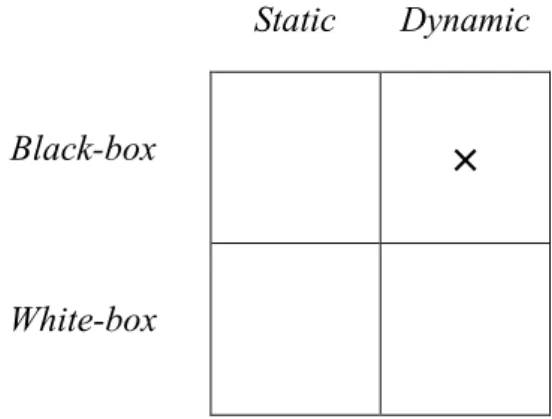
Software testing techniques have been categorised on the basis of their contrasting fundamental approaches: static vs. dynamic testing, and black-box vs. white-box testing (Lewis, 2009). In static testing, the software specification and/or program code is examined for faults without executing the program; while in dynamic testing, faults are revealed by running the program on a computer and observing its behaviour. In black-box testing, test cases are based on the functional and other specified requirements of the software without considering the details of the program code; while in white-box testing, test cases are based on knowledge of the program code and design (Beizer, 1990; Utting & Legeard, 2007). These fundamental approaches to software testing suggest categories of software testing techniques, represented as a quadrant diagram in Figure 1.
Static Dynamic
Black-box
×
White-box
Figure 1: Fundamental approaches to software testing
Each of the four quadrants in Figure 1 may be considered an important area of software testing research in its own right, for example the upper left-hand quadrant in Figure 1 can be characterised as static black-box testing in which the functional and other specified requirements of the software are examined without executing the program.
However, the focus of the present research falls within the upper right-hand quadrant marked as an X in Figure 1, characterised as dynamic black-box testing. Within the category of dynamic black-box testing, two further contrasting fundamental approaches can be identified: positive testing vs. negative testing. Positive testing employs only valid input values in order to demonstrate that software conforms to its specification (conformance testing), whereas negative testing employs invalid input values (or a mixture of valid and invalid values) to test software robustness; software testing will generally include both positive and negative testing (Beizer, 1990; Utting & Legeard, 2007).
1.2.2 Component-Based Software Engineering
The goal of component-based software engineering is to build software systems by the composition of pre-existing software components; this is expected to lead to improvements in software reliability and reduced cost, especially with the advent of commercial off-the-shelf (COTS) components (Gao, Tsao & Wu, 2003).
It is usual to test software components both individually before composition and afterwards as an integrated system (Bhor, 2001) because software systems may exhibit emergent behaviour that cannot be predicted by considering the components in isolation (Johnson, 2006).
A necessary corollary of the goal of component-based software engineering is to be able to predict the properties of the assembled system, and for this it is first necessary to characterise the properties of the individual components (Hamlet, Mason & Woit, 1999). Firesmith (2005) gives the following quality factors for software components: ‘capacity, correctness, dependability, interoperability, performance, and utility’; dependability is itself composed of the quality factors availability, defensibility, reliability, and robustness, while defensibility is in turn composed of the quality factors safety, security, and survivability. Since stochastic testing can be used to characterise the reliability and robustness of software components, these properties are investigated in the present research.
1.2.3 Software Component Reliability
Reliability has been defined as “the ability of a software component to perform its required functions under stated conditions for a specified period of time, or for a specified number of operations” (IEEE, 1991).
In principle, software component reliability might be determined by the use of statistical testing, that is random testing with a probability distribution (‘operational profile’) based on the expected use of the component in operation (Musa, 1993; Koziolek, 2005). In practice, an operational profile is difficult to define for a software component, because all the possible ways in which the component might be used are unknown, and measures of software reliability using operational profiles are open to criticism (Hamlet, 1994). However, components might be compared on the basis of their measured reliability for a specified test profile as one factor of design trade-off in component-based software engineering (Hamlet, Mason & Woit, 1999).
1.2.4 Reliability Measures
Pan (1999-a) has remarked: “Measuring software reliability remains a difficult problem because we don't have a good understanding of the nature of software. There is no clear definition to what aspects are related to software reliability. We can not find a suitable way to measure software reliability, and most of the aspects related to software reliability.” A further difficulty is that measures of software reliability depend on the operational profile used, so that testing with a different operational profile is likely to result in a different value for measured reliability (Whittaker & Voas, 2000). Nevertheless, reliability measures originally derived from theories of hardware reliability have been applied to software reliability (Fenton & Pfleeger, 1997).
A commonly used measure of software reliability is the Mean Time To Failure (MTTF); MTTF is a statistical measure defined as “the expected time that a system will operate before the first failure occurs” (Storey, 1996).
An equivalent measure of software reliability is failure rate, denoted by λ and defined as
“failures per unit time or per number of transactions” (IEEE, 1991); for a constant failure rate λ then MTTF = 1/λ (Storey, 1996).
In software testing, an alternative measure to MTTF is the F-measure defined as “the number of test cases required to detect the first program failure”. The F-measure can be shown to be equivalent to MTTF (Chen, Kuo & Merkel, 2004).
Other measures of software reliability include the Mean Time Between Failures (MTBF) defined as “the expected or observed time between consecutive failures in a system or component” and availability A defined as “the degree to which a system or component is operational and accessible when required for use” (IEEE, 1991).
The Mean Time To Repair (MTTR) is defined as “the expected or observed time required to recover a system or component and return it to normal operation” (IEEE, 1991). The MTTR is also known as the Mean Time To Recovery (Kyne, et al. 2010). By definition, MTBF = MTTF + MTTR and A = MTTF / MTBF (Teorey & Ng, 1998). The reliability measures MTBF and availability are not used in the present research, since these depend on the MTTR and this is not a factor in the experiments.
In the present research, the F-measure during stochastic testing with a ‘positive’ profile containing only valid input values will be recorded, and it is argued that this provides a comparative measure of software component reliability.
1.2.5 Software Component Robustness
IEEE (1991) defines robustness as “the degree to which a component or system can function correctly in the presence of invalid inputs or stressful environmental conditions.” From this definition it can be inferred that robustness testing is negative
testing, employing only invalid input values (or a mixture of valid and invalid input values) (Varpiola & Takanen, 2008).
One approach to the generation of negative test cases is by ‘mutation’ of positive test cases (data mutation) as described by BS 7925-2 (2001) and Shan & Zhu (2006, 2007) and this is the approach taken in the present research.
Robustness testing is generally not concerned with the correctness of the software (comparison with the expected result) but with ‘terminal’ failures such as a software crash or hang; robustness testing therefore does not require a sophisticated test oracle, beyond the general principle that the software should not crash or hang (Koopman, et al. 2002).
In the present research, the F-measure during stochastic testing with a ‘negative’ profile containing only invalid input values (or a mixture of valid and invalid values) will be recorded, and it is argued that this provides a comparative measure of software component robustness.
1.2.6 Dependability
Reliability and robustness are subsumed in the more general concept of dependability, as discussed by Avizienis, Laprie & Randell (2004), Firesmith (2005) and Koziolek (2005).
Vieira & Madeira (2009) define a dependability benchmark as “a specification of a standard procedure to measure both the dependability and performance of computer systems or components”. Several authors have discussed software dependability benchmarks; Madeira, et al. (2002) present a framework for dependability benchmarks and give examples including general purpose operating systems, on-line transaction processing systems, and embedded systems.
Such dependability benchmarks might be used as a basis for comparison of software components.
1.2.7 Stochastic Testing
Stochastic testing is a software testing technique that employs an extended random sequence of test cases to exercise the software under test; stochastic testing is expected to be an effective testing technique for software reliability and robustness (Mao & Lu, 2005).
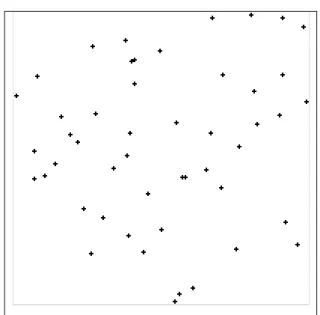
Stochastic testing effectively traces a path between random points in the ‘test space’ of input value and software state; this is illustrated by a two-dimensional scatter diagram of random points with axes of software state and input value in Figure 2. The diagram in Figure 2 was generated using a computer program written by the author.
Input Value
Software State
Figure 2: Random data points in the test space
Stochastic testing is important for the present research because an extended sequence of test cases does not continually reset the software state, unlike the conventional approach
to software testing with test ‘setup’ and ‘cleanup’ steps. Stochastic testing allows software errors to propagate beyond a single test case and is therefore a good candidate as a testing technique for delayed failure.
1.3
Terminology
This section gives definitions of special technical terms used in this thesis: fault, failure, error, error propagation, and latency. Definitions of general software testing terminology can be found in the following standard references:
BS 7925-1 (2004) Glossary of Software Testing Terms IEEE (1991) Standard Computer Dictionary 610
ISTQB (2007) Standard Glossary of Terms used in Software Testing.
1.3.1 Fault, Failure, and Error
Prasad, McDermid & Wand (1996) have noted that the terms fault, failure, and error are not used consistently in the software engineering literature. The following definitions are adapted from software testing terminology in the standard references, and will be used throughout this thesis:
Fault Deviation of program code from its intended design, or a mistake in the component design; a fault is also known as a defect or a bug.
Failure Deviation of software component behaviour from its specification, where a specification is defined as “a description of a component's function in terms of its output values for specified input values under specified preconditions” (BS 7925-1, 2004).
Error An incorrect software state; a state that was not intended by the designers of the component.
1.3.2 Error Propagation and Latency
Yim, Kalbarczyk & Iyer (2009) introduce the following terms in the context of a model of error propagation and latency, as shown in Figure 3.
Activation A fault is dormant until it is activated and causes an error. Activation may occur for example due to execution of program code that contains a fault.
Propagation An error is latent until it causes a failure. An error may be transformed into other errors in a chain of error propagation until a failure occurs. Latency Fault activation latency is the period between the start of software
execution and fault activation. Error propagation latency is the period between fault activation and failure.
Fault → Error → Failure
Fault Activation Latency
Error Propagation Latency
Figure 3: Error propagation and latency
1.4
Motivation
The author worked as a software test engineer in the telecoms industry from 1987 to 2004. The motivation for the present research originated in the author’s (unpublished) experience of high-volume automated testing and model-based testing (MBT) between 1997 and 1999.
This section describes a fundamental problem encountered in software testing, how this problem led to the idea of using a stateless request-response model in software testing, and how this model in turn led to the idea of delayed failure of software.
1.4.1 A Fundamental Problem in Software Testing
A fundamental problem encountered in software testing is the ‘coverage problem’ – the location of software faults in the test space is unknown, and the region of the test space covered in testing may or may not overlap the region of the test space containing faults, as illustrated by Slutz (1998). This problem can be paraphrased as, ‘how to do sufficient testing?’ given that “complete testing is impossible” Kaner (1997).
In the author’s experience, manual test case design was found to be too slow to allow a sufficiently large testing space to be covered with reasonable time and effort, and so an attempt was made to address this problem by using high volume automated testing to vastly increase the covered region of the test space.
1.4.2 High Volume Automated Testing
Automated software-testing tools can perform automatic test execution and automated comparison of results, and these tools can increase testing speed and reduce testing errors; however, even with automatic test execution, manual generation of test cases places a serious limitation on the volume of tests that can be executed. High volume automated testing (HVAT) addresses this problem by the automatic generation and execution of very large numbers of test cases (Kaner, Bond & McGee, 2003).
With HVAT, either deterministic or randomly generated test cases are produced automatically from a specification or model of the SUT, by the use of suitable software tools. For automated test execution, automatic comparison of test results with the expected outputs is performed, and so automatic generation of expected outputs by a ‘test oracle’ is required. Since the output response from the SUT generally depends on both the input request and on the state of the software, the test oracle must include a
the creation and maintenance of a state-based automated test oracle with reasonable time and effort was a problem, and a simpler approach was sought; a ‘stateless request-response’ model of the SUT was devised in response to this problem.
1.4.3 Stateless Request-Response Model
A common model of communication between software components is the request-response, or client-server model as described by Martin-Flatin (2005) and shown in Figure 4. In this communication model, a client sends a request to a server, and the server sends back a response containing the requested information.
Client Request → Response ← Server
Figure 4: Client-server model
In the stateless request-response model devised by the author, the SUT is regarded as a ‘black box’ that regardless of its internal state, should either accept a valid input request, or reject an invalid input request. For any given input request, it should be possible to determine from the software specification if this is a valid request that should be accepted, or if this is an invalid request that should be rejected. This stateless request-response model provided the basis of a simplified automatic test oracle. With this oracle, a failure of the SUT should be detected if a valid input request is rejected, or if an invalid input request is accepted (or if no output response is returned at all, as in the case of a crash or hang of the SUT) regardless of the software state.
1.4.4 Delayed Failure
Despite the more limited ability to detect failures, compared to a state-based oracle, in the author’s experience the stateless request-response model provided a cost effective
approach, complementary to manual testing; however, this approach raised the question of what was the resulting state of the SUT, if an invalid input request was accepted. The present research into delayed failure of software components was motivated by the following questions: If the SUT continues to correctly process subsequent input requests after accepting an invalid input request, can it be relied upon to continue to operate correctly? Might it fail unpredictably some time later, due to being left in an incorrect, but non-observable state?
These questions immediately suggested the further idea, that delayed failure might potentially also occur when processing valid input requests, leading to ‘invalid’ and ‘valid’ instances of delayed failure, and furthermore it seemed likely from the author’s experience that delayed failures might not be detected by the ‘conventional’ approach to software testing.
1.4.5 The Conventional Approach To Software Testing
The conventional approach to software testing (whether manual or automated) is to include ‘setup’ and ‘cleanup’ steps in test cases, so that the test cases are executed independently and with predictable results. This avoids the need for a complex state-based test oracle, and keeps test traces short and hence easier to investigate following a test failure (see ‘identifying failing input requests’ in Chapter 2); a test trace is a history of requests and responses during the execution of a test case.
Typical steps in a conventional test case are (Haftmann, Kossmann & Lo, 2007): 1. Test setup (initial software state for test)
2. Test execution (request-response sequence) 3. Test cleanup (undo changes to software state)
However, this approach prevents software errors from propagating beyond a single test case (Nyman, 2000) and so this approach is unlikely to reveal delayed failures that
result from long-latency error propagation; faults that cause delayed failures might therefore avoid detection and remain in released software, resulting in lower reliability and robustness.
1.5
Delayed Failure
A delayed failure is a failure that occurs some time after the condition that causes the failure. Delayed failure in a software component can be a result of long-latency error propagation. As well as delayed software failure, the phenomenon of delayed failure is also known from failure delay systems and the delayed failure of brittle materials in materials science.
1.5.1 Failure Delay Systems
The ubiquitous presence of software in the modern world, and the potentially insidious nature of software faults, was recently impressed on the author, on being unable to start his car and discovering the battery to be flat. It turned out that the Multiplex Integrated Control Unit (MICU) of the vehicle was failing to enter a ‘sleep mode’ after the ignition was switched off, resulting in a parasitic battery drain that would flatten the battery if the car was left standing for a sufficiently long period. According to the manufacturer, the fault was caused by a software error and the MICU was replaced. The operation of the MICU is described in United States Patent Application 20100082198, ‘Vehicle Load Control Device’.
An interesting feature of this failure is that, although the MICU entered an incorrect state shortly after the ignition was switched off, the car only failed to start if left standing for several hours. A general class of systems where failure does not occur immediately, but only after a delay are known as failure delay systems. These have been studied by Limnios (1988), who states that a characteristic of these systems is that failure occurs if and only if the conditions for failure are maintained for a sufficient time. Limnios (1988) gives the example of a water reservoir fed by a pump; if the pump stops working, the flow of water from the reservoir does not fail, provided the pump is
restarted before the reservoir is empty. However, if the pump stops working for a sufficiently long time, then the flow of water from the reservoir will fail.
The failure of the vehicle MICU is an example of a failure delay system involving a software component, although not a delayed failure of software, as such.
1.5.2 Delayed Software Failure
Although the existence of delayed failure in software was reported as early as 1971 (Pyle, McLatchie & Grandage) a review of the software engineering literature has found few systematic studies of delayed software failure. There are a small number of studies of error propagation, such as that of Yim, Kalbarczyk & Iyer (2009), however these are not linked to software testing techniques.
There are several possible reasons why delayed failure of software during testing might not have been recognised as important; first, because of the use of ‘setup’ and ‘cleanup’ in test cases, conventional software testing is unlikely to detect delayed failures. Second, any delayed failures found in testing could be difficult to recreate for debugging and so might simply be ignored as ‘irreproducible’. Third, if the delay is sufficiently long then another type of software failure may occur before the delayed failure, thus ‘masking’ the delayed failure.
1.5.3 Delayed Failure of Brittle Materials
Delayed failure (‘static fatigue’) of brittle materials such as ceramics, glass, and steel is well known and has been extensively reported in the literature of materials science, for example: Fischer-Cripps (2007) “Depending on environmental conditions, brittle solids may exhibit time-delayed failure, where fracture may occur some time after the initial application of load”. This behaviour has been studied for a considerable time, as noted by Fuller, Luecke & Freiman (2001) “As early as the 1920s, the strength of glass and other brittle materials was understood to be limited by the presence of small cracks. Under stress, the small cracks would grow into larger cracks until reaching a critical
Software systems have, indeed sometimes been called ‘brittle’ by analogy with the failure behaviour of brittle materials; Forsberg, Mooz & Cotterman (2005) “The inability of software to deal with unexpected inputs is sometimes referred to as brittleness” while Bellovin (2006) discusses the ‘brittleness’ of software in the context of software security.
Bush, Hershey & Vosburgh (2000) have attempted to construct a theory of brittle systems based on this analogy: “This behaviour is characterized by a sudden and steep decline in performance as the system state changes. This can be due to input parameters which exceed a specified input, or environmental conditions which exceed specified operating boundaries”. A theory of delayed failure of software by analogy with delayed failure of materials, with error propagation in software playing the role of crack propagation in materials, might be interesting, however this is beyond the scope of the present research.
1.6
Research Problem
This section states the research problem and explains why investigation of this problem is worthwhile; and discusses an alternative approach to that taken in the present research, the technique of ‘extended random regression’ (ERR).
1.6.1 Problem Statement
The research problem: Faults that cause delayed failures are likely to avoid detection by the conventional approach to software testing and remain in released software, resulting in lower reliability and robustness (than if they had been removed). Little is known from the software engineering literature of the failure delay characteristics and failure delay mechanisms of software components, of effective testing techniques for revealing delayed failure, or of the effect of delayed failure on software component reliability and robustness.
1.6.2 Why Investigation of this Problem Is Worthwhile
The argument was put forward in the ‘Motivation’ section of this chapter that the conventional approach to software testing is unlikely to detect faults that cause delayed failures, because this approach prevents software errors from propagating beyond a single test case. If this is correct then these faults are likely to remain in released software after testing, provided no additional testing techniques (such as stochastic testing) are employed. There is some evidence that testing techniques that could reveal this type of fault have only recently begun to be more widely employed, for example, tools supporting random testing of DBMS such as MySQL and Oracle (Stoev, 2009; Naraine, 2009). Indeed, the present research provides examples of faults resulting in delayed failure that have been found in released versions of commercial software components using stochastic testing.
To the extent that delayed failure affects software reliability and robustness, these faults can be expected to result in lower reliability and robustness of released software, than if they had been removed. Limnios (1988) describes reliability modelling of failure delay systems, however, there appear to be few systematic studies of delayed failure in the software engineering literature, and the effect of delayed failure on software component reliability and robustness does not appear to be well understood.
It is known that long test traces present difficulty in debugging (Zeller & Hildebrandt, 2002) and so faults resulting in delayed failure after software release can be expected to be particularly costly to identify and fix. Better understanding of testing techniques that effectively and efficiently reveal delayed failure should contribute to improved reliability and robustness, and reduced cost of software components.
1.6.3 Extended Random Regression
Kaner, Bond & McGee (2003) present a case study of ‘extended random regression’ (ERR) a HVAT approach that addresses the oracle problem by choosing a large collection of existing tests that the SUT has already passed, and re-executing these in a
random order. Although the tests are designed to be independent of one another, test execution may have unintentional side effects that change the software state; the order of execution of tests affects the outcome of the test run and some tests in the run may fail. The success of extended random regression as a test technique suggests that conventionally written software tests do in fact have an ability to detect some faults that cause delayed failures, provided tests are run multiple times in long random sequences, however this is not the conventional way of executing tests, which are usually executed in a fixed order.
Berndt & Watkins (2005) give examples of complex, distributed system failures in which long sequence testing might have been effective; failures of the Patriot Missile System, London Ambulance Service, Railway Switching in Germany, Kaner’s (1997) example of a phone system, and the NASA Mars Rovers.
1.7
Experimental Studies of DBMS
The motivation behind the present research was to study delayed failure of software components in general; however, a concrete example of a software component must be chosen as the focus for experimental study, and DBMS were identified as a suitable choice of subject. The present research therefore includes a contribution to the experimental study of DBMS and DBMS testing techniques. There is a growing literature in this area since the work of Slutz (1998) and Costa & Madeira (1999). The choice of DBMS as the subject for experimental study clearly influences the research methodology experimental procedures, and the domain of validity of the conclusions that can be drawn.
Experimental studies of DBMS fall within the relatively new field of experimental software engineering, exemplified by Basili (1996).
This section discusses the choice of DBMS as a subject of study, then introduces DBMS and SQL and the chosen DBMS components MySQL and Oracle XE, and finally describes the experimental approach adopted in the present research.
1.7.1 Choice of DBMS as a Subject of Study
In considering an experimental investigation of delayed failure of software components, the choice of DBMS as a subject of study was guided by the following criteria:
1. There is a perceived gap between academic research into software testing and industrial software testing practice (Reid, et al., 1999) therefore the chosen component should be a real software product, ideally in widespread commercial and industrial use. DBMS meet this criterion and MySQL and Oracle XE were chosen as being representative examples of commercial, off-the-shelf (COTS) DBMS products.
2. The chosen component should be a ‘stable’ production software release, having presumably passed the component supplier’s quality control and release test process. Although precise details of the suppliers’ test process are not known, they may be assumed to represent a baseline ‘industry standard’ practice. If the research method reveals faults that were not removed during release testing then it might be the case that the ‘industry standard’ testing process is not as effective at revealing these faults. MySQL and Oracle DBMS have documented release histories extending over several years, and in the case of MySQL there is a public ‘bugs database’ containing a detailed history of known faults and bug fixes and details of test suites.
3. The chosen component should be freely and easily available to researchers to allow replication of the research. The MySQL and Oracle XE DBMS may be downloaded from the suppliers’ websites free of charge under appropriate licensing terms.
4. The specification of the chosen component should be freely and easily available. This is necessary in order to be able to specify test cases for the component. Both MySQL and Oracle XE have extensive documentation, both downloaded from the suppliers’ websites and in published textbooks, and there is an international standard for SQL (ISO/IEC 9075, 2008). In the case of MySQL, program code is freely available as Open Source.
5. The chosen component should have an easily accessible and well-documented interface allowing automated testing. The Perl database interface (DBI) is freely available and supports both the MySQL and Oracle DBMS. Furthermore, the author already had some previous experience of using the Perl database interface for MySQL. 6. For the present research, the chosen component must conform to the ‘stateless request-response model’ of the conceptual framework described in Chapter 3. DBMS architecture typically follows a request-response model (Date, 2004) and any SQL request can be determined to be syntactically valid or invalid, regardless of the database state, by reference to the DBMS specification, such as the MySQL 5.0 Reference Manual (2010) or the Oracle® Database SQL Reference (2005).
7. The chosen component should be the subject of related work in the software engineering literature. Experimental studies of DBMS and DBMS testing are active areas of current research as discussed in Chapter 2; for example Slutz (1998), Haritsa (2006), Tuya, Suárez-Cabal & de la Riva (2006), Finnigan (2009), Garcia (2009), Naraine (2009), Stoev (2009), Khalek & Khurshid (2010).
8. The state of a DBMS is a combination of the software state and the database state. Although the software state of a component cannot usually be observed, in the case of a DBMS the content of database tables may be examined using the SQL statements SHOW TABLES, SHOW COLUMNS table and SELECT * FROM table thus providing some partial information about the DBMS state.
1.7.2 Introduction to DBMS and SQL
An introduction to DBMS and DBMS architecture can be found in Date (2004); a block diagram of a typical DBMS architecture is shown in Figure 5. Typically this architecture follows the request-response model described in Chapter 1 as shown in Figure 4. The client sends a request to the DBMS, which causes a database operation to be requested. The database returns a response to the DBMS with the result of the operation and the DBMS finally returns a result to the client. The DBMS typically
manages transactions composed of sequences of database operations and provides the capability to ‘roll back’ transactions in the event of detecting an error (Greenwald, Stackowiak & Stern, 2004; Vaswani 2004).
Client
↓ ↑
DBMS
↓ ↑
Database
Figure 5: Block diagram of DBMS architecture
The database holds logically organised data; in the case of a relational database, the data is organised as a collection of tables. SQL (structured query language) provides a syntax and semantics for communication between the client and the DBMS and has facilities for creating, reading, updating, and deleting database tables. An introduction to SQL can be found in Date (2004) and in Greenwald, Stackowiak & Stern (2004). The SQL international standard is ISO/IEC 9075 (2008), however both MySQL and Oracle offer a core sub-set of the earlier 2003 version of this standard, along with proprietary extensions.
1.7.3 MySQL
MySQL is a freely available Open Source relational DBMS that provides storage and management of data held in tables using SQL. Oracle Corporation acquired Sun Microsystems in 2010 and so acquired ownership of MySQL.
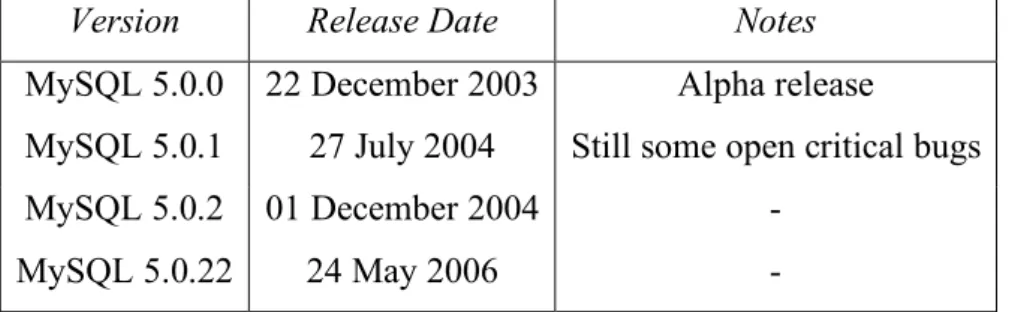
MySQL 5.0 release history from the MySQL 5.0 Reference Manual (2010) is shown in Table 1. MySQL 5.0.1 was released in 2004 (still with some open critical bugs) however the version of MySQL under test (5.0.22) was released in 2006 as a stable production version.
Version Release Date Notes MySQL 5.0.0 22 December 2003 Alpha release
MySQL 5.0.1 27 July 2004 Still some open critical bugs
MySQL 5.0.2 01 December 2004 -
MySQL 5.0.22 24 May 2006 -
Table 1: MySQL 5.0 release history
A technical guide to MySQL can be found in Vaswani (2004); MySQL provides a well-documented programming interface through the Perl database interface (DBI) as described in the MySQL Administrator’s Guide (2004), the MySQL 5.0 Reference Manual (2010) and by Robert (2010).
The MySQL database server returns either error responses or success responses to the client. The error responses syntax error and empty query do not depend on the DBMS state. Other error responses and success responses are dependent on the software state or the database state; an SQL statement may be accepted (stateless behaviour) even though it does not succeed (state-based behaviour). The MySQL client-server protocol is described in the MySQL Internals Manual (2005). Schumacher (2005) describes the handling of invalid inputs in MySQL 5.0.
1.7.4 Oracle XE
Oracle Database 10g Express Edition (Oracle XE) is a free ‘starter’ edition of Oracle 10g based on Oracle Database 10g Release 2, but limited to running on a single processor with up to 1 GB of RAM and 4 GB of user data as described in the Oracle® Database Express Edition Installation Guide (2007). The beta version was released in
2005. All of the Oracle Database 10g product family are based on the same database engine architecture as described in Greenwald, Stackowiak & Stern (2004).
A programming interface for Oracle Database is available through the Perl database interface (DBI) as described by Robert (2010).
Oracle’s programming language extension to SQL is called PL/SQL and is described in the Oracle® Database SQL Reference (2005) and by Murray (2008).
1.7.5 Experimental Approach
The experimental approach taken in the present research investigates the reliability, robustness and delayed failure characteristics of software components by comparing measures made on two DBMS using two stochastic testing techniques. Both testing techniques execute randomly generated SQL against a random database.
Positive tests for reliability comparison are performed using randomly generated syntactically valid SQL in an approach similar to that of Slutz (1998). Negative tests for robustness comparisons are performed using randomly generated invalid SQL produced by SQL mutation. This approach applies for DBMS the concept of testing with ‘hostile data streams’ as described by Jorgensen (2002). The experimental approach for determining F-measure and failure delay is based on an analysis of the state transition model of error propagation and failure, described in Chapter 3.
The experimental approach takes account of frameworks and guidelines for empirical studies of test techniques, based on a review of the literature of experimental software engineering presented in Chapter 2. Some of the methodological challenges encountered with the experimental approach were differences in SQL syntax between MySQL and Oracle XE, the need for automatically separating valid and invalid SQL statements following SQL mutation, and reproducibility of failures, as described in Chapter 5.
1.8
Key Elements and Focus of the Research
This section describes the key elements, and focus, of the research.
1.8.1 Key Elements of the Research
The key elements of the present research are:
a) Software component testing and delayed failure. The research problem arises from considering software component testing in the context of delayed failure. The investigation of the research problem should demonstrate an effective test method for revealing delayed failure of software components.
b) Reliability and robustness of software components. Reliability and robustness are important quality factors for software components and so these are interesting in the context of delayed failure.
c) Stochastic testing. Stochastic testing is likely to be an effective method for revealing delayed failure as well as a suitable technique for reliability and robustness testing of software components.
d) Experimental studies of DBMS. The MySQL and Oracle XE DBMS were selected as suitable subjects of study for an experimental approach to the research problem.
e) The conceptual framework. The conceptual framework described in Chapter 3 provides a context for the experimental approach and a model of delayed software failure that can be validated by experiment.
1.8.2 Research Focus
A Venn diagram as shown in Figure 6 may be helpful in illustrating the focus of the present research. This diagram shows the focus of the present research marked as an X at the overlap of fours areas: delayed failure, DBMS research, stochastic testing, and experimental software engineering. Venn diagram image is from Wikimedia Commons.
Figure 6: Research focus
1.9
Contributions to Knowledge
This section briefly summarise the contributions to knowledge of the present research. A full summary of contributions appears in Chapter 9.
Delayed Failure DBMS Stochastic Testing Experimental Software Engineering
×
a) That delayed failure is an important failure mode of software components. b) That the conventional approach to software testing is unlikely to detect delayed
failure.
c) A methodology for benchmarking software component dependability.
d) That stochastic testing is an effective technique for revealing delayed failure. e) Corroboration of related work in DBMS testing using random generation of
SQL.
f) A state transition model of delayed failure in software components.
g) That the research problem can be solved, at least for the components considered in the study.
1.10
Thesis Structure
This section gives a brief summary of each chapter of the thesis.
Chapter 1. INTRODUCTION
This chapter presents an introduction to software component testing and terminology, the motivation for the present research, an introduction to delayed failure, the research problem, experimental studies of DBMS, key elements and focus of the research, the contributions to knowledge, and lastly the structure of the thesis.
Chapter 2. LITERATURE REVIEW
This chapter presents a review of the software engineering literature in the areas of software component testing techniques, software component reliability, software component robustness, stochastic testing, alternative approaches to stochastic testing, experimental studies of DBMS, and delayed failure.
Chapter 3. CONCEPTUAL FRAMEWORK
This chapter presents the simple stateless request-response model and a refinement of this model developed during the present research – the partitioned request-response model; along with the state transition model of error propagation and failure, the Markov chain model, and the process of delayed failure.
Chapter 4. RESEARCH QUESTION AND HYPOTHESES
This chapter presents a statement of the research question, the research hypotheses H1 and H2 together with the associated null hypotheses, calculations of expected values of F-measure and failure delay using the Markov chain model, and why answering this question is worthwhile.
Chapter 5. METHODOLOGY AND EXPERIMENTAL PROCEDURE
This chapter first presents the research goals, a generic procedure for testing the hypotheses, the experimental design, experimental configurations, methods for random generation of SQL and SQL mutation, DBMS initialisation, database creation, and the method for identifying minimal test sequences. This chapter then presents the procedures to be followed in the 1st experiment - MySQL (invalid and valid SQL) and the 2nd experiment - Oracle XE (valid SQL), and discusses methodological challenges, experimental questions, and data analysis.
Chapter 6. RESULTS
This chapter presents results for the 1st experiment using MySQL with invalid and valid SQL, MySQL bugs found during the experiment, and results for the 2nd experiment using Oracle XE with valid SQL.
Chapter 7. ANALYSIS
This chapter presents an analysis of the experimental results. This analysis looks for differences between experimental profiles P1 and P2 with the same SUT and for differences between SUT S1 and S2 with the same experimental profile, as well as considering the accuracy of the response profile regression analysis and the statistical distribution of the results.
Chapter 8. DISCUSSION
This chapter presents a discussion of the present research within the context of stochastic testing, SQL mutation, experimental studies of DBMS, fault detection effectiveness and efficiency, the conceptual framework, delayed failure, the research problem, and threats to validity.