Abstract— In this work, intervention theoretic model technique was employed to assess the performance of Federal Government of Nigeria in road traffic casualty (injury and death) reduction through the institution of Federal Road Safety Corps, FRSC. Time series intervention model was used to analyze 55 -year (1960-2014) road traffic casualties in Nigeria. It was observed that a combination of Autoregressive Integrated Moving Average model, ARIMA 0,1,0, and first order type of intervention function amply captured the pattern of road traffic casualties in Nigeria. From the result obtained the multiple policy intervention measures introduced by Road Safety agencies are effective in whittling down road traffic casualties in Nigeria.
Index Terms — Intervention theoretic model, Road traffic casualties, ARIMA, FRSC
I. INTRODUCTION
Road traffic accidents have resulted in the loss of lives, untold injuries and unaccounted loss of goods in Nigeria. In Nigeria, an effort had been made to evaluate road traffic accident situations using various statistical methods. However, little work has been done in assessing the performance and efforts of Federal Government of Nigeria in road traffic casualty reduction. Available studies that had
Manuscript received May 15, 2017; revised June 19, 2017.
Benjamin Ufuoma Oreko is with Department of Mechanical Engineering, Federal University of Petroleum Resources Effurun, Delta State, Nigeria (corresponding author phone number: 08036785421; e-mail: [email protected]).
Stanley Okiy is with the Department of Welding Engineering and Offshore Technology, Petroleum Training Institute, Effurun, Delta State, Nigeria (e-mail: [email protected]).
been carried out in Nigeria employing mathematical models on road traffic accident situations were either limited to towns, States or the entire country with a limited number of years [1, 2, 3, 4, 5, 6]. Although [7] applied intervention model in assessing the impact of FRSC on road traffic accident occurrences, their work was limited to the Edo State of Nigeria for a period of 5 years (1994-2000). The result from their study indicated that road traffic accidents in that area were on the decreasing trends. However, their works in part may not reflect well on road traffic casualties in Nigeria and the effort of Federal Government of Nigeria in whittling down road traffic casualties. Hence, this work intended to develop a mathematical model capable of assessing the intervention of Federal Government of Nigeria through the institution of Federal Road Safety Corps, FRSC in the reduction of road traffic casualties (injuries and deaths) in Nigeria.
II. METHOD A. Research Design
The main focus of this research was to develop a model capable of evaluating and assessing the impact of intervention measures implemented by Federal Road Safety Corps (FRSC) and other safety agencies on road traffic casualty reduction in Nigeria. Intervention Model was developed and fitted to road traffic casualties (injuries and deaths) in Nigeria. SPSS 16.0 version and Excel 2010 software were used for the analysis. Also, C++ software program was used to developed code to compute the intervention model response. A statistical test was done to confirm the adequacy of the ARIMA models. Also, the sampling unit is geographical, involving the 36 State
An Intervention Theoretic Modelling
Approach on the Performance Assessment of
Federal Road Safety Corps in Road Traffic
Casualty Reduction in Nigeria
structures and the Federal capital, Abuja, Nigeria. The technique adopted in this research is the non-experimental research design concept. This concept deals mainly on data collections. A Fifty- five (55) year road traffic casualty data (1960 to 2014) were collected from the Department of Planning, Research and Statistics, Federal Road Safety Corps Headquarters, Abuja [8]. This agency, apart from the obligation to prevent or reduce road traffic accident occurrences in Nigeria, it is also saddled with the responsibility of recording and keeping data observed from the scene of road traffic accidents [9].
B. Method of Data Analysis and Model Employed Tables, scatter plots, autocorrelation functions (ACFs) and partial autocorrelation functions (PACFs) were employed in the analysis of data in order to determine the pattern, trends and other statistical features for robust model building methods. In this work, we employed intervention model technique of [10] in assessing the impact of FRSC in minimizing road traffic casualties in Nigeria. Generally, intervention model constitutes two main components namely, an intervention function, f(It) and an Autoregressive Integrated Moving Average (ARIMA) model, Nt as stated in [10]. Mathematically, the First-Order Intervention model, according to [10, 11] could be expressed as;
(1) and it consists of the following components;
(a) Gradual and permanent impact- which could be expressed as,
= + It (2)
(b) Abrupt and Temporary impact - which could be expressed as,
= + It (3) where, f(It) = The intervention function; Nt = ARIMA and
It = (4)
According to [10], ARIMA components model in equation (5), (6) and (7) could be combined to obtain other components of the ARIMA models.
i. ARIMA (1,0,0) or AR(1) model could be expressed as; (5)
where, are constant and coefficients, respectively chosen to minimize the sum of squared errors;
= bound of stationarity;
= Actual values; previous values; = residual errors
ii. ARIMA (0,1,0) could be expressed as (6) iii. ARIMA (0, 0, 1) could be expressed as
(7)
C. Basis for Model Selection
In this work, ARIMA models were analyzed. An attempt was made to consider Bayesian Information Criterion (BIC), as the first criteria (performance measures) in selecting the best ARIMA model that would be employed in forecasting road traffic casualties. Whenever ties exist in BIC, the Coefficient of determination (R2), Root Mean Squared Error (RMSE) and Mean absolute percentage error (MAPE) would be considered sequentially in the model fit selection.
D. Pre-Intervention Analysis
To model the impact of FRSC, other safety agencies and government policies (interventions), it is imperative to model the time series data of road traffic casualties when there was no established institution to intervene in road traffic casualties (interventions). Here, we assumed that prior to the establishment of FRSC, there were no well-coordinated governmental agencies saddled with the responsibility of reducing road traffic accidents to the barest minimum, thus resulting to little effect or impact that could be neglected. This required that we model the pre-intervention period which exists as ARIMA noise, Nt in the equation (1). Hence, the pre-intervention period for road traffic casualties in Nigeria was computed from 1960 to 1987, before the establishment of FRSC in 1988.
III. RESULTS AND DISCUSSIONS
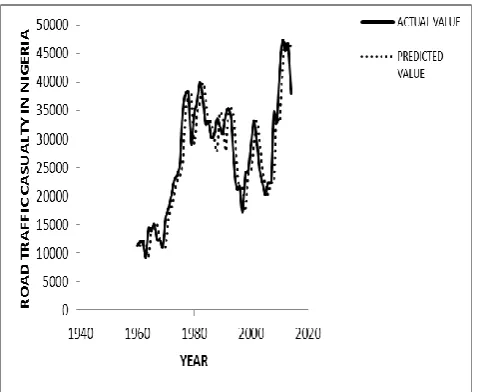
noticeable in 1988, which shows an irregular decreasing and increasing pattern from 1988 to 2014 in figure 2. In order to determine whether there was an existence of ARIMA components, autoregression functions, and partial autoregression functions were evaluated and plotted in Figures 3 and 4, respectively. The plots indicated an existence of ARIMA components model. The result of model adequacy for the various components of ARIMA models was tabulated in Table 1.
Table1 Model Adequacy of ARIMA Components
Road Traffic
Casualty Model
BIC R2 RMSE MAP
E
ARIMA (0,0,0)1 17.261 0.784 4.970x10³ 17.423
ARIMA (1,0,0)1 16.637 0.901 3.430x10³ 11.665
ARIMA (0,1,0)1 16.901 0.890 3.663x10³ 12.443
ARIMA (1,1,0)1 16.772 0.886 3.652x10³ 12.190
ARIMA (1,1,1)1 16.901 0.890 3.663x10³ 12.443
ARIMA (0,1,1)1 16.772 0.886 3.652x10³ 12.189
ARIMA (0,0,1)1 16.929 0.868 3.968x10³ 14.135
ARIMA (1,0,1)1 16.780 0.903 3.470x10³ 11.746
ARIMA (1,0,0) 16.893 0.851 4.135x10³ 15.021
ARIMA (0,1,0) 16.460 0.885 3.529x10³ 11.666
ARIMA (1,1,0) 16.621 0.885 3.598x10³ 11.623
ARIMA (1,1,1) 16.747 0.889 3.598x10³ 11.623
ARIMA (0,1,1) 16.621 0.885 3.598x10³ 11.623
ARIMA (0,0,1) 17.948 0.571 7.009x10³ 31.405
ARIMA (1,0,1) 17.047 0.851 4.209x10³ 15.068
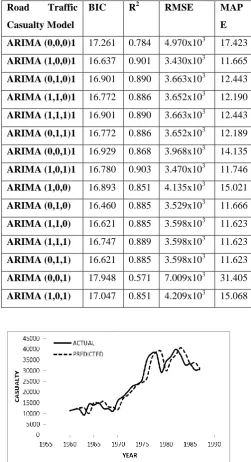
[image:3.595.305.531.49.203.2]Fig. 1. Plot of actual and fitted value of Road traffic casualty from 1960-1987 (Pre-intervention period).
Fig. 2. Plot of actual values of Road traffic casualty from 1960-2014.
Fig. 3. Autoregression function ACF for road traffic casualty in Nigeria from 1960 – 1987.
[image:3.595.40.292.238.701.2] [image:3.595.321.544.515.725.2]A close examination of Table 1, for the pre-intervention period of road traffic casualties in Nigeria, suggested a random walk process of ARIMA (0,1,0) model which has the lowest BIC value of 16.460. From figure 2, the impact of the intervention was noticeable from 1988 with an exponential decreasing and increasing profile. We observed that the pattern was of gradual - temporal impact of the first order intervention functions. Therefore, applying equation (4), we have,
I
t=
(8)From equation (6) the fitted model for ARIMA noise is (9)
From equation (9), the previous actual value of road traffic casualties best predicts future value. Hence applying equation (3), where = Nt = normal central value (which represents road traffic casualties in Nigeria obtained from ARIMA analysis); = Effect of the intervention on road traffic casualties. We have,
(10)
And taking = 0.5, chosen for model stability. The intervention model for road traffic casualties in Nigeria for 1960 to 2014 is developed as;
(11)
A code was developed with a computer program written in C++, for easy computation of the intervention result. The result of the actual value of road traffic casualties against the fitted intervention model response developed from 1960-2014 is shown in figure 5. We observed that total road traffic casualty occurrences in Nigeria are on the decreasing profile especially from the inception of Federal Road Safety Corps in 1988 as in figure 5, which shows a temporal reduction of road traffic casualty occurrences from one period to another, occasioned with a significant increase in some period especially from 2008 to 2014. This increment might have been as a result of an upsurge in the number of vehicles on Nigeria roads, poor road networks, road traffic rules violation and rapid population growth in recent times.
Overall, the impact of intervention measures had to a considerable level resulted in the reduction of road traffic casualties in Nigeria. This impact is as result of the multiple policy interventions introduced by road safety agencies in reducing road traffic accidents occurrence in Nigeria. Some of these policies include the presence of FRSC and police staff on the road to enforce compliance of road safety rules, penalties for road traffic rules violators, road safety education programs, maintenance of existing roads and construction of new ones etc. If road safety agencies in Nigeria would continue to build on the existing structures, policies and synergy and the Federal Government of Nigeria could adequately maintain existing road, new road networks and alternative means of transportation (such as railway and waterways) are adequately provided to meet the growing demands and pressures on the roads, there would be a systematic reduction of road traffic casualties in Nigeria [8].
Fig. 5. Plot of actual value of road traffic casualty with intervention measures versus fitted model response
IV. CONCLUSION
[image:4.595.305.545.366.562.2]ACKNOWLEDGMENT
WE ACKNOWLEDGED THE KIND RELEASED OF ROAD TRAFFIC CASUALTY DATA FROM THE DEPARTMENT OF POLICY RESEARCH AND STATISTICS, FEDERAL ROAD SAFETY CORPS, ABUJA,NIGERIA.
REFERENCES
[1] N. Eke, E.N. Etubu and S.O. Nwosu, Road Accident Mortalities in
Port Harcourt, Nigeria. Journal of Forensic Medicine and
Toxicology. 1(2), 2000.
[2] F.J. Jegede, F.J. “Spatio-Temporal Analysis of Road Traffic
Accidents in Oyo State, Nigeria”. Accident Analysis and Prevention.
24(2):149-55, 1988.
[3] O.E. Afamdi, Trends and Characteristics of Road Traffic Accidents
in Nigeria. Journal of Accident Analysis and Prevention. 106(1):
27-29, 1986.
[4] S.E. Asogwa and C.N. Obionu, Urban pedestrian accidents and the efficiency of counter measure. Central Afr. J. Med., 31: 62-65. PubMed, 1986.
[5] K.U. Nnadi and C.C. Ibe, “An Econometric Study of the Road Safety
Impact of Nigeria’s Federal Road Safety Commission”. International
Journal of Soft Computing. 2(2): 279-284, 2007.
[6] S.O. Ismaila, O.G. Akanbi, N.O. Adekunle and O.E. Charles-Owaba,
Current Trends of Vehicular Accidents in Nigeria. The Pacific
Journal of Science and Technology, Volume 10, Number 2. pp. 262-268, 2009.
[7] A.C. Igboanugo and E.F. Ekheumelo, Intervention Analysis of Road
Traffic Accidents in Nigeria. Advance Material Research. Vol. 18-19,
pp. 375-382, 2007.
[8] www.frsc.gov.ng
[9] B.U. Oreko, Intervention Analysis of Road Traffic Accidents in Nigeria, PhD Thesis, University of Benin, Benin-City, Edo State, Nigeria, 2016.
[10] De-Lurgio, S.A. (1998): Forecasting Principle and Applications.
McGraw-Hill Publishers. ISBN 0071159983