Enhancing learner centred education through the Eco-Schools framework:
Case studies of Eco-Schools practice in South Africa and Namibia
Thesis submitted in fulfilment of the requirements for
the degree of MASTERS OF EDUCATION (ENVIRONMENTAL EDUCATION) of RHODES UNIVERSITY by RUDOLPH HAINGURA ST No G05H5364
SUPERVISOR: PROFESSOR HEILA LOTZ-SISITKA
ABSTRACT
Since the early 1990’s both South Africa and Namibia have been engaged in educational reform processes to address the discriminatory impacts and orientations of education under Bantu Education which were implemented in both countries prior to independence (Namibia in 1990, and South Africa in 1994). A feature of both educational reform processes is the underpinning theory of learning which draws on social constructivism, and which is articulated as learner centred education. This approach to teaching and learning infuses both policy frameworks. Another common feature is the introduction of environmental education into the formal education systems of both countries, a process which has been championed by development assistance, and which has been supported by programmes such as the Eco-Schools programme which is an international
environmental education initiative started after the Rio Earth Summit in 1992, and implemented in a number of countries, including South Africa. The programme has also been piloted in some schools in Namibia.
To date no research has been done on the way in which the Eco-Schools framework (its practices, organizing principles, evaluation processes etc.) enhance learner centred
education. This study therefore aimed to investigate and understand how the Eco-Schools framework can enhance learner centred education. The study was conducted in 2007 in three Eco-Schools in Namibia and four Eco-Schools in South Africa in the context of the broader national programmes of implementing learner centred education policies, and environmental education histories.
The study used a case study methodology, using observation, interviews, and document analysis as the main methods for data generation. The analytical process followed two stages: the first involved an inductive analysis using categories which were organized into a series of analytical memos. The second phase of data analysis involved
recontextualising the data drawing on theory and contextual insights to provide insights that address the research question, using analytical statements.
The main findings of the study are that the Eco-Schools framework provides numerous opportunities to enhance learner centred education, through contextualization of learning, through strengthening school-community interactions, and through enabling active involvement of learners in decision making and a range of contextually meaningful Eco-Schools practices. The study also showed that the Eco-Eco-Schools framework allows for empowerment of learners in relation to diverse needs, and also allows for learner initiated contributions, although this aspect was not well developed in the schools that were included in this study. The study also found that the benefits of Eco-Schools in terms of enhancing learner centred education were limited to only a few learners who were involved in club activities or who were being taught by enthusiastic teachers who were participating in the Eco-Schools programme. The study showed that these benefits can be more widely shared if more teachers were to get involved, and if the Eco-Schools
programme were better understood in relation to the curriculum requirements of various subjects and learning areas, and if the Eco-Schools practices could be more successfully integrated across the curriculum. The study also showed that various forms of support were required for implementing the Eco-Schools programme, most notably the support of the Principal, and the Department of Education. The study also identified that parents and other stakeholders in the school were supportive of the Eco-Schools programme since it was perceived to have relevance to learning, as well as the community. The results broadly confirmed that the implementation of Eco-Schools using a whole school, values based and active learning approach promotes a school culture which enhances learner centred education more broadly across the school. The study also found that the Eco-Schools programme added a new dimension to existing discourses on learner centred education, which could be described as a community linked or situated approach to learner centred education.
ACKNOWLEDGEMENTS
I would first and foremost like to thank my Heavenly Father for giving me the necessary strength and wisdom to complete this thesis. I am grateful to my family for bearing with me for the long period of time that I spent away from home especially when they needed me most.
I would also like to thank my colleagues, the staff of Rundu College of Education in Namibia who encouraged me to take up this course of study and especially Ms. Sophia Daries and Ms. Awaala who so kindly offered to take over my teaching load. I am also grateful for those back at the college who kept in touch via Internet while I was away.
I acknowledge ‘Uncle’ Nicole Wilson, the head of the Science Department at Rundu College of Education for taking care of my vehicle and spending his own money on doing minor services. May the God of Africa always be with him and protect him at all times. ‘Uncle’ you have been my role model in life and I will always look upon you for advice and parenthood.
I would like to thank my supervisor, Professor Heila Lotz-Sisitka for the invaluable support that she rendered to me during this study. I am proud to have been supervised by one of the toughest and smartest people in the environmental education community, because today I can feel the benefits of the growth and depth that she bestowed upon me. Furthermore, without Heila I would never have had the opportunity to attend the World Environmental Education Congress 2007, in Durban.
I am also grateful to Ursula Van Harmelen for believing in me and helping me with my application for the Masters’ degree because at one time I had lost hope and courage in believing that I will be studying during 2007. Also, to Robert Kraft who has been with me during the hard times as a critical reader of my thesis and critical friend, I found your grounded feedback invaluable in this process. Though it often meant more work, the thesis is better because of it, even though we argued sometimes on academic fine points.
Lastly I must thank the Rhodes University Environmental Education Unit staff and students for their collective and positive approach to life and to all students who visited our unit. It was my home away from home. I never felt I was in this boat alone. Thank you for helping me to “unpack” and “grapple with” the complexities of the emerging environmental education discourses in our region. I feel lucky to have been part of such a diverse, friendly and inquisitive group. To Mucha, Shonai, Nsubunga and Soul Shava, my fellow ‘full-timers’ in the cubicles (offices), I shared many cups of tea, critical support and inspiration with you guys. Thanks for bearing with me in those times that I wanted your help or support.
Dedication
I dedicate this piece of work to….
The honourable memory of my late aunt Sandra Haingura Kasiku Maureen who was not able to see the moment of completing this thesis, to her I owe my life. She has been a pillar of strength in my life and she has shaped and moulded me into the man I am today.
TABLE OF CONTENTS
PG Abstract i Acknowledgements iii Dedication v Table of Contents vi List of Appendices ix List of Figures x List of Tables xList of Abbreviations and Acronyms xi
CHAPTER 1 1
INTRODUCTION TO THE STUDY
1.1 INTRODUCTION 1
1.2 THE AIM OF THE STUDY 1
1.3 CONTEXT OF THE RESEARCH 2
1.4 THEORY UNDERPINNING THE RESEARCH 3
1.5 OVERVIEW OF THE CHAPTERS 6
1.6 CONCLUDING SUMMARY 8
CHAPTER 2
7HISTORICAL CONTEXT OF THE STUDY
2.1 INTRODUCTION 9
2.2 BACKGROUND TO THE STUDY 10
2.3 THE ROLE OF THE FEDERATION OF ENVIRONMENTAL
EDUCATION
12
2.4 INTERNATIONAL PERSPECTIVES 15
2.4.1 Environment and schools initiative (ENSI, Eco- Schools, 1986) 15
2.4.2 Green school project, China 1996 16
2.4.3 Green school awards, Sweden (1998, Eco-Schools development process) 17
2.4.4 Enviroschools, New Zealand 2002 18
2.4.5 Eco-Schools international (FEE) 1994 19
2.4.6 The African context 20
2.4.7 SADC involvement in Eco-Schools, South Africa 2003 22
2.4.8. EE processes in Botswana (the Eco-Schools way) 24
2.5 HISTORY OF ENVIRONMENTAL EDUCATION AND
EDUCATIONAL TRANSFORMATION IN SOUTH AFRICA AND NAMIBIA
25
Namibia
2.5.1.1 Background to South African environmental education development 26 2.5.1.2 Background to Namibia’s environmental education development 31 2.5.2 The history of the legacy of Bantu education in both countries: South Africa
and Namibia
33
2.5.3 The Integration of environmental education in the curricula of South Africa 37 and Namibia
2.5.3.1 The integration of environmental education in the Namibian curriculum 37 2.5.3.2 The integration of environmental education into the South African
curriculum
44
2.5.3.3 Research insights into learner centred education 52
2.6 LEARNER CENTRED EDUCATION 55
2.6.1 Pre-independence education 55
2.6.2 From child centred to learner centred: distortions and misunderstandings 56
2.6.3 The components of learner centred education 59
2.7 MODELS AND APPROACHES INFLUENCING ECO-SCHOOLS IN DIFFERENT WAYS
62
2.7.1 The whole school approach 62
2.7.2 The Education for Sustainable Development approach 65
2.7.3 Teacher professional development and Eco-Schools 68
2.7.4 Key pedagogic theories underpinning the Eco-Schools approach 71
2.8 CONCLUDING SUMMARY 72
CHAPTER 3
74RESEARCH DESIGN AND METHODOLOGY
3.1 INTRODUCTION 74
3.2 RESEARCH ORIENTATION 74
3.3 DESCRIPTION OF THE RESEARCH METHOD 76
3.4 THE SAMPLE 78 3.5 DATA GENERATION 79 3.5.1 Semi-structures interviews 80 3.5.2 Observations 83 3.5.3 Document analysis 84 3.6 DATA ANALYSIS 87
3.7 ETHICS AND RESEARCH PROCESS 90
3.8 VALIDITY AND TRUSTWORTHINESS 91
3.9 CONCLUDING SUMMARY 92
CHAPTER 4
934.1 INTRODUCTION 93
4.2 ECO-SCHOOLS PRACTICES THAT TOOK PLACE IN SCHOOLS 94
4.2.1 Introduction 94
4.2.2 Eco-Schools clubs 94
4.2.3 Environmental policy development 96
4.2.4 Different Eco-Schools related activities in schools 98
4.2.4.1 School grounds 99
4.2.4.2 Herbal and Vegetable gardening 101
4.2.4.3 Tree planting 103
4.2.4.4 Guinea fowl and chickens 106
4.2.4.5 Recycling project 108
4.2.4.6 Water usage and conservation 109
4.2.4.7 Researching social issues 112
4.3. ACTIVE ROLES THAT LEARNERS TAKE UP IN THE ECO
PRACTICES
113
4.3.1 Introduction 113
4.3.2 Learners raise concerns about environmental issues in school 114
4.3.3 Taking environmental action 116
4.3.3.1 Polio campaign and health issues 117
4.3.3.2 Paper collection competition 118
4.3.3.3 Global warming 119
4.3.4 Learners work with teachers in the community 120
4.4. ROLES OF TEACHERS IN ECO-SCHOOLS PRACTICES 123
4.4.1 Introduction 123
4.4.2 The enthusiastic teacher 124
4.4.3 The Eco-Schools coordinator 125
4.4.4 The subject teachers 127
4.4.5 The principal’s role in promoting Eco-Schools 129
4.4.6 Teachers role in registration and portfolio handling 131
4.4.7 Organizing an Eco-Schools event 132
4.4.8 Support for including cross-curricular teaching 133
4.5. SUPPORT FOR LEARNING ENGAGEMENT IN ECO-SCHOOLS ACTIVITIES
136
4.5.1 Introduction 136
4.5.2 Support from parents and community 136
4.5.3 Support from the Principal 139
4.5.4 Support from teachers 140
4.5.5 The external support for Eco-Schools activities 141
4.6. LEARNING INTERACTIONS 144
4.6.1 Introduction 144
4.6.2 Peer-to-peer learning interactions 144
4.6.3 Learner and teacher interactions 145
4.6.4 Learner and environment interactions 145
4.6.5 Learner, environment and community interactions 145
4.7.1. Introduction 146 4.7.2 Positive learning environments, values and school improvements 146
4.7.3 Awareness 149
4.7.4 Understanding and Skills 151
4.8. CONCLUDING SUMMARY 152
CHAPTER 5
153DISCUSSION OF FINDINGS, RECOMMENDATIONS
AND SUMMARY OF THE STUDY
5.1 INTRODUCTION 154
5.2 DISCUSSION OF THE ANALYTICAL STATEMENTS AND RECOMMENDATIONS 155 5.2.1 Analytical statement 1 155 5.2.2 Analytical statement 2 160 5.2.3 Analytical statement 3 163 5.2.4 Analytical statement 4 165 5.2.5 Analytical statement 5 168
5.3 SUMMARY OF THE STUDY 171
5.4 REFLECTIONS ON THE STUDY AND RECOMMENDATIONS FOR
FURTHER RESEARCH
173
5.4.1 Lessons learned 173
5.4.2 The potential value of this study 173
5.4.3 Limitations of the study 174
5.4.4 Tentative suggestions for further research 175
5.6 CONCLUDING SUMMARY 175
REFERENCES 177
LIST OF APPENDICES
Appendix 1: Request for access to conduct a case study at the school 187 Appendix 2: Interview schedule for learners 188 Appendix 3: Interview schedule for teachers 189 Appendix 4: Interview with Principal 1 Namibia 191 Appendix 5: Interview with Node coordinators 1 193 Appendix 6: Example of colour coding and categories 198 Appendix 7: Lesson plan for Eco-Schools: Litter and waste 199 Appendix 8: Lesson plan for Eco-Schools: Medicinal Herbs 204 Appendix 9 A: Samples of EE school policy (Namibia) 208 Appendix 9 B: Sample of EE school policy (South Africa) 209
Appendix 10: Observation schedule 210
LIST OF FIGURES
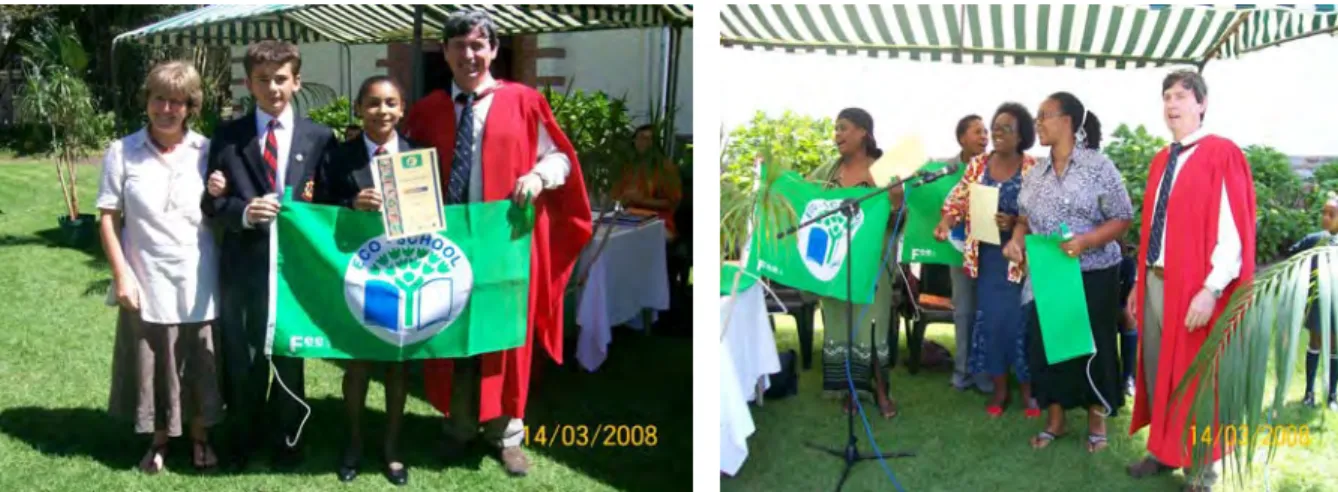
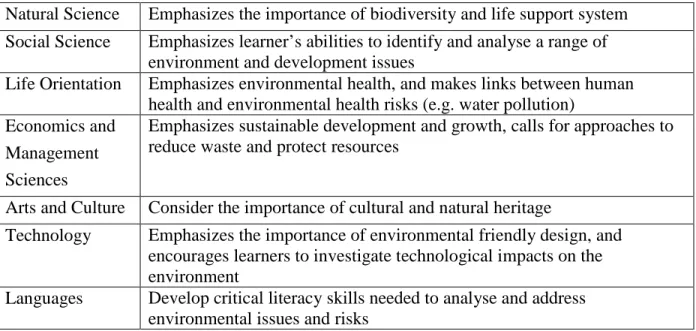
Figure 1& Figure 2:
Eastern Cape (South Africa) schools receive green flags for their Eco-Schools activities.
14 Figure 3&
Figure 4:
School environmental policies written on the walls of two of the Namibian schools to show their focus and interest.
96
Figure 5: A clean school ground in Namibia 100
Figure 6: Trees produced by schools for planting and selling to the community for fund-raising purposes
104
Figure 7: An example of the type of trees that are planted in the school grounds (in Namibia)
104
Figure 8: School chickens that the Namibian schools are farming with as part of a government initiative
106
Figure 9: Recycling collection point for the glass, tins, plastics and cardboard bins from portfolio 4
108
Figure 10: Careful usage of water and soap for hygienic purposes and saving water 111 Figure 11: Linkages between school, home and community learning environments 157
LIST OF TABLES
Table 2.1: Environment is integral to each Learning Area in the South African curriculum
49
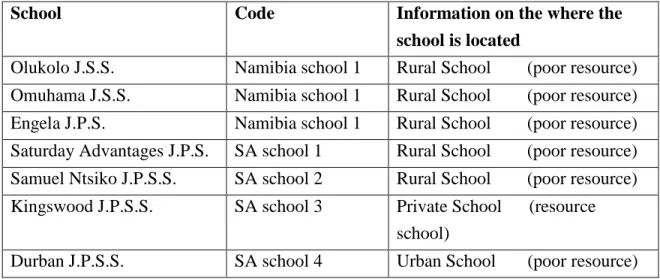
Table 3.1 Summary of the schools involved in the study 79
Table 3.2: Summary of the interviews with the specific codes used for identifying and referring to the interview sources in this study
82
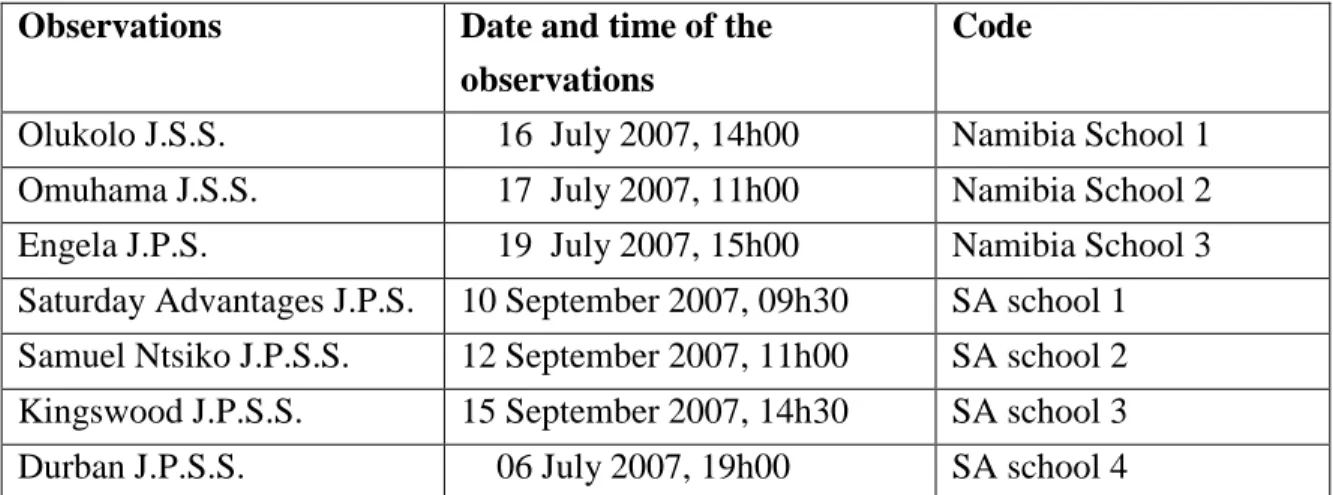
Table 3.3: Observation schedule outlining the specific days with code references used for schools involved in this study
84
Table 3.4 Different documents that were analysed to provide data for the study 85 Table 3.5 Table showing the categories and sub-categories of data analysis 88
LIST OF ABBREVIATIONS AND ACRONYMS
BETD Basic Education for Teachers DiplomaCERI Center for Educational Research and Innovation ESD Education for sustainable development
EE Environmental Education
ENSI Environment and schools initiatives (Europe)
EEASA Environmental Education Association of Southern Africa FEE Foundation for Environmental Education
IUCN International Union for Conservation of Nature LCE Learner Centered Education
MDG Millennium Development Goal
MBEC Ministry of Basic Education and Culture NIED National Institute of Education Development
NEEP-GET National Environmental Education Project-General Education and Training
NDP 1 National Development Plan 1 NGO Non Government Organization OBE Out Come Based Education
GRN Government of the Republic of Namibia IPCC Intergovernmental Panel on Climate Change RSA Republic of South Africa
RNCS Revised National Curriculum Statement SADC Southern African Development Community
SADC- REEP SADC Regional Environmental Education Programme
SEP&MP School Environmental Policy and Management Plan(Botswana) SEEN Support Environmental Education in Namibia
OECD Organisation for Economic Cooperation and Development UNEP United Nations Environmental Programme
UNDESD United Nations Decade of Sustainable Development
UNCED United Nations Conference on Environment and Development WEEC World Environmental Education Congress
CHAPTER 1
OVERVIEW OF THE STUDY
In this millennium we have the opportunity to create something wonderful or something disastrous with our lives, with each other, and with the planet. Even the scientists today tell us that global
survival not only depends on our brain but on our hearts (Fien, 2003: 3).
1.1 INTRODUCTION
This study focuses on a new policy development in Namibian and South African education, namely learner centred education (LCE), in the context of the Eco-Schools programme, which is an international environmental education initiative. The study sought to investigate how the Eco-Schools framework can enhance learner centred education. This chapter introduces the aim of the study and provides the background to the research project, and introduces the Eco-Schools framework, and the policy change context in which the study takes place. It furthermore locates the study in Namibian and South African educational transformation contexts, where the Eco-Schools framework is being used. The chapter therefore provides a brief overview of the context of the study, and also introduces the main theories underpinning the study. It also provides a brief outline of the structure of the chapters in the thesis.
1.2 THE AIM OF THE STUDY
The main aim of the study is captured in the research question: How can the Eco-Schools framework enhance learner centred education (LCE)?
The research goals, to examine these learner centred education learning engagements are:
• Investigate the learning interactions associated with the Eco-Schools programme,
• Investigate what Eco-Schools practices support learner centred education,
• Investigate what active roles learners are taking up in Eco-Schools Programmes, and
• Investigate the role of teachers, parents, subject advisors and node coordinators in enabling learner centred education approaches in the Eco-Schools Programme.
• Investigate the role of parents, subject advisors and node coordinators in enabling learner centred education approaches in the Eco-Schools Programme.
With a view to:
Understanding how Namibian and South African teachers can use the Eco-Schools framework to enhance learner centred education in their schools.
This research question allowed me to investigate how a sample of teachers, learners, parents, subject advisors and Eco-Schools node coordinators implemented the Eco-Schools framework in a small selection of schools in Namibia and South Africa. From this I was able to analyse how the Eco-Schools framework can enhance learner centred education.
1.3 THE CONTEXT OF THE RESEARCH
This study is informed by the factors that influenced the fast growing international movement called the Eco-Schools, which has it roots in the 1992 Rio Earth Summit.The main outcomes of the 1992 Rio Earth Summit are documented in a text known as Agenda 21 (UNESCO, 1993) which is a major action programme setting out what nations should do to achieve sustainable development in the 21st century. The United Nations (UN) recognised the
Foundation of Environmental Education’s (FEE) schools programme (called the Eco-Schools programme) as a viable model to fulfill some of the Agenda 21 requirements envisaged in Chapter 36 particularly at school-community level. As a result the UN encouraged member countries to participate in the programme. Today many countries have adopted the
international Eco-Schools programme, which is based on the Foundation of Environmental Education model (described in section 2.3), although some countries have adapted it
substantively to suit their own environment. The Eco-Schools programme is an international initiative designed to encourage whole school action for the environment. It incorporates a recognised award scheme that accredits schools that make a commitment to continuously improve their environmental performance (see section 2.3).
As mentioned above, the focus of this study is to investigate how learner centred education (LCE) is enhanced through the use of the Eco-Schools framework. The Eco-Schools
framework is seen to provide learners with the capacity and skills to make informed decisions about their life styles, livelihoods and relationships with their environment (Eco-Schools South Africa, 2006). It provides a mechanism for whole school development, which emphasizes education for sustainability and sustainability practices in the school and its community. It also provides schools with an incentive scheme in the form of a ‘green flag’, which is awarded for participation annually. It is a project that promotes the idea of a whole
school approach that allows for contextualisation of learning as an important facet in education (Lotz-Sisitka, Timmermans & Ward, 2005).
The Eco-Schools project in the Southern African Development Community (SADC) started officially in South Africa (SA) in May 2003 as an educational programme under the auspices of the Wildlife and Environmental Society of South Africa (WESSA) as an affiliated member of the international Foundation for Environmental Education (FEE). It started mainly in the Eastern Cape, KwaZulu Natal and Gauteng regions (Lotz-Sisitka, et al, 2005) with 50 schools registered in the first year. It built on an earlier initiative to support schools to develop school environmental policies and management plans. This programme has today become national and has spread into all the 9 South African provinces. Today (2008) South Africa has 870 schools registered with this programme, which is an indication of meaningful progress, and interest in the initiative.
As a teacher educator at a college of education in the Kavango region of Namibia, I have been involved in Eco-School type activities in the college grounds and I have been active in
involving students in sustainability practices, which included improving the vegetable garden as well as pig farming activities at the College. As a result of this experience, I realised that a teacher was capable of structuring the learning environment to accommodate the needs, interest and abilities of the students in the class and outside through sustainability practices, hence my interest in the Eco-Schools framework and its potential for strengthening learner centred education.
In Namibia the Eco-Schools framework was piloted in four regions during the Support Environmental Education in Namibia (SEEN) project in 2001 – 2005. I was interested in understanding the Eco-Schools framework and activities, since two schools Olukonda and Kameru received green flags from the South African Eco-Schools model during this time. In addition, most schools that were involved in the programme managed to develop Eco-Schools policies, which were written out explicitly on the walls of the gate of the schools. Despite this progress with the two Eco-Schools in Namibia, environmental education (EE) policy in Namibia was inadequately activated within the education system (see section 2.5.3).
1.4 THEORY UNDERPINNING THE RESEARCH
Learner centred education (LCE) in Namibia is a cornerstone policy for the transformation of education in Namibia, as noted in the development brief Towards Education for All (
Government of the Republic of Namibia, 1993) and expressed in the five major goals for education: access, equity, quality, democracy and lifelong learning. In my view all these goals are reflected in the Eco-Schools framework and objectives (see section 2.3). According to the above mentioned policy document, teachers are expected to be active creators and managers of the learning environment and not its masters or caretakers (Namibia. Ministry of Education and Culture, 1993: 41-42). This argument is at the centre of the intentions for the realisation of the Eco-Schools programme. Janse van Rensburg and Lotz-Sisitka (2000, 92) agree that South African’s new education system views learners as active participants in their own learning rather than ‘empty vessels’ to be filled with information.
The policy goals on access in Namibia emphasise “… that learning in or out of school, leads not only to individual achievements but also self reliance, self confidence and empowerment” of the child in facing the challenges of the 21st century (Namibia. MEC, 1993:34). This argument for independent learning and the development of life skills is also illustrated in the goal of life-long learning “… that schools have to become preparation for life” in a far more direct way than has been the case in the past and that “… opportunities for learning have to be recognised” (NIED, 2003: p. 3). This reflects a belief that society itself has to become a learning society. This belief in lifelong, active and socially engaged learning is also reflected in the Pilot Curriculum Guide for Basic Education (Namibia. Ministry of Basic Education and Culture 1998b:23-24), which acknowledges that children learn best when they are actively involved in the learning process and respond best when they are interested in the activities they are learning. Learning is seen as an interactive, shared and productive process, where teaching creates learning opportunities which will enable learners to explore different ways of knowing and develop thinking abilities both within and across subject areas of the whole curriculum (Namibia. MBEC, 1998).
Social cultural learning theories which consider the learner’s culture and language as being significant to the learning process (i.e. learning is more learner centred), developed from the earlier work of Lev Vygotsky, who researched how knowledge develops as one engages in dialogue with others (Palincsar, 2007). Palincsar (ibid) argues that conceptual development of learning and understanding are regarded as inherently socially and culturally shaped in
aspects of this learning theory has been developed in which students assume a more active role in learning to explain ideas to one another and cooperate in finding solutions to complex problems (see section 2.6). Teachers, parents, subject advisors and node coordinators
participate in the design of learning contexts and the facilitation and mediation of knowledge and activities. They also make efforts to make learning more relevant to learners’ life
experiences, and scaffold students by supporting and shared knowledge and ownership of learning.
In understanding learner centred education in this study I will draw on socio-cultural learning theories (Palincsar, 2007) which place emphasis on a) interactions b) practice c) the active role of learners and d) a changed role for the teachers. I will develop an analytical framework, drawing on these four dimensions of learner centred education and how they manifest in Eco-Schools activities in the schools under study. Working with this analytical framework drawn from theories of learning, provided the means for understanding how Eco-Schools enables learner centred education (or not) (see Chapters 4 and 5).
This analytical framework therefore allowed me to examine Eco-Schools within a LCE approach that underpins the objectives for educational transformation in South Africa and Namibia. South Africa and Namibia both share a similar educational history which was shaped by apartheid policies, and as both countries gained independence in close proximity; they also share similar transformation ideals (see section 2.5.2).
To provide a more in-depth perspective on the Eco-Schools framework and its relationship to LCE I explain two approaches to Eco-Schools that I consider important for the study, as they are both relevant to Eco-Schools, and to the process of learning and meaning making. As such, they influence the possibilities and practice of LCE as supported by Schools. Eco-Schools has been defined in a variety of ways, two of the approaches to Eco-Eco-Schools being: 1) the whole school approach; 2) and the more recent Education for Sustainable Development (ESD) approach. Both of these approaches have potential to contribute to learner centred education, and are therefore of interest to this study as they define certain practices, active roles for learners, new roles for teachers and give rise to different learning interactions (see section 2.7).
All of the above-mentioned discussions about learners and learning are described in the development brief of Namibia (National Institute for Education Development, 2003) and the outcomes-based objectives of the South African curriculum (South Africa, 2002a). The
Eco-Schools programme can, in general, be seen within the broad parameters of socio-cultural theories of learning that underpin a wider shift to learner centred education around the world (see section 2.6). As indicated above, the central question of this study is to examine how the Eco-Schools programme enhances learner centred education in contemporary education systems that are under transformation in South Africa and Namibia. A review of the literature indicates that while descriptions of the Eco-Schools programme and its intentions to support active learning and learner centred education have been provided in these two countries (Lotz-Sisitka et al, 2005; Murray, 2002), no research has been done to consider whether or to what extent this is or may be occurring in practice.
In summary: the main focus of the study was to examine, via a case study, how the Eco-Schools framework enhances learner centred education in selected schools in two countries. This involved understanding pedagogic theories informing the Eco-Schools framework. As mentioned above, these falls broadly within socio-cultural learning theories and in more detail involve theories of active learning, the theory of action competencies, the whole school approach and Education for Sustainable Development (ESD) approaches (these are discussed in more detail in Chapter 2). Similarly it also involved understanding some of the primary learning and teaching theories underlying learner centred education (in the Namibian context) and Outcome Based Education (in the South African context) such as active learning and social constructivism. A significant outcome of the review of the pedagogies informing Eco-Schools and learner centred education was the notable degree of overlay and interconnection or potential synergy between the underlying pedagogical intent of Eco-Schools and learner centred education (see Chapter 2). What then still had to be established was whether this was reflected in the events and practices in the schools themselves, and in the Eco-Schools
materials and framework (see Chapters 4 and 5). This work constitutes the thesis, contained in five chapters.
1.5 OVERVIEW OF THE CHAPTERS
The dissertation is structured as follows:
Chapter 1introduces the research and outlines themain aim of the study,the context of the study and introduces thetheories that underpin the study.
Chapter 2 describes the historical and contextual factors influencing the study.It highlights the background and factors that influenced the fast growing international Eco-Schools
movement and looks at international perspectives of Eco-Schools within some countries and in particularly the SADC countries. It also looks at the evolution of aspects of environmental education and education in Namibia and South Africa. It then focuses on the relevant
pedagogic theories underpinning Eco-Schools and learner centred education and outcomes- based education in Namibia and South Africa respectively, identifying the overlaps between these, and the central theoretical underpinnings of significance within a wider international learner centred educational movement. It also reviews approaches to Eco-Schools and considers how these potentially may support learner centred education.
Chapter 3 explains the methodology applied in the study, and the associated research design decisions and research process. It discusses the research orientation. It provides details on how the case study approach was applied. The chapter also explains how various methods were used to collect data and how data was analysed. It discusses issues of trustworthiness, validity and ethical considerations within the study.
Chapter 4 presents the data collected from the semi-structured interviews, observations and document analysis in the case study sites. It presents a first level of analysis of the data using a series of five analytical memos devised for this purpose that were based on the theoretical framework outlined above, and in more detail in Chapter 2, focussing particularly on practice, teachers’ roles, learners involvement, learning interactions, support for Eco-Schools activities and outcomes of the Eco-Schools processes in the schools.
Chapter 5 examines the research findings reported in Chapter 4 in greater depth. The approach used is to generate a series of analytical statements unique to this study. In this chapter the data continues to be considered in relation to the Eco-Schools framework within a learner centred education context, thus allowing for theoretical discussion of the results reported in Chapter 4.This chapter directly addresses the research question using the
analytical statements, and makes recommendations. It also provides a reflective review of the study, and comments on lessons learned, the value of the study, limitations of the study and makes suggestions for further research. It also provides a brief summary of the study.
NOTE: In referring to the term Eco-Schools framework in this study, I refer to the range of Eco-Schools practices (e.g. auditing and involvement in resource use and management, action projects or information seeking activities); different approaches (whole school and Education for Sustainable Development approaches); values of care and concern for the environment as well as democratic and participatory values that are supported by Eco-Schools, and different
processes such as ongoing evaluation and review, working in teams, producing portfolios for participation in an awards scheme, and involvement of the community that are proposed by Eco-Schools. As discussed in Chapter 2, these are oriented towards learner centred education and environmental improvements in schools.
1.6 CONCLUDING SUMMARY
In this chapter I have provided an overview of the aims and context of the study and the structure of this report, as well as some introductory information on the Eco-Schools programme and the context of the research. I also introduced the theoretical aspects of the study, and I provided an overview of the different chapters and explained what I meant by the use of Eco-Schools framework.
In the next chapter I discuss the contextual and theoretical framework of the study further, providing more depth to the introductory aspects of context and theory presented in this chapter.
CHAPTER 2
HISTORICAL AND THEORETICAL CONTEXT OF
THE STUDY
In some African countries ideological brainwashing (e.g. in Apartheid South Africa [and Namibia]) and violent indoctrination are fresh in living memory. South Africa has therefore been eager to embrace educational processes that encourage learners to think for themselves
and tolerate different points of view. … Constructivism as a philosophy is highly regarded in many ‘progressive’ education contexts today. A constructivist epistemology [has been called a] ‘progressive consensus’. At the same time, however, “… its implications for teaching and
learning constitute one of the most controversial and difficult visions to implement in education today”
(Taylor et al., 1999:21, cited in Janse van Rensburg and Lotz-Sisitka, 2000:14)
2.1 INTRODUCTION
This chapter provides an analysis of the contextual dimensions that influence the study as a whole. It provides insight into the broader context in which I was able to carry out the research.
Firstly, I discuss the historical context of the Eco-Schools originality by tracing it from the international level, which was influenced by the Rio de Janeiro Earth Summit in 2002. This discussion culminates in a description of the role that the Foundation for Environmental Education (FEE) is playing internationally in terms of its autonomous role in guiding Eco-Schools internationally.
The chapter also looks at various Eco-Schools processes in different countries like Sweden (Green School Awards), China (Green Schools Project), and New Zealand (Enviroschools) and how these have contributed towards environmental education activities in schools. The chapter describes further how the Eco-Schools movement is growing within the African context in particularly in the Southern African Development Community (SADC) region, with emphasis on the policies and projects that helped shape the growth of environmental education in South Africa and Namibia. The chapter reveals that learner centred education is a central focus of these initiatives.
To provide further depth to this discussion, I also consider socio-cultural (also referred to as social constructivist) theories of learning, which have influenced the learner centred education movements in post-apartheid education in South Africa and Namibia. I also review two approaches to Eco-Schools namely the Whole School Approach and the Education for Sustainable Development Approach to schools and sustainability initiatives to orient discussions on learner centred approaches to Eco-Schools. As indicated in chapter 1 (see section 1.4), this is to understand the overlaps and synergies between the theoretical
underpinnings of Eco-Schools and the educational reform initiatives in the two countries, and to develop an adequate analytical framework for analysing how the Eco-Schools framework enhances learner centred education (or not).
2.2 BACKGROUND TO THE STUDY
To gain sufficient background to this study, it is important to understand the context in which the Schools movement originated and how it is influencing the current set up of Eco-Schools activities within schools.
Eco-Schools is a fairly new concept within environmental education discourses of learning, which emerged strongly after the 1992 Rio Earth Summit also known as the United Nations Conference on Environment and Development (UNCED) held from 3-14 June 1992 in Rio de Janeiro, Brazil. One of the main purposes of the Summit was:
To work towards international agreements which respect the interests of all and protect the integrity of the global environmental and developmental system and to recognise the integral and interdependent nature of the Earth, our home … this proclaimed that human beings are at the center of concerns for sustainable
development. They are entitled to a healthy and productive life in harmony with nature (UNCED, 1992:17).
During the time of this conference stronger emphasis was placed upon trying to integrate thinking and action around ecological, social and economic systems in the global arena (Gough, 2006). The conference developed a document called Local Agenda 21 as a guiding document in the fight against the destruction of the environment, which gave different
stakeholders different responsibilities at a local level, with the explicit intention of decentring global policy discourse to a local level.
Stakeholders participating in the formation of Local Agenda 21 ranged from international organisations, to national governments, Non-Governmental Organisations (NGOs), regional and local government as well as certain sectors such as education. The Namibian and South African governments as well as other nations are signatories to the implementation of Local Agenda 21. In the broader Agenda 21 document, a chapter on ‘Promoting Education, Public Awareness and Training’ (Chapter 36) was included which focuses on the opening of schools towards the outside world and seeing schools as a place of teaching and learning in and for the community (UNCED, 1992). This had relevance to the concept of Local Agenda 21 initiatives and involvement of schools in local actions to address environmental and development issues at local level. Chapter 36 of Agenda 21 emphasised the importance of:
• Improvement of the quality of basic education at all levels,
• Reorientation of existing education at all levelstowards sustainable development, • Enhancement of public understanding and awareness of sustainable development, • Capacity building and training to address sustainable development issues in all sectors
of society (UNCED, 1992).
This reflects that all sectors of society need to participate in the new demands, processes and challenges of the 21st Century i.e. to participate in environmental education processes that respond to environmental and sustainability issues. Chapter 36 of Agenda 21 (ibid)
encourages member states to be involved in promoting environmental education within their own contexts and to reorient education towards sustainable development, which I regard as an important activity emerging from its principles.
During the Rio Earth Summit, the idea of ecological conservation, which was seen to be a primary focus point of teaching environmental education since the Stockholm Conference in 1972, shifted to Education for Sustainable Development (ESD), thus influencing
environmental education discourses (UNCED, 1992). Posch (1991), writing from a European context and experience of environmental education, explains that this shift implies that learners will no longer see environmental education as only based on field trips or celebrating recognized international environment days. He argues that the Education for Sustainable Development discourse will promote dynamic qualities based on taking an active part in solving future environmental problems in learner’s immediate surroundings (Posch, 1991). His argument reflects the learner centred dynamic of this shift, as learning is to be oriented towards active participation in locally relevant problems in immediate surroundings. This is a key discourse of the Eco-Schools movement as described in section 2.7 below.
2.3 THE ROLE OF THE FEDERATION OF ENVIRONMENTAL EDUCATION
As indicated in Chapter 1, the Eco-Schools movement is an international movement, which is an initiative of the United Nations (UN) in terms of creating environment learning that makes schools ‘… a better place in which to work, learn, live and play’ (Murray, 2005:20). As mentioned previously in Chapter one, Eco-Schools is one of the projects that were recognised by the UN as a viable schools program that fulfils the requirements of Local Agenda 21. According to Mogensen and Mayer (2005), Eco-Schools was originally commissioned by the member organisations of a European Union schools network called the Environment and Schools Initiative (ENSI) through the Foundation for European Environmental Education (FEEE) with the support of the European Commission. FEEE was established in 1981 as a programme that was to promote environmental education for schools in Europe. In the early years of FEEE, the organisation was mostly active through internal meetings, external seminars and conferences and in a number of publications (FEE International, 2007).
With the dawn of a new era of globalisation that emerged in Europe and in the world in general, and with the focus on the democratisation of international institutions and expansion of global markets, the education system was also influenced. This impacted on FEEE, which was faced with constitutional changes that resulted from schools all over the world wanting to participate in the European model, and eventually it changed its name and functions to the Foundation for Environmental Education (FEE) in order to accommodate other countries.
Other programmes of FEEE were also affected by this internationalization trend. In the mid-1990s there was a growing interest in FEEE programmes from outside Europe. In
co-operation with the United Nations Environment Programme (UNEP) and the World Tourism Organization (WTO), a manual for coastal zone management with the example of the Blue Flag was produced. With further support from UNEP, workshops on the Blue Flag
programme were held in the Caribbean, Africa and Asia. Further interest grew rapidly in the Caribbean area and solid interest was shown from South Africa in this programme (FEE, 2007).
Building on this partnership, in 2003 the UNEP signed a Memorandum of Understanding with FEE to provide a framework for long term cooperation on areas of common interest relating to education, training and awareness for sustainable development globally, it stated that:
Education is critical for achieving environmental and ethical awareness, values and attitudes, skills and behaviour consistent with sustainable development for effective public participation in decision-making. Both formal and informal education is indispensable to sustainable development (UNEP, 1992:23).
This Memorandum of Understanding provided a solid basis for furthering the work already undertaken in collaboration between FEE and UNEP, in particular with regard to the
introduction of FEE programmes and associated activities, especially in developing countries and those with economies in transition. This partnership was formed in recognition of the Eco-Schools programme being a preferred model of an international environmental education programme to help achieve sustainable development. In using its regional reach, UNEP’s role was to identify partners for the implementation of the Eco-Schools programme across the world. As such, UNEP recognized the FEE Eco-Schools programme as a preferred model to assist schools everywhere to achieve the sustainable development programmes that were spearheaded by the world body. In response to this, the FEE Eco-Schools programme defined its role in contributing to Local Agenda 21 by offering schools the opportunity to link with their communities and work together to solve and prevent environmental problems at the local level. The Eco-Schools program is a product of this agreement and has been in existence since 1994. All 13 member states of Europe and Australia who were involved in the programme at that stage of the programme remain involved and other member countries of FEE and the UN are requested to participate in the Eco-Schools activities to strengthen Local Agenda 21 initiatives.
For a country to become a member of FEE it should coordinate and promote the program under a non-governmental and non-profit organization, which is allowed to affiliate to FEE. This center will also award a green flag annually to participating schools (Mogensen & Mayer, 2005) to acknowledge the work done by a particular school in promoting the ultimate goal of the UN organisations and member states to achieve sustainable development. The Eco-Schools programme leads to the prestigious international environmental award - the Green Flag (see Figure 1 and 2 below). The flag is awarded in acknowledgment that a school is committed to the highest standards in environmental education and management –
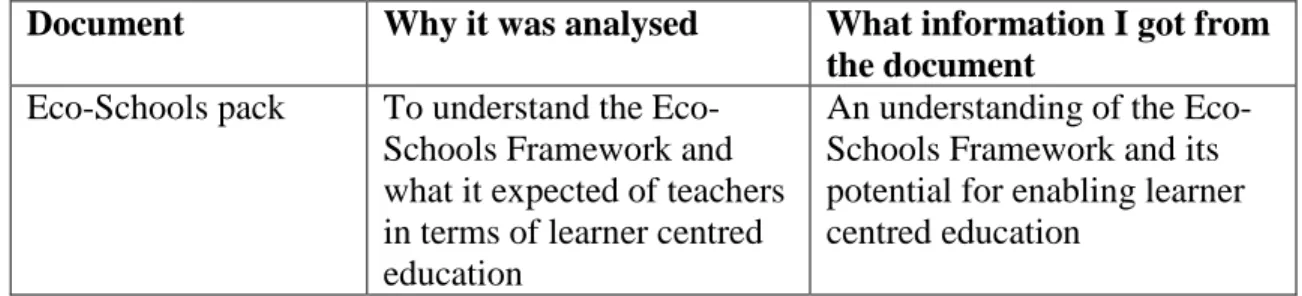
Figure 1: Figure 2:
Eastern Cape (South Africa) schools receive green flags from Prof. O’Donoghue for their Eco-Schools activities
In most cases the Eco-Schools NGO partner in a country works in close partnership with the national education authority together with the secretariat of FEE international, which is currently based in Portugal. When an international organisation/institution or a second national organisation wishes to be connected to FEE, it is possible through becoming an affiliate member of FEE, and its membership must be approved by the already existing FEE member organisation from that country.
When a national organisation is accepted as member of FEE it becomes an associate member of FEE. Within 3-5 years of FEE membership, the organisation must become a full member of FEE, which means that it has to fully implement at least two FEE programmes (FEE, 2007). Organisations therefore become members of FEE through full, associate and affiliate
memberships of FEE in a process that takes place over a period of three to five years. Initially FEE has five main areas of cooperation in which member countries are registered and
participate in officially (Eco-Schools UK, 2007) as participant. For a country to register, it needs to have not less than two of the following programmes (years of establishing the area by FFE) or activities in its country programme that needs to be in operation at the same time.
1. The Blue Flag (1990) 2. The Eco-Schools (1994)
3. The Young Reporters for the Environment (1994) 4. The Learning about Forests Programme (2002) 5. The Green Key Programme (2003)
As mentioned in Chapter 1, the Eco-Schools program is a project that promotes the idea of a whole school approach to development in a school, and supports environmental learning in the curriculum focused on the contextualisation of learning as an important facet in education (Lotz-Sisitka, Timmermans & Ward, 2005; see als
03/04/2008).
2.4 INTERNATIONAL PERSPECTIVES
In this section I review the Eco-Schools initiatives internationally to better understand the broader Eco-Schools movement in a southern African context especially the links between Eco-Schools and learner centred education. I particularly examine the range of programmes that promote environmental education activities through the whole school approach. I discuss the ENSI project, the Green Schools project in China, the Green School Award of Sweden and New Zealand Enviroschools in the context of FEE international, which I have already introduced.
2.4.1 Environment and schools initiatives (ENSI, Eco-Schools 1986)
The Environment and Schools Initiatives (ENSI) is an international government-based environmental education learning network, which operates under the umbrella of the
Organisation for Economic Co-operation and Development’s (OECD) Centre for Educational Research and Innovation (CERI). ENSI has currently more than 16 members originating mainly from Europe and Australia. ENSI provides opportunities for member countries to come together in formal settings and share practice and research in environmental education and one of its main projects relate to research and school development work in Eco-Schools.
The aim of the ENSI Eco-Schools project is to develop, test and publish methods of teaching and learning which define good practice of environmental education, by setting up
international school partnerships and conducting comparative studies in areas such as quality criteria for Eco-Schools development. At the same time ENSI provides opportunities for reflection, communication and professional development through seminars and cultural exchange, electronic forums, and research publications for all stakeholders interested in whole school approaches to sustainability.
ENSI is underpinned by a pedagogical approach of constructivism and the research approach of action research and promotes a reorientation of education to student centred learning and changes in student community and school community relationships.
ENSI identifies teachers as core agents of change in innovative and transformative educational processes, which promote education for sustainability, although research has indicated that there is still a gap between theory and practice (ibid). It has also been reported that teachers think that they are undertaking environmental education or Education for Sustainability, while what they do in practice is not aligned with the participatory pedagogic approaches advocated by Eco-Schools theories (Mogensen & Mayer, 2005).
2.4.2 Green School project, China 1996
China’s Green School project is an initiative of the Ministry of Education (MoE) and is funded by the State Environmental Protection Administration (SEPA). A guiding document was introduced which promulgated ‘The National Action for Environment Publicity and Education (1996-2010)’ as the model for schools to follow. China’s Green School programme started in 1996 and is based on the international concept, which is informed by the European Eco-Schools module. Since 2000, the program has been run by the Centre for Environmental Education and Communication (CEEC) and their local networks (Nan, Xiaoqiang & Jin, 2003: 64).
The program’s key environmental focus areas include whole school environmental management and protection, and environmental education curriculum and professional development. Its focus is on building of skills and knowledge for environmental management in school grounds and the wider environment. The programme promotes student awareness of, and participation in sustainable development activities.
Schools must undertake a series of steps before applying for Green School Awards. Awards are categorized through a stage development process, starting at municipal, provincial and then national level.
When the CEEC took over the running of the Green School program, it realized that there were some evaluation problems and in 2002 they introduced a set of assessment criteria for the national level and at district level. The district criteria contain the provincial and civic
criteria, which were originally developed in the Guangzhou region (ibid: 65). The set of national assessment criteria contain ten core indices. These are:
• Establish a committee for green schools and appoint an environmental manager. Develop a plan to guide green schools construction,
• Provide special financial support for environmental education in schools,
• Ensure effective approaches for preventing pollution, reducing and recycling garbage, saving energy, etc.
• Collect and keep all materials related to green school construction, • Put the context of the environment into the main school subjects,
• Encourage teachers to take part in environmental education training programmes, and to undertake environmental education research,
• Form a school culture of environmental protection. Encourage higher levels of
environmental awareness among students and teachers and ensure active participation in various activities,
• Encourage students and teachers to show life style choices that reflect environmental protection,
• Green the campus, and
• Establish a student’s environmental group to foster student’s participation in environmental management of schools (ibid).
2.4.3 Green School awards, Sweden (1998, Eco-Schools development process)
The Keep Sweden Tidy Foundation has coordinated the Eco-Schools programme in Sweden since 1996. The Foundation is a creator of public opinion that focuses on environmental issues, promotes recycling and combats litter through public awareness campaigns, awards and environmental education. The Foundation strives to influence people's attitudes and behaviour in order to encourage a sustainable environmental development (Eco Sweden, 2008). In Sweden, Eco-Schools is part of the Ministry of the Environment and Statistics. There are three levels of awards; bronze, silver and then the first, second and third green flag. After that the school will receive a permanent Eco-Schools award.
In 1998 the Swedish National Agency for Education in collaboration with program partners developed the Green School Award program under the ordinance of the Swedish Government. The purpose of the award is to encourage and support the development of methods for
teaching and learning about sustainable development. Schools that apply for a Green School Award need to meet specific criteria before they can qualify for the award, which will be valid for the next three years. The criteria that a school needs to meet are based on school life, consumption, democracy, ethical, aesthetic, cultural and health considerations. By 2004 the
criteria had changed from ecological sustainability towards a broader process oriented view encompassing ecological, economical and social dimensions.
A distinctive feature of the (Swedish) Green School programme is that pupils, staff and parents are all involved as active participants in the development of a sustainable society (Nyander, 2004). It sees links to teacher training as crucial to support programme
implementation and as a result a framework syllabus for environmental education was developed for further teacher training (ibid).
2.4.4 Enviroschools, New Zealand (2002)
The Enviroschools concept was developed in the Waikato region of New Zealand in the 1990’s; it has since been extended into schools across New Zealand. Implementation is on a regional basis, along regional council boundaries.
The New Zealand Association for Environmental Education (NZAEE) has managed the programme from 2001 to 2003, until establishment of the Enviroschools Foundation. Since then the role of the Foundation has been to provide support and oversee the strategic direction of the national programme and Awards Scheme and the national office opened in Hamilton. In 2002 the Ministry of Education, Ministry for Environment and the Enviroschools launched the Enviroschools Awards Scheme as a result of a joint effort. The Awards are designed as an incentive to support schools that are not able to, or not ready to access the facilitated
programme (see explanation below).
A review of the New Zealand Enviroschools programme document reveals a focus on creating critical thinking and futures thinking, worldviews and cultural perspectives and students decision-making. Henderson and Tilbury (2004) remark that Enviroschools regional coordinators support the programme by offering two options for schools involvement:
• The Facilitated Enviroschools Programme – where schools sign-up to a 3 year process of environmental learning and action; as an Enviroschool they gain access to an extensive resource kit and a trained facilitator.
• The Enviroschools Awards Scheme - an incentive scheme for schools to become actively involved in environmental education through achieving bronze, silver and green/gold levels with the assistance of an awards booklet (Enviroschools Foundation, 2003).
These options both focus on whole school approaches and sustainability, built around the themes of organizational principles, operational practices, physical surroundings and a living curriculum (ibid).
Enviroschools is a national programme that involves students in taking action towards creating a sustainable environment with the purpose of creating healthier, more peaceful, and sustainable communities. Through a whole school approach, students plan, design and create sustainable projects that benefit the school and wider community (ibid).
2.4.5 Eco-Schools International (FEE), 1994
This is the largest international Eco-Schools programme focused on whole school approaches with more than 40 countries involved. Originally founded as a European programme it has since expanded to countries in Africa, Asia, South America and Australia (see Chapter 1, and section 2.3.above).
Although the programme is coordinated through a common framework at the international level, member nations have flexibility in tailoring the programme to their needs. In general participating schools undertake a seven-step process to work towards the Green Flag
certification, although variations exist in the content and the focus of the steps. The generally accepted steps are to:
1. Improve the school's environment, 2. Reduce litter and waste,
3. Reduce energy and water use,
4. Devise efficient ways of traveling to and from school, 5. Promote healthy lifestyles,
6. Encourage active citizenship,
7. Build strong partnerships with a variety of community groups.
(Eco-Schools, UK, 2007)
The Eco-Schools programme is democratic and participatory and provides opportunities for young people to engage in schools and community action to promote sustainability, to engage in and experience active citizenship (Scottish Executive 2004). The FEE international
environmental awareness and improvement of students’ skills for active participation and decision-making (FEE International, 2007).
The Eco-Schools programme has been characterized by a strong issue focus that places emphasis on water, energy and waste as key areas of action throughout the year. Member countries can adapt the programme in order to meet their needs and priorities in the context in which they find themselves. In the case of the United Kingdom (UK) the focus has broadened to include litter, waste minimization, transport, and healthy living and school grounds as extra issues of concern. In the African context a need has been expressed to adapt the programme to pressing issues such as health, sanitation and community based natural resources management and poverty. The South African Eco-Schools promotes the needs for students to be involved in activities and democratic decision-making in implementing projects of this nature. In Kenya, the focus is on poverty alleviation activities in which schools are involved in micro projects that contribute to the goals of poverty alleviation (Eco-Schools International, 2007).
Schools that are involved in the whole school sustainability programme are recognised for their progress and achievements through an award scheme, which provides an important milestone. These awards (in the form of logos, plaques, flags, diplomas and certificates) serve as a motivation for participation and implementation and provide an opportunity to celebrate schools achievements for hard work and progress towards sustainability.
The award scheme is seen to be very meaningful to teachers and learners especially those who struggle sometimes seemingly anonymously in isolated school situations. There is no winner in the Eco-Schools programme; rather Eco-Schools can be seen as an ongoing status for a school (Ward & Schnack 2003:143).
The Agenda 21 focus on FEE’s Eco-Schools programme promotes local actions aimed at solving global environmental problems with education and it recognizes achievements in relation to this goal. Through this focus the FEE Eco-Schools programme offers opportunities for schools to link with their communities and work together to solve and prevent
environmental problems at the local level.
2.4.6 The African context
Three countries in Africa (South Africa 2003, Morocco 2004, and Kenya 2002) are currently members of FEE and they have different interests in terms of their affiliation. All the three countries have registered for the Eco-Schools and the Blue Flag projects while Morocco is
currently the only country involved with the Young Reporters for the Environment Project, which is an activity for secondary schools. Tunisia received associate membership in September 2007, and operates only with the Eco-Schools project.
In Kenya, Eco-schools have been in operation since 2002 and an NGO, the Kenyan Organisation for Environmental Education (KOEE), runs the programme under the
supervision of the Danish Outdoor Council (DOC) and with the financial support of Danida. Some of the major achievements of the first project phase include:
• The KOEE has under the supervision of the DOC successfully developed a Kenyan version of the Eco-Schools programme focusing on the linkage between
environmental degradation and poverty.
• The KOEE has gained skills in coordinating and facilitating Eco-Schools at school level.
• Twelve pilot schools have been established as demonstration Eco-Schools in Nyanza Province setting up income generating micro projects addressing local environmental problems. Micro projects have been used for out-of-classroom curricula teaching and cooperation with the local community e.g. women’s groups.
• Around demonstration schools, local community groups have been mobilized to support the school micro projects through donations, offering expert advice and acting as caretakers of micro-projects during holidays and working for free.
• School micro projects have demonstrated income-generating projects that have been replicated by groups/ individuals in neighboring societies in at least seven cases. This includes new farming practices such as agro forestry, introducing new crops, tree nurseries, poultry production and others.
• 24 teachers have gone through an extensive training course and act as Eco-Schools ambassadors encouraging other schools to effectively address local environmental problems through action based learning following the principles of Eco-Schools. An additional 208 teachers have been introduced to the programme on 1-day course sessions (Odeke, 2006).
In close cooperation with teachers and key governmental institutions the Eco-Schools project has developed the first ever-Kenyan environmental education materials that comply with the curriculum requirements to treat environment as a cross curricula subject. Thus, six
environmental theme-packs for primary schools and six for secondary schools have been produced and made available to schools. Materials have been widely acknowledged by relevant authorities in the Kenyan educational sector (ibid).
2.4.7 SADC involvement in Eco-Schools, South Africa 2003
The Southern African Development Community (SADC) was originally formed as a co-operative resistance organization to address the impacts of the processes of colonialism and apartheid and to strengthen regional political independence efforts. Following independence of all southern African countries, SADC today serves as a regional economic community to strengthen economic cooperation and development across the region’s 14 countries. The SADC region is home to some 291 million people, of which about 75% live in rural areas where a very large proportion of them depend on natural resources for their livelihoods (Lotz-Sisitka, 2004). SADC as a community is developing and shaping its own concepts based on international expectations. As a result the region is grappling to come to terms with
environmental and social issues that are affecting its people such as poverty, illiteracy, the scourge of HIV/AIDS, shortage of energy and water, which affect its already vulnerable communities since the region has been identified as being economically one of the poorest in the world. In addressing these problems South Africa took the lead in participating in
international programmes such as Eco-Schools in trying to address some of the environmental issues that are affecting the region.
The Eco-Schools project in the SADC region started officially in South Africa and it was launched in May 2003 as an educational programme under the auspices of the Wildlife and Environmental Society of South Africa (WESSA) as an affiliated member of FEE, mainly in the KwaZulu Natal, Eastern Cape and Gauteng regions (Lotz-Sisitka, Timmermans and Ward, 2005). WESSA is the NGO programme coordinator in South Africa and it encourages and supports whole school learning and curriculum-based action for a healthy environment. The programme was based on an earlier initiative, called the School Environmental Policy (SEP) project, which was taken up in other countries such as Botswana and Namibia to a limited extent.