www.geosci-instrum-method-data-syst.net/4/57/2015/ doi:10.5194/gi-4-57-2015
© Author(s) 2015. CC Attribution 3.0 License.
A new instrument to measure plot-scale runoff
R. D. Stewart1, Z. Liu2, D. E. Rupp3, C. W. Higgins2, and J. S. Selker2
1Crop and Soil Environmental Science Department, Virginia Polytechnic Institute and State University, Blacksburg, VA, USA 2Biological & Ecological Engineering Department, Oregon State University, Corvallis, OR, USA
3Oregon Climate Change Research Institute, College of Earth, Ocean and Atmospheric Sciences, Oregon State University, Corvallis, OR, USA
Correspondence to: R. D. Stewart ([email protected])
Received: 26 September 2014 – Published in Geosci. Instrum. Method. Data Syst. Discuss.: 17 November 2014 Revised: 4 February 2015 – Accepted: 5 February 2015 – Published: 2 March 2015
Abstract. Accurate measurement of the amount and timing of surface runoff at multiple scales is needed to understand fundamental hydrological processes. At the plot scale (i.e., length scales on the order of 1–10 m) current methods for di-rect measurement of runoff either store the water in a collec-tion vessel, which is not conducive to long-term monitoring studies, or utilize expensive installations such as large-scale tipping buckets or flume/weir systems. We devel-oped an alternative low-cost, robust and reliable instrument to measure runoff that we call the “Upwelling Bernoulli Tube” (UBeTube). The UBeTube instrument is a pipe with a slot machined in its side that is installed vertically at the base of a runoff collection system. The flow rate through the slot is inferred by measuring the water height within the pipe. The geometry of the slot can be modified to suit the range of flow rates expected for a given site; we demonstrate a slot geometry that is capable of measuring flow rates across more than 3 orders of magnitude (up to 300 L min−1) while re-quiring only 30 cm of hydraulic head. System accuracy is dependent on both the geometry of the slot and the accu-racy of the water level measurements. Using a pressure sen-sor with±7 mm accuracy, the mean theoretical error for the demonstrated slot geometry was∼17 % (ranging from errors of more than 50 % at low flow rates to less than 2 % at high flow rates), while the observed error during validation was 1–25 %. A simple correction factor reduced this mean error to 0–14 %, and further reductions in error could be achieved through the use of taller, narrower slot dimensions (which re-quires greater head gradients to drive flow) or through more accurate water level measurements. The UBeTube device has been successfully employed in a long-term rainfall-runoff study, demonstrating the ability of the instrument to measure surface runoff across a range of flows and conditions.
1 Introduction
Surface runoff, or overland flow, is a fundamental process of interest in hydrology. Surface runoff generation can occur at multiple scales, ranging from small pools of excess water that propagate downhill to stream networks that drain large catchments (Horton, 1939; Betson, 1964; Hewlett and Hib-bert, 1967; Dunne and Black, 1970; Goodrich et al., 1994; Van de Giesen et al., 2000; Stomph et al., 2001, 2002a; Mc-Donnell, 2003; Descroix et al., 2007; Blume et al., 2008; McGuire and McDonnell, 2010; Ali et al., 2013; Jones et al., 2013; Radatz et al., 2013; Steenhuis et al., 2013; Blair et al., 2014; Stewart et al., 2014). Runoff is a primary cause of ero-sion and can drive nutrient losses from watersheds (Aksoy and Kavvas, 2005; Butler et al., 2008; Nearing et al., 2011). Accurate measurement of runoff quantity is therefore vital to understand the mechanisms and effects of overland flow.
V-notched weirs and flumes have also been used to mea-sure runoff at the plot scale (Hashim et al., 1995; Radatz et al., 2013), as well as for measuring surface runoff in larger catchments (Hudson, 1993). However, these installa-tions are often expensive, with a per-plot cost that can exceed USD 5000 (Pinson et al., 2004). Further, maintaining the re-quired up-stream condition of the bed being well below the notch of the weir requires frequent maintenance in natural streams. Finally, Stomph et al. (2002b) designed a flowmeter to measure small discharge rates (2 to 60 L min−1), in which water enters into and then drains from a chamber filled with small circular orifices. While quite accurate in controlled lab-oratory conditions, the instrument is highly sensitive to tem-perature shifts (due to the use of an air pressure gauge to determine water height), and the orifice configuration needs to be varied depending on the expected range of flows; thus, the instrument is not well suited for many field conditions.
Seeing the need for a low-cost, reliable and accurate method for measuring runoff in the field, we developed a new instrument called the “Upwelling Bernoulli Tube”, or “UBe-Tube” for short. Similar in function to a v-notch weir, the instrument is self-emptying, features no moving parts, and can be configured to minimize sensitivity to sedimentation. Our tested design possessed the ability to accurately measure flows as low as 0.05 L min−1and up to 300 L min−1(the lat-ter roughly translating to a runoff rate of 200 mm h−1from a 100 m2plot), making it suitable for long-term monitoring studies. Best of all, the instrument can be constructed using commonly available, low-cost materials, which should en-able its widespread usage in environmental monitoring stud-ies.
2 Methods
2.1 Instrument design
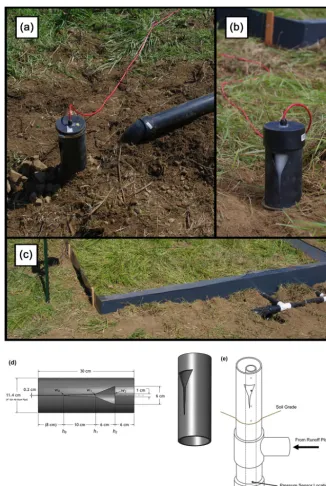
The UBeTube design employed here consisted of a vertical 10 cm (4 inch) diameter pipe with a slot machined into one side (Fig. 1). Schedule 40 aluminum pipe (alloy 6063-T52, though others could be used with equal success) was em-ployed, due to its relatively low cost, strength, rigidity, resis-tance to corrosion, and machinability. Schedule 40 or higher
2. splashing due to incoming water, which causes pressure fluctuations, is minimized;
3. the runoff system piping can be buried below grade, which protects it, buffers temperature swings, and se-cures the system. Example installations are shown in Fig. 1a, b and c.
It should be noted that having the inflow arrive through the bottom of the pipe could create complicated backwater con-ditions within the runoff delivery pipe, which can alter the shape and timing of the runoff hydrograph. Thus, in certain situations, it may be preferable to have the inflow enter the UBeTube from the top.
The UBeTube instrument’s machined slot can be any shape and dimension, providing the ability to accurately measure a wide range of discharge rates. Our example sys-tem used a slot formed by two superimposed trapezoids: the lower trapezoid had dimensions of 0.2 cm bottom width, 1 cm top width and 10 cm height, while the upper trapezoid had dimensions of 6 cm top width and 6 cm height (Fig. 1c). This allowed the system to be operated with less than 30 cm of pressure head.
By measuring the water height within the pipe, the volu-metric flow rate of water through the trapezoidal slot can be calculated using Bernoulli’s equation. Assuming steady-state conditions, the volumetric flow rate (Q) of water through a slot formed from two superimposed trapezoids (such as is shown in Fig. 1c) can be calculated as follows: when h0≤h≤h1
Q=2
3cw0 p
2gh3/2+ 4
15c
(w1−w0) h1
p
2gh5/2, (1) whenh1< h≤h2
Q=23cw1
√
2g(h−h1)3/2+154c(w(h22−−wh11))
√
2g(h−h1)5/2
+23cw0
√
2g h3/2−(h−h1)3/2
+c(w1−w0)
h1
√
2g(154h5/2+2 5(h−h1)
5/2−2
3h(h−h1) 3/2)
Figure 1. (a, b) Examples of UBeTubes installed below runoff plots; (c) connection between the runoff plots and the UBeTube system; (d) dimensions of the slot as machined (modified with permission from Christopher CNC); and (e) schematic of the instrument setup.
whenh>h2
Q=2
3cw1
√
2g((h−h1)3/2−(h−h2)3/2)+c(w2 −w1)
(h2−h1)
√
2g(154(h−h1)5/2+25(h−h2)5/2−23(h−h1)(h−h2)3/2)
+23cw0
√
2g(h3/2−(h−h1)3/2)+c(w1 −w0)
h1
√ 2g (154h5/2+2
5(h−h1) 5/2−2
3h(h−h1) 3/2)
, (3)
wherehis the water height,gis the gravitational,h0is the height of the bottom of the slot (bottom of the lower trape-zoid),h1is the height of the lower trapezoid,h2is the height of the upper trapezoid, w0 is the slot width at the bottom
±0.1 cm decreases the minimum flow requirement to less than 0.05 L min−1 and greatly improves the overall accu-racy of the instrument (red dotted lines). Thus, the super-imposed trapezoid slot design presented in Figs. 1d and 2c can measure a range of flows spanning more than 3 orders of magnitude: from <0.3 to∼300 L min−1. The minimum flow threshold can be further reduced through optimization of the slot geometry for the expected range of flows; how-ever, very small widths are difficult to machine and are more susceptible to clogging and capillary effects.
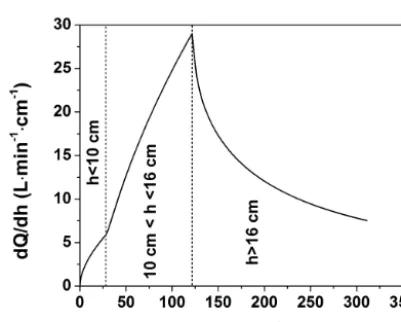
The effect of slot width on instrument sensitivity can also be seen by plotting the derivative of the rating curve (dQ/dh) against the flow rate (Q)(Fig. 3). The rate of change is steep-est in the upper section of the slot, where the width is great-est. Two inflection points can also be seen in the dQ/dhline: the first when the water level transitions from the lower to up-per trapezoid (i.e.,h1), and the second when the water level goes above the top of the slot (i.e., h2). Again, optimizing the slot geometry for the expected range of flows can help to increase the instrument sensitivity.
2.2 Instrument storage
To calculate inflow into the UBeTube instrument (rather than outflow), it is necessary to quantify the water storage within the instrument itself. We recommend the storage equation provided by Stomph et al. (2002b):
It=
S
t−St−1 1t
+
Q
t−Qt−1 2
, (4)
St = π d2ht
4 , (5)
whereItis the inflow into instrument at timet,St is the
stor-age in flowmeter at timet,Qt is the outflow at timet,dis the
pipe diameter,ht is the height of the water within the pipe at
timet, and1tis the time difference between present (t )and previous observations (t-1).
Equation (4) allows for the near-instantaneous calculation of runoff and can allow for the study of runoff timing and shape of the hydrograph. It also is useful for times when the water level is not precisely at the bottom of the notch, due to evaporation or capillary effects (as discussed in Sect. 4).
Based on the mean value for each 5 min repetition, the measurement error ranged from 1 to 25 % (Fig. 4). Error in-creased as a function of flow rate as momentum effects began to dominate and the instrument response became more sensi-tive to water height (as demonstrated by the dQ/dhcurve in Fig. 3). At the same time, our simple bucket-and-stopwatch method for estimating the “true” flow also had greater sys-tematic error at high rates, so it is difficult to determine how much of the observed error was solely attributable to the UBeTube instrument. Future calibration efforts may bene-fit from a more robust method for determining the true dis-charge (such as an inline digital flowmeter).
A calibration factor can be included in the calculation of flow rate to account for roughness in the slot surface and de-viation from steady-state flow conditions. While a number of different correction factor techniques may be suitable, we found that for this particular design a simple first-order cor-rection factor of
c=1−1.4h
100 , h < 32 cm, (6)
reduced the maximum measurement error of the aforemen-tioned laboratory experiment from 25 to 14 % (Fig. 4) and caused the data to closely follow the theoretical 1 : 1 line.
3 Results of field installations
Figure 2. (a) Rating curve for the UBeTube configuration shown in Fig. 1, withc=0.95; (b) the low flow (<3 L min−1)characteristic of the instrument; and (c) schematic showing the slot geometry. The black dashed lines in (a) and (b) show the expected measurement error due to a±0.7 cm water level measurement error within the tube, whereas the red dashed lines show the expected measurement error due to a ±0.1 cm water level measurement error.
Figure 3. Derivative of the rating curve (dQ/dh) plotted against the flow rate (Q). The curve has inflection points ath=10 cm (when the water reaches the top of the first trapezoid) and ath=16 cm (when the water reaches the top of the slot).
rain gauges and for the pressure transducers within the UBe-Tube instruments.
As can be seen, not all precipitation events caused a cor-responding runoff response. For instance, at the Alsea site (Fig. 5b) the first rainfall event on 5 March 2014 did not produce any measurable runoff, likely due to dry antecedent conditions. However, subsequent rainfall events of approx-imately the same magnitude produced runoff rates that ap-proached or exceeded the rainfall rate (the latter occurrence due to run-on being delivered from the adjacent highway sur-face). Moreover, comparing the runoff rates from two exam-ples demonstrates the dynamic range of the UBeTube sys-tem, as it proved itself capable of adequately measuring low flows at the Otis site (∼0.2 mm h−1)and high flows at the Alsea site (up to 40 mm h−1).
Figure 4. Results of the laboratory validation experiment. The un-corrected measurements are represented by the gray-filled circles, while the measurements corrected using Eq. (5) are represented by the open diamonds. Each point represents the mean flow rate mea-sured over a 5 min period.
4 Considerations
Although the UBeTube instrument has proven its capability in measuring flow for plot- and field-scale experiments, we here list several considerations that practitioners should keep in mind when installing and/or using the instrument, to en-sure the quality of collected data:
Figure 5. Examples of field applications of the UBeTube instru-ment in a long-term study measuring highway stormwater runoff produced by highway surfaces within western Oregon. (a) Data come from (a) state highway OR-18 near Otis, Oregon; and (b) state highway OR-34 near Alsea, Oregon. The leftyaxis shows the runoff rate measured by the instrument, and the rightyaxis shows the natural rainfall rate as measured by tipping bucket rain gauges installed at the sites.
our example system) can become damaged if the water around/within them freezes. While installing the sensor below grade (as shown in Fig. 1e) should provide some protection from freezing, we nonetheless recommend field inspection of the installation before and/or after snow events to ensure the quality of data and to verify proper operation of the water level sensor (Fig. 6a).
2. Under ideal conditions, the water level inside the tube would be maintained at the bottom of the thin slot so that whenever there is an inflow event, the water will flow out of the tube instantaneously. However, this can be difficult to achieve in field installations due to water films forming in the slot due to capillary rise (Fig. 6b) or inevitable water loss from evaporation (Fig. 6c). There-fore, the tube should either be refilled to the outlet level prior to expected flow events, or a calibration should be developed to account for flows that occur before the water level reaches the bottom of the slot. Equation (4),
which accounts for storage within the instrument, can also be used in such instances.
3. As water flows into the tube, it will carry sediments and small debris that can pass through the filter mesh in-stalled at the front edge of the collection channel. These sediments and debris can be accumulated in the thin slot and block the flow path, thus, jeopardizing the reliabil-ity of data (Fig. 6c). Regular cleaning may be necessary. 4. The presence of suspended sediment within the still-ing well could increase the fluid density and, thus, cause measurement error. In high sediment environ-ments it may therefore be necessary to account for this effect and/or use alternative methods for measuring wa-ter level, such as capacitance probes.
5. When the UBeTube is installed at places where stormwater runoff does not quickly drain (e.g., at the bottom of a roadside vegetated swale), it is exposed to the risk of being flooded (Fig. 6d), which will prevent the collection of reliable data until the surrounding area drains.
6. Momentum effects can cause pressure fluctuations in both the water level and in the pressure measurements. These effects become more prominent as the flow rates increase, as seen in Fig. 4. Therefore, it is important to have a carefully designed stilling well that can help alle-viate some of the higher-frequency fluctuations. The use of alternative (non-pressure) water level sensors, such as capacitance probes, may also reduce error from momen-tum effects. Moreover, as previously mentioned, such sensors might also be preferable in high sediment sys-tems.
5 Conclusions
flows at the plot scale. The design is small, sturdy (no moving parts), and can measure both low (∼0.05 L min−1)and high (∼300 L min−1) flows, with increased range possible de-pending on the configuration of the instrument. The instru-ment is capable of high accuracy, dependent on the resolu-tion and accuracy of the measurement of water level within the instrument. Our laboratory measurements showed the er-ror ranging from 1 to 25 % (over a flow rate range of 2– 40 L min−1), which could be reduced to<14 % with a sim-ple first-order correction. Additional reductions in error can likely be attained by using a combination of more accurate pressure sensors, more robust correction factors, and/or by optimizing the slot geometry to the expected conditions.
Most important, the instrument is low-cost, as a single instrument can be manufactured and installed for less than USD 150 (not including water measurement sensor and data-logging costs). The instrument has thus far been used in two field-based studies, providing multiple years of near-continuous runoff data. We presented sample plot-scale data showing that the instrument is capable of providing reliable, near-continuous measurements of surface runoff. Overall, the combination of reliability, accuracy and affordability makes the UBeTube a practical choice for measuring runoff.
Acknowledgements. This work was performed under two grants: National Science Foundation award 0943682, and Oregon De-partment of Transportation award 13-025. The authors would like to acknowledge the contributions of Majdi Abou Najm of the American University of Beirut, Jon Hesseltine and Zane Rogers of Oregon State University, and recognize Frank Selker of Selkermetrics, LLC, for sparking the original idea that lead to the development of this instrument. Finally, we would like to thank Kevin Christopher of Christopher CNC for his assistance and patience in prototyping the instrument.
Edited by: A. Benedetto
References
Aksoy, H. and Kavvas, M. L.: A review of hillslope and watershed scale erosion and sediment transport models, Catena, 64, 247– 271, 2005.
Ali, G., Oswald, C. J., Spence, C., Cammeraat, E. L., McGuire, K. J., Meixner, T., and Reaney, S. M.: Towards a unified threshold-based hydrological theory: necessary components and recurring challenges, Hydrol. Process., 27, 313–318, 2013.
Betson, R. P.: What is watershed runoff?, J. Geophys. Res., 69, 1541–1552, 1964.
Blair, A., Sanger, D., White, D., Holland, A. F., Vandiver, L., Bowker, C., and White, S.: Quantifying and simulating stormwa-ter runoff in wastormwa-tersheds, Hydrol. Process., 28, 559–569, 2014. Blume, T., Zehe, E., Reusser, D. E., Iroumé, A., and Bronstert, A.:
Investigation of runoff generation in a pristine, poorly gauged catchment in the Chilean Andes I: A multi-method experimental study, Hydrol. Process., 22, 3661–3675, 2008.
Butler, D. M., Franklin, D. H., Cabrera, M. L., Tasistro, A. S., Xia, K., and West, L. T.: Evaluating aeration techniques for decreas-ing phosphorus export from grasslands receivdecreas-ing manure, J. En-viron. Qual., 37, 1279–1287, 2008.
Descroix, L., Viramontes, D., Estrada, J., Gonzalez Barrios, J.-L., and Asseline, J.: Investigating the spatial and temporal bound-aries of Hortonian and Hewlettian runoff in Northern Mexico, J. Hydrol., 346, 144–158, 2007.
Dosskey, M. G., Hoagland, K. D., and Brandle, J. R.: Change in filter strip performance over ten years, J. Soil Water Conserv., 62, 21–32, 2007.
Dunne, T. and Black, R. D.: Partial area contributions to storm runoff in a small New England watershed, Water Resour. Res., 6, 1296–1311, 1970.
Goodrich, D., Schmugge, T., Jackson, T., Unkrich, C., Keefer, T., Parry, R., Bach, L., and Amer, S.: Runoff simulation sensitivity to remotely sensed initial soil water content, Water Resour. Res., 30, 1393–1405, 1994.
Habib, E., Krajewski, W. F., and Kruger, A.: Sampling errors of tipping-bucket rain gauge measurements, J. Hydrol. Eng., 6, 159–166, 2001.
Hashim, G. M., Ciesiolka, C. A. A., Yusoff, W. A., Nafis, A. W., Mispan, M. R., Rose, C. W., and Coughlan, K. J.: Soil erosion processes in sloping land in the east coast of Peninsular Malaysia, Soil Tech., 8, 215–233, 1995.
Hewlett, J. D. and Hibbert, A. R.: Factors affecting the response of small watersheds to precipitation in humid areas, Forest Hydrol., 1967, 275–290, 1967.
Horton, R. E.: Analysis of runoff-plat experiments with varying infiltration-capacity, Trans., Amer. Geophys. Union, 20, 693– 711, 1939.
Hudson, N. W.: Field measurement of soil erosion and runoff, FAO, Rome, Italy, 1993.
Humphrey, M., Istok, J., Lee, J., Hevesi, J., and Flint, A.: A new method for automated dynamic calibration of tipping-bucket rain gauges, J. Atmos. Ocean. Tech., 14, 1513–1519, 1997. Jones, O. D., Sheridan, G. J., and Lane, P. N.: Using queuing theory
to describe steady-state runoff-runon phenomena and connectiv-ity under spatially variable conditions, Water Resour. Res., 49, 7487–7497, 2013.
McDonnell, J. J.: Where does water go when it rains? Moving be-yond the variable source area concept of rainfall-runoff response, Hydrol. Process., 17, 1869–1875, 2003.
McGuire, K. J. and McDonnell, J. J.: Hydrological con-nectivity of hillslopes and streams: Characteristic time scales and nonlinearities, Water Resour. Res., 46, W10543, doi:10.1029/2010WR009341, 2010.
Meals, D. W. and Braun, D. C.: Demonstration of Methods to Re-duce Runoff from Dairy Manure Application Sites, J. Environ. Qual., 35, 1088–1100, 2006.
Nearing, M., Wei, H., Stone, J., Pierson, F., Spaeth, K., Weltz, M., Flanagan, D., and Hernandez, M.: A rangeland hydrology and erosion model, Trans. ASABE, 54, 1–8, 2011.
Srinivasan, M., Wittman, M., Hamlett, J., and Gburek, W.: Surface and subsurface sensors to record variable runoff generation areas, Trans. ASAE, 43, 651–660, 2000.
Steenhuis, T. S., Hrnˇcíˇr, M., Poteau, D., Romero Luna, E. J., Tilahun, S. A., Caballero, L. A., Guzman, C. D., Stoof, C. R., Šanda, M., Yitaferu, B., and Císlerová, M.: A Saturated Excess Runoff Pedotransfer Function for Vegetated Watersheds, Vadose Zone J., 12, 1–10, doi:10.2136/vzj2013.03.0060, 2013. Stewart, R. D., Hut, R., Rupp, D. E., Gupta, H., and Selker, J. S.: A
resonating rainfall and evaporation recorder, Water Resour. Res., 48, W08601, doi:10.1029/2011WR011529, 2012.
2002b.
Van de Giesen, N., Stomph, T., and De Ridder, N.: Scale effects of Hortonian overland flow and rainfall–runoff dynamics in a West African catena landscape, Hydrol. Process., 14, 165–175, 2000. Yu, B., Rose, C. W., Coughlan, K., and Fentie, B.: Plot-scale
rainfall-runoff characteristics and modeling at six sites in Aus-tralia and Southeast Asia, Trans. ASAE, 40, 1295–1303, 1997. Zhao, S., Dorsey, E., Gupta, S., Moncrief, J., and Huggins, D.: