Promoting mathematics teaching in the framework of STEM
integration
Maria Cristina Costa1,3 and António Domingos2,3
1Instituto Politécnico de Tomar, Portugal; [email protected]
2Faculdade de Ciências e Tecnologia, Universidade Nova de Lisboa, Portugal; [email protected] 3UIED* - Research Education and Development Unit, Universidade NOVA de Lisboa, Lisbon,
Portugal.
*This work is supported by national funds through FCT - Foundation for Science and Technology, I. P., in the context of the project PTDC/CED-EDG/32422/2017
A growing number of studies and reports all over the world refer to the importance of integrating Science, Technology, Engineering and Mathematics (STEM), in order to meet the increasing challenges of the 21st Century. In particular, STEM education can be an innovative way of learning and teaching mathematics. But, despite recommendations to relate these subjects, there is lack of research about STEM integration and there is the need of more empirical research about this subject. This paper presents an empirical study about the development and implementation of mathematical interdisciplinary tasks related to STEM integration in the context of primary school teachers Continuing Professional Development. With a qualitative methodology and an interpretative approach based on a case study, findings of our research show that it is possible to promote the teaching of mathematics in the framework of STEM integration by supporting teachers in the development and implementation of interdisciplinary tasks.
Keywords: Hands-on, mathematics education, primary school, professional development, STEM education.
Introduction
A growing number of studies and reports, all over the world, refer to the importance of integrating Science, Technology, Engineering and Mathematics (STEM) in order to meet the increasing challenges of the 21st Century (Baker & Galanti, 2017; Rocard et al., 2007). In addition, integrative
approaches among STEM subjects have positive effects on student attainment, with better results in elementary school (Becker & Park, 2011). In particular, “Integration of mathematics with Science, Technology and Engineering (STE) provides students with the context in which they can make meaningful connections between mathematics and STE subjects” (Becker & Park, 2011, p.25). This paper aims to contribute to research by presenting an empirical study about the development and implementation of mathematical interdisciplinary tasks related to STEM integration, in the context of a collaborative Continuing Professional Development Program (CPDP) targeted to primary school teachers. In this regard, our research question is: how to promote the teaching of mathematics in the framework of STEM integration? In our STEM integration framework, we refer to tasks related to all the STEM subjects, i.e., tasks that integrate Science, Technology, Engineering and Mathematics. In these tasks, we intend to emphasize Mathematics. Based on the case study of a
primary teacher, who participated in the CPDP, we analyse the STEM tasks designed and implemented by the teacher.
Literature Review
Despite the increasing calls for the promotion of STEM education, there is no agreement about a definition. In this regard, Baker and Galanti (2017) refer that the academic community “struggle to define STEM integration” (p. 2). For example, several authors refer to STEM by only integrating two disciplines (Ríordáin, Johnston, & Walshe, 2016; Treacy & O’Donoghue, 2014). Concerning this matter, Stohlmann (2018) refers different interpretations of several authors and claims that mathematics should be more emphasized in STEM integration. In this sense, STEM education can be a form of innovation for teaching mathematics (Fitzallen, 2015) and to increase mathematical performance (Stohlmann, 2018).
However, despite relating STEM subjects has been widely advocated by several authors, there is lack of research about STEM integration and there is a need for more empirical research about this subject (Becker & Park, 2011). Also, there is the need to develop research to understand how STEM integration can promote mathematics education (Baker & Galanti, 2017). In particular, there is lack of research about science and mathematics integration (Treacy & O’Donoghue, 2014), mainly concerning in-service teachers (Ríordáin et al., 2016).
Kim and Bolger (2017) sustain the creation of a curriculum that integrates STEM, being crucial to involve teachers into interdisciplinary lessons adequate to this approach. In this regard, there is the need to promote their Professional Development (PD) by providing mentoring and support to face the multiple challenges related to sustainable STEM pedagogy (Baker & Galanti, 2017). Also, resources are crucial for teachers and they shape them according to their individual preferences, this being a process of interpretation and design of the resources (Pepin, Gueudet & Trouche, 2013). For Gimeno Sacristán (2000), tasks are teaching and learning activities, carried out in school environments, being inserted into the curriculum in action. The way how tasks are introduced and conducted by the teacher in the classroom is essential for teaching effectiveness (Ponte, 2005). To improve teaching and learning, it is crucial to develop a partnership between researchers and designers, in order to develop appropriate pedagogical approaches to integrate tasks in the classroom (Geiger, Goos, Dole, Forgasz, & Bennison, 2014). Also, it is fundamental to create a network that motivates teachers and contributes to the sustainability of their professional development (Hewson, 2007; Rocard et al., 2007). A PD program will only be successful if teachers can apply in their classrooms what they learned and experienced during training (Buczynski & Hansen, 2010). In fact, a PD only achieve real effects if innovation is appropriated by the teachers and transformed into their own practice (Zehetmeier, Andreitz, Erlacher, & Rauch, 2015).
Methodology
Based on the literature review recommendations, a partnership amongst university teacher’s educators, local schools and a Continuing Training Centre was established, in 2015, in order to develop a CPDP that is adequate to local primary school teachers’ needs (Costa & Domingos, 2017, 2018). With a total duration of 26 hours, the program lasts an entire school year (September to June)
and includes STEM related workshops with a 2-3 hours duration. By the end of each school year teachers present a portfolio with a critical account on the CPDP and their proposals and implementation of innovative practices. In this context, teachers may choose a science theme to develop in the classroom with their students by integrating with the other STEM topics. So far, more than 70 teachers participated in the CPDP from 2015/2016 to 2017/2018 school year.
In this research, we use a qualitative methodology and an interpretative approach by resorting to a case study. According to Yin (2005), a case study is an empirical investigation that looks at a contemporary phenomenon within its real-life context, allowing a generalization of the obtained results. Data collected include participant observation (first author of the paper is a participant observer) and portfolios compiled by the teachers (Cohen, Lawrence, & Keith, 2007). Participant observation takes place in the workshops with the teachers (to learn and practice what they are expected to implement) and at their classrooms (to support and observe them in action). When necessary, some semi-structured interviews are conducted to better interpret the case. In a first stage documental analysis was performed in teachers’ portfolios in order to look for evidence of STEM contents. It was verified that most teachers chose astronomy or sound to implement in the classroom, and electricity is always at the bottom of their choices. This is the main reason why we decided to present the case study of Josefina (fictitious name) who chose electricity experiments to develop mathematical interdisciplinary tasks.
Teacher Josefina (42 years old, 18 years of service, in charge of a 3rd and 4th grade class) participated in the CPDP during the school year 2016/2017 and decided to conduct electricity experiments in her classroom with the educators help. The teacher’s educators visited her class for two afternoons to observe and/or to help her implement some hands-on tasks. At the end of the CPDP, teacher Josefina (like all the other teachers) presented a portfolio with a critical account about the CPDP and documentary evidence of the activities that she performed with her students.
Data analysis, results and discussion
In this section, we begin by analyzing the case study of teacher Josefina that shows the development and implementation of mathematical tasks within the context of STEM integration, in particular related to electricity.
Josefina’s case study
Based on classroom observations, semi-structured interviews and the teacher’s portfolio, we realized that, in the first session, Josefina introduced the electrical current topic by calling students’ attention to sustainable development using videos and information from the Internet. After, she asked the students to bring to class batteries that they had at home and that did not work.
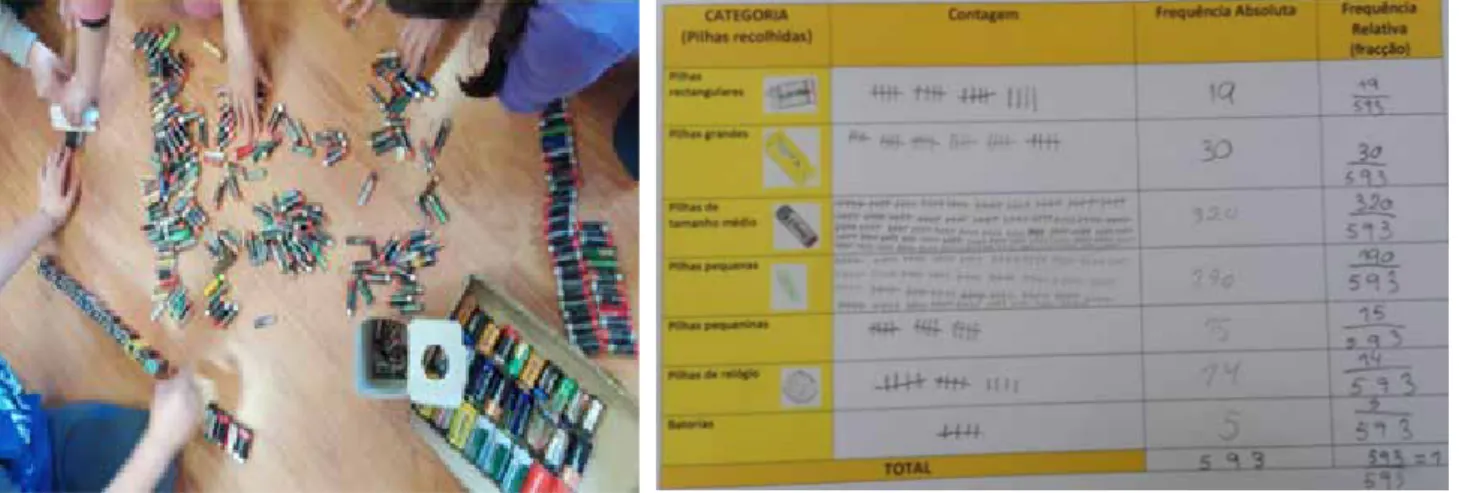
In a second class, using the batteries, she asked the students to organise them according to their sizes and models (Figure 1). Next, they counted the different types of batteries and with this data, students produced graphics and diagrams, amongst other mathematical tasks.
In another class, with the educators’ help, the teacher introduced concepts like potential difference (p.d.) and asked the students to verify if the batteries still had “energy” using multimeters. The students were organised in groups, and each group used a multimeter to measure the p.d. of each
battery. After measuring they registered the p.d. (in volts) in a table. The batteries with more p.d. were saved to be used in future hands-on experiments.
Figure 1: Collection, organisation and processing of data from the batteries
In a third session, teacher Josefina organised her students in groups of two or three, in order to implement several hands-on tasks. After training how to create electrical circuits to light one or two lamps (some of them used the batteries they saved in the previous class) the teacher decided to work mathematics. She gave a battery to each group and asked the students to measure and register the battery p.d. in volts (V). Then, she introduced biological batteries using fruit or vegetables and asked to measure their p.d., amongst other measurements (Figure 2).
Figure 2: Potential difference and intensity measurements from fruit and vegetables
The following excerpt of a dialogue shows how the teacher conducted the hands-on tasks using inquiry:
Josefina: What is the potential difference (p.d.) of the orange? Student: It is 0,51 volts.
Josefina: How much p.d. does the lamp need to light up? Student: It needs 1,5 volts. Look! It’s almost the triple!
Josefina: Then … how many oranges do you need to light up the lamp? Student: Three.
Student: It will be about half of the orange.
Josefina: Cut the orange in two pieces and measure the p.d. of each piece! Student: No! It´s not right! It gave almost the same as the orange!
Josefina: Cut those two pieces in another two pieces and measure again! What do you think it will happen?
Student: Maybe it will happen the same! Yes! The size of the fruit doesn’t count! Josefina: Do you need three oranges to light the lamp?
Student: No! Let’s see ... I think three pieces are enough. Let’s see what happens…It worked!
After an explanation and discussion about the experiments, the teacher continued the inquiry. Each group had different pieces of fruit or vegetables at their table.
Josefina: Each group is going to choose different pieces of fruit or vegetable and measure its potential difference and give me the result!
While students told the results, the teachers registered them on the black board. After having all the results registered, she continued the inquiry:
Josefina: Which is the fruit with the bigger potential difference? Student: The tomato!
Josefina: Which biological battery has the least potential difference? Student: The mushroom!
The teacher continued asking questions while introducing the concepts. For another section, she created a worksheet to perform more mathematical tasks such as organisation and processing of data from the measurements obtained in the last class. She also created problems to be solved by students. The above dialogue shows that she was able to perform mathematical tasks from the hands-on experiments, in particular mathematical tasks in the framework of STEM integration. Indeed, Josefina developed hands-on tasks based on concepts and procedures from mathematics and science while incorporating the design methodology of engineering and using appropriate technology (Shaughnessy, 2013). In particular, mathematics was worked in all the tasks, namely “Numbers and Operations” when students organized and counted the old batteries; “Geometry” when they organized the batteries according to their patterns and sizes and draw the different types of batteries; and “Data Organisation and Processing” when building tables to register and work the collected data from the batteries (Figure 1). Also, Josefina was able to introduce biological batteries and to teach the students to perform several measurements such as the p.d. in volts (V) and to develop the hands-on tasks using inquiry to lead the students to reflect on the performed experiments and discuss in order to obtain conclusions.
Concerning the way teacher Josefina introduced and implemented the tasks, we consider these are exploratory, investigative tasks. In this regard, students performed the tasks guided by the teacher who asked questions to lead them to search for answers. One example is related to the question “How much potential difference does the lamp need to light up?” and “Do you need three oranges to
light the lamp?” To answer the questions students developed several activities in order to understand and gain knowledge about this theme.
Table 1 shows the contents of the STEM tasks developed and implemented by teacher Josefina. Table 1. Contents of the tasks implemented by teacher Josefina
Science Technology Engineering Mathematics
Electricity. Computer Internet Video Multimeters, Lamps, interrupters, etc. Planning, designing and performing electrical circuits.
Measuring the p.d. of the batteries in volts.
“Numbers and Operations” when students organized and counted batteries. “Geometry” when they organized the batteries according to their patterns and sizes and draw the different types of batteries.
Data Organisation and Processing” when building tables to register and work the collected data from the batteries.
Next, we present some excerpts of the teacher’s reflections that she wrote in her final report.
I was able to apply some new practices and methodologies in the context of the classroom, incorporating mathematics and science experiments (Josefina final report, June 2017).
The overall results of this training workshop are clearly positive: (…) enabled me to acquire / apply new knowledge in the context of the classroom (…); as well as collaboration including the sharing of good practices and the difficulties experienced (Josefina final report, June 2017). In summary, teacher Josefina recognised that she gained skills to innovate her practices by highlighting the collaborative context of the CPDP. In addition, she developed exploratory, investigative tasks to work mathematics topics related to STEM.
Final considerations
This paper aims to contribute to existing literature by presenting an empirical study about the development and implementation of mathematical tasks in the framework of STEM integration. To face challenges related to STEM integration it is recommended to develop an adequate teachers’ PD context (Baker & Galanti, 2017; Treacy & O’Donoghue, 2014), being crucial to provide a collaborative environment that supports the teachers to innovate their practices (Capps & Crawford, 2013; Costa & Domingos, 2017). According to Buczynski and Hansen (2010), a PD program will only be successful if teachers can implement, in practice, with their students, what they learned and experienced during their training. Also, Zehetmeier et al. (2015) sustain that innovations should be appropriated by those who implement them and transformed into their practice to have real effects. We believe this is what happened to teacher Josefina who designed and implemented interdisciplinary tasks that are not part of teachers’ traditional practices. In fact, Josefina was able to introduce commercial and biological batteries and to teach the students to perform several measurements such as the p.d. in volts (V). She also developed several hands-on tasks using inquiry to lead the students to reflect on the performed experiments and obtain conclusions.
Based on Josefina’s case study, it was verified that she implemented several mathematical tasks in the framework of STEM integration (Table 1). Indeed, Josefina developed hands-on tasks based on concepts and procedures from mathematics and science while incorporating the design methodology of engineering and using appropriate technology (Shaughnessy, 2013).
Josefina’s example shows how to develop exploratory and investigative mathematical tasks from hands-on STEM experiments. Mathematical tasks proposed by the teacher and performed by the students included problems and exercises related to several topics of the Portuguese curriculum such as “Numbers and Operations”, “Geometry”, and “Data Organisation and Processing”, including tables, graphics and diagrams.
We observed that teacher Josefina promoted mathematics teaching in the framework of STEM integration by developing and implementing several interdisciplinary tasks in the classroom related to these subjects. Teacher Josefina’s example shows that it is possible to work mathematics while performing several hands-on STEM tasks in class. We conclude that to promote mathematics’ teaching in the framework of STEM integration it is necessary to provide teachers with a collaborative professional development context that supports them in the development and implementation of interdisciplinary tasks.
References
Baker C K, Galanti T M. (2017). Integrating STEM in elementary classrooms using model-eliciting activities: responsive professional development for mathematics coaches and teachers. International Journal of STEM Education. 4(1), 1-15.
Becker, K., & Park, K. (2011). Effects of integrative approaches among science, technology, engineering, and mathematics (STEM) subjects on students’ learning: A preliminary meta-analysis. Journal of STEM Education, 12(5 & 6), 23-37.
Buczynski, S., & Hansen, C. B. (2010). Impact of professional development on teacher practice: Uncovering connections. Teaching and Teacher Education, 26(3), 599-607.
Bybee, R. W. (2010). Advancing STEM education: A 2020 vision. Technology and Engineering Teacher, 70(1), 30.
Capps, D. K., & Crawford, B. A. (2013). Inquiry-based professional development: What does it take to support teachers in learning about inquiry and nature of science? International Journal of Science Education, 35(12), 1947-1978.
Cohen, L., Lawrence, M., & Keith, M. (2007). Research methods in education. 6th Edition. Taylor and Francis Group.
Costa, M. C., & Domingos, A. (2017). Innovating teachers’ practices: potentiate the teaching of mathematics through experimental activities. Dooley, T., & Gueudet, G. (Eds.) (2017).
Proceedings of the Tenth Congress of the European Society for Research in Mathematics Education (CERME 10, February 1-5, 2017, pp. 2828-2835). Dublin, Ireland: DCU Institute of Education and ERME.
Costa, M. C., & Domingos, A. (2018). Promoting STEAMH at primary school: a collaborative interdisciplinary project. New Trends and Issues Proceedings on Humanities and Social Sciences. 4(8), 234-245.
Fitzallen, N. (2015). STEM Education: What does mathematics have to offer? In M. Marshman (Eds.). Proceedings of the 38th Annual Conference of the Mathematics Education Research Group of Australasia, Sunshine Coast,pp. 237-244.
Geiger, V., Goos, M., Dole, S., Forgasz, H., & Bennison, A. (2014). Devising principles of design for numeracy tasks. In J. Anderson, M. Cavanagh, & A. Prescott (Eds.), Curriculum in focus: Research-guided practice: Proceedings of the 37th annual conference of the Mathematics Education Research Group of Australasia (pp. 239–246). Sydney: MERGA.
Gimeno Sacristán, J. (2000). O Currículo: uma reflexão sobre a prática [The Curriculum: a reflection on practice]. Tradução [Translation] Ernani Rosa. 3rd Ed. Porto Alegre: Artmed.
Hewson, P.W. (2007). Teacher professional development in science. In Abell, S. K., & Lederman, N. G. (Eds.), Handbook of Research on Science Education (pp. 1177-1202). York: Routledge. Pepin B, Gueudet G, Trouche L. (2013). Re-sourcing teachers’ work and interactions: A collective
perspective on resources, their use and transformation. ZDM Mathematics Education, 45(7), 929-943.
Kim, D., & Bolger, M. (2017). Analysis of Korean elementary pre-service teachers’ changing attitudes about integrated STEAM pedagogy through developing lesson plans. International Journal of Science and Mathematics Education, 15(4), 587-605.
Office of the Chief Scientist (2016). Australia's STEM workforce: Science technology, engineering and mathematics. Canberra: Commonwealth of Australian.
Ponte, J. P. (2005). Gestão curricular em Matemática. em GTI [Curricular management in Mathematics in GTI] (Ed.), O professor e o desenvolvimento curricular [The teacher and curriculum development] (pp. 11-34). Lisboa: APM.
Ríordáin M N, Johnston J., Walshe G. (2016). Making mathematics and science integration happen: key aspects of practice. International Journal of Mathematical Education in Science and
Technology, 47(2), 233-255.
Rocard, M., Csermely, P., Jorde, D., Lenzen, D., Walberg-Henriksson, H., & Hemmo, V. (2007).
Science education now: A renewed pedagogy for the future of Europe. Bruxelas: Comissão Europeia.
Stohlmann, M. (2018). A vision for future work to focus on the “M” in integrated STEM. School Science and Mathematics, 118(7), 310-319.
Shaughnessy, J. M. (2013). Mathematics in a STEM context. Mathematics Teaching in the Middle School, 18(6), 324-324.
Treacy, P., & O’Donoghue, J. (2014). Authentic integration: A model for integrating mathematics and science in the classroom. International Journal of Mathematical Education in Science and Technology, 45(5), 703-718.
Yin, R. K. (2005). Estudo de caso: Planejamento e métodos (3.ª Ed). Porto Alegre: Bookman. Zehetmeier, S., Andreitz, I., Erlacher, W., & Rauch, F. (2015). Researching the impact of teacher
professional development programmes based on action research, constructivism, and systems theory. Educational Action Research, 23(2), 162-177.