Annotation of Conceptual Co-reference and Text Mining the
Qur’an
Abdul Baquee Muhammad
Submitted in accordance with the requirements for the degree of Doctor of Philosophy
The University of Leeds School of Computing
September, 2012
The candidate confirms that the work submitted is his own and that appropriate credit has been given where reference has been made to the
work of others.
This copy has been supplied on the understanding that it is copyright material and that no quotation from the thesis may be published without
Dedication
ـ لياولحا نحمرلا دبع نب رفس روتكدلل ةحورطلأا هذه يدهأ
ةعمابج ةديقعلا مسق سيئر
اقباس ىرقلا مأ
.
رودي ًاملح هاروتكدلا جمانبرب قاحتللاا ةركف تلظ دقل
لىإ يرطاخ في
جشتو همعدل ناكف .هب تيقتلا نأ
هعي
.ثحبلا اذه ماتملإ يربكلا رثلأا
I dedicate this thesis to Dr. Safar ibn Abdur-Rahman Al-Hawali – former dean of Islamic theology Department, Umm Al-Qura University, Makkah, Saudi Arabia. Pursuing a PhD journey was a dream until I met Dr. Safar. His support and encouragement made this happen.
Declaration
I declare that the work presented in this thesis, is the best of my knowledge of the domain, original, and my own work. Most of the work presented in this thesis have been published. When co-authored with my supervisor, I prepared the first draft and then Eric reviewed and suggested amendments. Publications are listed below:
(Abdul Baquee Muhammad1)
Chapter 2 Sections 2.1 and 2.2
Muhammad, A. and Atwell, E. (2009) A Corpus-based computational model for knowledge representation of the Qur'an. 5th Corpus Linguistics
Conference, Liverpool.
Muhammad, A. and Atwell, Eric, (2012) "QurAna: corpus of the Qur’an annotated with pronominal anaphora", LREC 2012
Atwell, ES; Brierley, C; Dukes, K; Sawalha, M; Muhammad, A (2011) An Artificial Intelligence Approach to Arabic and Islamic Content on the Internet in: Proceedings of NITS 3rd National Information Technology Symposium. 2011.
Chapter 4 Section 4.3
Muhammad, A. and Atwell, E. (2009) A Corpus-based computational model for knowledge representation of the Qur'an. 5th Corpus Linguistics
Conference, Liverpool. Chapter 5
Muhammad, A. and Atwell, Eric, (2012) "QurAna: corpus of the Qur’an annotated with pronominal anaphora", LREC 2012
Chapter 6
Muhammad, A. and Atwell, Eric. (2012) "QurSim: A corpus for evaluation of relatedness in short texts", LREC 2012
Chapter 8
1 My surname was officially changed at the University records from ‘Sharaf’ to ‘Muhammad’ to resolve earlier confusion between surname and father’s name in my passport. Although, in this section I have used the corrected surname, readers may note that my earlier surname i.e.,‘Sharaf’ was used in most of the already published papers.
Muhammad, A and Atwell, Eric (2011) ةينآرقلا روسلل يللآا فينصتلا "Automatic categorization of the Qur’anic chapters". 7th International Computing Conference in Arabic (ICCA11).31th May - 2nd June 2011, Imam Mohammed Ibn Saud University, Riyadh, Saudi Arabia
Chapter 9
Muhammad, A. and Atwell, E. (2009) A Corpus-based computational model for knowledge representation of the Qur'an. 5th Corpus Linguistics
Conference, Liverpool.
In addition all text mining applications cited in chapter 7 were scripted by me and made available online along with their documentation under the website which I own:
Acknowledgements
First and foremost I praise Allah for His bounty and blessings who provided me the strength to research His Words (i.e., the Qur’an) leveraging on the advancement of computational sciences.
I am indebted to my advisor, Dr. Eric Atwell, for the guidance he provided me during my studies. Eric has given me plenty of freedom to explore the directions I was most interested in. At the same time he brought me back to the right focused course, when temptations used to drag me to distant directions. Eric’s comments on draft papers were very instrumental and resulted in quality publications. Eric also was very understanding during the ups and downs of my PhD journey, and I always found in his counselling and support a moral boost towards destination.
I would like to acknowledge Kais Dukes for his Qur’anic Arabic Corpus (QAC). I have used it extensively while annotating Qur’anic anaphora, and it has substantially reduced the manual effort I would had to exercise otherwise . I have enjoyed being part of the Natural Language Processing group at Leeds University. The weekly seminars were very informative and we used to exchange ideas and suggestions on each other’s research. Special thanks to Majdi Sawalha and Justin Washtell for their constructive suggestions and support on various topics.
I would like to thank also the Islamic Development Bank – my employer- for granting me leave to study. My colleagues in the IT Department were very cooperative and supportive during the course of my studies.
This achievement was not possible without the support and understanding of all members of my family. My parents – Dr. Sharful Islam and Fatima Islam- were always behind me with their supplications and encouragement. Kids – Anas, Muhammad, Ayesha and Safiyyah- were very understanding and cooperative when dad spent yet another weekend behind the screen annotating or experimenting with datasets. And of course, my wife – Momtaj Begum- for her patience and support taking care of the kids and guaranteeing a conducive atmosphere for research at home.
Abstract
This research contributes to the area of corpus annotation and text mining by developing novel domain specific language resources. Most practical text mining applications restrict their domain. This research restricts the domain to the Qur’anic Text.
In this thesis, a number of pre-processing steps were undertaken and annotation information were added to the Qur’an. The raw Arabic Qur’an was pre-processed into morphological units using the Qur’anic Arabic Corpus (QAC). Qur’anic terms were indexed and converted into a vector space model using techniques in Information Retrieval (IR). In parallel, nearly 24,000 Qur’anic personal pronouns were annotated with information on their referents. These referents are consolidated and organized into a total of over 1,000 ontological concepts. Moreover, a dataset of nearly 8,000 pairs of related Qur’anic verses are compiled from books of scholarly commentary on the Qur’an. This vector space model, the pronoun tagging, the verse relatedness dataset, and the part-of-speech tags available in QAC all together served for a number of Qur’anic text mining applications which were rendered online for public use. Among these applications: lemma concordance, collocation, POS search of the Qur’an, verse similarity measures, concept clouds of a given verse, pronominal anaphora and Qur’anic chapter similarity.
Furthermore, machine learning experiments were conducted on automatic detection of verse similarity/relatedness as well as categorization of Qur’anic chapters based on their chronology of revelation. Domain specific linguistic features were investigated to induct learning algorithms. Results show that deep linguistic and world knowledge is needed to reach the human upper bound in certain computational tasks such as detecting text relatedness, question answering and textual entailment. However, many useful queries can be addressed using text mining techniques and layers of annotations made available through this research. The works presented here can be extended to include other similar texts like Hadith (i.e., saying of Prophet Muhammad), or other scriptures like the Gospels.
Table of Contents
Dedication ... ii
Declaration ... iii
Acknowledgements ... v
Abstract ... vi
Table of Contents ... vii
List of Tables ... xiii
List of Qur’anic Verses ... xiv
List of Figures ... xvii
Chapter 1 Introduction ... 1
1.1 Proposed Text Mining Solution ... 1
1.2 Novel Contributions of this thesis ... 2
1.3 Potential Usage of the resources produced by this thesis ... 3
1.3.1 Arabic NLP ... 3
1.3.2 Computational Text similarity and relatedness ... 4
1.3.3 Computational Anaphora Resolution ... 4
1.3.4 Computational Stylistics ... 4
1.3.5 Translation studies ... 5
1.4 Thesis Outline ... 6
1.5 Summary ... 7
Chapter 2 Background on the language of the Qur’an ... 9
2.1 What is the Qur’an?... 9
2.1.1 Classical Arabic (CA) vs. Modern Standard Arabic (MSA) ... 9
2.1.2 Inimitability of the Qur’an ... 10
2.1.3 Some Linguistic features ... 10
2.1.3.1 Scattered information on the same topic ... 11
2.1.3.2 Literal vs. technical sense of a word... 11
2.1.3.3 Verbs preposition binding ... 12
2.1.3.4 Metaphor and Figurative use ... 13
2.1.3.5 Metonymy ... 13
2.1.3.6 Imperative vs. non-Imperative senses ... 14
2.1.4 Why computational analysis of the Qur’an? ... 14
2.2.1 Pronominal System in Arabic ... 17
2.2.2 Anaphora in the Qur’an ... 18
2.2.2.1 Pronoun antecedent agreement in the Qur’an... 20
2.3 Text Similarity and relatedness in the Qur’an ... 22
2.3.1 Ambiguity in resolving the sense of a noun ... 22
2.3.2 Ambiguity in resolving the sense of a verb ... 23
2.3.3 Ambiguity in resolving the sense of a particle ... 24
2.3.4 Clarifying the meaning of an indefinite word ... 24
2.3.5 Clarifying an indefinite subject through a relative clause .... 25
2.3.6 Overriding Linguistic Defaults ... 25
2.3.7 Cause of an action in different Verse ... 26
2.3.8 Reason of an action in different Verse ... 26
2.3.9 Mentioning the Object of a Subject in different verse ... 27
2.3.10 Mentioning the Adverb of Place and Time in another verse ... 27
2.3.11 Specify Semantic Role in a different verse ... 28
2.3.12 Clarify a difficult vocabulary in another verse ... 28
2.3.13 Specifying whether a condition is being fulfilled ... 29
2.3.14 Explicit reference to another verse ... 29
2.4 The Qur’an Translations ... 30
2.5 Qur’an Exegesis (Tafsir books) ... 30
2.5.1 Significance of books of Tafsir ... 30
2.5.2 Tafsir Methodologies ... 32
2.6 Summary ... 33
Chapter 3 Literature Review ... 34
3.1 Computational Qur’anic Studies ... 34
3.1.1 Computational Clustering ... 34
3.1.1.1 Thabet 2005 ... 34
3.1.1.2 Moisl 2009 ... 35
3.1.2 Computational Stylistic Studies ... 37
3.2 Anaphora Resolution ... 38
3.2.1 Automatic resolution systems ... 39
3.3 Computational text similarity and relatedness ... 40
3.3.1 Evaluation Corpora for Text Similarity and Relatedness experiments ... 40
3.3.2 Knowledge Sources for similarity and relatedness
experiments... 41
3.3.3 Semantic relatedness measures ... 41
3.3.3.1 Path-Based Measures ... 41
3.3.3.2 Information Content based measures ... 42
3.3.3.3 Gloss based measure ... 42
3.3.3.4 Concept vector based measures ... 42
3.3.4 Text similarity and relatedness applications ... 42
3.4 Summary ... 43
Chapter 4 Linguistic Annotations of the Qur’an ... 44
4.1 Raw Qur’anic Text ... 44
4.1.1 Qur’anic Pause Marks ... 44
4.1.1.1 Mandatory Pause (M) ... 45
4.1.1.2 Voluntary Pause (V) ... 45
4.1.1.3 Voluntary Pause where continuation preferred (VC) ... 46
4.1.1.4 Voluntary Pause where pause preferred (VP) ... 46
4.1.1.5 Exclusive OR pause (XOR) ... 47
4.1.2 Qur’anic Pause Mark Annotation ... 47
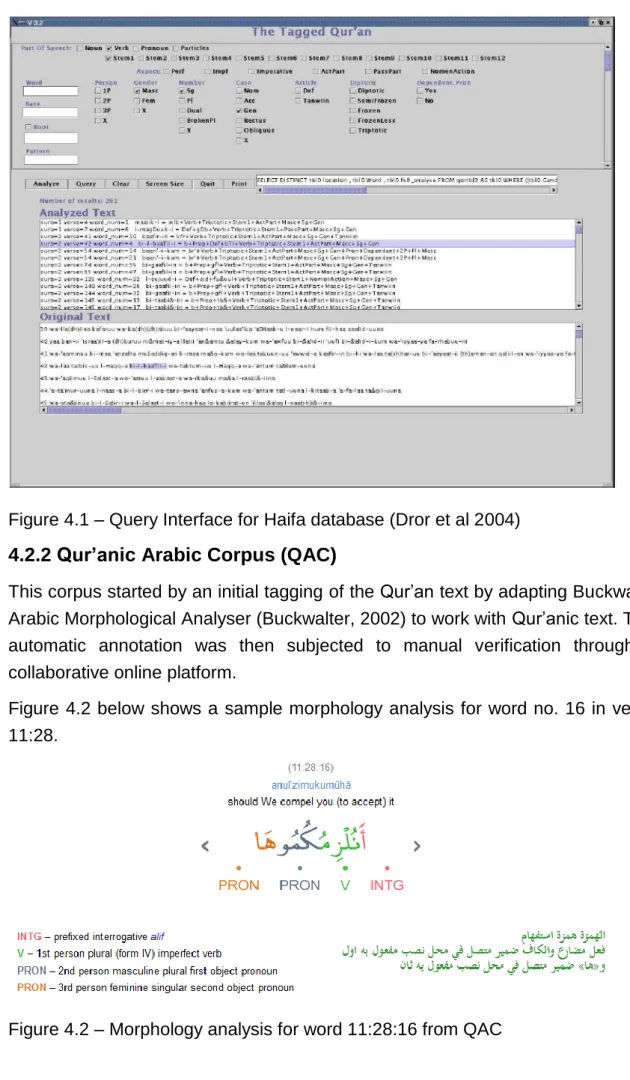
4.2 Morphological Annotation ... 47 4.2.1 Haifa Corpus ... 47 4.2.1.1 Lexicon ... 48 4.2.1.2 Finite-State Rules ... 48 4.2.1.3 Query Interface ... 49 4.2.1.4 Evaluation ... 49
4.2.2 Qur’anic Arabic Corpus (QAC) ... 50
4.3 Syntactic Annotation... 51
4.3.1 Qur’anic Arabic Dependency Treebank... 51
4.3.2 Pronoun antecedent annotation ... 53
4.4 Semantic Annotation ... 54
4.4.1 Frame Semantics ... 54
4.4.2 Qur’anic Prepositional Verbs ... 56
4.5 Other annotation research ... 57
4.5.1 Qur’anic Concept Ontology ... 57
4.5.2 Annotation of intonation and pronunciation (Tajweed) ... 58
4.6.1 Sampling and Representativeness ... 60
4.6.2 Finite Size ... 62
4.6.3 Machine-readable form... 62
4.6.4 Standard Reference ... 63
4.7 Summary ... 63
Chapter 5 QurAna: Corpus of the Qur’an annotated with Pronominal Anaphora ... 64
5.1 Introduction ... 64
5.2 Annotation Scheme ... 64
5.2.1 Related annotation schema ... 64
5.2.2 QurAna Annotation Schema ... 66
5.3 Annotation Process ... 67
5.4 Concept Ontology from QurAna ... 68
5.5 Quality Assurance ... 70
5.6 Applications ... 71
5.7 Quantitative Measures of QurAna ... 72
5.8 Challenges and future improvement ... 73
5.9 Summary ... 75
Chapter 6 QurSim: A corpus for evaluation of relatedness in short texts ... 76
6.1 Introduction ... 76
6.2 Book of Tafsir by Ibn Katheer ... 77
6.3 Compilation process ... 77
6.3.1 Dataset filtration and extension ... 78
6.4 Quality Assurance ... 81
6.5 Applications ... 82
6.6 Challenges ... 83
6.7 Future Improvements ... 85
6.8 Summary ... 86
Chapter 7 Text Mining Application on the Qur’an ... 87
7.1 Qur’anic Concordancer: QurConcord ... 87
7.2 QurAna: Qur’anic Pronoun Referents Application ... 89
7.3 Qur’anic Verse Similarity and Relatedness Application ... 92
7.3.1 Lexical Similarity ... 92
7.3.1.1 PHP Similar_Text function ... 92
7.3.1.3 Vector Similarity using TF-IDF ... 94
7.3.1.4 Verse segment lexical similarity ... 96
7.3.2 Semantic Relatedness through QurSim ... 98
7.3.2.1 Graph of network of verses ... 98
7.3.2.2 directly and indirectly related verses ... 99
7.3.2.3 concept clouds ... 101
7.3.3 Semantic relations between Qur’anic chapters ... 101
7.4 n-Gram Search ... 102
7.5 Qur’anic Word Co-Occurrence ... 104
7.6 Color coded POS display ... 105
7.7 QurCloud: Qur’anic Chapter Word Cloud ... 105
7.8 Concept ontology of the Qur’an ... 107
7.9 Summary ... 108
Chapter 8 Machine Learning Experiments ... 109
8.1 Introduction ... 109
8.2 Meccan and Medinan Chapters ... 109
8.2.1 Significance ... 109
8.2.2 Source of Information ... 110
8.2.3 Features of Meccan and Medinan Chapters ... 113
8.2.4 Searching resources ... 115
8.2.5 Counting Features ... 115
8.3 Running Experiments using The WEKA Tool ... 120
8.3.1 ARFF file ... 121 8.3.2 WEKA Explorer ... 122 8.3.2.1 Pre-process panel ... 123 8.3.2.2 Visualize Panel ... 124 8.3.2.3 Classify Panel ... 126 8.3.2.4 Clustering ... 131
8.4 Re-running experiments using QurAna dataset ... 135
8.5 Experiments for calculating verse distance using QurAna and QurSim ... 140
8.6 Summary ... 142
Chapter 9 Conclusion and Future Work ... 144
9.1 Overview ... 144
9.1.1 Overall findings ... 144
Chapter 1 ... 144 Chapter 2 ... 145 Chapter 3 ... 145 Chapter 4 ... 146 Chapter 5 ... 146 Chapter 6 ... 147 Chapter 7 ... 147 Chapter 8 ... 147
9.2 Aims and Objectives ... 148
9.3 Future works ... 149
9.3.1 Improvements on QurAna and QurSim ... 149
9.3.2 Potential Machine Learning applications to Qur’anic Studies ... 150
9.3.2.1 Discovering patterns from Prophet’s companion’s exegesis ... 151
9.3.2.2 Discover patterns and correlations among the seven readings of the Qur’an ... 151
9.3.2.3 Machine Learning on Syntactic and Linguistic Patterns: ... 152 9.3.2.4 Machine Translation ... 153 9.3.2.5 Computational Stylistics ... 154 9.3.2.6 Subjectivity Analysis ... 154 Bibliography ... 156 List of Abbreviations ... 168
Appendix A Header of the download file for QurSim Dataset ... 169
List of Tables
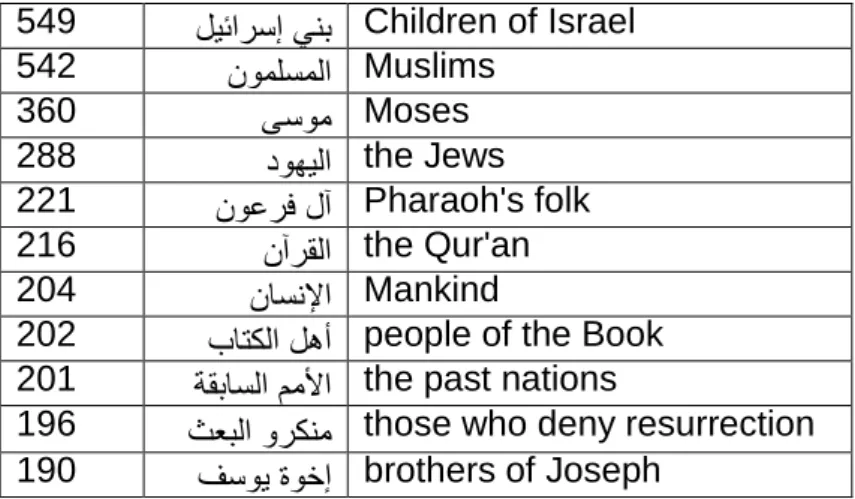
Table 2.1– Arabic Pronominal System ... 18 Table 5.1 - 20 Most frequent concepts in the Qur’an ... 69 Table 5.2 – Quantitative measures from QurAna corpus ... 73 Table 7.1 – comparison of different similarity measures against
verse 27:65 ... 98 Table 8.1 - Meccan (K) and Medinan (D) sūra index. (*) indicates a
debatable case. ... 111 Table 8.2 – Summary of features used to classify Meccan and
Medinan Chapters ... 120 Table 8.3- Analysis of the outcome of J48 classification of the 21
debatable suras. ... 130 Table 8.4 – Count of Prophet names in the Qur’an addressed as
pronouns ... 135 Table 8.5 – Count of eschatological terms in the Qur’an addressed
as pronouns ... 136 Table 8.6 - Count of ‘marriage’ related terms in the Qur’an
addressed as pronouns ... 136 Table 8.7 - Count of the concepts related to ‘People of the Book’ in
the Qur’an addressed as pronouns ... 137 Table 8.8 - Count of the concepts related to ‘pillars of Islam’ in the
Qur’an addressed as pronouns ... 137 Table 8.9 – Attribute counts of 21 test cases for Meccan-Medinan
classification. Prediction-1 shows classifier result before QurAna counts, and Prediction-2 is after incorporating QurAna counts. Shaded cells show the misclassification instances. Shaded columns are the attributes where QurAna was incorporated. ... 140
List of Qur’anic Verses
Qur’anic Verse - 23:67 ... 5 Qur’anic Verse - 2:23 ... 10 Qur’anic Verse - 17:88 ... 10 Qur’anic Verse - 10:38 ... 10 Qur’anic verse - 1:6,7 ... 11 Qur’anic Verse – 4:69 ... 11 Qur’anic Verse – 2:14 ... 13 Qur’anic Verse - 19:4 ... 13 Qur’anic Verse - 33:10 ... 13 Qur’anic Verse - 12:82 ... 14 Qur’anic Verse - 5:75 ... 14 Qur’anic Verse - 2:197 ... 14 Qur’anic Verse - 5:2 ... 14 Qur’anic Verse - 2:124 ... 19 Qur’anic Verse - 5:8 ... 19 Qur’anic Verse - 97:1 ... 19 Qur’anic Verse - 112:1 ... 19 Qur’anic Verse - 33:35 ... 20 Qur’anic Verse - 17:105 ... 20 Qur’anic Verse - 35:9 ... 21 Qur’anic Verse - 10:22 ... 21 Qur’anic Verse - 2:17 ... 21 Qur’anic Verse – 17:106 ... 22 Qur’anic Verse – 39:23 ... 22 Qur’anic Verse – 22:29 ... 23 Qur’anic Verse – 3:96 ... 23Qur’anic Verse – 81:17 (literal translation) ... 23
Qur’anic Verse - 74:33 ... 23
Qur’anic Verse – 91:4 ... 23
Qur’anic Verse - 93:2 ... 23
Qur’anic Verse - 2:7 ... 24
Qur’anic Verse - 2:37 ... 24 Qur’anic Verse - 7:23 ... 24 Qur’anic Verse - 5:1 ... 25 Qur’anic Verse - 5:3 ... 25 Qur’anic Verse - 6:152 ... 25 Qur’anic Verse – 4:6 ... 26 Qur’anic Verse – 6:8 ... 26 Qur’anic Verse - 25:7 ... 26 Qur’anic Verse – 2:74 ... 26 Qur’anic Verse – 5:13 ... 26 Qur’anic Verse – 57:16 ... 27 Qur’anic Verse – 2:51 ... 27 Qur’anic Verse – 20:88 ... 27 Qur’anic Verse – 1:2 ... 27 Qur’anic Verse – 30:18 ... 27 Qur’anic Verse – 28:70 ... 28 Qur’anic Verse – 84:1 ... 28 Qur’anic Verse – 55:37 ... 28 Qur’anic Verse – 69:16 ... 28 Qur’anic Verse – 25:25 ... 28 Qur’anic Verse - 15:74 ... 28 Qur’anic Verse – 51:33 ... 29 Qur’anic Verse – 4:154 ... 29 Qur’anic Verse – 2:65 ... 29 Qur’anic Verse – 16:118 ... 29 Qur’anic Verse – 6:146 ... 30 Qur’anic Verse – 2:219 ... 31 Qur’anic Verse – 4:43 ... 31 Qur’anic Verse – 5:90 ... 31 Qur’anic Verse – 16:44 ... 32 Qur’anic Verse – 6:36 ... 45 Qur’anic Verse – 18:13 ... 45 Qur’anic Verse – 10:107 ... 46 Qur’anic Verse – 28:68 ... 46
Qur’anic Verse – 2:2 – Translation modified from Pickthall to express the pause mark significance ... 47
Qur’anic Verse – 11:70 ... 56 Qur’anic Verse – 54:19 ... 57 Qur’anic Verse – 19:11 ... 57 Qur’anic Verse – 16:71 ... 57 Qur’anic Verse – 4:95 ... 57 Qur’anic Verse - 31:27 ... 60 Qur’anic Verse - 43:3 ... 61 Qur’anic Verse - 26: 192-195 ... 61 Qur’anic Verse - 39:28 ... 61 Qur’anic Verse - 25:33 ... 61 Qur’anic Verse - 20:123 ... 61 Qur’anic Verse – 67 : 5 ... 66 Qur’anic Verse - 23:67 ... 69 Qur’anic Verse - 22:15 ... 70 Qur’anic Verse – 65:1 ... 74 Qur’anic Verse – 67:5 ... 74 Qur’anic Verse – 2:26 ... 78 Qur’anic Verse – 6:44 ... 78 Qur’anic Verse – 78:20 ... 79 Qur’anic Verses – 20:105-107 ... 79 Qur’anic Verse - 78:20 ... 80 Qur’anic Verse - 18:47 ... 80 Qur’anic Verse - 52:10 ... 80 Qur’anic Verse – 2:255 ... 84 Qur’anic Verse – 11:97 ... 84 Qur’anic Verses – 79:21-26 ... 85 Qur’anic Verse - 2:255 ... 97 Qur’anic Verse – 2:219 ... 110 Qur’anic Verse – 5:90 ... 110 Qur’anic Verse – 27:66 ... 142 Qur’anic Verse -5:6 ... 152
List of Figures
Figure 3.1 – Chapter clusters reported by (Thabet 2005) ... 35
Figure 3.2 – Chapter clusters reported by (Moisl 2009) ... 37
Figure 3.3 – A number of Qur’anic chapter chronology systems reported by (Sadeghi 2011) ... 37
Figure 4.1 – Query Interface for Haifa database (Dror et al 2004) ... 50
Figure 4.2 – Morphology analysis for word 11:28:16 from QAC ... 50
Figure 4.3 – Syntactic annotation for verse 1:1 from QADT ... 52
Figure 4.4 - Pronoun resolution of verse 10:58 ... 53
Figure 4.5 – Semantic frames for the concept ‘praise’ in the Qur’an ... 56
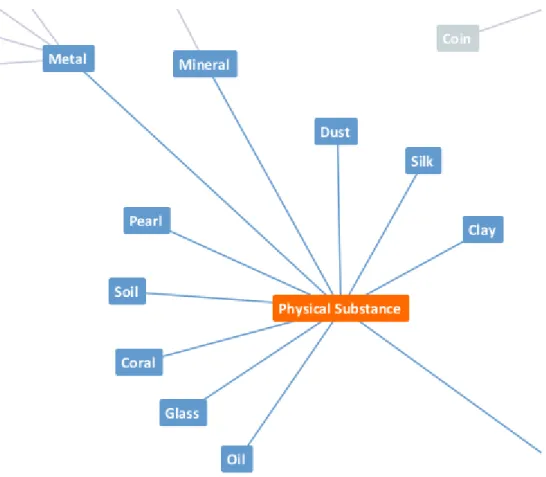
Figure 4.6 - partial concept graph from QAC showing the category ‘physical substance’ ... 58
Figure 4.7 – excerpt from (Taha 2008) showing colour coded annotation of tajweed rules ... 59
Figure 5.1 – Example of annotation scheme from UCREL project (Garside et al. 1997) ... 64
Figure 5.2 – Example of annotation scheme from MUC-7 SGML schema (Hirschman and Chinchor 1997) ... 65
Figure 5.3 – Example of annotation scheme from GNOME project (Poesio 2004) ... 65
Figure 5.4 - Example of annotation scheme from AQA project (Boldrini et al. 2009) ... 66
Figure 5.5 - Example of annotation scheme of Arabic anaphora corpus by (Hammami et al 2009) ... 66
Figure 5.6 – Excerpt from verse 67:5 showing QurAna annotation schema ... 67
Figure 5.7 - Pronoun resolution of verse 38:29 ... 72
Figure 6.1 – A sample QurSim XML representation ... 81
Figure 6.2 - Verses directly related to 7:187 ... 83
Figure 6.3 - Concept cloud from pronoun referents of all related verses to 7:187 ... 83
Figure 7.1 – First 10 concordance lines for the input word “باتك” ... 87
Figure 7.2 – sample concordance lines for the verb ‘eat’ in the Qur’an (Muhammad and Atwell 2009) ... 89
Figure 7.3 - Pronoun resolution of verse 7:25 ... 90
Figure 7.5 – Lexical similarity using PHP Similar_Text()
function ... 93
Figure 7.7 – lexical similarity using vector similarity (TF*IDF) ... 96
Figure 7.8 – Network of verses related directly or indirectly to verse 27:65 from QurSim dataset ... 99
Figure 7.9 – verses directly related to verse 27:65 from QurSim ... 100
Figure 7.10 – Concept cloud from pronouns of all verses related to verse 27:65 ... 101
Figure 7.11 - Relatives of chapter No. 2 “Al-Baqarah”, red nodes are Meccan chapters, whereas green nodes represent Medinan chapters ... 102
Figure 7.12 – The top 5 n-gram patterns for the word Allah with their frequencies. ... 103
Figure 7.13 – Top 5 results from the n-gram (اللهنودنم) “other than Allah” ... 103
Figure 7.14 – Co-occurrences of the Qur’anic word (ءامس) “sky/heaven” ... 104
Figure 7.15 – color coded POS display of chapters 1 and 114 ... 105
Figure 7.16 – Word cloud from chapters 113 and 114 ... 106
Figure 7.17 – first few concepts from Qur’anic pronouns. The number refers to the count of verses under each concept. ... 108
Figure 8.1 - WEKA Explorer pre-processing tab. ... 123
Figure 8.2 – Visualizing all attributes in WEKA ... 124
Figure 8.3 - Visualize pane ... 125
Figure 8.4 – comparing two attributes ... 125
Figure 8.5 - WEKA classification on 93 chapters from the training set ... 126
Figure 8.6 - Decision tree using J48 classifier on 93 chapters ... 127
Figure 8.7 - Decision tree produced by ‘random tree’ classifier ... 127
Figure 8.8 - Decision tree based on ADT classifier. Note that negative values indicate Meccan and positive values indicate Medinan ... 128
Figure 8.9 - Check ‘output predictions’ for machine prediction on the 21 test chapters ... 128
Figure 8.10 - Outcome of the J48 Machine Learning algorithm on the 21 debatable chapters. ... 129
Figure 8.11 - K-Means clustering into 2 clusters ... 132
Figure 8.12 - Cluster of the 114 sūra into two clusters against ‘kalla’ attribute ... 133
Chapter 1
Introduction
This research contributes to the area of corpus annotation and text mining. The objective is to create a platform that enables analysis of unstructured information in search of interesting knowledge embedded within the text. The raw text is usually pre-processed and stored into intermediate representation that contains extra annotated information. The text mining application then performs a series of operations on this intermediate representation to fulfil a user’s request and produce results in a visually appealing format. Text mining thus returns to users information that would otherwise be impossible to discover –or would take a long time- through manual processing. A number of underlying disciplines interact in the background to collectively cater for text mining needs, prominent among them are Natural Language Processing (NLP), Machine Learning (ML) and Information Retrieval (IR).
Although text mining applications can work on unrestricted text, practical and efficient solutions restrict their domain. For example, biomedical text mining solutions offer a wide range of useful applications restricted to the electronic literature available under the biomedical and molecular biology domain. This research restricts its domain to Islamic religious scripture where novel annotations and text mining applications are created on the original Qur’an in classical Arabic. This work can be extended to include other texts in the same domain, like texts of Hadith – i.e., sayings and traditions of Prophet Muhammad, or even religious texts in Modern Standard Arabic. Detailed discussion of the rationale behind choosing this text and domain is given in section 2.1.
1.1 Proposed Text Mining Solution
In order to enable text mining applications on the Arabic Qur’an, a number of pre-processing steps were undertaken and annotation information added to the Qur’an. The raw Arabic Qur’an was pre-processed into morphological units using the Qur’anic Arabic Corpus (QAC). Qur’anic terms were indexed and converted into a vector space model using techniques in IR. In parallel, nearly 24,000 Qur’anic personal pronouns were annotated with information on their referents. These referents are consolidated and organized into a total of over 1,000 ontological concepts. This corpus is named QurAna – or Qur’anic Anaphora
Corpus (see chapter 5). Moreover, a dataset of nearly 8,000 pairs of related Qur’anic verses are compiled from books of scholarly commentary on the Qur’an. This dataset is given the name QurSim – or Qur’anic Similarity Corpus (see chapter 6). The vector space model, the QurAna, the QurSim, and the part-of-speech tags available in QAC all together served for a number of Qur’anic text mining applications which were rendered online for public use. Among these applications: lemma concordance, collocation, POS search of the Qur’an, verse similarity measures, concept clouds of a given verse, pronominal anaphora and Qur’anic chapter similarity (see chapter 7).
Furthermore, machine learning experiments were conducted on automatic detection of verse similarity/relatedness as well as categorization of Qur’anic chapters based on their chronology of revelation into Meccan and Medinan chapters (see chapter 8). Specialized domain attributes and linguistic features were investigated to induct learning algorithms. Results show that in order for machine learning algorithms to reach the human upper bound in certain computational tasks on Qur’anic text, it requires deep linguistic, contextual and external world knowledge. Mostly, these are tasks that require more semantic and discourse analysis, for example, verse relatedness, question answering and textual entailment. However, many useful queries on the Qur’an - discussed by domain scholars since early times- can be addressed using text mining techniques relying on the layers of annotations made available through this research.
1.2 Novel Contributions of this thesis
To the best of my knowledge, no full-fledged computational PhD programme has been conducted earlier on Qur’anic annotation and text mining. The novelty of this research lies in attempting to apply techniques from computational linguistics to a novel domain of the Qur’anic text. Many NLP techniques in Arabic or English NLP were needed to be adapted for the Qur’anic texts. This novel research has motivated other researchers towards the subject, and very often, I receive request from NLP research community requesting for collaboration and extension on this work.
The novel contribution of this thesis to computational Qur’anic studies can be summarized as follows:
Adding a novel annotation layer on the entire Qur’an, i.e., annotation of Qur’anic personal pronouns with their antecedents. To the best of our knowledge, no pronominal annotation on the entire Qur’an exists. See chapter 5 for details.
Compiling a dataset of semantically related verses from a scholarly source, and converting it into machine readable representation that enables computational experimentation. See chapter 6 for details.
Compiling an ontological map of Qur’anic concepts emanating from pronoun referents. Although several topical indexes of the Qur’an exist, the ontology I developed is unique in being grounded on attachment of concepts with each pronoun, and exhaustively covering all the Qur’an. It has been found that the Qur’an exhibits very frequent use of pronouns, which rationalised this initiative to add an ontological map out of pronouns tagging. Existing ontologies and subject maps of the Qur’an can be extended to incorporate our ontology. See section 5.4 for details.
Designing and implementing online text mining applications that enables corpus based language analysis of the Qur’an. This includes: lemma concordance, collocation, POS search of the Qur’an, verse similarity measures, concept clouds of a given verse, pronominal anaphora and Qur’anic chapter similarity. See chapter 7 for details.
Conducting machine learning experiments utilizing Qur’anic Corpus and QurAna and QurSim datasets for a Qur’anic studies classification problem. See chapter 8 for details.
1.3 Potential Usage of the resources produced by this thesis
Further to the novel contribution of this thesis, following is a description of other potential contributions this thesis could add to a number of relevant fields, among them: Arabic NLP, computational text similarity analysis, computational anaphora resolution, stylometrics, and translation studies.1.3.1 Arabic NLP
As the Qur’anic text does not vary much in morphology and syntax from standard modern Arabic (see section 2.1.1), the resources contributed through this thesis will benefit the Arabic NLP community. Particularly, the corpus on anaphora resolution (i.e., QurAna) will be a very useful resource for researchers in the field
of Arabic pronoun resolution. Similarly, the dataset on related verses (i.e., QurSim) is a unique contribution for computational analysis of semantic relatedness in short Arabic texts.
Moreover, the Qur’anic text is considered to be the finest form of Arabic literature, and the resources I contributed on the Qur’an would prove very helpful for researchers of classical Arabic grammar.
1.3.2 Computational Text similarity and relatedness
There has been much research in recent years on semantic relatedness at word level. The task gets more complicated when studying semantic similarity and relatedness at phrasal and sentence level. A major bottleneck towards efficient computational solution is the availability of high-quality evaluation datasets. To this end, the QurSim dataset (see chapter 6 for details) brings relief by providing a comparatively large dataset of pairs of related short texts. As the pairs represent Qur’anic verses that are tagged with unique numbers, and as multiple Qur’anic translations are available, this dataset can easily be ported to other languages and thus could contribute as an evaluation resource for researchers in semantic similarity and relatedness in these languages. In fact, an English version of this dataset was automatically compiled and communicated to Justin Washtell for experimentation using Expectation Vectors (Washtell 2011).
1.3.3 Computational Anaphora Resolution
Pronominal Anaphora constitutes a major portion of overall anaphora in a text. Despite the many useful NLP applications an anaphora resolution system has, not many evaluation corpora exist on this subject. The QurAna corpus (see chapter 5 for details) should fill a gap in this regard. As is the case with QurSim, our annotation of Qur’anic pronouns preserves verse and word numbers thus allowing alignment of pronouns to other word-by-word literal translations of the Qur’an.
1.3.4 Computational Stylistics
Stylistics focuses on the style of the text through various textual features that uniquely identifies the author’s ability to evoke feelings in the audience. The Qur’an has been a subject of such studies since its revelation. The new annotation layer I created (i.e., QurAna) will ease empirical analysis of Qur’anic pronouns for detecting pronominal stylistic features of the Qur’an.
1.3.5 Translation studies
Resolving pronoun antecedents is vital for machine translations. There are already translations of the Qur’an to many languages and often multiple translations within one language. The QurAna corpus will contribute in evaluating the quality of these translations and verifying correct resolution of pronoun antecedents.
Take for an example verse 23:67 as follows1:
رب َنيرربِْكَتْسُم
ره
َنوُرُجْهَ ت اًررماَس
(Being) arrogant / about it, / conversing by night, / speaking evil." /In scorn thereof. Nightly did ye rave together.
Qur’anic Verse - 23:67
The pronoun ‘it’ in this verse has no explicit antecedent mentioned and as such could refer to multiple entities like, Prophet Muhammad, the Qur’an or ‘the house of Allah’. I have found out through empirical experiments that 54% of pronouns in the Qur’an have no antecedence. More elaboration will be given in chapter 5. For this verse and after consulting books of Tafsir, the majority opinion favours that this pronoun refers to ‘the house of Allah’, and as such I have tagged this pronoun accordingly in QurAna. However, when I compared the six English translations for this verse available in (Quran.com) website as listed in the box below, I notice that 2 and 4 marked the reference of the pronoun in brackets as “the Qur’an”, whereas 1,3 and 6 did not included any comments on the referent. Shakir was the most non-literal and replaced the pronoun in the translation with referent. Remarkably, none of these six prominent translators suggested the referent to be “the house of Allah” which is the most appropriate one according to Ibn Katheer (Ibn-Katheer 1372).
1. Sahih International
In arrogance regarding it, conversing by night, speaking evil. 2. Muhsin Khan
1 Unless otherwise mentioned, all English translations were taken from online rendering of (Pickthall 1973) available at http://Quran.com
In pride (they Quraish pagans and polytheists of Makkah used to feel proud that they are the dwellers of Makkah sanctuary Haram), talking evil about it (the Qur’an) by night.
3. Pickthall
In scorn thereof. Nightly did ye rave together. 4. Yusuf Ali
"In arrogance: talking nonsense about the (Qur'an), like one telling fables by night."
5. Shakir
In arrogance; talking nonsense about the Qur’an, and left him like one telling fables by night.
6. Dr. Ghali
Waxing proud against it, forsaking it for entertainment."
This example shows the value-added our corpus provides to the evaluation of existing translations and the active role it can play in building new translations in English or other languages. Moreover, this resource would be useful for authors who would attempt a novel translation of the Qur’an to a language that has no Qur’an translation done yet.
1.4 Thesis Outline
The reminder of this thesis is organized as follows. Chapter 2 is dedicated to a background introduction of the main subjects of this thesis, starting with introducing the text under investigation: the Qur’an. After a general overview of the text, a detailed discussion is given to rationalise usage of this text for text mining and NLP research. In addition, this chapter provides some linguistic background on Arabic pronominal anaphora and text relatedness, particularly focusing on classical Arabic of the Qur’an. This chapter also highlights the importance of Qur’anic translations and Qur’anic exegesis – or books of Tafsir.
Chapter 3 reviews literature on major computational works done under corpus and computational linguistics discipline related to this thesis, particularly areas under: computational Qur’anic studies, anaphora resolution and computational analysis of similarity and relatedness in short texts.
Chapter 4 reviews existing linguistic annotations of the Qur’an. Starting from the raw Qur’anic text, I reviewed available annotations done on the Qur’anic text. A detailed review of two existing corpora on the Qur’an is given: the Haifa corpus and the Qur’anic Arabic Corpus (QAC). In addition, this chapter highlights other partial attempts to annotate the Qur’an with other linguistic and semantic analysis like dependency parse trees and semantic frames. This chapter also investigates corpus features of the Qur’an.
Chapters 5 and 6 give a detailed description of the two major language resources contributed through this thesis, namely QurAna and QurSim respectively. Each chapter describes the annotation scheme, the annotation process, evaluation, quality assurance, applications and major challenges and future improvements.
Chapter 7 describes a number of text mining applications created online using the language resources discussed earlier, i.e., QAC, QurAna, and QurSim. The usefulness of each application to the domain users is emphasised by showing how these applications alleviates the pain of daunting manual tasks carried by Qur’anic researchers today.
Chapter 8 details machine learning experiments carried out on the Qur’anic text, enriching features from developed corpora. This includes experiments on categorizing Qur’anic chapters chronologically into Meccan and Medinan based on certain linguistic features. Other experiments explored computational analysis of text similarity between two verses based on vector space models.
Chapter 9 concludes this thesis summarizing the main contribution of this thesis to the user community and discussing potential fronts where this research could be extended in future.
1.5 Summary
This research focuses on building language resources that would eventually enter into beneficial text mining applications. The main contribution of this thesis has been the development of three novel resources, namely, a corpus of Qur’anic pronoun tagging, a domain concept ontology of the Qur’an emanating from
pronoun referents and a dataset of related verses in the Qur’an compiled from scholarly sources. These resources were used in a number of text mining applications and machine learning experiments.
This chapter explored a number of possible ways this research could add value to the NLP community, particularly: Arabic NLP, computational text similarity analysis, computational anaphora resolution, stylometrics, and translation studies.
Chapter 2
Background on the language of the Qur’an
2.1 What is the Qur’an?
The Qur’an is a scripture which is according to Muslims the verbatim words of Allah containing over 77,000 words revealed through Archangel Gabriel to Prophet Muhammad over 23 years beginning in 610 CE. It is divided into 114 chapters of varying sizes, where each chapter is divided into verses, adding up to a total of 6,243 verses. The Qur’anic chapters (known as Suras) are classified into Meccan or Medinan depending upon the time of their revelation in respect to the Hijra or the Migration of Prophet from Makkah to Medina. The two categories of chapters vary in thematic as well as stylistic approaches. More detailed analysis of these two categories is made in chapter 8.2.
2.1.1 Classical Arabic (CA) vs. Modern Standard Arabic (MSA)
The form of the Arabic language used in the Qur’an is often called the Classical Arabic (CA), which is the form of Arabic language used in literary texts authored by early Arabic scholars from the 6th through 10th century. In contrast to most modern languages, the published body of text in the Classical Arabic is very rich and both in size and language usage. The corpora of Modern Standard Arabic (MSA) - the form used in contemporary scholarly works as well as in the media- on the other hand is growing in size over time and new technical terms are being introduced, but the richness of Arabic vocabulary and stylistic usage is superior in the Classical Arabic register. For example, Maha Al-Rabiah has compiled a corpus of Classical Arabic of 50 million words from the period between seventh and eleventh Gregorian century (Al-Rabiah 2012) comprising of -in addition to the Qur’an- reference materials from a wide range of topics including: religion, linguistics, literature, science, sociology and biography. MSA does not differ from Classical Arabic in morphology or syntax, but richness of stylistic and lexis usage is apparent in Classical works. Thus, both CA and MSA could be thought of as two registers of the same language. Given this, I believe conducting computational and linguistic research work on CA would benefit also the MSA. However, most recent work on Arabic corpus annotation has concentrated on MSA, and the computational corpus linguistic community has largely ignored the study of the language resources available in Classical Arabic. This has been one of the motivations behind this thesis (Muhammad and Atwell 2012a).
2.1.2 Inimitability of the Qur’an
The Qur’an was revealed to Prophet Muhammad in verbal form, and so it continued to the death of the Prophet when Caliph Abu Bakr commissioned a team of scholars to record the Qur’an in a written format collecting from scattered sources, thus guarding it against getting lost. Two decades later (651 CE), when Islam spread to foreign lands, Caliph Uthman produced a standard codex for the written form out of this master copy, and distributed copies to all distant lands. Being words of God, Qur’an is considered inimitable by Muslims. Muslim Scholars consider the linguistic style of the Qur’an unique and cannot be imitated by human based on a number of Qur’anic verses on this matter as follows. In fact, in multiple verses, the Qur’an has placed challenge to mankind to produce a book like this Qur’an (e.g., verses 2:23, 17:88) or even a chapter like it (e.g., verse 10:38).
ُد نمم مُكَءاَدَهُش اوُعْداَو رهرلْثمم نمم ٍةَروُسرب اوُتْأَف اَنردْبَع ٰىَلَع اَنْلَّزَ ن اَّممِّ ٍبْيَر رفِ ْمُتنُك نرإَو
نرإ رهَّللا رنو
َيرقرداَص ْمُتنُك
And if ye are in doubt concerning that which We reveal unto Our slave (Muhammad), then produce a surah of the like thereof, and call your witness beside Allah if ye are truthful.
Qur’anic Verse - 2:23
َو ُسنرْلْا رتَعَمَتْجا رنرئَّل لُق
اًيررهَظ ٍضْعَ برل ْمُهُضْعَ ب َناَك ْوَلَو رهرلْثرربِ َنوُتْأَي َلَ رنآْرُقْلا اَذَٰه رلْثرربِ اوُتْأَي نَأ ٰىَلَع ُّنرْلْا
Say: Verily, though mankind and the jinn should assemble to produce the like of this Qur'an, they could not produce the like thereof though they were helpers one of another.
Qur’anic Verse - 17:88
ُهاَرَ تْ فا َنوُلوُقَ ي ْمَأ
ۖ
َيرقرداَص ْمُتنُك نرإ رهَّللا رنوُد نمم مُتْعَطَتْسا رنَم اوُعْداَو رهرلْثمم ٍةَروُسرب اوُتْأَف ْلُق
Or say they: He hath invented it? Say: Then bring a surah like unto it, and call (for help) on all ye can besides Allah, if ye are truthful.
Qur’anic Verse - 10:38
2.1.3 Some Linguistic features
The Qur’an being part of the Classical Arabic register, exhibits rich features of language usage. Following is a brief discussion of some linguistic and rhetorical features of the Qur’an. These features are not particularly unique to the Qur’an
as a text, however, their extent of usage is more prominent and significant in the Qur’an. Most information in this section was adapted from our published paper (Muhammad and Atwell 2009)
2.1.3.1 Scattered information on the same topic
The Qur’an often talks about a topic scattered within many different verses in different chapters. Consider the following two sets of verses. In 1:6,7 there is a reference to a ‘straight/right path’ and a reference to a category of people whom God has favoured without highlighting who might be in this category. Verse 4:69 elaborates on this query and gives examples of four categories whom Allah has favoured .
َميرقَتْسُمْلا َطاَرمصلا اَنردْها
ْمرهْيَلَع َتْمَعْ نَأ َنيرذَّلا َطاَررص
Show us the straight path, The path of those whom Thou hast favoured Qur’anic verse - 1:6,7
َّللا َمَعْ نَأ َنيرذَّلا َعَم َكرئَٰلوُأَف َلوُسَّرلاَو َهَّللا رعرطُي نَمَو
َيررلِاَّصلاَو رءاَدَهُّشلاَو َيرقيمدمصلاَو َيميربَّنلا َنمم مرهْيَلَع ُه
ۖ
Whoso obeyeth Allah and the messenger, they are with those unto whom Allah has shown favour, of the prophets and the saints and the martyrs and the righteous
Qur’anic Verse – 4:69
The Qur’an also repeats a story, for example, stories of prophets. However each instance of repetition adds some details not available in other instances. For example, the Qur’an tells various aspects of the story of Moses in 132 places distributed among 20 chapters. It is one of the novel contributions of this thesis to study verse relatedness and compile a dataset for future computational analysis. See chapter 6 for details.
2.1.3.2 Literal vs. technical sense of a word
The Qur’an borrows an existing Arabic word and specializes it to indicate a technical term. Consider for example the word ةّن َج /jannah meaning literally ‘a
garden’, but whenever this word is used in the Qur’an, it refers to ‘the paradise’ where the believers will abode as reward after the Day of Judgment. However, there are some instances where this word is used in its original literal meaning to
refer to certain gardens in this world. In the following two verses, 3:133 uses the more frequent technical sense and 34:15 uses the less frequent literal meaning.
ْمُكمبَّر نمم ٍةَررفْغَم َٰلَرإ اوُعرراَسَو
ٍةَّنَجَو
َيرقَّتُمْلرل ْتَّدرعُأ ُضْرَْلْاَو ُتاَواَمَّسلا اَهُضْرَع
And vie one with another for forgiveness from your Lord, and for a paradise as wide as are the heavens and the earth, prepared for those who ward off (evil); Qur’anic Verse - 3:133
ٌةَيآ ْمرهرنَكْسَم رفِ ٍإَبَسرل َناَك ْدَقَل
ۖ
رناَتَّنَج
ٍلاَرشَِو ٍيرَيَ نَع
There was indeed a sign for Sheba in their dwelling-place: Two gardens on the right hand and the left.
Qur’anic Verse - 34:15
2.1.3.3 Verbs preposition binding
The Qur’an exhibits many examples where a certain verb is associated with a preposition which is unusual with this verb, but common with a different verb. Consider verse 2:14 with two translations [a] and [b] below, the Arabic verbs لاخ/khala means “be alone”, which is usually followed by the preposition ‘with’ like
‘John was alone with Mary’. However, in this verse the Qur’an choose to use the preposition ‘to’ with ‘be alone’ which sounds unusual to say, ‘John was alone to Mary’. However, this is a valid classical Arabic style when a verb borrows a preposition that binds with another verb and uses it to indicate at the same time the meaning of both verbs. The Arabic verb بهذ/dhahaba (go) fits well with the preposition ‘to’ as in: ‘John went to Mary’. So, in this verse, the Qur’an by using a verb (be alone) with a preposition (to) from another verb ‘go’ conveyed the meaning of both “being alone” and “going to” at the same time. This unique characteristic made both translations in [a] and [b] partially true, highlighting either the sense of the original verb ‘be alone with’ as in [a] or the implicit verb with explicit preposition ‘go to’ as in [b]. See (Ibn-Katheer 1372) on his commentary on this verse.
اَذرإَو اَّنَمآ اوُلاَق اوُنَمآ َنيرذَّلا اوُقَل اَذرإَو
َٰلَرإ اْوَلَخ
َنوُئرزْهَ تْسُم ُنَْنَ اََّنَّرإ ْمُكَعَم اَّنرإ اوُلاَق ْمرهرنيرطاَيَش
[a] When they meet those who believe, they say: "We believe;" but when they are alone with their evil ones, they say: "We are really with you: We (were) only jesting." [2:14 Yusuf Ali Translation]
Yusuf Ali Translation
[b] And when they fall in with those who believe, they say: We believe; but when they go apart to their devils they declare: Lo! we are with you; verily we did but mock.
Pickthall Translation
Qur’anic Verse – 2:14
2.1.3.4 Metaphor and Figurative use
The Qur’an uses a lot of metaphors and figurative language. Below are two examples. In 19:4 Pickthall translation used the verb ‘shine’ but the Arabic verb لعتشا/ishtala means ‘to flare’ and compares spread of gray hair with a ‘fire burning
a bush’. In 33:10, the Muslim army was so frightened that it felt as if their “hearts reached to their throats”.
َلَعَ تْشاَو منِّرم ُمْظَعْلا َنَهَو منِّرإ مبَر َلاَق
اًبْيَش ُسْأَّرلا
My Lord! Lo! the bones of me wax feeble and my head is shining with grey hair. Qur’anic Verse - 19:4
َر رجاَنَْلِا ُبوُلُقْلا رتَغَلَ بَو ُراَصْبَْلْا رتَغاَز ْذرإَو ْمُكنرم َلَفْسَأ ْنرمَو ْمُكرقْوَ ف نمم مُكوُءاَج ْذرإ
When they came upon you from above you and from below you, and when eyes grew wild and hearts reached to the throatsQur’anic Verse - 33:10 2.1.3.5 Metonymy
In many verses the Qur’an uses metonymy, which is a rhetorical tool whereby a thing is not called by its own name but rather by something associated with that name. For example, in 12:82 the Arabic verse literally means ‘ask the town’ which was intended to be (and was translated so) ‘ask the people who live in the town’. In 5:75 ‘eating food’ metonymically symbolizes a human nature that contrast with god’s who does not need provision, see for example (Ibn-Katheer 1372) commenting on this verse.
َةَيْرَقْلا رلَأْساَو
اَهيرف اَنْلَ بْ قَأ رتَِّلا َيررعْلاَو اَهيرف اَّنُك رتَِّلا
ۖ
Ask the township where we were, and the caravan with which we travelled hither.
Qur’anic Verse - 12:82 ّم
ٌةَقيمدرص ُهُّمُأَو ُلُسُّرلا رهرلْبَ ق نرم ْتَلَخ ْدَق ٌلوُسَر َّلَرإ ََيَْرَم ُنْبا ُحيرسَمْلا اََ
ۖ
اَناَك
َماَعَّطلا رن َلَُكْأَي
The Messiah, son of Mary, was no other than a messenger, messengers (the like of whom) had passed away before him. And his mother was a saintly woman. And they both used to eat food
Qur’anic Verse - 5:75
2.1.3.6 Imperative vs. non-Imperative senses
Arabic verb-forms or tenses are classified into past, present and imperative. Future tense in Arabic is usually denoted by prefixing a present form with a future particle like Seen (ـس) or Sawfa (فوس). The imperative sense can be understood from the type of the verb used. Although this general rule applies in the Qur’an, however there are many instances where an imperative is understood although no imperative form of verb is used. For example, verse 2:197 makes it imperative for pilgrims to abstain from lewdness during pilgrimage, however no imperative verb form is used. The opposite is also true: there are instances where an imperative verb is used, but that does not employ imperative instruction, for example, verse 5:2 uses imperative form “go hunting”, however it indicates the permission to hunt after leaving sacred territory where hunting was forbidden. Note how the translator (Pickthall) explicitly indicated this non-imperative meaning within brackets (i.e., ‘if ye will’).
مجَْلِا رفِ َلاَد رج َلََو َقوُسُف َلََو َثَفَر َلََف َّجَْلِا َّنرهيرف َضَرَ ف نَمَف
[14] and whoever is minded to perform the pilgrimage therein there is nolewdness nor abuse nor angry conversation on the pilgrimage. Qur’anic Verse - 2:197
اوُداَطْصاَف ْمُتْلَلَح اَذرإَو
ۖ
But when ye have left the sacred territory, then go hunting (if ye will). Qur’anic Verse - 5:2
2.1.4 Why computational analysis of the Qur’an?
We considered the Qur’anic text to be a potential subject for computational analysis. In what follows few rationale behind this choice is given. (Atwell et al. 2011)
Distribution of a particular concept or subject over many scattered verses within different chapters is very evident in the Qur’an. Often a concept summarized in one verse is elaborated in another verse. Historical events, stories of prophets, emphasis on a command, attributes and qualities of Gods, description of paradise and hell fire, are some of the common subjects that are often repeated in the Qur’an. However, each repetition adds new meanings absent in other instances, and the overall subject could be fully understood when all instances are taken into consideration. This property of the Qur’an made it an attractive text for the purpose of analysing semantic relatedness between short texts, which in our case are between individual verses, or a group of verses of the Qur’an. See chapter 6 for details.
The original Arabic Qur’an is characterized by very frequent use of anaphors. The majority of anaphoric devices in the Qur’an appear around pronominal anaphora. Hence, the ability to resolve pronoun antecedence is vital to understanding the Qur’an. See chapter 5 for details.
The Qur’anic scripture is a widely used and cited document that guides the lives of over 1.6 billion Muslim adherents today (according to a Pew Forum report1). Increasingly non-Arabic speaking Muslims –and many non-Muslims- learn classical Arabic with the objective of understanding the Qur’an. For Arabic speakers, the Qur’an is considered to be the finest piece of literature in the Arabic Language. Producing language evaluation resources for computational analysis of such an important text should be well justified. Moreover, there have been a number of language resources around other spiritual scriptures like the Bible (Resnik et al., 1999).
The majority of works done by NLP community are concentrated on Modern Standard Arabic. Classical Arabic –which is the language of the Qur’an- consists a huge register of the Arabic literature (See sec. 2.1.1). Computational studies of the Qur’an is a first step toward investigating this register.
Being a central text in Arabic, over the past 14 centuries a huge body of scholarly commentary volumes has been compiled elaborating on linguistic, stylistic, semantic and other aspects of the Qur’an. This makes the task of compiling evaluation datasets and annotated corpora on the
1 “The Future of the Global Muslim Population”, Pew Analysis, Janurary 27, 2011.
Qur’an simpler; as it is usually possible to find scholarly comments on any difficult annotation question. In the QurSim related-verse dataset, I relied on the Qur’anic commentary work of Ibn Katheer -a well-known Qur’anic scholar who died in 1373 CE. See chapter 6.
The Qur’an is widely available translated into almost all live languages of the world, and in many cases there are multiple translations within one language. Among these translations a number of them are also available in machine readable electronic format in the web . All translations maintain chapter and verse numbers, allowing alignment between these translations at verse level. Moreover, to be faithful to the words of God, all translations are made very carefully. Given this fact, any language evaluation resource in the source language of the Qur’an could be used to evaluate computational tasks on the target language translations as well. The size of the Qur’an is manageable for manual or semi-automatic
annotation tasks. Given that the Arabic language still lacks many NLP resources available for a language like English (e.g., taggers, parsers, Wordnet, frameNet, etc.), developing a manually annotated language resource on a small scale like the Qur’an text could be a good starting point. A case in point is the Qur’anic Arabic Corpus (QAC) project (Dukes et al 2010), where every word of the Qur’an is tagged with morphological, part-of-speech and syntactic information, and is publicly available for research purposes. Another available resource is QurAna, pronominal anaphora of the entire Qur’an tagged with pronoun antecedent references (Muhammad & Atwell, 2012) . Our QurSim dataset, along with these other available resources on the Qur’an, will enable interesting computational linguistic applications on the Qur’an which in turn will eventually motivate wider applications and resource development for Classical and Modern Standard Arabic.
In Western media and WWW, ‘Islam’ is often associated with ‘terrorism’1. An impartial online Qur’an text mining tool would enable Western schools, universities and general public to understand Islam and its most central source, i.e., the Qur’an.
1 See for example, an article on the Telegraph published on 07 – June- 2010 titled “Islam associated with terrorism by public, poll shows”.
Going beyond simple ‘factoid’ question answering system, one needs deep annotation of multiple layers, and integration with external knowledge sources.
It is important that answers returned by text mining systems on the Qur’an are logically consistent and correct. Although many NLP experiments, especially those requiring textual entailment and inferences may tolerate acceptable error margin; for the Qur’an users, any false inference may be unacceptable.
2.2 Pronominal Anaphora
Anaphora is generally meant to be any expression that receives interpretation by something mentioned before in the discourse known as the antecedent. When this anaphoric expression is restricted to be personal pronouns – which is the focus of this research – then we have Pronominal Anaphora.
Pronouns can fall into four classes: personal pronouns (e.g,: I, we, us, our, you, your, he, she, it, they, her, him, it, them), possessives (e.g., his, her, their), reflexives (e.g., himself, herself) and demonstratives (e.g., this, that, those, these). In terms of the usage, personal pronouns represent the most important class and is the focus of this research.
A detailed discussion of linguistic aspects of anaphora and pronouns is beyond the scope of this thesis. In what follows is a brief introduction to the pronominal system in Arabic, followed by a discussion of pronominal anaphora in the Qur’an.
2.2.1 Pronominal System in Arabic
Pronouns in Arabic take various forms depending on multiple morpoho-syntactic features like, person, number, gender, grammatical case (i.e., nominative, accusative or genitive), and whether the pronoun form is a separate word or suffixed to another part of speech. Table 2.1 gives a summary of all these classifications.
Note that unlike English, Arabic has dedicated dual pronouns for 2nd and 3rd person. Also, 2nd and 3rd person has different gender form to address plurals. Arabic pronouns do not dedicate a separate form for 3rd person neuter.
pe rs on nu mb er ge nd er Separate Enclitic
Acc. Nom. Gen. Acc. Nom.
Fem. ينـ
dual Mas.
Iyyana انايإ Nahnu نحن -na انـ Fem. Pl. Mas. Fem. 2nd Sin.
Mas. Iyyaka َكايإ Anta َتنأ -ka َكـ -ta َتـ Fem. Iyyaki كايإ Anti تنأ -ki كـ -ti/-i/ يـ/ تـ
dual Mas. Iyyakuma امكايإ Antumaامتنأ -kumaامكـ -tuma/-a امتـ اـ/ Fem. Pl. Mas.
Iyyakumمكايإ Antumمتنأ -kumمكـ -tum/-mu متـ اوـ/
Fem.
Iyyakunnaنكايإ Antennaنتنأ -kunnaنكـ -tunna/-na نتـ نـ/
3rd
Sin.
Mas. Iyyahuهايإ Huwaوه -hu هـ
Fem. Iyyahumaاهايإ Hiyaيه -ha اهـ
dual Mas.
Iyyahumaامهايإ Humaامه -huma امهـ
-a/-an ناـ/اـ
Fem. -ta/-an ناـ/اتـ
Pl.
Mas. Iyyahumمهايإ Hum مه -hum مهـ -u/-un نوـ/وـ
Fem. Iyyahunnaنهايإ Hunnaنه -hunna نهـ -na نـ
Table 2.1– Arabic Pronominal System
A detailed treatment of Arabic pronoun system can be retrieved from a reference book like (Wright 1967).
2.2.2 Anaphora in the Qur’an
This subsection is adapted from our published paper on QurAna, (Muhammad and Atwell 2012a).
Pronouns in the Qur’an can refer to an entity like a person (as in verse 2:124), or a verbal phrase (as in 5:8).
ٰىَلَ تْ با رذرإَو
ََميِهاَرْ بِإ
ُّبَر ُه
And when / tried / Ibrahim / his LordAnd, when Abraham was tried by his Lord Qur’anic Verse - 2:124
اوُلِدْعا
َوُه
ٰىَوْقَّ تلرل ُبَرْ قَأ
Be just / it / (is) nearer / to [the] pietyDeal justly, that is nearer to your duty Qur’anic Verse - 5:8
The distance between the pronoun and its antecedents can vary greatly in the Qur’an. For instance, in chapter 2 of the Qur’an, a series of verses address the “Children of Israel” using the 2nd person plural “you”. Sometimes the distance between the pronoun and the antecedent reaches to a maximum of 1062 word segments, as is the case between the pronoun “you” in verse 2:80 and its referent in verse 2:47.
Often we notice that the Qur’an deliberately omits a noun and replaces it with a pronoun when this omitted noun is obvious for a human reader. For example in verse 97:1, the pronoun “it” is understood to refer to the “Qur’an”.
اَنْلَزنَأ اَّنرإ
ُه
ررْدَقْلا رةَلْ يَل رفِ
Indeed, We / revealed it / in / (the) Night / (of) Power. /Lo! We revealed it on the Night of Predestination. Qur’anic Verse - 97:1
As expected, in most cases the antecedent –when available- comes before the pronoun, however in some cases the referent comes after the pronoun. Such cases are called “cataphor”. For example, verse 112:1 uses “He” to refer to the cataphor “Allah”.
ْلُق
َوُه
َُهَّللا
ٌدَحَأ
Say, "He is Allah , [who is] One,Qur’anic Verse - 112:1
The Qur’an makes very efficient use of pronouns as a handy tool to avoid repetition of concepts and entities mentioned previously. For instance, verse 33:35 talks about 10 category of people from both sexes, and towards the end