Making the Systemically Desirable Culturally Feasible –
Towards the Integration of Gender-Knowledge into Informatics
Study Programs
Thomas Persson Slumpi
DEPARTMENT
OF
INFORMATION
TECHNOLOGY
AND
MEDIA
MID
SWEDEN
UNIVERSITY
GRADUATE
SCHOOL
FOR
GENDER
STUDIES
UMEÅ
CENTRE
FOR
GENDER
STUDIES
UMEÅ
UNIVERSITY
Akademisk
avhandling
som
med
tillstånd
av
Mittuniversitetet
framläggs
till
offentlig
granskning
för
avläggande
av
filosofie
doktorsexamen
fredagen
den
25
mars
2011,
klockan
10.00
i
sal
Q221,
Mittuniversitetet
Östersund.
©
Thomas
Persson
Slumpi,
2011
Department
of
Information
Technology
and
Media
Mid
Sweden
University,
Sweden
Graduate
School
for
Gender
Studies
Umeå
Centre
for
Gender
Studies,
Umeå
University,
Sweden
Mid
Sweden
University
Doctoral
Thesis
97
ISSN
1652
‐
893X
ISBN
978
‐
91
‐
86694
‐
28
‐
9
ABSTRACT
This dissertation scrutinizes the problem domain of gender‐knowledge integration into Swedish higher education study programs in informatics. This integration has
been expressed as desirable by for example the Swedish government, individual
universities and university colleges and the student union alike. In Swedish
informatics study programs however, gender‐knowledge seems to have been
integrated to a limited extent and there is a dearth of research in this area as well.
This indicates that gender‐knowledge has so far only to a limited extent been
recognized as important for Swedish informatics study programs. The purposes of this research is to 1) increase the insight of managers and developers of informatics study programs into the potential of gender‐knowledge to enrich informatics as a
subject; and to 2) inspire commitment and provide a means for the design of
informatics study programs in which gender‐knowledge is integrated. The
overarching research question for this project is: What are the crucial challenges for
a successful integration of gender‐knowledge into Swedish informatics study
programs?
To address the overarching research question, several studies have been
conducted through scrutinizing documents like articles, reports, evaluations and
syllabuses, as well as listening to the accounts of experiences of the gender‐
knowledge integration process communicated by lecturers, PhD students and
study program coordinators following a hermeneutic research approach. The
results of these studies indicate that the process of integrating gender‐knowledge is challenging and that there is a need of support for getting the process up and
running. For this, a guide that identifies different important questions to be
addressed related to challenge categories like knowledge, organization,
pedagogical, and resistance has been developed. The knowledge challenge seems
to be particularly challenging hence special attention is paid to the development of
a basic theoretical gender‐knowledge base that, along with some concrete
examples on how the basic theoretical gender‐knowledge base, could be integrated into areas of concern for informatics study programs.
The different types of support suggested above should be considered food for thought and perhaps pointers of where to start looking. After all, only the local
SAMMANFATTNING
I denna avhandling undersöks integrationen av genus som kunskapsområde
(genuskunskap) i den svenska högre utbildningen i informatik. Denna integration
har uttryckts som önskvärd av bland annat den svenska regeringen, universitet
och högskolor, samt Sveriges förenade studentkårer. När det gäller integreringen
av genuskunskap i svenska informatikutbildningsprogram så finns det
indikationer på att den är högst begränsad, men det saknas forskning på området.
Dock kan både den begränsade integreringen och avsaknaden av forskning på
området tolkas som att genuskunskap inte i någon större omfattning betraktas som
av någon större vikt för den svenska informatikutbildningen. Syftet med detta
forskningsprojekt är att 1) öka insikten hos de som leder och utvecklar
informatikprogram om genuskunskapens potential att berika informatik som
ämne; 2) skapa engagemang och tillhandahålla verktyg för design av
informatikprogram där genuskunskap finns integrerat. Den övergripande
forskningsfrågan för detta projekt är: Vilka är de huvudsakliga utmaningarna för
en framgångsrik integrering av genuskunskap i informatikprogram?
För att kunna adressera den övergripande forskningsfrågan och uppfylla
syftena så har ett flertal olika studier utförts. Artiklar, rapporter, utvärderingar, kurs‐ och utbildningsplaner, samt redogörelser av föreläsares, forskarstuderandes
och programansvarigas erfarenheter av integrationen av genuskunskap har
insamlats och tolkats i en hermeneutisk forskningsprocess. Resultatet av dessa
studier indikerar att processen att integrera genuskunskap är utmanande och att
det finns ett behov av stöd för denna process. Som stöd för processen har en guide bestående av en uppsättning frågor relaterat till olika kategorier av utmaningar så
som kunskap, organisering, pedagogik och motstånd utvecklats.
Kunskapsutmaningen verkar dock vara speciellt utmanande och kräver därför
speciell uppmärksamhet. Därför har en grundläggande teoretisk
genuskunskapsbas samt hur denna kan integreras inom områden som är av
intresse för informatikprogram utvecklats.
De olika typerna av stöd som föreslås ovan skall betraktas som inspiration och
kanske indikationer var man ska börja. Trots allt så är det bara den lokala
ACKNOWLEDGEMENTS
The work with this dissertation is coming to an end and there are many people that in their own way have contributed to it. I would like to start by giving my sincere
thanks to my supervisors, Professor Viveca Asproth, Professor Stig Holmberg,
Pirjo Elovaara PhD and Christina Björkman PhD. You have kept me on track when I was about to drift away and at the same time have given me the space I needed to find my own way and finish writing this dissertation.
This dissertation would never have materialized without the input of the
participants in the different studies conducted, such as the coordinators of the
informatics study programs and everyone at the department used for the case
study. I would especially like to thank Lars, Morgan, Anna, Karin, P‐O, Carl‐Johan,
Ulrika, Johan, Johanna and Rikard for your participation. Your input has been
invaluable to me.
Others that also have influenced this dissertation include all those who have
read different drafts of it and provided me with feedback. I would like to thank
Christina Mörtberg PhD, Anna Croon Fors PhD, and Tarja Tiainen PhD, who have all been official opponents at different seminars. Your comments have helped and
inspired me to continue the work. There are also others that have contributed
comments on different parts of the dissertation and on articles and with whom I
have enjoyed stimulating discussions in general over the years. Especially I would like to mention Lena‐Maria Öberg, Joel Palmius, Christina Amcoff‐Nyström, Ulrika Danielsson, Erik Borglund, and the members of the CITIZYS research group. Gary Watson should also receive a mention. He provided me with comments, not on the content as such, but on the way the content was presented. I am also grateful to all my coworkers in building Q, who have made the everyday work of a PhD student enjoyable. Finally, to my wonderful family Anna and Agnes, thank you for giving me the opportunity to realize my dream and also keeping my mind occupied with things other than work. I love you. Thomas Persson Slumpi, Östersund, Februari 2011.
TABLE OF CONTENTS
1. INTRODUCTION ... 1
1.1 Aim and research questions ... 3
1.2 Type of dissertation and its audience ... 5
1.3 Structure of the dissertation ... 6
2. APPROACHING THE PROBLEM DOMAIN ... 7
2.1 A hermeneutic approach ... 9
2.2 Suggesting alternatives ... 20
3. THE THEORETICAL LENS OF THIS WORK ... 23
3.1 Paradigms ... 23
3.2 Paradigm shift ... 25
4. SOME POINTS OF DEPARTURE ... 29
4.1 Informatics study programs ... 29
4.2 Gender‐knowledge ... 31
4.3 Towards a basic understanding of gender‐knowledge ... 38
4.4 Integration ... 46
5. EXPERIENCES OF GENDER‐KNOWLEDGE INTEGRATORS ... 49
5.1 Presuppositions and prejudices ... 49 5.2 Designing lines of enquiry ... 49 5.3 Collecting empirical material ... 49 5.4 Interpreting the empirical material ... 52 5.5 Challenging presuppositions and prejudices ... 60 5.6 A deeper understanding of the phenomena ... 60
6. GENDER‐KNOWLEDGE INTEGRATION IN SYLLABUSES ... 63
6.1 Presuppositions and prejudices ... 63
6.2 Designing lines of enquiry ... 64
6.3 Collecting empirical material ... 64
7. STUDY PROGRAM COORDINATORS’ EXPERIENCES OF GENDER‐ KNOWLEDGE INTEGRATION ... 81 7.1 Presuppositions and prejudices ... 81 7.2 Designing lines of enquiry ... 81 7.3 Collecting empirical material ... 82 7.4 Interpreting the empirical material ... 84 7.5 Challenging presuppositions and prejudices ... 88 7.6 A deeper understanding of the phenomena ... 89
8. GENDER‐KNOWLEDGE INTEGRATION INTO A STUDY PROGRAM IN INTERACTION DESIGN ... 91 8.1 Presuppositions and prejudices ... 91 8.2 Designing lines of enquiry ... 91 8.3 Collecting empirical material ... 92 8.4 Interpreting the empirical material ... 92 8.5 Challenging presuppositions and prejudices ... 96 8.6 A deeper understanding of the phenomena ... 97
9. THE INTEGRATION OF A THEORETICAL GENDER‐KNOWLEDGE BASE – AN EXAMPLE ... 99 9.1 Presuppositions and prejudices ... 99 9.2 Designing lines of enquiry ... 99 9.3 Collecting empirical material ... 100 9.4 Interpreting the empirical material ... 102 9.5 Challenging presuppositions and prejudices ... 116 9.6 A deeper understanding of the phenomena ... 116
10. EXAMPLE ON A THOROUGH INTEGRATION OF GENDER‐ KNOWLEDGE IN INFORMATICS ... 121 10.1 Presuppositions and prejudices ... 121 10.2 Designing lines of enquiry ... 121 10.3 Collecting empirical material ... 121 10.4 Interpreting the empirical material ... 121 10.5 Challenging presuppositions and prejudices ... 122 10.6 A deeper understanding of the phenomena ... 122
11. TOWARDS A DEEPER UNDERSTANDING OF THE PROBLEM DOMAIN ... 125
11.1 Some guidance in the integration of gender‐knowledge ... 130
11.2 The questions related to the challenges summarized ... 138
11.3 Towards a basic theoretical gender‐knowledge base ... 141
11.4 Applying the theoretical gender‐knowledge base ... 144
12. DISCUSSIONS AND CONCLUSIONS ... 153
12.1 Knowledge contribution ... 153 12.2 Method contribution ... 155 12.3 Becoming a researcher ... 156 12.4 Concluding remarks... 162 12.5 Future research ... 162 REFERENCES ... 164
1. INTRODUCTION
This dissertation scrutinizes the problem domain of gender‐knowledge integration
into Swedish higher education study programs in informatics. The integration of
gender‐knowledge into Swedish informatics study programs – really into the
whole Swedish higher education ‐ has been expressed as desirable by for example
the Swedish government, individual universities and university colleges and the
student union alike. Examples of statements that communicate this desire are: “The
equality goal for higher education is to increase the impact of the gender
perspective in the education” (Swedish Government, 2006), “The equality and
gender perspective should be integrated and noticeable in all activities at Umeå University” (Umeå universitet, 2006), or “A more thorough inclusion of gender in education is important for increasing its quality, and for the development of a more equal society” (Swedish National Union of Students, 2003/2004).
The desire to integrate gender‐knowledge is here viewed as a call for change. Change‐oriented processes in general depart from some sort of dissatisfaction with
the current situation. The amount of change called for can however vary from
trivial to revolutionary, but in order to be realized it must be, according to
Checkland and Scholes (1990), systemically desirable and culturally feasible. The
statements from the Swedish government and others clearly signal that gender‐
knowledge integration is systemically desirable. This desire can, however, be
questioned. Is it really desirable that actors outside of an individual subject chart
the development trajectory? Should not this be left to the representatives of the subject to decide upon? What is the basis for the dissatisfaction? These are very
interesting questions to discuss, but outside of the scope of this dissertation. The
focus of this dissertation is on what ways and to what extent the systemically
desired integration of gender‐knowledge has become or been made culturally
feasible in informatics, and hence integrated into study programs.
To gain a first understanding of the position informatics has taken in this
matter, an overview focusing on to what extent gender‐knowledge has been
viewed as culturally feasible in Swedish higher education in general is a suitable
point of departure. In Swedish higher education it seems to be the case that the
easy to find research on the integration of gender‐knowledge into study programs and courses in for example social work (McPhail, 2008; Nichols‐Casebolt, Figueira‐ McDonough and Netting, 2000; Phan et al., 2009), geography (McDowell, 1992; van Hoven, 2009), psychology (Madden and Hyde, 1998) and teacher education (Titus, 2000). It is even the case that it is easy to find research on the integration of gender‐
knowledge in medicine and health science (see for example Hammarström, 2003;
Verdonk et al., 2009; Verdonk, Mans and Lagro‐Janssen, 2005).
When it comes to the technical sciences, it is much more difficult to find research. Hence the fact that it is difficult find research on this matter in IT subjects
like computer science, computer technology, computer engineering and
informatics is not all that strange. Searching in a database like Scopus, the closest
one gets is research on the underrepresentation of women and girls in IT‐related
education programs and measures to address this (Ahuja et al., 2004). Two
examples from Sweden that depart from the same problem as Ahuja et al. are
Björkman (2005) and Salminen‐Karlsson (1999). In both these cases, the point of
departure is in what ways existing study programs or courses could be more
inclusive in nature, attract more women and hence combat the under‐
representation of women in IT‐related higher education. In the case of Salminen‐
Karlsson it is not really an integration of gender‐knowledge into a study program that is argued to be the solution to the problem. Instead it is the use of gender‐ knowledge in the redesign of computer engineering study programs that is seen as the solution. Björkman, on the other hand, addresses how gender‐knowledge could
enrich and diversify computer science; hence making the subject more inclusive.
What must be pointed out however is that computer engineering and computer
science are as subjects different from informatics. This leaves the integration of
gender‐knowledge into Swedish informatics study programs more or less
uninvestigated. In fact one of the few attempts to investigate the problem domain
is found in a report based on a national evaluation of informatics as a subject in
Swedish higher education conducted by the agency responsible for quality in the
Swedish higher education system – the Swedish National Agency for Higher
The evaluation was conducted in 2003. In the subsequent report, it was
concluded that at the time of the evaluation, work on integrating gender‐
knowledge had only been initiated in the Swedish informatics community to a
limited extent (Swedish National Agency for Higher Education, 2004). Hence, in
2003 the absence of gender‐knowledge in informatics higher education seemed
more or less to be the norm. What should be mentioned here though is that the
integration of gender‐knowledge into informatics is also addressed in some reports on the more general work with equality and gender‐knowledge integration carried
out at Umeå University (Westberg, 2005; Wide, 2008). However, these reports are
far from solely focusing on informatics.
Summarizing the discussion so far, gender‐knowledge seems to have been
integrated into Swedish informatics study programs to a limited extent. However, depending on the dearth of researched in this area, the only clear indication is the
report by The Swedish National Agency for Higher Education based on the
evaluation conducted as far back as in 2003. Hence it is rather difficult to say in
what ways the expressed desire to integrate gender‐knowledge has become or
been made culturally feasible in informatics. The lack of research and knowledge
of the problem domain is in itself reason enough for conducting research in it. But the limited integration of gender‐knowledge and the lack of research also could be
interpreted as a scant interest in gender‐knowledge among informaticians. Hence
informaticians that have an interest in or at least are curious about gender‐
knowledge are forced to tackle not only gender‐knowledge as a new body of
knowledge, but also the tradition of the informatics community not to view
gender‐knowledge as particularly interesting or relevant.
1.1.
Aim and research questions
The limited research concerning the integration of gender‐knowledge into
informatics study programs and the perceived lack of interest in it are the point of departure for the research conducted. The purpose of the research is firstly to
increase the insight of managers and developers of informatics study programs
into the potential of gender‐knowledge to enrich informatics as subject. Gaining insight into gender‐knowledge is a crucial step towards becoming able to integrate
commitment and provide a means for the design of informatics study programs in which gender‐knowledge is integrated.
In order to fulfill the established purposes, the following overarching research question has been identified:
What are the crucial challenges for a successful integration of gender‐
knowledge into Swedish informatics study programs?
To be able to address this overarching research question, a set of sub‐research questions (RQ) have been developed. First of all, as was indicated in the report
referred to earlier, the Swedish informatics community has integrated gender‐
knowledge to a limited extent. The mapping of the integration so far is however of
great importance and will give insights into what gender‐knowledge might be
about in an informatics context, what ways it can be integrated into informatics
study programs, and to what extent informaticians are already involved in this
work. Hence the first RQ is:
RQ 1: What areas of gender‐knowledge have so far been identified and
integrated into informatics study programs?
The limited integration reported on indicates however that informaticians have limited experience in this matter and possibly have experienced more failure and difficulties than success. Addressing these, what can be called challenges in
the integration process is however of great importance because it might give
insights into what means are needed to succeed in the integration. It is also important not just to focus on the informatics perspective when experience gained outside the sphere of informatics might be of great value in the future integration work. Hence, the second RQ is: RQ 2: What challenges have informaticians and others working with gender‐ knowledge integration identified? As was suggested in the purpose, one important part of this dissertation is to create a means for gender‐knowledge integration. As part of fulfilling this purpose, the identified challenges in the integration process need to be addressed. Hence the following question: RQ 3: In what ways can the identified challenges be addressed?
To be able to answer this question, there is a need to explore the potentials
identified in gender‐knowledge that have been integrated into informatics study
programs addressed in RQ 1. However, equally important is to identify the
potentials that so far have not been integrated and hence probably not explored.
This is addressed in the question:
RQ 4: What areas of gender‐knowledge have so far not been identified as
contributing to the enriching of informatics study programs, but still have the potential to do so?
The final RQ, related to RQ 4, concerns the ways the identified potential can be integrated into informatics study programs:
RQ 5: In what ways can some of the areas of gender‐knowledge that have not
been integrated so far, but have been found to have potential to enrich
informatics study programs, be integrated?
These five RQs address different aspects of the process of integrating gender‐ knowledge into informatics study programs. They span from what potentials have already been integrated, via different identified challenges that in one way or
another are creating obstacles for integration, to an unawareness of different
potentials in gender‐knowledge that could enrich an informatics study program.
Addressing the RQs developed will give both an illustration of the present as well as of a potential future and how to get there.
1.2.
Type of dissertation and its audience
This dissertation is written within the intersection of two different domains:
informatics and gender research. Hence the dissertation has potential to enrich
both these fields with new knowledge. I have however chosen to focus on
informatics solely. This choice was made because I am an informatician, because
the problem domain mainly focuses on informatics, and because the intended
audience is not only informaticians in general but also, even more importantly, informaticians managing and developing informatics study programs. Simply put, the contribution is mainly in informatics. This eagerness to address informaticians
that strange. As a contrast, I would like to mention the article I co‐authored with a
colleague within the more mainstream area of simulation. This article was
awarded a best‐paper award at a simulations conference and was published
(Palmius and Persson‐Slumpi, 2010). Even though the research community
informatics is part of might view the research reported on in this dissertation as more or less outside of its scope, I argue that it is still important to communicate to
both the informatics community in general and practitioners in informatics study
programs in particular.
1.3.
Structure of the dissertation
The structure of this dissertation is as follows. Chapter 2 discusses the way the
problem domain is approached. Chapter 3 introduces the theoretical lens used to
interpret the empirical material. Chapter 4 addresses some presuppositions and
prejudices that have guided the establishment of the research project. Chapters 5 –
10 look at the studies conducted in order to investigate the problem domain
empirically and present and discuss the results. Chapter 11 summarizes the
increased understanding of the problem domain, which is the basis for a proposal
on how to support the integration of gender‐knowledge into informatics study
programs. Finally Chapter 12 presents and discusses the main conclusions and
2. APPROACHING THE PROBLEM DOMAIN
The limited knowledge as to the current state of the integration of gender‐
knowledge into Swedish informatics study programs suggests that the process
firstly needs to be studied and understood. By doing this the relevance of
integrating gender‐knowledge into informatics can be identified and perhaps some
commitment and means for gender‐knowledge integration can be generated.
However, the limited research also signals that there is a scant interest in this matter. This indicates that just understanding the integration of gender‐knowledge
so far is not enough in order to inspire commitment and develop a means for
integration. The existing knowledge concerning gender‐knowledge and ways to
integrate it into informatics study programs is simply inadequate. A more change‐
oriented approach is also necessary to create commitment and develop a sound
means for integration. This division of the work into one part focusing on
understanding, and one focusing on change and development is visible in the
research questions as well. The research questions of this dissertation are:
RQ 1: What areas of gender‐knowledge have so far been identified and
integrated into informatics study programs?
RQ 2: What challenges have informaticians and others working with gender‐ knowledge integration identified?
RQ 3: In what ways can the identified challenges be addressed?
RQ 4: What areas of gender‐knowledge have so far not been identified as
contributing to the enriching of informatics study programs, but still have the potential to do so?
RQ 5: In what ways can some of the areas of gender‐knowledge that have not
been integrated so far, but have been found to have potential to enrich
informatics study programs, be integrated?
The first two RQs address the current progress in integrating gender‐
knowledge; both what has been done so far and what problems, difficulties, etc.
have been encountered. Addressing these two RQs would mainly increase the
future. Hence it both concerns the present as well as the future; understanding and change. Finally, RQ 4 and 5 do not address the current process as such, but rather
what has been overlooked that could be relevant for future integration. Here the
main focus is on change.
Drawing on McGrath (2005), I have chosen to label my research approach
interpretative with a critical intent. This means that I do not only intend to understand the integration of gender‐knowledge into informatics study programs,
but also intend to develop alternatives to it. The overarching method for the
research conducted, drawing on the work of Braa and Vidgen (1999), could be
called the action‐case method. According to Braa and Vidgen (1999) the action‐case
method is a hybrid between the highly change‐oriented action research and the
understanding‐oriented soft‐case method. They describe the characteristics of this method as follows (See Table 1):
Characteristic category Characteristic of the action‐case
research method Change (intervention) Intended, small to medium scale Prediction (reduction) Low Understanding (interpretation) Medium Duration Short to medium Time orientation Contemporary and building future Participation Medium Table 1: Characteristics of the action‐case method The way I have applied the action‐case method has however greater emphasis on understanding than on change. Hence the influence from the soft‐case method is stronger. A table of the characteristics of the research method applied in this
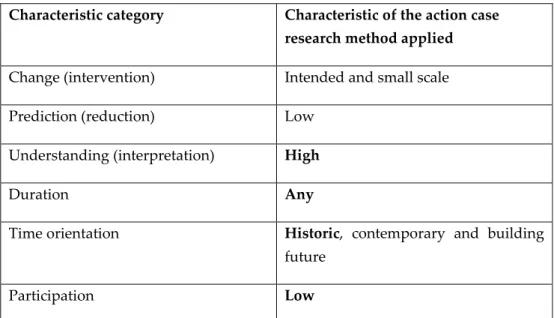
research project, with the stronger influences from soft‐case method in bold type,
Characteristic category Characteristic of the action case
research method applied
Change (intervention) Intended and small scale
Prediction (reduction) Low
Understanding (interpretation) High
Duration Any
Time orientation Historic, contemporary and building
future
Participation Low
Table 2: Characteristics of the action‐case method applied in this research project With the emphasis on understanding in mind, it is natural to address the way
the understanding of the integration of gender‐knowledge into informatics study
programs is achieved in this research project.
2.1.
A hermeneutic approach
In order to understand the integration process, a hermeneutic approach has been
chosen. Even though hermeneutics as an approach has a long tradition, it is still a rather novel approach in information systems (IS) research according to Cole and Avison (2007). Hermeneutics has however been used in IS research in the analysis of web‐pages (Zahedi, van Pelt and Srite, 2006), e‐mails (Lee, 1994), notes and transcribed interviews (Tingling and Parent, 2004; Trauth and Jessup, 2000), and action and behavior (Lee, 1994). Even though all of the above suggest different ways to apply hermeneutics in IS research, I have chosen to adopt the six‐stage
hermeneutic framework for practical research suggested by Cole and Avison
The basic stages of this framework, as I have adopted it, are the following: 1) Presuppositions and prejudices 2) Designing lines of enquiry 3) Collecting empirical material 4) Interpreting empirical material 5) Challenging presuppositions and prejudices 6) Achieving more in‐depth understanding
A more thorough discussion of each stage is provided below but what must be
pointed out beforehand is that this is an iterative process. When the process has
reached stage six, it might return to stage one with new, altered or reinforced presuppositions and prejudices.
Stage one: Presuppositions and prejudices
The first stage in the six‐stage framework suggested by Cole and Avison is
becoming aware of one’s own position, i.e. one’s own presuppositions and
prejudices. This awareness is important according to Cole and Avison (2007)
because it affects the interpretation and hence the understanding of the problem
domain. I would however like to extend this discussion further. I argue that
presuppositions and prejudices actually affect the very establishment of a research project in the first place. It is presuppositions and prejudices that make researchers curious to find out more about a problem domain. Presuppositions and prejudices are however rarely reflected upon, or at least I argue not reflected upon thoroughly enough in research. This might be why bringing them into a research project is
seen as highly problematic. It is claimed that doing this compromises the
objectivity of the project. This way of seeing anything other than scientific “facts” as problematic for a research project is possibly the result of the strong influence of Western science tradition. According to Harding (1991), this tradition celebrates objectivity, rationality and distance to the researched subject/object, or as Haraway (1988) labels it, “the view from nowhere”. But the research reported on in this
dissertation does not take a view from nowhere. Instead it takes a view from
“somewhere”, and by accounting for at least some presuppositions and prejudices that have affected this research project in more or less obvious manner, I will try to locate this “somewhere”. By identifying this “somewhere”, I also claim to fulfill the
aim of this stage which, according to Cole and Avison (2007), is to increase the
critical awareness of the researcher. In this stage I communicate presuppositions
and prejudices of the integration of gender‐knowledge into informatics that have
triggered each and every one of the conducted studies. Stage two: Designing lines of enquiry
The second stage is, based on the critical awareness achieved in the first stage, to
design the line of enquiry, by, for example, identifying appropriate sources of empirical material, interpreting strategies, etc. (Cole and Avison, 2007). Starting
with identifying appropriate sources for empirical material, the Swedish
informatics community is the main focus. The whole research is centered on the
Swedish informatics community. However, as was indicated in the Introduction,
the integration of gender‐knowledge does not seem to have come that far in
Swedish informatics higher education. It follows, therefore, that there might be limited experience of gender‐knowledge integration and that focus could not solely be on this primary source. Thus, there is a need to expand the focus to include
experience gained within informatics but outside Sweden as well as experience
gained in other subjects with longer tradition of gender‐knowledge integration.
This experience is probably relevant for the Swedish informatics community as
well and is therefore important to utilize. It follows then that two different data
sources can be identified: the Swedish informatics community and gender‐
knowledge integrators outside the Swedish informatics community. Even though
there are two different data sources identified, focus is still on the Swedish informatics community and its integration of gender‐knowledge.
According to Cole and Avison (2007), a second part of this stage is to identify the strategy for analysis. I have labeled this strategy “a strategy for interpretation”. The strategy for interpretation of this research has been to identify and if possible
divide opinions, challenges, problems and approaches to gender‐knowledge
integration into thematic categories. Using this as a basis, I discuss the process of
integrating gender‐knowledge into informatics study programs as a whole. In the
initial phase, I have let my own presuppositions and prejudices guide the
interpretation process. Often this is expressed by the way I have approached the
interview study concerns challenges in database security, the pattern emerging will concern this. I will discuss the keywords and themes in relation to each study later on. I want to emphasize though that the emerging patterns can easily be related to and discussed based on different theoretical frameworks. Thus, in relation to each
study, I have used a theoretical lens to deepen the understanding of the material
gathered and of the problem domain as a whole. The theoretical lens adopted is
Kuhn’s (1992) theory concerning paradigms and paradigm shifts as discussed in
Chapter 3.
I have chosen to discuss different tools and techniques for collecting empirical material in this section as well. The choice of tools and techniques for conducting
the research is dependent on ontological and epistemological assumptions. The
exploration conducted in this work departs from ideas expressed by for example
Haraway (1988), who argues that knowledge is always located, situated, and
partial, or as Lykke (2009) puts it when arguing that the keywords of the
knowledge field of gender are “pluralism” and “diversity”. This means that there
are many realities and truths that sometimes overlap and sometimes diverge.
Hence there are possibly many different “realities” to investigate. A metaphor for this could be to investigate a landscape and its inhabitants. In order to gain a
comprehensive knowledge of the landscape, it is not enough to pass through it
only once. All parts of the landscape must preferably be visited and many of the
inhabitants must be interviewed concerning their different perceptions of the
landscape, all of which must be viewed as equally valid. To be able to capture the many different voices, a multi‐technique approach has been applied using different
forms of the overarching techniques identified by Harding (1987) for conducting
feminist research: listening, observing and examining historical traces and records. In this dissertation, listening and examining historical traces are the overarching techniques used. Within these overarching techniques, however, different types of sub‐techniques have been used.
Starting with the examination of historical traces and records, this is important in virtually every research project. But before actually getting to the examining part of the process, the historical traces and records must be identified and collected. In this work, several databases have played an important part in the collection of
historical traces and records or have at least pointed to where the empirical
material could be accessed. The databases accessed through the ISI web of
articles. Three different databases have been accessed: ‘Science citation index
expanded’ covering natural sciences, technical sciences, medicine, and other
related sciences, ‘Social science citation index’ and the ‘Arts and humanities science citation index’ covering the sciences mentioned in the names of the databases. The
‘Scopus’ database (SciVers, 2010) http://www.scopus.com/home.url covering
natural science, medicine, social science and technical science has also been used. The four different databases all contain references to articles that could possibly
generate an understanding of the knowledge‐landscape. However, there are
probably many other databases that could also provide important references, but I
have chosen these because the three databases of ISI web of knowledge are
comprehensive and give access to many distinguished journals. Scopus is used as a
complement that to some extent overlaps with the other databases and to some
extent diverges from them when it comes to what journals are indexed. Together
they will give an adequate picture of gender‐knowledge integration into courses
and study programs.
The search in the databases accessed through ISI web of knowledge was
conducted by searching the topic of each article. In Scopus on the other hand the
search was conducted by searching the title, the abstract, and the keywords of each
article. The searches generated lists of references to articles that sometimes could
be accessed directly and sometimes the article was indexed but not accessible
through the database. All articles referred to are however part of the electronic
library provided by Mid Sweden University. In cases when an article was not
accessible through the regular service of the library or was not open for access on
the web, depending on for example delays in the access of electronic versions or
that the journal is not part of the Mid Sweden University’s electronic library, it has not been included at all in the studies.
Even though the databases discussed above have been very valuable in the
structured search for literature, there has also been a more unstructured search
process. By labeling the process unstructured, I indicate that the aim has been to
find interesting articles and reports that either could serve as an inspiration for a
more structured search or to identify and access articles and reports not indexed in
the databases used. In this process, the ‘Google Scholar’ (Google, 2010)
Besides using databases and Google Scholar for identifying articles and
reports, I have been using databases for another purpose as well. Namely to
identify informatics study programs, which has been important for a couple of
different studies conducted within this research project. To do this, I have used the
database accessed through the web‐portal at www.studera.nu (Swedish National
Agency for Higher Education, 2010). The web‐portal that is the access point to the database is the result of cooperation between Swedish universities and university
colleges, the Swedish Agency for Higher Education Services (Verket för
högskoleservice (VHS) and the Swedish National Agency for Higher Education
(Högskoleverket). This web‐portal is used by a majority of students to apply to
courses and study programs in Swedish higher education. The cooperation
between the different important actors in Swedish higher education and the fact
that most applications are sent in via the web‐portal is an indication that most, if
not all, informatics study programs can be found here.
The web‐portal contains a lot of information and functions to access this
information. To search for informatics study programs, the function that enables
potential students to search for courses and study programs is used. This function has both a Swedish and an English interface. In this research, the Swedish interface has been used. The interface is rather intuitive and is designed as a set of questions like when ‐, what ‐, where ‐, and how, which are answered by marking alternatives
in drop‐down menus, scroll lists, or by checking boxes. By marking the relevant
answers to the questions, in this case a set of informatics study programs will be
generated. However, the result of this search is really only a set of study programs
and some brief information concerning each particular study program. To access
more comprehensive information related to a unique study program, the web‐page related to that study program must be visited. These web‐pages are found on the website of the university or university college managing the study program.
Several different forms of listening have also been part of the method toolbox applied in this dissertation such as: face‐to‐face interviews, e‐mail interviews,
workshops, and informal discussions. The face‐to‐face interviews were all semi‐
structured in nature, meaning that a manual had been developed by the researcher on what were considered to be important areas to discuss in the interviews in
accordance with what Holme and Solvang (1997) suggest. For each area, I had
prepared a set of questions that were used to illuminate some part of the problem domain, but the interviews were to all intents and purposes dialogues. The manual
was used as a support for the researcher, so that all areas of interest for the
research conducted were covered in each interview. Interviewees were however
free to discuss whatever they wanted to related to the different areas. The manual was also used in the communication with conceivable interviewees. All face‐to‐face interviews were recorded with a Mini Disc player.
A second form of listening is e‐mail interviews. Even though both face‐to‐face
interviews and the e‐mail interviews are basically semi‐structured in nature, they
diverge in the sense that they are extended differently in time and space, as well as
being documented differently. As was discussed above, each of the face‐to‐face
interviews was conducted at one particular time in one particular space, and was
documented by recording it. E‐mail interviews on the other hand are more or less time‐ and space‐independent and in this case were automatically recorded as soon as the e‐mails were sent. I started out by identifying potential respondents and sending them an e‐mail in which I introduced my project and asked if they would be kind enough to answer a few questions. Depending on the answers I received, there were follow‐up questions and in one case I actually deepened the interview even further. A third form of listening that I have conducted is in the form of a workshop. The workshop as a technique for listening is quite different, even though the basic
structure with a few areas of concern being addressed is the same as in the other
two forms of listening. For the workshop a method called Nominal Group
Technique (NGT) was used. NGT, as it is presented in for example Dennis and
Reinicke (2004), Duggan and Thachenkary (2003), or Sutton, et al. (2008), consists
of two major parts or steps. The first step is individual work where, as Dennis and Reinicke (2004) put it, the individual works separately without input from others. The result of this step is a set of ideas, keywords, problems, etc. The second step is
to present the work of each individual and merge it together. The result of these
two different steps forms the result of the study.
The last form of listening is the more or less informal discussions that have taken place in coffee rooms, over the phone, in e‐mails, etc. In many cases these
have not been recorded or documented at all, but they have helped me turn my
Collecting empirical material
The third stage according to Cole and Avison (2007) is to conduct active interviews that should be theme‐oriented. But as was indicated above, several other tools and techniques other than interviews have been used in this research. I have made this
choice because hermeneutics as a method focuses on the text as such, not on the
way the text was collected.
In this research project several different studies have been conducted targeting
primarily the integration process of gender‐knowledge into informatics study
programs, but also the integration of gender‐knowledge in more general terms.
Each study conducted is a separate iteration through the six stages of the
hermeneutic framework. I will here introduce each of the studies to give an overall picture of the research project. I will however leave the details to be communicated when the results of each study are discussed.
The structure of the presentation as well as in the more thorough presentation of each study goes from general experiences of integrating gender‐knowledge into courses and study programs (I call it an international level), via experiences of
integrating gender‐knowledge into Swedish informatics study programs (A
national level), to a more in‐depth study or the integration of gender‐knowledge at
a local informatics department (A local level). Finally I turn back to the
international level by investigating different ways systems development has been
addressed through applying gender‐knowledge. I will also relate the relevant RQs
to each of the studies to indicate in what ways each study contributes to
addressing each RQ and hence fulfills the purpose of the dissertation. A summary of the studies is provided in Table 3 below.
Study Research question (RQ) Level 1 2 3 4 5 1 Experiences of gender‐knowledge integrators X X X International 2 Gender‐knowledge integration into Swedish informatics study program syllabuses X X National 3 Gender‐knowledge integration into informatics study programs – Experiences of coordinators X X X National 4 Gender‐knowledge integration into a study program in interaction design X X X Local 5 Self‐ evaluation of the gender‐knowledge integration X X X Local 6 Difficulties in integrating gender‐knowledge ‐ PhD students’ accounts X X Local 7 Potentials in integrating gender‐knowledge – Lecturer’s account X X X Local 8 Example on a thorough integration of gender‐knowledge X X Local 9 Literature study concerning gender‐ knowledge, technology and IT X X International Table 3: The relationship between studies conducted and the RQs
To begin with, Study 1 addresses the international level. Initially it was
designed for identifying research on the integration of gender‐knowledge into
informatics or other IT‐related subjects, hence addressing RQ 1. However, the
study was designed rather generally, meaning that experiences and lessons learned in other subjects were also included. This choice was made because of the limited research found on the integration of gender‐knowledge in IT‐related subjects. The main focus became to identify not only different challenges that the integration
process might encounter (RQ 2) but also suggestions on how to overcome these
challenges (RQ 3). These challenges have been studied by means of a literature review of articles and reports. The databases at ISI web of knowledge and Scopus, as well as Google Scholar, have been used to identify articles and reports to be included.
Turning to the national level, Study 2 focused on to what extent informatics
departments and groups communicated gender‐knowledge as important to actors
such as students in syllabuses. This study primarily addressed RQ 1, although it
did touch on RQ 3 in that by identifying the ways in which the integration of gender‐knowledge was communicated in informatics study program syllabuses, it also identified the way different challenges had been addressed.
Study 3 addresses the same level and was an e‐mail interview study with
informatics study program coordinators in which they were asked to reflect upon
their experiences of gender‐knowledge integration into the study program they
coordinated. They were asked to describe in what ways gender‐knowledge had
been integrated or present the arguments why it had yet to be integrated. This primarily addressed RQ 1 and RQ 2, but also RQ 3 in that by indicating what ways gender‐knowledge had been integrated, it also identified the ways challenges had been dealt with.
Study 4 was a more in‐depth e‐mail interview with one of the coordinators
who had indicated that gender‐knowledge had been integrated into the study
program he was coordinator for. Because this study is an extension of Study 3, RQ 1, 2 and 3 are again addressed, but in greater depth. I however argue that this study concerns the local level and not the national level.
Continuing on the local level, a more comprehensive study of the integration
process at one particular informatics department was conducted. This study
documents related to the evaluation conducted by the Swedish National Agency for Higher Education of the subject in 2003, referred to earlier in this dissertation. This study focused on establishing a point of departure for the integration process at the department in question. Hence the focus was on RQ 1. But as it turned out,
RQ 2 and 3 were also addressed since the documents not only reported the
integration of gender‐knowledge conducted, but also identified challenges and
how to address them as well as provided recognition of the fact that gender‐
knowledge is a vast domain and in need of exploration.
Study 6 was a workshop in which PhD students were asked to reflect upon
informatics as a subject, give their views on gender‐knowledge and, as it turned
out, the difficulties of integrating gender‐knowledge. This study primarily
addressed RQ 2 but also touched upon RQ 3 to some extent.
Study 7 was an interview study conducted with two experienced lecturers at
the department who were positive to the integration of gender‐knowledge into
informatics study programs. The focus was mainly on the potential of gender‐
knowledge to enrich informatics, hence addressing primarily RQ 3, but also RQ 1 and 2.
In study 8 an e‐mail interview was conducted with a lecturer on a study
program that successfully had in the syllabus study most clearly communicated an integration of gender‐knowledge. In focus for this study was RQ 1 but also RQ 3.
Finally, one more literature study was conducted, Study 9, that aimed to
explore the potential of gender‐knowledge to enrich informatics study programs.
This study mainly addresses RQ 4 and 5, and was conducted on an international
level.
Interpreting the empirical material
According to Cole and Avison (2007), the process of interpreting the empirical
material should be straight forward. The text is read through or listened to
repeatedly in search of statements or phrases that seem to be particularly essential or revealing. I have followed this recommendation and in the process of reading or listening, I have been able to identify clusters as well as a variety of challenges,
The second step was to interpret the empirical material by using the theoretical lens provided by Kuhn.
Challenging presuppositions and prejudices
In stage five, presuppositions and prejudices identified in stage one are challenged
by the knowledge acquired by interpreting the empirical material (Cole and
Avison, 2007). I have contrasted presuppositions and prejudices identified as
guiding each study with the results from the conducted interpretation of the
empirical material. By doing this, presuppositions and prejudices are either
challenged and changed, challenged but left intact, or not challenged at all, hence left intact or even reinforced.
Achieving a more in-depth understanding
The result of stage five was a new understanding of the problem domain. This
leads to stage six, which is a more informed and sophisticated understanding of
the problem domain than any of the preceding understandings (Cole and Avison,
2007). The interpretative process might stop here with a more in‐depth
understanding having been achieved. But, it might also continue with a new
iteration of the six stages. As was mentioned earlier, several studies form the basis of the research conducted in this project. It follows therefore that the six stages of
the interpretative process are iterated once for each study. However, I also
indicated that this was not only an interpretative process with the aim of achieving more in‐depth understanding. It was also a process targeted at suggesting change to the existing situation. In this work this process of suggesting alternatives is
based on the more in‐depth understanding achieved, hence can be said to start
when the interpretative process ends. There are arguments that the process of
suggesting alternatives really has been ongoing through the whole interpretation
process (see discussion of the design process in for example Stolterman, 1991). However, I have decided to describe the process this way because the feedback of the suggested alternatives to those they were aimed at has been limited.
2.2. Suggesting
alternatives
The final step in the research process is to develop suggestions on ways to address the desired integration of gender‐knowledge into informatics study programs. The basis for the alternatives identified is the more in‐depth understanding achieved inwhich gender‐knowledge is not integrated at all. The idea is to identify some good
examples on ways gender‐knowledge has been integrated into Swedish
informatics study programs. These examples are the first set of alternatives
identified.
The second set of alternatives is based on what so far has been identified as
either problematic or not addressed at all so far in the integration process. These
alternatives are developed from a mix of experiences from gender‐knowledge
integrators communicated in articles, reports and books as well as my own
experience of being part of the informatics community over the past 15 years and
as a gender‐researcher. The idea here is to demonstrate alternative ways of
working with gender‐knowledge integration that have so far not or only partly
been addressed in a Swedish informatics setting. One important part of this is to
study ways in which phenomena relevant for informatics have been coupled with
gender‐knowledge and then introduce them into the informatics context. The
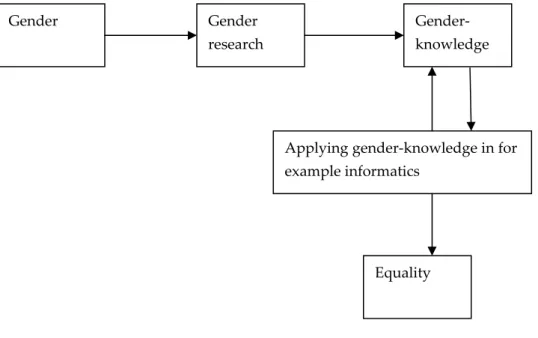
whole process for this research is summarized in Figure 1: 1) Presuppositions and prejudices 2) Designing lines of enquiry 3) Collecting empirical material 4) Interpreting empirical material 5) Challenging presuppositions and prejudices 6) Achieving more in‐depth understanding 7) Suggesting alternatives to the Deepen the understanding Suggesting alternatives
3. THE THEORETICAL LENS OF THIS WORK
In the section above the conceptual framework developed by Kuhn concerning
paradigms and paradigm shifts was identified as the theoretical lens of this work. In this section I intend to discuss this theoretical lens.
3.1. Paradigms
The key concept of the theoretical lens used for discussing the empirical material is
paradigm. Kuhn (1992) describes paradigm as an agreement within a community
on what the phenomenon or phenomena in focus for the community is/are. The
basis for the establishment of a paradigm is the achievements of the scientific community in the past. To explain the fact that certain achievements are adopted as the foundation of a scientific paradigm, Kuhn identifies two characteristics. The
achievements are sufficiently unprecedented to attract researchers from other
previous foundations and sufficiently open‐ended to fit various kinds of problems to be solved. (Kuhn, 1992)
Starting with the phenomenon in focus for the Swedish informatics
community, it could be summarized as being the intersection of IT and human
activities. This is expressed in different ways; not least the way informatics as a subject was established once upon a time.
In Sweden, informatics was established in the mid sixties and from the very
beginning has been part of both social science and technical science. This was particularly emphasized with the first professorship in the subject of automated
data processing, which later became informatics. This professorship ‐ awarded to
Börje Langefors – had a clearly stated emphasis on technological aspects as well as
business and social aspects. As a way of signaling this intention and its
importance, the professorship was co‐managed by the Royal Institute of
Technology and Stockholm University. (Bansler, 1990)
Turning to how informatics has been defined in a Swedish setting, there have been some attempts to develop a general definition of the subject. These definitions communicate the combination of technical science and social science. For example, informatics has been characterized by Dahlbom (1996) as an artificial science with
and nations performing purposeful activities. In both these definitions, the
entwinement of technological and social aspects is visible; what I label the
intersection of IT and human activities
The phenomenon in focus seems to be something that is shared between
informatics departments and groups, hence they to some extent share a paradigm. However, as the two attempts to define informatics as a subject illustrate, there are some differences between different departments and groups in the way they define the subject and hence probably how they approach the phenomenon. I therefore do
not view informatics in Sweden as completely sharing the same paradigm.
Different departments and groups have their unique characteristics and
approaches to the phenomenon. Hence, I prefer to view each unique informatics
department and group as a community of its own with its own paradigm. This
paradigm is to some extent unique and to some extent shared with others in the
informatics community.
The paradigm is however not only highlighting what phenomenon to focus
on. One part of the paradigm according to Kuhn (1992) is also the agreement on
what rules, e.g. legitimate methods and anticipated results, that should govern the
approach to the phenomenon. Approaching the phenomenon according to the
rules is labeled ‘normal science’.
Generally, I would say that informatics as a subject is fairly open when it comes to methods used for approaching the phenomenon in focus as well as when
it comes to the anticipated results. Perhaps this is the outcome of being a subject
affiliated to both technical and social science. It has made informatics open for
influences from a variety of subjects. From technical science, the strongest
influences are from computer science, computer technology, etc., whereas from
social science, the influences come from statistics, business economics, sociology,
psychology, to mention but a few. What has been indicated so far though is that
the phenomenon in focus for informatics in Sweden is rarely approached based on
gender‐knowledge. The integration of gender‐knowledge can hence be argued to
concern a shift in what are the anticipated results upon approaching the